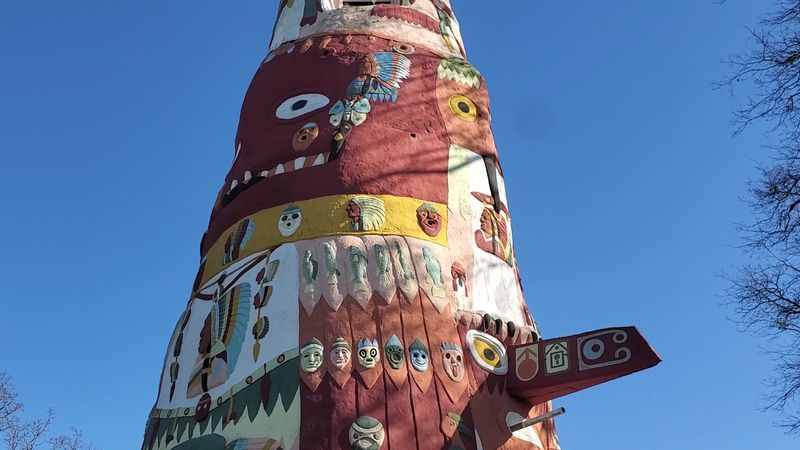
Some of the best stops in Oklahoma are the ones nobody puts on a billboard. A couple of miles off the old highway, past pasture fence and a gravel shoulder, a 90-foot painted tower rises out of the grass like somebody’s daydream got out of hand.
One man built it by hand, mixing concrete by the wheelbarrow, and he kept going for eleven years. Pull in expecting a quick photo and you may find yourself wandering for an hour, reading every carved face.
A Nine-Acre Folk Art Yard Off Route 66
Turn off Route 66 near Foyil, follow OK-28A a couple of miles east, and the trees open onto nine acres of painted concrete that looks like nothing else in the state. The official address puts it at 21300 OK-28A, Chelsea, and travelers often note that GPS earns its keep on this one.
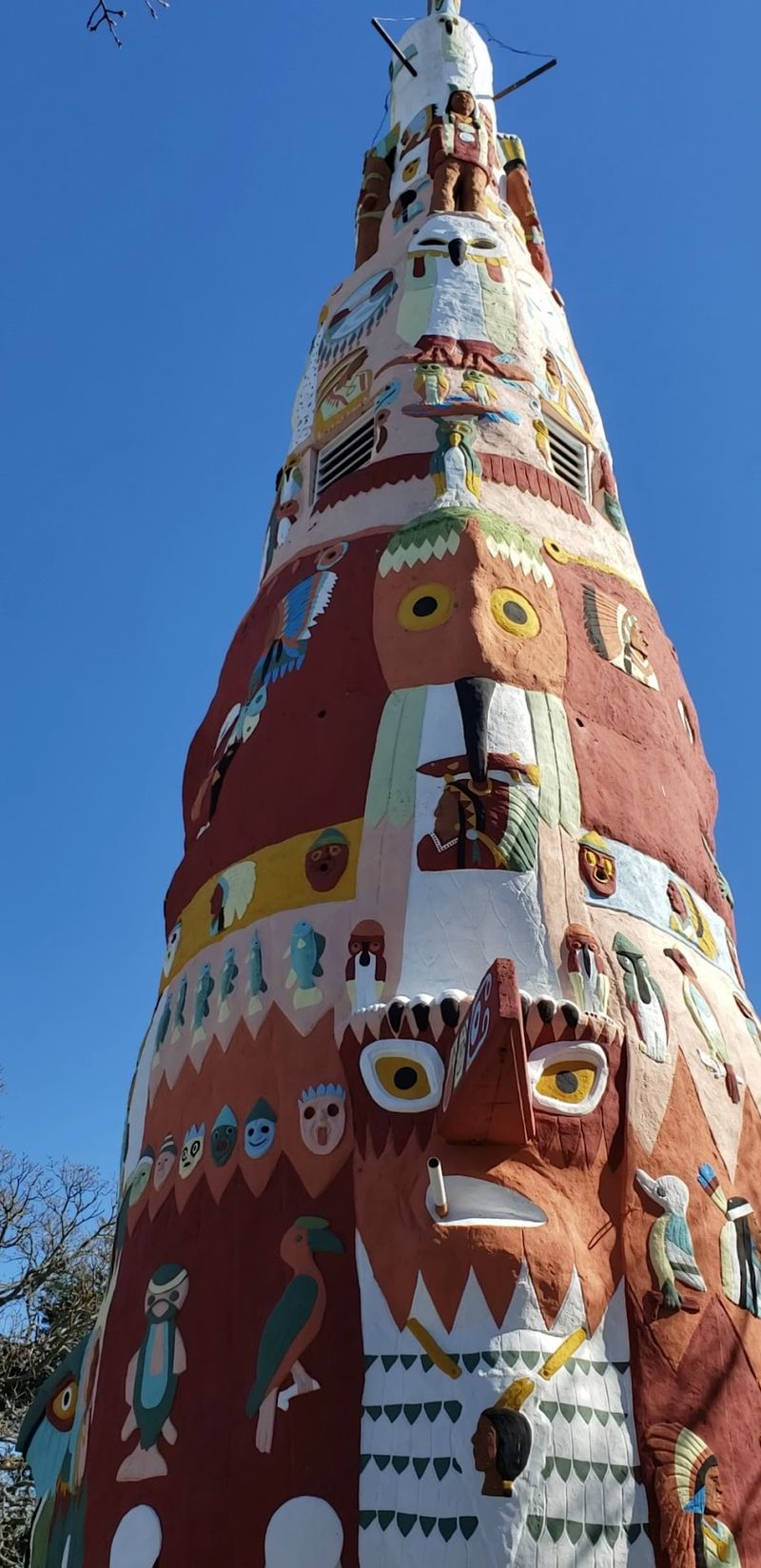
What waits at the end of that short detour is Ed Galloway’s Totem Pole Park, a folk art environment built entirely by hand between 1937 and 1961. Eleven sculptures and one very unusual building sit spread across mowed lawn, with picnic tables scattered under shade.
The centerpiece rises 90 feet, the tallest concrete totem pole anywhere, and it anchors everything around it. Visitors frequently describe the place as small but genuinely worth the drive, the kind of stop you budget fifteen minutes for and then double.
From Tulsa the trip runs well under an hour, making it an easy half-day outing paired with other Route 66 stops. Entry costs nothing, parking sits behind the park, and the gate stays open dawn to dusk every day of the year.
The Man Who Retired Into a Bigger Job
Born in Springfield, Missouri in 1880, Nathan Edward Galloway made his living with his hands long before he ever mixed a batch of concrete for art. He was a wood carver and a blacksmith, and for roughly two decades he taught manual arts, mostly woodworking, to orphan boys at the Sand Springs Home in Sand Springs.
Retirement arrived in 1937. Most people slow down.
Galloway bought a farm near Foyil and started the largest project of his life at an age when many are putting tools away for good.
His interest in Native American cultures came from postcards and issues of National Geographic, and he framed the whole undertaking as a tribute to the American Indian. Whether the imagery reads as accurate or as one man’s outsider interpretation is part of what makes the site worth thinking about.
He rose around 5:00 a.m. and worked past sunset, day after day, until he passed in 1962. Visitors often walk away struck less by the scale than by the plain stubbornness behind it, one person choosing to spend a quarter century this way.
Twenty-Eight Tons of Cement and Eleven Years of Mornings
Numbers tell this story better than adjectives. Twenty-eight tons of cement.
Six tons of steel. One hundred tons of sand and rock, much of the sand hauled up from a creek bed nearby.
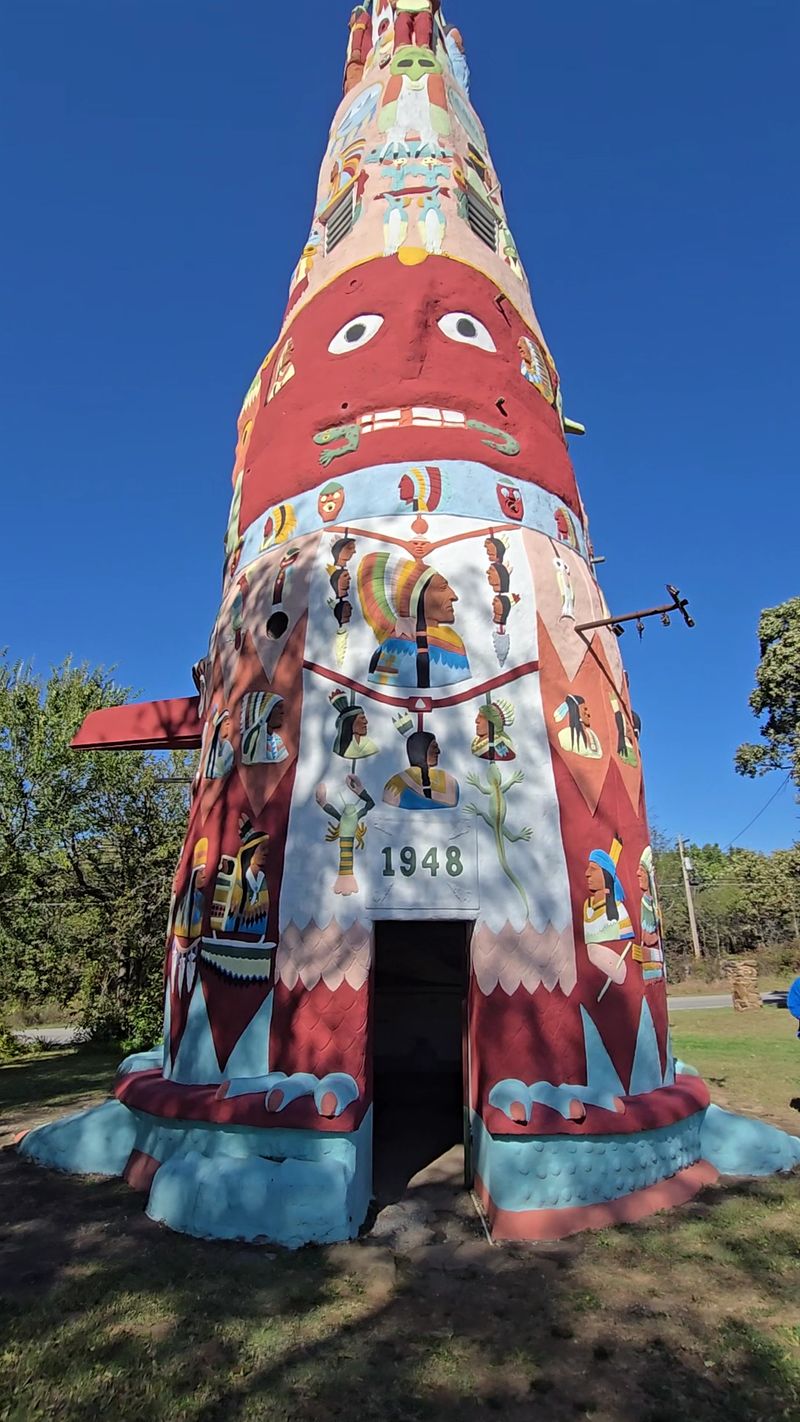
Galloway started the main pole in 1937 and finished in 1948, eleven years of hauling, mixing, troweling and carving, largely alone with occasional help from friends and former students. There were no cranes and no crew of contractors, just a man, a wheelbarrow and a ladder.
The whole tower rests on the back of an enormous three-dimensional turtle carved from a natural sandstone outcrop, a nod to a Native American creation story about the world resting on a turtle’s shell. Standing at the base and looking up, the turtle is the detail most people miss on a first pass.
Ninety feet of hand-built concrete has held its ground through Oklahoma wind, ice and summer heat for more than seventy-five years. Folks who stop tend to linger simply doing the math on how long that must have taken.
Two Hundred Carved Faces Facing Four Directions
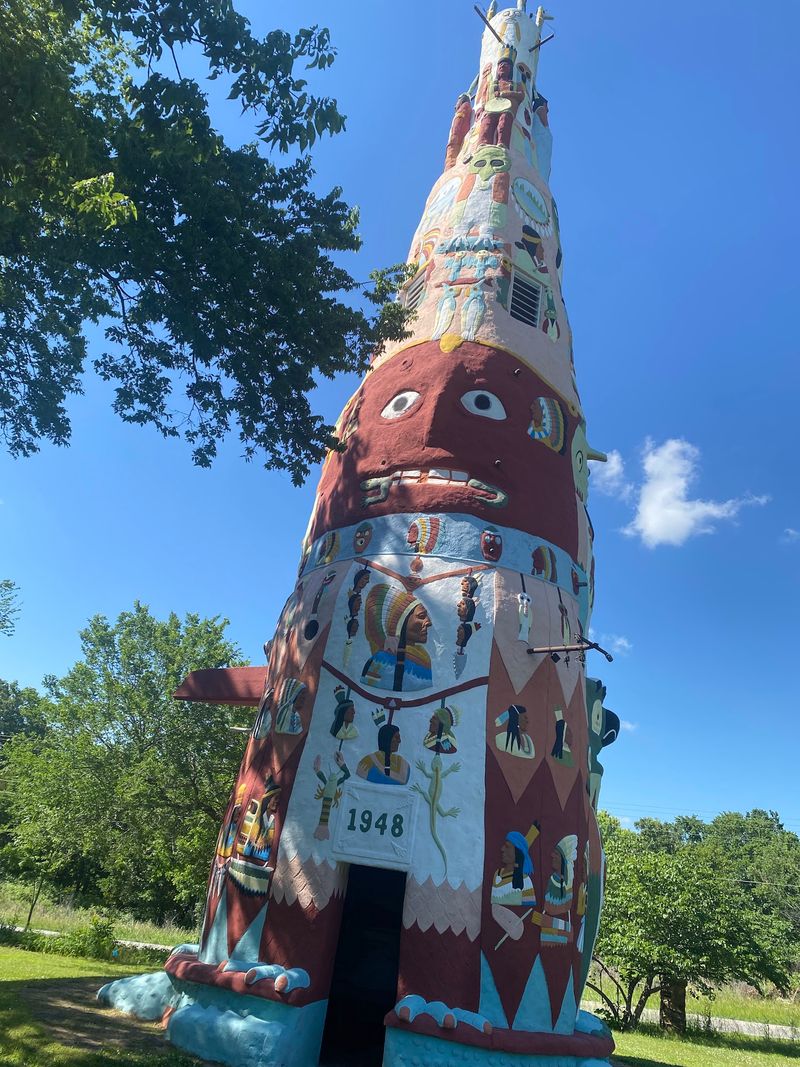
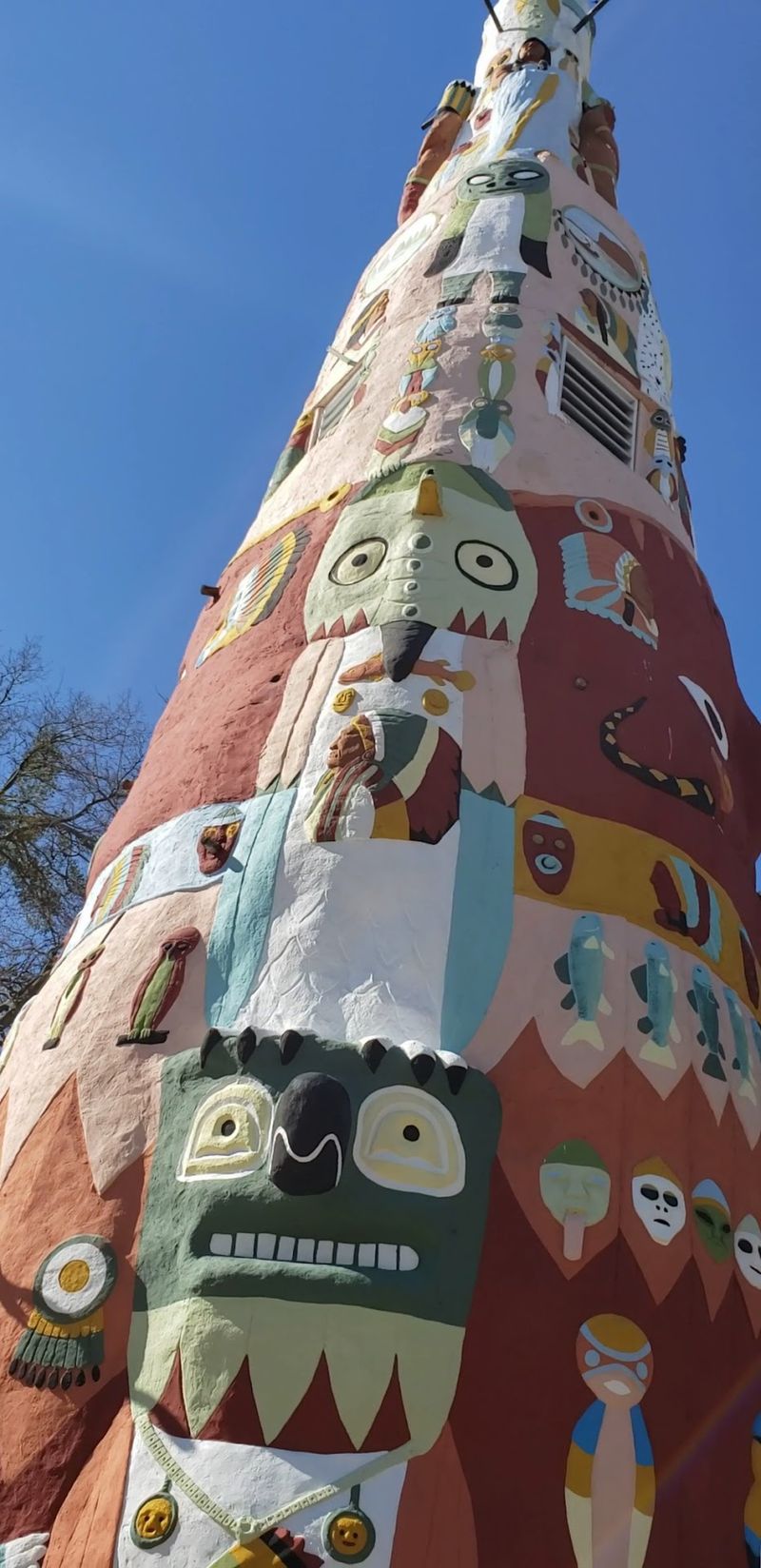
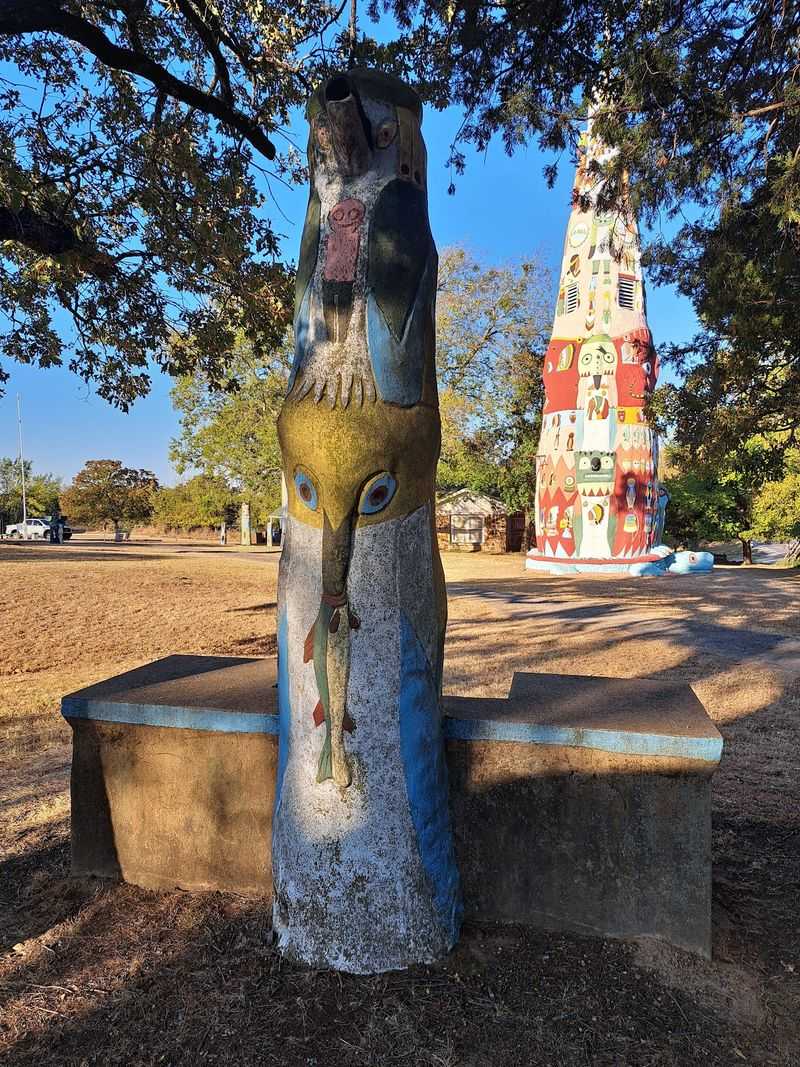
Roughly 200 bas-relief images cover the surface of the main pole, and no two repeat. Brightly painted portraits, animal figures and symbols wrap the column from the turtle all the way up, arranged so the major panels face the four cardinal directions.
Birds show up constantly, along with imagery drawn broadly from Northwest Coast and Alaska traditions mixed with Plains cultures. Galloway worked from magazines and postcards, so the result is a wide sweep rather than a documentary record of any single nation.
Near the top, four figures stand nine feet tall apiece, representing Sitting Bull, Quanah Parker, Chief Joseph and Geronimo. Spotting all four requires backing up across the lawn and craning your neck.
Paint is the part that fades fastest, and restoration has been ongoing for decades. A Tulsa visitor who finally made the trip after forty-one years noted that many totems looked freshly painted while other sections waited their turn.
Bring a zoom lens or just good patience. The detail rewards slow looking far more than a quick phone snapshot from the parking area.
Nine Hollow Floors and a Cone Open to the Sky
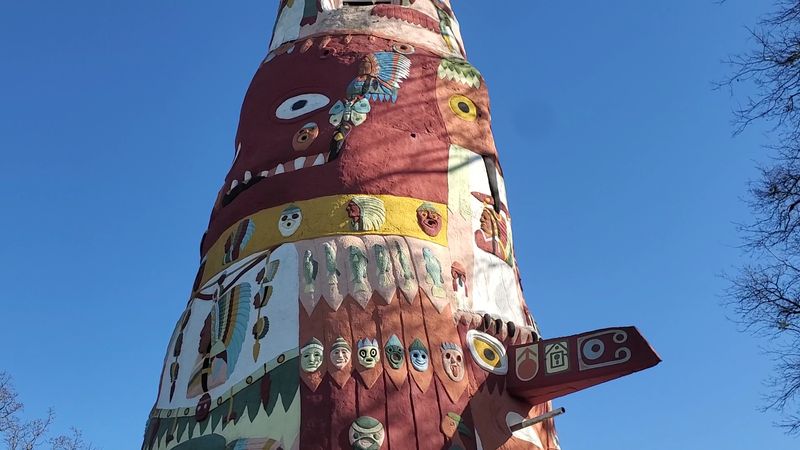
Here is the surprise most people never expect: the tower is hollow. The interior rises through nine so-called floors, with the ground level measuring nine feet across, narrowing as it climbs.
Plastered walls inside carry painted murals of mountain-and-lake scenes, bird totems, Native American shields and arrow points, artwork Galloway made for an audience of almost nobody. The cone at the very top stays open to the sky, which means daylight filters down the shaft in a way photographs never quite capture.
Access to the inside is not guaranteed on any given day. One traveler arrived in winter to find the big totem closed until spring and still called the visit worthwhile, which says something about the rest of the grounds.
Restoration crews have worked on the main pole repeatedly, from 2008 to 2009 and again from 2015 to 2020, so conditions change. Calling ahead at 918-283-8035 may save disappointment if seeing the interior is the reason you are making the drive.
Either way, knowing it is hollow changes how the outside looks.
The Fiddle House and Its Hand-Carved Collection
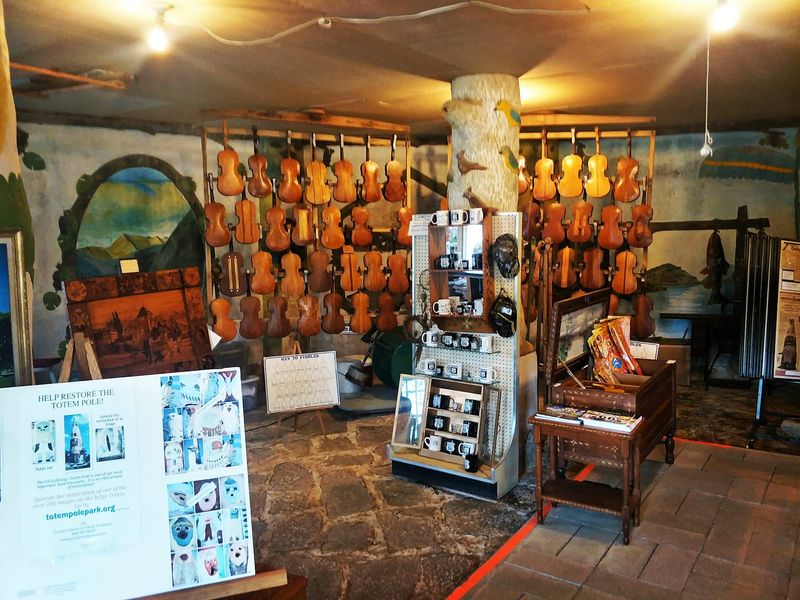
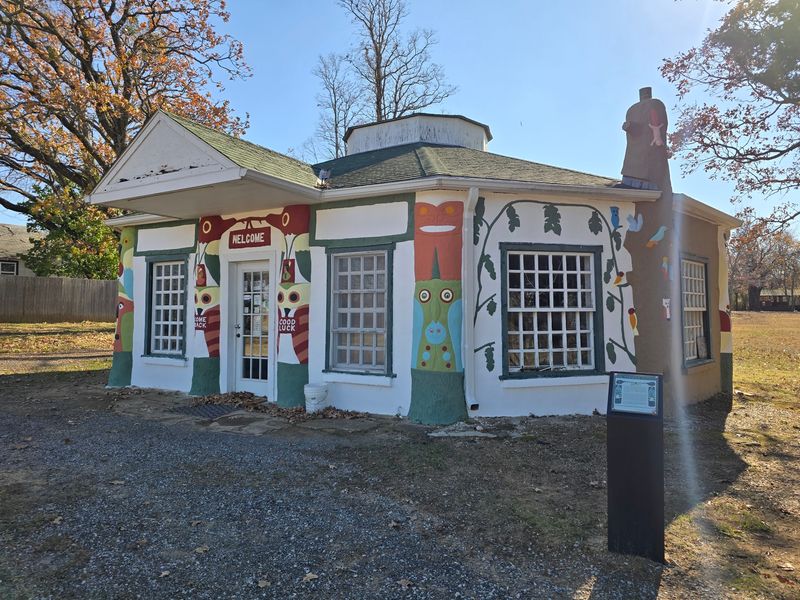
Eleven sides, twenty-five concrete totem poles holding it up inside and out, and a shape people often compare to a Navajo hogan. The Fiddle House is the strangest small building you will find on a Sunday drive in Rogers County.
Galloway built it to hold his hand-carved fiddles, handmade furniture and bas-relief portraits of U.S. Presidents.
Visitors today report seeing 300 or more fiddles, along with inlaid tables, carved wood pictures and displays walking through how the park came together.
The woodwork is what stops people. Several travelers say they came for the giant totem and ended up spending most of their time in this little round room, quietly stunned by the craftsmanship.
It doubles as the gift shop, and purchases there help keep the lights on. The volunteer working the counter often knows Galloway’s story in detail, and folks regularly mention leaving with facts they never would have picked up from a plaque.
Hours run daily, typically noon to 5:00 p.m., though seasonal closures happen. Skipping this building means missing half the park.
Smaller Totems, Animal Picnic Tables and Other Oddities
Wander past the big pole and the park keeps giving. An Arrowhead Totem, a Birdbath Totem and a Tree Totem stand scattered across the lawn, each one its own small experiment in painted concrete.
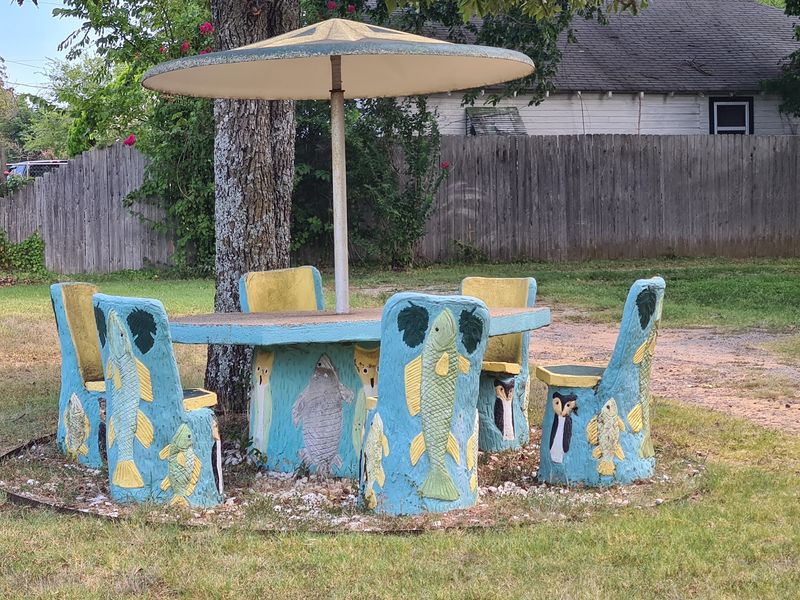
The picnic tables deserve their own mention because the seats are shaped like animals. There is also a concrete barbecue or fireplace and a set of gateposts that look like Galloway simply could not resist decorating them.
His Craftsman-style house from the late 1930s still sits on the property, a reminder that this was a working farm and a home before it was a landmark. Seeing the residence alongside the sculptures makes the scale of the project land differently.
A half-mile wooded nature trail loops through the back, and there is a pet area too, which explains why dog owners keep showing up. One visitor mentioned walking both dogs around the grounds without a second thought.
Picnic tables plus shade plus no admission fee adds up to a legitimate lunch stop, not just a photo pullover. Pack a cooler and make an afternoon of it.
Free Gate, Donation Box and Dawn-to-Dusk Access
Cost of admission: nothing. The park opens dawn to dusk every day, there are no tickets and no reservations, and plenty of parking sits behind the grounds.
Operations run on visitor donations and gift shop sales alone, handled by the Rogers County Historical Society with help from the Foyil Heritage Association. Dropping something in the box or buying a small souvenir is how the mowing, painting and repairs get paid for.
The Fiddle House Museum and Gift Shop generally open daily from noon to 5:00 p.m., though seasonal schedules shift and one visitor planned a return trip specifically for when the shop reopened for the season. Timing your arrival midday gives the best odds of catching both.
Plan on fifteen minutes minimum, an hour if you read everything. Summer heat and Oklahoma wind are real considerations since most of the site is open lawn, so spring and fall tend to be the most comfortable windows.
Listed on the National Register of Historic Places since March 30, 1999, it has earned its keep as a preserved piece of the state.
Why This Detour Sticks With People
Something about one person building something this large, this slowly, without any expectation of payment, tends to stay with visitors long after the drive home. Travelers keep describing it as a short side trip that turned out to be the highlight of their Route 66 day.
The grounds are simple. Mowed grass, a few benches, faded and freshly painted concrete side by side, and usually not much of a crowd.
Quiet is part of the appeal.
Families with small children can roam the lawn freely, though one parent did mention a less than warm moment in the shop, so expectations there may vary from day to day. Most people describe the volunteers as generous with their knowledge and happy to talk.
For anyone within ninety minutes of Tulsa, this is an easy yes. It costs nothing, it takes less time than a movie, and it delivers a story worth repeating at the next family gathering.
Bring a picnic, leave a donation, and give the turtle at the base a proper look before you go.
