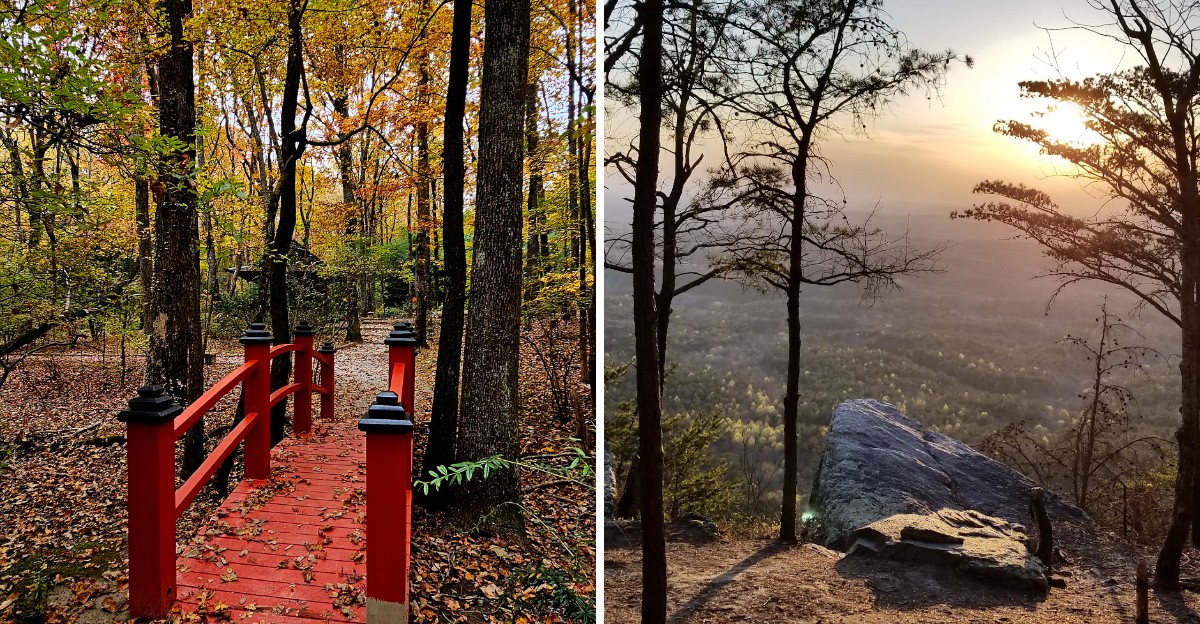
Alabama has a color problem. Every fall, the mountains start showing off so aggressively that the state starts looking like it belongs much farther north.
Red leaves cover winding roads. Orange trees crowd the ridges.
Gold light catches on rocky overlooks. Then somebody inevitably asks the obvious question: Why is everyone driving somewhere else for fall color?
These Alabama mountain spots bring the waterfalls, canyons, overlooks, and crisp air people chase every autumn, but without quite the same traffic. A scenic pull-off can still feel like a place to stop instead of a place to fight for parking.
The strangest part is that this scenery has been here the whole time. The mountains were never hiding.
People just kept looking in the wrong direction.
1. Cheaha State Park, the Top of Alabama
Cool wind on the summit of Cheaha Mountain carries a hint of pine, and the view stretches far enough to make anyone forget the long drive. At 2,413 feet, this is the highest point in Alabama.
The park covers 2,799 acres and sits inside the huge Talladega National Forest, so trees spread out in every direction.
Late October through early November usually brings the best color here. Sweetgums flash purple, red, and orange, while hickories and oaks add gold and bronze.
The mix looks almost painted on.
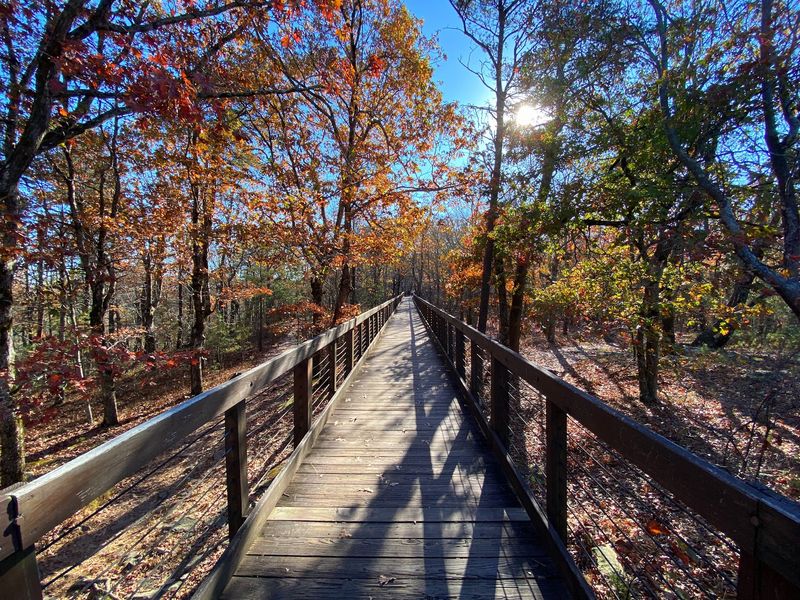
For an easy look, the Bald Rock Boardwalk rolls out over the ridge with no tough climbing required. Hikers wanting more of a workout can head for Pulpit Rock, where a rocky ledge offers equally memorable scenery.
Bunker Tower, a stone lookout built by the Civilian Conservation Corps in 1933, gives long views across the mountains.
Getting there is part of the fun. The Talladega Scenic Drive, also called Alabama Highway 281, curves for nearly 30 miles through the national forest between Heflin and Adams Gap.
Pull over near Devil’s Den Falls to see a quiet waterfall reflecting bright leaves in its pools.
Overnight guests can choose rock cabins, A-frame chalets, lodge rooms, or primitive campsites. Many of them sit close to the best viewpoints.
Pack a warm layer, since mornings at the top can feel surprisingly chilly.
2. Monte Sano, the Mountain of Health
Huntsville may be famous for rockets, but the real launch of color happens just above town. Monte Sano translates to Mountain of Health, and one deep breath of the crisp October air explains the name.
The park covers 2,140 acres on a ridge around 1,600 feet high.
Peak foliage usually arrives in late October. That is when the canopy turns into a patchwork of scarlet, amber, and butter yellow.
Trail lovers have plenty to choose from, with about 20 miles of hiking paths and 14 miles of biking trails. The North Plateau Loop Trail is a friendly pick for families, and it leads toward O’Shaughnessy Point, where the valley spreads out below like a giant quilt.
Bring a snack and linger a bit.
The drive up can steal the show too. Bankhead Parkway, a winding two-lane road on the back side of the mountain, is lined with trees that burst into bright bouquets each fall.
Take it slow, both for safety and for the view.
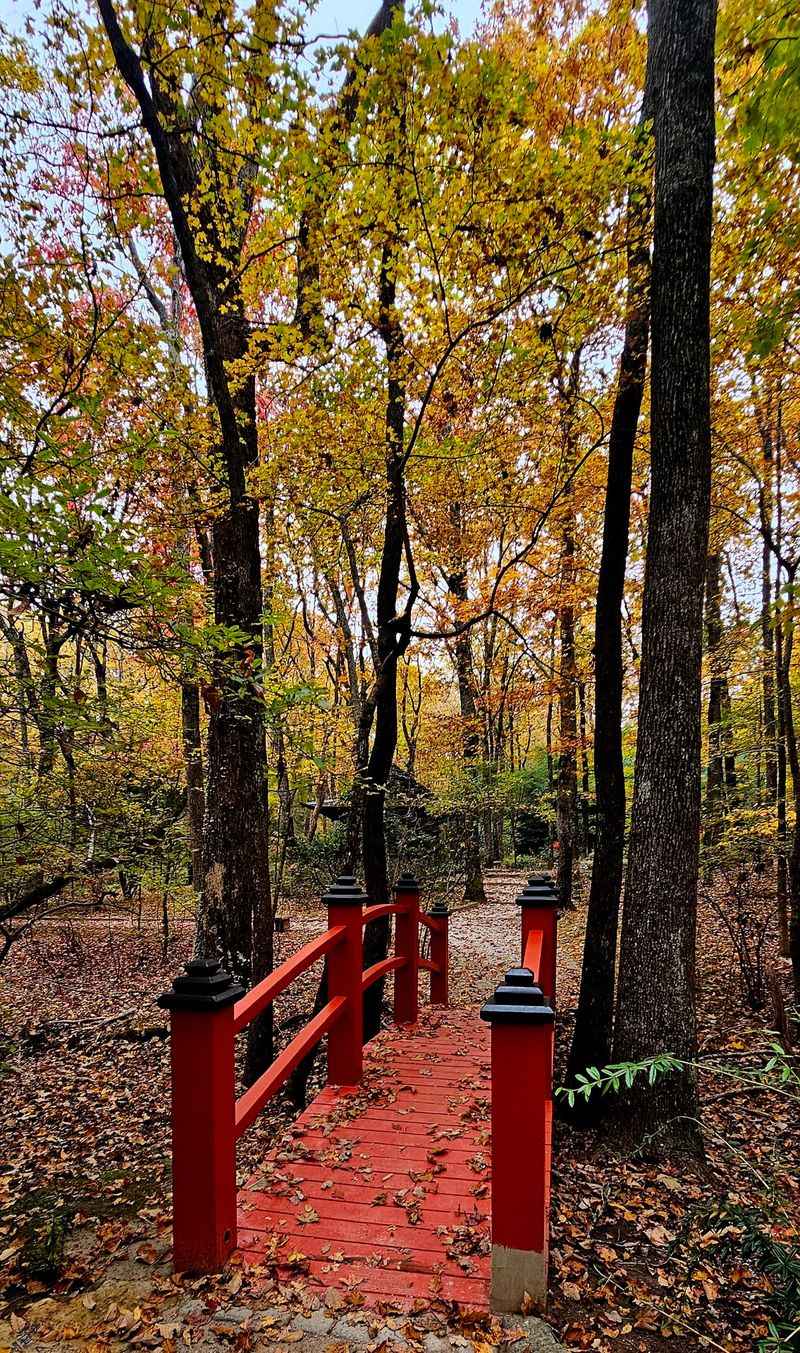
For a calmer moment, the North Alabama Japanese Garden offers stone lanterns, curving paths, and maples that blush a deep red. Rustic cabins, many built by the Civilian Conservation Corps in the 1930s, face the sunrise, and 89 improved campsites are available nearby.
Next door, the Monte Sano Nature Preserve adds over 22 more miles of trails for extra leaf peeping.
3. Little River Canyon, the Grand Canyon of the East
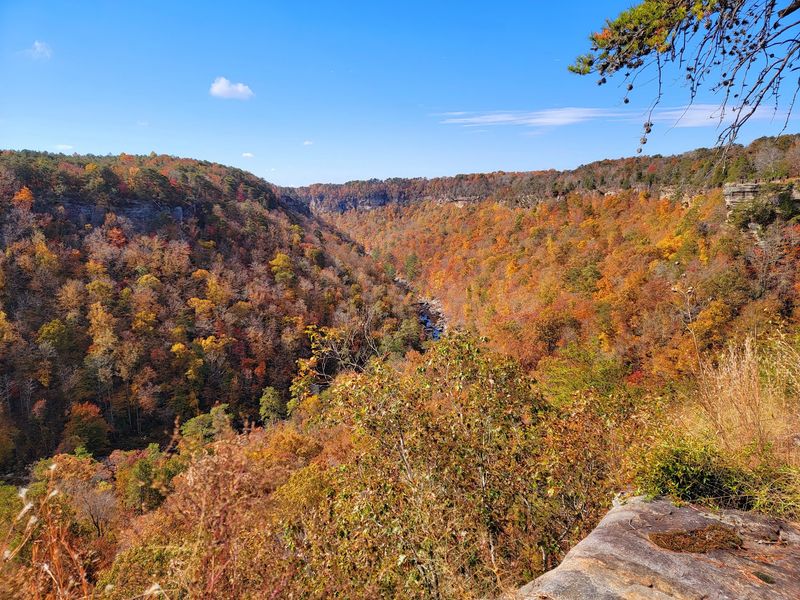
Peering over the rim of Little River Canyon gives the stomach a tiny flip, and then the colors take over. Locals and visitors alike call it the Grand Canyon of the East.
In some spots the gorge drops more than 600 feet, carved by one of the longest mountaintop rivers in the United States.
The preserve sits on top of Lookout Mountain near Fort Payne. Late October to early November is prime time for color.
Sassafras, flowering dogwood, hickory, oak, and maple all crowd the slopes, which means the palette changes almost every few feet. One tree glows orange, the next looks like it is wearing a red sweater.
Nature clearly did not get the memo about matching.
The easiest way to soak it in is the Canyon Rim Parkway, also known as Alabama Highway 176. This 11-mile route has nine named overlooks, including Wolf Creek Overlook, where the gorge opens wide and quiet.
Crowds tend to stay small, so pulling over rarely feels rushed.
Little River Falls is the star attraction. The 45-foot waterfall pours over a wide ledge, and in autumn it gets framed by a bright ring of leaves that looks almost too perfect to be real.
Adventurous hikers can also head down toward the canyon floor for a closer look at the hardwoods. Wear sturdy shoes, since the rocks can be slick after rain.
4. DeSoto State Park and Its Famous Red Boathouse
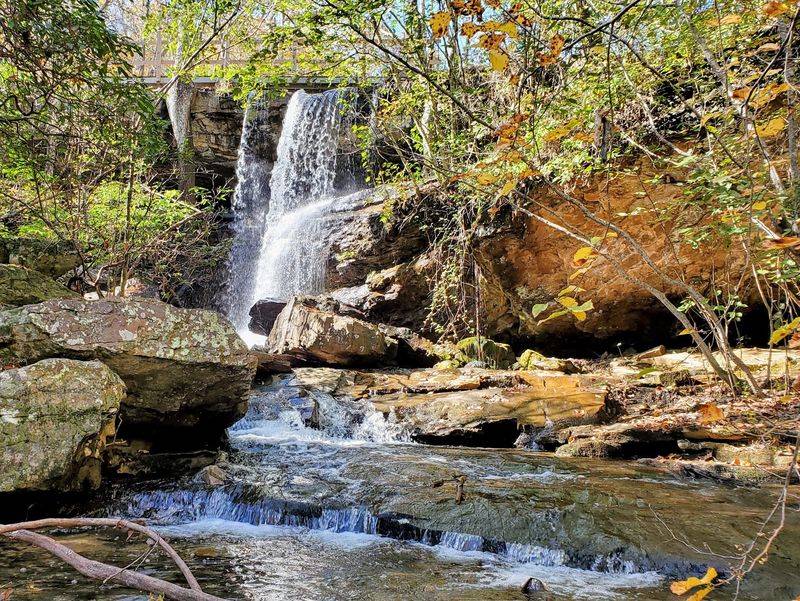
Few things in Alabama get photographed more in October than a small red boathouse at DeSoto State Park. Set against bright trees and still water, it looks like something from a storybook.
Cameras come out the moment it appears.
The park sits on Lookout Mountain near the cozy town of Mentone. Its 3,502 acres hold waterfalls, rocky trails, and roads tucked under thick leafy tunnels.
Color usually peaks from late October through early November.
DeSoto Falls is the big headliner, dropping a mighty 107 feet into a rocky basin. A railed overlook, reached by about 50 steps, gives a sweeping look at the water and the forest around it.
Those steps are worth every breath.
Driving here is a treat on its own. County Roads 89 and 618 slip beneath dense hardwood canopies, so sunlight filters through in gold and orange flickers.
Roll the windows down and listen to the leaves crunch under the tires.
Hikers can wander a long network of trails that pass creeks, boulders, and small cascades. Each turn brings a new mix of reds and yellows.
Quiet mornings tend to be the most peaceful.
Staying overnight makes the visit even better. Options include mountain chalets, log and rustic cabins, motel rooms, and an improved campground.
Waking up to fog lifting off a colorful ridge is a pretty great way to start the day.
5. Bankhead National Forest, Land of a Thousand Waterfalls
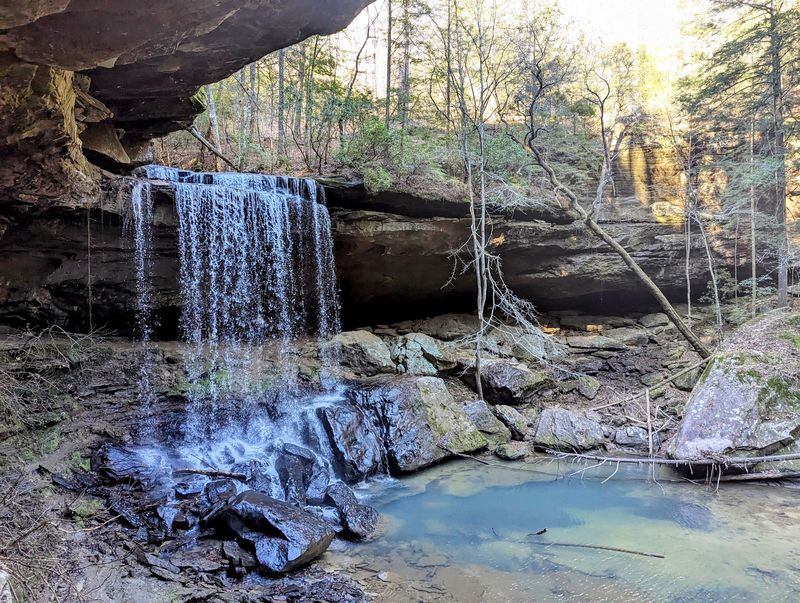
Somewhere in Bankhead National Forest, a waterfall is probably splashing right now with nobody around to see it. That is part of the charm.
Nicknamed the land of a thousand waterfalls, this forest spreads across 181,230 acres in Lawrence, Winston, and Franklin Counties.
Inside it lies the Sipsey Wilderness and the Sipsey Fork, Alabama’s only National Wild and Scenic River. Sandstone bluffs, shady caves, and tall hardwoods create a rugged playground.
Fall colors tend to blaze brightest toward the end of October.
The Rippey Trail, also called Trail 201, runs north to south along a ridge. In the afternoon, the western sun lights up northern red oak, hickory, sugar maple, and American beech until the whole ridge seems to glow.
Timing a hike for late day pays off here.
Trail 206 drops down into the Sipsey Fork canyon. From there, the view up the walls shows a mosaic of reds, oranges, and yellows.
Down on the canyon floor, dark green hemlocks stay green all year. That deep shade makes the fiery colors above pop even more, like a frame around a painting.
Cooler autumn temperatures make long hikes far more comfortable than in summer. Keep an eye out for ancient petroglyphs and rock carvings left by early people.
Bring a map, though, since cell service can be spotty in the backcountry.
6. Oak Mountain, Big Trails Near Birmingham
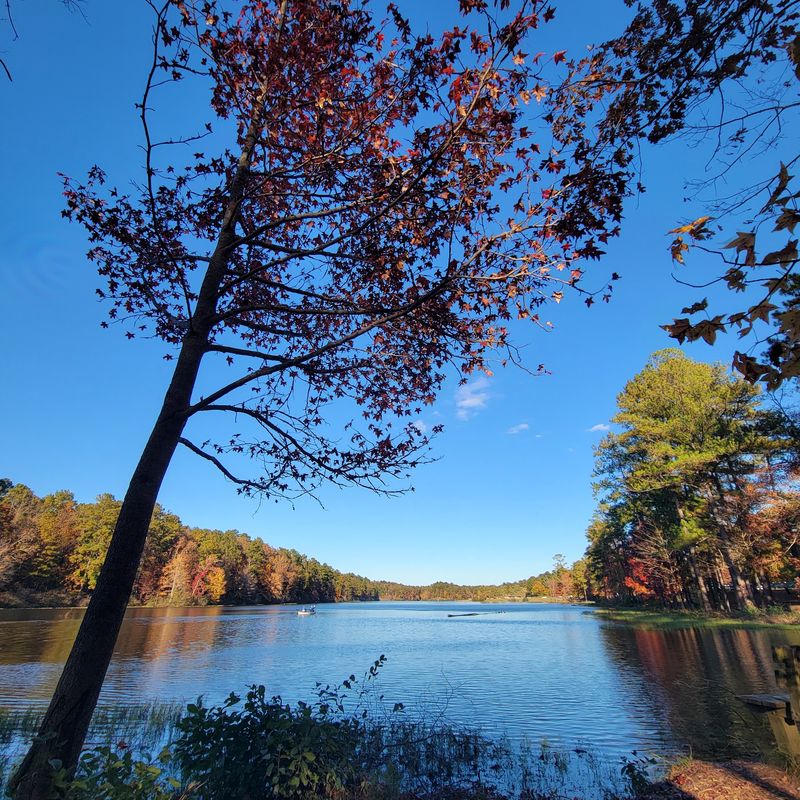
Just a short drive from Birmingham, Oak Mountain hides more wild space than most people expect. At 11,632 acres, it is the largest state park in Alabama.
The trail map alone could keep a hiker busy for weeks.
The park sits in Pelham and offers more than 100 miles of paths. Calm lakes reflect the season, and the forest is packed with oak, sweetgum, hickory, and poplar.
Late October to early November usually brings the richest color.
King’s Chair Overlook is a crowd favorite for good reason. A rocky perch opens onto a sweeping valley that turns into a sea of rust, crimson, and gold.
Sitting there for a while is practically required.
Peavine Falls and the nearby Peavine Overlook deliver a different mood. The water spills down a rocky gorge while bright leaves drift past.
Even the road up gets attention. Peavine Falls Road climbs in tight switchbacks, and each curve reveals a fresh splash of color through the windshield.
Drivers should keep their eyes on the road while passengers handle the gawking.
For a walk focused on leaves, the Red Road Trail is a solid choice. Mountain bikers, picnickers, and families with strollers all find room to enjoy the day.
Arrive early on weekends, since this park is popular with locals who know exactly how pretty autumn gets here.
7. Dismals Canyon, Glowing by Night
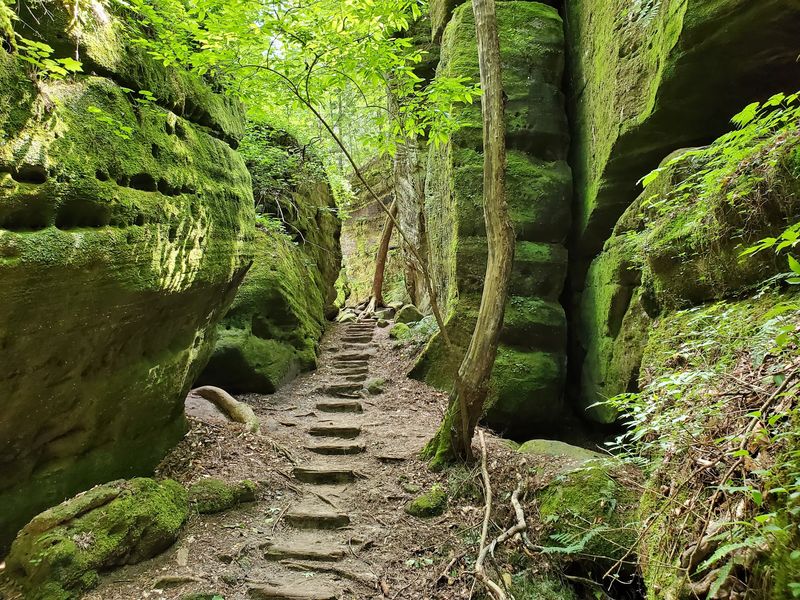
Glowing worms on canyon walls sound like something from a fantasy novel, yet they are real in northwest Alabama. Dismals Canyon is a privately owned 85-acre spot and a National Natural Landmark.
It feels tucked away, a little mysterious, and wonderfully quiet.
Visitors can find the conservatory and canyon entrance at 901 County Road 8, Phil Campbell, Alabama 35581. Early October brings the first hints of color.
Peak foliage usually lands from late October to early November.
A trail about a mile and a half long winds through a sunken forest. It crosses six natural bridges and passes giant boulders, small waterfalls, and old-growth trees.
Mossy sandstone walls hold in the cool air, so the walk feels almost like a secret garden.
Because the canyon holds so many types of plants, fall here looks different from an open ridge. Leaves glow softly in filtered light instead of blazing in full sun.
Now for the fun part. After dark, tiny insect larvae called dismalites give off a blue-green light that speckles the canyon walls like stars.
Late September through early October is the best window to spot them, so an evening visit early in fall can mean colorful leaves by day and twinkling walls by night.
Wear shoes with good grip. Some rocks stay damp all year long.
8. Lake Guntersville State Park on Taylor Mountain
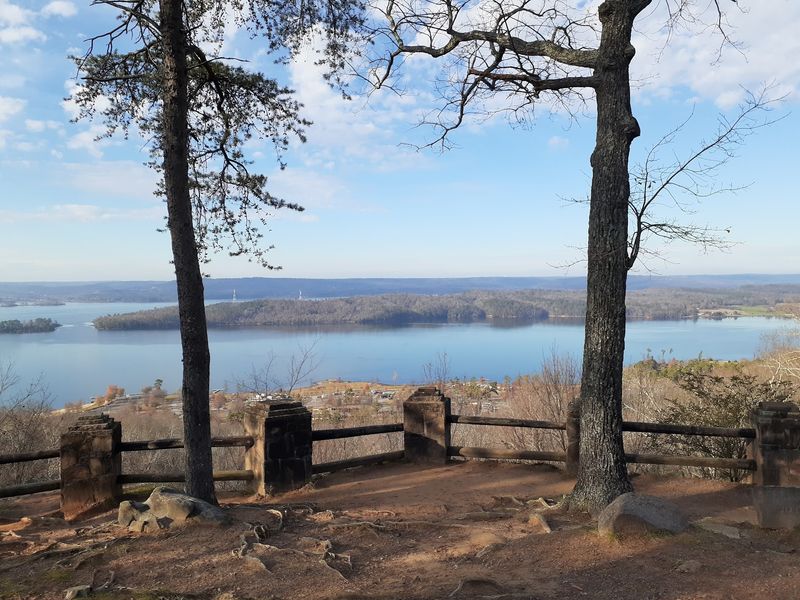
Mountains and water make a great team, and Lake Guntersville State Park proves it every fall. The lodge sits high on Taylor Mountain, looking down over the sprawling lake on the Tennessee River.
Color here often starts right at the shoreline.
Yellow poplars shimmer beside scarlet dogwoods, while orange maples and golden hickories fill in the gaps. On calm mornings, the water mirrors everything, doubling the show.
Fog drifting across the lake adds a dreamy touch.
Lodge rooms come with private balconies that face the water. That means fall scenery can be enjoyed with a warm mug in hand and slippers still on.
No hiking boots needed.
For travelers who prefer more space, cabins rest near the lake and chalets perch along the ridge top. A modern campground welcomes RVs and tents too.
Thrill seekers can take a zip line course through the treetops. Gliding past bright branches gives a bird’s-eye view of autumn that few places offer.
Hold on tight and try not to scream too loudly.
Road trippers will enjoy Alabama Highway 227, which winds through the park and continues toward nearby Buck’s Pocket State Park. The route keeps the colors coming mile after mile.
It makes a relaxing final stop on a fall journey, blending lakeside calm with mountain views in one beautiful spot.
9. Mount Cheaha Wilderness, the Pinhoti Trail’s Wild Heart
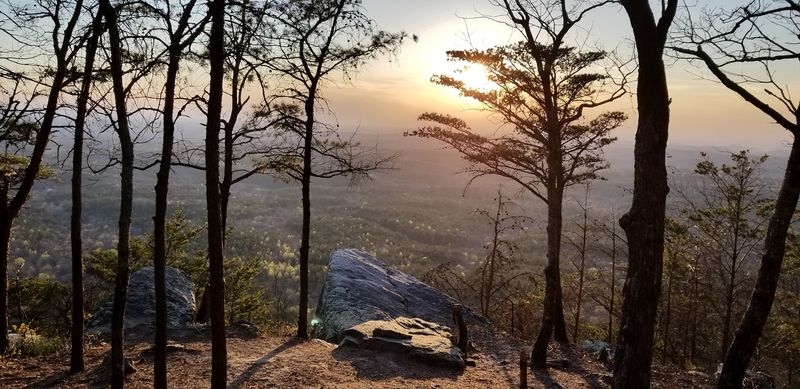
Hikers who crave real quiet often whisper one name: the Cheaha Wilderness. Tucked deeply into the sweeping stretches of the Talladega National Forest, this pristine, legally protected backcountry area covers about 7,400 acres with absolutely no paved roads, no cars, and no commercial gift shops.
It is a gorgeous scenic mountain escape built entirely for footprints and true silence. Walking the rugged Pinhoti Trail through this wilderness during the autumn season feels like stepping directly into an old oil painting.
Massive hickory trees glow a vibrant gold, ancient sourwoods turn a brilliant deep red, and jagged rocky overlooks show off rolling mountain ridges stretching all the way toward the distant Georgia border. Fun fact: the legendary Pinhoti Trail stretches roughly 335 miles across the region and serves as a vital pathway that links up directly with the famous Appalachian Trail system.
Late October usually brings the brightest colors across the high-elevation canopy, turning the landscape into a mesmerizing sea of crimson and orange. To safely enjoy the seasonal magic, modern travelers must always plan ahead.
Pack plenty of clean drinking water, wear sturdy hiking boots with good ankle support, and start your trek early in the morning, since cellular telephone service can disappear incredibly fast here. This untouched wilderness paradise demands careful preparation, but the peaceful mountain vistas are absolutely worth it all now.
