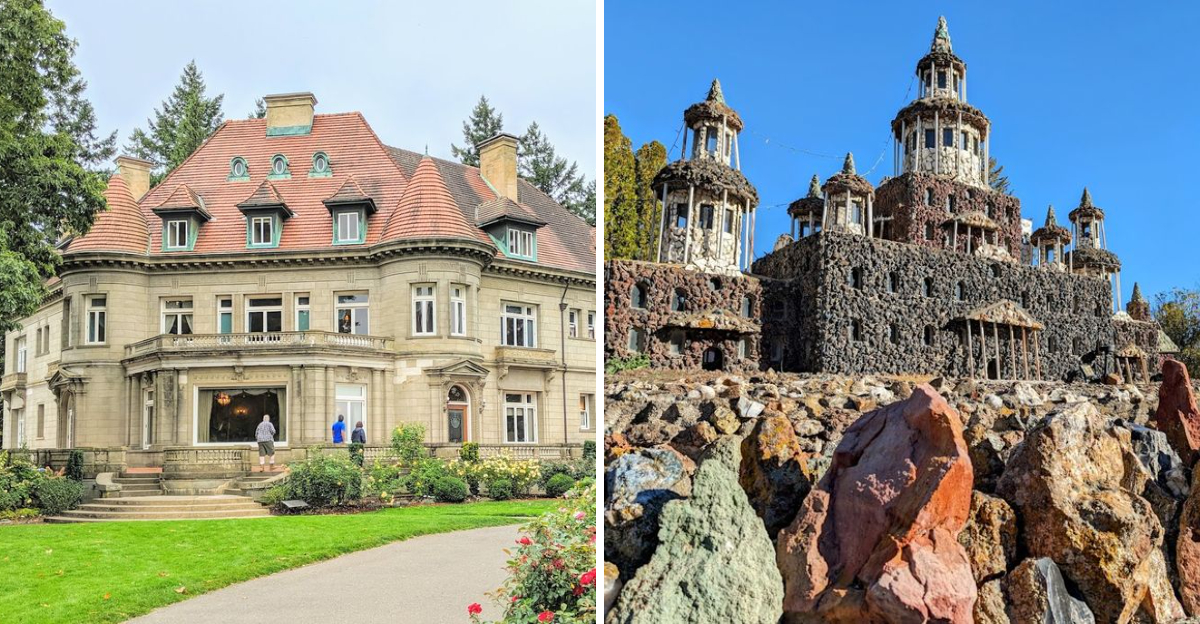
Oregon has a way of surprising you. One moment you are hiking through dense forest, and the next you are standing in front of crumbling stone walls or a ghost town frozen in time.
I have spent years exploring this state, and I keep coming back to its forgotten corners. The ruins here are not just old structures.
They are stories carved in stone, wood, and earth.
Some of these places are easy to reach. Others require a solid pair of boots and a sense of adventure.
All of them are worth every step.
This list covers nine historic sites across Oregon that left a real mark on me. Each one carries its own character, its own mystery, and its own slice of history that you simply cannot find in a museum.
1. Pittock Mansion, Portland, Oregon
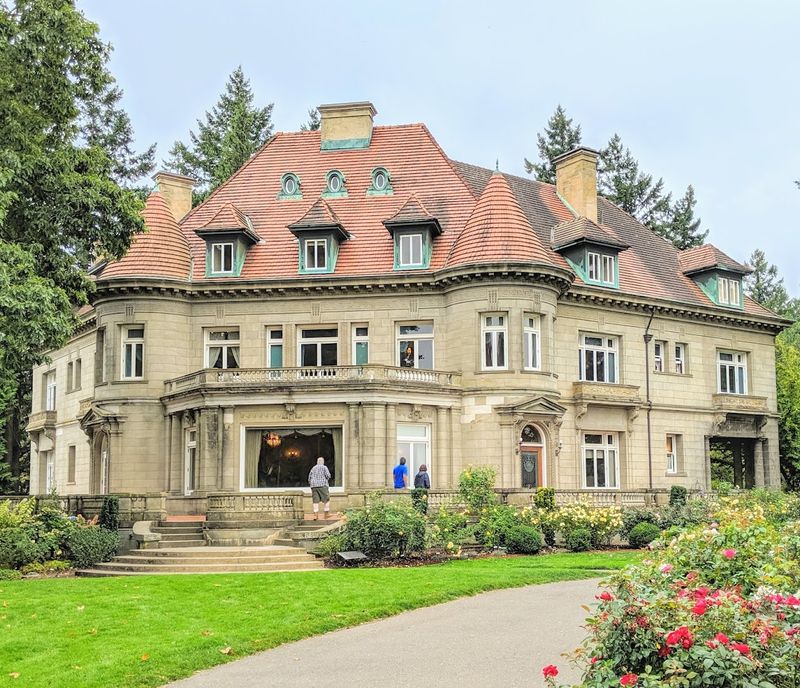
A publisher with big dreams and a hillside with even bigger views gave Portland one of its most beloved landmarks.
Pittock Mansion sits high above Portland, Oregon, in the United States. It was built in 1914 for Henry Pittock, founder of The Oregonian newspaper.
The French Renaissance-style chateau spans over 16,000 square feet. Its architecture feels bold and theatrical, with turrets and stone details that stand out against the skyline.
Inside, you will find period-accurate rooms restored with careful detail. Original furnishings, decorative tiles, and a stunning circular staircase make every room feel like a page from history.
The mansion now operates as a historic house museum. Visitors can tour the interior and learn about the Pittock family and Portland’s early growth as a city.
The grounds are equally impressive. A sweeping lawn and formal gardens frame views of Mount Hood and Mount St. Helens on clear days.
The property is managed by the Pittock Mansion Society and sits within the boundaries of Forest Park. Admission is required for interior tours, but the grounds are accessible for free.
Plan to spend at least two hours here. The combination of architecture, history, and panoramic scenery makes it one of Portland’s most rewarding stops for curious travelers.
2. William L. Holmes House, Oregon City, Oregon
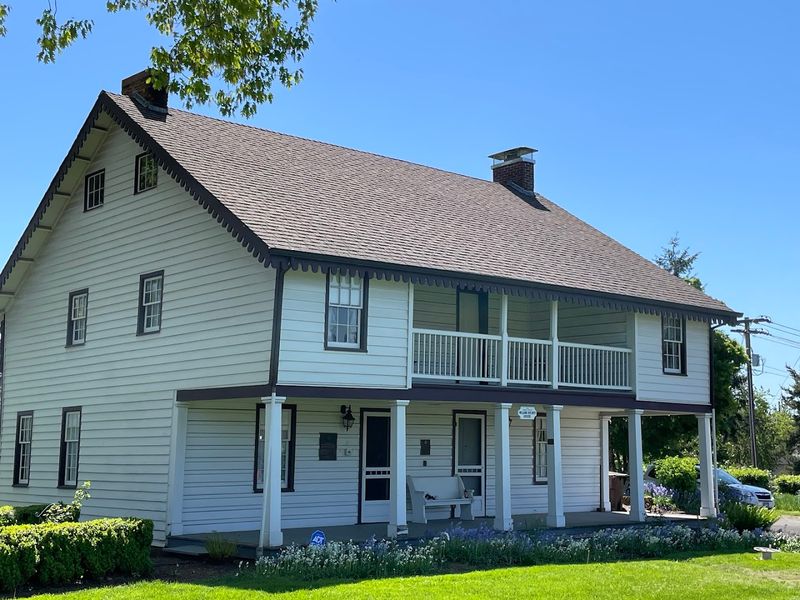
Long before Oregon was a state, one small house in Oregon City was already making history.
The William L. Holmes House stands in Oregon City, Oregon, in the United States.
Built in 1848, it is one of the oldest surviving structures in the entire state.
This modest wood-frame house looks unassuming from the outside. But inside its walls, Oregon’s first Territorial Governor, Joseph Lane, was officially inaugurated in 1849.
That single moment gave this building a significance far beyond its size. It represents the formal beginning of organized American government in the Oregon Territory.
The house is listed on the National Register of Historic Places. That recognition reflects just how rare and important this structure is among Oregon’s surviving early buildings.
Oregon City itself is worth exploring while you are in the area. It was the first incorporated city west of the Rocky Mountains and carries deep historical weight throughout its streets.
Visiting this site connects you directly to the earliest chapter of Oregon’s political identity. You are standing in the same room where a governor took his oath on the frontier.
For history enthusiasts, this is a genuinely powerful experience. Few places in the Pacific Northwest offer such a direct and tangible link to the region’s earliest days of American governance.
3. Mosier Mounds Complex, Mosier, Oregon
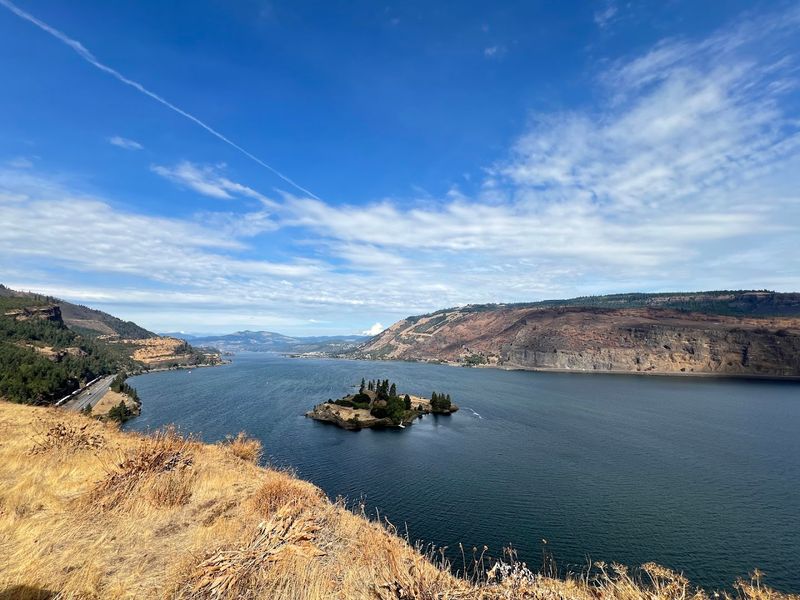
Some places carry a quiet weight that you feel before you even understand what you are looking at.
The Mosier Mounds Complex sits near the small town of Mosier, Oregon, in the United States, along the southern edge of the Columbia Plateau.
This archaeological site features stone walls, pits, and earthen mounds spread across a rugged basalt talus slope. Researchers consider it the largest and most complex site of its kind in the southern Columbia Plateau region.
The structures were built by Indigenous peoples who lived and traded along the Columbia River for thousands of years. Their craftsmanship and knowledge of the landscape is visible in every carefully placed stone.
Visiting this site requires a respectful mindset. These are not ruins in the traditional sense.
They are sacred cultural landmarks that deserve thoughtful attention from every visitor.
The surrounding scenery adds to the experience. Rolling hills, basalt cliffs, and wide open skies create a dramatic backdrop that makes the site feel both ancient and alive.
Access to the area can involve hiking across uneven terrain. Sturdy footwear is strongly recommended, and visitors should stay on established paths to protect the site.
The Mosier Mounds Complex is a reminder that Oregon’s history stretches far beyond European settlement. This place holds thousands of years of human story within its stones.
4. Charles Piggott House, Portland, Oregon
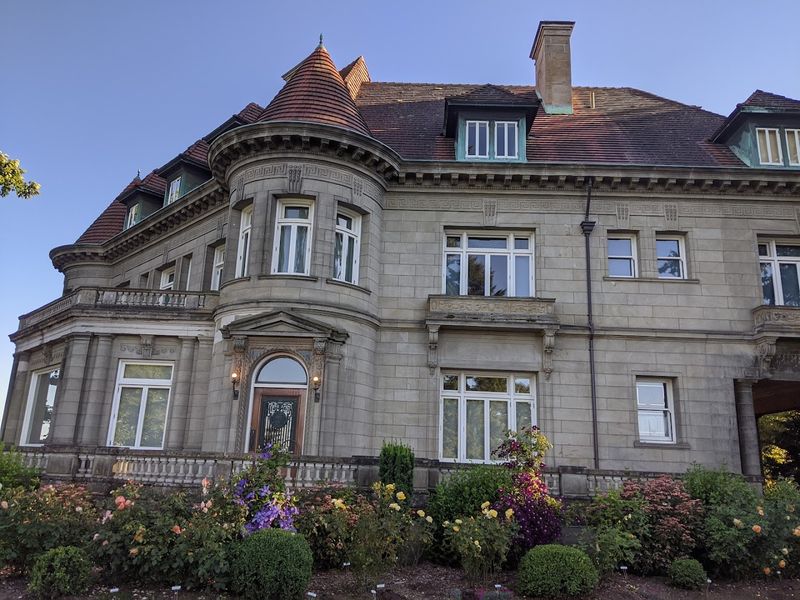
Portland has a lot of Victorian architecture, but only one building that people actually call a castle.
The Charles Piggott House, also known as Piggott’s Castle, stands in Portland, Oregon, in the United States. It was constructed in 1892 in the Romanesque Revival style.
Its stone facade, arched windows, and tower-like features set it apart from every other house on the block. In a city full of charming historic homes, this one genuinely looks like something from a fairy tale.
Charles Piggott was a local businessman who clearly had a flair for the dramatic. He commissioned a home that was as much a statement as it was a residence.
The building was added to the National Register of Historic Places in 1979. That designation helped protect it from the kind of redevelopment that has erased many of Portland’s older buildings.
It remains the only surviving castle-style home in the city. That alone makes it a remarkable piece of Portland’s architectural identity.
The exterior is the main attraction for most visitors. Walking past and taking in the stonework and tower details is a worthwhile stop on any Portland history walk.
Piggott’s Castle proves that one person’s bold vision can outlast generations. This 130-year-old structure still commands attention every single time someone walks by it.
5. Petersen Rock Garden, Redmond, Oregon
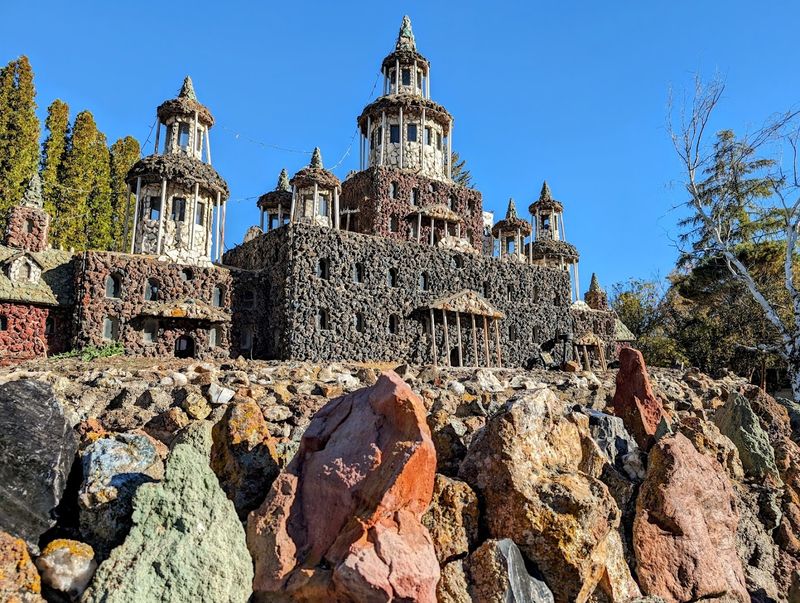
One Danish immigrant looked at the high desert of central Oregon and decided to build an entire miniature world out of rocks.
The Petersen Rock Garden is located between Bend and Redmond, Oregon, in the United States. Danish-born farmer Rasmus Petersen spent decades creating this four-acre outdoor wonderland starting in the 1930s.
Using rocks collected within an 85-mile radius, he built miniature castles, churches, bridges, and towers entirely by hand. The level of detail in each structure is genuinely astonishing for a self-taught builder working alone.
The garden was added to the National Register of Historic Places in 2013. That recognition acknowledged it as a rare example of American folk art on a grand outdoor scale.
A small museum on the property houses Petersen’s rock and mineral collection. Agates, thunder eggs, and petrified wood are among the highlights on display inside.
The garden is family-friendly and easy to explore at a relaxed pace. Kids and adults alike tend to slow down and look closely at every tiny carved detail.
Peacocks roam freely across the grounds, which adds an unexpected and delightful layer to the whole experience. Bring a camera, because you will want to capture every angle.
The Petersen Rock Garden is proof that creativity and patience can turn ordinary stones into something truly extraordinary.
6. Witch’s Castle, Portland, Oregon
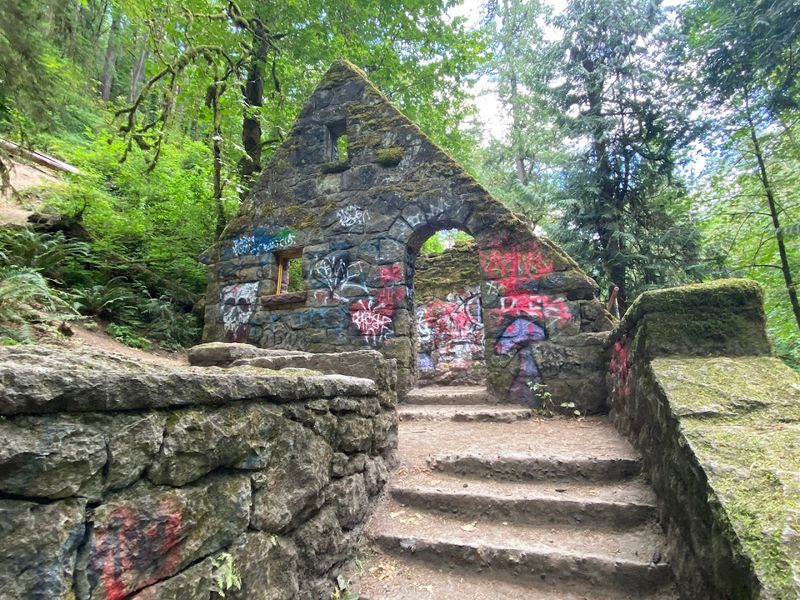
Moss-covered stone walls, a forest swallowing an old building whole, and a name that practically dares you to visit after dark.
The Witch’s Castle sits inside Forest Park in Portland, Oregon, in the United States. The structure was originally built in the 1930s as a park ranger station and public restroom facility.
Over the decades, the building fell into disuse and the forest crept in. Today, thick moss blankets every surface, and the walls have partially collapsed into a genuinely eerie tableau.
Local ghost stories have attached themselves to this place over the years. Tales of strange occurrences and restless spirits have made it a favorite stop for urban explorers and thrill-seekers.
The hike to reach the ruins follows the Lower Macleay Trail, one of Forest Park’s most popular paths. The trail is well-marked and accessible for most fitness levels, making it a great forest walk even without the ruins as a destination.
The ruins sit near Balch Creek, adding the sound of running water to the already atmospheric setting. In autumn, the colors around the structure are especially striking.
Photography enthusiasts love this spot for its moody, cinematic quality. The contrast between stone and green growth creates images that look almost too dramatic to be real.
Getting there early in the morning means fewer crowds and the best light filtering through the tall trees above.
7. Shaniko Ghost Town, Shaniko, Oregon
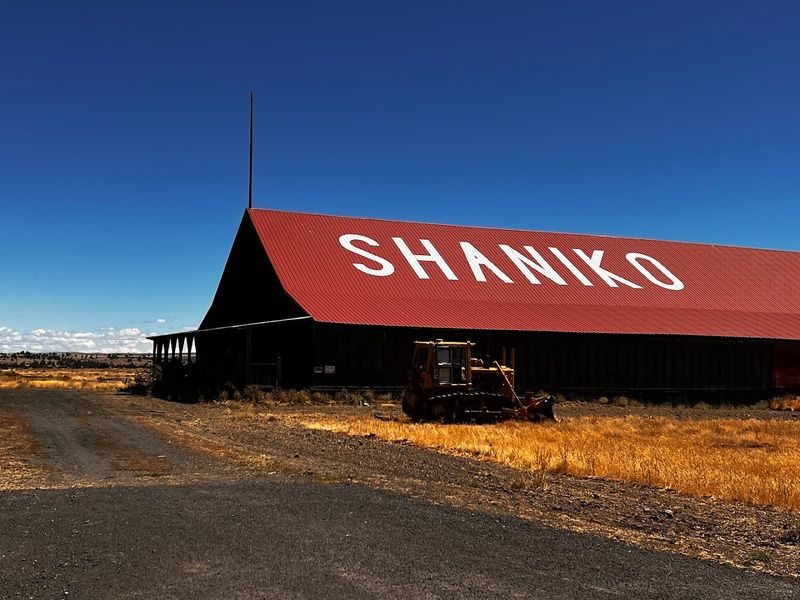
At its peak, this tiny town was handling more wool than almost anywhere else in the country.
Shaniko is a ghost town located in north-central Oregon, in the United States. It sits in the high desert of Wasco County, about 70 miles south of The Dalles.
In the early 1900s, Shaniko earned the title of Wool Capital of the World. Millions of pounds of wool passed through this small railroad hub every year, and the town buzzed with commerce and activity.
When the railroad shifted its route, Shaniko’s economic lifeline was cut. The population dropped sharply, and the town was gradually left behind.
Today, Shaniko’s weathered storefronts, old hotel, and historic schoolhouse stand largely intact. Walking its deserted streets feels like stepping directly into a Western film set.
The town is considered one of Oregon’s best-preserved ghost towns. Several buildings have been stabilized and are open for exploration, giving visitors a tangible sense of what life once looked like here.
A small museum in the area provides context about the town’s wool trade history. Local volunteers often share stories that bring the faded buildings back to life in your imagination.
Shaniko is best visited in spring or fall when the high desert temperatures are comfortable. The wide open skies and golden grasslands surrounding the town make the drive out here worthwhile on their own.
8. Cornucopia Ghost Town, Wallowa Mountains, Oregon
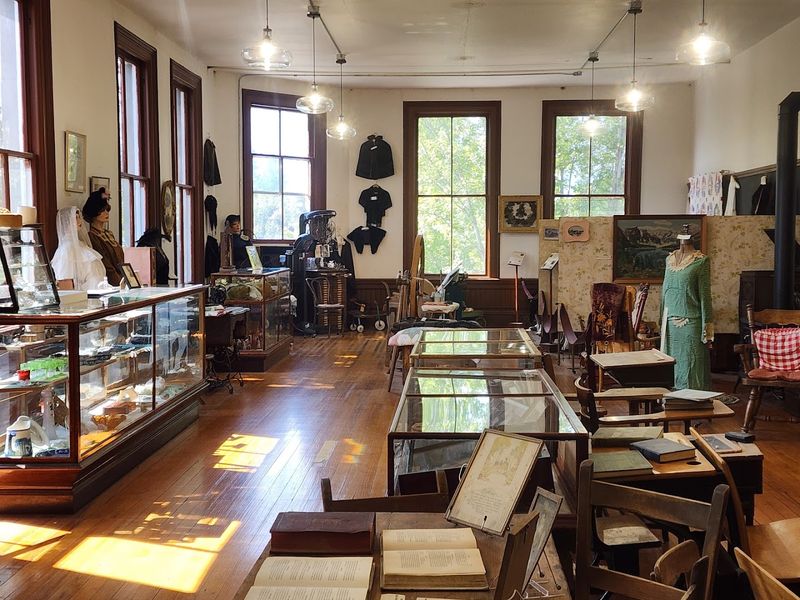
Gold fever once drew hundreds of people deep into the Wallowa Mountains, and the buildings they left behind are still standing.
Cornucopia is a ghost town located in the Wallowa Mountains of eastern Oregon, in the United States. It sits at a high elevation near the Eagle Cap Wilderness, surrounded by rugged alpine terrain.
The town boomed in the late 1800s and early 1900s as a gold mining settlement. At its height, Cornucopia had a hotel, a post office, multiple stores, and a population eager to strike it rich.
When the gold ran out and the mines closed, people left quickly. The wooden structures they abandoned have been slowly weathering ever since, creating a hauntingly beautiful scene.
The remaining mine buildings, rusted equipment, and collapsed cabins sit against a backdrop of jagged peaks and dense pine forest. Photographers regularly make the long drive out here just for that view.
Reaching Cornucopia requires navigating unpaved mountain roads. A high-clearance vehicle is recommended, especially earlier in the season when the road can be rough and soft in places.
Hiking trails in the surrounding wilderness offer additional rewards. Wildflower meadows and clear mountain streams are common sights just beyond the old town boundaries.
Cornucopia rewards the effort it takes to get there. Few ghost towns in Oregon combine this level of preserved history with scenery this dramatic.
9. Bayocean, Tillamook County, Oregon
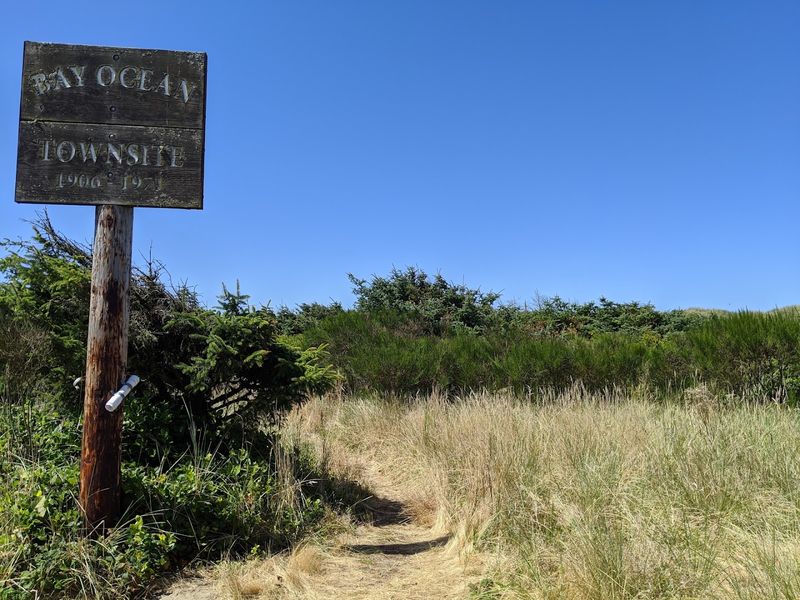
An entire resort town once stood here, complete with hotels, a natatorium, and hundreds of homes, and the ocean took all of it.
Bayocean was a planned resort community located on a spit of land in Tillamook County, Oregon, in the United States. Developers in the early 1900s marketed it as the Atlantic City of the West.
The ambition was real. A large hotel, a bowling alley, and a heated indoor pool were all constructed on this narrow stretch of coastal land.
The problem was the jetty. Construction of a jetty at the mouth of Tillamook Bay altered the natural movement of sand along the coast.
Erosion accelerated rapidly, and the spit began to narrow.
By the mid-20th century, homes were falling into the sea. The last structures disappeared by the 1970s, leaving behind only the land itself and a few buried remnants.
Today, Bayocean is a hiking destination managed as part of the Tillamook Bay area. A trail runs along the spit, offering sweeping views of the bay on one side and the open Pacific on the other.
On a clear day, the hike is stunning. On a stormy day, it is absolutely dramatic in the best possible way.
Walking Bayocean spit is a quiet, windswept experience that carries a powerful lesson about the relationship between human ambition and the forces of nature.
Dear Reader: This page may contain affiliate links which may earn a commission if you click through and make a purchase. Our independent journalism is not influenced by any advertiser or commercial initiative unless it is clearly marked as sponsored content. As travel products change, please be sure to reconfirm all details and stay up to date with current events to ensure a safe and successful trip.
