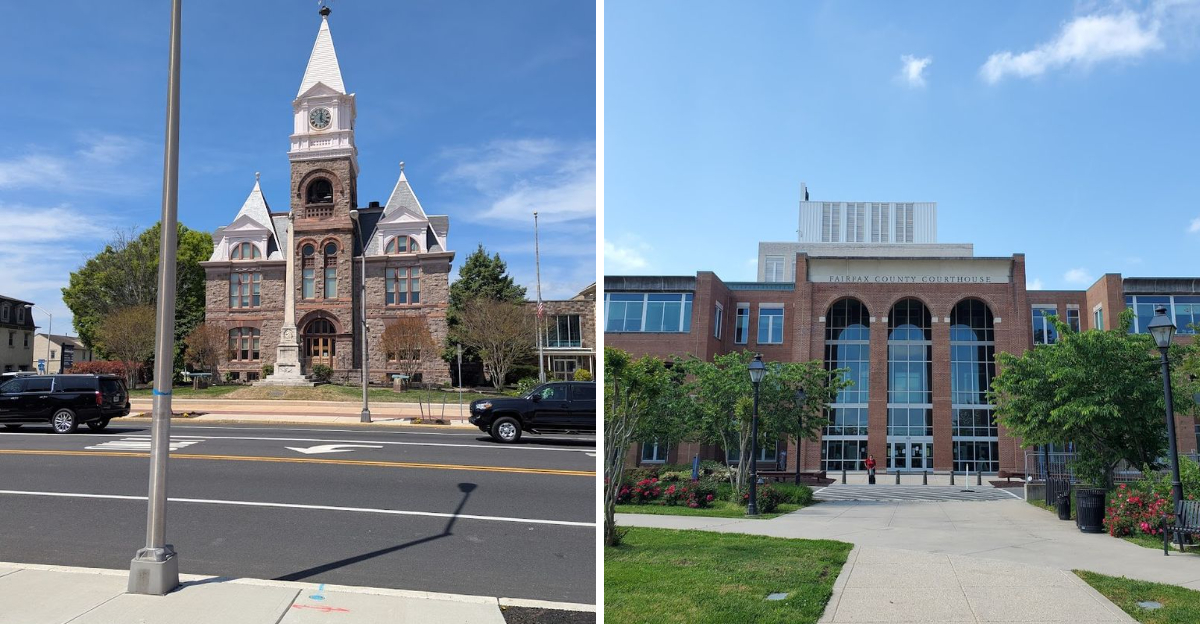
The ceilings are high, the wood is dark, and the rooms still carry the weight of decisions made centuries ago. These historic Virginia courthouses are places where you can still feel the 18th century, where the past is present in the architecture and the atmosphere.
I have visited each one, and each time I have felt the quiet power of the spaces. Some are still in use, with modern cases heard in the same rooms where earlier judges presided.
Others are preserved as museums, their history carefully maintained. All of them offer a connection to the legal and social history of the Commonwealth.
Virginia has plenty of historic buildings, but these courthouses are living history.
1. King William County Courthouse, VA
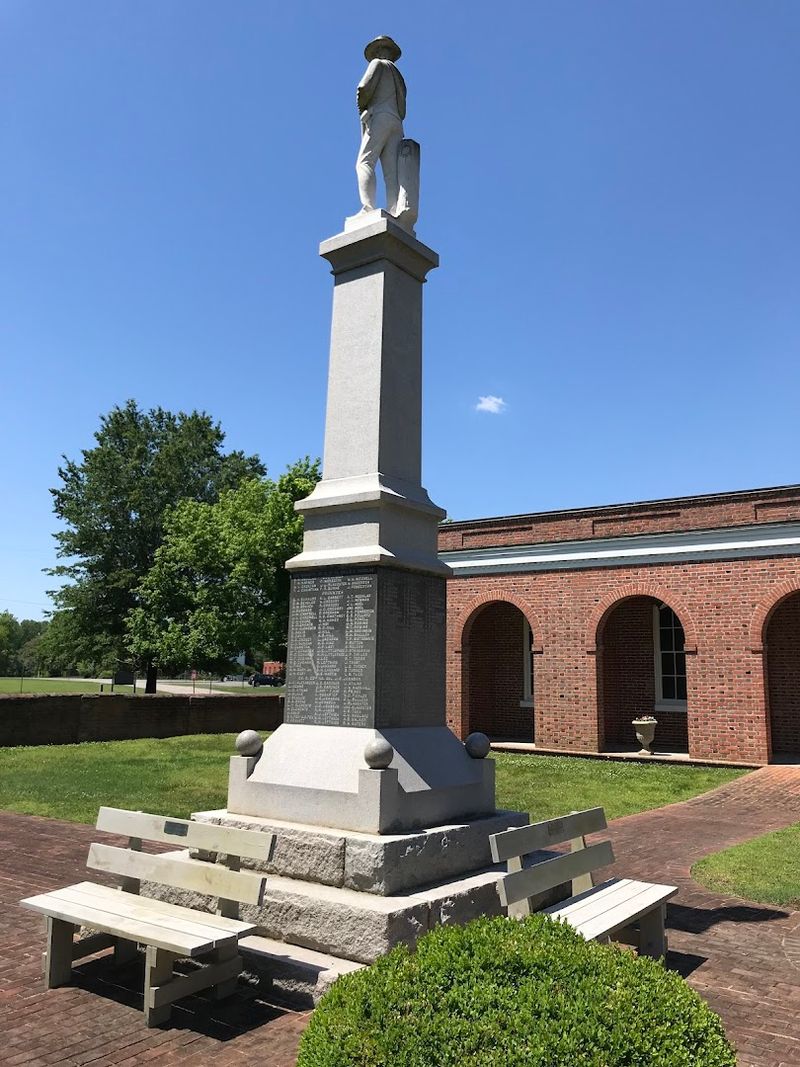
Justice has echoed through these walls without interruption since the early 18th century, making King William County Courthouse one of the most astonishing legal landmarks anywhere in the United States. Built in the Georgian style with meticulous red brick laid in Flemish bond, the structure carries an unmistakable dignity that no modern building can manufacture.
Its T-shaped footprint and steep hipped roof cut a silhouette so perfectly colonial that it genuinely looks lifted from a history textbook illustration.
Five graceful arches form an inviting arcade along the front, the kind of architectural detail that makes you slow your pace and really look. A brick enclosure wall, added around the mid-1800s, wraps the court green in a layer of charm that has somehow survived generations of change.
Most county business has since moved to a newer complex nearby, but the old courthouse still hosts periodic judicial sessions as a living tribute to its unbroken tradition.
Standing inside, I felt the weight of all those centuries pressing gently against the present. The proportions of the room, the worn surfaces, the quality of light filtering through original-style windows, all of it conspired to make me forget what year I was in.
Few places in America can claim this level of continuous legal operation, and King William wears that distinction with quiet confidence. If you only visit one courthouse on this entire list, make it this one first and let the others build from there.
Address: 227 Courthouse Lane, King William, VA 23086
2. Essex County Courthouse, VA
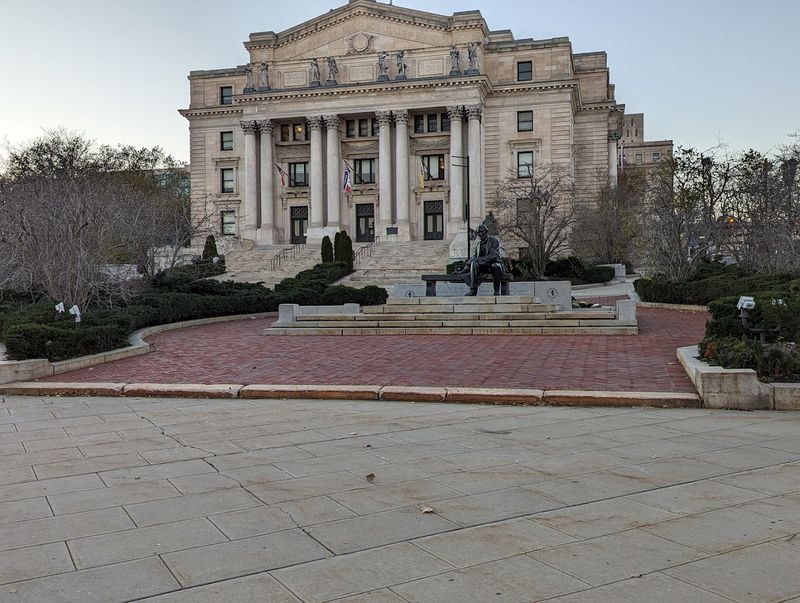
Few buildings in Virginia carry as many identities as the old Essex County Courthouse in Tappahannock. Constructed between 1728 and 1729, this compact one-story red brick gem has been a courthouse, a battleground, and a church, all without losing its original bones.
The Flemish bond brickwork and beautifully arched windows give it an elegance that feels almost too refined for a small river town, until you remember that Tappahannock was once a thriving port where tobacco and ambition flowed in equal measure.
British forces tested the building’s resilience in 1814, and it passed that test admirably. Its legal career ended in 1848, after which it was converted into the Beale Memorial Baptist Church, gaining a belfry that still crowns the roofline today.
Essex County reacquired the property in 2004, and that reclamation feels like a love story, a community choosing to hold onto something irreplaceable rather than let it fade into someone else’s story.
Walking through the archways here, I kept thinking about the river just beyond the town center, and how every legal ruling made in this building once rippled outward along those trade routes. The Rappahannock shaped Essex County, and this courthouse shaped the Rappahannock community.
That layered connection between water, commerce, and law is something you feel rather than read about. Tappahannock itself is worth an afternoon of wandering, and this courthouse is the anchor that makes every other stop in town feel more meaningful.
Address: 202 North Church Lane, Tappahannock, VA 22560
3. Charles City County Courthouse, VA
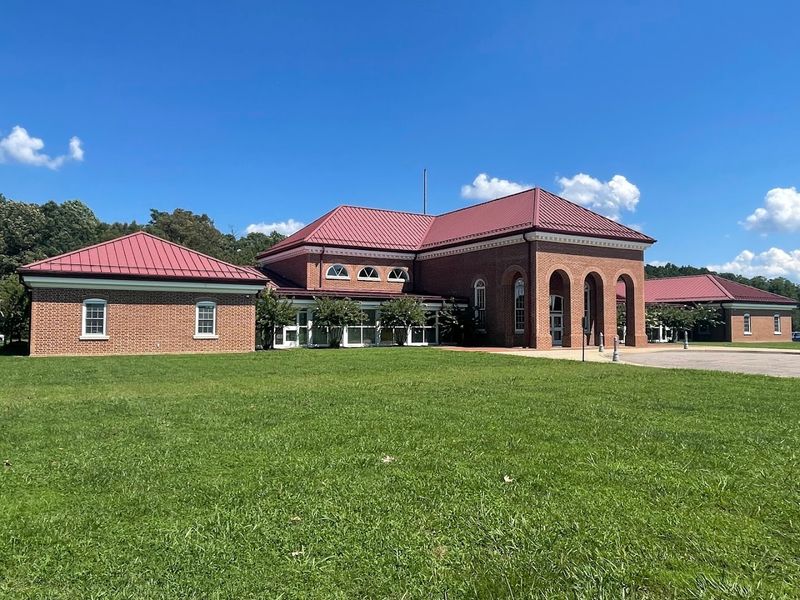
Built somewhere in the 1730s to 1750s, the Charles City County Courthouse has survived more than most buildings ever face. Union troops marched through during the Civil War, rifling through records and upending the order of things, yet the building itself held firm.
Many early documents were lost in those chaotic years, which makes the physical structure itself all the more precious as the primary surviving archive of this county’s oldest legal history.
The T-shaped brick form, the arcaded front, and the modillion cornice running beneath the roofline all signal a confident Georgian sensibility. Whoever designed this courthouse understood proportion, and that understanding is still visible nearly three centuries later.
The steep hipped roof gives the building a composed, almost stoic presence, as if it knows exactly what it has endured and sees no reason to dramatize the fact.
What strikes me most about Charles City is how the courthouse still actively serves its original function. After nearly three hundred years, real legal business continues to unfold within these walls.
That continuity is rare anywhere in the world, let alone in a country as young as America. The surrounding countryside adds another layer of atmosphere, with plantation landscapes and historic roads threading through the region in every direction.
Charles City County sits along the scenic Route 5 corridor between Richmond and Williamsburg, making it an easy and deeply rewarding detour on any Virginia road trip. Come for the architecture, stay for the quiet sense of time folding back on itself.
Address: 10780 Courthouse Road, Charles City, VA 23030
4. Hanover County Courthouse, VA
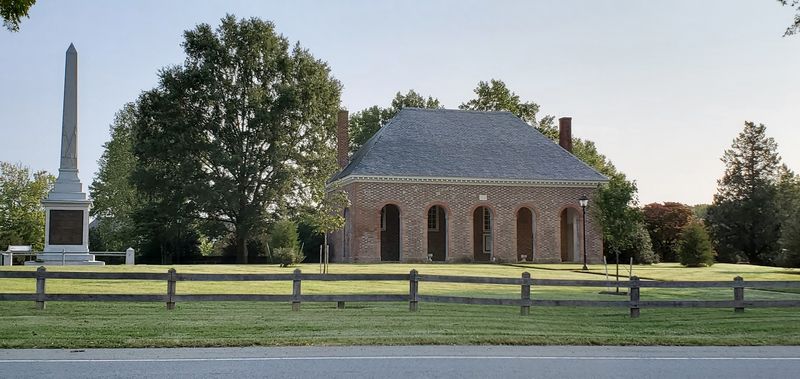
Patrick Henry stood here. That single fact transforms the Hanover County Courthouse from a beautiful old building into an electric landmark.
Erected in the early 1740s, this one-story red brick structure with its Flemish bond brickwork and glazed headers is already a visual delight. However, knowing that Henry delivered his legendary Parson’s Cause argument within these walls in 1763 adds a charge to the air that I genuinely felt the moment I stepped onto the grounds.
The five-arched arcade stretching across the front is one of the finest examples of colonial courthouse design in Virginia. That argument against the Crown wasn’t just a legal case, it was a preview of the revolutionary spirit that would reshape the world a decade later.
Citizens later gathered here to adopt the Hanover Resolutions, asserting their rights with a clarity and courage that still resonates. Both the Revolution and the Civil War touched this place, yet it endured both without losing its essential character.
Full trials relocated elsewhere in the 1970s, but the courthouse found a graceful second act hosting ceremonial occasions, community meetings, and even weddings. Tours are available by appointment, and I’d strongly recommend booking one rather than simply admiring the exterior from the road.
The interior details, the scale of the arcade, and the knowledge of what was spoken here combine into something genuinely moving. Hanover County is roughly twenty miles north of Richmond, making it a perfectly manageable day trip with serious historical payoff.
Address: 13182 Hanover Courthouse Road, Hanover, VA 23069
5. Old Isle of Wight Courthouse, VA
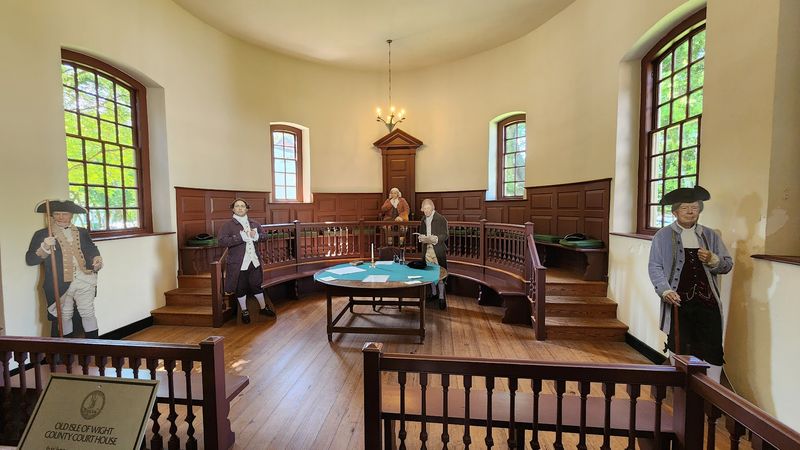
Most colonial courthouses follow a fairly predictable playbook, but the Old Isle of Wight Courthouse in Smithfield decided to do something wonderfully different. Built between 1750 and 1752, this structure features a semicircular apse capped with a conical roof.
It’s a design element so unusual that it immediately sets the building apart from every other courthouse on this list.
That curved roofline echoes the Colonial Capitol in Williamsburg, suggesting that whoever commissioned this building had both ambition and a good eye for architectural drama.
For roughly fifty years, this courthouse was the beating heart of Isle of Wight County life. After 1802, it shifted to private ownership and underwent changes including a blocked arcade and a modified roof.
The story could have ended there, but a preservation effort in 1938 restored the building to its original appearance, arcade and all. That restoration was an act of genuine civic love, and the result is one of the most photogenic colonial structures in all of Virginia.
Today the building is open for free tours, and you can even rent it for private events, which strikes me as one of the more inspired uses of a historic landmark I’ve encountered anywhere. Smithfield itself is a charming small town with a distinct character shaped by its agricultural and maritime heritage.
The courthouse sits right on Main Street, making it impossible to miss and easy to pair with a leisurely walk through the surrounding historic district. Quirky, beautiful, and surprisingly intimate, this one will stay with you.
Address: 130 Main Street, Smithfield, VA 23430
6. Gloucester County Courthouse Square, VA
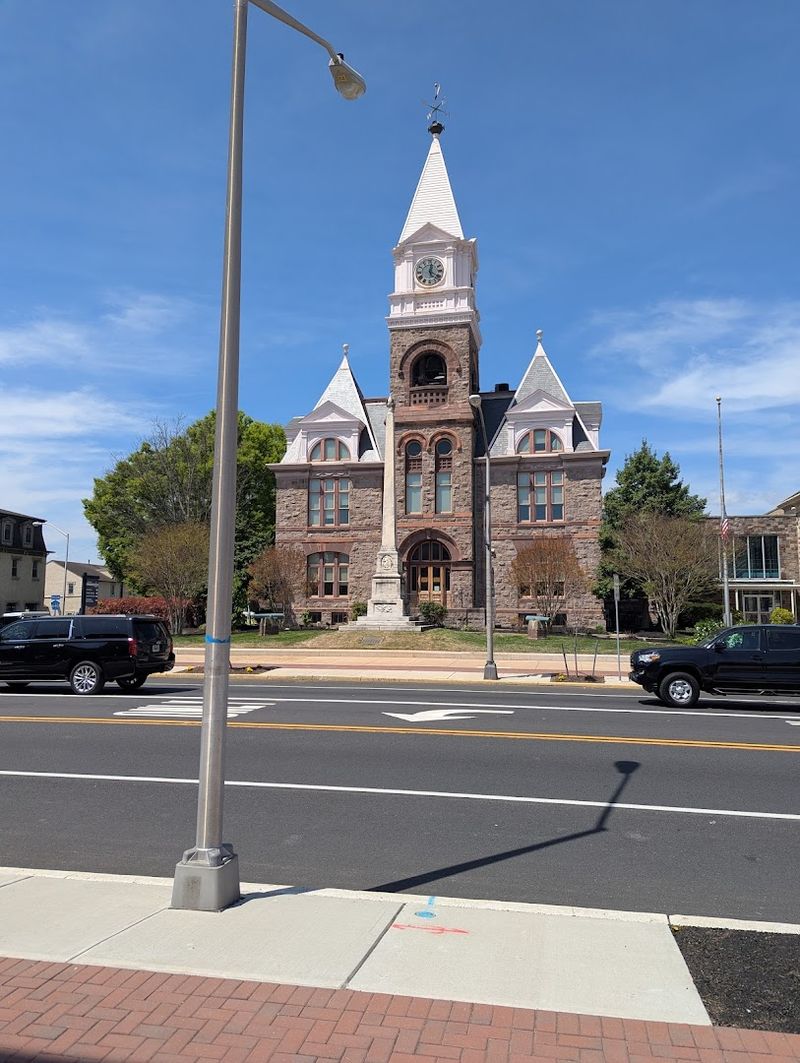
Gloucester County Courthouse Square is the kind of place that makes architectural historians go quiet with admiration. At its center stands the courthouse, traditionally dated to 1766.
It’s a grand T-shaped brick structure with Flemish bond brickwork, round-arched windows, and proportions so precisely calibrated that the building radiates calm authority.
Four white Ionic columns support a pediment portico at the entrance, giving the whole composition a stately formality that feels genuinely impressive rather than merely decorative.
The real showstopper, though, is the intact colonial walled court green. A circular brick enclosure, built in the 1930s following colonial precedents, wraps the entire complex in a layer of historic atmosphere that most courthouse squares can only dream about.
Within that wall, other historic structures cluster around the courthouse like a small village frozen in time, including an early debtor’s prison, a jail, and the Botetourt Hotel, which served as a colonial tavern and remains one of the most evocative buildings on the green.
County government and community meetings still take place inside the courthouse, giving the whole square a sense of living purpose rather than preserved stagnation. Gloucester sits on the northern neck of the Middle Peninsula, a scenic stretch of Virginia that rewards slow driving and unhurried exploration.
The square itself is free to walk around, and the surrounding town offers enough character to justify a longer stay. I spent a full morning here and still felt like I had only scratched the surface of what this remarkable complex has to offer.
Address: 6509 Main Street, Gloucester, VA 23061
7. Colonial Williamsburg Courthouse, VA
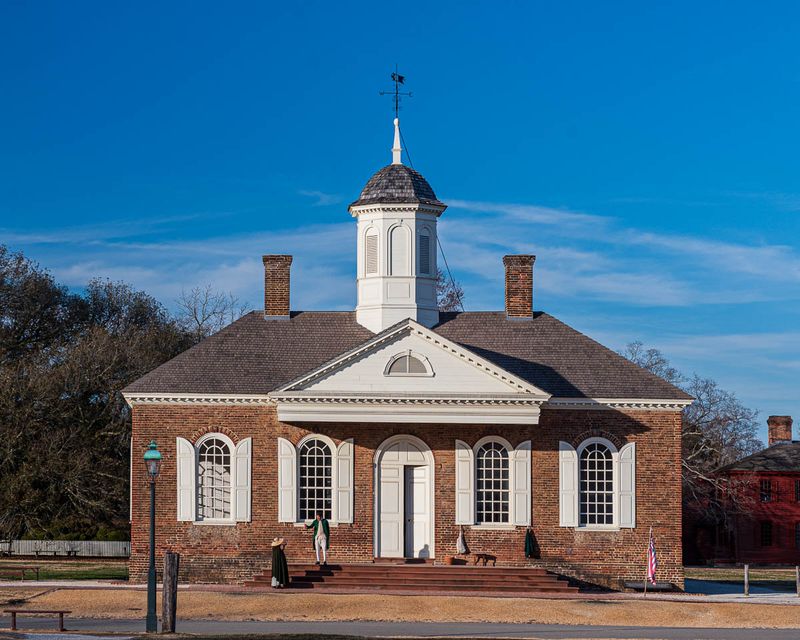
Standing on Duke of Gloucester Street with the Colonial Williamsburg Courthouse in front of me, I had one of those rare moments where the past and present genuinely overlap.
Built between 1770 and 1771, this striking Georgian structure combines red brick with crisp white wooden trim and tall arched windows fitted with white shutters.
The projected portico at the entrance is architecturally unique among colonial courthouses, giving the building a presence that commands the street without shouting for attention.
The historical weight here is considerable. Benjamin Waller stood at this very building and read aloud the Declaration of Independence on July 25, 1776, and the excitement of that moment must have been extraordinary.
A fire in 1911 caused significant damage, but Colonial Williamsburg acquired the property in 1928 and restored it to its 18th-century appearance with admirable fidelity. What exists today is as close to the original as careful scholarship and skilled craftsmanship can achieve.
Unlike most entries on this list, the Williamsburg courthouse operates as an active living museum. It’s hosting historical interpretations and costumed reenactments that bring the colonial legal process to vivid life.
Actors portray court proceedings, and the whole experience is genuinely engaging rather than merely educational.
Colonial Williamsburg as a destination is expansive, but this courthouse earns a prominent spot on any itinerary. It sits right on the main street of the historic district, surrounded by taverns, shops, and other restored buildings that collectively make this one of the most immersive historic experiences in the entire country.
Address: 101 W Duke of Gloucester Street, Williamsburg, VA 23185
8. Shenandoah County Courthouse, VA
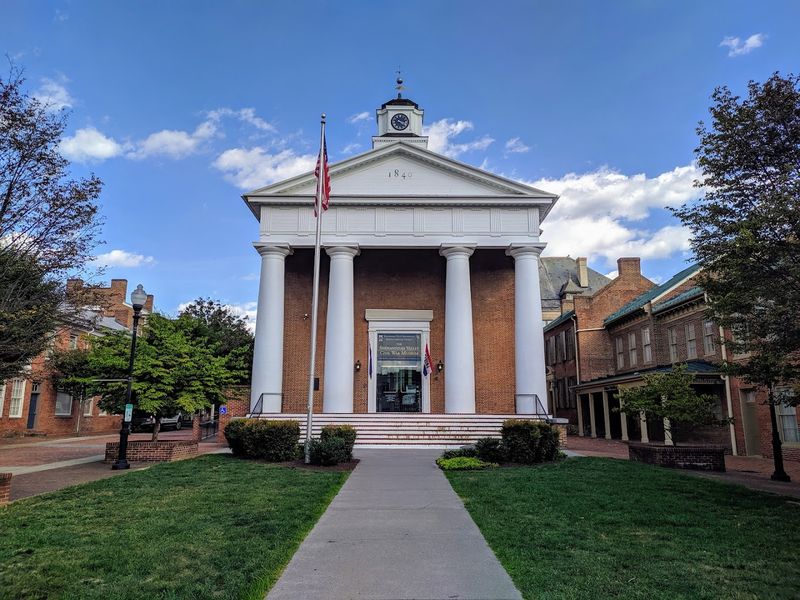
Cross the Blue Ridge and the courthouse architecture changes completely. The Shenandoah County Courthouse in Woodstock, built in 1795 from native limestone, looks and feels nothing like its Tidewater counterparts.
That’s the point. This region was settled heavily by German immigrants, and the building reflects that heritage in its most distinctive feature, a hexagonal baroque cupola that sits atop the roof like something transplanted from a Central European parish church.
It is completely unexpected and absolutely wonderful.
Layers of history have been added carefully over the decades. A Greek Revival wing arrived in 1840, Victorian-style clerk’s offices followed in 1880, and a Tuscan portico was appended in 1929.
Rather than creating a confused jumble, these additions read like a timeline of American architectural taste, each layer respectful of what came before. Inside, the walls carry something even more personal: graffiti left by troops from both sides of the Civil War, scratched directly into the surfaces during their respective occupations of Woodstock.
Today the courthouse serves as a Visitor Information Center, a Historic Courtroom Museum, and the home of the Shenandoah County Historical Society, while still seeing periodic court functions and public gatherings. W
oodstock itself is a charming small town in the heart of the Shenandoah Valley, surrounded by mountain scenery that makes the drive here as rewarding as the destination.
I found the combination of German heritage architecture, Civil War history, and mountain landscape utterly compelling. This courthouse earns its reputation as the oldest in continuous use west of the Blue Ridge.
Address: 103 North Main Street, Woodstock, VA 22664
9. Fairfax County Courthouse, VA
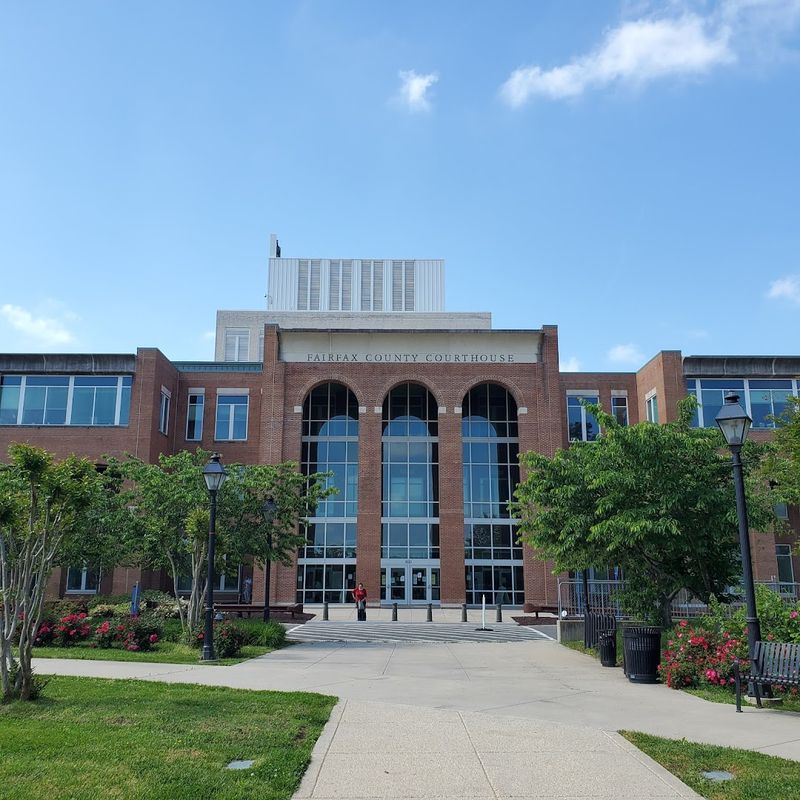
George Washington’s will was filed here. Let that sink in for a moment.
The Fairfax County Courthouse, completed between 1799 and 1800 and attributed to designer James Wren, holds that remarkable distinction among its many historical credentials.
The building brilliantly fuses two architectural traditions, the arcaded colonial courthouse form and the grander temple-front Classical Revival style, into a single composition that feels both deeply rooted and quietly ambitious.
Red brick, original fireplaces, and carefully proportioned windows complete the picture.
Martha Washington’s will also found its way into the records kept here, cementing the building’s connection to the most famous household in early American history.
The Civil War brought further drama: this courthouse was the site of the first Confederate officer casualty of the conflict, and both Union and Confederate forces occupied the building at various points during the war.
Few structures anywhere in America carry that kind of layered significance across so many defining chapters of national history.
The original building now forms part of a larger, modern courthouse complex, and it remains an active component of Fairfax County’s judicial operations. That ongoing function is itself a statement about how much the community values this particular piece of its past.
Fairfax sits in Northern Virginia just outside Washington, D.C., making it one of the most accessible destinations on this list for travelers arriving by car or public transit. A visit here pairs naturally with other historic sites in the region, and the courthouse itself deserves a slow, attentive look rather than a quick photo stop.
Address: 4000 Chain Bridge Road, Fairfax, VA 22030
