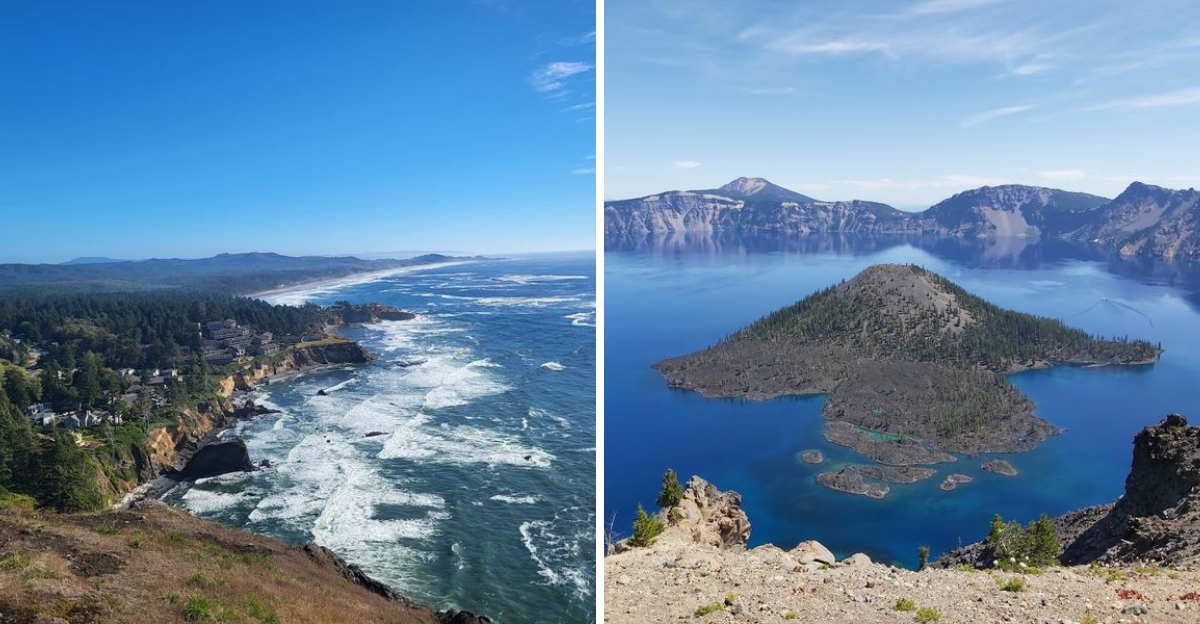
Oregon doesn’t really believe in average viewpoints. I hit the first one and immediately realize every stop on this list feels like it was designed to make you pause mid-sentence.
Cliffs, coastlines, mountains, and wide-open valleys all take turns showing off. Locals treat them like familiar favorites, while I keep arriving and instantly reaching for my camera without even thinking.
Each viewpoint feels like the best seat in the state in its own way. Some hit you with dramatic ocean energy, others with calm, endless space that makes everything feel smaller for a second.
And somehow, no matter how many you visit, the next one still manages to surprise you.
1. Portland Women’s Forum State Scenic Viewpoint, Corbett, Oregon
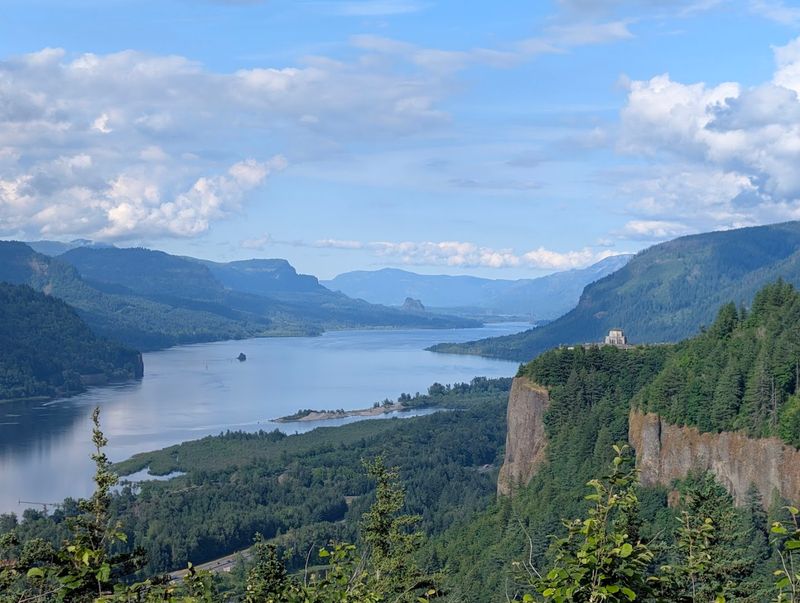
There is a reason photographers keep returning to this spot on the Historic Columbia River Highway in Corbett, Oregon.
The Portland Women’s Forum State Scenic Viewpoint frames the Columbia River Gorge in a way that feels almost too perfect to be real.
From this elevated pullout, you can see the Vista House sitting on the edge of Crown Point. The Columbia River stretches wide and silver in the distance.
The forested cliffs drop steeply below. On clear days, the view extends for miles in both directions.
This is a drive-up viewpoint. You do not need to hike to reach it. You pull into the small parking area and walk just a few steps to the railing.
Morning visits offer softer light and fewer crowds. Fog often rolls through the gorge in early morning. It adds a moody, cinematic quality to the scene.
The viewpoint is named in honor of the Portland Women’s Forum. The group helped preserve this corridor decades ago.
Their efforts kept this stretch of highway and landscape intact. Today everyone can enjoy it.
Keep a camera ready. The framing feels naturally composed, with trees on either side and the Vista House centered in the distance.
It is one of the most photographed spots in the entire state. Once you see it, the reason becomes obvious.
2. Cape Perpetua Lookout, Yachats, Oregon
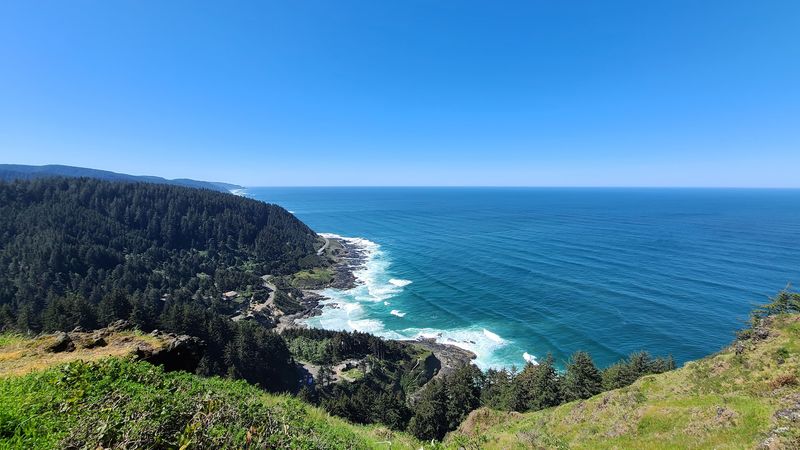
Standing at the highest car-accessible viewpoint on the entire Oregon Coast feels like earning something without doing much work at all.
Cape Perpetua Lookout sits about 800 feet above sea level near the small coastal town of Yachats, Oregon. The views it delivers are extraordinary.
The Pacific Ocean stretches endlessly to the west. The jagged coastline curves north and south in both directions.
On clear days, you can see more than 70 miles of coastline from a single spot. That range is rare anywhere, especially from a paved pullout.
The lookout is part of the Cape Perpetua Scenic Area. The U.S. Forest Service manages it.
A short drive up a winding road leads from Highway 101 to the summit. The road stays narrow but works for most vehicles.
Spring and early summer bring wildflowers along the hillside. They add bursts of color to an already vivid scene.
Whale watching is also popular here during migration seasons. That usually happens in winter and spring.
Bring binoculars if you have them. You can pick out fine detail along the coastline and offshore rocks. The extra effort pays off.
Cape Perpetua changes slightly with every visit. The season, the weather, and the ocean all shape the experience.
3. Jonsrud Viewpoint, Sandy, Oregon
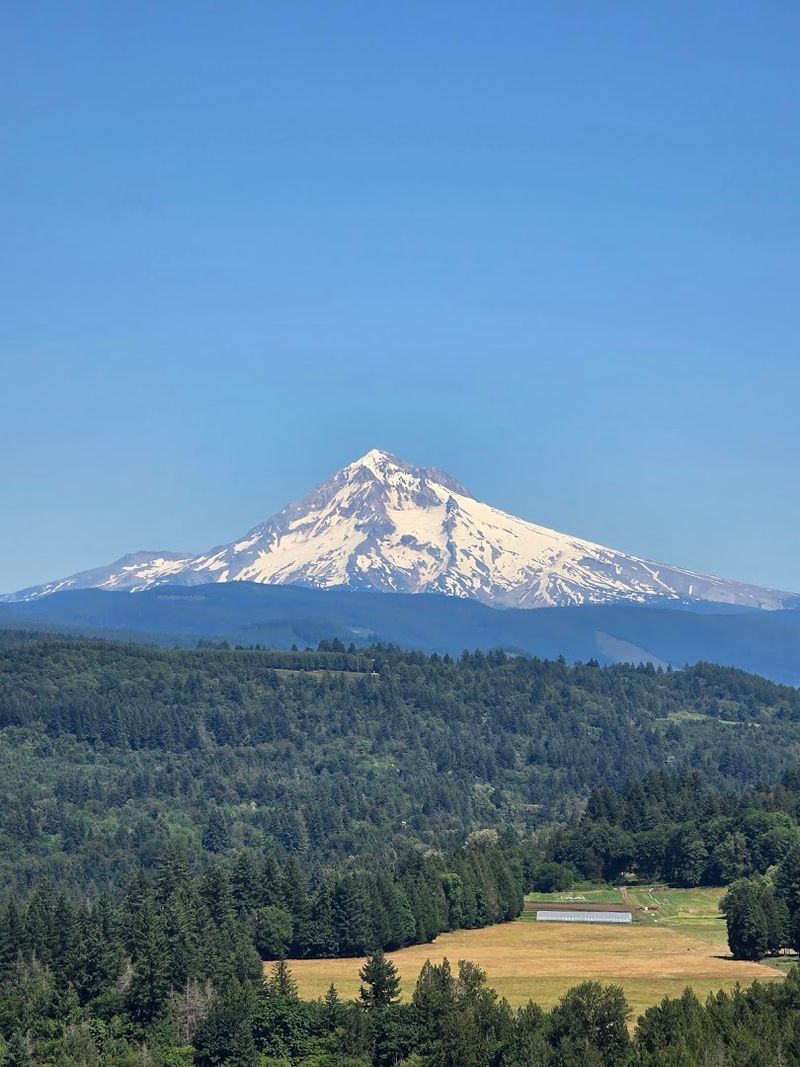
Mount Hood has no shortage of admirers, but few spots show it off quite like Jonsrud Viewpoint in Sandy, Oregon.
This beloved overlook sits at the edge of town and delivers a sweeping look at both Mount Hood and the Sandy River Valley below.
The mountain fills the eastern horizon with its snow-covered peak, while the valley floor spreads out in a patchwork of green fields and forested ridges.
It is the kind of view that makes you understand why people choose to live in the Pacific Northwest.
Jonsrud is considered one of the finest viewpoints in the entire state, and it is remarkably easy to reach.
The parking area is just off Bluff Road in Sandy, and the viewpoint itself is just a short walk from your car.
Telescopes are available on-site, which let you zoom in on the mountain’s glaciers and ridgelines in impressive detail.
Sunrise visits are especially rewarding here. The alpenglow on Mount Hood’s peak turns the snow shades of pink and orange that feel almost surreal.
Fall brings rich golden foliage to the valley floor, creating a completely different but equally beautiful scene.
Local residents often stop here during their daily routines, which tells you something about how special this place really is.
Sandy is a small town with a big view, and Jonsrud is the clearest proof of that.
4. Natural Bridges Viewpoint, Brookings, Oregon
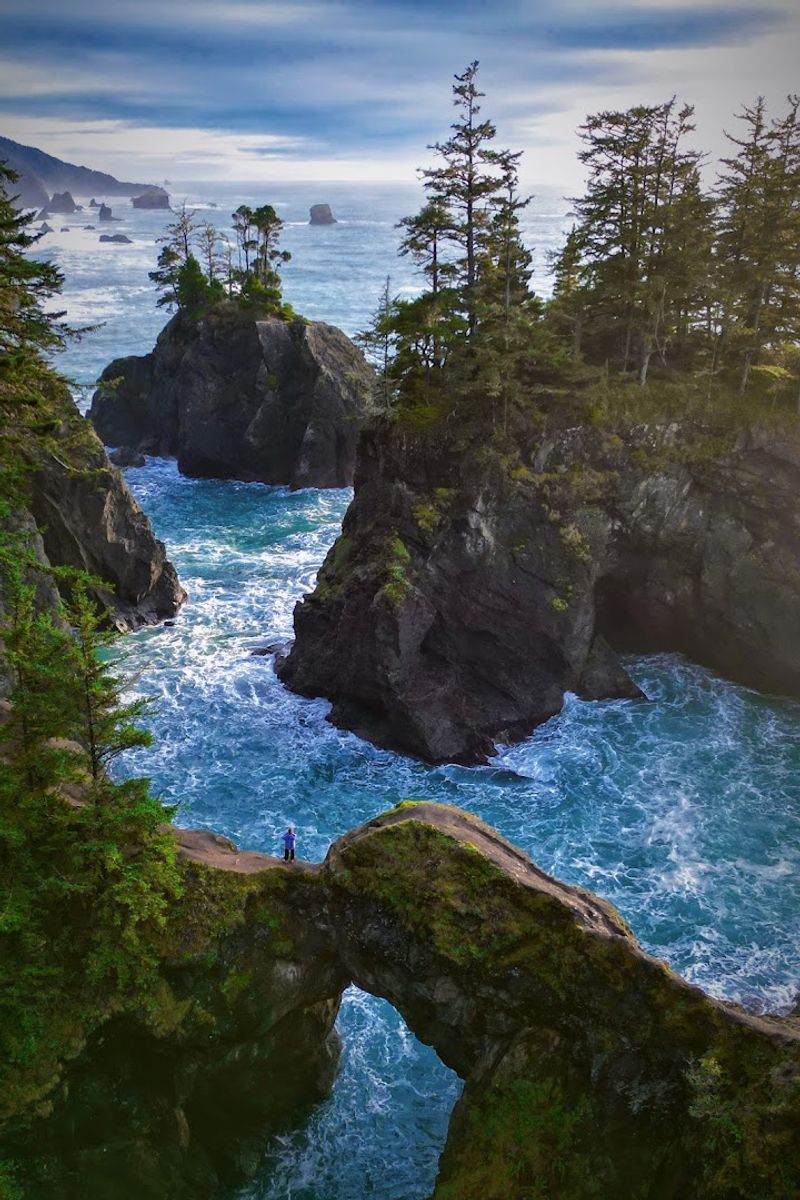
Some views are beautiful. This one is flat-out weird in the best possible way. That is exactly what makes it unforgettable.
Natural Bridges Viewpoint is located near Brookings in southern Oregon. It sits close to Samuel H. Boardman State Scenic Corridor.
Centuries of wave action carved tunnels and arches through the coastal rock. These formations create natural bridges that look like something out of a fantasy novel.
The ocean rushes through these openings with dramatic force. On windy days, it sends spray high into the air.
The viewpoint sits above the action on a forested bluff. It gives you a clear, unobstructed look down at the formations.
Access comes from a short trail at a small parking pullout on Highway 101. The path stays mostly flat. It only takes a few minutes to walk.
High tide amplifies the drama. Water pushes forcefully through the arches below.
Low tide reveals more of the rock structure. It makes it easier to appreciate their scale.
Brookings has some of the warmest temperatures on the Oregon Coast. That makes this one of the more comfortable viewpoints to visit year-round.
Natural engineering, roaring surf, and forested surroundings come together here. The scene rewards every visitor who makes the short detour off the highway.
5. Mount Hebo Summit, Tillamook County, Oregon
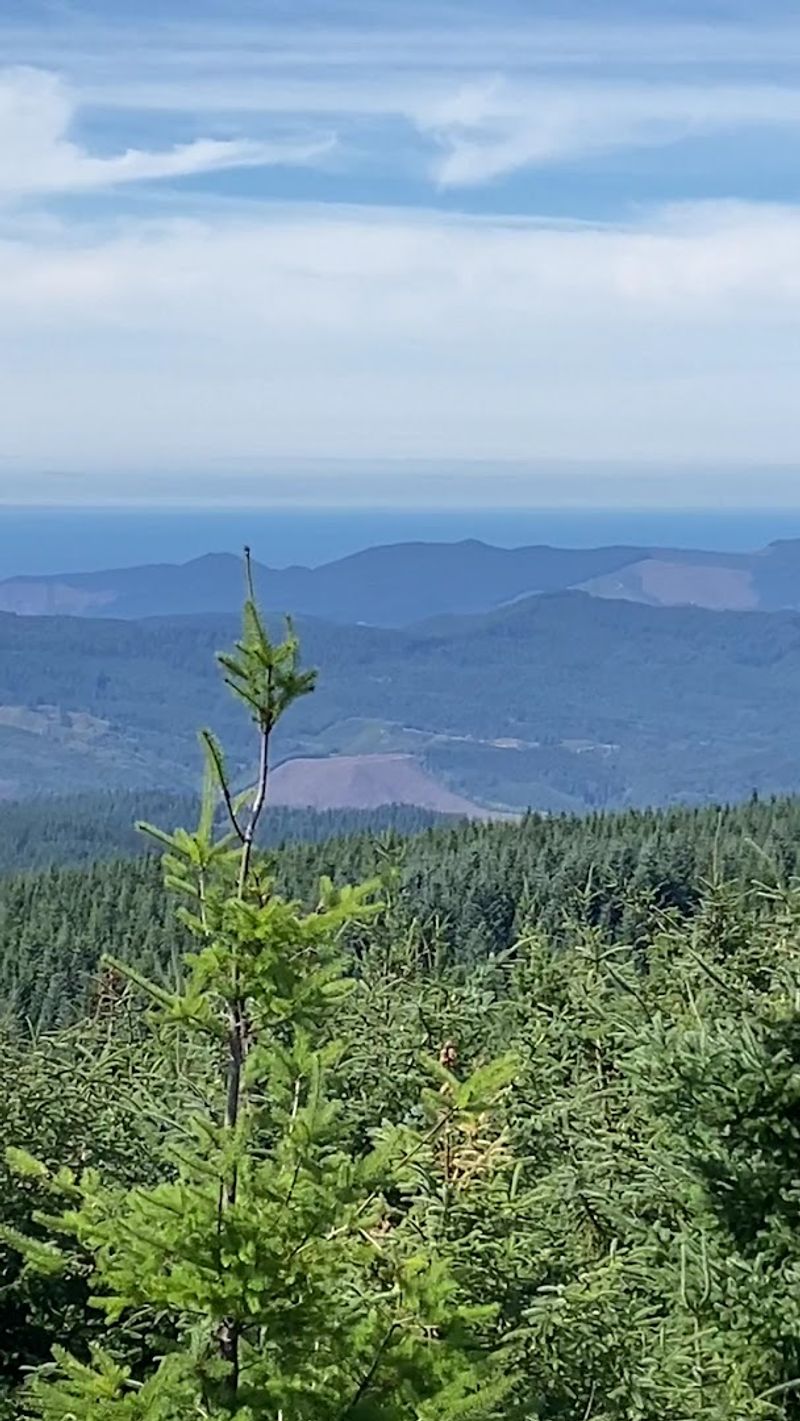
Not many summits in Oregon offer a full 360-degree view without requiring a serious hike, but Mount Hebo pulls it off with style.
Rising about 3,154 feet in the Northern Oregon Coast Range near Tillamook County, Oregon, Mount Hebo rewards those who drive up its forest service road.
The eight-mile road is unpaved in sections. It stays generally passable for most vehicles in dry conditions.
At the top, the view opens in every direction. The Pacific Ocean shimmers to the west on clear days.
Inland, rolling ridges of the Coast Range stretch as far as you can see. Dense green forest breaks up the landscape, with open meadows scattered throughout.
The summit area feels surprisingly open. Grassy clearings make it easy to walk around and take in different angles of the view.
Mount Hebo also carries historical significance. The U.S. Air Force once operated a radar station at the summit during the Cold War era. Remnants of those structures are still visible today.
Wildflowers bloom across the meadows in late spring and early summer. Butterflies move through the open summit and add color and motion to the scene.
Fog often rolls in from the coast. Watching it swirl around the ridges below becomes part of the experience.
This remains a quieter destination than many Oregon viewpoints. That often means you get the entire summit to yourself.
6. Otter Crest State Scenic Viewpoint, Lincoln County, Oregon
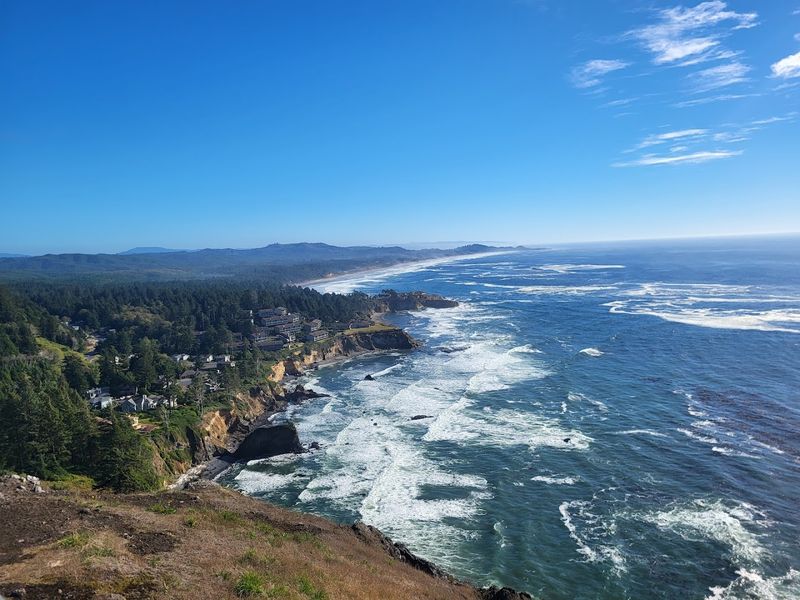
Perched just south of Cape Foulweather along the central Oregon Coast, Otter Crest State Scenic Viewpoint offers one of the most dramatic cliff-top perspectives in the state.
The viewpoint sits in Lincoln County, Oregon, and looks out over a stretch of coastline where tall basalt cliffs plunge sharply into the churning Pacific below.
The scene is raw and powerful, especially on stormy days when waves crash hard against the rocks and spray drifts upward in white curtains.
Cape Foulweather itself was named by British explorer Captain James Cook in 1778, making this one of the historically noted points on the Oregon Coast.
The viewpoint is accessible directly from the Otter Crest Loop, a scenic side road off Highway 101.
Parking is available, and the viewing area is just steps from your car. A short walking path lets you move along the bluff and explore different vantage points.
Sea lions and harbor seals are frequently spotted on the rocks far below, especially during calmer weather.
Birding is also rewarding here, as seabirds nest in the cliff faces and soar on the updrafts created by the coastal winds.
Otter Crest is the kind of stop that turns a regular road trip into something genuinely memorable.
7. Face Rock State Scenic Viewpoint, Bandon, Oregon
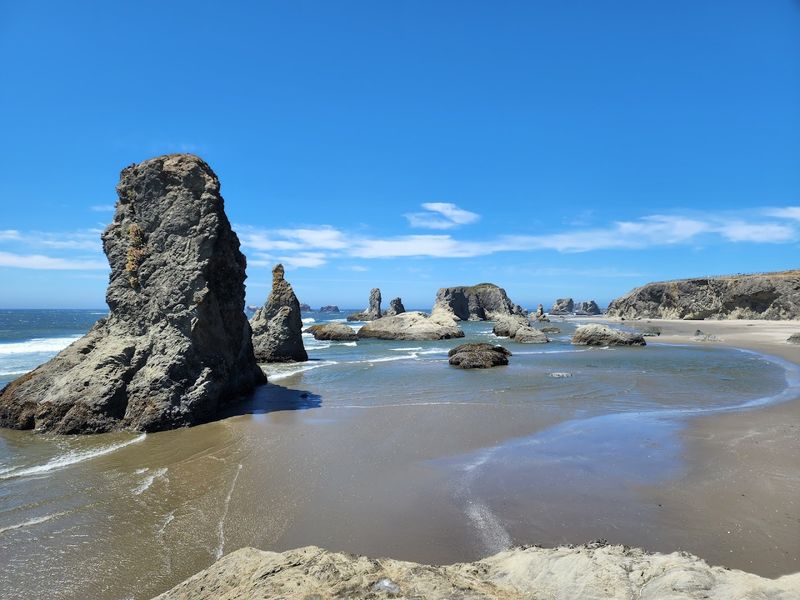
Bandon, Oregon, has a stretch of coastline so packed with sea stacks that it looks like a chess board designed by nature.
Face Rock State Scenic Viewpoint sits right along this stretch, giving visitors a front-row look at some of the most distinctive rock formations on the entire West Coast.
The sea stacks rise dramatically from the surf, some tall and narrow, others broad and layered, each shaped by thousands of years of wave erosion.
The most famous of them, Face Rock, resembles a human face gazing skyward. Local Coquille tribal legend says the face belongs to a princess, frozen in stone by a sea spirit.
That story alone makes the visit feel a little more magical.
The viewpoint is easy to access from Beach Loop Drive in Bandon. A short path leads from the parking area to an open bluff above the beach.
Sunset here is spectacular. The warm light turns the sea stacks into silhouettes against a blazing orange and pink sky.
Bandon itself is a wonderful coastal town with great food and a laid-back atmosphere worth exploring after your visit.
Face Rock is the kind of place you photograph a hundred times and still feel like you missed something.
8. Neahkahnie Viewpoint, Oswald West State Park, Oregon
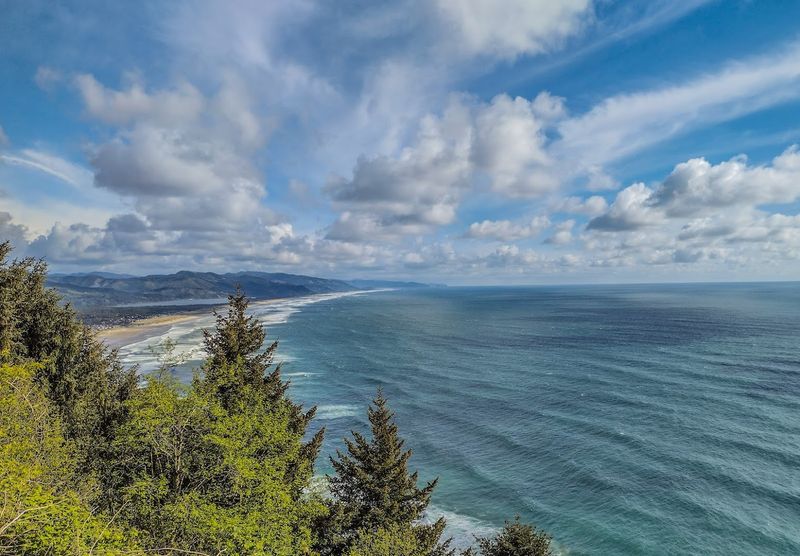
If Oregon’s coast had a crown jewel of viewpoints, Neahkahnie Mountain inside Oswald West State Park would be a strong contender for the title.
Located along the northern Oregon coast, this viewpoint rewards those who make the climb with a perspective that feels truly earned.
The trail to the summit gains about 900 feet in elevation over roughly two miles, winding through old-growth Sitka spruce and western hemlock before breaking out onto open rocky slopes.
At the top, the Pacific stretches wide to the west, and the coastline curves dramatically both north and south.
Neahkahnie Bay sits below in a perfect arc of sand, framed by forested headlands on either side.
On clear days, you can see Tillamook Rock Lighthouse far offshore, a solitary structure rising from the ocean.
Neahkahnie Mountain carries its own layer of legend. Spanish shipwreck stories from the 1700s suggest that buried treasure may rest somewhere on its slopes, a rumor that has never been fully disproven.
The forest surrounding the trail is stunning in its own right. Massive trees draped in moss create a green tunnel that feels ancient and quiet.
9. Sahalie Falls Viewpoint, Willamette National Forest, Oregon
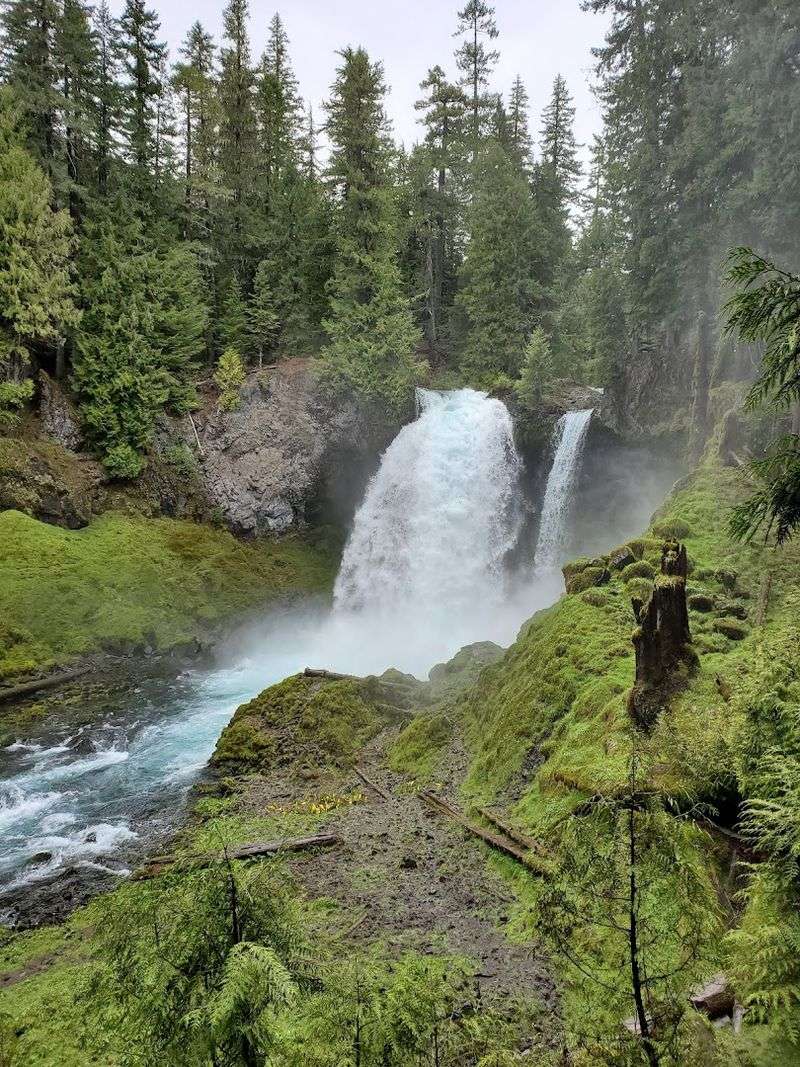
The color of the water at Sahalie Falls is the first thing that catches you off guard. It is an almost electric shade of blue-green that does not look entirely natural.
Sahalie Falls is located in the Willamette National Forest along the McKenzie River, in the central Cascades of Oregon.
The falls drop about 100 feet over a ledge of ancient basalt lava, sending a powerful rush of water into the canyon below.
The roar is impressive, and the mist that rises from the base drifts across the viewing area and cools everything around it on warm days. Access is straightforward.
A short, paved trail leads from the parking area directly to the main viewpoint, making this one of the most accessible waterfall views in Oregon.
The trail continues along the McKenzie River to Koosah Falls, just a short walk downstream, giving you two spectacular waterfalls in one easy outing.
The surrounding old-growth forest is thick with Douglas fir, western red cedar, and carpets of bright green moss that cover every rock and fallen log.
The water here originates from underground springs fed by snowmelt filtered through layers of volcanic rock, which explains the remarkable clarity and color. Sahalie is one of those places that makes you stop talking mid-sentence just to listen.
10. Crater Lake National Park, Klamath County, Oregon
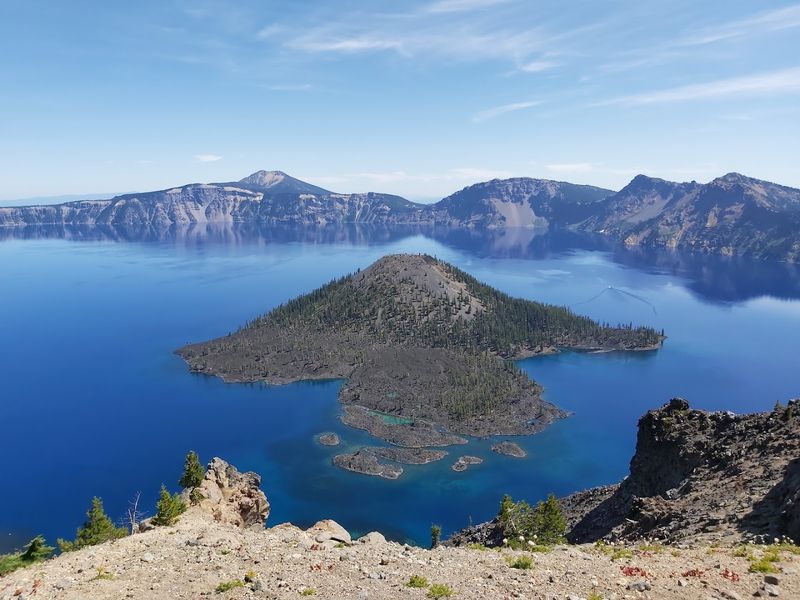
About 7,700 years ago, a massive volcanic eruption caused Mount Mazama to collapse inward, and what was left eventually filled with water to create Crater Lake.
The result is the deepest lake in the United States, reaching down about 1,943 feet, and one of the most visually striking natural features anywhere on Earth.
Crater Lake sits in Klamath County, Oregon, entirely within Crater Lake National Park, and the views from the rim are the kind that make you stand quietly for a long time.
The water is famously blue. Because the lake has no rivers flowing in or out, the water is extraordinarily pure, and that purity creates a blue so deep and rich it looks almost unreal.
Rim Drive circles the entire lake and offers dozens of pullouts and named viewpoints, each providing a slightly different angle on the same incredible scene.
Watchman Overlook and Rim Village are two of the most popular spots, but even a random pullout along the drive delivers something worth stopping for.
Wizard Island rises from the center of the lake, a small volcanic cinder cone that adds a dramatic focal point to the view.
Crater Lake is not just a viewpoint. It is a full-on argument that Oregon is one of the most beautiful states in the country.
Dear Reader: This page may contain affiliate links which may earn a commission if you click through and make a purchase. Our independent journalism is not influenced by any advertiser or commercial initiative unless it is clearly marked as sponsored content. As travel products change, please be sure to reconfirm all details and stay up to date with current events to ensure a safe and successful trip.
