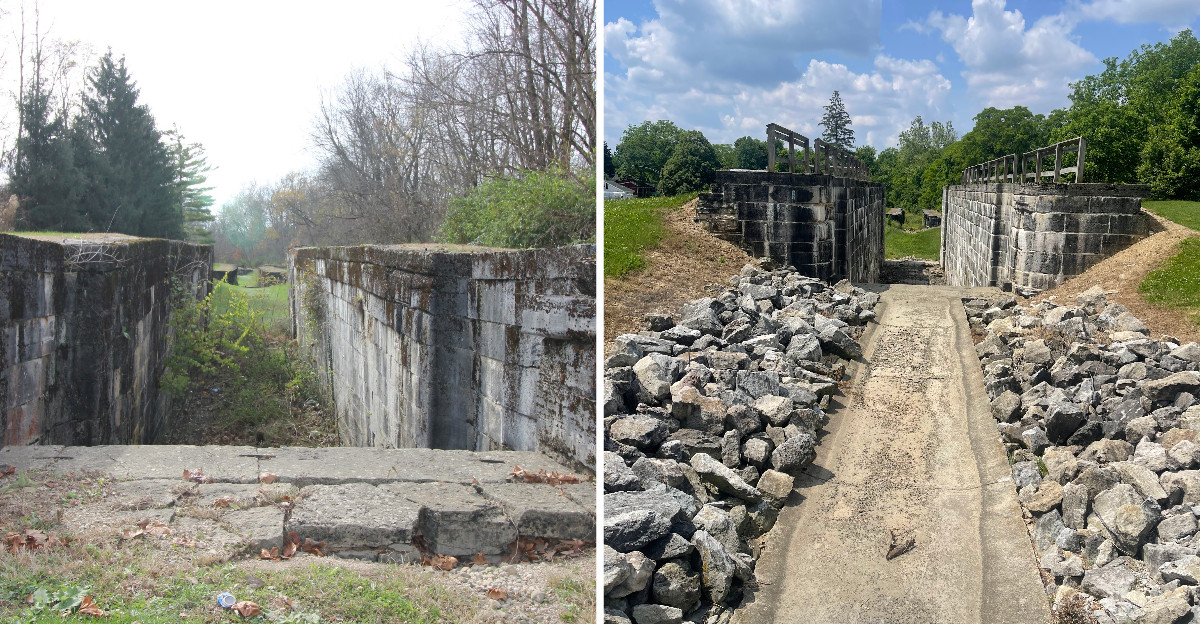
Limestone chambers march up a grassy hillside on a quiet Ohio country road, and the scale catches you off guard before you even park. What looks like a historical marker and a bench turns out to be something far more impressive.
These locks were part of an old canal system that once lifted loaded boats an astonishing 67 feet toward the highest stretch of water between two major cities.
Construction started in 1833, boats began moving through in 1845, and for decades this spot was one of the busiest bottlenecks in western Ohio.
Walk the mowed edge today and there is no water, no mules, no shouting boatmen. Stacked stone holds its shape after nearly two centuries, rising in steps that once carried freight and passengers.
Ohio history sits right out in the open here, free to visit, waiting for anyone curious enough to stop.
A Staircase of Stone Built for Boats
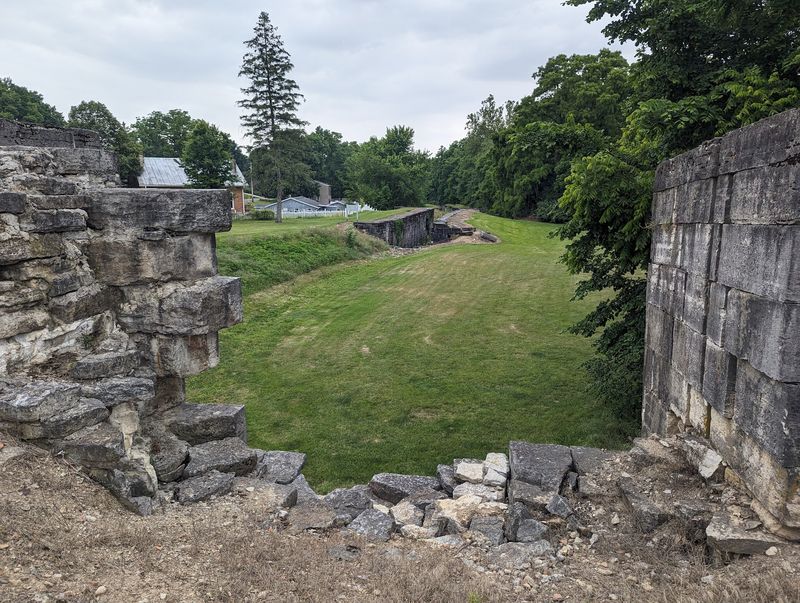
The first thing that surprised me was how tall the walls are. Standing beside one chamber, the limestone rises well above head height, and the whole flight stretches roughly a quarter mile up the slope.
Six locks were grouped close together here, with a seventh placed at the southern end of the system. Together they raised and lowered boats about 67 feet, which is roughly the height of a six-story building.
Canal engineers called setups like this a flight, though visitors over the years have described it more simply as a giant water elevator. A boat would float into one chamber, the gates would close, water would fill or drain, and the vessel would rise or drop to the next level.
Repeat that process six times and a boat had climbed the hill.
What makes the effect so strong today is the absence of water. You see the bare bones of the machine, the stone throat of each chamber, the recesses where gates once swung.
I found myself pacing the length of one lock just to get a sense of how narrow the old boats had to be. It is a genuinely humbling piece of nineteenth century problem solving.
Limestone Blocks Stacked Without Machines
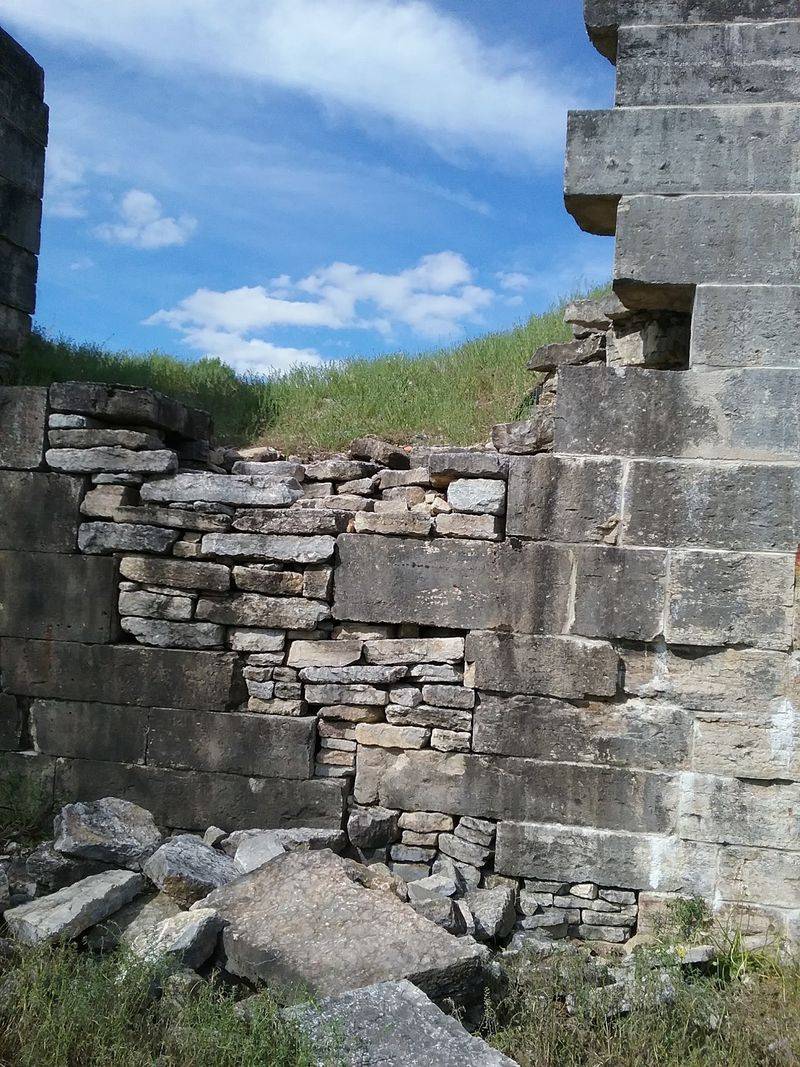
Run your hand along one of these walls and the craftsmanship becomes obvious. The blocks are enormous, some weighing around 500 pounds, cut and fitted so tightly that many joints still hold their line.
No cranes. No hydraulic lifts.
Workers moved that stone with animal power, timber, rope, and a lot of sweat.
Wooden floors and gates made of white oak filled out the design, and those pieces are long gone, which is exactly what you would expect after all this time. Wood rots, stone endures.
A visitor I passed mentioned how strange it feels to look at something built entirely by hand, and I agreed. The scale of the labor is the real story here.
Moss has crept into the seams, and small ferns push out of gaps in a few spots. Rather than making the walls look neglected, it gives them the texture of a ruin that has settled comfortably into its landscape.
Photographers will love the details, especially in early morning light when the tool marks on the stone throw shadows. Bring a lens you like for texture work, because the close-ups here are better than the wide shots.
Lock 1 and Its Careful 2014 Rebuild
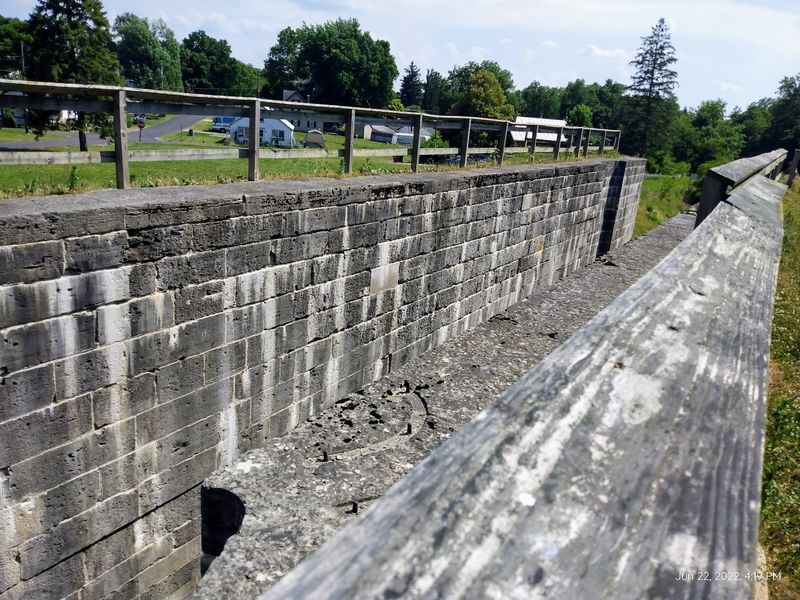
One lock looks noticeably newer than the rest, and there is a good reason for that. Lock 1 was restored in 2014 using a Transportation Enhancement grant, and the work involved taking the structure apart and rebuilding it on a fresh foundation.
Crews reused as much of the original material as they could, which is why it still reads as historic rather than replica.
Seeing it next to the weathered chambers further up the hill creates a useful comparison. On one side you get sharp edges and level courses, close to how the flight would have appeared to a boatman in the 1840s.
On the other, you get the softened, leaning reality of stone left to the weather for generations.
I actually preferred the untouched locks for atmosphere, but the restored one taught me more. It clarified what I was looking at everywhere else.
The rest of the locks are maintained in their original visible condition rather than rebuilt, so the site reads as a preservation project instead of a reconstruction. Start at Lock 1, get your bearings, then work uphill and let your eyes adjust to the older stonework.
Locksport, the Village That Grew Around the Wait
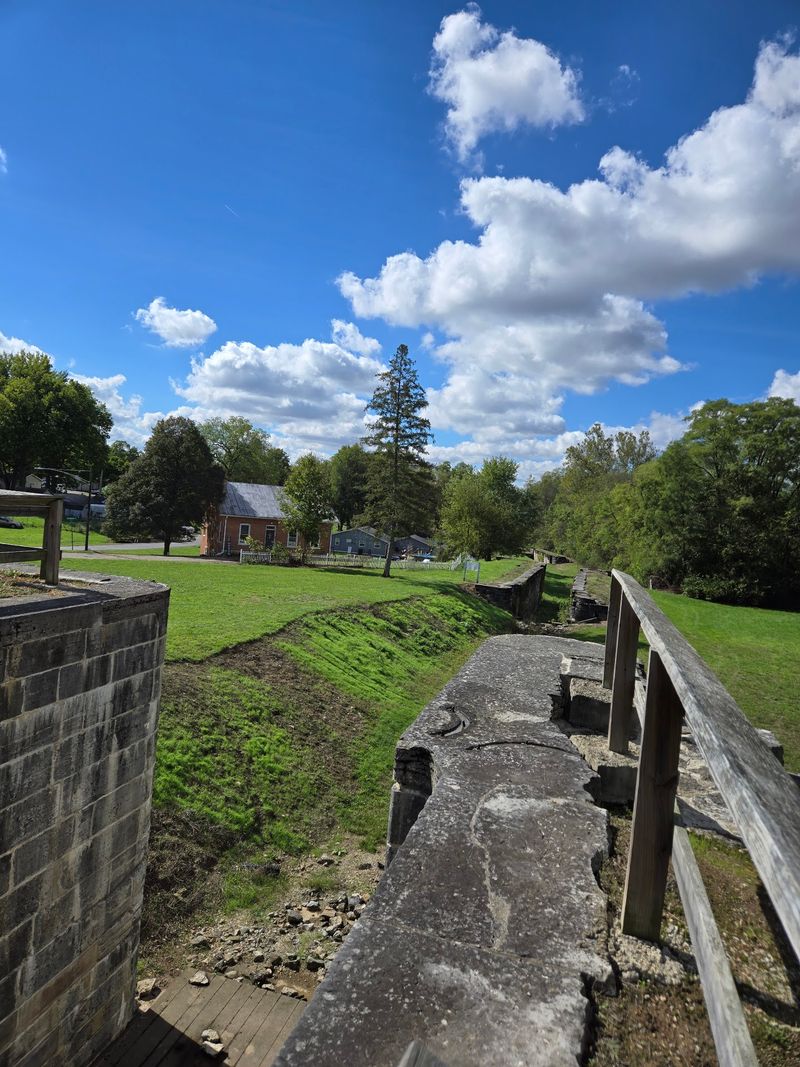
Here is a detail I keep repeating to people. The village was originally called Locksport, and it existed largely because boats got stuck waiting their turn through the flight.
Six locks take time. Crews and passengers had hours to fill, and businesses appeared to serve them.
During the canal years, the settlement held what was described as Ohio’s largest grain storage complex, which tells you how much freight moved through this narrow corridor of water. Farmers brought grain to the canal because the canal was the fastest road to market.
Walking the surrounding streets now, Lockington is small and quiet, the kind of place where a passing car is an event. The contrast with its busy past is part of the appeal.
The old lockmaster’s house still stands near the locks, and it is a private residence today, so admire it from the public path and leave the occupants their peace.
I spent a while just imagining the noise of it all, teams of mules, creaking gates, grain wagons on dirt streets. Few places in Ohio let you stand inside a vanished economy this easily.
The Dry Dock Basin and Other Hidden Clues
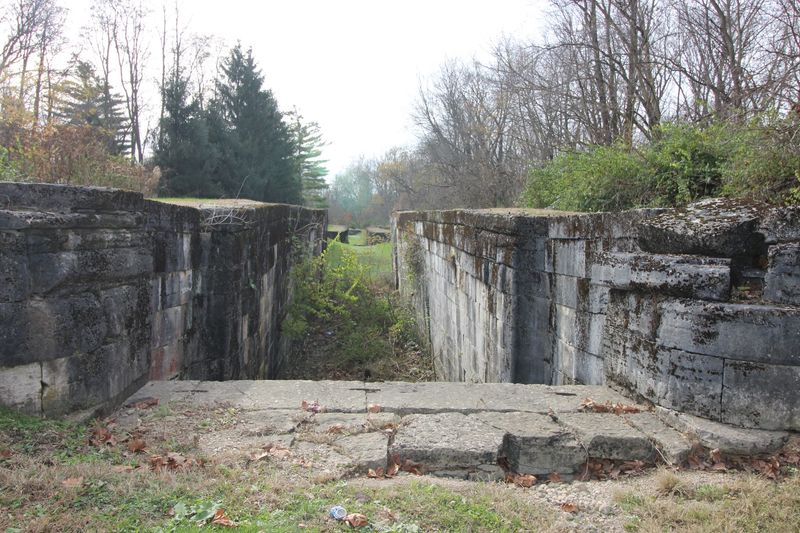
Not everything here announces itself. Beyond the obvious stone chambers, there is a dry dock basin where canal boats were pulled out for repairs, and if nobody tells you about it, you might walk right past the depression in the ground.
Once you know, the whole site starts reading differently.
Look for the towpath line where mules once walked, the subtle grading that marks the old canal prism, and the places where the channel heads toward the Great Miami River. Visitors have mentioned spotting where an old bridge stood before the flood took it out.
Honestly, a bit of reading before you arrive pays off enormously, because interpretive signage on site is limited. I would suggest looking up a historic map of the Miami and Erie Canal on your phone before you get out of the car.
Vegetation can be tall in midsummer, which hides some of these softer features. Late fall and early spring give much better sightlines.
Treat it like a gentle scavenger hunt rather than a museum visit, and the place rewards you far more than a quick photo stop ever could.
Railroads, the 1913 Flood, and a Quiet Ending
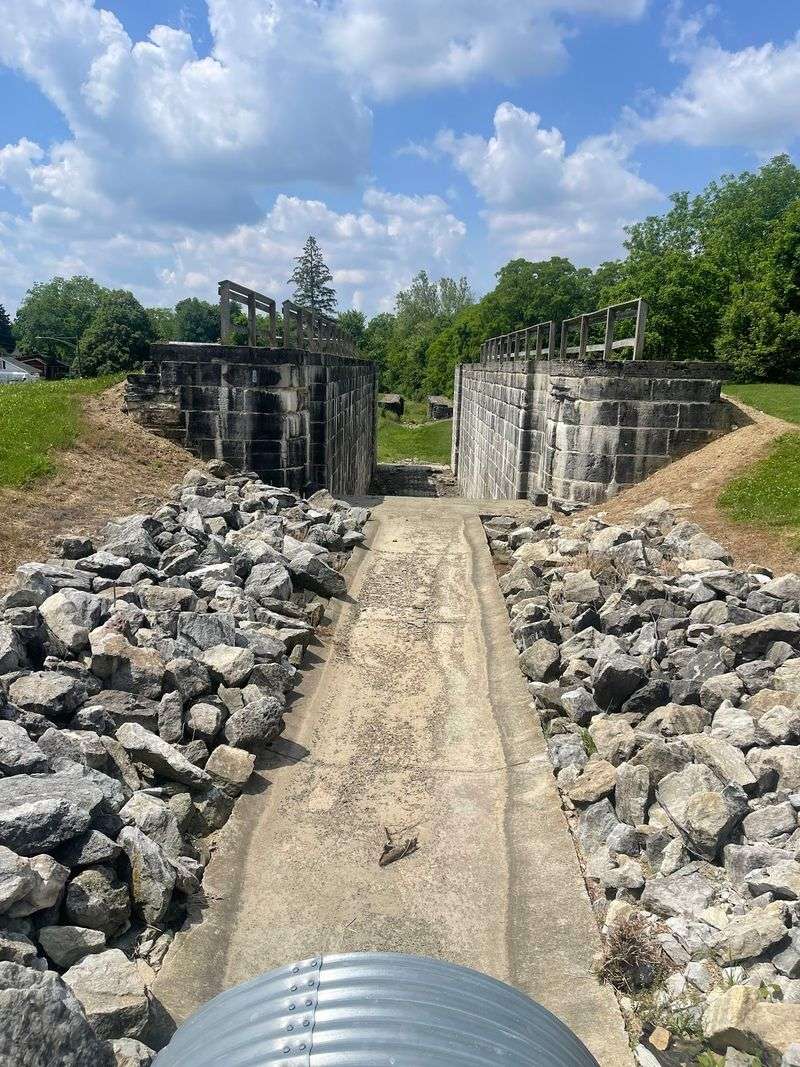
Canals were king for a few decades, then something faster arrived. Railroads could run in winter, climb grades without water, and move freight in a fraction of the time, so traffic drifted away from the canal steadily through the later 1800s.
The final blow came with the devastating flood of 1913, which tore apart long sections of the canal system and ended its commercial use for good.
Around Lockington, much of the channel was later filled in, and the locks were left standing as the most durable survivors. Locals have long pointed out nearby houses that show old high water lines from that flood.
Flood control shaped this area afterward as well. Lockington Dam sits only a few minutes away, one of the earthen dams built to protect Dayton from another disaster like 1913.
I drove past it after my walk, and the pairing makes sense. One structure represents Ohio trying to use water, the other represents Ohio trying to control it.
Standing between the two, the region’s whole relationship with its rivers snaps into focus in a way no textbook managed for me.
Planning a Visit That Actually Works
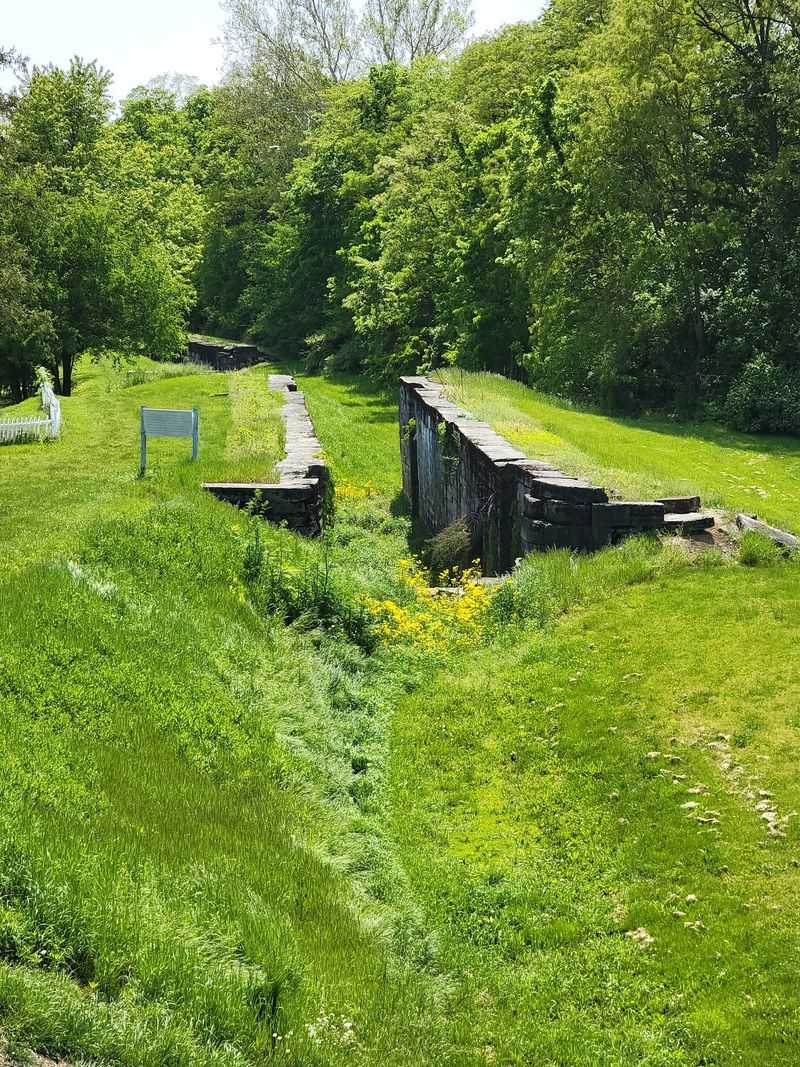
A few practical things will make your trip smoother. Admission is free, the site is open during daylight hours, and there is a gravel lot nearby that serves as the logical place to park.
Wear real shoes. The route along the flight is mowed grass and uneven ground rather than a paved trail.
Grass grows tall in high summer, so spring and fall visits show the stonework far more clearly. Give yourself around 45 minutes to walk the locks at an easy pace, longer if you like lingering over details.
Dogs are welcome on short leashes, and the rules here are straightforward. No littering, no metal detectors, no drones, no motor vehicles on the site, and no overnight parking.
Stay back from the lock edges, especially with children, because the drops are real and the stone can be slick after rain. The towpath may become a formal hiking trail someday, which would open the place up even further.
Listed on the National Register of Historic Places in 1969 and managed by the Ohio History Connection, it earns a slow visit.
Address: Museum Trail and Cross Trail, Lockington, Ohio
