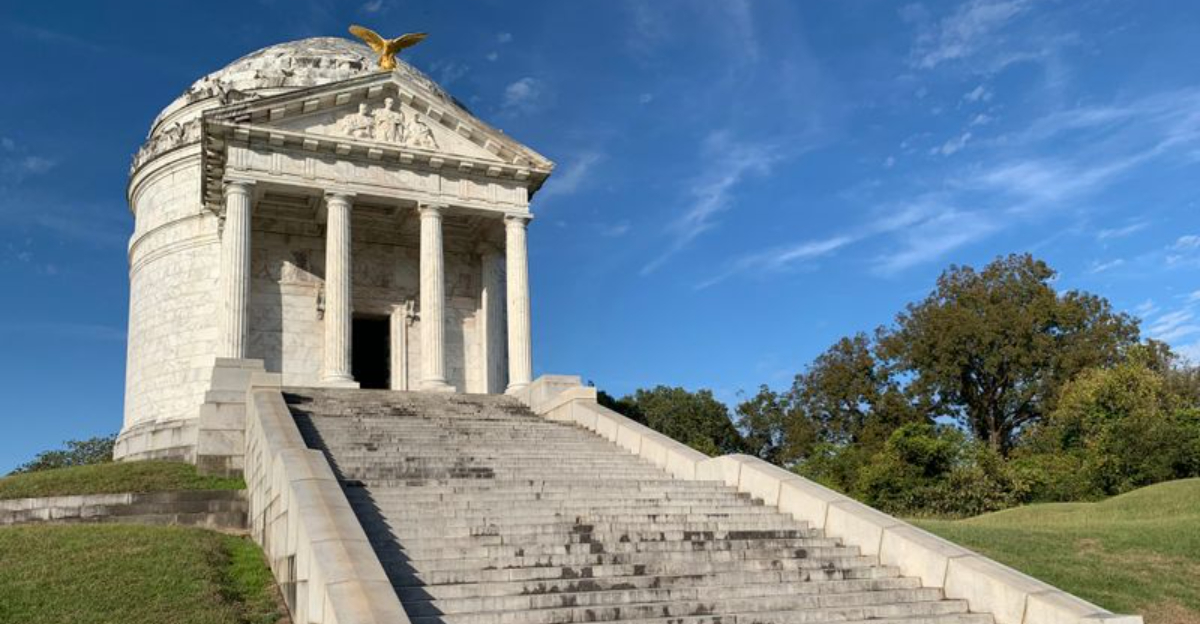
Mississippi holds secrets that most people never expect to find tucked away in the Deep South.
From grand antebellum mansions to mysterious swamps shrouded in Spanish moss, the state offers landscapes straight out of Hollywood’s wildest imagination.
Filmmakers have long recognized what locals already know; this place has a cinematic quality that captures hearts and camera lenses alike.
Whether you’re a movie buff, a photography enthusiast, or simply someone who appreciates breathtaking scenery, Mississippi delivers visual drama at every turn.
The state’s diverse terrain ranges from rolling hills to mighty river valleys, each location more photogenic than the last.
Ancient oak trees form natural cathedral ceilings while forgotten plantation roads wind through settings that transport you to another era entirely.
Small towns preserve architectural gems that look frozen in time, their Main Streets resembling movie sets waiting for directors to call action.
Coastal areas blend Southern charm with Gulf Coast magic, creating backdrops worthy of romantic comedies or thrilling adventures.
Mississippi doesn’t just look like it belongs in movies; it actually has starred in many, though its beauty often goes unrecognized beyond state lines.
Get ready to discover seven extraordinary locations that prove this underrated state deserves its close-up.
1. Windsor Ruins

Standing like ghostly sentinels in a Mississippi field, these towering columns tell a story that Hollywood couldn’t script better.
The Windsor Ruins represent all that remains of what was once the largest antebellum mansion in the state, a Greek Revival masterpiece that survived the Civil War only to burn down in 1890.
Twenty-three magnificent Corinthian columns still reach toward the sky, creating an otherworldly atmosphere that photographers and filmmakers find irresistible.
Located near Port Gibson off Highway 552, these ruins have appeared in numerous films and photo shoots because they possess an undeniable dramatic quality.
The columns stand approximately 45 feet tall, casting long shadows across the surrounding landscape that change character throughout the day.
Spanish moss drapes from nearby oak trees, adding to the haunting beauty that makes visitors feel transported to another century entirely.
What makes Windsor Ruins particularly cinematic is how nature has reclaimed the space around these architectural survivors.
Wildflowers grow between the columns during spring, while morning fog creates an ethereal effect that looks straight out of a period drama.
The site offers different moods depending on when you visit; golden hour bathes everything in warm amber light, while overcast days emphasize the melancholic beauty of what was lost.
History buffs appreciate knowing that Union troops used the mansion as an observation post during the Civil War, recognizing its strategic hilltop position.
Today, visitors can walk freely among the columns, touching history while imagining the grand balls and Southern society gatherings these walls once contained.
The Mississippi Department of Archives and History maintains the site, ensuring these remarkable ruins continue inspiring awe for generations to come.
Whether you’re seeking the perfect Instagram backdrop or simply want to experience Mississippi’s most photogenic historical site, Windsor Ruins delivers unforgettable visual drama.
2. Natchez Trace Parkway
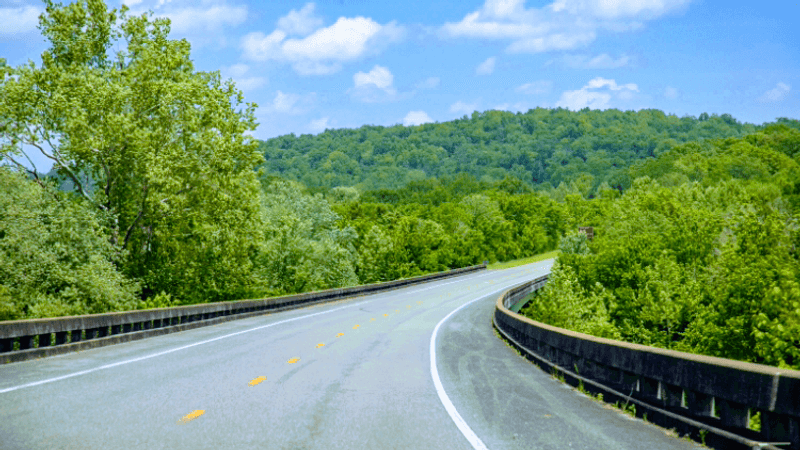
Imagine a road trip where every mile looks like it was designed by a location scout for a romantic adventure film.
The Natchez Trace Parkway delivers exactly that experience, stretching 444 miles through three states with some of its most spectacular sections winding through Mississippi.
This National Parkway follows an ancient path once traveled by Native Americans, frontiersmen, and traders, creating a living corridor through Southern history.
The Mississippi portion offers countless pullouts and scenic overlooks that reveal landscapes worthy of any big-screen production.
Cypress swamps emerge suddenly along certain stretches, their mirror-like waters reflecting towering trees that create natural special effects.
During autumn, hardwood forests explode in colors so vibrant they seem enhanced by Hollywood filters, though nature deserves all the credit.
What sets this parkway apart from ordinary highways is its deliberate design to showcase natural beauty without commercial intrusion.
No billboards, gas stations, or strip malls interrupt the visual flow; just pure, unfiltered Mississippi landscapes that change with each passing season.
Spring brings dogwood and redbud blooms that transform the roadside into a pastel wonderland, while summer’s lush greenery creates tunnel-like canopies overhead.
Several spots along the trace have become favorites for photographers and filmmakers seeking authentic Southern settings.
The sunken sections of the original trace, worn deep into the earth by countless footsteps and wagon wheels, offer particularly compelling visuals.
These ancient pathways, preserved alongside the modern parkway, remind travelers that this route has been cinematically beautiful for centuries.
Whether you’re driving the entire length or exploring a single section, the Natchez Trace Parkway provides endless opportunities for discovery.
Pack a picnic, bring your camera, and prepare for a journey where every curve reveals another reason Mississippi deserves more recognition for its natural splendor.
3. Longwood Mansion
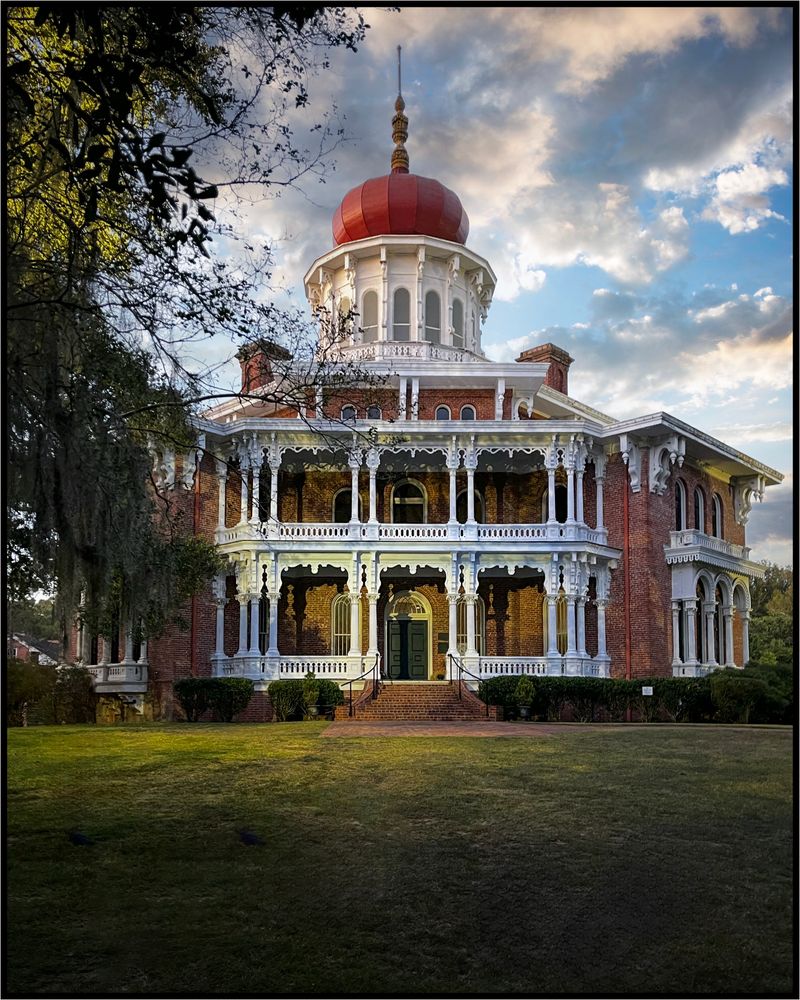
Few buildings anywhere capture the imagination quite like Longwood, an architectural marvel that looks like it belongs in a Tim Burton film or Gothic mystery.
This six-story octagonal mansion in Natchez represents one of America’s most unusual antebellum homes, featuring an exotic oriental-revival design that stands apart from typical Southern architecture.
The home’s most striking feature is its massive Byzantine-style dome, which crowns the structure like something transported from a completely different continent and era.
Construction began in 1860 for wealthy cotton planter Haller Nutt, who envisioned a winter residence unlike anything the South had ever seen.
Philadelphia architect Samuel Sloan designed this extraordinary building, incorporating features inspired by Middle Eastern palaces and Italian villas.
Then the Civil War interrupted everything, and Northern craftsmen who were building the mansion abandoned their tools and returned home, leaving the project forever frozen in time.
Today, visitors touring Longwood experience something truly unique; a finished basement level where the Nutt family lived, and five upper floors that remain exactly as workers left them in 1861.
Scaffolds, tools, and building materials still sit where craftsmen set them down over 160 years ago, creating an eerie time capsule that filmmakers would struggle to recreate.
The contrast between the elegant, furnished basement and the raw, unfinished upper levels creates visual tension that feels deliberately staged for maximum dramatic effect.
Located at 140 Lower Woodville Road in Natchez, Longwood operates as a house museum offering guided tours that reveal the fascinating story behind its incomplete state.
The surrounding gardens, designed to complement the exotic architecture, add another layer of cinematic beauty to the property.
Magnolia trees and carefully planned landscaping frame the mansion perfectly, making every angle photograph-worthy and every view memorable enough to haunt your imagination long after leaving.
4. Vicksburg National Military Park
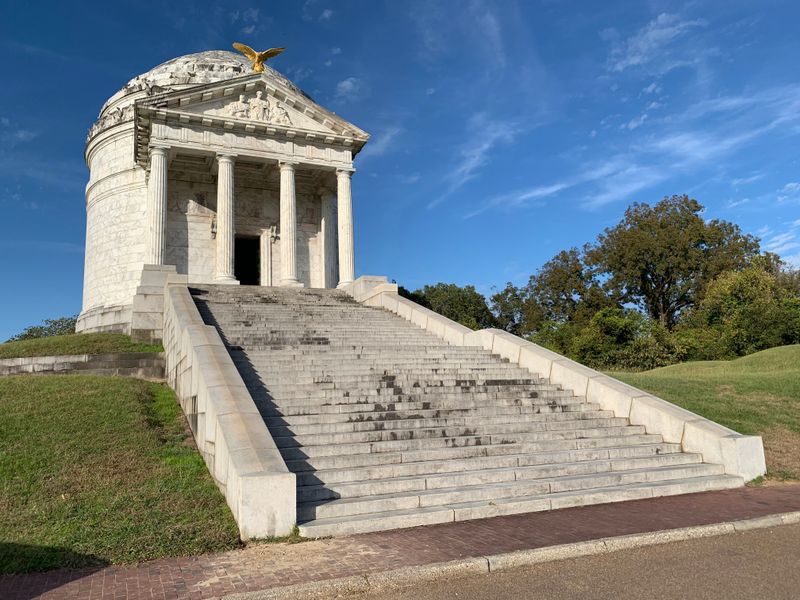
Wars have provided endless material for filmmakers, and Vicksburg National Military Park preserves one of the Civil War’s most significant battlefields with cinematic grandeur.
Spread across 1,800 acres, this hallowed ground tells the story of the 47-day siege that ultimately gave Union forces control of the Mississippi River.
More than 1,300 monuments and markers dot the landscape, creating a visual timeline that guides visitors through one of history’s most pivotal military campaigns.
The park’s rolling hills and strategic overlooks reveal why both armies fought so desperately for control of this particular location.
From certain vantage points, you can see for miles across the Mississippi River valley, understanding immediately the tactical importance this high ground represented.
Massive earthwork fortifications still scar the landscape, their shapes preserved to show exactly where soldiers dug in and fought with desperate determination.
What makes Vicksburg particularly striking is how nature has softened the battlefield without erasing its essential character.
Oak trees that witnessed the conflict still stand, their branches spreading over ground where soldiers from both sides fell.
The contrast between the park’s current peaceful beauty and the violence it once witnessed creates a poignant atmosphere that resonates deeply with thoughtful visitors.
The USS Cairo Museum, located within the park grounds, displays a restored Union ironclad gunboat that sank during the campaign and was recovered a century later.
Seeing this massive vessel, its machinery and artifacts preserved, adds another dimension to understanding the siege’s complexity.
The park’s 16-mile tour road winds past state memorials, each designed by different architects, creating an outdoor sculpture gallery unlike anything else in America.
Located at 3201 Clay Street in Vicksburg, the park offers both driving and walking tours that accommodate different levels of interest and physical ability.
Whether you’re a history enthusiast or simply appreciate landscapes with profound stories to tell, Vicksburg delivers powerful visual experiences.
5. Cat Island

Some places feel like they exist outside normal time and space, and Cat Island certainly qualifies as one of Mississippi’s most enchanting escape destinations.
This barrier island lies about 10 miles off the Mississippi Gulf Coast, accessible only by boat, which immediately gives it an adventurous quality that landlocked locations can never match.
The island’s isolation has preserved natural features and ecosystems that disappeared long ago from more accessible coastal areas.
What strikes visitors first is how wild and untamed Cat Island remains compared to developed beach destinations.
Martime forests of twisted oak trees create shadowy pathways that feel lifted from adventure novels, their branches sculpted by constant Gulf winds into fantastical shapes.
The island’s interior holds freshwater ponds and marshes where wildlife thrives undisturbed, offering glimpses of nature that feel increasingly rare in our developed world.
Cat Island’s beaches present a different character than typical Gulf Coast strands—more remote, more pristine, and definitely more photogenic for anyone seeking authentic coastal beauty.
Shells accumulate in abundance along certain stretches, and the absence of crowds means you might walk for hours without encountering another soul.
This solitude creates opportunities for reflection and photography that busy public beaches simply cannot provide, no matter how beautiful their settings.
The island holds particular significance for wildlife enthusiasts, as it serves as important habitat for numerous bird species and sea turtles.
Watching sunrise from Cat Island’s eastern shore, with nothing but water between you and the horizon, delivers a spiritual experience that transcends mere sightseeing.
Sunsets from the western beaches are equally spectacular, painting the sky in colors that seem almost too vivid to be real.
Getting to Cat Island requires planning; you’ll need a boat or charter service from Gulfport or Biloxi—but the effort rewards visitors with experiences impossible to find elsewhere.
Bring supplies, respect the fragile ecosystem, and prepare for an adventure that feels remarkably like stepping into a castaway film.
6. Rowan Oak
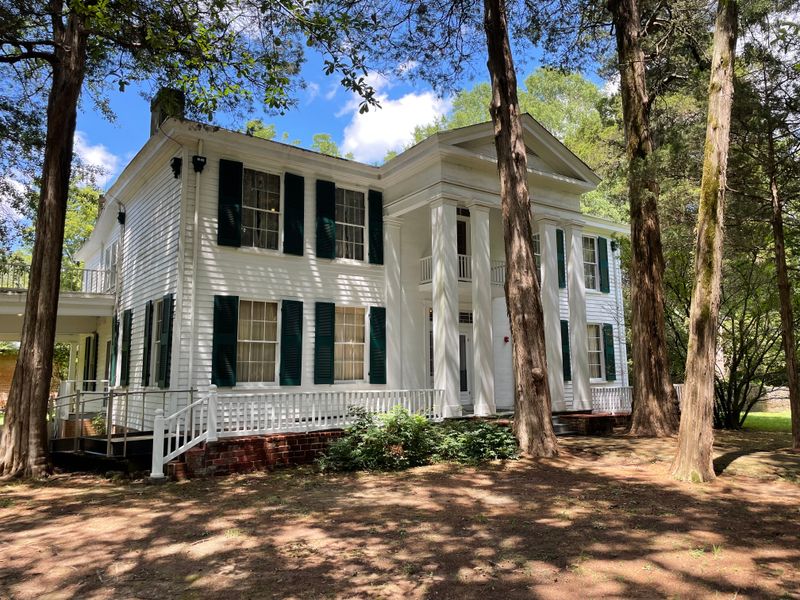
Literary pilgrims and architecture enthusiasts alike find something magical about Rowan Oak, the Oxford home where William Faulkner created some of America’s greatest novels.
This graceful Greek Revival house, built in the 1840s, sits on 29 acres that feel worlds away from the nearby University of Mississippi campus bustle.
Faulkner purchased the property in 1930 when it was badly deteriorated, then spent years restoring and modifying it to suit his family’s needs and his creative process.
Walking through Rowan Oak feels like entering a perfectly preserved period film set, except everything here is authentically real and historically significant.
The writer’s study remains exactly as he left it, complete with his manual typewriter and the outline for “A Fable” written directly on the wall in his own handwriting.
This intimate glimpse into a literary genius’s working environment creates connections between visitors and Faulkner’s creative process that no biography could adequately convey.
The grounds surrounding the house contribute significantly to Rowan Oak’s cinematic atmosphere and contemplative mood.
Magnolia and cedar trees shade winding paths that Faulkner himself walked daily, seeking inspiration or clearing his mind between writing sessions.
A stable building that Faulkner converted into an office stands apart from the main house, offering insight into how he separated his writing life from family activities.
Located at 916 Old Taylor Road in Oxford, Rowan Oak operates as a house museum managed by the University of Mississippi.
The property hosts literary events and educational programs that celebrate Faulkner’s legacy while preserving the physical spaces where he lived and worked.
Spring visits are particularly lovely when azaleas and dogwoods bloom throughout the grounds, adding seasonal beauty to the timeless architecture.
Whether you’ve read every Faulkner novel or simply appreciate beautiful historic homes, Rowan Oak delivers an experience that lingers in memory long after your visit concludes.
7. Clarksdale Crossroads
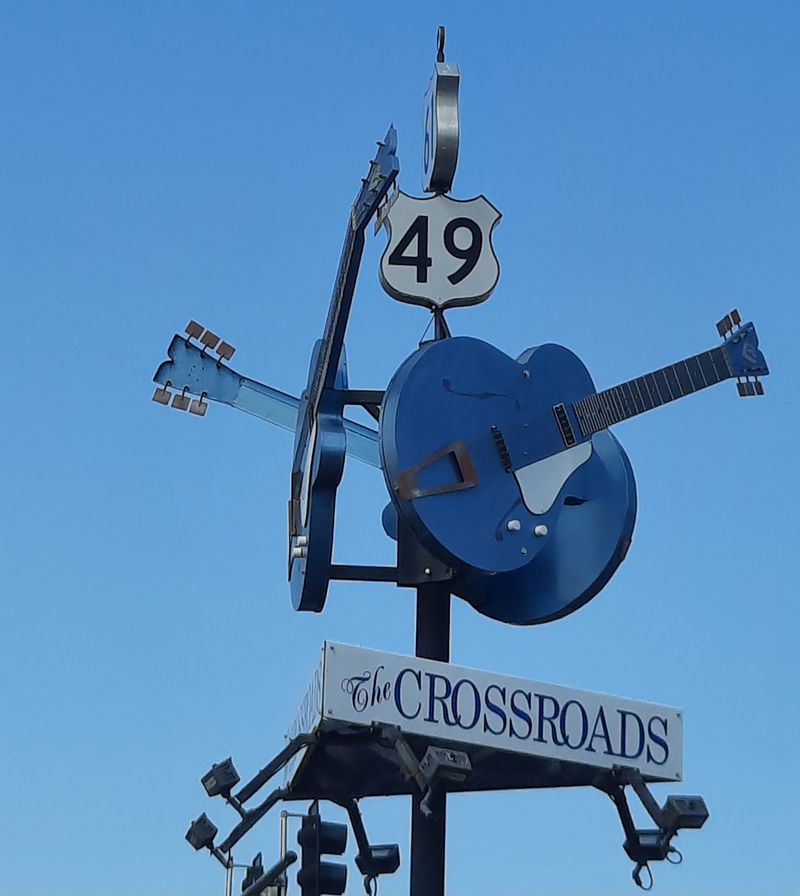
Legends sometimes have physical addresses, and in Clarksdale, the intersection of Highways 61 and 49 marks ground zero for one of America’s most enduring musical myths.
According to blues folklore, this is where Robert Johnson allegedly sold his soul to the devil in exchange for extraordinary guitar skills that changed music history forever.
Whether you believe the supernatural story or not, standing at this crossroads delivers a genuine emotional experience that connects visitors to the Delta blues tradition’s very foundation.
The intersection itself looks deceptively ordinary at first glance; just two highways meeting in the flat Mississippi Delta landscape.
But giant blue guitars mark the spot, and the weight of musical history transforms this simple crossroads into something approaching sacred ground for blues enthusiasts.
Clarksdale recognizes its significance as the blues capital of the world, and the city has carefully preserved and promoted its connections to legendary musicians.
What makes this location particularly cinematic is how it represents the collision between the mundane and the mythological.
The Delta flatlands stretch endlessly in every direction, cotton fields and scattered buildings creating landscapes that inspired countless blues lyrics about hardship and hope.
This visual simplicity actually enhances rather than diminishes the crossroads’ power, allowing visitors to imagine the scene as it might have appeared in Robert Johnson’s era.
Clarksdale itself offers numerous blues-related attractions that complement a crossroads visit, including the Grammy Museum Mississippi at 800 West Sunflower Road and Ground Zero Blues Club.
The city hosts festivals throughout the year that bring the blues tradition to life with live performances from contemporary artists carrying forward the legacy.
Walking Clarksdale’s streets, especially in the historic downtown district, feels like stepping into a music documentary where every building has a story to tell.
Visiting the crossroads works best when you approach with open imagination and respect for the cultural traditions that make this intersection meaningful beyond its physical reality.
Dear Reader: This page may contain affiliate links which may earn a commission if you click through and make a purchase. Our independent journalism is not influenced by any advertiser or commercial initiative unless it is clearly marked as sponsored content. As travel products change, please be sure to reconfirm all details and stay up to date with current events to ensure a safe and successful trip.
