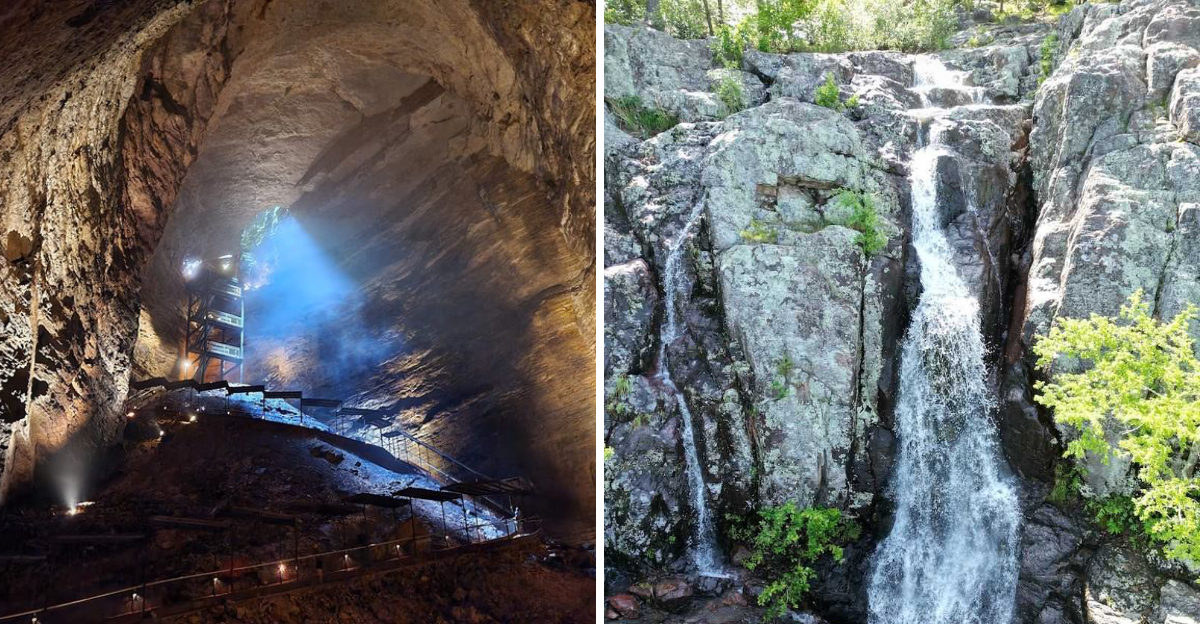
The first time someone tells you to pack hiking boots for Missouri, you laugh. Then you see the sandstone canyons slicing through the forest like nature’s own maze.
This place that clearly forgot it belongs in the Midwest. You will climb bluffs that rise three hundred feet above the river, your heart pounding not from effort but from the view alone.
Paddlers navigate rapids that have no business existing this far from the Appalachians. Kayaks scrape over ledges while kingfishers dart past, unimpressed by your adventure.
One trail leads to a natural bridge carved by water over millions of years. Another drops you into a canyon where ferns drip from every rock face and the temperature falls ten degrees just from the shade.
You will check your phone’s location twice, maybe three times. The map insists you are still in Missouri. Your eyes insist otherwise. Believe your eyes.
1. Johnson’s Shut-Ins State Park, Middle Brook, MO
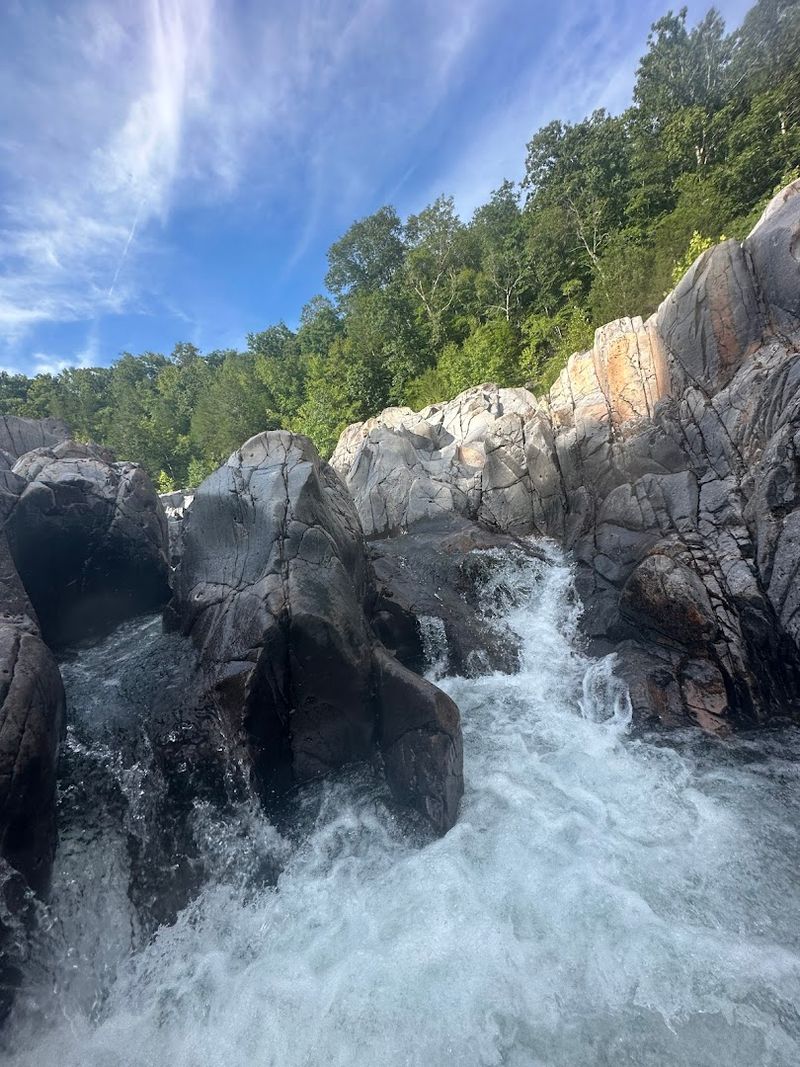
Picture a natural water park built entirely by geology over millions of years, and you start to get close to what Johnson’s Shut-Ins State Park feels like in person.
Located at 148 Taum Sauk Trail in Middle Brook, Missouri, this park sits in the St. Francois Mountains region of the eastern Ozarks.
The “shut-ins” are narrow rock gorges where the Black River gets squeezed through ancient rhyolite and granite formations.
The result is a wild series of natural slides, chutes, pools, and channels that you can actually swim through.
The water runs surprisingly clear, and the smooth volcanic rock underfoot has been polished by centuries of rushing current.
I spent an entire afternoon scrambling from one pool to the next, completely losing track of time.
The park also connects to the Ozark Trail system, so hikers can extend their visit well beyond the shut-ins themselves.
One trail leads up to Taum Sauk Mountain, which is the highest point in Missouri at 1,772 feet.
The surrounding forest is dense and green, full of oak, hickory, and shortleaf pine that turn spectacular shades in autumn.
Spring and early summer tend to bring the best water levels for swimming, while fall offers the most dramatic scenery on the trails.
Camping is available inside the park, which means you can wake up early and hit the shut-ins before the crowds arrive.
This place genuinely feels more like the Ozark Highlands of Arkansas than a typical Midwestern state park, and that is exactly what makes it unforgettable.
2. Grand Gulf State Park, Thayer, MO
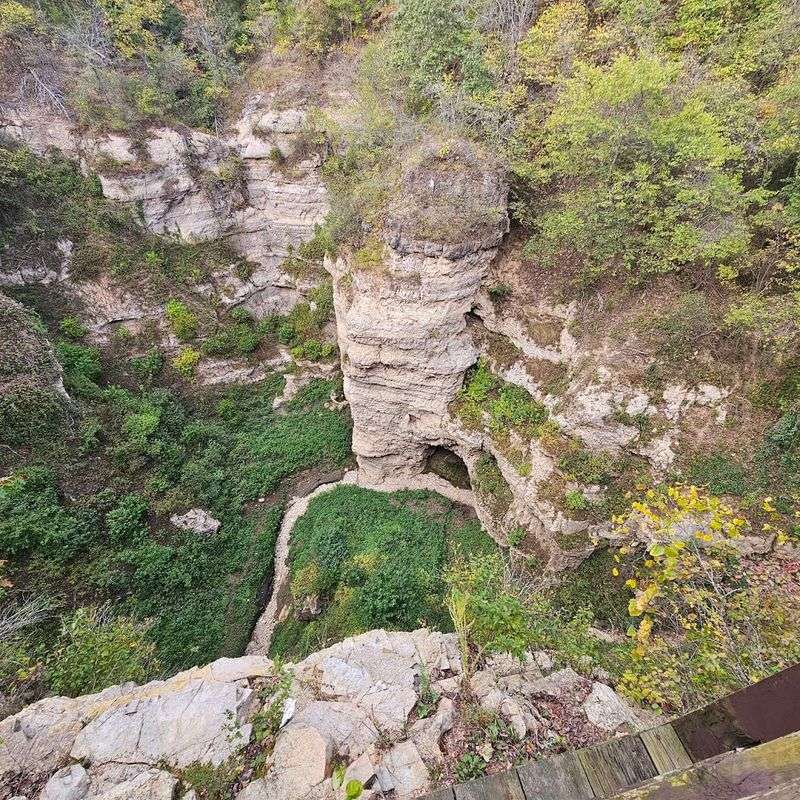
Standing at the rim of Grand Gulf feels like someone quietly dropped a piece of the American Southwest into the Missouri Ozarks without telling anyone.
Located near Thayer, Missouri, on Route W, Grand Gulf State Park is often called “The Little Grand Canyon,” and that nickname earns its keep.
A massive underground cavern collapsed here thousands of years ago, leaving behind a canyon stretching roughly 10,000 feet long with bluffs that rise up to 130 feet on either side.
One end of the canyon still has a natural tunnel where a small stream disappears underground entirely.
Walking the rim trail gives you a series of overlook points that keep delivering bigger and more dramatic views the further you go.
The scale of this place is genuinely hard to process at first glance.
A lower trail drops you down into the canyon floor itself, where the walls close in and the light shifts into something moody and cinematic.
The rock here is pale limestone, streaked with water stains and dotted with ferns clinging to the crevices.
Because this park sits in a less-traveled corner of southern Missouri near the Arkansas border, it rarely gets crowded.
I had the lower trail almost entirely to myself on a weekday morning, which made the whole experience feel even more remote and wild.
Spring is a strong time to visit since the creek runs fuller and the surrounding forest is bright with new growth.
Grand Gulf is the kind of place that stops you mid-sentence because words just do not do it justice.
3. Echo Bluff State Park, Eminence, MO
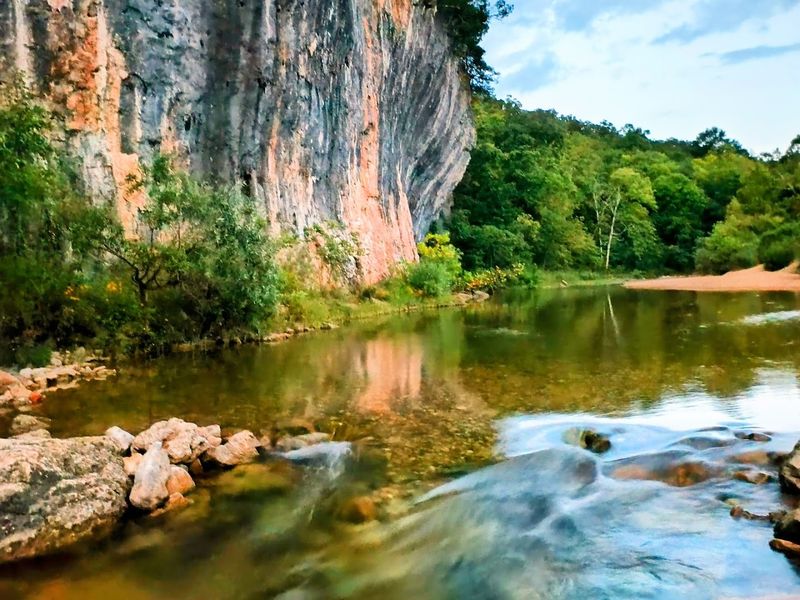
There is a moment when you round the bend at Echo Bluff State Park and the cliff face just appears, and your brain genuinely needs a second to catch up.
Sitting at 34489 Echo Bluff Drive in Eminence, Missouri, this park opened in 2016 and quickly became one of the most visually striking destinations in the entire Ozarks region.
The defining feature is a towering bluff of pale sandstone that rises straight up from the edge of Sinking Creek.
The creek itself runs remarkably clear, almost blue-green in the right light, which makes the whole scene feel more like a postcard from the Pacific Northwest than central Missouri.
Kayaking or canoeing along Sinking Creek puts you right at the base of the bluff, and looking up from the water is a perspective that stays with you.
The park also has a network of hiking trails that wind through dense Ozark forest and connect to the Current River area.
Fishing in the creek is popular, and the calm stretches of water are well-suited for beginners and experienced anglers alike.
The park offers modern lodge-style cabins and a dining lodge, which makes it genuinely comfortable for families or couples who want scenery without roughing it too hard.
Fall is arguably the best season here, when the bluff reflects warm golden and amber tones from the surrounding tree canopy.
Summers are lively with water activity, while spring brings a freshness to the trails that is hard to match anywhere else in Missouri.
Echo Bluff earns every bit of the awe it inspires.
4. Alley Spring Grist Mill, Eminence, MO
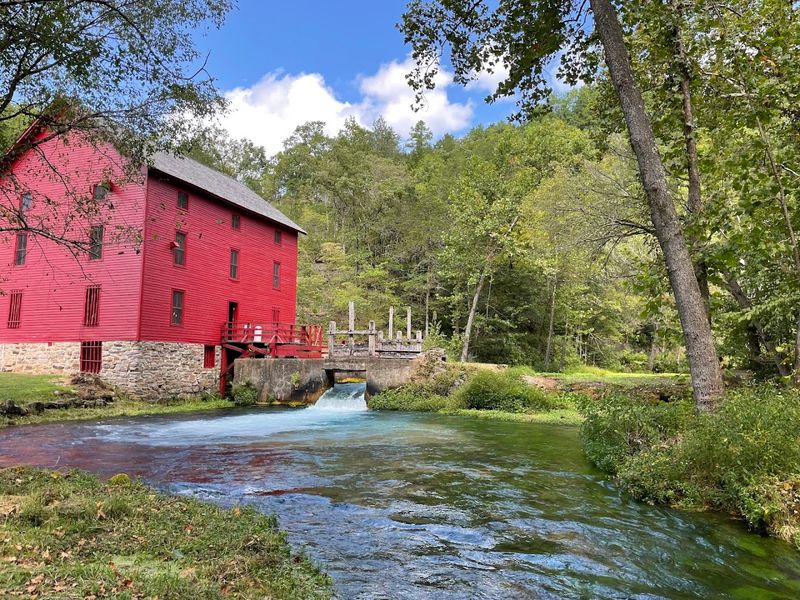
Few sights in Missouri stop people in their tracks quite like the turquoise spring pool at Alley Spring, framing that iconic red mill like something out of a painting.
Located on State Highway 106 in Eminence, Missouri, Alley Spring Grist Mill sits within the Ozark National Scenic Riverways and has been drawing visitors since the 1800s.
The spring itself discharges millions of gallons of cold, crystal-clear water daily, feeding directly into the Jacks Fork River nearby.
That vivid blue-green color comes from the depth and purity of the water, not from any filter or trick of photography.
The red mill building dates to 1894 and was used to grind corn and wheat for local communities across the region.
Today it stands beautifully preserved, and rangers sometimes demonstrate how the old machinery once worked.
Walking the short path from the parking area to the spring feels like stepping into a completely different world.
The contrast between the red wooden mill, the lush green forest, and that impossibly vivid water creates a visual combination that feels almost unreal.
Canoeing on the Jacks Fork River is a popular add-on since the spring sits right at a popular put-in point.
A small campground nearby makes it easy to stay for a night and catch the spring in the soft morning light before anyone else arrives.
Late spring and early summer tend to show off the colors at their most saturated and vibrant.
Alley Spring is one of those rare places that genuinely exceeds whatever expectation you bring to it.
5. Ha Ha Tonka State Park, Camdenton, MO
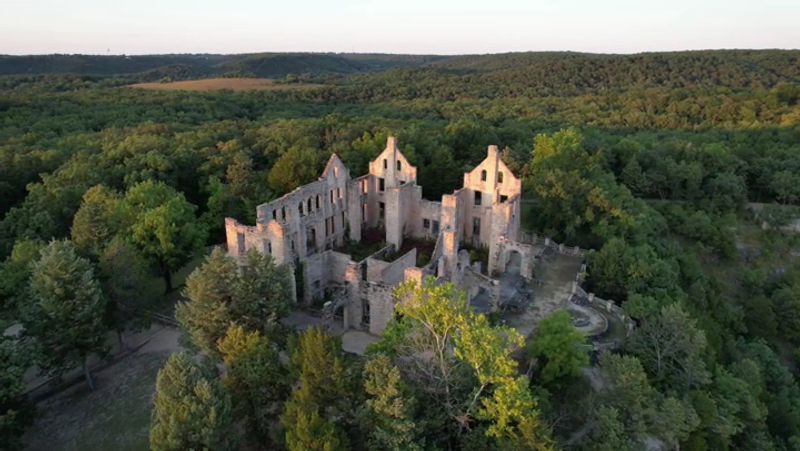
Somewhere between a fairytale and a geology textbook, Ha Ha Tonka State Park manages to deliver castle ruins, sinkholes, caves, and sweeping lake views all in one visit.
Sitting at 1491 State Road D in Camdenton, Missouri, this park overlooks the Lake of the Ozarks and packs an almost ridiculous amount of variety into its trails.
The ruins at the top of the bluff belong to a stone mansion that was built in the early 1900s and never fully completed before a fire left it in its current dramatic state.
Walking among those crumbling stone walls with the lake stretching out far below is the kind of experience that does not feel remotely Midwestern.
The park sits on a karst landscape, which means the ground beneath you is riddled with caves, springs, sinkholes, and natural bridges.
One trail leads to a massive natural bridge carved by an underground stream that eventually collapsed.
Another path drops down to a large spring that bubbles up cold and clear near the lakeshore.
The combination of geological drama and historic architecture makes Ha Ha Tonka genuinely unique among Missouri state parks.
Birdwatching is excellent here too, particularly for osprey and great blue herons along the lakeshore sections of the trail.
Fall is spectacular when the oak and hickory forest turns and the ruins take on an even more atmospheric quality in the golden light.
Spring brings wildflowers to the bluff trails and keeps the caves and springs flowing at their most active.
Ha Ha Tonka rewards repeat visits because each season genuinely changes the whole mood of the place.
6. Marvel Cave, Branson, MO
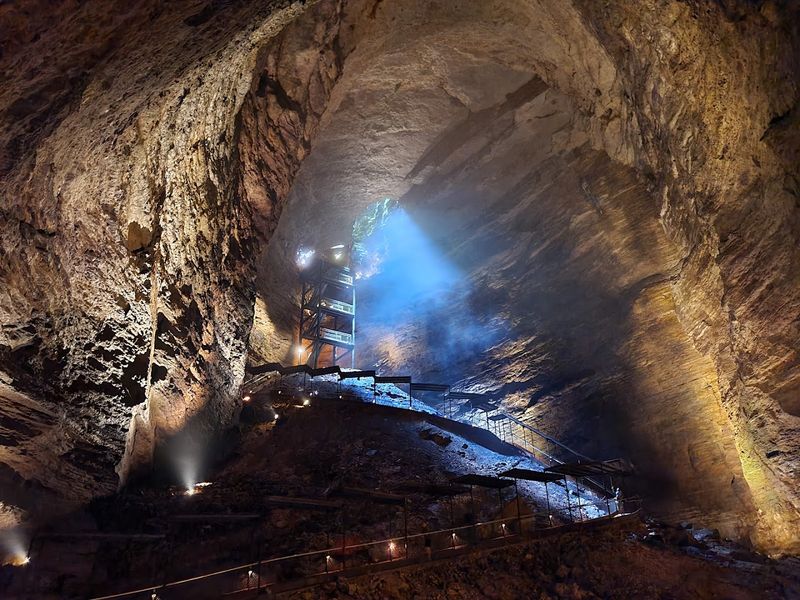
Most caves ask you to duck and shuffle through tight passages, but Marvel Cave opens with a cathedral-sized room that makes you tilt your head all the way back and stare upward in disbelief.
Located at 399 Silver Dollar City Parkway in Branson, Missouri, Marvel Cave sits beneath the Silver Dollar City theme park and holds the distinction of having one of the largest cave entrance rooms in North America.
The Cathedral Room drops roughly 204 feet from the surface and stretches wide enough to fit a decent-sized building inside.
Guided tours wind through several chambers, each with its own character, from tight fossil-lined passages to wide rooms bristling with stalactites and stalagmites.
The cave stays at a constant cool temperature year-round, which makes it a genuinely refreshing escape during Missouri’s humid summers.
The history here adds another layer of interest since the cave was first explored commercially in the late 1800s and drew visitors from across the region long before the theme park existed.
There is a tram that carries visitors back up to the surface at the end of the tour, which is a thoughtful touch given how far down the cave actually goes.
The tour itself takes about an hour and covers a reasonable amount of ground without feeling rushed.
Branson is accessible from multiple directions along Highway 76, making it a practical stop on a broader Ozarks road trip.
Marvel Cave is the kind of underground experience that earns its name, and the sheer scale of that first room never stops being impressive no matter how many times you see it.
7. Devil’s Well, Salem, MO
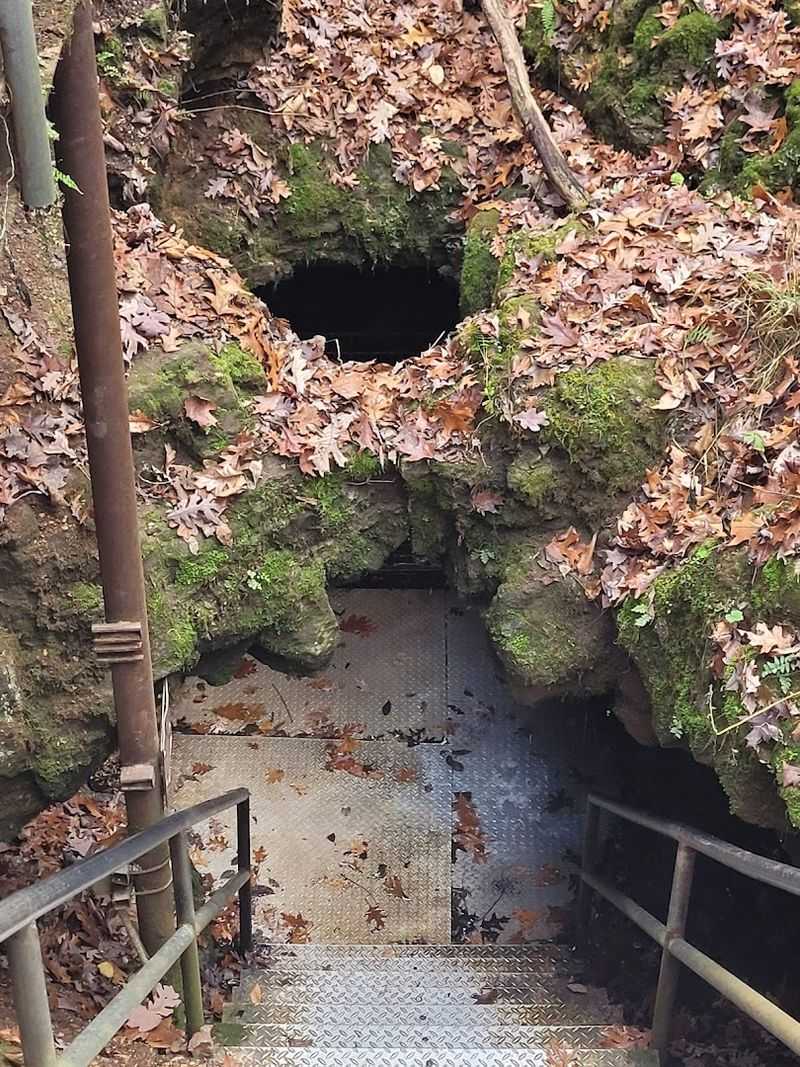
Crouching over a narrow hole in the forest floor and peering down into an enormous underground lake is not something most people expect to do on a Missouri road trip, but Devil’s Well makes it a reality.
Located on Devils Well Road near Salem, Missouri, this site is managed as part of the Mark Twain National Forest and is genuinely unlike anything else in the region.
The well itself is a sinkhole that drops down about 100 feet into a cavern holding a large, dark underground lake.
A small viewing platform at the surface lets you lean over and look down into the chamber, where the water stretches out in near-total darkness below.
The lake inside is estimated to be around 400 feet long and has never been fully explored.
That combination of depth, darkness, and mystery gives this place an atmosphere that is hard to shake once you have experienced it.
The surrounding area is peaceful Ozark forest, full of cedar and oak, with a short trail leading from the parking area to the well itself.
There is also a cave entrance nearby that adventurous visitors can use to get closer to the water’s edge, though that access requires more preparation and appropriate gear.
Visiting in spring or fall tends to offer the clearest air and the most comfortable temperatures for exploring the forest trails nearby.
The site is free to visit and relatively low-traffic, which means you can often have the viewing platform entirely to yourself.
Devil’s Well is the kind of place that earns its dramatic name with absolutely no exaggeration required.
8. Elephant Rocks State Park, Belleview, MO
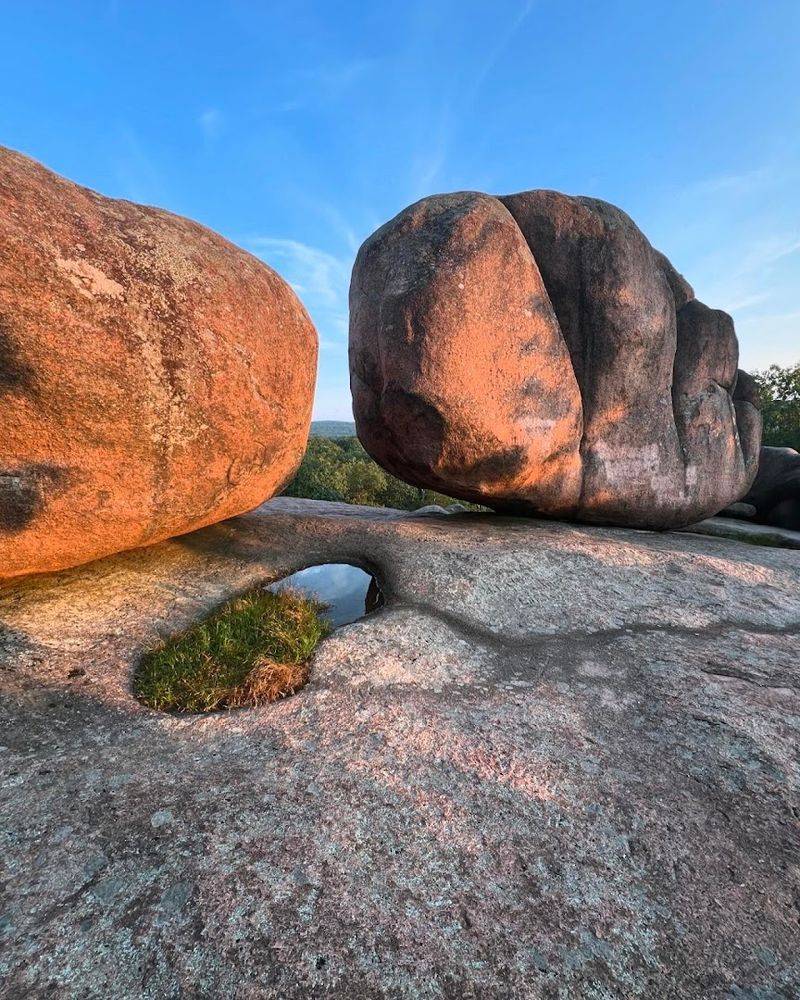
Walking into Elephant Rocks State Park for the first time feels like stumbling onto a planet where the rocks forgot to stop growing.
Located at 7406 Highway 21 in Belleview, Missouri, this park protects a field of enormous Precambrian granite boulders that are roughly 1.5 billion years old.
The boulders are rounded, deeply red in color, and stacked in formations that genuinely resemble a line of elephants walking trunk to tail, which is exactly how the park got its name.
The largest boulder in the park, named Dumbo, weighs an estimated 680 tons and stands over 27 feet tall.
A paved interpretive trail loops through the boulder field and makes the park accessible for a wide range of visitors, including those who prefer a shorter, more relaxed walk.
For those who want more challenge, the surrounding terrain offers scrambling opportunities over and between the rocks themselves.
The geology here is part of what makes this spot so unusual for Missouri since this type of exposed ancient granite is far more common in places like the Canadian Shield or the American Southwest.
The color of the rock shifts throughout the day as the light changes, going from deep rust in the morning to almost orange at midday.
Autumn is a wonderful time to visit since the sparse woodland surrounding the boulders turns and the contrast of red rock against golden leaves is genuinely striking.
The park also has a small pond and some picnic areas, making it a relaxed full-morning outing.
Elephant Rocks is one of those Missouri spots that earns genuine gasps from first-time visitors, and rightfully so.
9. Mina Sauk Falls, Ironton, MO
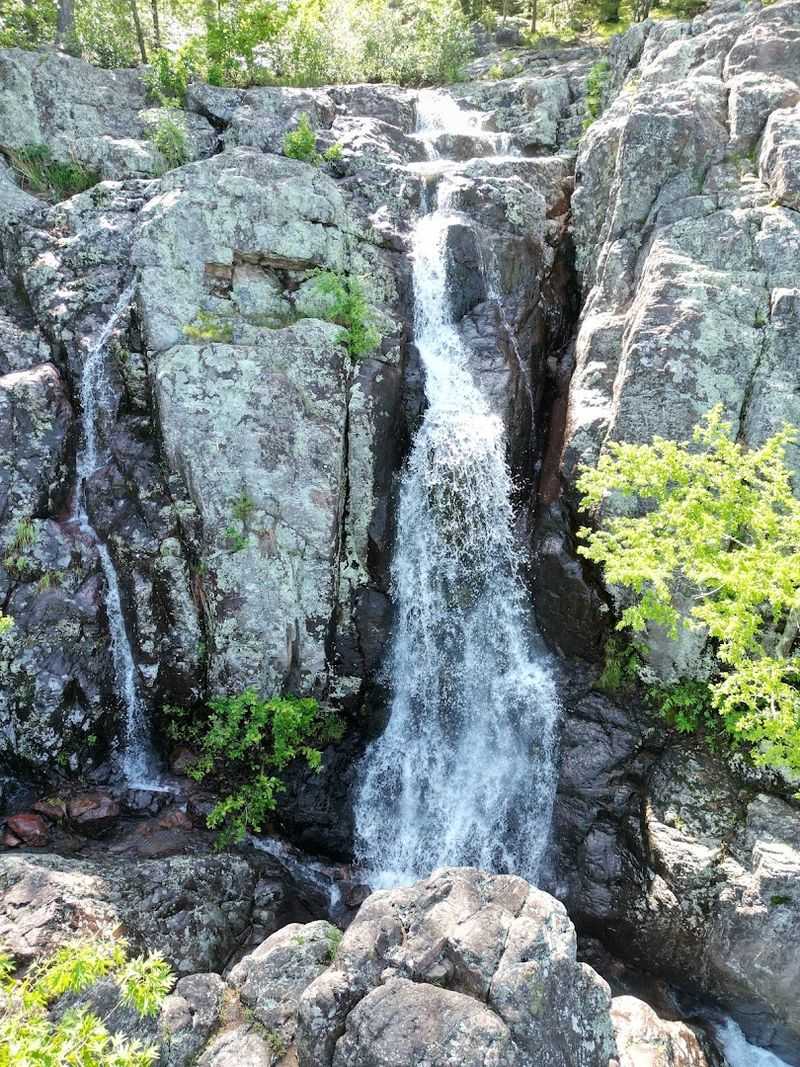
Hiking to Mina Sauk Falls rewards every step with a finale that genuinely earns its title as the tallest waterfall in Missouri.
Located within Taum Sauk Mountain State Park off Highway CC near Ironton, Missouri, the falls drop 132 feet over a series of rugged black rhyolite volcanic rock ledges in a remote corner of the St. Francois Mountains.
The trail to reach the falls is part of the Taum Sauk section of the Ozark Trail and runs roughly three miles round trip from the summit area.
The path winds through dense forest before opening suddenly to the rocky overlook above the falls, where the full drop comes into view.
After heavy rain or spring snowmelt, the falls run wide and powerful, sending mist up into the surrounding trees and filling the gorge below with noise and motion.
During drier summer months the flow narrows, but the volcanic rock formations themselves remain dramatic and deeply photogenic regardless of water volume.
The black rhyolite here is ancient, formed from volcanic activity that predates most of the rock you will find elsewhere in the Midwest.
That dark, jagged texture gives Mina Sauk Falls a rugged quality that sets it apart from the softer limestone landscapes found in other parts of Missouri.
The trailhead also connects to the Taum Sauk Mountain summit, which is the highest point in the state at 1,772 feet.
Combining both in a single hike makes for a deeply satisfying half-day in the woods.
Spring is the prime season for chasing the falls at full flow, but the trail itself stays beautiful and worthwhile in every season.
10. Johnson’s Shut-Ins State Park to Taum Sauk Mountain Loop, Middle Brook, MO
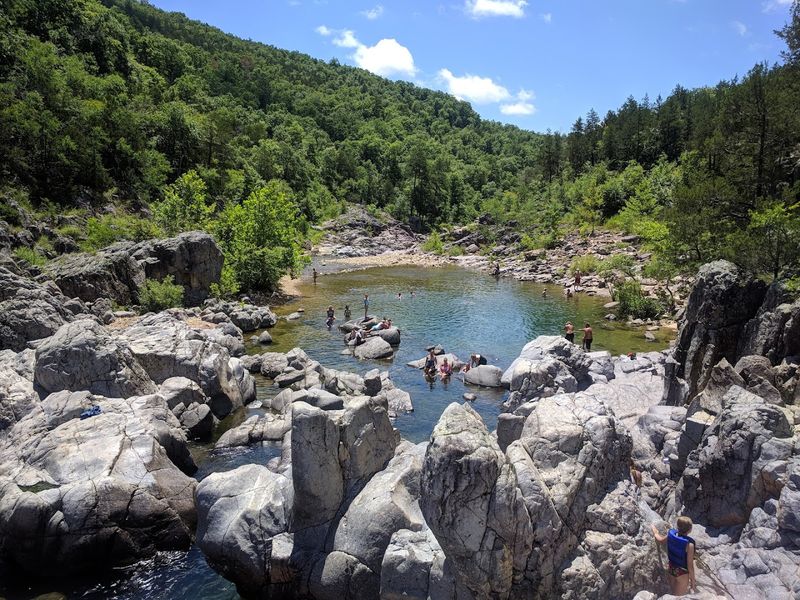
Connecting two of Missouri’s most dramatic landscapes into a single adventure, the loop linking Johnson’s Shut-Ins to Taum Sauk Mountain is the kind of hike that resets your entire idea of what this state can offer.
Both destinations sit within the Taum Sauk section of the Ozark Trail near Middle Brook, Missouri, in the heart of the St. Francois Mountains.
The full loop covers roughly eleven miles of varied terrain, moving from the boulder-strewn river gorge of the shut-ins up through hardwood forest to the exposed rocky summit of Taum Sauk.
The elevation change is modest by mountain standards but feels meaningful in the context of the surrounding Ozark plateau.
Along the way the trail crosses open glades, skirts the edges of rocky outcrops, and passes through sections of old-growth forest that feel genuinely remote and untouched.
Wildlife sightings are common on this route, including white-tailed deer, wild turkey, and various hawk species riding thermals above the ridge.
The trail surface ranges from smooth packed dirt to loose rock scrambles, so solid footwear is strongly recommended for the full loop.
Backpackers can use the primitive campsites along the Ozark Trail corridor, making this a great overnight option for those who want to slow things down.
Water sources are available near the shut-ins area, but filtering is necessary throughout the backcountry sections.
Late April and early May bring wildflowers to the forest floor and make the upland sections especially beautiful.
This loop is the rare Missouri trail that delivers genuine backcountry feel without requiring a drive to a more famous mountain state.
