Glassy black slag on an Ohio hiking trail turned out to be a piece of an industry that once lit up entire valleys, and I did not know what I was holding the first time I found one. Ohio used to run on iron, brick, coal, and paper, and when the work dried up, whole towns simply stopped and let the trees move back in.
I spent a lot of weekends chasing those leftovers, from bright yellow mill houses in the north to crumbling stone stacks buried deep in southern forests, and each site felt like a different chapter of a story that had been left open.
Some of these places have been polished up and given brand new lives, with boutiques and breweries where workers once punched the clock.
Others are quietly falling apart under vines and fallen leaves, holding the shape of what they used to be without any explanation. What I love most is how honest they feel, because nothing here has been staged for visitors, no plaques telling you how to feel, just the weight of the buildings and the silence of the spaces between them.
This route across the state will stick with you long after you get home.
1. Jaite Mill Historic District, Brecksville
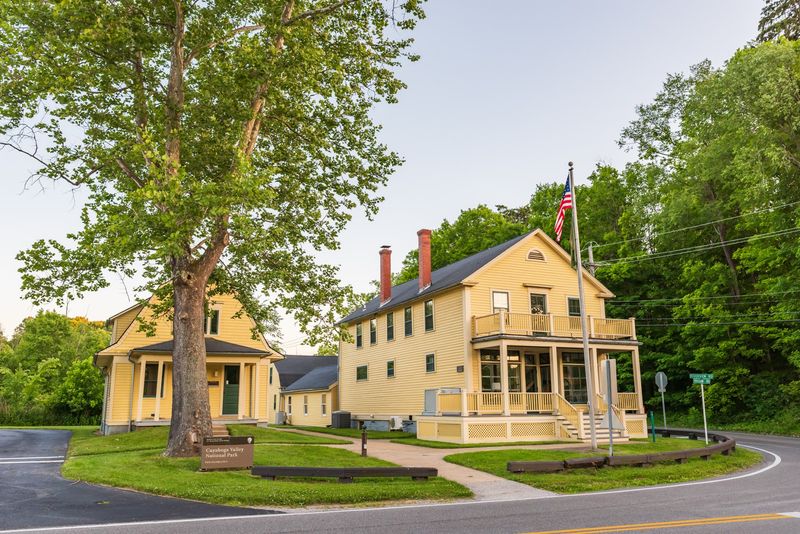
Bright mustard-yellow houses with white trim are the first thing that catches your eye here, and they look almost too cheerful for a place built around a paper mill. Charles Jaite started the operation back in 1905, making concrete blocks on site with sand pulled straight from the Cuyahoga River.
Flour sacks, cement bags, fertilizer sacks, and bread bags all rolled out of the mill for decades. The canal and the railroad sat close by, which made shipping easy and made the little town possible.
Workers rented homes at reasonable rates, and unlike a lot of company towns, nobody was paid in company scrip here. That small detail changes how the whole place feels when you walk past the row of houses.
The mill shut down in 1951 and much of it came down in 1984, but the National Park Service took over the property in 1985. Several restored buildings now serve as park headquarters, so the houses are not open inside.
Trailheads branch off nearby, and along the canal towpath you can still spot bits of the old factory hiding in the brush.
Address: Vaughn Road and Riverview Road, Brecksville, Ohio
2. Eclipse Company Town, The Plains
Coal built this cluster of little houses, and somehow they are all still standing in a neat row. The Hocking Valley Coal Company put them up between 1900 and 1902, right on top of Eclipse Mine No. 4, and back then the settlement was simply called Hocking.
Miners lived in company-owned homes and were often paid in credit that only worked at the company store. That arrangement kept everybody close, in more ways than one.
The mine went quiet in the early 1930s during the Depression, reopened in 1940 for the war effort, then closed for good in 1948. A group of friends started restoring the town in 1997, and they have been at it ever since.
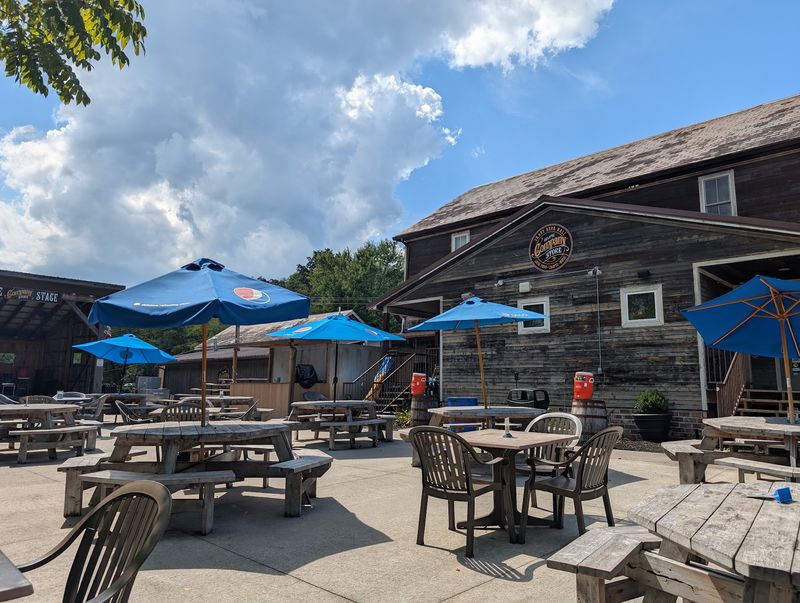
Today the two-story store has been remodeled into a busy gathering spot that opened in 2017, and a former mine office holds a nonprofit. Twelve four-room houses remain, some rented as homes, others hosting small businesses.
Cyclists on the Hockhocking Adena Bikeway roll through constantly, which gives the whole place a lived-in, friendly buzz rather than a museum hush.
Address: 11309 Jackson Drive, The Plains, Ohio
3. Haydenville Historic Town, Hocking County
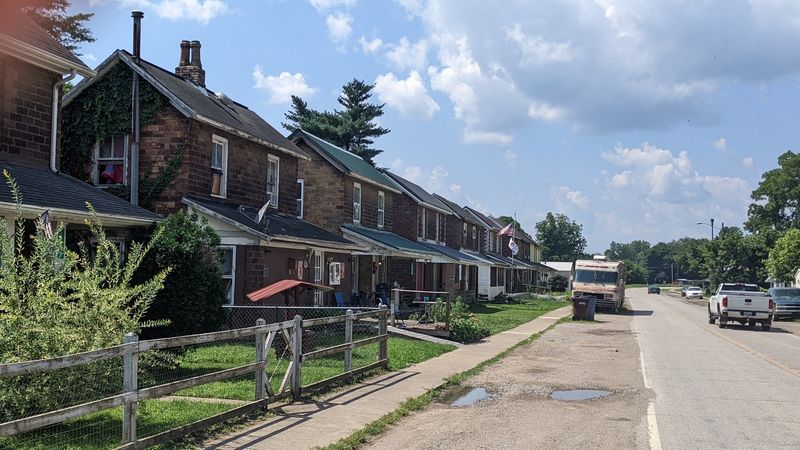
Nowhere else in Ohio looks quite like this village, where houses were built out of whatever the local factory happened to be making. Sewer pipe, silo tiles, paving blocks, and fire clay all show up in the walls, turning the streets into a walking catalog of company products.
Peter Hayden, a Columbus industrialist, founded the settlement in 1852 and originally called it Hocking Furnace. He tapped into coal, iron, sandstone, and fire clay, running a furnace, mines, and quarries.
By 1882 the mining and manufacturing company was incorporated and turning out brick and ceramic tile. Every house and both stores belonged to the company, workers were paid in scrip, and losing your job meant losing your home.
That system held on until 1964, making it the last fully company-owned town in the state. Residents finally bought their houses in the early 1960s, years after Natco purchased the town in 1906.
Brick homes on the east side date to the 1870s, while most tile block houses went up in the 1880s and 1890s. Keep an eye out for the round house, easily the strangest building in town.
4. Greendale Brick Plant Ruins, Hocking County
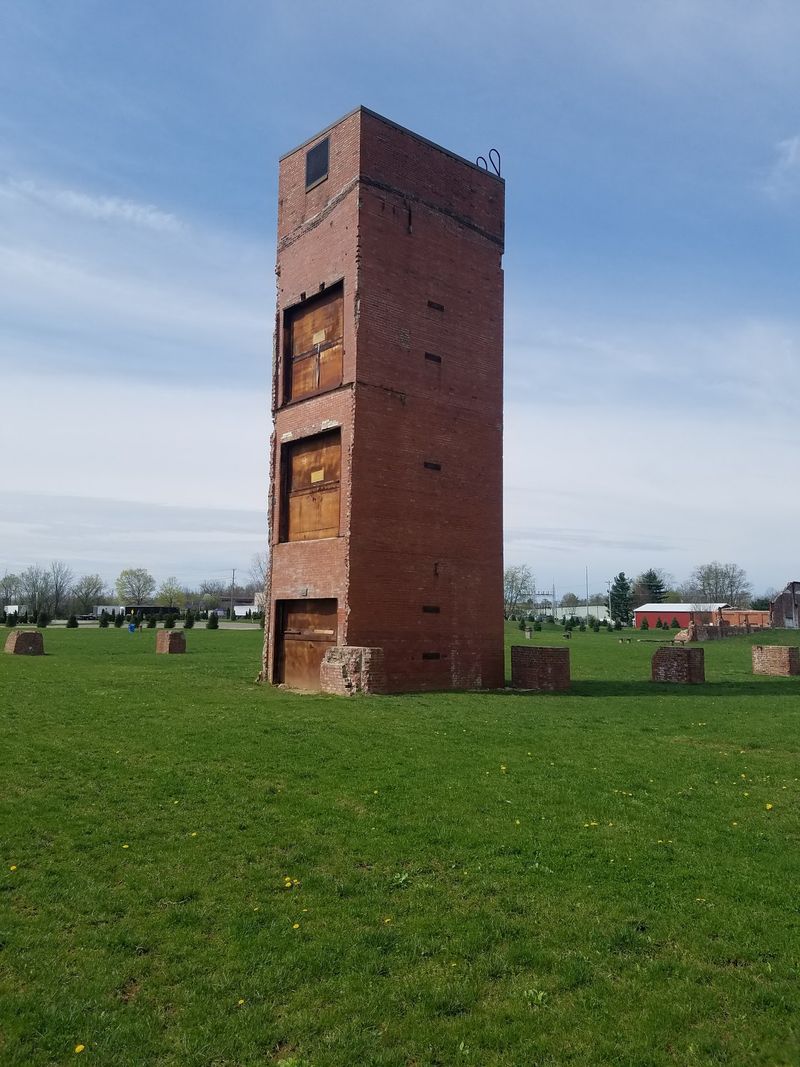
A lone smokestack rising above the weeds is basically all the advertising this place gets, and honestly it does the job. Nils Kachelmacher opened the brick plant in 1907, and at its height it employed between 175 and 200 men.
The numbers are hard to picture now. Roughly 100,000 bricks came out of here every single day, adding up to around 30 million a year.
Its famous Greendale Rug Brick shipped to buyers around the world, and the operation was once billed, maybe generously, as the biggest face brick plant anywhere. A huge power plant was built to sell electricity to nearby communities, though that plan never penciled out.
Trouble piled up through the 1920s, and the Depression finished things off when the plant closed permanently in 1930. The company let go of about 13,000 acres afterward.
What survives is mostly the smokestack and some power plant walls, plus scattered foundations and the shells of houses swallowed by brush. A few people still live in the area, so drive slowly and stay respectful of private land.
Address: Maysville-Greendale Road, Greendale, Ohio
5. Peters Cartridge Factory, Kings Mills
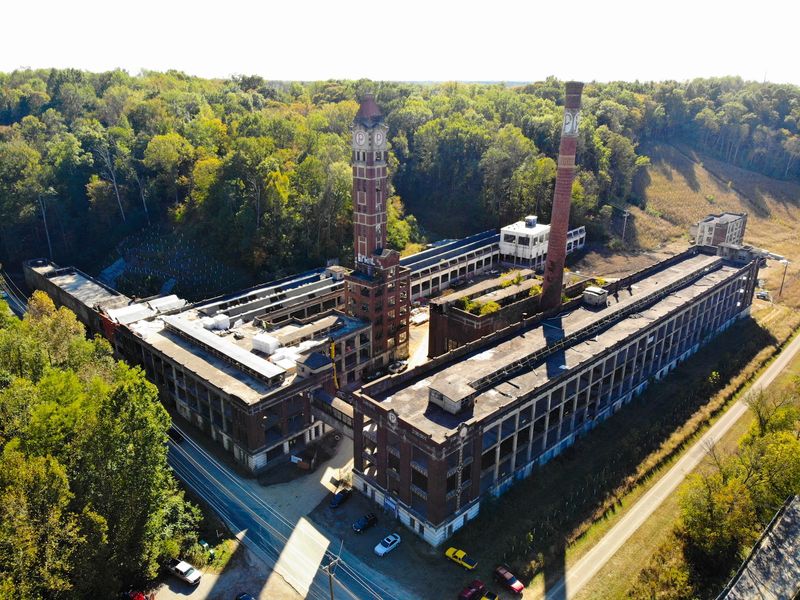
Few industrial sites in Ohio have had as many second acts as this one. Gershom Moore Peters founded the cartridge company in 1887 along the Little Miami River, and it grew into a major maker of ammunition.
Supplies from here reached Allied forces in both World Wars, and the company was the first to produce machine-loaded shotgun shells. A terrible explosion in 1890 killed twelve workers and forced a rebuild at the current spot.
The brick shot tower you see today replaced an earlier wooden one during World War I. At peak production, as many as 3,000 people worked on the grounds.
Remington bought the operation in 1934 and sold it a decade later, after which Columbia Records pressed 78 rpm discs here until 1949. Warehouse use followed, then abandonment in 1968.
Contamination from lead, mercury, and copper brought a Superfund designation in 2012, with cleanup wrapping up in 2017. The buildings, listed on the National Register since 1985, now hold 134 apartments plus a restaurant, and the bike trail runs right past the smokestack.
Address: 1415 Grandin Road, Kings Mills, Ohio
6. Oreton Ghost Town, Vinton County
Forest has done a thorough job of erasing this one, and that is exactly what makes poking around so interesting. Once called Aleshire, the community grew in eastern Vinton Township around coal and iron work, with births recorded here as far back as 1853.
A post office served residents from 1880 all the way to 1950. There was a church too, plus as many as 70 company houses, many built for mining families by Bert Harder.
Eagle Furnace ran through the second half of the 1800s under superintendent Samuel T. Benner, and it anchored everything around it.
When mining and railroad traffic faded, families drifted away one by one.
The last household left in 1947, and by the 1960s nearly every building had vanished. Oddly, the town never had its own cemetery, so burials happened in neighboring communities.
Crumbled furnace stonework, concrete slabs, old mine openings, and the stubborn brick safe from Dave Ebert’s store are what greet you now. Wear sturdy boots, watch your footing near openings, and bring a paper map since signal is unreliable.
Address: State Route 160, Vinton County, Ohio
7. Buckeye Furnace Historic Site, Wellston
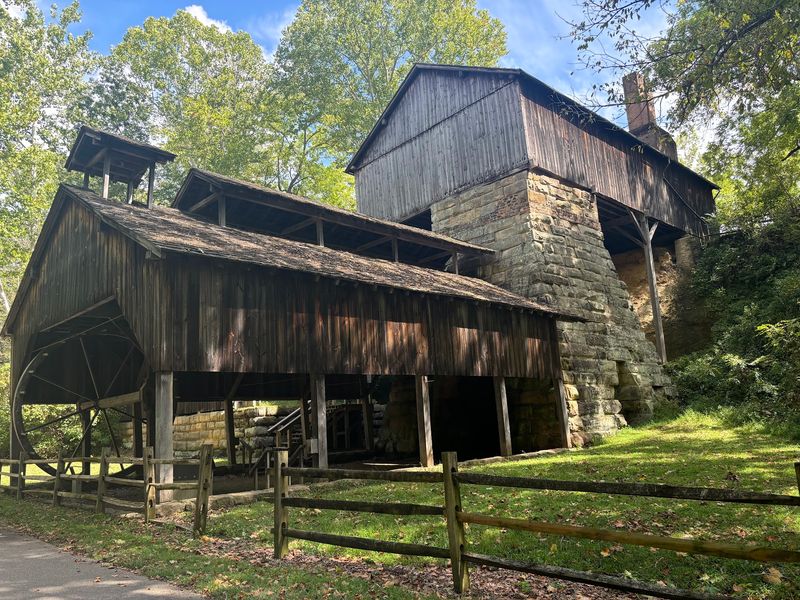
Of all the iron sites on this route, this is the one where the whole operation finally makes sense. Reconstructed buildings surround the original stack, so you can see how charcoal, ore, and limestone moved through the process instead of guessing at it.
The furnace ran from 1852 to 1894 in the Hanging Rock Iron Region, turning out pig iron that supplied the Union Army during the Civil War. At its busiest, roughly 200 men and 100 teams of oxen kept it fed.
A company town named Buckeye sat right beside it, housing the families who did that grueling work. Cheaper, more efficient coke-fueled furnaces eventually pushed it out of business.
The Ohio Historical Society bought the property in 1935 and rebuilt the structures in the 1960s using interviews with workers who were still alive. National Register listing followed in 1970.
A replica company store holds a small museum and shop, open May through October, while the grounds stay open year-round in daylight. Two nature trails and a picnic area with grills make it easy to linger.
Address: 123 Buckeye Park Road, Wellston, Ohio
8. Hope Furnace Ruins, Lake Hope State Park
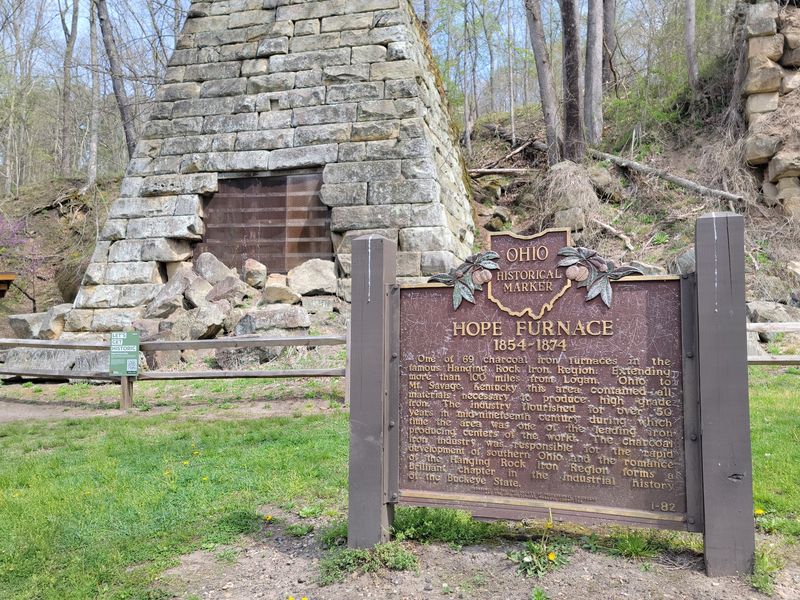
Slag is the giveaway here. Scuff the forest floor near the trail and you will turn up glassy, bubbled chunks left over from smelting, which is a strangely satisfying souvenir moment even if you leave them where they lie.
Built between 1853 and 1854, the furnace ran from 1854 to 1874 as part of the Hanging Rock Iron Region. Charcoal fed the fire, which meant stripping timber off the surrounding hills at an enormous rate.
Hundreds of workers kept it going, and a temporary settlement of at least three hundred people grew up around the operation. Ohio was a national leader in iron production during those years.
Richer, easier ore deposits farther west ended the run after about two decades. Not one building from the old community survives above ground.
The stone chimney and parts of the foundation still stand, right beside the park road, with a historical marker explaining the region’s iron story. Faint depressions in the woods hint at where homes once sat, and the surrounding park makes it an easy stop to pair with a hike.
Address: 27331 State Route 278, McArthur, Ohio
9. Vinton Furnace, Vinton Furnace State Forest
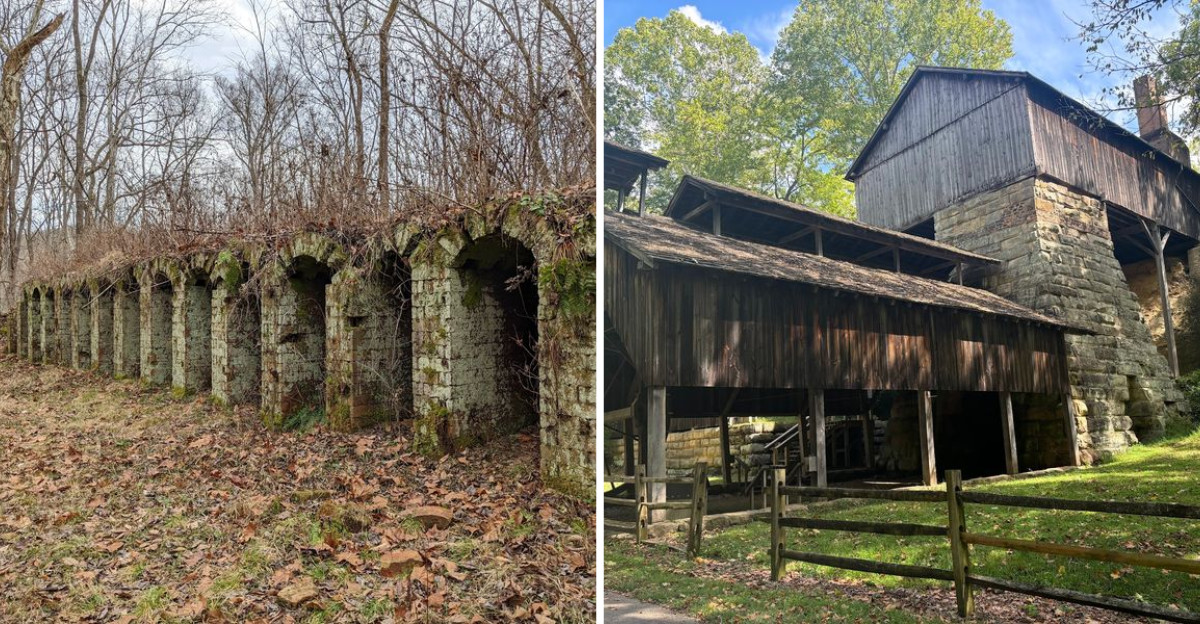
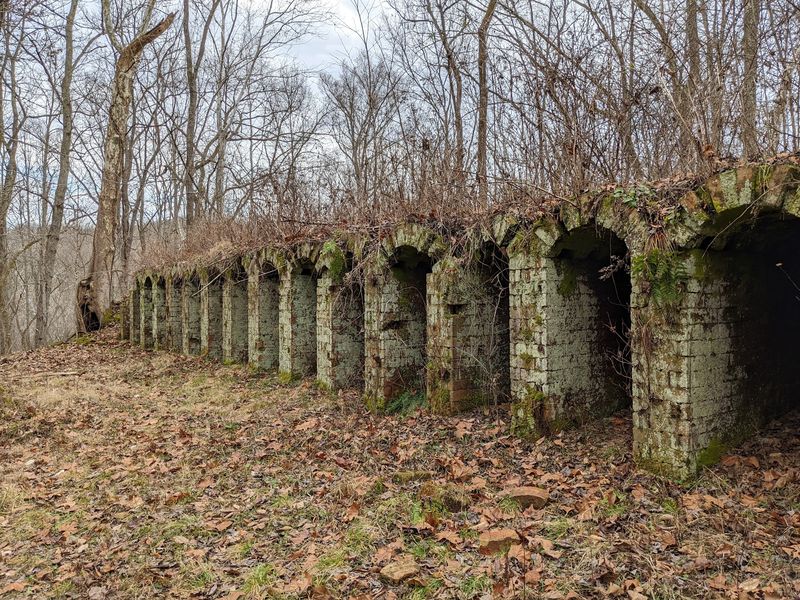
Earning this one takes effort, and the payoff is a row of arched stone ovens that may be the last of their kind anywhere on the planet. Twenty-four Belgian coke ovens sit in a line out in the woods, quietly holding a world record almost nobody knows about.
Clark Culbertson and Company got the charcoal furnace going in 1854, and iron production continued until the early 1880s. A settlement called Vinton Station grew alongside it with a store, a post office that ran from 1854 to 1901, and a railroad stop.
Conversion to coke fuel came in 1875, but local coal held too much sulfur to make decent coke. Shipping better coal in by rail cost too much, and that failure helped sink the whole operation.
In 1952 the Baker Wood Preserving Company set the land aside as an experimental forest, later used by the USDA Forest Service for research. Trails wind through unusually diverse woodland.
Reaching the ovens, furnace, and engine house foundation usually means a 5.6-mile out-and-back walk from a gated entrance.
The trail winds through a forest that feels older than it should, and the silence is broken only by the rustle of leaves and your own footsteps on the path. When the ovens finally come into view, they appear almost suddenly, a row of stone arches that seem to belong to a different century entirely.
Standing there, running your hand along the cool, mossy brick, it is easy to imagine the heat and smoke that once poured from these openings.
The place feels like a secret that the woods have been keeping, and earning the view through a long walk makes it all the more rewarding. For anyone willing to make the trek, this quiet, forgotten corner of Ohio offers a glimpse into a piece of industrial history that time has nearly erased, but not quite forgotten.
Address: Experimental Forest Road, Wilkesville, Ohio
