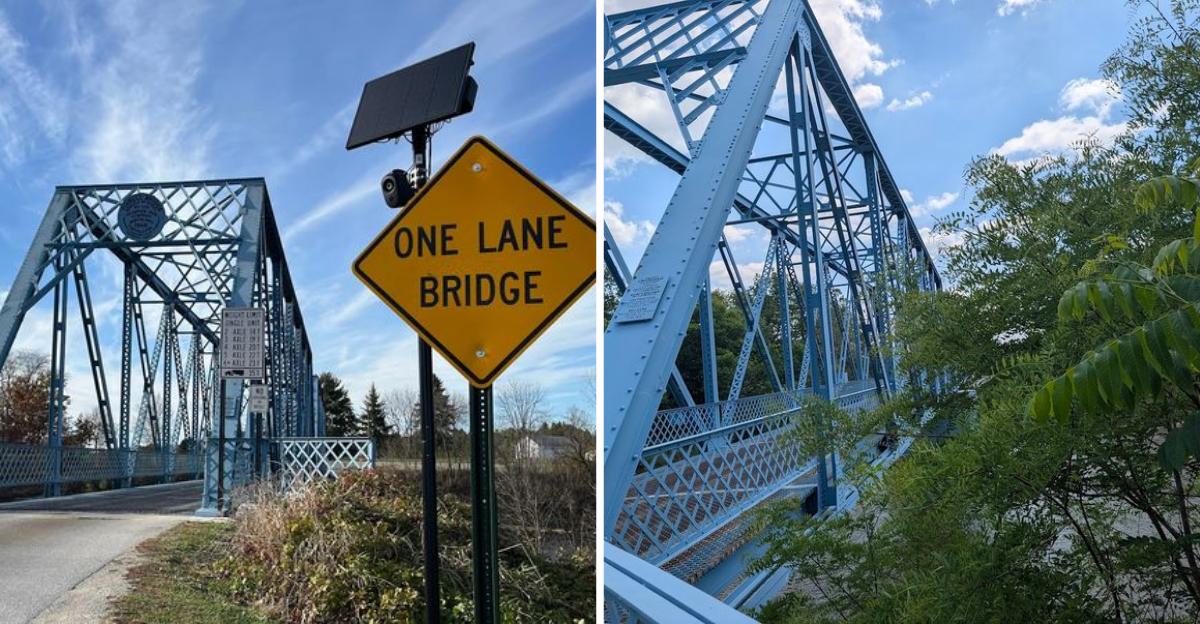
An old steel bridge in Ohio has been pulling people in for over a century, drawing curious visitors, local kids on dares, and families looking for a slice of real history.
Crossing the river on a narrow, one-lane span, the steel framework rises up around you as you drive across, and the water below moves with a quiet, steady confidence.
Built in 1915, that bridge is the kind of place that feels like it belongs in a story.
I remember the first time I heard about it, someone mentioned the legends and the dare games, and I was already halfway out the door.
I drove across slowly, feeling the old structure groan beneath the weight of my car, and parked on the other side just to walk back and take it all in.
Come for the history, the photography, the fishing, or just to see what all the fuss is about, that bridge delivers something genuinely unforgettable.
The Bridge That Built Its Own Legend
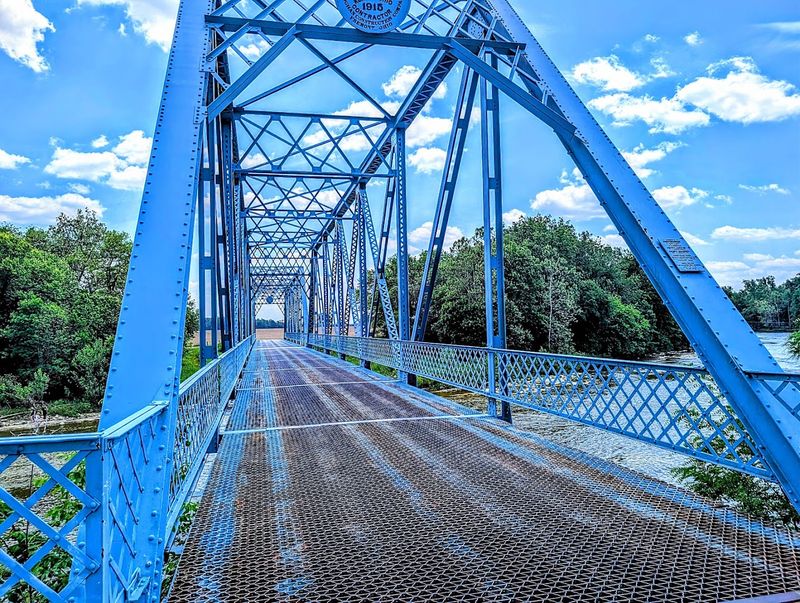
Some places earn their reputation quietly, and the Historic Tindall “Blue Iron” Bridge is one of them. Built in 1915 by the Champion Iron Company of Kenton, Ohio, this two-span, 332-foot Pratt through truss bridge replaced a wooden covered bridge that had been wiped out by a devastating flood in 1913.
The Tindall family, early settlers who arrived in the area in 1822, established a farm and mill near this very crossing, and their legacy is baked into the land around it.
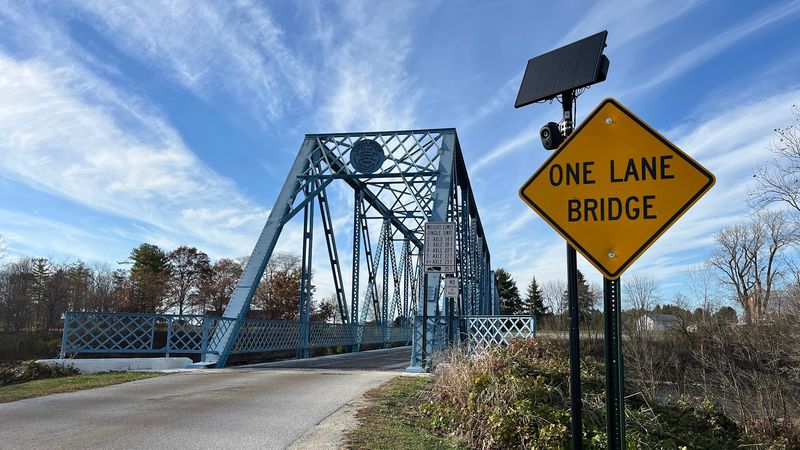
The bridge spans the Sandusky River along Rice Road in Fremont, Sandusky County, and its steel rivets and lattice railings give it a look that feels both industrial and oddly elegant. At just 15.7 feet wide, it is essentially a one-lane crossing, which means drivers approaching from opposite directions have to take turns.
That alone gives every crossing a little bit of drama.
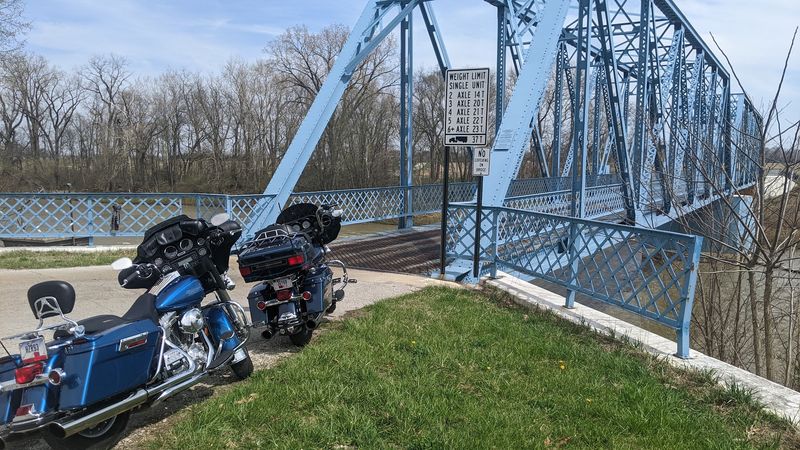
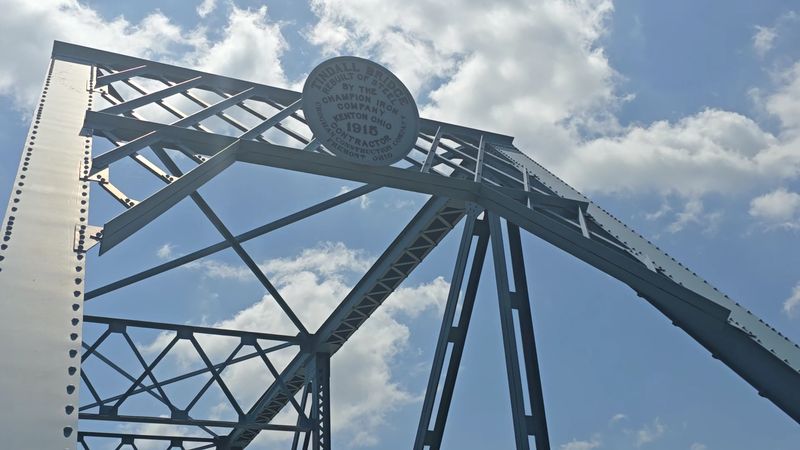
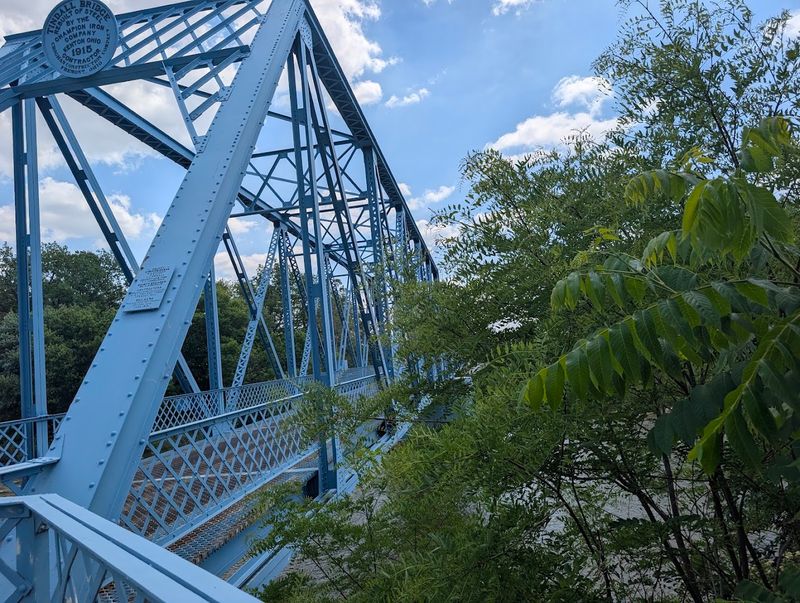
The deep lattice portal braces frame the roadway like a tunnel of iron, and the oversized builder’s plaque near the entrance is easy to spot if you slow down to look. The bridge has been well maintained by the county and carries a 25-ton weight limit.
Locals who drive it regularly barely blink, but first-time visitors often grip the wheel a little tighter. That combination of age, engineering, and narrow width is exactly what makes it so memorable the moment you roll onto it.
A Childhood Dare That Never Gets Old
Ask almost any kid who grew up in Sandusky County about Tindall Bridge and watch their face change. The bridge has a long-running reputation as a “crybaby bridge,” which is exactly the kind of label that makes teenagers pedal their bikes faster and parents shake their heads.
The most common legend involves an unwed mother who supposedly threw her baby from the bridge, and visitors have long claimed to hear unexplained crying sounds near the water.
Researchers have pointed out that the crybaby legend itself may trace back to a similarly named bridge in Birmingham, England, where an actual incident occurred. But that detail rarely slows anyone down when they are already parked on the bridge at night with the windows down.
The dare that has circulated through generations of Ohio kids involves parking on the bridge, walking away, and returning to find small handprints on the car.
Nobody can fully explain where the legend started or why it stuck so hard in this particular spot. What is clear is that the dare tradition has been passed from older siblings to younger ones, from one graduating class to the next, for decades.
It is the kind of local folklore that does not need to be verified to feel absolutely real when you are standing there in the dark. The bridge is not just a structure at that point.
It becomes a test of nerve, and somehow, that is exactly what makes it worth visiting.
Documented Tragedies Behind the Ghost Stories
The legends around Tindall Bridge are not entirely without roots. The bridge and its surrounding area have been connected to a handful of real, documented tragedies over the decades, and those events have layered onto each other to create a genuinely dark history.
In 1922, a woman passed of a heart attack after her car rolled off an embankment near the bridge. A tragic passing was recorded beneath the structure in 1948.
The most widely referenced tragedy is the 1955 passing of Shirley Bradford, who was abducted and ended near the bridge by a man named Samuel Tannyhill following a robbery at a nearby restaurant. Tannyhill was later convicted and put to rest.
That case, more than any other, is believed to be the origin of the ghost story involving a woman’s spirit heard sobbing or shrieking beneath the bridge.
Additional incidents include a child who drowned in the Sandusky River near the bridge in 1962 after falling through ice, and a woman believed to have jumped from the bridge in 1961. More recently, in July 2019, an unidentified person was found deceased in the woods close to the bridge, though authorities noted the body was near rather than directly on the structure.
None of this is invented or exaggerated for effect. The history is real, and it gives the bridge a weight that goes far beyond old steel and river water.
You feel it when you are there, even in broad daylight.
What the River Looks Like From Up There
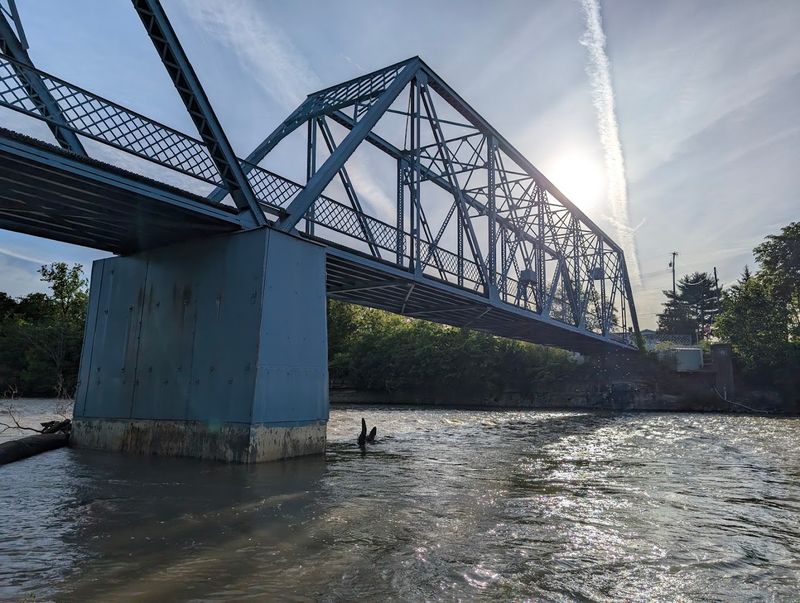
One of the most underrated parts of visiting Tindall Bridge is simply looking at the Sandusky River from the middle of the span. The water moves with real purpose here, especially after rain, and the sound of it rushing under the open grid deck is surprisingly loud.
Visitors have described the river as moving fast when they arrived, and that energy is part of what makes the spot feel alive rather than just historical.
The lattice railings inside the truss lines frame the view in a way that almost feels intentional, like a photographer set it up. The steel superstructure rises on both sides, and the river stretches out ahead and behind, giving you a full panoramic feel without being able to see it all at once.
That narrow, enclosed quality makes every glance outward feel a little more dramatic than it might on a wider bridge.
There is a nature reserve right next to the bridge that offers a parking area and a path down to the riverbank. Getting below the bridge and looking back up at the steel underside is a completely different experience from driving across it.
The concrete substructure units are visible from below, and the scale of the whole thing hits differently when you are standing next to the water. For photographers, that angle is genuinely worth the short walk down.
The river, the steel, and the afternoon light together create something that is hard to capture but easy to remember.
Fishing, Photos, and Finding Your Own Reason to Visit
Not everyone who visits Tindall Bridge comes for the ghost stories. The area around the bridge has been a gathering spot for leisure and recreation for a long time, going back to when families would come out for picnics, barbecues, and swimming in the Sandusky River.
That tradition has not completely disappeared. Fishing here is still a popular reason to make the trip, with some visitors claiming to have cast a line at this spot hundreds of times over the years.
Photography is another major draw. The bridge has served as a backdrop for senior portraits, maternity photos, homecoming pictures, and casual scenic shots.
The steel framework, the river, and the rural surroundings come together in a way that suits a wide range of photography styles. The light in the late afternoon is particularly good when the sun hits the metal at an angle and the water reflects it back.
Families with kids who are old enough to appreciate history or enjoy a mild adventure will find plenty to work with here. The nature reserve next to the bridge gives younger visitors space to explore the riverbank safely, and the short walk down to the water is easy enough for most ages.
For anyone just passing through Sandusky County on the way to the Ballville area or the reservoir nearby, stopping at Tindall Bridge adds something genuinely interesting to the day. It is the kind of detour that you end up talking about later, which is the best kind.
Why This Bridge Still Matters in Modern Ohio
A steel bridge built in 1915 that is still carrying traffic more than a hundred years later is not something you see everywhere. The fact that Tindall Bridge remains in active use, maintained by the county and holding a solid 25-ton weight limit, says something real about the quality of its original construction and the ongoing commitment to preserving it.
It is a functioning piece of Ohio infrastructure that also happens to be a historical landmark, which is a rare combination.
The bridge was constructed using rivet-connected steel by the Champion Iron Company, a builder that left a significant mark on Ohio’s bridge-building history. The deep lattice portal braces and the oversized builder’s plaque near the entrance are details that most modern bridges simply do not have.
There is a craftsmanship visible in the structure that feels intentional and proud, not just functional.
Places like Tindall Bridge matter because they connect people to where they actually come from. The Tindall family settled near this river in 1822.
The covered bridge that preceded this one was taken out by a flood in 1913. The current bridge went up two years later and has outlasted nearly everything around it.
Kids dare each other to visit it at night, families pose for portraits on it, and fishermen return to the riverbank beside it year after year. That is not just history on a plaque.
That is a living place, and it deserves the visit.
Address: 2402 S River Rd, Fremont, Ohio
