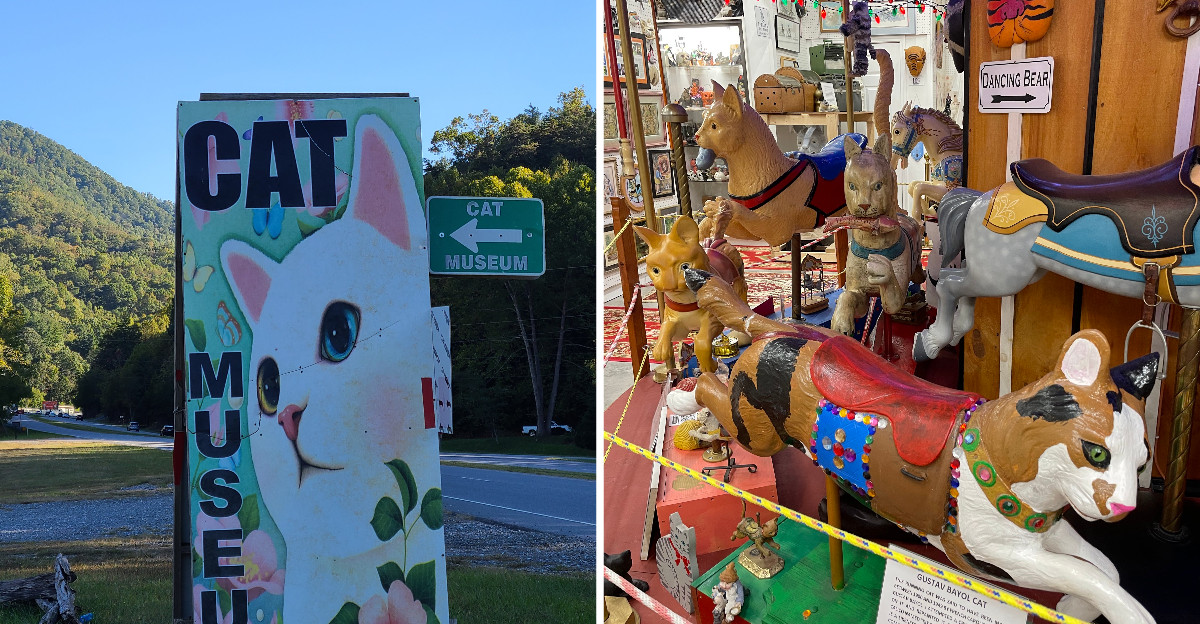
Cats covered the outside walls of a brightly painted building along a mountain highway, and my eyes left the road without permission. What was meant to be a quick stop stretched into more than an hour of wandering past mummies, music boxes, carousel figures, and shelf after shelf of tiny feline faces.
In the middle of it all, a fluffy resident cat strolled up and decided to walk between rooms like a tour guide. This North Carolina spot started as one man’s personal collection, built over decades, and it now supports a shelter for cats who need homes.
The collection includes Egyptian-style cat mummies, antique music boxes, and hand-carved carousel animals. Every corner holds another set of whiskers, another pair of glass eyes, another small ceramic creature waiting to be noticed.
The visit ended with a grin, a paper bag of souvenirs, and a plan to return.
The Catman Behind the Whole Thing
Before there was a museum, there was a retired professor with a very specific hobby. Dr. Harold Sims taught biology, botany, and ecology, and spent more than thirty years gathering cat art, toys, books, and oddities from wherever he could find them.
People around Sylva knew him as The Catman.
He opened the museum in April 2017, mostly because a collection that big deserved to be seen by people who would actually appreciate it. Anyone who loves cats counts as the right audience here.
What struck me while walking through was how personal everything feels. Nothing is arranged like a sterile gallery, and you can sense that each object was chosen by someone who genuinely cared about it.
The labels, the groupings, the little handwritten touches all point back to one person’s curiosity.
Dr. Sims passed away in November 2024 at the age of 89, but the museum he built keeps running exactly as he set it up.
I think that’s the part that stayed with me longest. Collections usually get scattered after someone dies, sold off piece by piece to strangers.
Here, the whole thing stayed together, still doing the job he intended. Staff keep the doors open, the cats fed, and the story going for every new visitor who wanders in off the highway.
More Than 10,000 Cat Artifacts Under One Roof
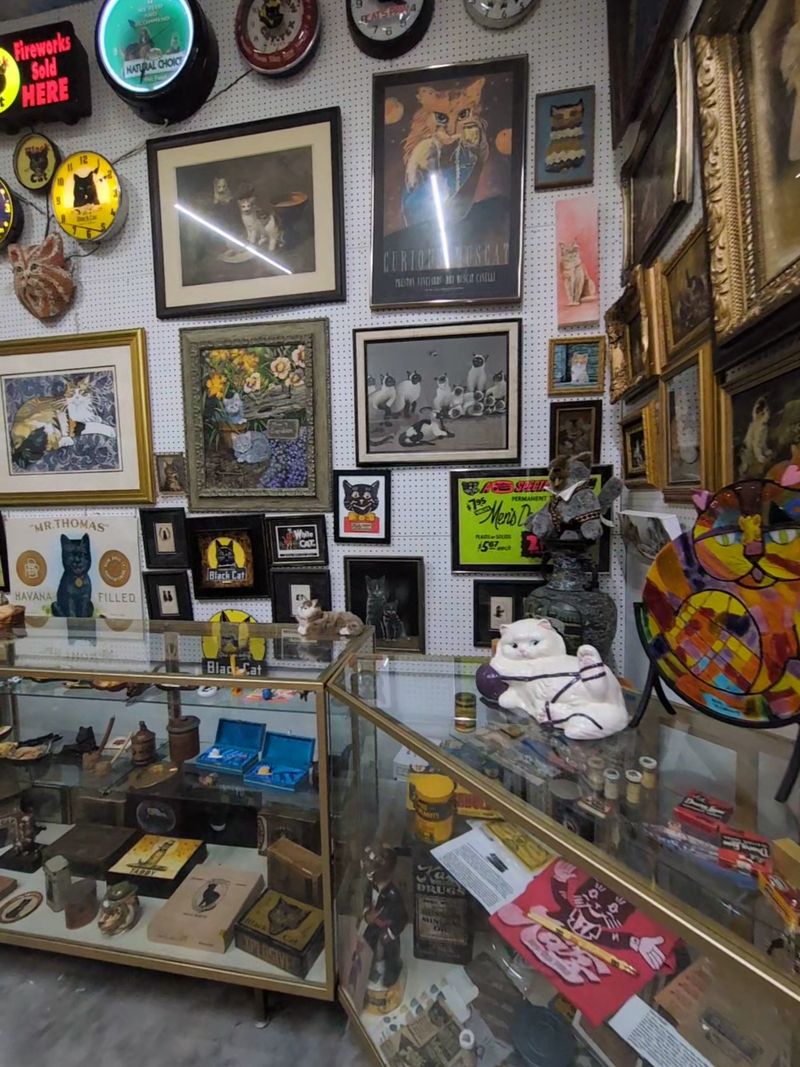
Ten thousand is a number that sounds abstract until you’re standing in a room surrounded by it. Shelves climb the walls, display cases fill the floor space, and framed artwork covers nearly every gap in between.
My first walk through was too fast. I circled back and immediately spotted a dozen things I’d completely missed, which happens to almost everybody here.
The range is what makes it strange in the best way. Antique porcelain sits near vintage tin toys, folk art carvings share space with fine paintings from the late 1800s, and rare advertising pieces hang beside poster art from another century.
Some visitors breeze through in half an hour. Others, myself included, lose track of time entirely and end up doing two full loops.
My advice is simple: come earlier in the day rather than later, because rushing this place defeats the point. The last tour usually starts around 4:30 pm, so arriving at 4:15 means you’ll be watching the clock instead of the exhibits.
Bring your phone or a camera too. Photo opportunities pop up constantly, from the painted exterior walls to the oddest little displays tucked into corners.
Even the bathroom is decorated head to toe in cat themes, which genuinely made me laugh.
Carousel Cats You Can Actually Get Close To
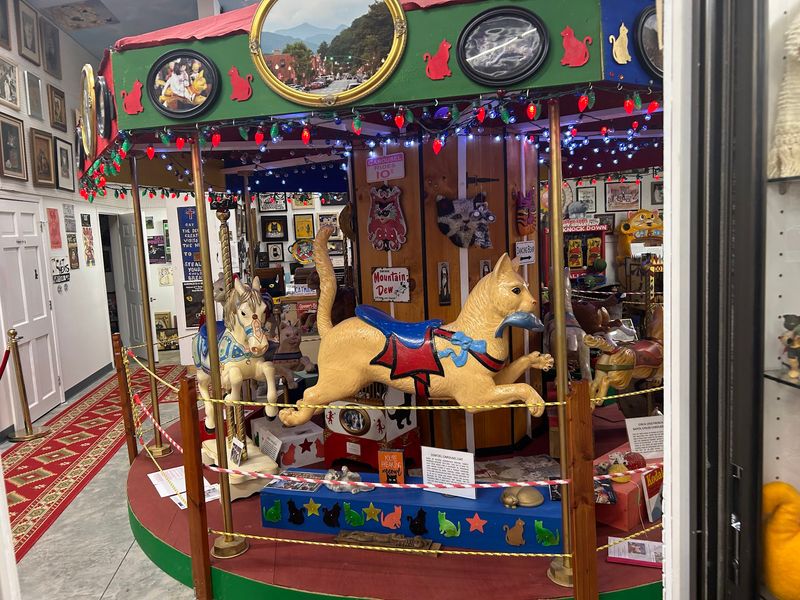
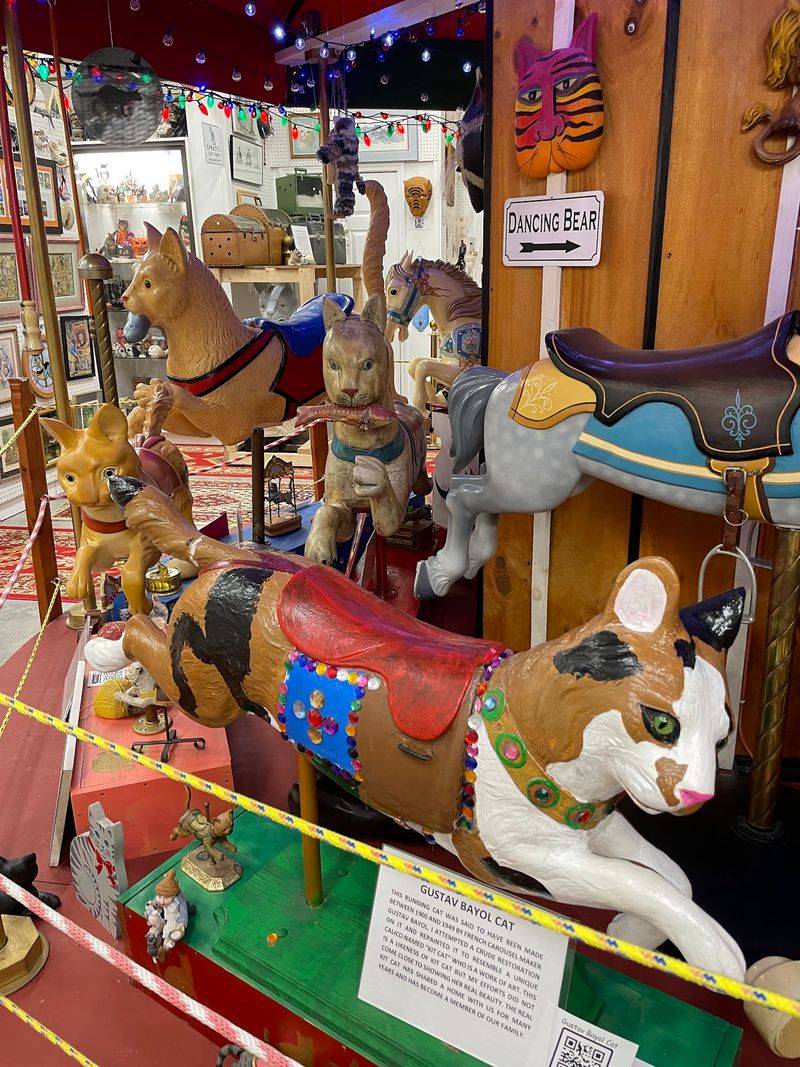
Carousel animals are usually horses, so seeing a whole carousel built around cats felt delightfully wrong in the best way. The hand-carved figures are big, brightly painted, and close enough that you can study the carving details on their faces and paws.
Visitors mention the carousel constantly in reviews, and once you see it you understand why.
Carousel carving was a serious craft in the late 1800s and early 1900s, with workshops competing to make the most eye-catching animals. Cats were always rarer than horses, which makes a collection like this unusual.
Each figure has its own personality, from wide-eyed and playful to almost regal.
I spent a good while circling it and taking photos from different angles, because the light catches the painted surfaces differently depending on where you stand. It’s easily one of the best photo spots in the museum.
What I appreciated was the lack of velvet ropes everywhere. The displays feel accessible, like you’re invited to look closely rather than kept at arm’s length.
If you’re traveling with kids, this is the section that usually wins them over. Big, colorful, and instantly understandable, no explanation needed.
Adults tend to linger just as long, which says something about how well these old carvings still hold up.
Resident Cats Who Run the Place
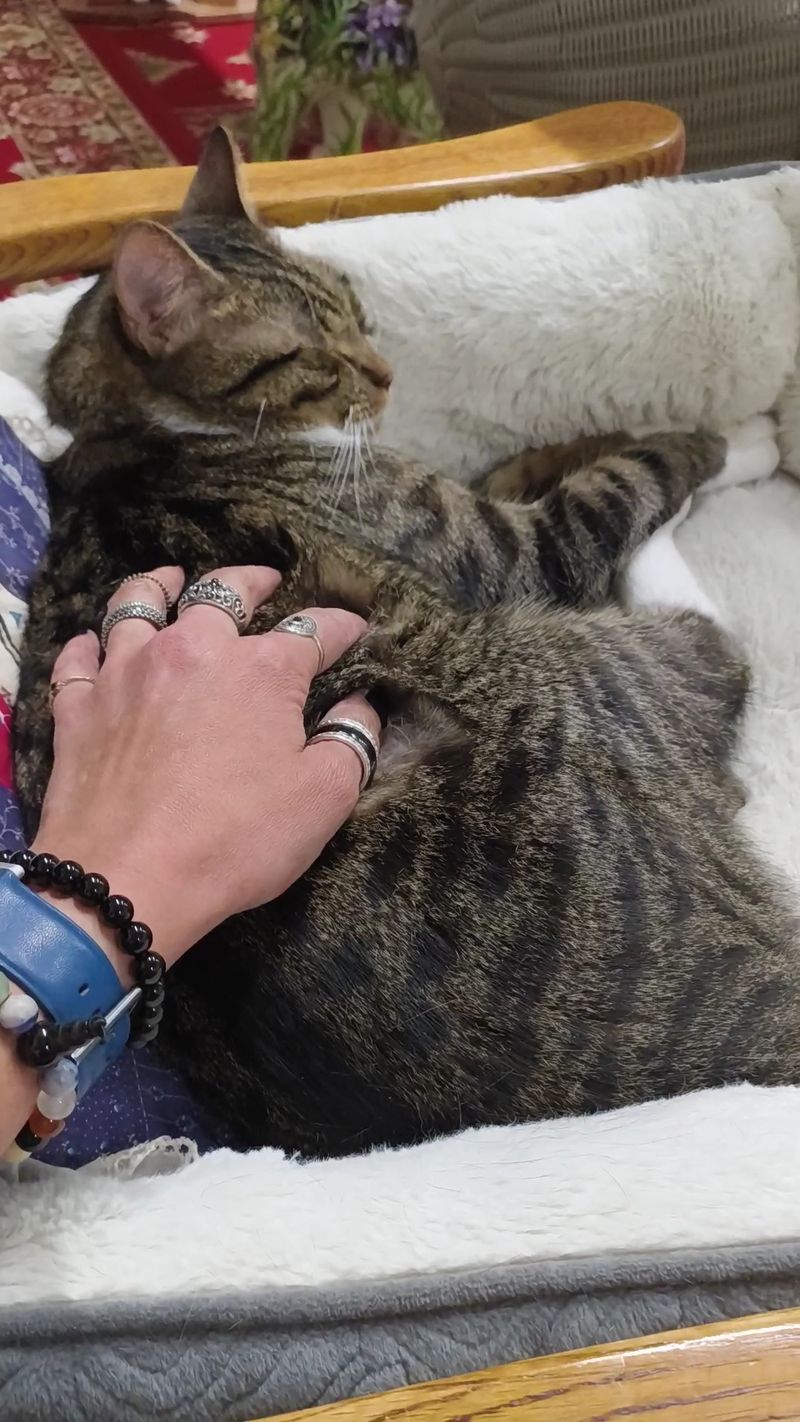
Halfway through my visit, a cat decided I needed company and followed me from room to room. Several visitors report the exact same thing happening, which suggests the resident cats take their jobs seriously.
They call them North Carolina’s MuseumCats, and they wander freely through the galleries.
Depending on when you visit, you might meet three or four, sometimes including Persian kittens who are far more interested in your shoelaces than in ancient artifacts. Older cats tend to claim sunny spots and accept attention on their own schedule.
Petting is welcome, which turns the whole experience from looking at cat things into actually hanging out with cats.
Allergy sufferers, take note. A few reviewers with sensitivities said they managed fine, while another mentioned needing the restroom at the back to blow their nose a few times.
Plan accordingly and bring what you need.
The cats change the tone of the place completely. Museums can feel hushed and slightly formal, but it’s hard to stay formal when a kitten is batting at your bag strap.
Staff are happy to answer questions about each cat, where they came from, and how they ended up living among ten thousand artifacts. That conversation alone is worth a few extra minutes at the front desk.
Louis Wain, Warhol, and Cat Art Worth Slowing Down For
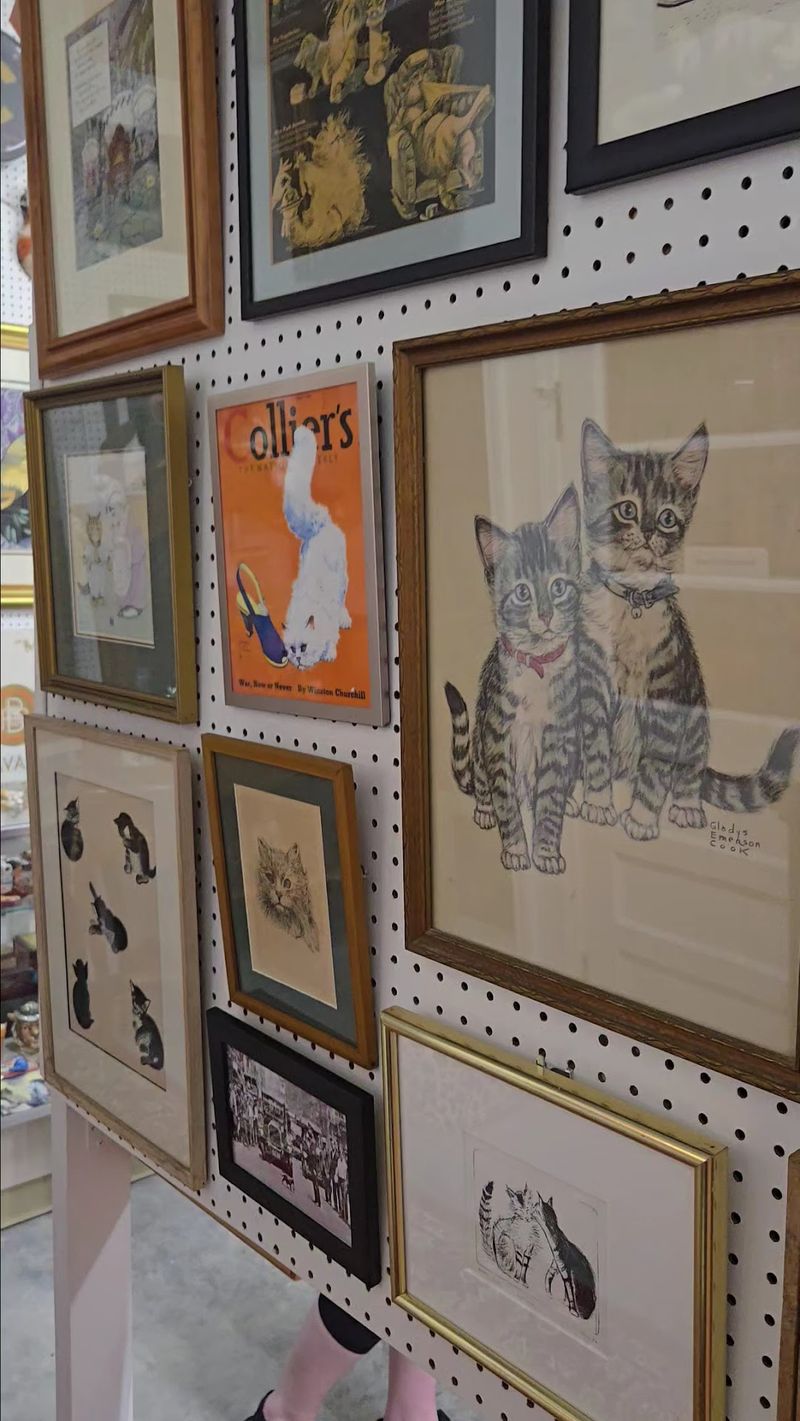
Art lovers get more than they bargain for in this building. There’s a notable Louis Wain collection, the English artist famous for his wide-eyed, wildly expressive cats that became enormously popular in the early 1900s.
His work is instantly recognizable once you’ve seen a few pieces.
Alongside Wain, the walls hold fine art from the late 1800s, folk art, art glass cats that catch the light beautifully, and vintage posters advertising everything from theater shows to household products. A few pieces by Andy Warhol are in the mix as well, which surprised me completely.
Warhol drew cats early in his career, long before soup cans made him a household name.
I found myself moving slower through this section than anywhere else. Lithographs, tintypes, and paintings are hung densely, so it pays to actually stop and look rather than scan.
There’s also a research library for anyone who wants to go deeper into feline history. That’s not something you typically find attached to a roadside attraction.
What makes the art hang together is the obvious care in how it’s displayed. Nothing feels dumped on a wall to fill space.
Someone thought about groupings, sightlines, and what belongs next to what, and that attention shows in every room.
Automatons, Music Boxes, and Antique Toys That Still Charm
My favorite corner turned out to be the mechanical one. Antique automatons, wind-up toys, and music boxes fill the cases, all built around cats in various poses and states of motion.
Some are over a century old and still look ready to perform.
Automatons were the high-tech marvels of their day, gears and springs hidden inside figures that could move their heads, paws, or tails. Wealthy families displayed them as conversation pieces long before anyone had a television.
Seeing a whole shelf of them dedicated to cats is a genuine rarity.
Music plays softly throughout the museum, and more than one visitor has mentioned how much it adds to the mood. It keeps the rooms from feeling like a warehouse of objects.
There’s also a Chessie System train display that catches people off guard. Chessie was a sleeping kitten mascot used by a railroad company starting in the 1930s, and the advertising art built around her is charming in a very specific mid-century way.
Vintage Halloween decorations with black cats fill another section, and those were a highlight for several visitors I read about.
Take your time here. The small mechanical pieces reward close looking far more than a quick glance ever will.
Planning Your Stop Along Highway 441
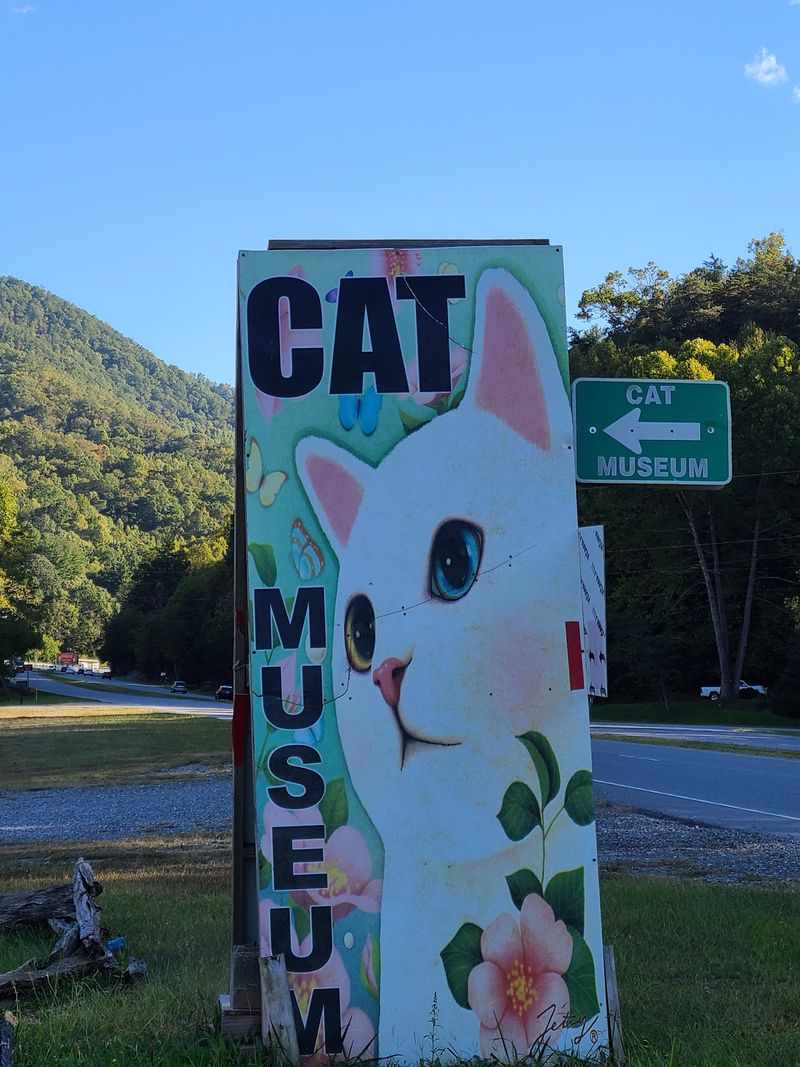
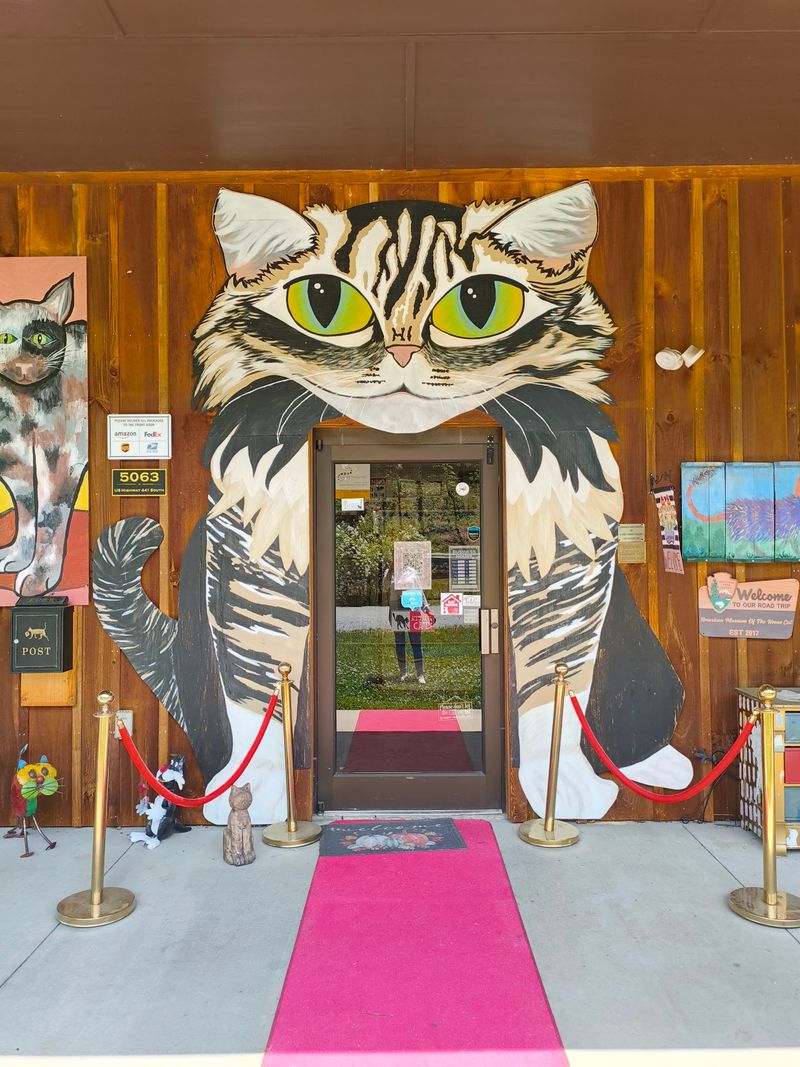
Getting there is easy, and honestly the building does half the work of grabbing your attention. Bright paint and painted cats cover the exterior, with plenty of spots for photos before you even step inside.
Plenty of people spot it while driving and turn around on the spot.
Hours run Monday through Saturday from 10 am to 5 pm, and Sunday from noon to 5 pm, with the last tour usually starting around 4:30 pm. Giving yourself at least an hour is smart, though I’d argue ninety minutes is more realistic if you like to read labels.
The location makes it an easy add-on to a Smoky Mountains trip. Asheville is a comfortable day-trip distance, and the drive through the mountains is scenic on its own.
One visitor even brought their own cat along in a carrying pack, which staff were fine with.
The museum moved to a larger building in 2020, so there’s more room to spread out than there used to be. It’s one of only two museums in the entire country devoted solely to house cats, which alone makes the detour worthwhile.
Address: 5063 US Hwy 441 S, Sylva, North Carolina 28779
