
Right in the middle of a suburban Houston office park, a 200-year-old Indian temple appears like a beautiful mirage.
The massive white marble structure seems to have teleported directly from another continent, complete with hand-carved domes and pillars that took over 1.3 million volunteer hours to assemble.
More than 33,000 individual pieces of stone were carved in India, shipped across the ocean, and fitted together in Texas like a giant three?dimensional jigsaw puzzle. No nails or steel beams hold it up, just ancient stone joints and a whole lot of dedication.
The quiet courtyards and reflective pools make it feel like stepping into a completely different world. Texas is full of wild roadside sights, but nothing quite prepares a person for this one.
A First Glimpse That Genuinely Stops You Cold
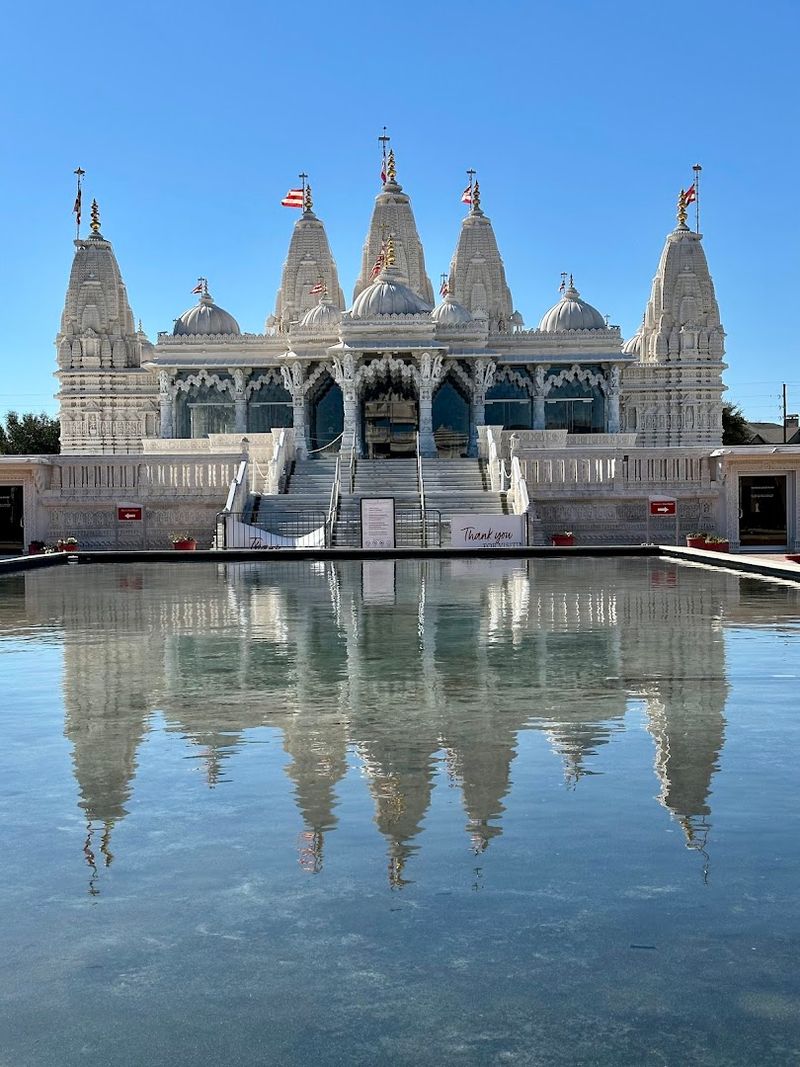
The moment the Mandir appears through the trees, something shifts. Your brain genuinely struggles to process what your eyes are seeing, because nothing in suburban Texas prepares you for this level of architectural drama.
It looks like it was lifted from the heart of India and gently set down between strip malls and highway exits.
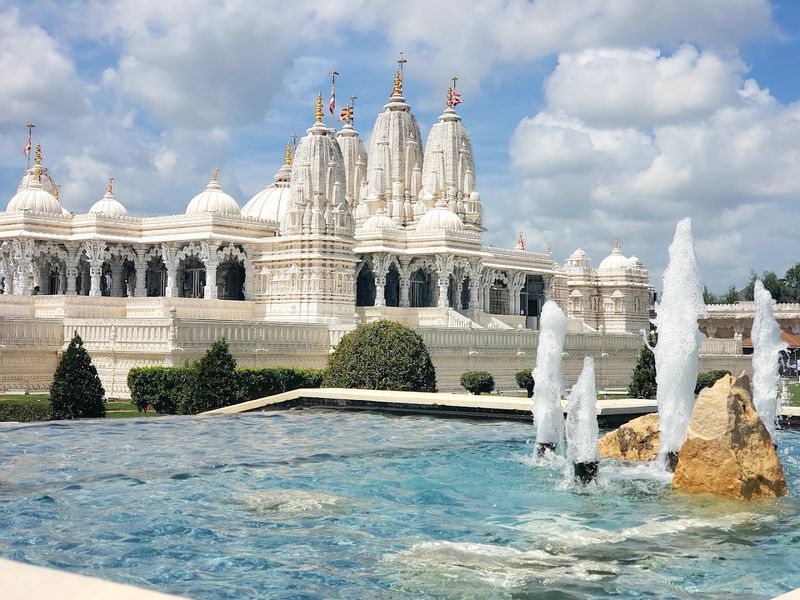
The structure stands 73 feet tall and covers 11,500 square feet of ground. Five towering pinnacles called shikhar rise from the roofline, flanked by eleven smaller domes and one central dome stretching 22 feet across.
The whole thing is wrapped in hand-carved marble and limestone, covered in figures and flowers and geometric patterns that seem to multiply the longer you stare.
What makes that first look so disorienting is the contrast. You are in Stafford, Texas, a place known for its industrial parks and proximity to Houston’s sprawl.
Then suddenly, this. The 25,620-square-foot deck surrounding the Mandir frames it like a stage, and the gated 20-acre property gives it room to breathe and be seen properly.
I remember just standing there for a solid minute, not saying anything, just taking it in. Some places earn your silence before they earn your words, and this is absolutely one of them.
The Staggering Story Behind How It Was Built
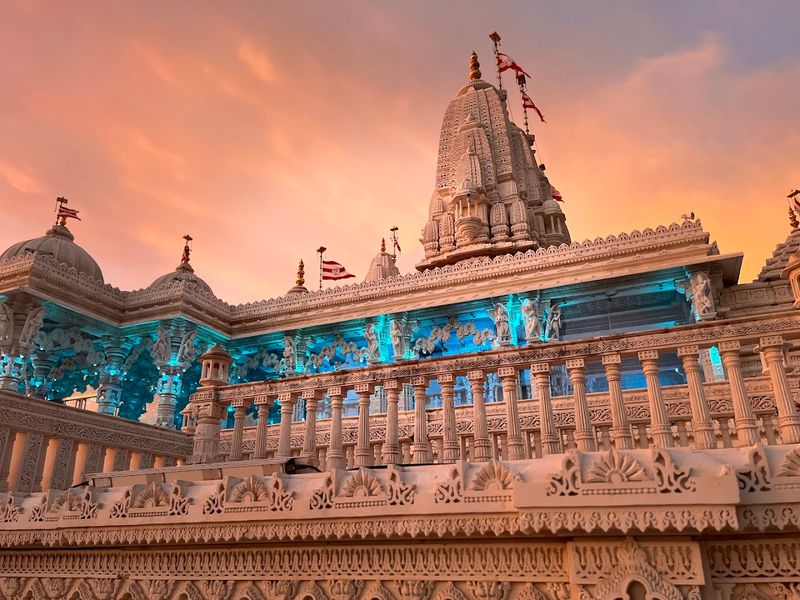
Most buildings come with a construction story that involves cranes, contractors, and a lot of concrete. This one is completely different, and honestly, the more you learn about how it was made, the more remarkable it becomes.
The Mandir was built from roughly 33,000 to 34,000 individual pieces of hand-carved Italian marble and Turkish limestone.
The stone was quarried in Carrara, Italy, and Turkey, then shipped to India, where somewhere between 2,000 and 3,000 traditional artisans spent months hand-sculpting every single piece according to ancient Hindu architectural principles called the Shilpa Shastras. These scriptures are roughly 5,000 years old.
Each carved piece was then shipped to Stafford, where hundreds of local volunteers assembled them like the world’s most intricate three-dimensional jigsaw puzzle.
The entire project ran from 2002 to 2004, drawing an estimated 1.3 to 2 million volunteer hours from people across the community. Here is the detail that really gets people: not a single piece of iron or steel was used anywhere in the construction.
The whole structure holds together through traditional joinery methods that have been trusted for millennia. It was inaugurated on July 25, 2004, by the spiritual leader Pramukh Swami Maharaj.
Knowing all of this while looking at the finished building adds a completely different layer to what you are seeing. It is not just beautiful.
It is a miracle of collective human effort.
Architectural Details That Reward Every Slow Look

Most people walk up to the Mandir and immediately start photographing the big picture, the full facade, the sweeping roofline, the general glory of it all. That is completely understandable.
But the longer you slow down and actually look at the individual details, the more the building reveals itself in the best possible way.
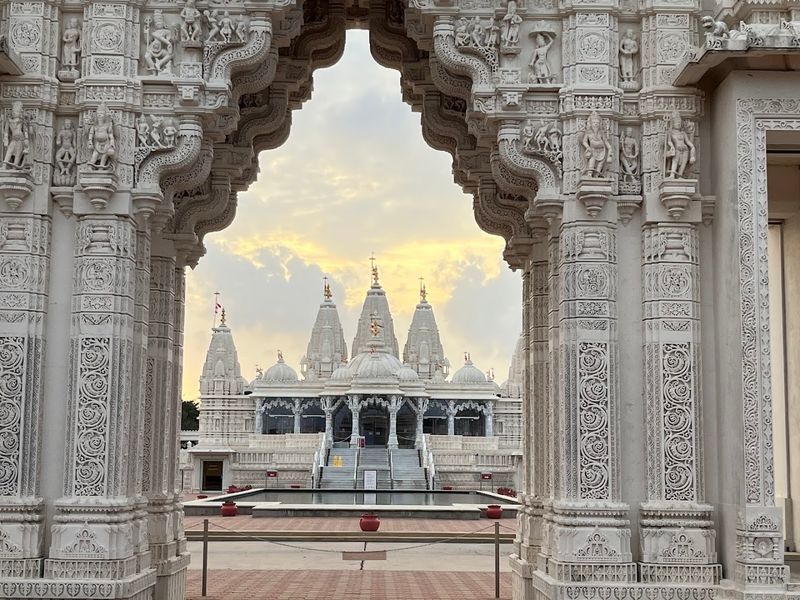
There are 136 pillars on the structure, each featuring one of seven unique carved designs. The ceilings number 70 in total, spread across 24 distinct patterns.
Deities, musicians, animals, lotus flowers, vines, and geometric forms cover nearly every surface, and none of it feels repetitive. You can spend twenty minutes on a single column and still find something new hiding in the stone.
The craftsmanship follows the ancient Shilpa Shastras, which dictate not just proportion and design but also spiritual intention behind every carved element. Each figure and motif has meaning within the tradition.
Even the placement of the five pinnacles, the shikhar, carries symbolic weight tied to Hindu cosmology. I kept circling the exterior, finding new angles, new carvings I had missed on the first pass.
It is genuinely one of those rare places where the more attention you give it, the more it gives back. Bring good walking shoes, a full phone battery, and plan to spend more time outside than you originally expected.
What Visiting the Interior Darshan Actually Feels Like
Stepping inside the Mandir for Darshan, which is the viewing of the sacred shrines, is a genuinely different kind of experience from exploring the exterior. The air is cooler.
The noise of the outside world disappears almost instantly. There is a stillness in there that feels active rather than empty, the kind of quiet that hums with something ongoing.
Photography is not permitted inside, which is actually a gift. It forces you to just be present, to actually look at the shrines and the carvings and the light rather than spending the whole time framing shots.
The interior detail rivals the exterior in its precision, with carved marble surfaces climbing the walls and surrounding each shrine. Devotees move through quietly, and visitors are welcome alongside them as long as the dress code is respected.
Darshan hours run daily at specific windows: 7:30 to 10:30 in the morning, 11:30 to noon, 4 to 6 in the afternoon, and 7 to 8 in the evening. Shoes must be removed before entering, which is standard practice.
The experience is open to everyone and completely free of charge. It is one of those rare situations where a deeply sacred space is also genuinely welcoming to curious outsiders.
Respectful curiosity is met warmly here. Going in without expectations and just letting the atmosphere settle around you is absolutely the right approach.
The Dress Code and Etiquette Worth Knowing Before You Go
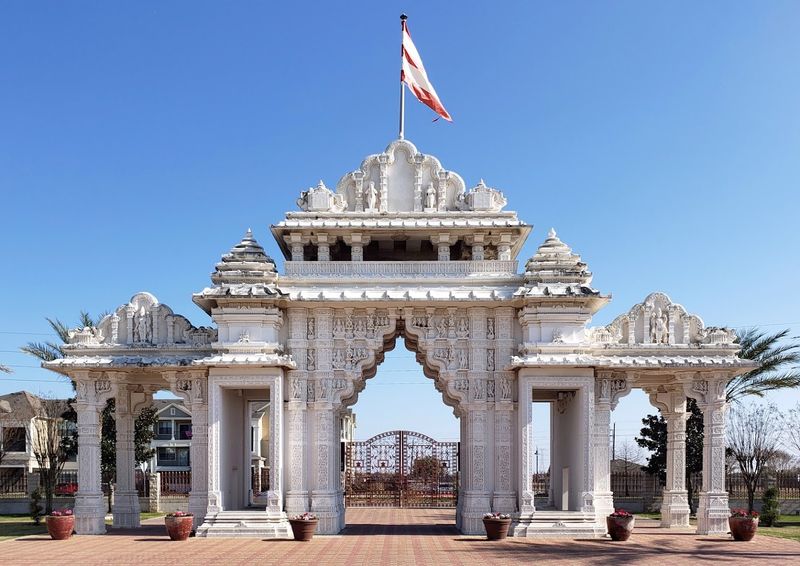
A little preparation goes a long way at the Mandir, and knowing the basic etiquette before you arrive makes the whole visit smoother and more enjoyable for everyone. The rules are simple, sensible, and easy to follow once you know them going in rather than figuring them out at the gate.
Shoes come off before entering the temple. There are designated areas to leave them, and the process is quick and organized.
The dress code requires that clothing covers the knees and shoulders, so shorts, skirts above the knee, and sleeveless tops are not appropriate.
If you show up in shorts on a hot Texas day, which is basically every day from April through October, a simple solution is to keep a light pair of pants or a sarong in your bag.
Photography is fine on the ground level outside, great news for anyone who wants to document the exterior in detail. Inside the Mandir itself, cameras and phones stay put away.
This is not a rule that feels restrictive once you are in there. It genuinely improves the experience.
The overall atmosphere is calm and welcoming, and the staff and volunteers are patient with first-time visitors who have questions. Arriving a few minutes before a Darshan window opens gives you a chance to get oriented without feeling rushed.
The whole visit moves at its own gentle pace, and matching that rhythm makes it noticeably better.
Shayona Cafe, the Vegetarian Gem Hidden on Campus
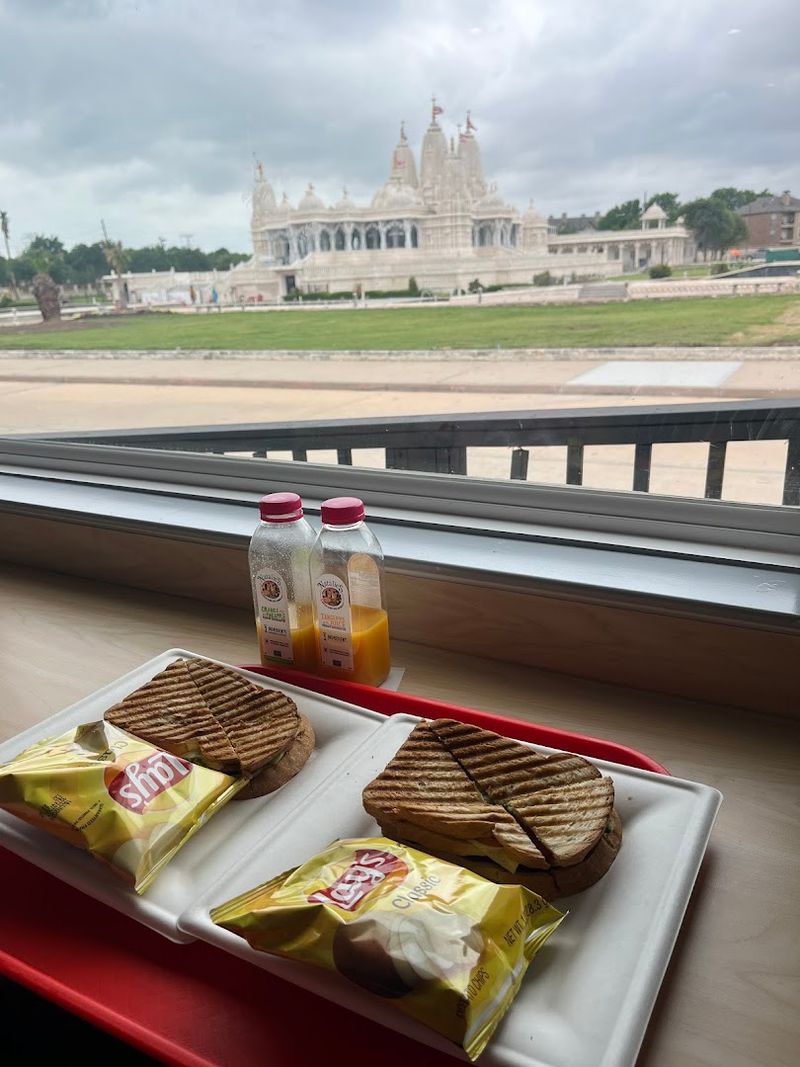
After spending a couple of hours wandering the exterior and going through Darshan, hunger tends to show up right on schedule.
Fortunately, the campus has you covered with Shayona Cafe, a casual vegetarian restaurant that sits right on the property and serves traditional Indian food made with real care.
The menu is fully vegetarian, which fits the spiritual values of the BAPS Swaminarayan tradition. That said, even dedicated meat eaters tend to leave happy.
Indian vegetarian food, done well, is genuinely satisfying, and the portions here are generous. Think fresh rotis, lentil dishes, rice, and seasonal specials prepared with spices that smell incredible from halfway across the dining area.
It is not a fancy restaurant by any stretch. The vibe is relaxed and communal, the kind of place where families gather and conversations flow easily between tables.
The cafe operates as part of the larger campus community, and that warmth carries into the dining experience. Grabbing a meal here rounds out the visit in a way that feels natural rather than like an afterthought.
It is also a genuinely affordable option compared to most sit-down restaurants in the area. Visiting on an empty stomach is highly recommended so you can fully appreciate what is on offer.
The Gift Shop and What Makes It Worth Browsing

Not every temple gift shop is worth your time, but the one on the BAPS campus is a genuinely interesting stop, especially if you are curious about the tradition and want to take something meaningful home. It is not crowded with tourist trinkets.
The items lean toward devotional goods, books, and cultural pieces that reflect the BAPS Swaminarayan tradition with real thoughtfulness.
You will find books about the history of the Mandir itself, which are worth picking up if you want to go deeper into the story behind the architecture and the community that built it. There are also small murti figures, incense, and items used in daily Hindu worship.
For visitors who are new to the tradition, browsing the shop is actually a quiet education in itself. Labels and descriptions help contextualize what you are looking at.
The staff in the shop are friendly and genuinely happy to answer questions, which makes the experience feel personal rather than transactional. Even if you do not end up buying anything, spending ten minutes in there adds context to everything you saw outside.
A small book about the Mandir’s construction or the Swaminarayan tradition makes for one of those rare souvenirs that actually gets read after you get home.
Why This Place Matters Far Beyond Its Beauty

It would be easy to visit the BAPS Shri Swaminarayan Mandir purely as an architectural spectacle, take some photos, admire the carvings, and move on. But the longer you spend on the campus, the more you understand that this place is doing something much larger than looking impressive.
It is a functioning spiritual and cultural center for one of the largest Hindu organizations in the world.
The BAPS Swaminarayan Sanstha has mandirs across the globe, but this one carries particular significance as the first traditional stone-and-marble mandir of its kind built in North America.
The community that gathered here to assemble it, volunteer by volunteer, hour by hour, was making a statement about belonging, about culture, about the kind of permanence that comes from building something with your own hands in a place you have chosen to call home.
For the broader Houston area, which has one of the most diverse populations of any city in the United States, the Mandir represents something that goes beyond religion. It is a point of civic pride, a cultural landmark, and a reminder that Texas contains multitudes.
Visitors from every background show up here regularly, drawn by curiosity, beauty, and the quiet pull of a place that genuinely feels different from anything else around it. Going in with an open mind and a willingness to learn turns a sightseeing trip into something you will actually remember for years.
Practical Tips for Planning Your Visit Right
Getting the most out of a trip to the Mandir comes down to a few small planning decisions that make a surprisingly big difference. The exterior is open daily from 9 in the morning until 8:30 at night, giving you a wide window to visit without rushing.
Interior Darshan runs during specific time slots, so checking the schedule before you go and timing your arrival accordingly is genuinely worth the two minutes it takes.
Parking is available on the gated campus, and admission is completely free. The grounds are well maintained and easy to navigate on foot.
Wear comfortable shoes since you will be walking a fair amount across the deck and around the exterior before removing them to go inside. Mornings on weekdays tend to be quieter than weekend afternoons, which is worth considering if you prefer a more relaxed pace.
Bringing a small bag with a change of clothing layers is smart, especially since the dress code requires covered shoulders and knees. Texas heat is real, so light, breathable fabrics that still meet the requirements make the experience much more comfortable.
Plan to spend at least two to three hours on the campus to do it justice, including time for Darshan, a walk around the exterior, a stop at Shayona Cafe, and a browse through the gift shop.
The Mandir sits at 1150 Brand Ln, Stafford, TX 77477, about 20 minutes southwest of downtown Houston, making it an easy and very rewarding day trip.
