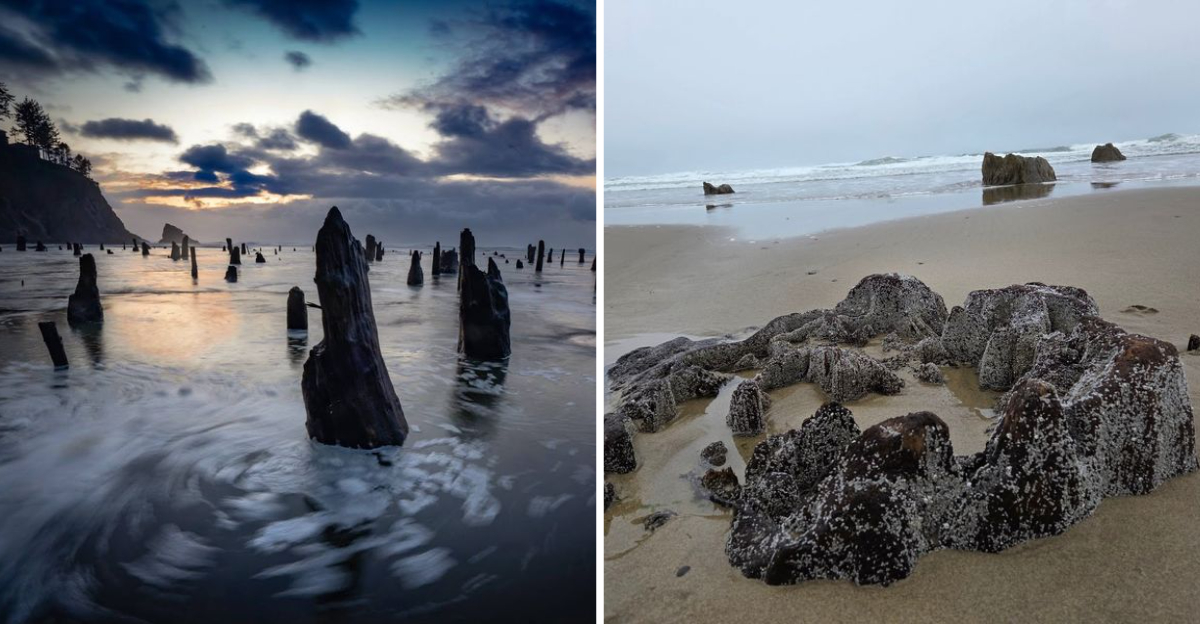
There’s something hauntingly beautiful about watching nature slowly reclaim what was once hers. That’s exactly what you’ll witness at this Oregon beach, where ancient tree stumps stand like silent sentinels in the surf. They’re a reminder that nothing stays the same forever.
The ghost forest emerges during low tide, a collection of weathered stumps that were buried for centuries beneath sand and soil. Now the ocean is gradually swallowing them again, bit by bit, year after year.
It’s humbling to stand there, knowing those trees have witnessed more change than we could ever imagine. You don’t need to be a history buff or a scientist to feel the weight of that. You just need to stand still, watch the waves roll in, and let it sink in.
Take a walk along this beach, but bring your camera and a little patience. Oregon’s disappearing forest is a sight you won’t soon forget.
An Ancient Forest That Only Shows Up at Low Tide
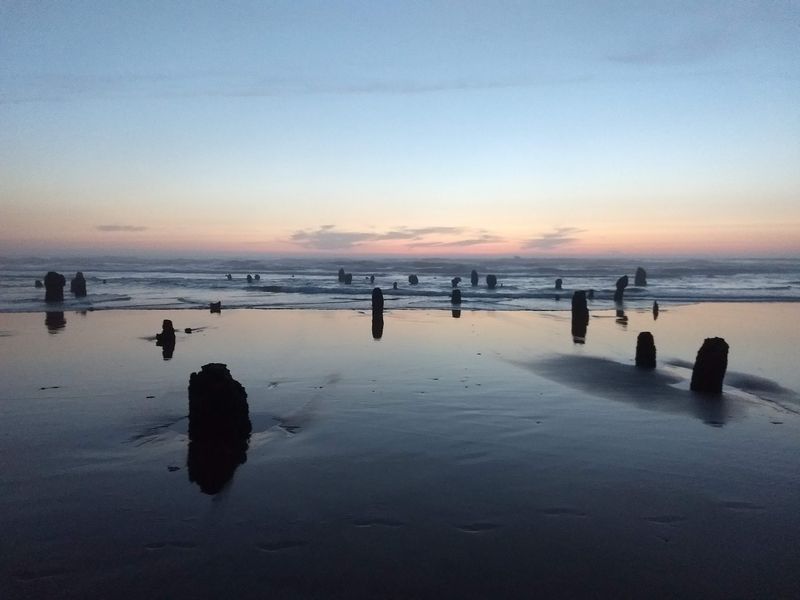
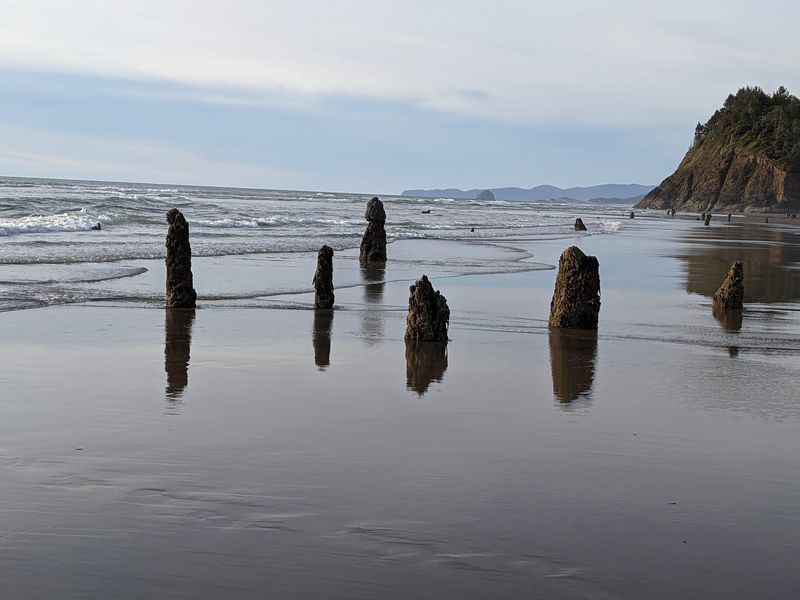
Low tide rearranges this whole beach. Water pulls back, and dark stumps push up through the wet sand like blunt, broken teeth. Those shapes are the remains of Sitka spruce trees that grew here in a real coastal forest, long before the town existed.
Salt water and sand preserved them instead of rotting them away.
Numbers vary depending on the day. Some visits reveal only two or three visible stumps, while a very low tide can expose many more scattered south of the creek. Sand movement plays a huge role too, burying the trunks one winter and uncovering them the next.
What makes the walk memorable is the mix of scales. Underfoot sits something roughly two thousand years old, while gulls squabble overhead and the surf keeps its steady rhythm.
Plan for a quiet, slightly strange kind of sightseeing rather than a dramatic viewpoint. The reward comes from noticing details, like barnacles crusted on ancient wood and shallow pools ringing each stump.
Bring patience. The forest shows up on the ocean’s schedule, not yours.
The Sitka Spruce Stumps and Their Long Story
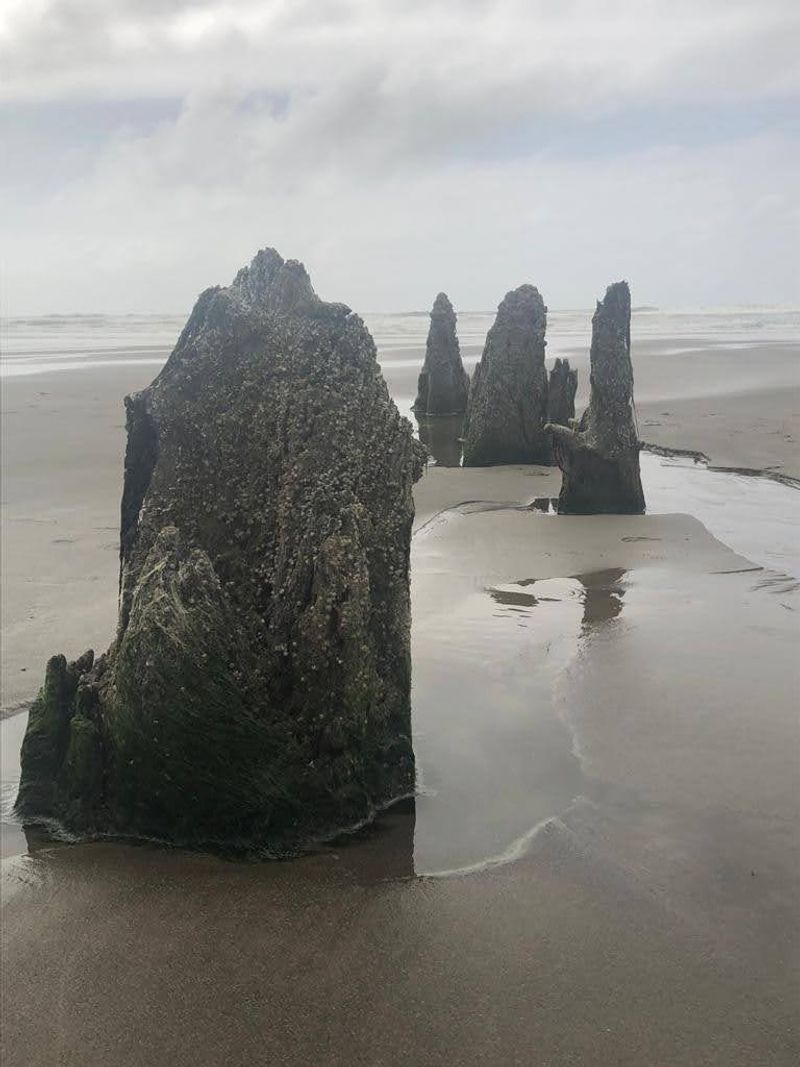
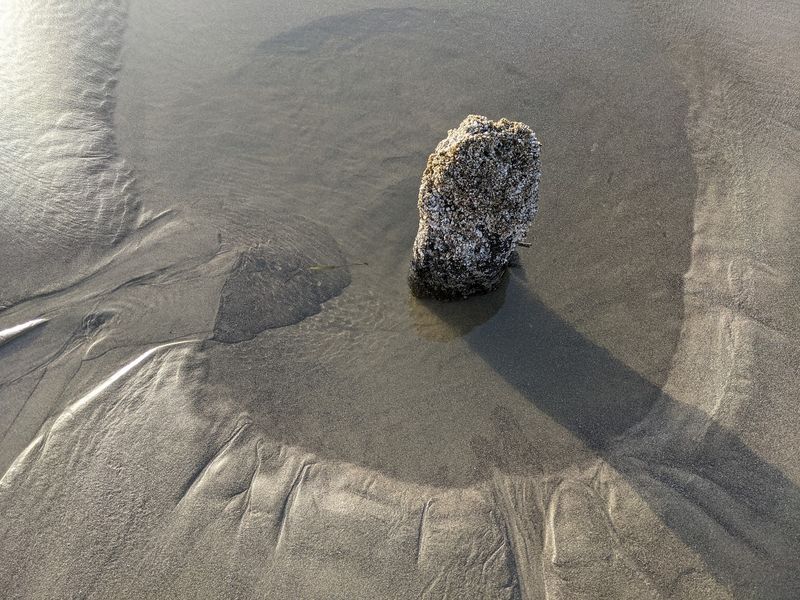
Run a hand across one of the stumps and the texture surprises: hard, dense, almost stone-like in places, studded with shells.
These were Sitka spruce, the same species that still lines the headlands above the beach. Some trunks were wide enough that the remaining bases look like small tables. Growth rings are mostly gone from the surface, worn smooth by centuries of waves, though a few faint circles survive.
Researchers have dated the wood to roughly two thousand years ago, placing the forest well before European contact on this coast. Height is deceptive now. Only knee-high or waist-high remnants remain, so picturing tall spruce in the same spot takes a bit of mental effort.
Shells and mussels colonize the tops, turning each stump into a tiny reef. Shoot low to the ground for drama, because a stump silhouetted against foam and gray sky reads far better than an overhead photo.
One small courtesy matters here. Climbing and carving damage soft, waterlogged wood that cannot repair itself, so look closely and leave the surface alone.
How an Earthquake Turned Woods Into Beach
Geologists connect the ghost forest to the Cascadia Subduction Zone, the fault line running offshore along the Pacific Northwest. During a massive quake, land can drop suddenly. Forest floor sinks below sea level, and salt water rushes in over the roots.
Trees die quickly in those conditions, then mud and sand seal the trunks before decay can finish the job. Geology rarely feels this immediate. That burial explains why the stumps still stand upright rather than lying scattered like driftwood.
Several ghost forests dot the Oregon and Washington coastline, and Neskowin remains one of the easiest to reach on foot.
Reading about it beforehand changes the mood of the walk. Instead of odd beach debris, the stumps become evidence of one violent afternoon centuries ago. There is something sobering in that, especially knowing the same fault is still active today.
Tsunami evacuation signs along the coast highway suddenly make more sense afterward. Kids often ask the obvious question first, wondering how trees ended up in the ocean, and the answer usually holds their attention longer than expected.
Proposal Rock, the Landmark You Cannot Miss
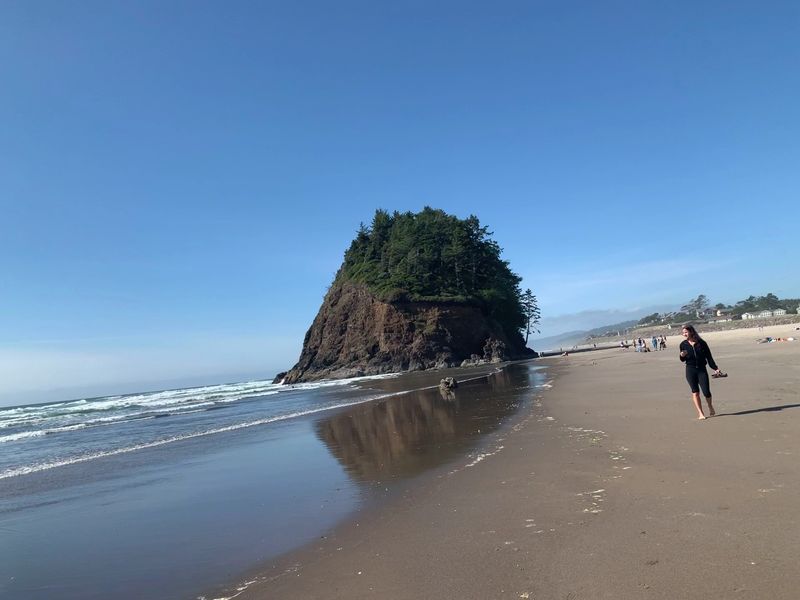
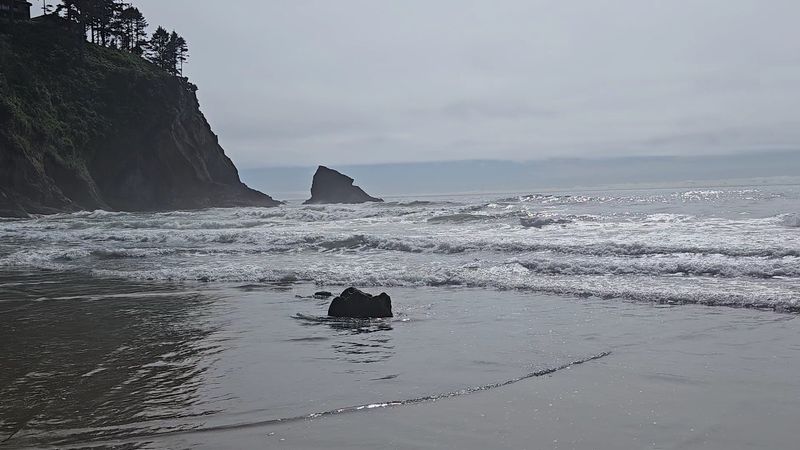
Before the stumps appear, attention goes straight to Proposal Rock, a tree-covered sea stack sitting near the creek mouth. Its shape is round and green on top, almost like a small island that wandered too close to shore.
At lower water, walking around the base becomes possible, and arches and hollows open up on the seaward side. Barnacles, mussels and anemones cling to the rock in thick bands, each one marking a different tide level.
Photographers usually find the best angles from the south side, with the rock framed against surf and stumps in the foreground. Caution helps here. Waves wrap around sea stacks fast, and the sand near the base can hide deeper channels than it appears.
Children tend to love the caves and puddles more than the ancient wood, which is fair enough. The name comes from local tradition, and plenty of visitors still treat the rock as a scenic spot for a marriage question.
North of it, the coastline opens toward Cape Kiwanda. Clear days stretch that view surprisingly far. It anchors the whole beach.
Timing Everything Around the Tide Table
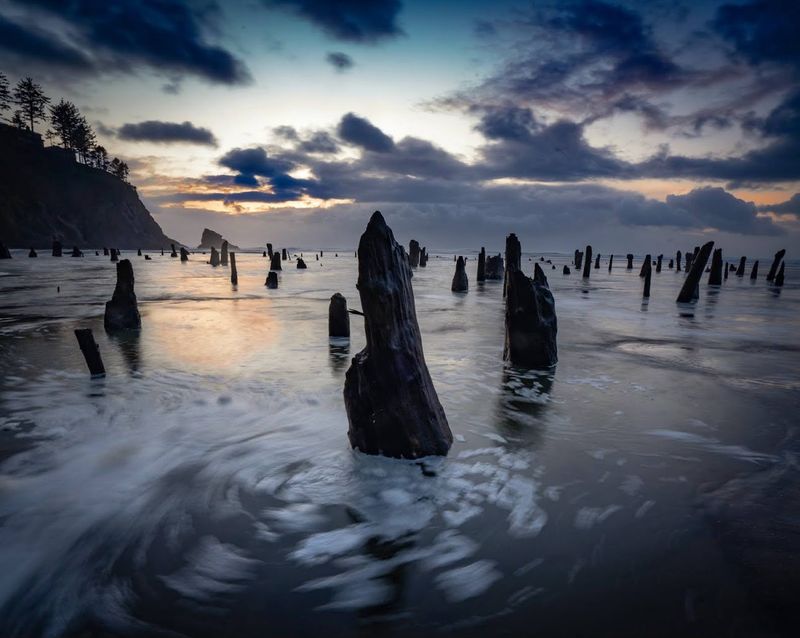
Tide charts decide whether the trip works or flops. At high water, the stumps sit hidden and the beach shrinks to a narrow strip. Aim for a tide of roughly one foot or lower, and arrive thirty to sixty minutes before the low point.
Free tide tables for Lincoln City or Pacific City give close enough numbers for Neskowin. Minus tides, which happen a few times each month, expose the widest stretch of sand and the greatest number of trunks.
Winter and early spring often bring the most dramatic conditions, partly because storms strip sand away and reveal buried wood. Summer visits still work, though drifted sand can cover much of the forest for weeks at a time.
Set a turnaround time before starting the walk. Incoming tide moves quickly across flat sand, and the creek crossing deepens as water returns. Sunset lows are the sweet spot for photos, mixing warm light with mirrored sand. Checking twice beats driving out for nothing. Weather reports help too.
Crossing Neskowin Creek Without Regrets
Neskowin Creek runs across the sand between the parking area and the stumps, and there is no bridge on the beach. Depth changes constantly. During a good low tide it can be ankle deep, while after heavy rain it reaches the knees or higher.
Water shoes or old sneakers beat bare feet, since the bottom holds gravel, shells and the occasional buried branch. Rolled trousers help. So does a small towel stashed in a bag.
Look for the widest, shallowest section rather than the narrowest, because narrow usually means faster and deeper. Walking beside the creek on packed sand also saves energy compared with slogging through soft dunes near the trail.
After storms or flooding, the crossing turns genuinely awkward and the stumps may sit inside a temporary lake. Waiting a few days for drainage usually pays off, and the beach itself stays lovely in the meantime. Nobody enjoys soggy socks for the drive home.
Parking, the Path and the Walk Itself
The route mapping apps sometimes suggest leads into a gated residential area, so skip Beach Road and head for the public beach access instead. Parking sits near Hawk Creek Cafe in the middle of the village, with a short signed path leading down to the sand.
From there, expect fifteen to twenty minutes of walking south, longer if the sand is dry and loose. Soft sand tires legs faster than the distance suggests, so drift toward the firmer band near the waterline.
Wheelchairs and strollers struggle badly on this stretch, which is worth knowing before planning a group outing. Restrooms are limited in the village, so handle that before setting out.
Layers matter more than heavy coats. Coastal wind arrives without warning, and fog can drop the temperature in minutes. Pack water and a snack, since there is nothing to buy once the walk begins.
Local streets are narrow and residential, so use the designated lot and keep noise down out of respect for neighbours.
Fog, Gray Light and Why Photographers Love It
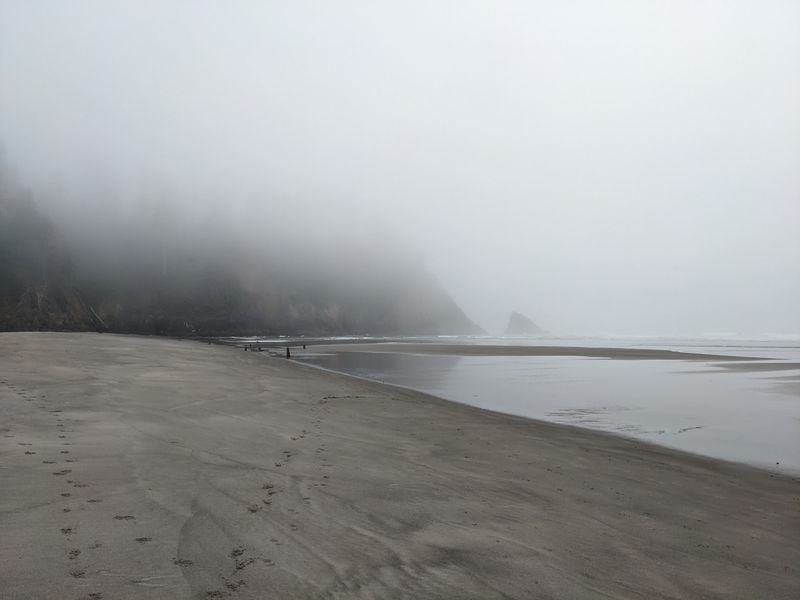
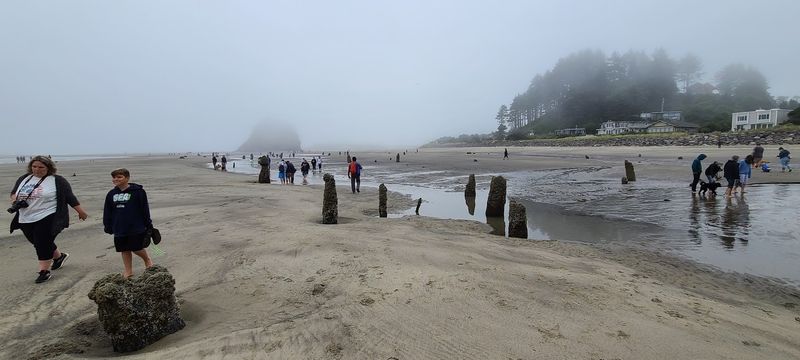
Sunshine is pleasant, but fog is what makes this beach look otherworldly. Mist softens Proposal Rock into a shadow, and the stumps turn into dark silhouettes with almost no background at all.
Wet sand acts like a mirror after the tide retreats, doubling every shape and every streak of cloud. Morning often delivers the heaviest fog, while late afternoon brings low, angled light that picks out texture in the old wood.
A polarizing filter cuts glare off standing water, and a low camera angle exaggerates the height of the stumps. Phone cameras handle the scene surprisingly well, especially in portrait mode close to a single trunk.
Protect gear from spray and blowing sand. A plastic bag and a lens cloth cover most problems. Black and white processing suits the mood, though the greens of the headland deserve colour too.
Even without a camera, the quiet is the point. Sound carries oddly in thick fog, and voices seem to vanish a few steps away. Few beaches feel this hushed.
Tide Pools, Shells and Small Coastal Life
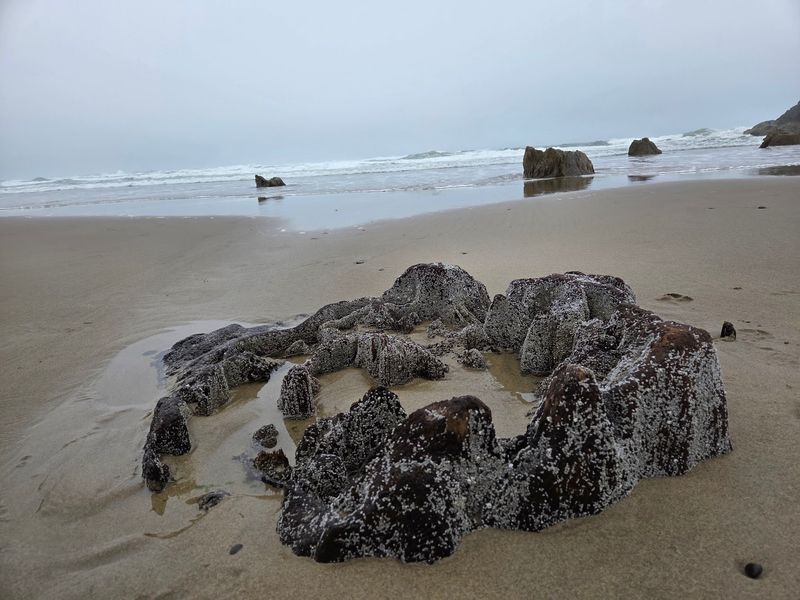
Ancient wood gets the headlines, yet the living creatures nearby steal plenty of attention. Hollows in the beach rocks trap seawater, creating miniature pools where tiny crabs and snails wait out the low tide.
Mussel beds coat the base of Proposal Rock in dense, shiny clusters, and anemones close up like green blobs when exposed to air. Shorebirds work the shallows, probing the sand with quick, jabbing movements.
Look but do not collect. Harvesting shellfish requires licences and regulations, and moving animals between pools often kills them. Sand dollars, crab shells and polished agates turn up regularly along the wrack line, especially after storms.
Kids can spend an hour on a single pool without getting bored, which makes the long walk back easier to negotiate. Rock surfaces get slick with algae, so step carefully near the sea stack. Keep dogs leashed near nesting birds. It keeps the peace for everyone.
Watching a hermit crab shuffle across an ancient stump stays oddly satisfying, no matter your age.
Practical Notes for a Respectful Visit
Daylight hours cover most visits, with beach access generally open from early morning until around five in the evening. Cell service can be patchy, so download tide charts and maps before arriving.
Weather on Highway 101 shifts fast, and winter landslides occasionally close sections, making a quick check of road conditions worthwhile. Neskowin is a small, quiet community rather than a tourist strip, so keep voices low and stick to public access points.
Leave the stumps as found, pack out rubbish, and skip stacking rocks or carving initials. Pair the walk with a stop in the village shops for a warm drink and a browse before driving on. Allow two hours minimum for the round trip, more if photography is involved.
A thermos and dry socks waiting in the car make the ride home much nicer. The forest will not last forever, since waves and shifting sand keep wearing it down year after year.
