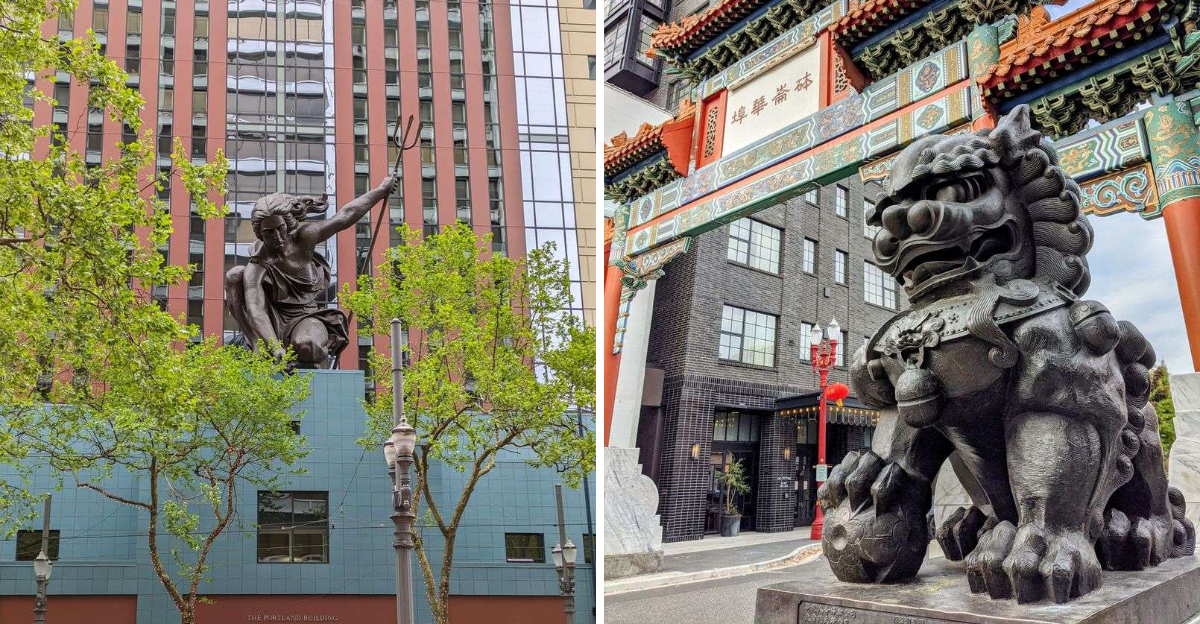
Oregon has always marched to the beat of its own drum, and nowhere is that more obvious than in the public art scattered across the state.
I’ve spent years exploring this quirky corner of the Pacific Northwest, and I can tell you that Oregonians don’t do statues the way everyone else does.
Instead of predictable bronze generals on horseback, you’ll find giant lumberjacks, dragons with questionable accessories, and salmon literally swimming through buildings. Each one sparks conversation, debate, and occasionally outrage.
Some locals defend these sculptures as essential expressions of regional character, while others roll their eyes and mutter about tax dollars.
What makes these statues so fascinating isn’t just their oddball appearance but the passionate responses they provoke.
I’ve watched tourists snap selfies while residents argue about artistic merit, and honestly, that’s part of what makes Oregon so entertaining. Join me as I walk you through nine of the most controversial, beloved, and downright bizarre statues the state has to offer.
1. Portlandia, Portland
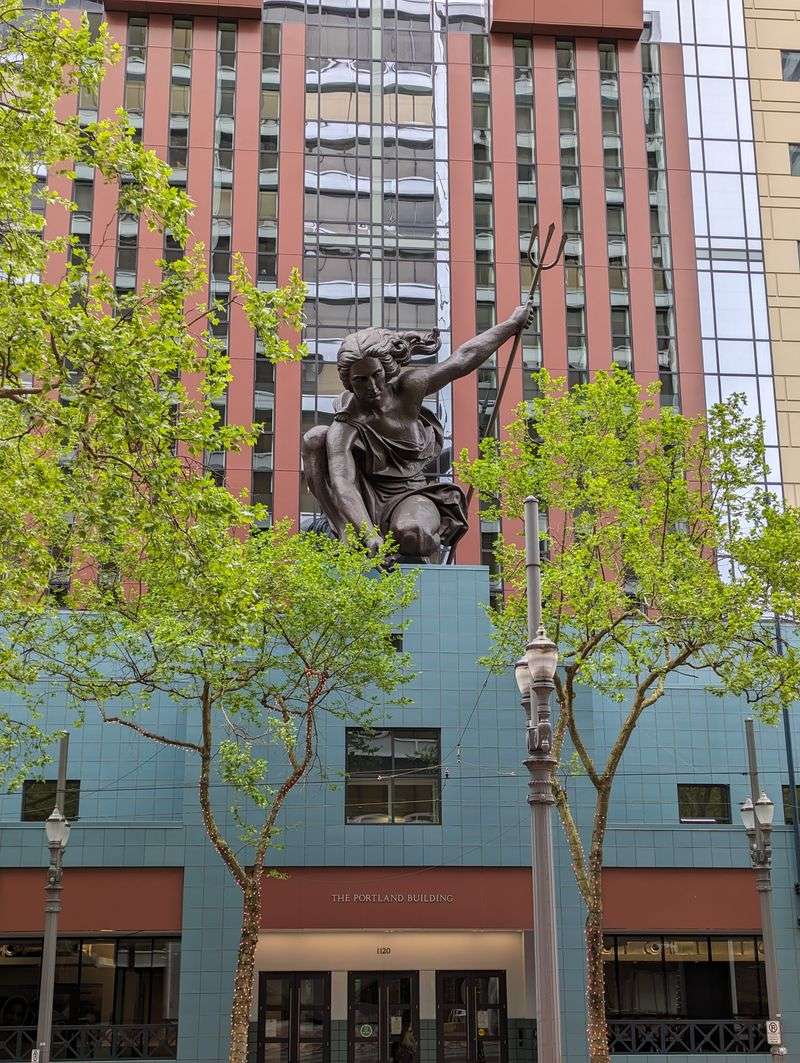
Perched above the entrance to the Portland Building downtown, this massive copper lady has been watching over the city since 1985. At over 34 feet tall, Portlandia ranks as the second-largest hammered copper statue in the country, trailing only the Statue of Liberty.
Artist Raymond Kaskey designed her to represent the spirit of Portland, kneeling with a trident in one hand and reaching downward with the other. The pose is meant to welcome visitors, though some folks think she looks more like she’s about to topple off the building.
Getting her installed was a whole production. She had to be barged up the Willamette River in pieces because she was too big to transport by truck.
Thousands of Portlanders lined the waterfront to watch her arrival, turning it into an impromptu parade.
People have strong feelings about her appearance. Some think she’s elegant and powerful, a fitting symbol for the city.
Others find her face oddly expressionless, even derpy, and question whether she truly captures Portland’s personality.
The statue inspired the name of the television show Portlandia, which poked fun at the city’s eccentric culture for eight seasons. Love her or not, she’s become an undeniable part of Portland’s identity, sparking conversations about public art and civic representation for nearly four decades.
2. Beverly Cleary Sculptures, Portland
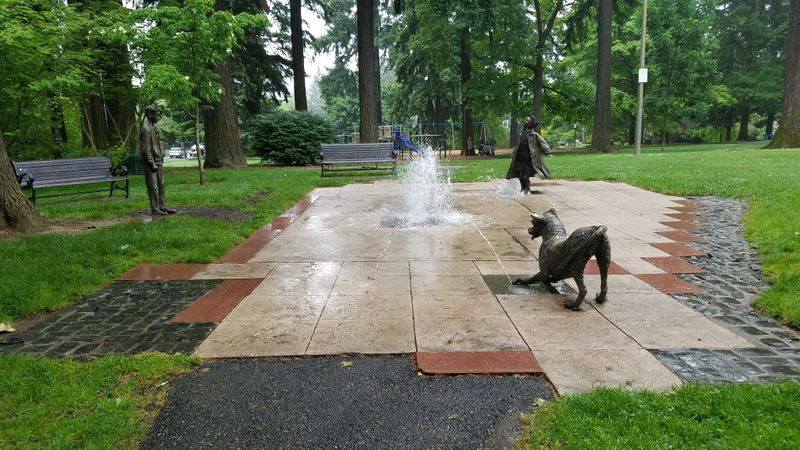
Grant Park in northeast Portland hosts three bronze kids who never age. Ramona Quimby, Henry Huggins, and Henry’s dog Ribsy stand frozen mid-adventure, honoring author Beverly Cleary, who called Portland home for much of her life.
Sculptor Lee Hunt created these figures in 1995, capturing the characters exactly as generations of readers imagined them. Ramona stomps through a puddle in her boots, Henry clutches his fishing pole, and Ribsy sits alert at his side.
Cleary’s books, set in Portland’s Klickitat Street neighborhood, introduced millions of children to the city’s quirks and charms. The statues sit in a park she actually played in as a child, creating a beautiful circle connecting fiction to reality.
Unlike many controversial Oregon statues, these three earn almost universal affection. Parents bring their kids to climb on Ribsy’s back and pose with Ramona.
Teachers organize field trips to discuss literature and local history.
The sculptures represent something rare in public art: a piece that makes people genuinely happy. No debates about aesthetics or appropriateness here, just pure nostalgia and appreciation for stories that shaped childhoods.
They remind us that sometimes the best monuments celebrate imagination rather than historical figures.
The statues have become a beloved Portland tradition, proving that honoring children’s literature can create meaningful public spaces everyone enjoys.
3. Grants Pass Caveman, Grants Pass
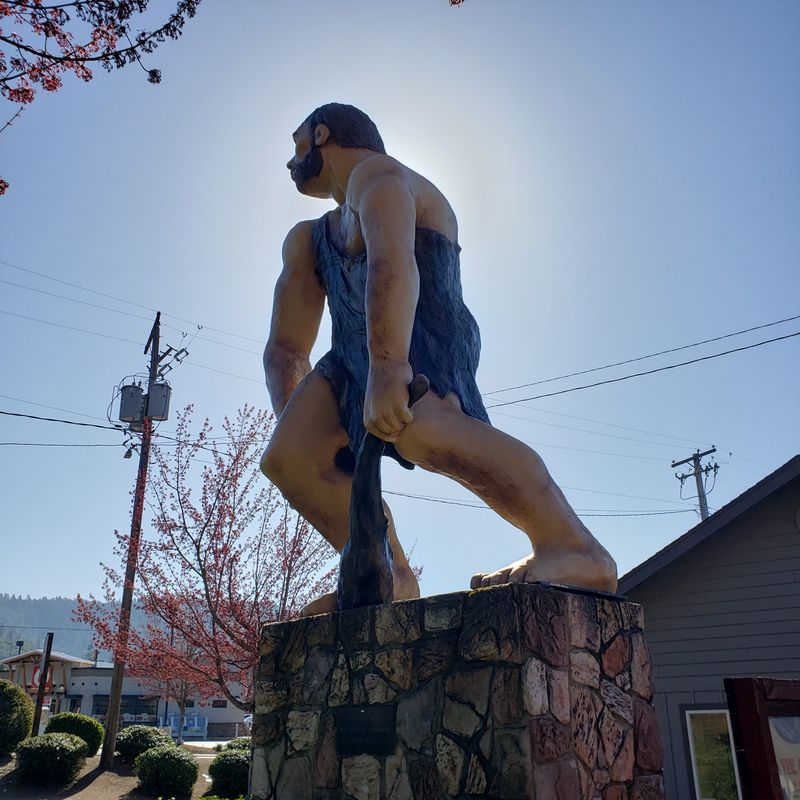
Standing guard over downtown Grants Pass, this club-wielding prehistoric figure embodies small-town roadside Americana at its finest. The caveman has been the town’s unofficial mascot since the 1920s, when someone decided ancient cave dwellers once roamed the area.
Historical accuracy takes a backseat here. The statue celebrates the Oregon Caves, located about 50 miles away, and plays into mid-century tourist marketing that valued memorable gimmicks over archaeological precision.
Multiple versions of the caveman have existed over the decades. The current fiberglass iteration went up in 1971, replacing earlier wooden models that succumbed to weather and time.
He’s become such a fixture that the high school sports teams are called the Cavemen.
Opinions split along predictable lines. Longtime residents view him with affection, a harmless relic of simpler times when roadside attractions ruled family vacations.
Critics see outdated kitsch that doesn’t represent modern Grants Pass particularly well.
The caveman appears on city signage, business logos, and countless tourist snapshots. Whether you find him charming or embarrassing often depends on your tolerance for vintage tackiness.
He’s survived multiple proposals for removal, protected by nostalgia and the argument that he brings tourist dollars.
Love him or laugh at him, the Grants Pass Caveman isn’t going anywhere soon, club raised high above the Rogue River Valley.
4. Old Town Chinese Dragons, Portland
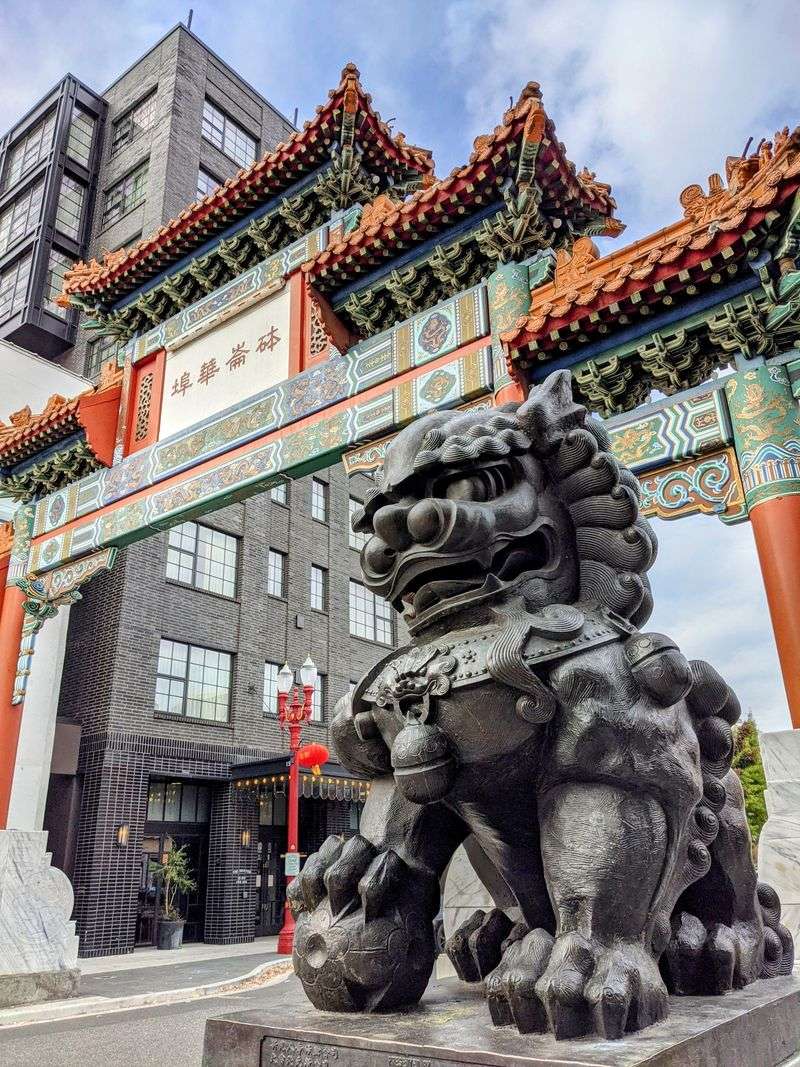
Portland’s Chinatown gateway features five dragon statues that ignited unexpected controversy. Artist Shan Shan Sheng created them in 2001 to honor the neighborhood’s Chinese heritage, but one design element sparked immediate backlash.
Each dragon wears what appears to be a stainless steel collar around its neck. To many in the Chinese community, this detail evoked painful associations with subjugation and control, symbols deeply inappropriate for creatures that represent power and good fortune in Chinese culture.
The artist maintained the collars were decorative elements, not symbols of bondage. Community members disagreed, arguing that dragons should never be depicted as restrained or subservient, especially in art meant to celebrate Chinese cultural contributions to Portland.
Calls for removal or modification began almost immediately after installation. The debate highlighted larger questions about cultural consultation in public art and who gets to decide what appropriately represents a community.
Years of discussion followed, with passionate voices on multiple sides.
Eventually, the city agreed to remove the collars, though the process took considerable time and expense. The modified dragons now stand collar-free, though the controversy left lasting impressions about the importance of cultural sensitivity in civic projects.
This statue saga demonstrates how seemingly small design choices can carry enormous symbolic weight, and why diverse input matters when creating art meant to honor specific communities and their histories.
5. Paul Bunyan Statue, Portland
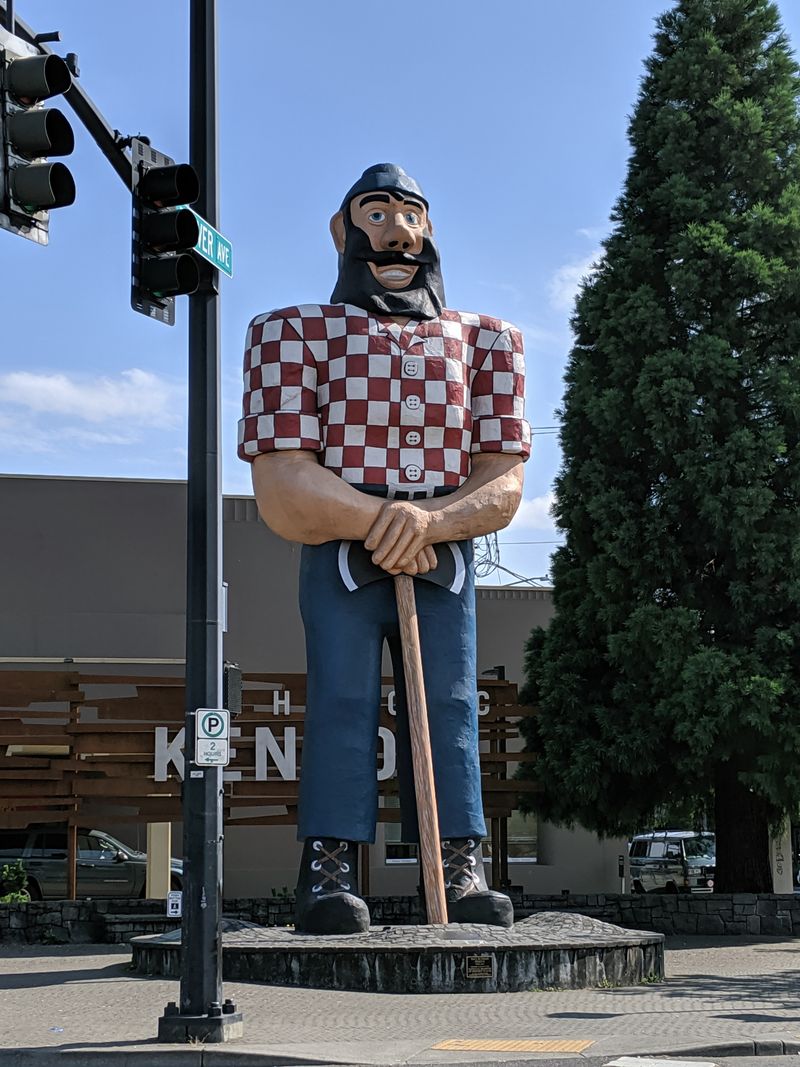
Towering 31 feet above the Kenton neighborhood, this giant lumberjack greets visitors with a permanent wave and an enormous grin. Built in 1959 for Oregon’s centennial celebration, Paul Bunyan embodies the state’s logging heritage in the most literal way possible.
His creator, Kenton merchant Kenny McKay, wanted something that would draw attention to the neighborhood. Mission accomplished.
The bright colors and cartoonish proportions make him impossible to miss, standing beside Interstate 5 like a cheerful giant from a children’s story.
Paul talks. A motion sensor triggers recorded messages when people approach, though the current voice sounds less like a rugged woodsman and more like someone’s enthusiastic uncle.
The talking feature delights kids and creeps out adults in roughly equal measure.
Reactions range wildly. Some Portlanders embrace him as charming Americana, a nostalgic nod to simpler times and Oregon’s natural resource economy.
Others find him garish and outdated, a relic that glorifies an industry with complicated environmental and social impacts.
He’s survived several restoration efforts, including a major renovation in 2009 that refreshed his paint and updated his electronics. The statue represents a specific era’s vision of Oregon identity, one focused on timber and frontier mythology.
Whether that vision still resonates depends entirely on who you ask, but Paul keeps waving regardless.
6. Transcendence, Portland
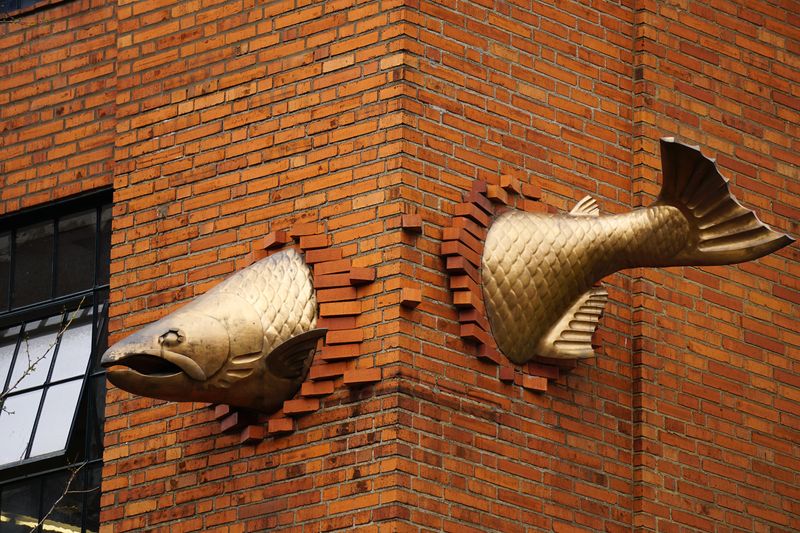
A salmon appears to swim straight through a brick building in northwest Portland, creating one of the city’s most surreal public art moments. Artist Dan Webb installed Transcendence in 2010, and people have been arguing about it ever since.
The sculpture depicts a chinook salmon mid-journey, its body emerging from one side of a building and disappearing into the other. The concept plays on Portland’s relationship with salmon, creatures that famously return home against impossible odds, swimming upstream through obstacles.
Webb chose this particular building on Northwest Davis Street deliberately. The salmon appears to be swimming eastward, the direction real salmon travel when returning from the ocean to spawn in rivers and streams throughout Oregon and the Pacific Northwest.
Artistic merit becomes the main debate point. Supporters praise the piece as clever and thought-provoking, a visual metaphor for persistence and homecoming that perfectly captures Portland’s environmental consciousness.
Detractors find it heavy-handed, arguing that the symbolism is too obvious and the execution looks more silly than profound.
The salmon has become a popular photo opportunity, with visitors posing beneath it and debating its meaning. Some locals barely notice it anymore, while newcomers often do double-takes when they first spot a fish apparently defying physics.
The sculpture succeeds in making people look twice and think about salmon, urban wildlife, and what public art should accomplish.
7. Prehistoric Gardens Dinosaurs, Port Orford
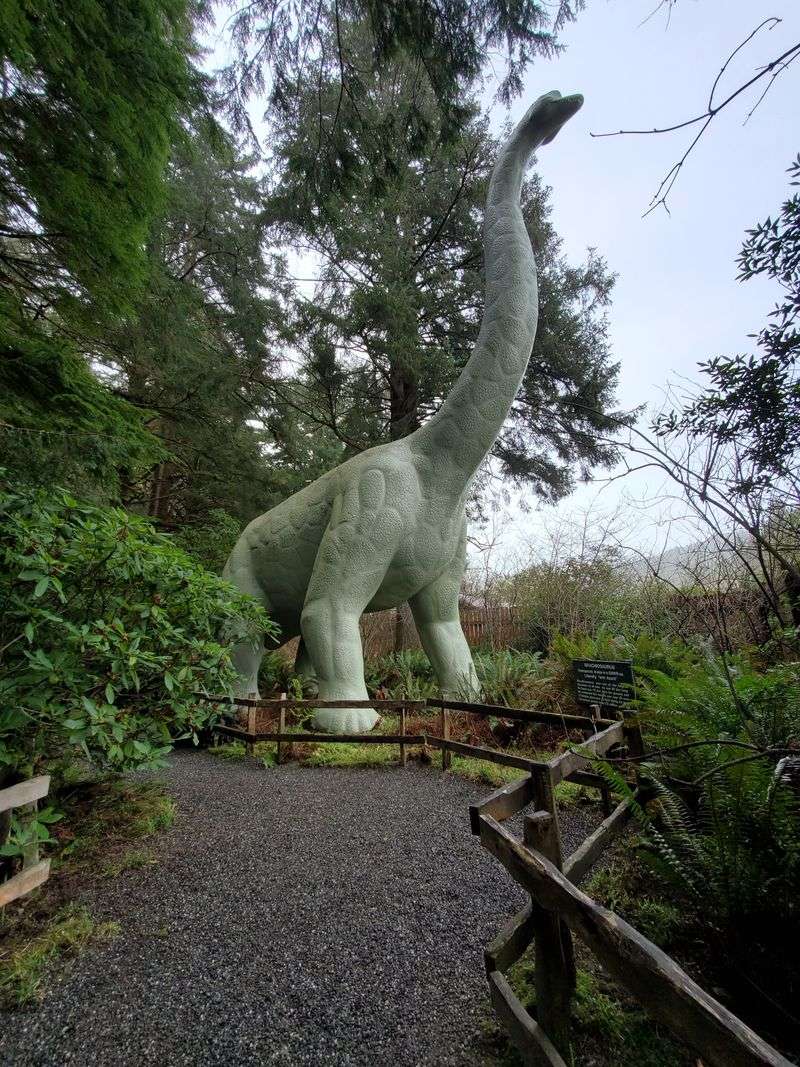
Hidden in a coastal rainforest south of Port Orford, dozens of brightly painted dinosaurs lurk among the ferns and towering trees. Prehistoric Gardens has been luring curious travelers off Highway 101 since 1955, when sculptor E.V.
Nelson began populating the forest with his concrete creations.
Nelson built each dinosaur by hand, using chicken wire, rebar, and concrete to create species ranging from Tyrannosaurus rex to Stegosaurus. He painted them in vivid colors that have nothing to do with scientific accuracy and everything to do with catching attention.
The attraction occupies a unique space between educational exhibit and pure roadside kitsch. Signs provide information about each species, though the scientific content hasn’t been updated much since the Eisenhower administration.
The dinosaurs themselves look charmingly retro, products of a pre-Jurassic Park era when people imagined prehistoric creatures very differently.
Visitors either love the place for its vintage charm or dismiss it as outdated and silly. Families with young kids tend to have a blast, while paleontology enthusiasts might cringe at the inaccuracies.
The lush coastal forest setting adds unexpected beauty to the experience, making it feel like stumbling into a time capsule.
Prehistoric Gardens represents a specific type of American roadside attraction that’s rapidly disappearing. Its survival depends on people who appreciate handmade oddities and don’t mind that the dinosaurs look nothing like modern scientific reconstructions suggest they should.
8. Portland Horse Rings, Portland
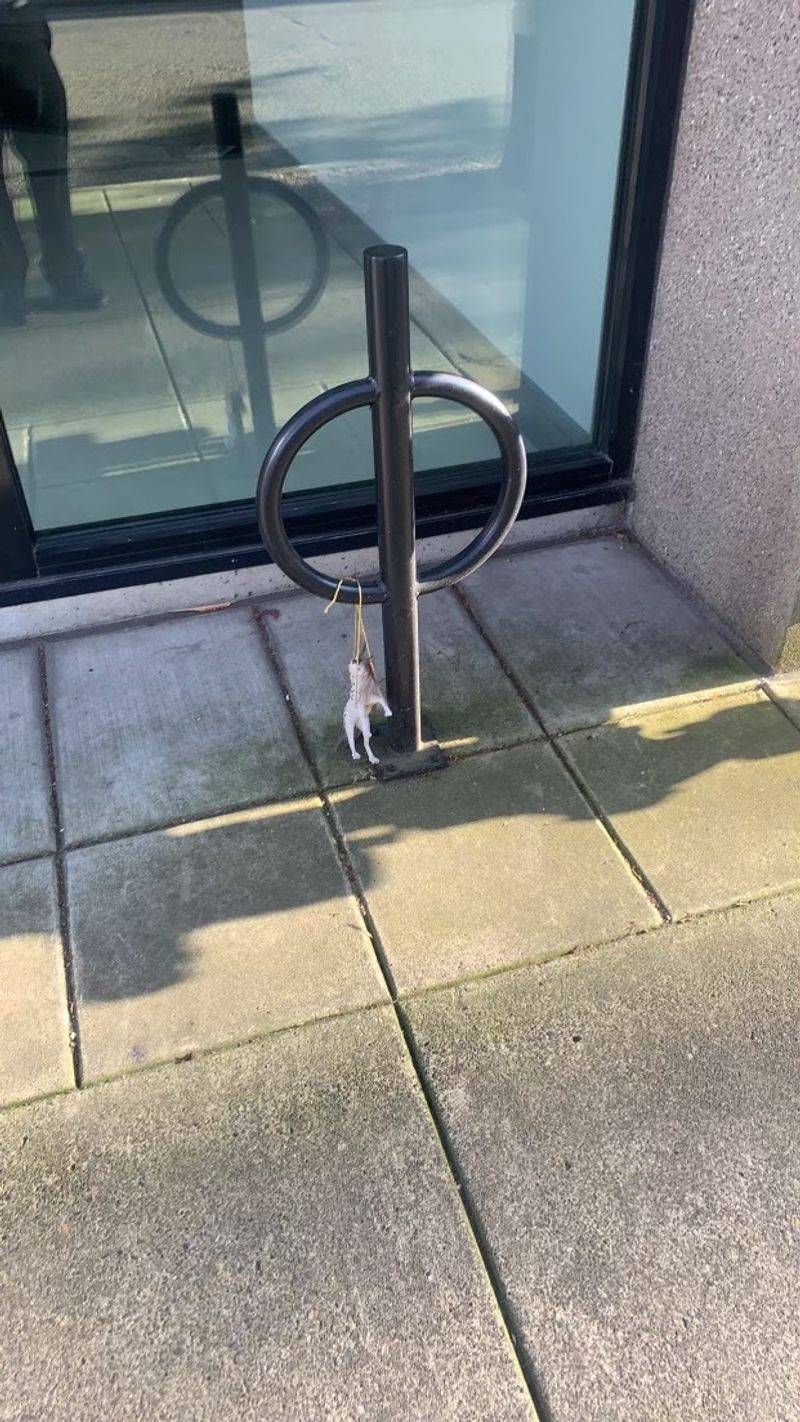
Scattered across Portland sidewalks, tiny horses no bigger than your thumb stand tethered to antique iron rings. These miniature sculptures represent one of the city’s most delightfully strange ongoing art projects, blending history with whimsy in a way only Portland could manage.
The rings themselves date back to the late 1800s, when horses were the primary transportation method. Riders would tie their horses to these rings while conducting business.
Most cities removed such relics during modernization, but Portland left dozens in place.
Artist Scott Wayne Indiana began installing tiny horses at these rings in the early 2000s, creating what he calls the smallest public art project in the city. Each horse is individually crafted and placed without official permission, making them guerrilla art installations that happen to be adorable.
Finding the horses has become a treasure hunt for locals and visitors. They’re easy to miss if you’re not looking down, but once you spot one, you start noticing rings everywhere and wondering which ones host tiny equine residents.
Some horses disappear and reappear, adding to the mystery.
The project earns almost universal affection, a rare feat in Portland’s contentious public art scene. It’s hard to get angry about something so small and charming.
The horses honor Portland’s past while adding playful touches to present-day streets, proving that public art doesn’t need to be grand or expensive to capture imaginations and create joy.
9. Bazalgette the Whale, Yachats
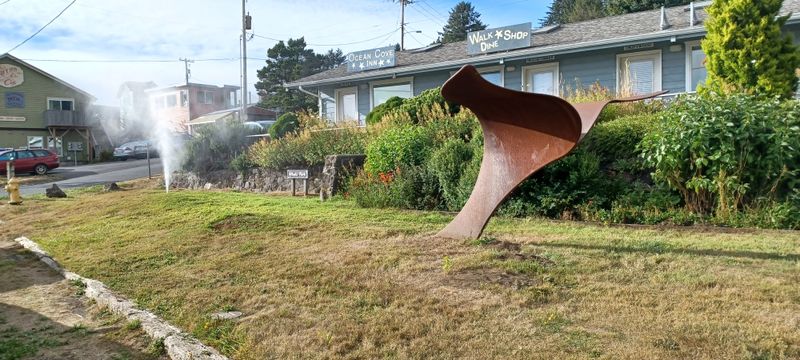
In a pocket park barely bigger than a living room, a whale sculpture greets visitors to the tiny coastal town of Yachats. Bazalgette, named after a 19th-century British engineer, adds an unexpected touch of whimsy to this already quirky community of fewer than 1,000 residents.
The sculpture sits in what locals call the Whale Park, though calling it a park is generous. It’s really just a small triangle of land where the highway curves, but Yachats residents have turned it into a beloved landmark.
Bazalgette presides over this space like a gentle guardian of the coast.
Artist Jim Adler created the whale in the 1990s, crafting it to withstand the brutal coastal weather that batters this exposed stretch of Highway 101. The sculpture has held up remarkably well, requiring only occasional maintenance to keep it looking presentable for the endless stream of tourists who stop to take photos.
Yachats embraces its reputation as the “Gem of the Oregon Coast,” and Bazalgette fits perfectly into that self-image. The whale represents the town’s commitment to accessible public art and its connection to the ocean that defines local life and economy.
Unlike some controversial Oregon statues, Bazalgette generates mostly smiles and appreciation. It’s hard to argue with a friendly whale in a beautiful coastal setting.
The sculpture captures Yachats’ character perfectly: small, unpretentious, and charming in ways that can’t be manufactured or forced.
Dear Reader: This page may contain affiliate links which may earn a commission if you click through and make a purchase. Our independent journalism is not influenced by any advertiser or commercial initiative unless it is clearly marked as sponsored content. As travel products change, please be sure to reconfirm all details and stay up to date with current events to ensure a safe and successful trip.
