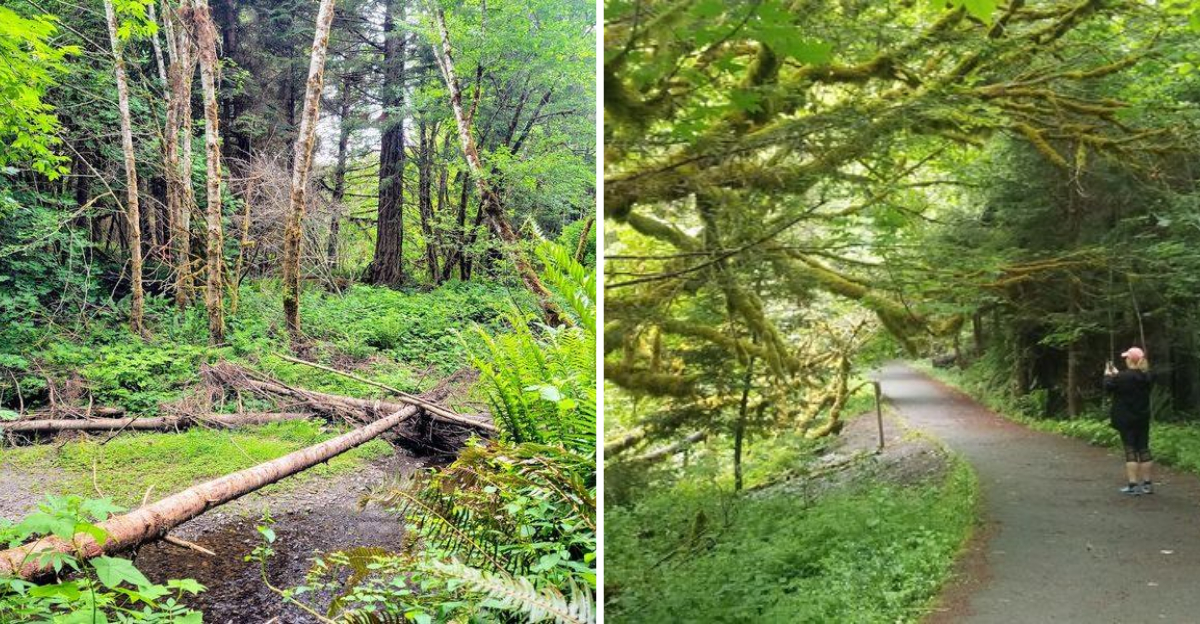
Headwaters Forest in California is known for ancient redwoods and quiet trails. But tucked inside those trees is a ghost town that park rangers do not like to discuss.
Not because it is dangerous. Because it feels wrong.
The logging town was abandoned decades ago, leaving behind rusted equipment and rotting cabins. Rangers report strange feelings near the old sites. The sense of being watched.
Sudden cold spots on warm days. Footsteps behind them when no one else is there.
I talked to a ranger who shrugged and said “we just don’t go there alone after dark.” No aggression. Just a heavy presence that makes people want to leave.
California has plenty of ghost towns. This one feels different.
Older. Colder.
The Ghost Town of Falk: A Company Town Swallowed by Time
Not many people realize that a full, functioning town once hummed with life deep inside what is now Headwaters Forest Reserve. Falk was established in 1884 by a man named Noah Falk, who built the settlement to support his Elk River Mill and Lumber Company.
At its height, roughly 400 people called this place home.
The town had everything a community needed: a cookhouse, a general store, a post office, a school, and even a dance hall. Families lived here, kids played here, and workers spent their days felling the massive redwoods that surrounded them.
It was a real, breathing place with a full social life tucked into the forest.
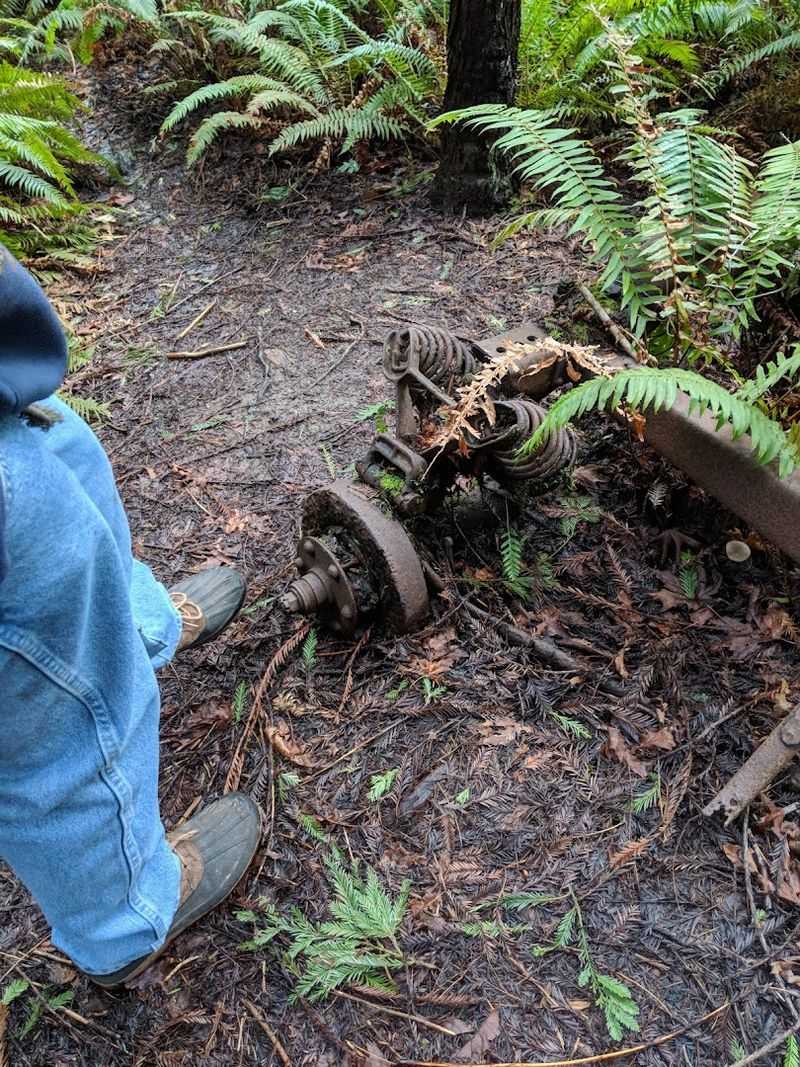
The mill closed in 1937, largely because of the economic pressure of the Great Depression, and Falk slowly emptied out. Most of the remaining structures were demolished in 1979 by the lumber company that then owned the land, reportedly over liability concerns.
What was once a lively settlement became nothing more than scattered foundations and quiet earth. The Falk Archaeological District was added to the National Register of Historic Places in 2023, finally giving this forgotten community the recognition it deserved.
Knowing that history as you walk the trail makes every mossy concrete slab feel oddly personal.
Elk River Road: The Quiet Drive That Changes Everything
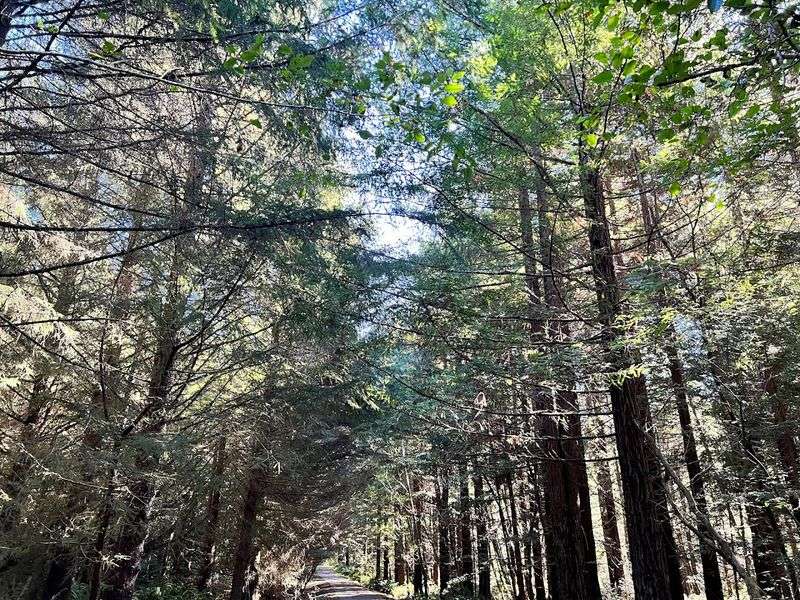
The drive along Elk River Road is one of those experiences that eases you into something bigger before you even realize it is happening. Starting from Eureka, the road moves south and gradually sheds the noise of town.
The air gets cooler, the trees get taller, and the light shifts into something softer and more diffused.
There is a particular stretch where the canopy closes overhead and the road narrows just enough to feel like you are entering a different world entirely. Locals know this feeling well.
Visitors often pull over just to take it in for a moment, not quite ready to keep moving.
The road eventually leads to the trailhead for the Elk River Trail, which is the main access point for the Headwaters Forest Reserve and the Falk town site. The drive itself is worth savoring slowly, because it sets the mood for everything that follows.
Birdsong, the smell of damp earth, and the occasional glimpse of the Elk River through the trees all build a quiet anticipation. I remember rolling the window down and just listening, which felt like the right way to arrive somewhere like this.
The address that anchors the whole journey is Elk River Road, Eureka, CA 95503, a simple stretch of pavement that leads to something genuinely extraordinary.
The Ranger Who Heard the Ghosts Whispering
Julie Clark is a Bureau of Land Management park ranger who has spent considerable time at the Falk site, and her experience there is not easy to dismiss. She has spoken openly about feeling a presence when she first began working at the location.
Her words on the subject are specific and sincere: she has said that the ghosts of Falk got her the job, and that they seemed to whisper to her to tell their story.
That kind of statement from a federal employee carries a certain weight. This is not a campfire tale passed around for entertainment.
Clark took those feelings seriously enough to research the town’s history and eventually write a book about Falk, giving the community a documented legacy that might otherwise have been completely forgotten.
What makes her account compelling is how grounded it is. She does not describe dramatic hauntings or theatrical moments.
It is more of a persistent, quiet awareness, a feeling that the place holds something unresolved. That description matches what many visitors report independently, people who had no idea about Clark’s experience before arriving.
The site has a weight to it that is hard to explain away as imagination. Whether you believe in the supernatural or not, there is something undeniably present at Falk that seems to resist being ignored.
It is the kind of thing that stays with you long after you have driven back down Elk River Road.
Charlie Webb: The Caretaker Who Never Really Left
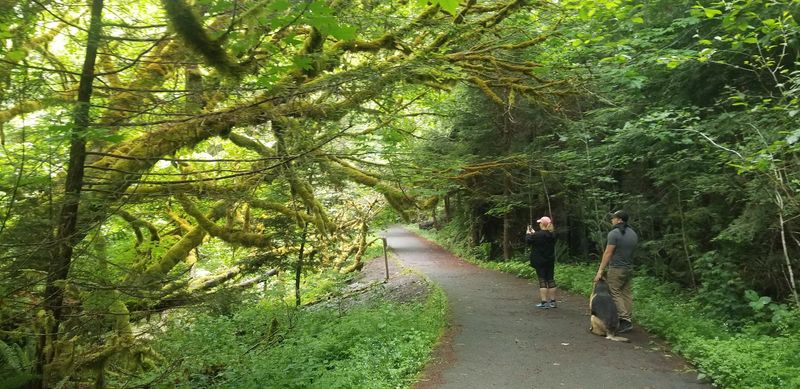
Local legend around the Falk site centers heavily on a figure named Charlie Webb. After the town emptied out and the mill closed, Webb stayed behind as a caretaker, living alone among the decaying structures while the forest crept back in around him.
That image alone is striking enough to linger.
Stories passed down through the area suggest that Webb was not exactly welcoming to anyone who wandered onto the property uninvited. He reportedly chased off trespassers aggressively, and over time his reputation grew into something more than just a protective caretaker.
The legend evolved, as legends do, into claims that his ghost still haunts the site and continues to run off unwanted visitors.
It is easy to understand how a story like that takes hold in a place like Falk. The isolation, the dense forest, the crumbling remnants of a vanished community, all of it creates the perfect environment for a legend to grow roots.
Whether Webb’s spirit is actually out there patrolling the old town boundary is a matter of personal belief. But the feeling that you are being watched while hiking the Elk River Trail through the Falk site is something visitors mention repeatedly and consistently.
That shared experience across strangers who have never met each other is genuinely curious, and it gives the Charlie Webb legend a staying power that pure fiction rarely manages to hold.
Hiking the Elk River Trail to the Falk Site
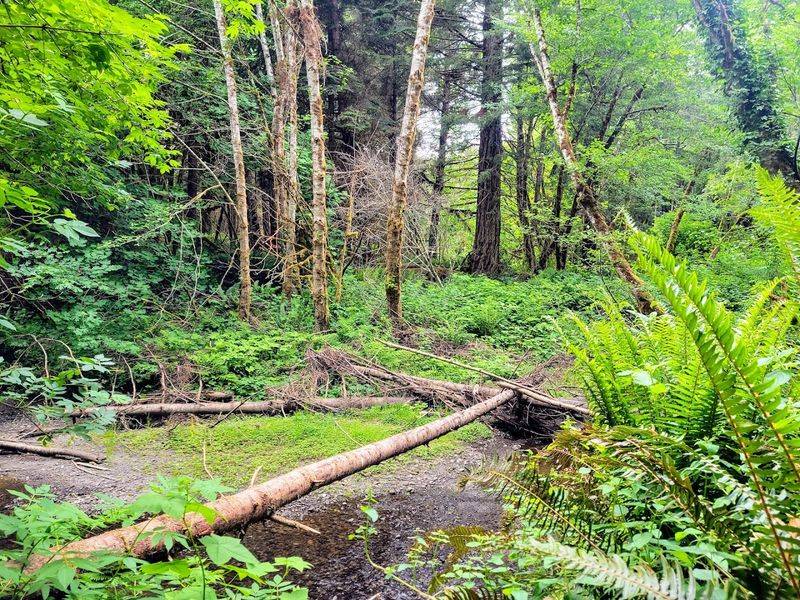
The Elk River Trail is the only way to reach the Falk town site on foot, and that feels appropriate. You cannot drive up to it or stumble onto it accidentally.
The hike demands a little effort and rewards you with something genuinely rare.
The trail runs roughly 5.5 miles one way from the trailhead off Elk River Road, passing through second-growth redwood forest with sections of old-growth that survived the logging era. The terrain is mostly flat with gentle grades, making it accessible for a wide range of hikers.
The forest along the way is dense and quiet in a way that feels almost deliberate, like the trees are keeping something close.
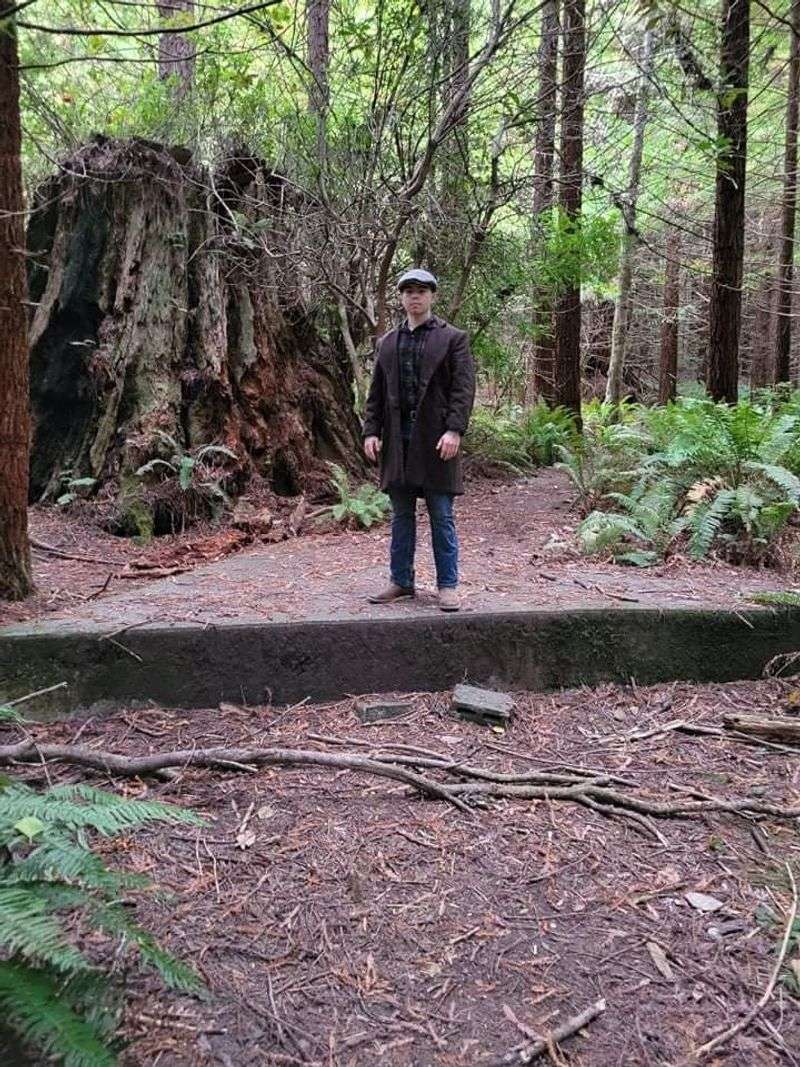
When you reach the Falk site, interpretive signs and a self-guided tour help orient you among the foundations and scattered remnants. Concrete slabs, depressions in the earth, and the occasional rusted artifact mark where buildings once stood.
The Bureau of Land Management has done thoughtful work preserving the archaeological integrity of the site while keeping it accessible to curious visitors. Most people who make the hike describe the moment they realize they are standing in the middle of a former town as unexpectedly emotional.
The forest has reclaimed so much, yet the outline of human life is still clearly readable in the landscape. That combination of wildness and history is what makes this trail one of the most memorable walks in Northern California.
Headwaters Forest Reserve: The Bigger Story Around Falk
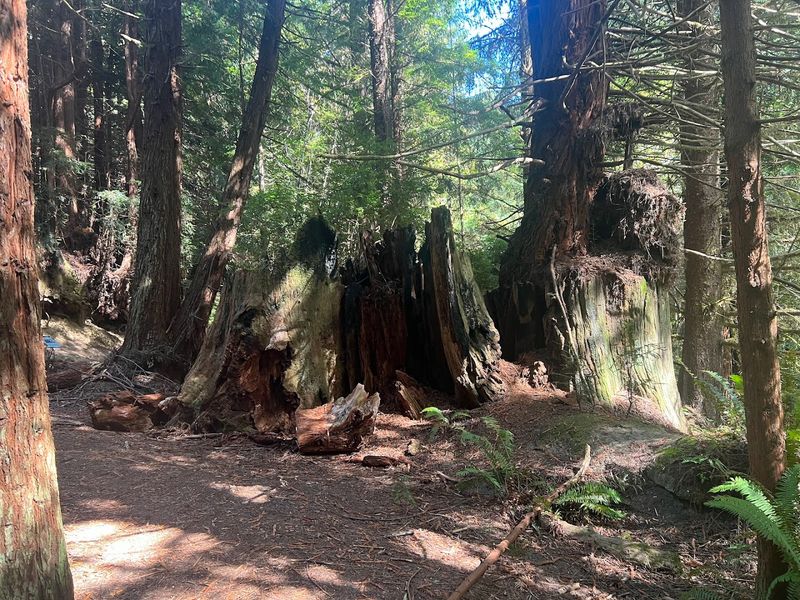
Headwaters Forest Reserve did not come easily. The land that now protects some of the last remaining old-growth redwood groves in the world was the subject of one of the longest and most contentious environmental battles in California history.
The fight to preserve this forest stretched through the 1980s and 1990s and involved protests, legal battles, and eventually a landmark federal and state purchase in 1999.
The reserve is managed by the Bureau of Land Management and covers around 7,472 acres. It protects not only the old-growth groves but also the watersheds and wildlife corridors that keep the broader ecosystem functioning.
Marbled murrelets and coho salmon are among the species that depend on the habitat the reserve provides.
For visitors coming from Eureka along Elk River Road, the reserve offers more than just the Falk ghost town. The sheer scale of the trees, some of them over a thousand years old, puts everything in a different kind of perspective.
Standing beneath a redwood that was already ancient when Falk was founded has a way of recalibrating your sense of time completely. The reserve is free to visit, and the trailhead off Elk River Road is well-signed and maintained.
It is the kind of place that rewards repeat visits at different seasons, since the forest shifts its mood considerably between the dry summer months and the foggy, rain-soaked winters that define the Northern California coast.
Why Falk Feels Different From Other Ghost Towns
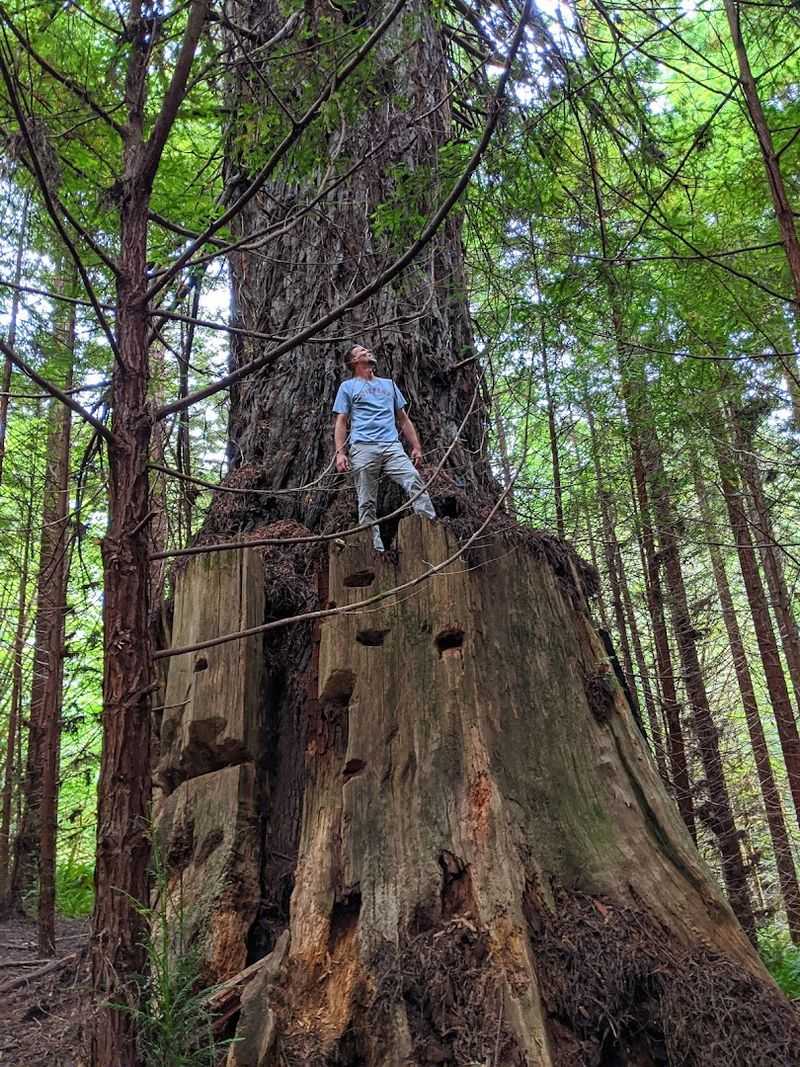
Most ghost towns sit in the open, baked dry by desert sun, their wooden bones bleached and visible from a distance. Falk is the opposite of that.
The forest has wrapped itself so completely around the remains that you have to look carefully to see what is there. That quality makes the experience feel more like discovery than tourism.
The fact that the Falk Archaeological District was officially added to the National Register of Historic Places in 2023 signals that the site has real cultural and historical significance beyond ghost town curiosity. Archaeologists and historians have documented the layout and artifacts in ways that give future researchers a foundation to build on.
That kind of institutional recognition changes how the site feels, at least to me.
There is also something emotionally distinct about a town that was not abandoned slowly but was actively demolished. The decision to raze most of Falk’s structures in 1979 was practical, but it also erased a lot of what might have made the place visually dramatic.
What remains is subtler and somehow more affecting for it. You are not looking at picturesque ruins.
You are reading a landscape that has been deliberately quieted. That restraint gives Falk a contemplative quality that louder ghost towns simply do not have.
Visiting in the early morning, when mist sits low in the forest and the trail is empty, amplifies that feeling into something close to reverence.
Address: Elk River Road, Eureka, California 95503
