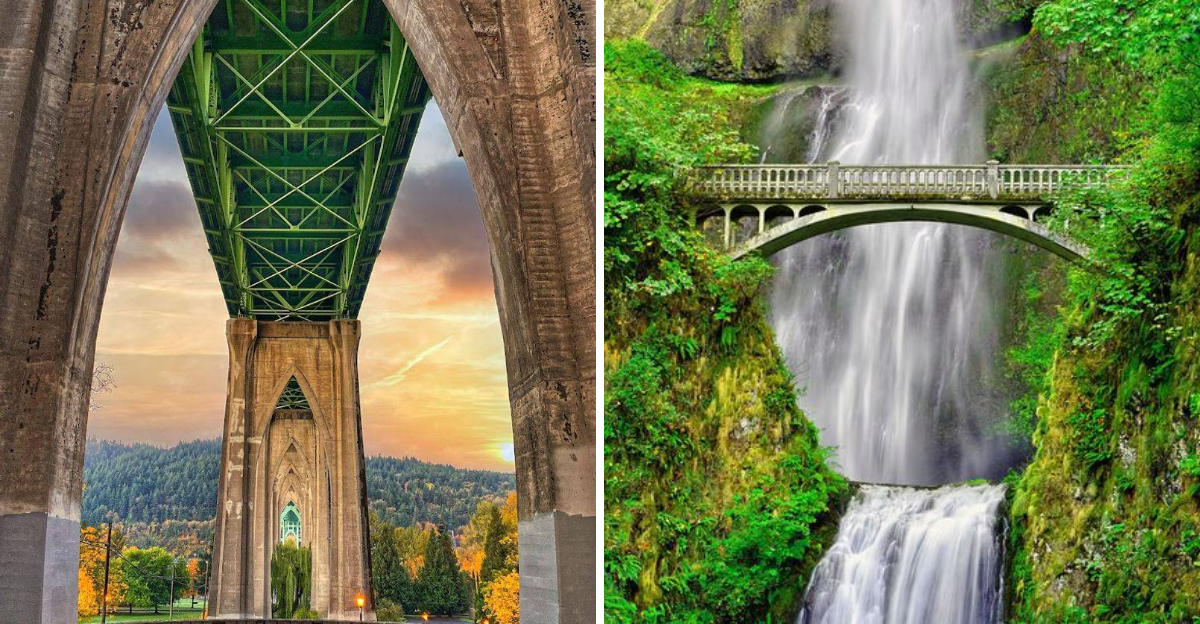
Oregon has a way of making even its infrastructure look like art. Across the state, you will find bridges that span wild rivers, rugged coastlines, and misty gorges, each one telling a story about the era it was built and the people who built it.
I have spent time exploring Oregon’s most iconic crossings, from the fog-draped spires of Portland to the windswept coast near Florence.
Some of these structures are massive feats of engineering, while others are small and quietly breathtaking.
What they all have in common is that they stop you in your tracks. Whether you are a history buff, an architecture lover, or simply someone who appreciates a good view, these bridges are worth going out of your way to see.
Keep reading, because this list is going to give you some serious travel inspiration.
1. St. Johns Bridge, Portland, Oregon
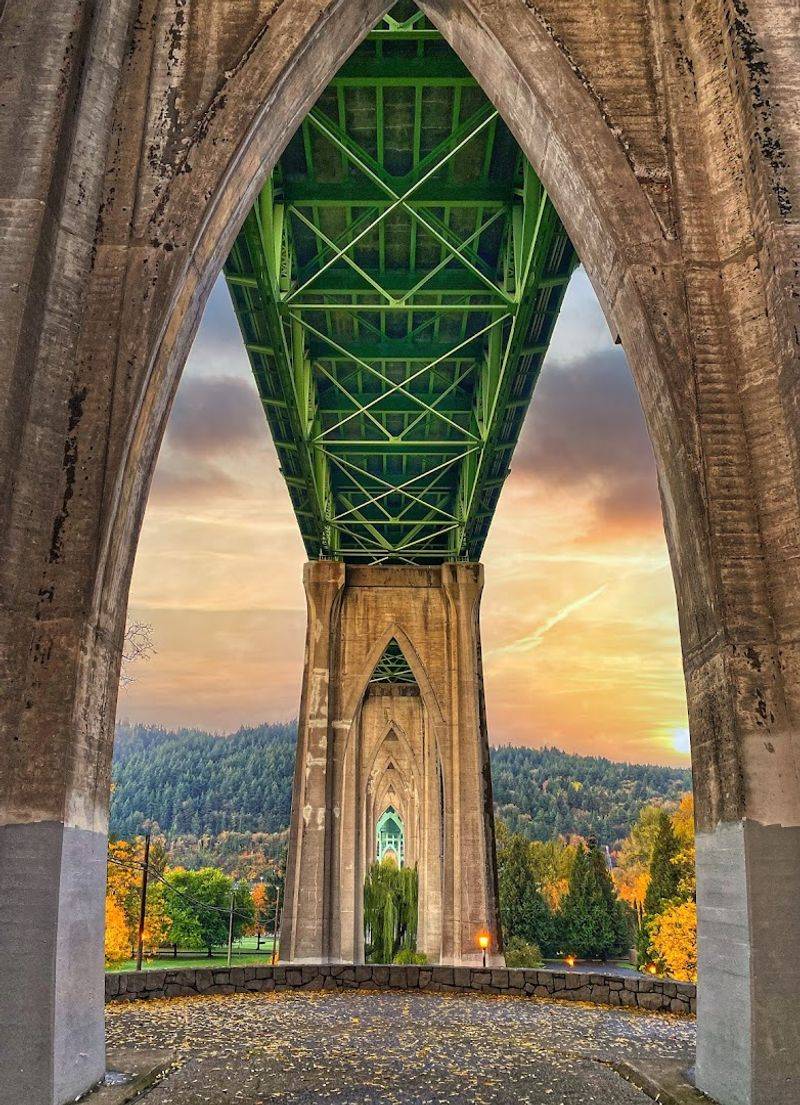
Rising above the Willamette River like something out of a fairy tale, the St. Johns Bridge is one of the most visually striking structures in all of Portland. Built in 1931 and designed by David Steinman, this Gothic-style suspension bridge features two soaring towers that stretch nearly 400 feet into the Oregon sky.
The bridge connects the St. Johns neighborhood in North Portland to the Cathedral Park area on the west bank. Speaking of Cathedral Park, the space beneath the bridge is one of the most photographed spots in the city, and for good reason.
The arched Gothic portal frames are absolutely stunning when viewed from below, especially in the early morning when mist rolls off the river.
The bridge spans 1,207 feet and remains the only Gothic suspension bridge on the West Coast. It was added to the National Register of Historic Places in 2000, which gives you a sense of just how significant it is.
Cyclists and pedestrians can cross it freely, and the views of the river from the walkway are genuinely spectacular. If you visit Portland and skip this bridge, you are missing one of the city’s most unforgettable landmarks.
Plan your visit around sunset for a view that will absolutely stay with you long after you leave.
2. Astoria-Megler Bridge, Astoria, Oregon
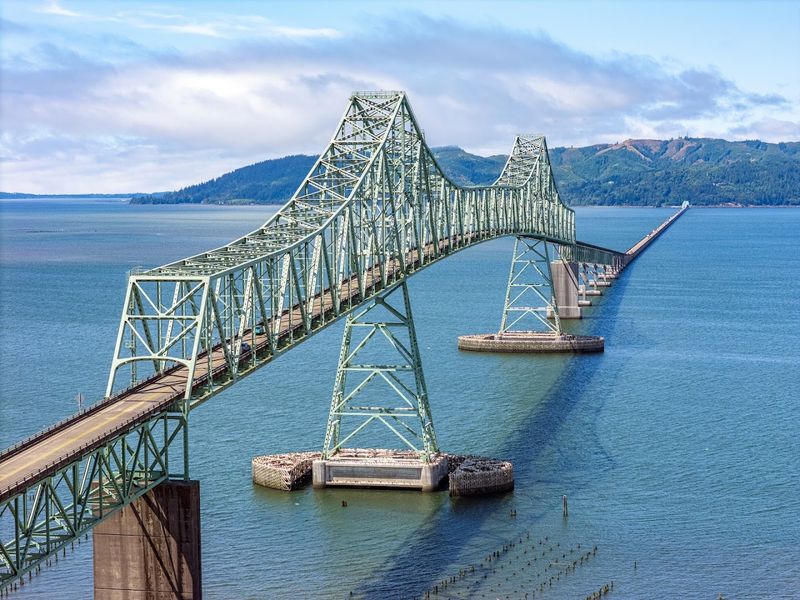
At over four miles long, the Astoria-Megler Bridge is the kind of structure that makes your jaw drop the moment it comes into view. Crossing the mouth of the Columbia River between Astoria, Oregon and Point Ellice, Washington, it holds the title of the longest continuous truss bridge in North America.
Completed in 1966, the bridge replaced a ferry service that travelers had depended on for decades. Driving across it is a genuine experience.
The roadway curves and climbs as it rises above the river, giving you sweeping views of the Columbia and the surrounding coastline that feel almost cinematic.
The bridge stretches 21,474 feet and reaches a clearance of 196 feet at its highest point to allow large ships to pass underneath. On a clear day, you can see the Pacific Ocean from the upper sections of the bridge, which is a perspective you simply cannot get anywhere else.
Astoria itself is a charming historic town full of Victorian homes, maritime history, and great food, so the bridge makes for a perfect starting or ending point on a coastal road trip.
Crossing it in either direction feels like a proper gateway moment, and that sense of arrival never really gets old no matter how many times you make the drive.
3. Yaquina Bay Bridge, Newport, Oregon
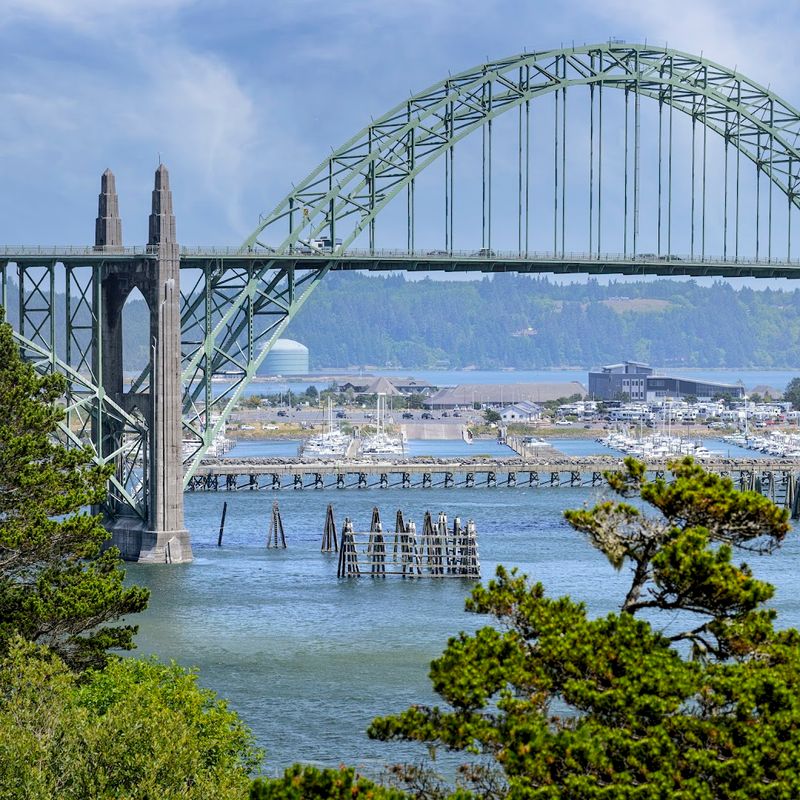
Few bridges on the Oregon Coast carry as much elegance as the Yaquina Bay Bridge in Newport. Designed by the legendary Conde B.
McCullough and completed in 1936, this arched steel structure spans Yaquina Bay with a kind of quiet confidence that has made it a beloved landmark for nearly a century.
McCullough was the Oregon State Bridge Engineer during the 1930s and is widely regarded as the master of coastal bridge design in the Pacific Northwest. The Yaquina Bay Bridge reflects his signature style, blending classical architectural details with practical engineering.
The decorative elements on the towers and railings give the bridge a refined look that stands out even among his other impressive works.
The bridge stretches 3,223 feet and connects the two sides of Newport, a lively coastal town known for its aquarium, fresh seafood, and busy bayfront. Walking across the pedestrian path offers unobstructed views of the bay, the harbor, and the Pacific Ocean in the distance.
Watching fishing boats pass below while the ocean breeze sweeps in is one of those simple travel pleasures that is hard to beat.
Newport is also a great base for exploring the central Oregon Coast, and the Yaquina Bay Bridge serves as a fitting introduction to the scenic wonders that await you along Highway 101 in this part of the state.
4. Tilikum Crossing, Portland, Oregon
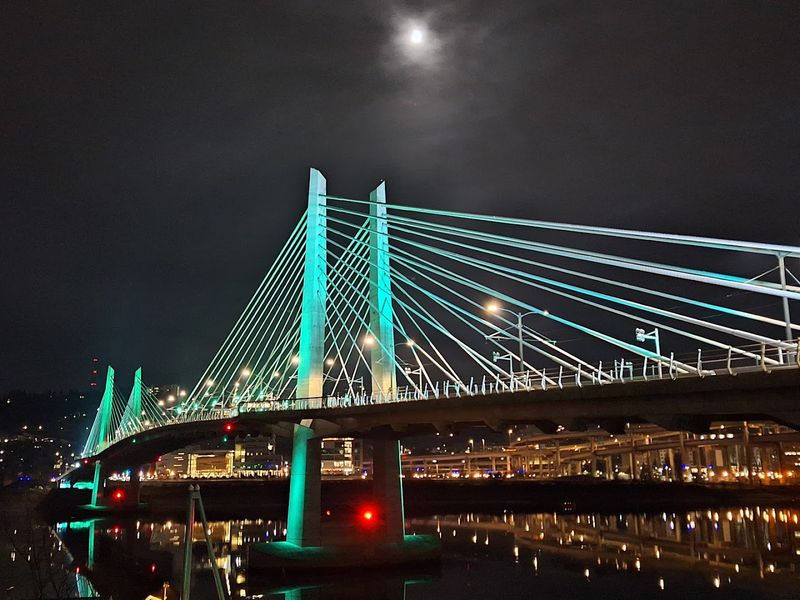
Portland has always had a reputation for doing things differently, and Tilikum Crossing is proof that innovation can be beautiful. Opened in 2015, this cable-stayed bridge is the largest car-free bridge in the United States, designed exclusively for light rail, buses, cyclists, and pedestrians.
The name Tilikum comes from the Chinook word meaning “people” or “tribe,” which is why it earned the nickname the Bridge of the People. That name feels fitting when you stand on it and watch the mix of MAX light rail trains, cyclists commuting to work, and families out for a stroll all sharing the same stunning crossing over the Willamette River.
The bridge features a striking set of cables that are illuminated at night with LED lights that shift colors based on real-time data from the river, including water temperature and flow rate. It is genuinely one of the most thoughtfully designed public infrastructure projects in recent American history.
The bridge connects the South Park Blocks area on the west side to the OMSI district on the east side, making it a practical route as well as a scenic one. At 1,720 feet long, it offers great views of the Portland skyline in both directions.
Tilikum Crossing proves that a bridge built for people rather than cars can still be an absolute showstopper.
5. Siuslaw River Bridge, Florence, Oregon
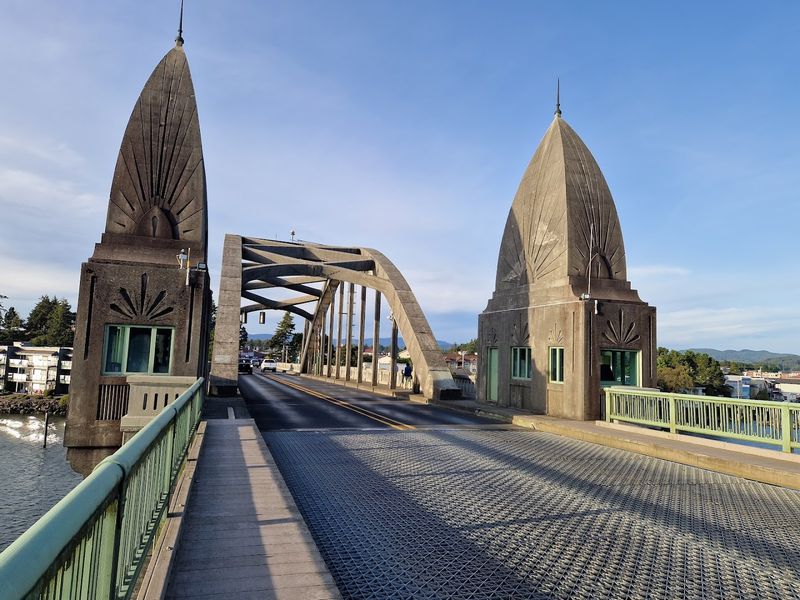
There is something almost theatrical about the Siuslaw River Bridge in Florence, Oregon. Designed by Conde B.
McCullough and completed in 1936, this bascule drawbridge combines Art Deco styling with a mechanical grace that is rare in bridge design anywhere in the world.
A bascule bridge uses a counterweight system to raise its center span, allowing tall boats and vessels to pass through. Watching the Siuslaw River Bridge open is a genuine spectacle, and if you time your visit right, you might catch it in action.
The ornate towers on either side of the movable span are decorated with Art Deco details that McCullough was known for incorporating into his coastal bridges.
Florence is a charming coastal town that sits at the edge of the Oregon Dunes National Recreation Area, and the bridge serves as a scenic gateway between the town and the dunes. The historic Old Town area of Florence is just steps from the bridge, offering waterfront restaurants, shops, and a relaxed small-town atmosphere that pairs perfectly with a walk across the span.
The bridge stretches 1,568 feet and was added to the National Register of Historic Places in 2005 as part of a multiple-property listing of McCullough’s coastal bridges. Standing on it while looking out over the Siuslaw River toward the Pacific feels like a proper Oregon Coast moment.
6. Cape Creek Bridge, Lane County, Oregon
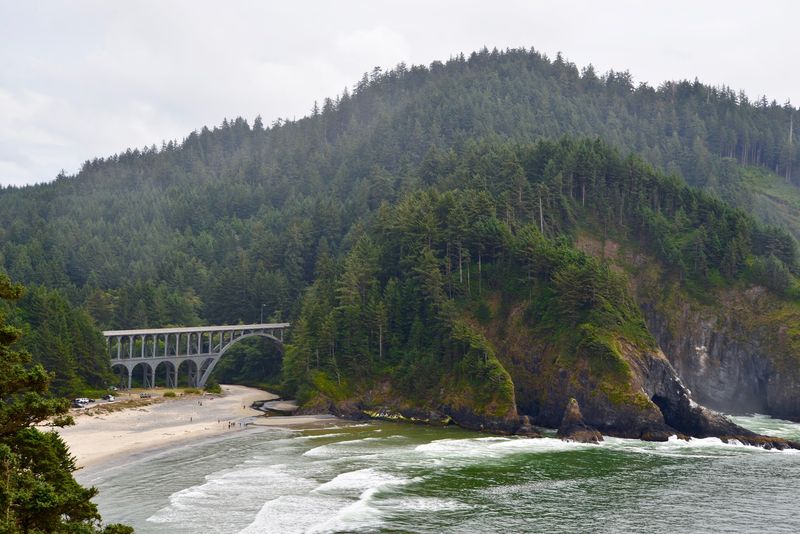
Built in 1931 and sitting inside Heceta Head Lighthouse State Scenic Viewpoint in Lane County, Oregon, the Cape Creek Bridge is one of those structures that earns its reputation not just through design but through setting. The concrete arch bridge spans a deep coastal canyon carved by Cape Creek before it meets the Pacific Ocean, and the surrounding scenery makes it one of the most photogenic bridge crossings on the entire Oregon Coast.
The bridge was also designed by Conde B. McCullough, making it part of a remarkable collection of coastal crossings that transformed travel along Highway 101 in the 1930s.
The graceful curve of the arch fits naturally into the rugged landscape, almost as if the bridge grew out of the rocky canyon walls rather than being placed there by engineers.
Heceta Head Lighthouse stands nearby on a dramatic headland, and combining a visit to both the bridge and the lighthouse makes for a genuinely memorable afternoon. The lighthouse itself dates to 1894 and is one of the most photographed on the West Coast.
The trail system in the area allows you to view the bridge from multiple angles, including from below along the creek. Parking is available at the adjacent day-use area, and the short walk to the overlook offers one of the best perspectives of the bridge framed against the forest and the sea.
7. McCullough Memorial Bridge, Coos Bay, Oregon
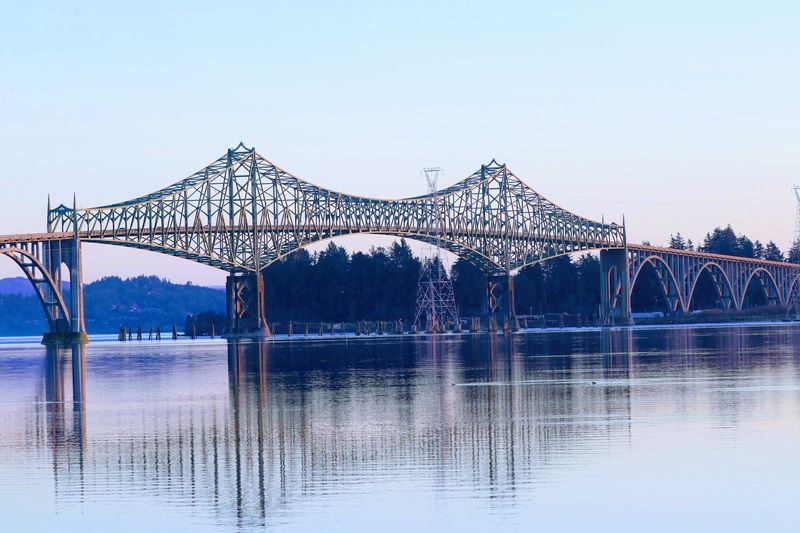
Named in honor of the engineer who made it famous, the McCullough Memorial Bridge over Coos Bay is one of the most structurally impressive bridges on the Oregon Coast. Completed in 1936, this cantilever truss bridge stretches 5,305 feet across the bay and was considered one of the most ambitious engineering projects in the state at the time of its construction.
Conde B. McCullough designed the bridge with his characteristic attention to architectural detail, blending the functional demands of a major coastal crossing with Art Deco ornamentation on the towers and approach spans.
The result is a bridge that looks as if it belongs in a 1930s architectural magazine while still carrying thousands of vehicles a day across one of Oregon’s largest coastal bays.
Coos Bay is the largest coastal city in Oregon and serves as a hub for commerce, fishing, and outdoor recreation along the southern coast. The bridge connects Coos Bay to North Bend and beyond, making it a critical link in the Highway 101 corridor.
In 2005, it was added to the National Register of Historic Places as part of the same McCullough coastal bridges listing that recognized several of his other masterworks. Viewing the bridge from the waterfront in Coos Bay gives you a full appreciation of its scale and elegance.
It is a structure that rewards a second look, and sometimes a third.
8. Bridge of the Gods, Cascade Locks, Oregon
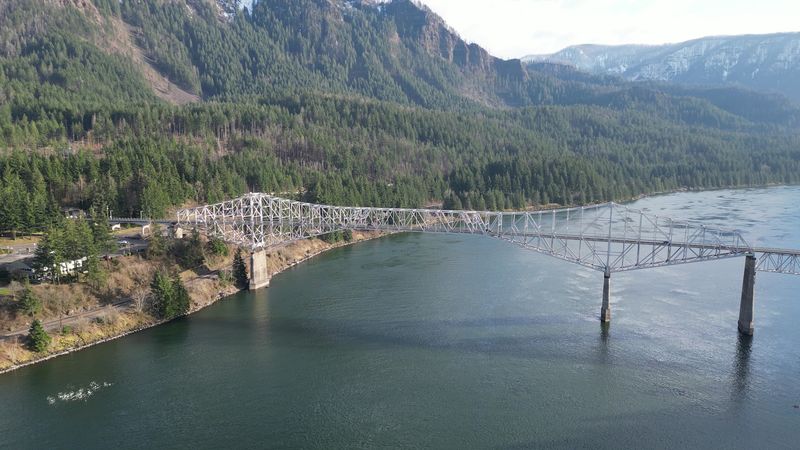
Few bridges in Oregon carry as much mythology as the Bridge of the Gods at Cascade Locks. Named after a legendary land bridge that Native American oral traditions describe as once spanning the Columbia River, this steel truss structure has been connecting Oregon and Washington since 1926 and carries a sense of history that goes far deeper than its construction date.
The bridge was rebuilt and raised in 1940 when the construction of Bonneville Dam raised the water level of the Columbia River by about 40 feet. Today it sits 140 feet above the river at its highest point, offering dramatic views of the Columbia River Gorge in both directions.
The gorge itself is one of the most scenic stretches of landscape in the entire Pacific Northwest, with basalt cliffs, waterfalls, and dense forest lining both banks.
Cascade Locks is a small town with a big personality, and it serves as a popular stop along the Historic Columbia River Highway. The bridge also crosses the Pacific Crest Trail, which means long-distance hikers walking from Mexico to Canada actually cross the Columbia River right here.
Watching a PCT thru-hiker make that crossing with a fully loaded pack is a moment that puts the bridge’s place in American outdoor culture into sharp perspective. A small toll is required to cross by vehicle, but for the views you get, it is absolutely worth every cent.
9. Benson Bridge, Multnomah Falls, Oregon
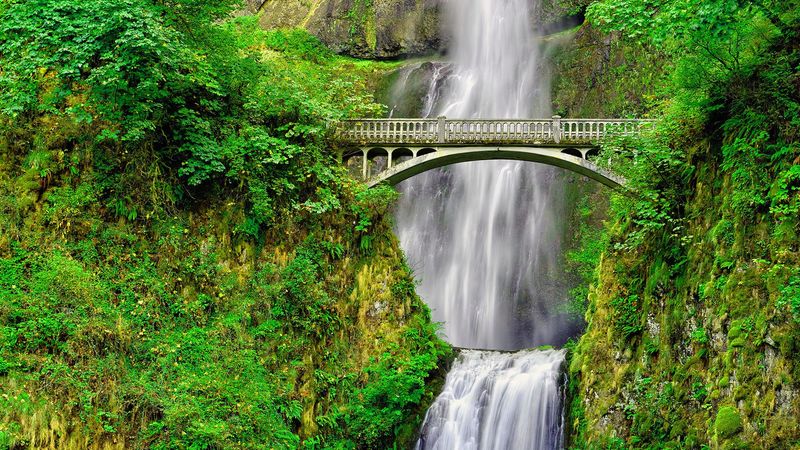
Standing on the Benson Bridge at Multnomah Falls is one of those travel experiences that genuinely earns the word unforgettable. Built in 1914 and named after Portland businessman Simon Benson, this 45-foot stone pedestrian bridge spans the narrow gorge between the upper and lower tiers of Multnomah Falls, placing you right in the heart of the most visited natural attraction in Oregon.
Multnomah Falls drops a total of 620 feet in two dramatic tiers, making it the tallest waterfall in Oregon and one of the tallest year-round waterfalls in the United States. The Benson Bridge sits at the midpoint of that drop, and when you stand on it, you are surrounded by mist, roaring water, and the deep green of the Columbia River Gorge forest.
It is a sensory experience that photographs can only partially capture.
The bridge is accessible via a paved trail that begins at the Multnomah Falls Lodge, a historic structure built in 1925 that houses a restaurant and visitor center at the base of the falls. The trail to the bridge is relatively short and suitable for most visitors, though the path continues steeply upward to the top of the falls for those who want the full hike.
Arriving early in the morning helps you avoid the crowds and gives you a much better chance of having a quiet moment on the bridge with just the sound of the water around you.
10. Chambers Railroad Covered Bridge, Cottage Grove, Oregon
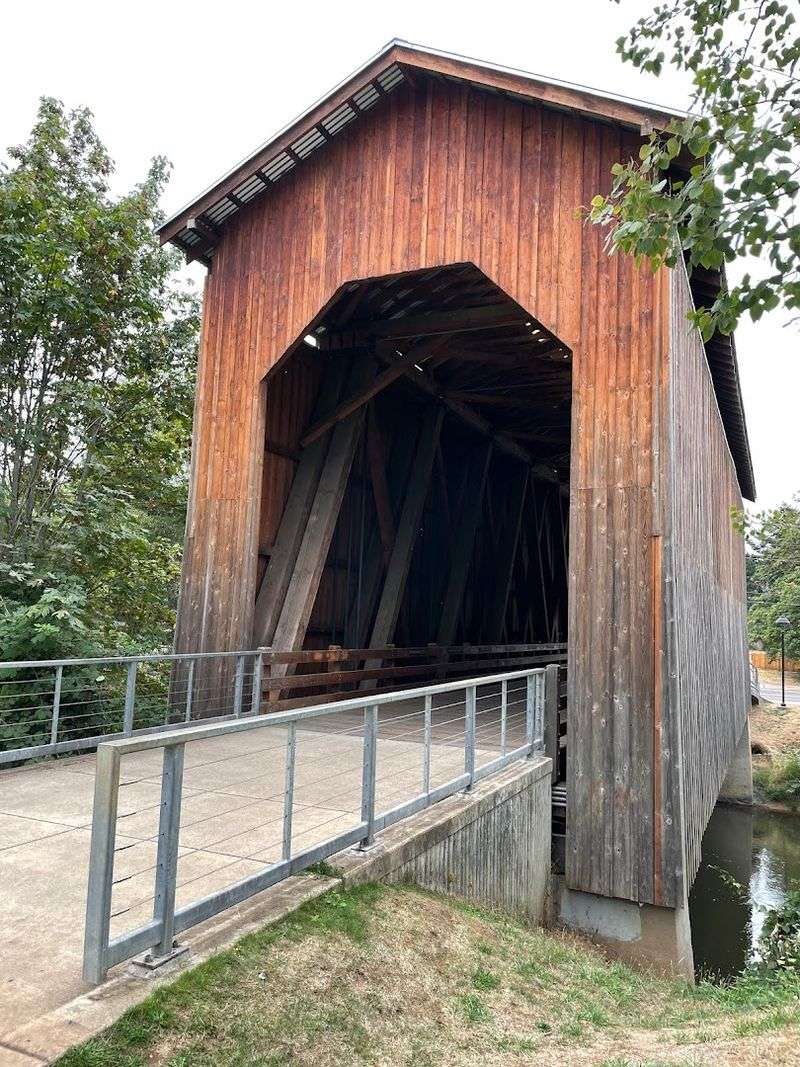
Oregon is famous for its covered bridges, but the Chambers Railroad Covered Bridge near Cottage Grove holds a distinction that no other structure in the western United States can claim. It is the only remaining covered railroad bridge west of the Mississippi River, and that fact alone makes the drive to see it completely worthwhile.
Built in 1925 and spanning the Row River near Cottage Grove in Lane County, the bridge was constructed to carry logging railroad traffic through a region that was deeply shaped by the timber industry. The wooden covered design was common for railroad bridges of that era because the roof protected the structural timbers from moisture, dramatically extending the life of the bridge in the famously wet Pacific Northwest climate.
Cottage Grove itself is known as the covered bridge capital of Oregon, with eight covered bridges accessible along a scenic driving loop through the surrounding countryside. The Chambers Railroad Covered Bridge is the crown jewel of that collection.
Today the bridge is preserved as a historic landmark and is no longer in active railroad use, but it remains structurally sound and visually compelling. The surrounding landscape of ferns, Douglas fir trees, and quiet river water creates a peaceful setting that feels completely removed from the modern world.
Visiting the Cottage Grove covered bridge loop makes for a perfect half-day or full-day road trip through one of the most quietly beautiful corners of the Willamette Valley.
Dear Reader: This page may contain affiliate links which may earn a commission if you click through and make a purchase. Our independent journalism is not influenced by any advertiser or commercial initiative unless it is clearly marked as sponsored content. As travel products change, please be sure to reconfirm all details and stay up to date with current events to ensure a safe and successful trip.
