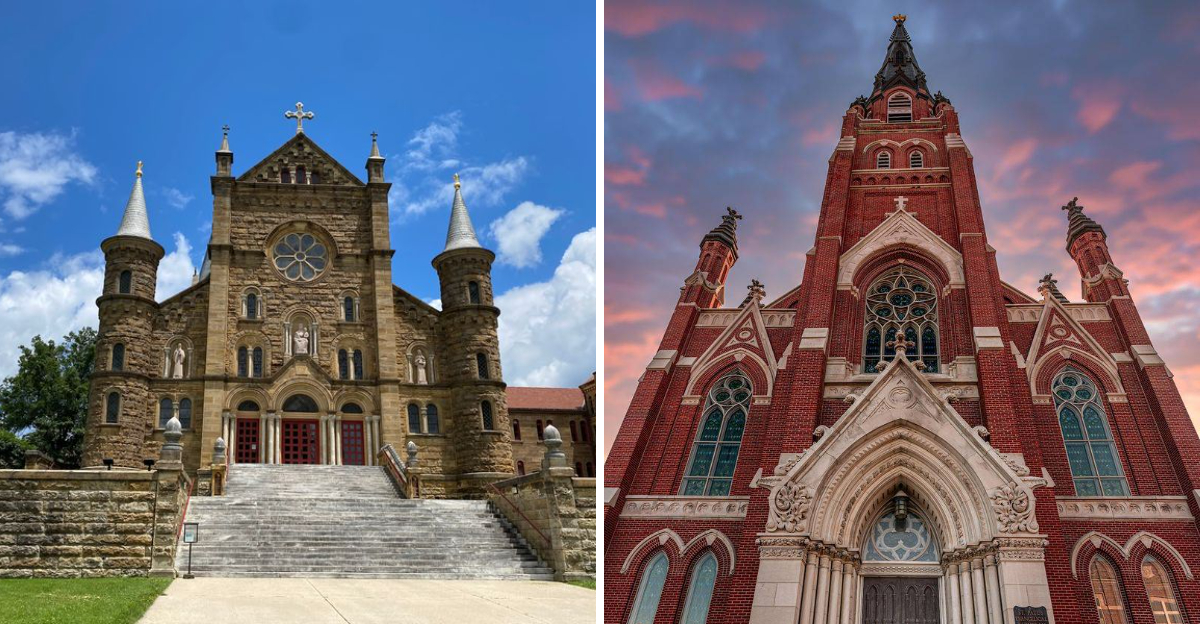
The outside says “small-town Indiana.” The inside says something entirely different. There are stained-glass windows that look imported from Bavaria, altars covered in intricate carving, frescoes stretching across ceilings, and bells that have been calling people to worship for generations.
None of it feels especially expected until the history comes into focus. Immigrant communities built these churches as a way of carrying familiar traditions into a new home, sometimes going to remarkable lengths to recreate the architecture they had left behind.
Today, that effort makes for one of the state’s most unexpected architectural road trips. The cornfields and county roads can stay exactly where they are.
The churches bring the old world with them.
1. Cathedral of the Immaculate Conception, Fort Wayne
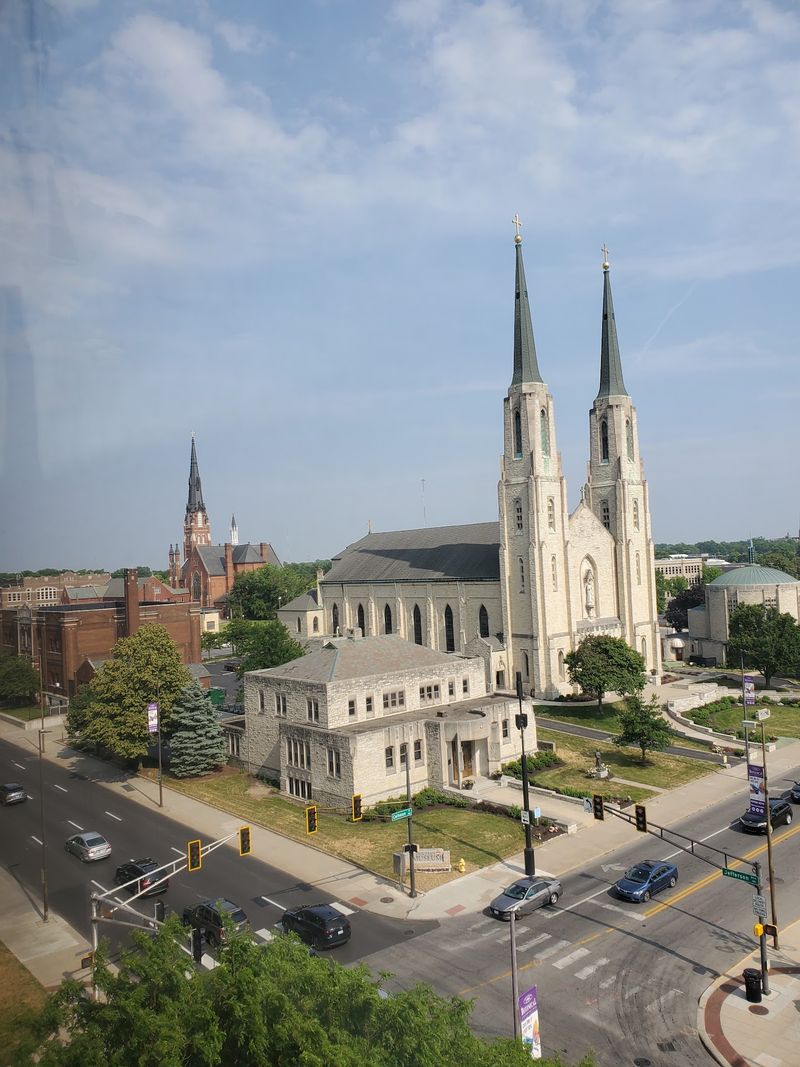
Twin spires climbing 200 feet above downtown traffic tend to stop conversation mid-sentence. Fort Wayne’s Gothic cathedral sits right in the thick of the city at 1105 South Calhoun Street, Fort Wayne, IN 46802, and its bell towers still act as an unofficial compass for anyone navigating the grid below.
The story starts in 1836 with St. Augustine Parish, and the building itself was dedicated in 1860, designed by Father Julian Benoit. Red brick came first.
Indiana limestone and Lannon stone from Wisconsin wrapped the exterior in 1950, giving it the pale, weathered look of an older European church.
Inside, the European connection stops being a suggestion and becomes a list. Twelve stained-glass windows telling the life of Mary were ordered from the Royal Bavarian Art Institute in Munich in 1896.
Wood-carved Stations of the Cross arrived from Germany, and the sanctuary window plus brass candlesticks came from France.
Fourteen original columns march down the nave, and hand-carved Gothic reredos anchor the altar area with fussy, beautiful detail.
Here is an odd bit of history worth knowing. Part of the church was built over a former cemetery, a custom borrowed straight from the Old World, where sacred ground stayed sacred.
Recognized as the oldest church structure in continuous use around Fort Wayne, it rewards visitors who linger near the windows on a bright morning.
2. St. Mary’s Catholic Church, Indianapolis
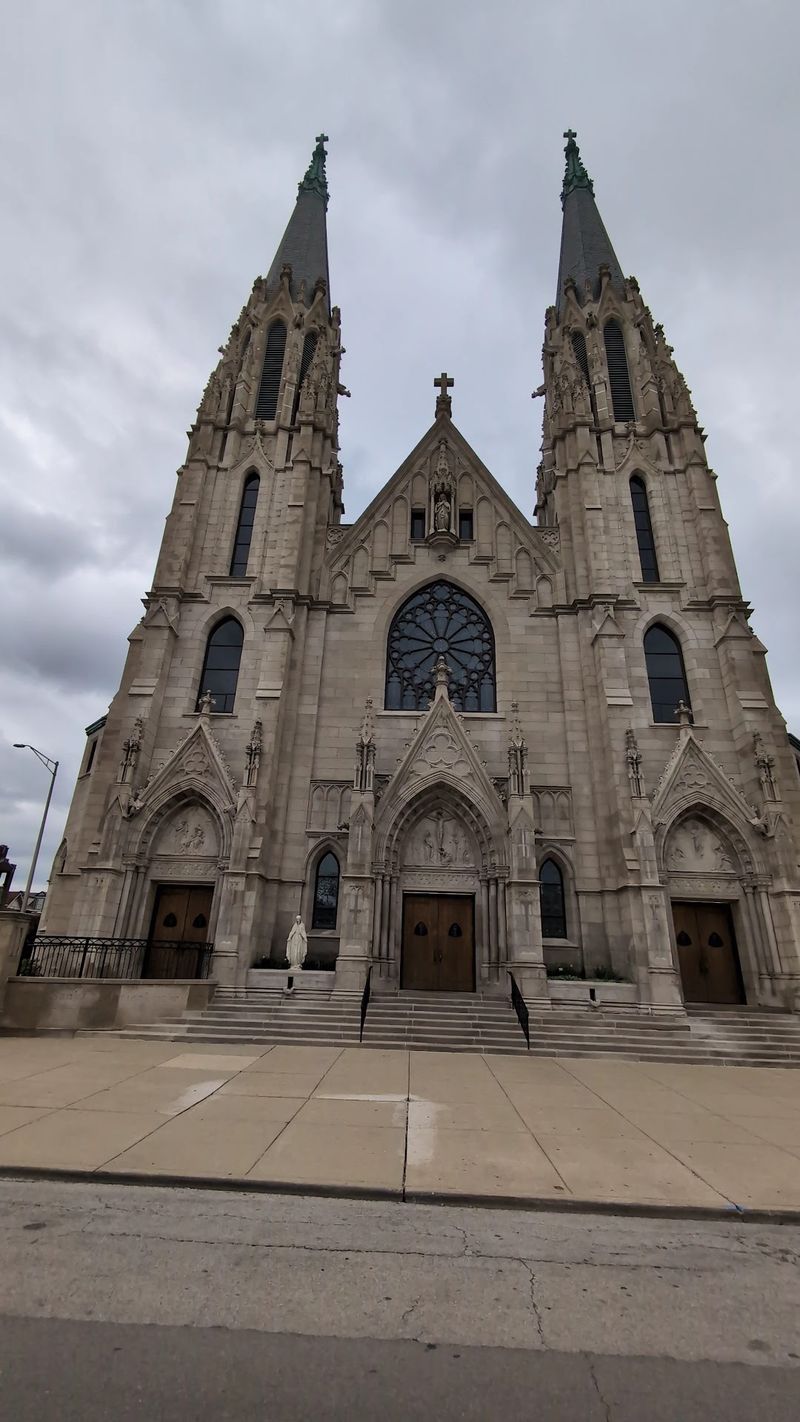
Cologne Cathedral has a distant Indiana cousin, and it stands a few blocks east of downtown Indianapolis. St. Mary’s, at 317 North New Jersey Street, borrows its cruciform plan from that famous German landmark, which explains why the whole thing feels bigger than its footprint.
Architect Hermann J. Gaul was born in Cologne, so the resemblance was no accident.
Look at the stone facade and the details start piling up: a gabled central section with a trefoil motif, a finial, and a statue of the Virgin Mary keeping watch over the sidewalk. Symmetrical towers rise on either side, capped with slender spires that catch late afternoon light.
Buttresses, vaulted arches, and gargoyles finish the job. Gargoyles in Indianapolis feel like a small joke the architect got away with.
Step through the doors and the vaulted ceiling pulls the eye upward, past statues, skylights, and art glass windows worked in fine detail. Two of those windows show Saint Boniface and Saint Henry of Uppsala, saints tied directly to German Catholic tradition.
The parish began in 1858 for the city’s German Catholic community, and this building was finished in 1912.
Gothic Revival suited that congregation perfectly, keeping Old World customs alive in a young Midwestern capital. Quiet weekday visits let the glass do the talking.
3. Christ Church Cathedral, Indianapolis
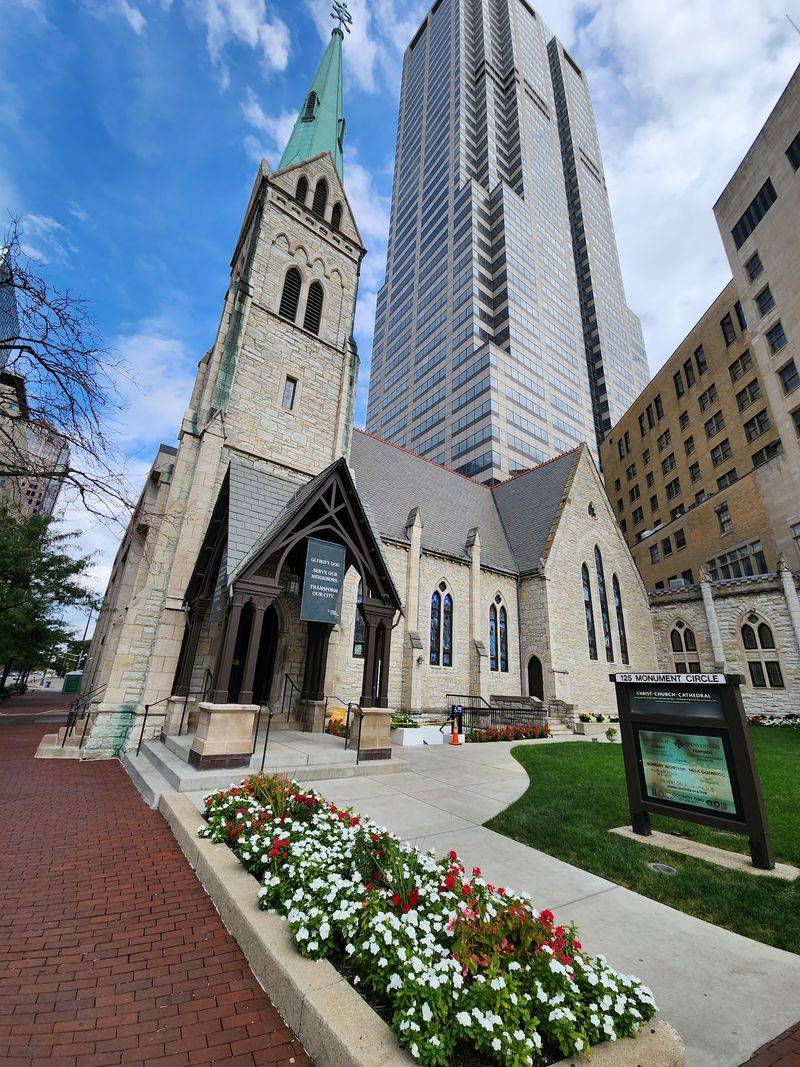
Glass office towers surround it on all sides, yet the little limestone church on Monument Circle refuses to shrink. Christ Church Cathedral, at 131 Monument Circle, Indianapolis, Indiana, holds its ground in English Gothic Revival style and somehow makes the skyscrapers look like the newcomers they are.
Erected in 1857, it is the oldest church building in Indianapolis and Marion County still in continuous use.
Irish-born architect William Tinsley handled the design, working in pointed arches, stained glass, and a tall bell tower built from rusticated limestone. The rough-cut stone gives the walls texture that photographs beautifully in low sun.
The spire took a while. It was part of Tinsley’s original plan but only went up in 1867, ten years after the rest of the building.
Inside, the wooden roof truss system spreads overhead like the ribs of an upturned boat, and a carved wood screen separates the altar space with a thicket of Gothic detail.
The reredos follows a model found in St. Albans Cathedral in England, which is about as direct a transatlantic borrowing as an Indiana visitor could hope for.
Circle traffic hums outside while the interior stays hushed.
Pair a visit with a lap around the monument, then duck inside for the contrast between granite bombast and quiet English restraint.
4. Basilica of the Sacred Heart, Notre Dame
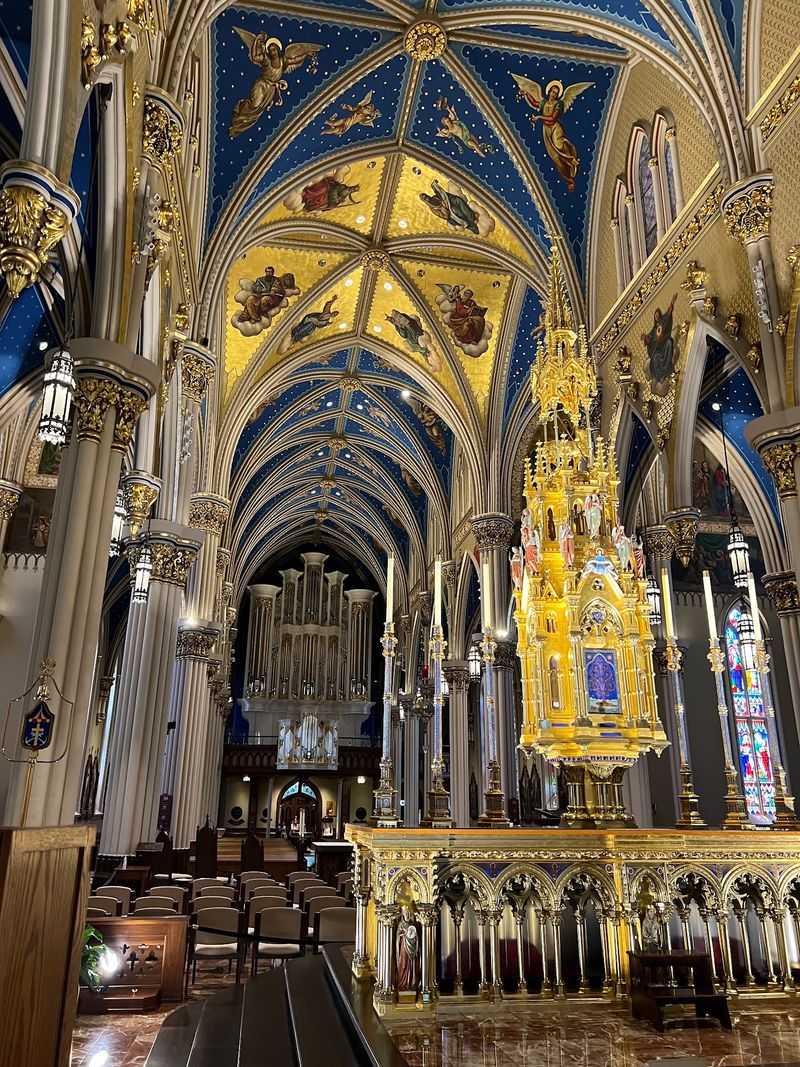
Few college campuses can claim a French-inspired basilica, and Notre Dame leans into it. At 101 Basilica Drive, Notre Dame, IN 46556, the Basilica of the Sacred Heart rises in Neo-Gothic form, built from Notre Dame brick and limestone, with a bell tower and two lateral pinnacles reaching 230 feet.
That makes it the tallest university chapel in America.
Father Edward Sorin, whose French taste shaped the whole vision, started construction in 1868 and clearly aimed high. Consecrated in 1888, the building was raised to Minor Basilica status in 1992 by Pope John Paul II.
The interior is where visitors tend to lose track of time. Forty-four large stained glass windows hold more than 1,200 individual panels, all designed and produced by the Carmel du Mans Glassworks in Le Mans, France, so the colored light falling across the floor genuinely came from Europe.
Above, murals and frescoes cover the walls and azure vaulted ceilings, painted by Vatican artist Luigi Gregori across seventeen patient years.
Then there is the Lady Chapel, where a Baroque altar is believed to have come from the studios of Giovanni Bernini in Rome.
Autumn suits the approach, with campus trees framing the spire. Football weekends bring crowds, so quieter weekdays offer more room to study the ceiling without a stiff neck queue.
5. Holy Rosary Catholic Church, Indianapolis
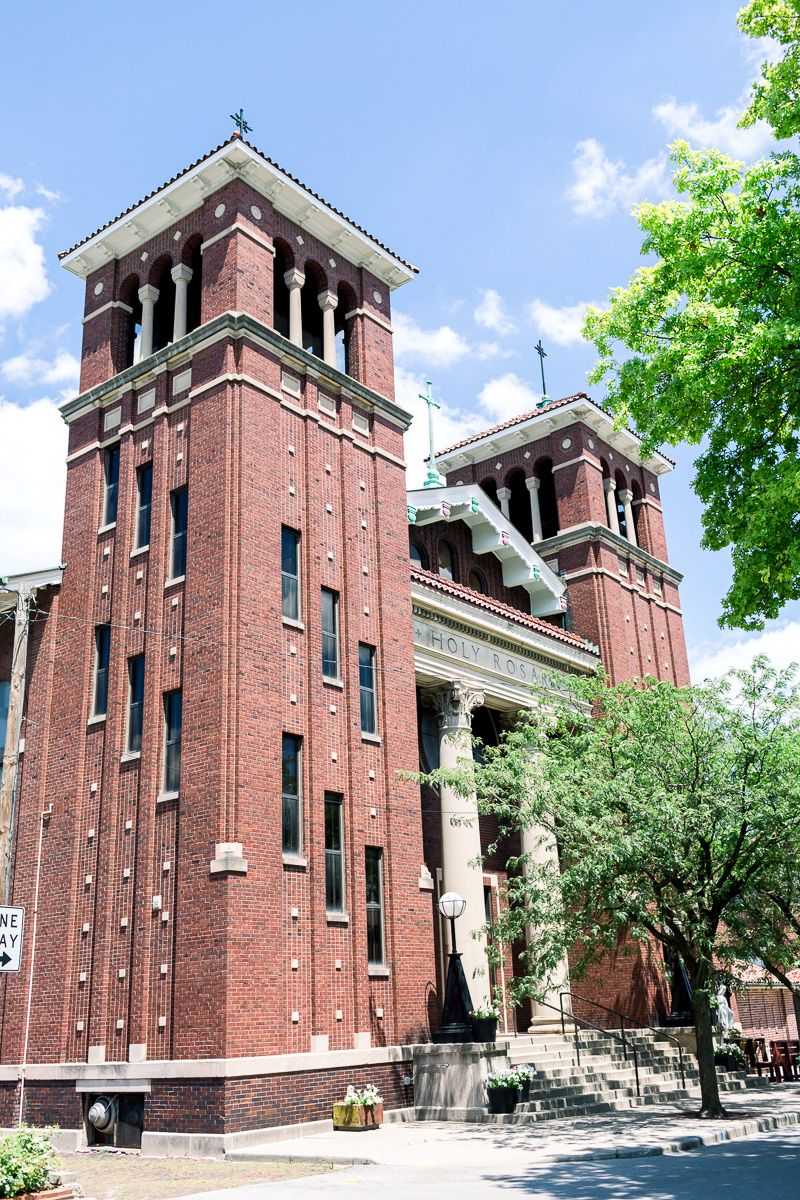
Bells drifting over the southeast corner of downtown Indianapolis have been part of neighborhood life here for generations. Holy Rosary, at 520 Stevens Street, Indianapolis, IN 46203, grew out of the city’s Italian-American community, and its architecture points straight back toward Rome.
The design follows the Church of San Giorgio in Rome, Italy, in an Italian Renaissance style that trades Gothic spikes for calmer proportions.
Architects J. Edwin Kopf and Kenneth K.
Woolling based their plans on that Roman model, adding Indiana limestone accents to the exterior. The nave feels welcoming rather than overwhelming, which fits a parish built by working families.
Construction began in 1911 to serve Italian Catholic immigrants, then hit the usual obstacles. Funding ran thin, World War I intervened, and the building was not finished until 1925.
Fourteen years is a long wait for a church, and the persistence shows in how carefully the details were handled.
The surrounding streets still carry an Italian flavor, making this a good stop for travelers who like their architecture paired with a walkable neighborhood. Sidewalks are narrow, the pace is slow, and the bell tower keeps reappearing between rooftops.
Anyone comparing Gothic churches all day will appreciate the change of rhythm here, where round arches and Renaissance balance offer a genuine breather.
6. St. John the Evangelist Catholic Church, Indianapolis
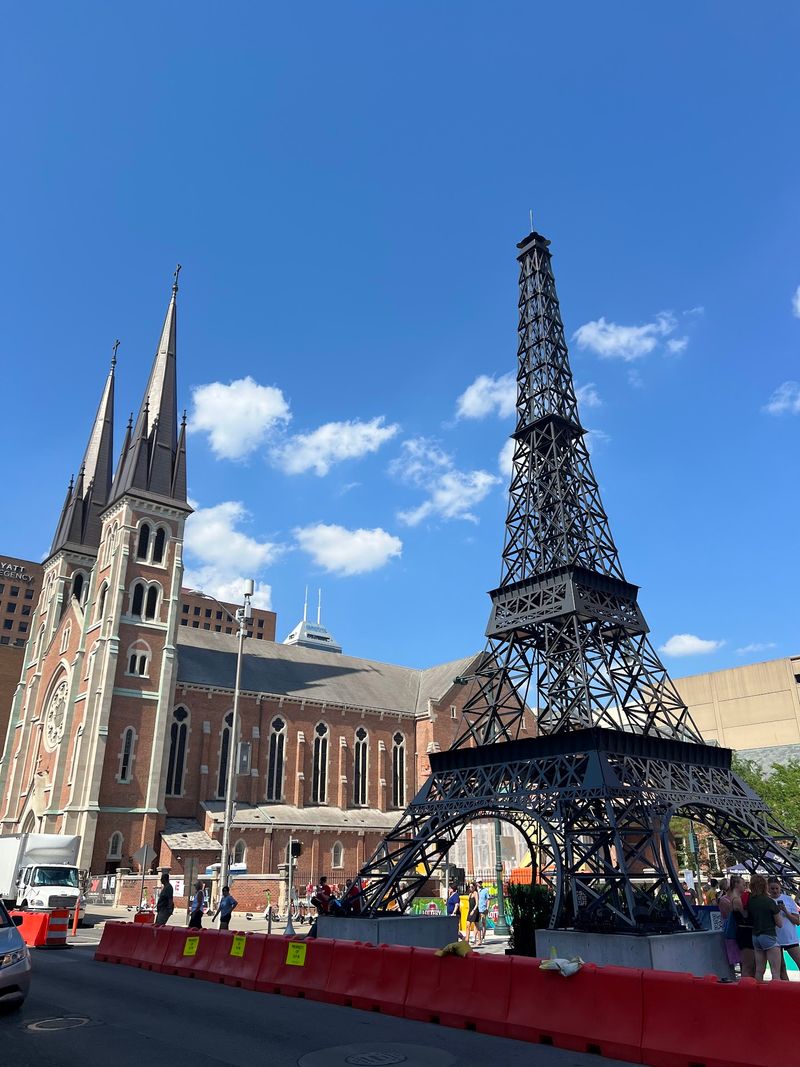
Copper spires above red brick make for an unusual silhouette in downtown Indianapolis, especially with a convention center humming nearby.
St. John the Evangelist, at 126 West Georgia Street, Indianapolis, Indiana, is the oldest Catholic parish in the city, and its architecture mixes French Gothic Revival with American Romanesque Revival in a way that resists easy labels.
Limestone coping trims the brick, and the detail work rewards a slow walk around the block.
Two five-story towers dominate the main facade. Those prominent copper spires were added in 1893, giving the building the vertical punch it had been missing.
Arched windows and a heavily detailed entryway carry the Gothic side of the argument, while a large circular rose window above the main door steals the show.
Inside its frame sits a central glass rosette ringed by limestone and eight smaller rosette windows, a pattern that echoes cathedral fronts in France.
Diedrich A. Bohlen designed the present church, begun in 1867 and completed in 1871.
Fun bit of trivia: when the cornerstone was laid, the sanctuary seated 3,000 people, making it the largest in Indiana at the time.
Modern hotels and arenas crowd the area now, so the contrast between old brick and new glass is part of the experience. Early mornings offer the quietest views.
7. St. Meinrad Archabbey Church, St. Meinrad
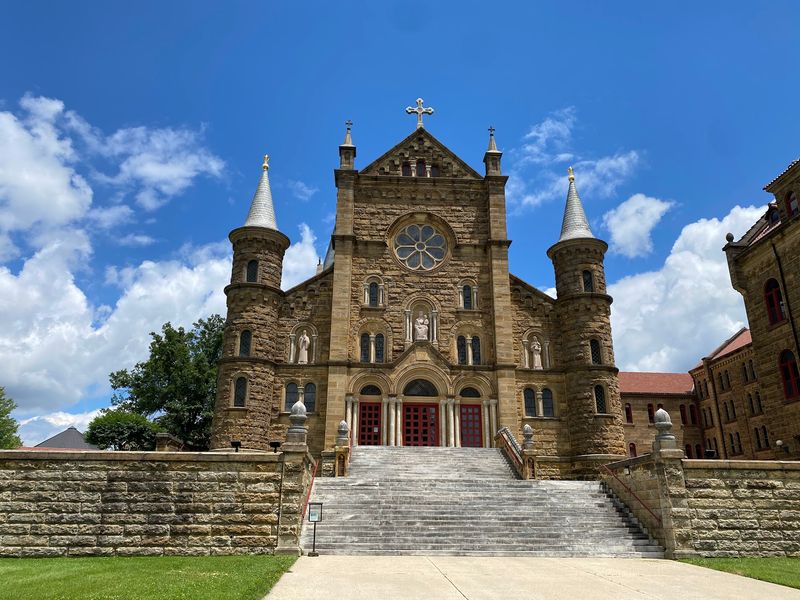
Southern Indiana hill country hides a Benedictine complex that looks lifted from the Swiss countryside, which makes sense given who built it.
The Archabbey Church of Our Lady of Einsiedeln sits within Saint Meinrad Archabbey at 200 Hill Drive, St. Meinrad, IN 47577, and the community itself was founded in 1854 by monks from the Swiss Abbey of Einsiedeln.
Romanesque lines dominate, all rounded arches and heavy, grounded strength rather than Gothic reach.
Work on the current church started in 1899 and wrapped in 1907, using local sandstone quarried right from abbey land. Stone from the property, shaped by monks and workers on site, gives the walls a warm, honey-toned glow in evening light.
Franciscan Brother Adrian Wewer drew up the design, and inside, massive columns of Georgia marble hold everything aloft.
Marble steps lead to the main entrance, where niches hold statues of the Madonna and Child, St. Benedict, and St. Scholastica, carved from Tennessee marble by Herbert Jogerst.
The original high altar came from the studios of Joseph Deplaz in Regensburg, Bavaria, a genuine piece of German craftsmanship parked in rural Indiana.
Rolling farmland surrounds the hilltop, and the drive in is half the pleasure.
Visitors who arrive when the monks are chanting will hear the acoustics doing exactly what the builders intended.
8. St. Paul’s Evangelical Lutheran Church, Fort Wayne
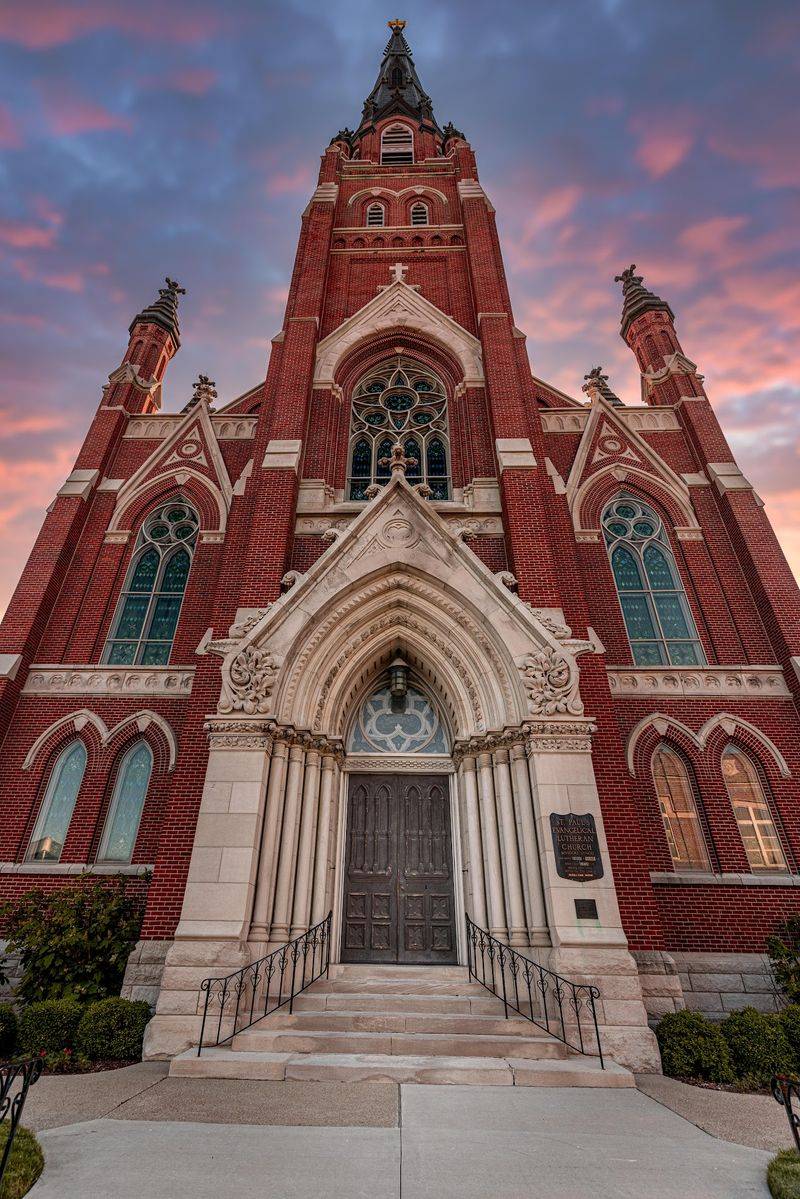
German Lutheran roots run deep in Fort Wayne, and this church wears them proudly. St. Paul’s, at 1126 South Barr Street, Fort Wayne, Indiana, works in High Victorian Gothic style, a look that trades delicacy for weight and precision.
The congregation dates to 1837, formed by German Lutherans whose traditions still shape the building’s mood.
Step inside and the high ribbed ceiling immediately sets the scale. Sound carries differently under those ribs, sharpening organ music and hymns alike.
An ornately carved pulpit anchors the sanctuary, and stained glass filters daylight into a soft, honeyed wash across the pews. Trefoil panes sit above the altar, a small flourish that most visitors miss on a first pass.
The current building, designed by the firm Wing and Mahurin, was first completed in 1889. Then came trouble.
A devastating fire in 1903 forced a near-complete rebuild, finished by 1905, which means the church standing today is both original in spirit and reconstructed in fact.
Reverence is the word people reach for here, though the craftsmanship deserves credit too. Carved wood, pointed arches, and careful proportion combine into something that feels genuinely transplanted from a German city center.
Fort Wayne makes it easy to pair this stop with the downtown cathedral, since the two sit only a short drive apart.
9. St. Benedict Catholic Church, Terre Haute
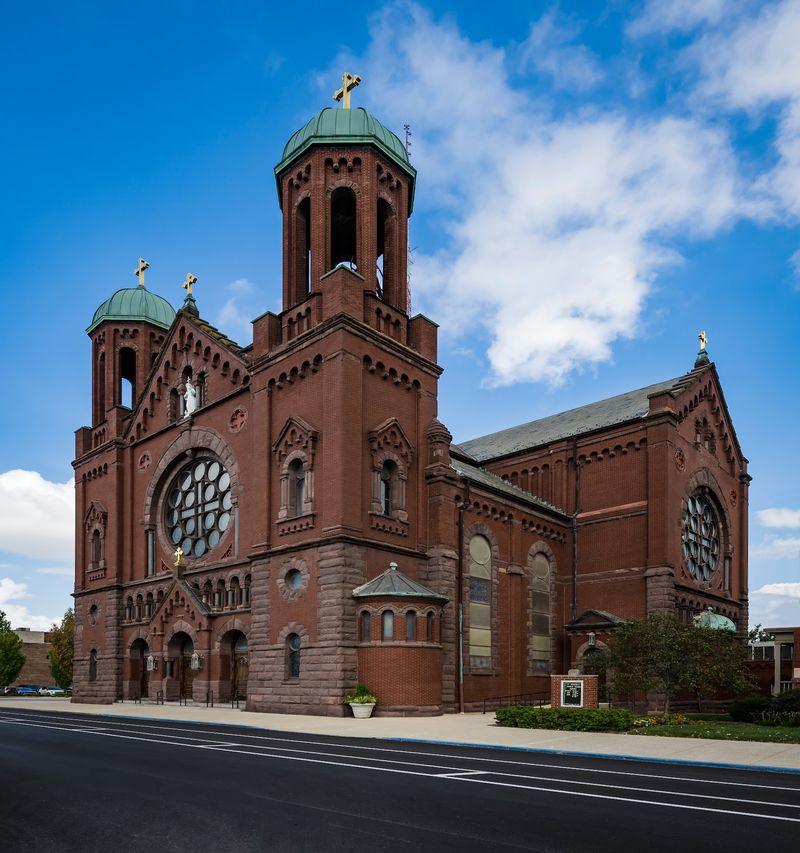
Two cupolas rising 125 feet over Terre Haute announce this church long before the front doors come into view.
St. Benedict, at 111 South Ninth Street, Terre Haute, Indiana, chose Romanesque over Gothic, an interesting decision given that its founders came from Germany, where Gothic was the expected choice.
Those distinctive tower caps became a signature of the parish’s Teutonic heritage.
German immigrants founded the parish in 1864. The cornerstone for the present building was laid in 1896, dedication followed in 1899, and a fire in 1930 forced a rebuild.
The plan is cruciform, and inside, frescoed walls and ceilings turn the whole space into a painted canopy. Towering columns with ornate capitals march toward an intricate altar that pulls focus down the nave.
Windows are the quiet highlight. Three large rose windows sit on the west, north, and south facades, joined by arch and lancet windows, some of which were crafted in Austria for the 1899 dedication.
Colored light moving across frescoes is a combination worth timing a visit around.
Terre Haute sits handy to Interstate 70, making this an easy detour for travelers crossing the state. Downtown parking is straightforward, and the towers make navigation almost automatic.
Round arches and painted ceilings offer a warmer, more Italianate feeling than the state’s many Gothic landmarks.
10. St. Adalbert Catholic Church, South Bend
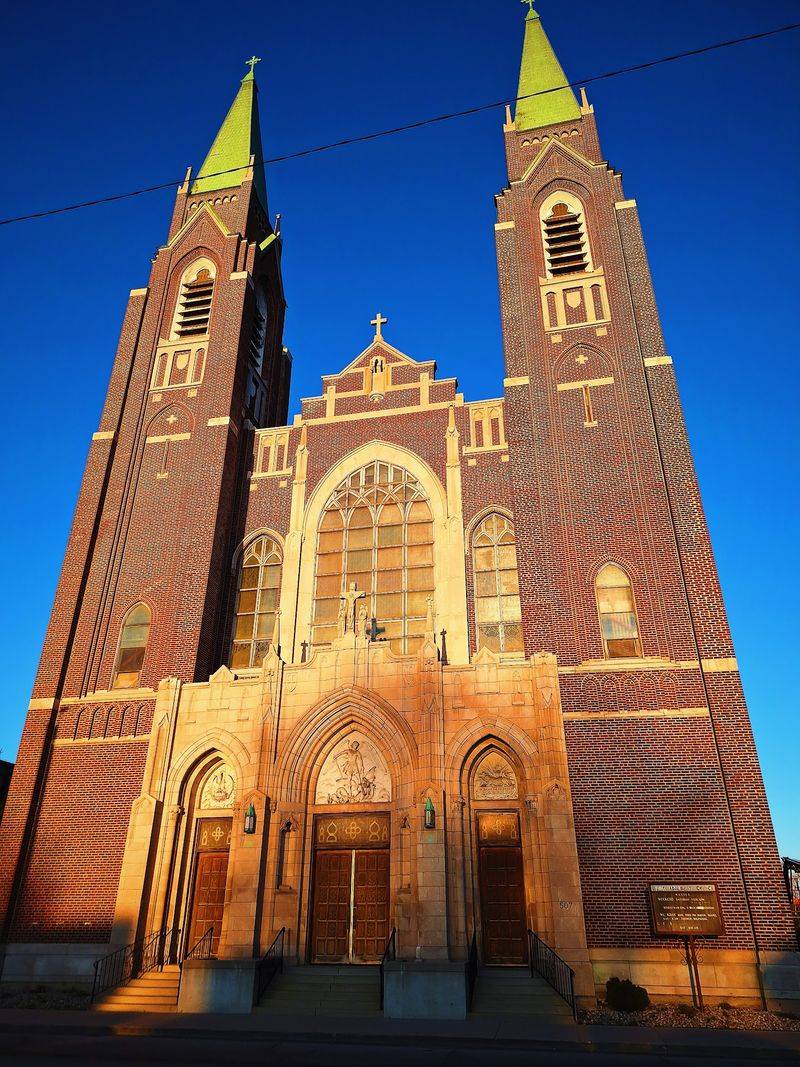
Twin steeples pushing 175 feet into the sky over South Bend’s west side tell a story about ambition and homesickness.
St. Adalbert, at 2505 West Grace Street, South Bend, Indiana, follows the Neo-Gothic style often called Polish Cathedral, a look Polish immigrant communities used to make a statement in brick and stone.
Brick masonry trimmed with limestone forms the shell, sturdy and confident.
Pointed arch stained-glass windows sit above the entryways, sending colored light into a cruciform interior that has changed remarkably little over the decades. Murals, friezes, and sculptures cover the walls.
One of them breaks the mold completely. The Polish Worker Mural by John A.
Mallin shows working-class immigrant life rather than religious scenes, which is unusual enough to make the trip worthwhile on its own.
Polish immigrants founded the parish in 1910, and the current building went up between 1923 and 1926, constructed by the Chicago firm Worthmann and Steinbach.
The neighborhood around it still functions as a cultural anchor, welcoming new generations of immigrants and keeping the parish’s original purpose intact.
South Bend makes a natural finish or start to this route, since the Notre Dame basilica sits just minutes away.
Two very different European visions, one French and academic, the other Polish and working-class, standing in the same city. That contrast says a lot about Indiana.
