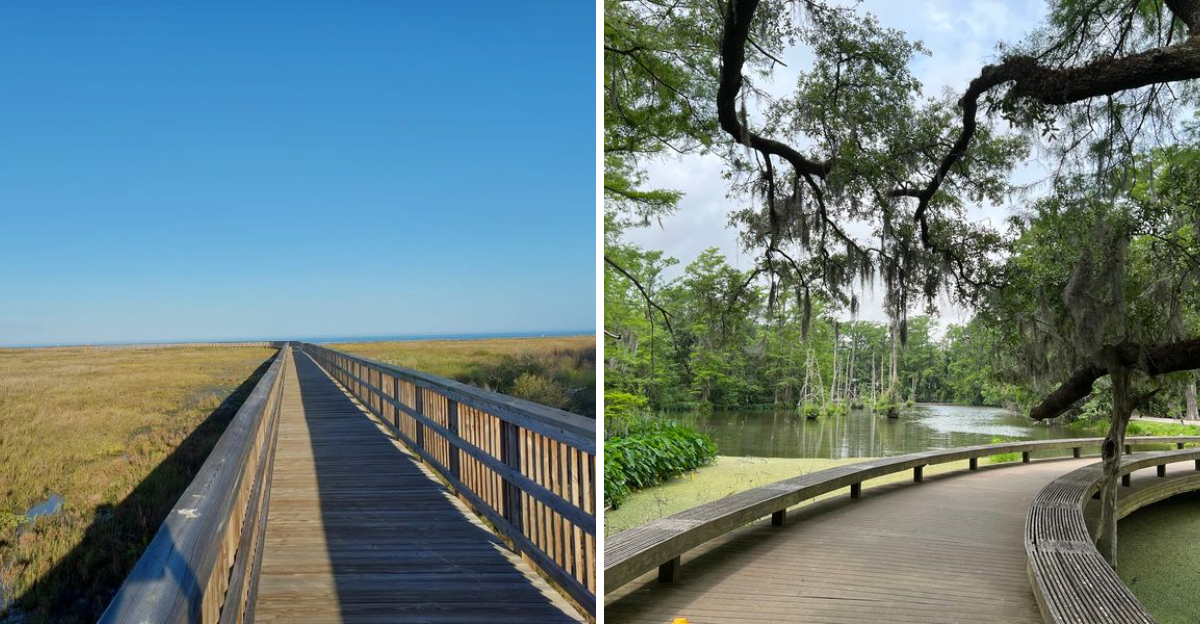
Boardwalks are basically nature trails for people who enjoy wild scenery but prefer their shoes not to disappear into six inches of mud.
Across Texas, wooden paths slip through marshes, wetlands, swamps, coastal habitats, forests, and wildlife refuges where the scenery can change dramatically within a surprisingly short walk.
Instead of worrying about steep climbs, the entertainment comes from watching the water, scanning for birds, spotting unusual plants, and occasionally noticing something move nearby that makes everyone suddenly much more observant.
These trails can feel wonderfully removed from parking lots and busy roads even when the walk itself is easy, which is a pretty good return on effort.
Texas has landscapes that look like they belong in completely different parts of the country, and a simple stretch of boardwalk can put you right in the middle of them.
1. Floating Bridge Lake Weatherford
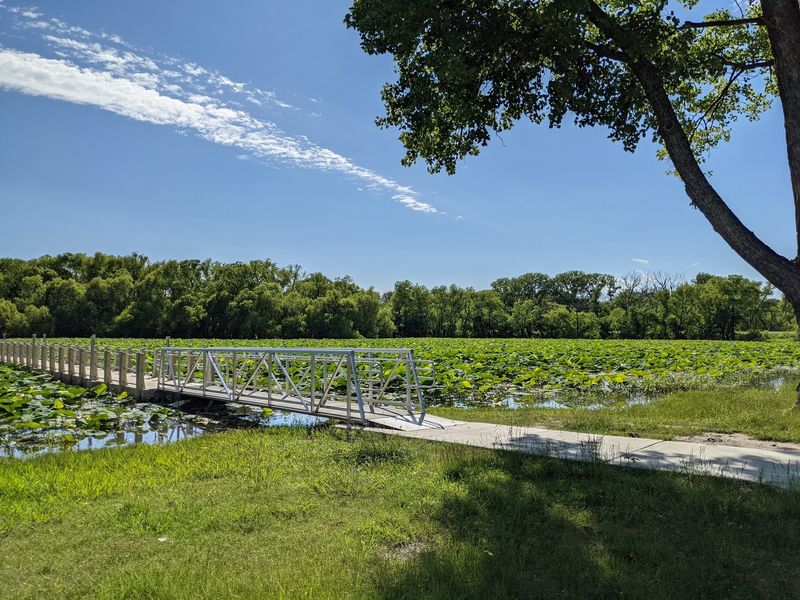
There is a certain thrill in realizing the ground beneath your feet is actually floating. The Floating Bridge at Lake Weatherford holds the remarkable distinction of being the longest floating pathway in the United States, extending roughly 4,313 feet directly across the lake’s shimmering surface.
The beige polyurethane structure rises and falls with changing water levels, so the experience shifts subtly with every season.
Benches are placed at regular intervals, inviting visitors to sit and let the quiet wash over them. During late June and into early July, American water lilies burst into bloom across portions of the lake, turning the surrounding water into a sea of vivid yellow flowers.
It is genuinely one of the most striking natural displays in North Texas.
The trail is flat and accessible, making it a comfortable outing for families, older visitors, and anyone who simply wants a peaceful morning outdoors. Early risers are rewarded with glassy water reflections and birdsong that carries easily across the open lake.
Sunsets here are equally impressive, painting the sky in warm shades that mirror perfectly on the still surface below. The boardwalk remains open from before dawn until well after dusk, offering flexible timing for every kind of visitor.
Address: 2912 E Lake Dr, Weatherford, TX 76087
2. Cattail Marsh Scenic Wetlands and Boardwalk
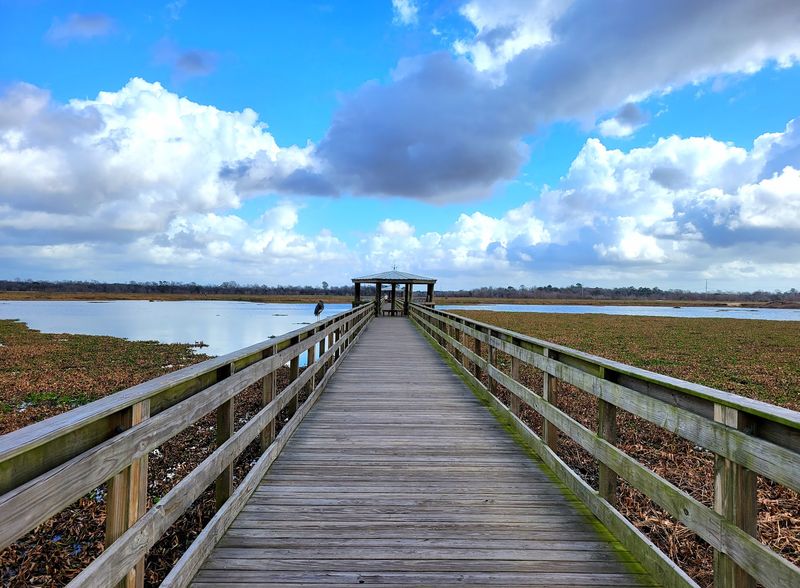
Few places in Southeast Texas carry the kind of ecological weight that Cattail Marsh quietly holds.
Spread across roughly 900 acres of managed wetland, this sanctuary outside Beaumont draws more than 250 to 300 bird species annually, making it one of the most productive birdwatching sites along the entire Gulf Coast flyway.
Pelicans, roseate spoonbills, egrets, ibis, and red-winged blackbirds are just a handful of the species that call this marsh home throughout the year.
The modern boardwalk pushes deep into the heart of the wetland, with two covered observation platforms positioned at ideal vantage points for wildlife viewing. Over eight miles of gravel levee roads complement the boardwalk, offering additional routes on foot, by bicycle, or even on horseback.
The variety of access options makes it genuinely easy to spend an entire morning here without retracing a single step.
What makes Cattail Marsh especially fascinating is its origin story. The site began as part of Beaumont’s municipal wastewater treatment system, then transformed over time into a thriving natural wetland.
Environmental experts from across the state have taken notice, and the marsh now serves as a model for ecological restoration.
Alligators are a common sight along the sunny banks, adding a prehistoric energy to the experience. The boardwalk is fully wheelchair accessible, and an elevator leads to an elevated observation deck with sweeping views of the entire marsh below.
Address: 4233 Babe Zaharias Dr, Beaumont, TX 77705
3. Laguna Madre Nature Trail
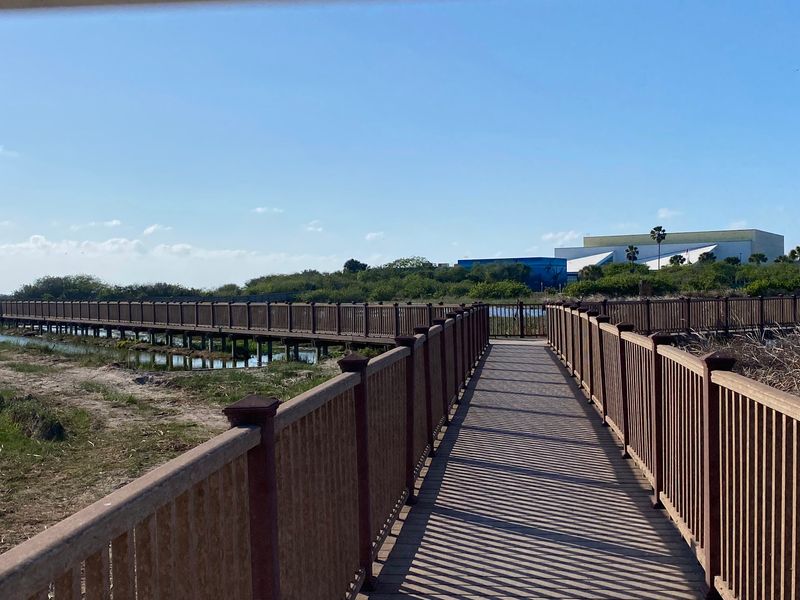
South Padre Island has a reputation for sandy beaches and warm Gulf breezes, but hidden along its quieter side lies a trail that feels like stepping into a living nature documentary.
The Laguna Madre Nature Trail follows a 1,500-foot boardwalk over four acres of pristine coastal marsh, offering an intimate look at one of the rarest water bodies on the planet.
Laguna Madre is a hypersaline lagoon, meaning its waters are saltier than the open ocean, and that unique chemistry supports a distinctly unusual ecosystem.
More than 300 bird species pass through or reside in this area throughout the year.
Birdwatchers can expect excellent sightings from the multiple vantage points built into the boardwalk’s design, and informative plaques along the path help identify the species and explain the ecology of the surrounding wetland.
The adventure begins near the colorful Whaling Wall mural, a vivid gateway into the marshland.
Sunrise and sunset views from the elevated pathway are genuinely breathtaking. The sky reflects across the lagoon in layered hues of coral, amber, and gold, and the stillness of the water amplifies every color.
It is the kind of scene that makes people stop mid-step and just stare.
The trail is mostly wheelchair accessible, and its thoughtful construction minimizes environmental impact so the delicate habitat remains undisturbed. For anyone visiting the island, this trail offers a meaningful counterpoint to the beach scene nearby.
Address: 7355 Padre Blvd, South Padre Island, TX 78597
4. Kirby Nature Trail, Big Thicket National Preserve
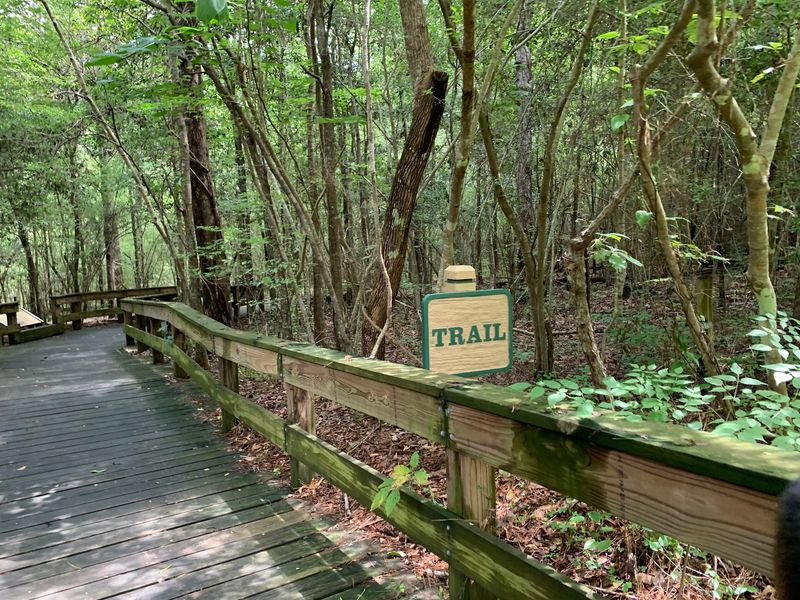
Big Thicket National Preserve protects nine distinct biological habitats within a single stretch of East Texas, and the Kirby Nature Trail is the best single route for experiencing that staggering diversity firsthand.
The 2.5-mile loop moves through ancient forest, open wetland, and mysterious bayou swampland, and the transitions between ecosystems happen so quickly that each bend in the path feels like crossing an invisible border into a different world entirely.
Boardwalks are placed strategically throughout the loop, carrying hikers smoothly over the wettest and most sensitive sections. The bald cypress trees here are the undeniable stars of the show.
Their broad, flared bases and woody knees emerge from the dark water below in formations that look almost architectural, and the filtered light that falls through their canopy creates a soft, cathedral-like atmosphere.
Educational placards appear at intervals along the trail, offering context about the preserve’s remarkable biodiversity and the species that depend on these protected lands.
The first section of the loop features a mix of paved surfaces and wooden boardwalks before transitioning to hard-packed soil with scattered gravel.
Some areas include slight dips and exposed tree roots, so sturdy footwear is a practical choice.
An iron bridge spanning Village Creek connects the Kirby trail to the longer Turkey Creek Trail for those wanting to extend the outing. The preserve itself is recognized globally for the sheer concentration of life it shelters within a relatively compact area.
Address: 1618 FM 420, Kountze, TX 77625
5. Sundew Trail, Big Thicket National Preserve
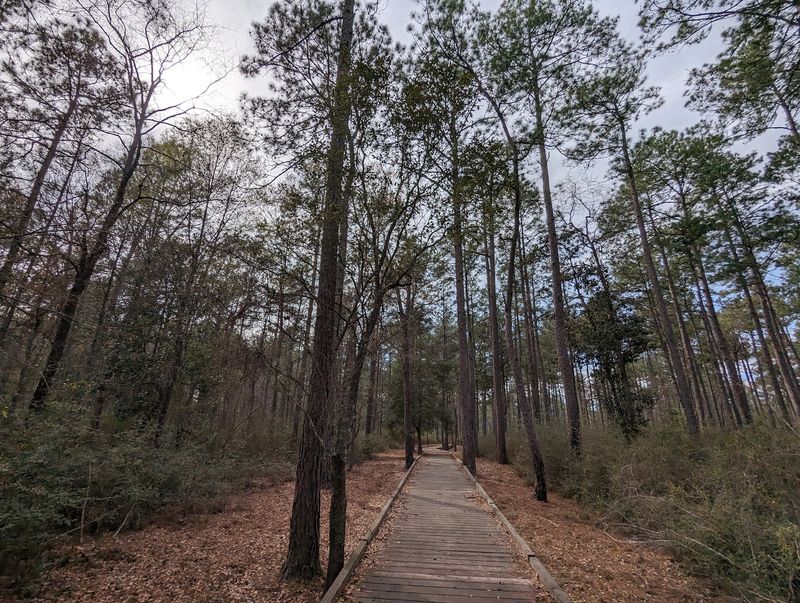
Not many trails in Texas can claim carnivorous plants as their main attraction, but the Sundew Trail earns that distinction with quiet confidence.
Located in the Hickory Creek Savannah Unit of Big Thicket National Preserve, this short loop ranges between 0.3 and 1 mile in length and packs a surprising amount of botanical wonder into a compact space.
The boardwalk meanders through a small bog, and it is here that the trail reveals its most captivating secret.
Tall, funnel-shaped pitcher plants line the edges of the path, their open mouths waiting patiently for unsuspecting insects. Tiny red sundews cluster nearby, their coin-sized leaves glittering with sticky droplets that catch the light.
Spring and summer bring the most dramatic displays, though sundews remain visible and sparkling through winter as well.
Crawfish holes dot the muddy water along the boardwalk, hinting at the active community of creatures living just beneath the surface. Elegant longleaf pines stretch skyward beyond the bog, framing the wetland with a sense of open, sun-dappled space.
The contrast between the delicate bog plants and the towering pines creates a visual dynamic that is genuinely hard to find anywhere else in the state.
A shaded pavilion with picnic tables sits at the trailhead, offering a comfortable spot to rest and eat before or after the walk. The inner loop is fully accessible, welcoming visitors of all mobility levels to experience this remarkable botanical environment without difficulty.
Address: Hickory Creek Savannah Unit, Warren, TX 77664
6. Aransas National Wildlife Refuge Boardwalk
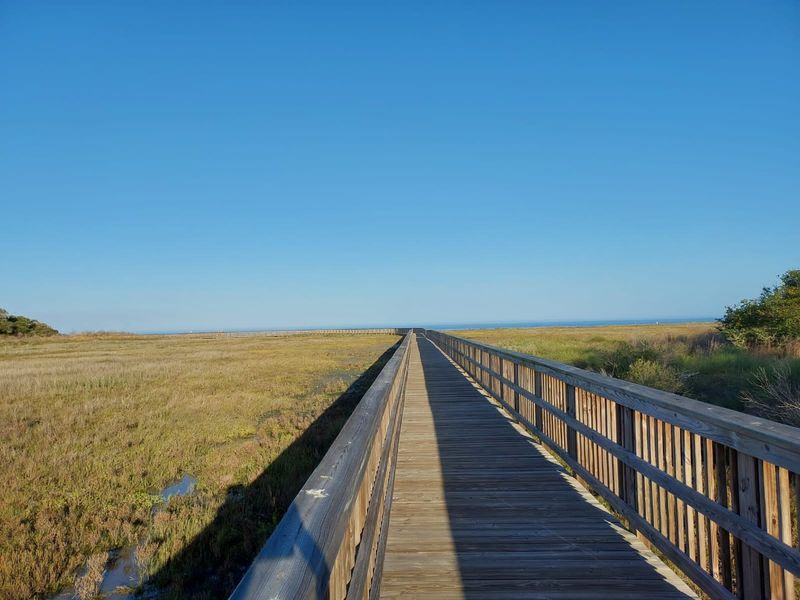
The Aransas National Wildlife Refuge carries a conservation story that is both humbling and genuinely inspiring.
Established in 1937 along the Texas Gulf Coast, the refuge was created specifically to protect the last wild flock of whooping cranes, one of the most critically endangered bird species on Earth.
Every autumn, these towering white birds complete an epic migration of more than 2,400 miles from their summer grounds in Canada, arriving at Aransas to spend the winter in its sprawling coastal marshes.
December through February offers the best viewing conditions, and spotting a whooping crane foraging in the marsh is an experience that is difficult to put into words.
The birds stand nearly five feet tall, and watching them move through the shallow water with such unhurried grace is quietly extraordinary.
I found myself holding my breath the first time one walked close to the observation area.
Beyond the cranes, the refuge shelters an impressive range of wildlife. Sandhill cranes, roseate spoonbills, pelicans, herons, egrets, javelinas, armadillos, and alligators all share this protected landscape.
Observation towers and a network of hiking trails give visitors multiple angles for wildlife viewing throughout the day.
The auto tour and all trails are open daily from sunrise to sunset, and the refuge connects to a broader network of protected areas along the coast dedicated to the long-term survival of vulnerable species. It is a place that rewards patience in the most meaningful way.
Address: 1 Wildlife Cir, Austwell, TX 77950
7. Leonabelle Turnbull Birding Center Boardwalk
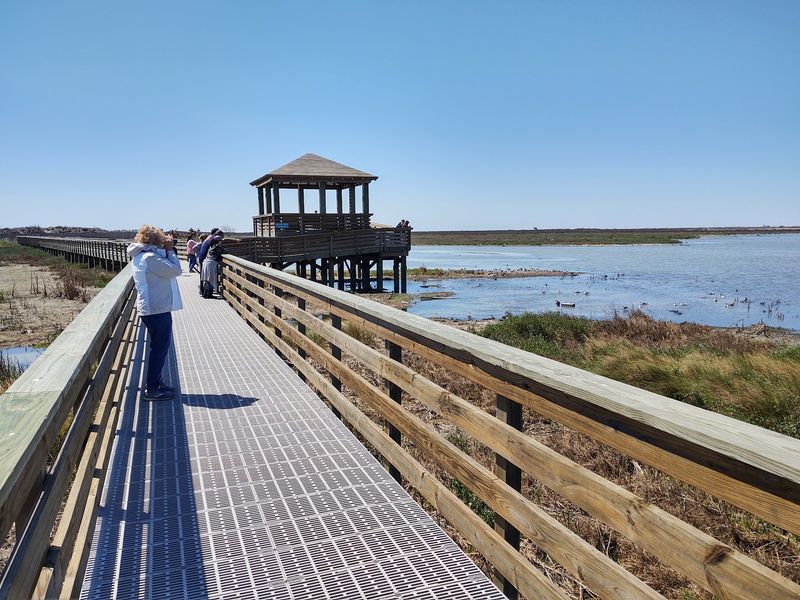
Port Aransas has a reputation as a laid-back beach town, but the Leonabelle Turnbull Birding Center adds a completely different dimension to a visit.
Part of the Port Aransas Nature Preserve, the center features a 1,250-foot ADA-accessible boardwalk that stretches over expansive freshwater wetlands, offering some of the most accessible and rewarding birdwatching on the entire Texas coast.
Two shaded observation towers rise above the path, giving visitors elevated views across the water that are ideal for extended watching sessions.
An additional 750-foot accessible trail winds through wildflower fields and along the edge of a saltmarsh, connecting seamlessly to Charlie’s Pasture South Trail for those who want to cover more ground.
That connection adds another 1.25 miles through diverse grassland prairie and salt marsh habitat, including yet another observation tower.
The full route rewards walkers with a genuine sense of coastal Texas in its most natural form.
The bird list here is remarkable. Black-bellied Whistling-Ducks, Cinnamon Teal, Least Grebes, cormorants, Black-necked Stilts, and the famously pink Roseate Spoonbill, the official city bird of Port Aransas, are all regular sightings.
Spotting scopes are available on-site, and benches are positioned thoughtfully along the route for rest stops.
One beloved local resident is “Boots,” a large American alligator who makes occasional appearances near the boardwalk. The center opens at sunrise and closes at sunset, and the lush pollinator garden near the entrance makes for a lovely first impression.
Address: 1356 Ross Ave, Port Aransas, TX 78373
8. Shangri La Botanical Gardens and Nature Center
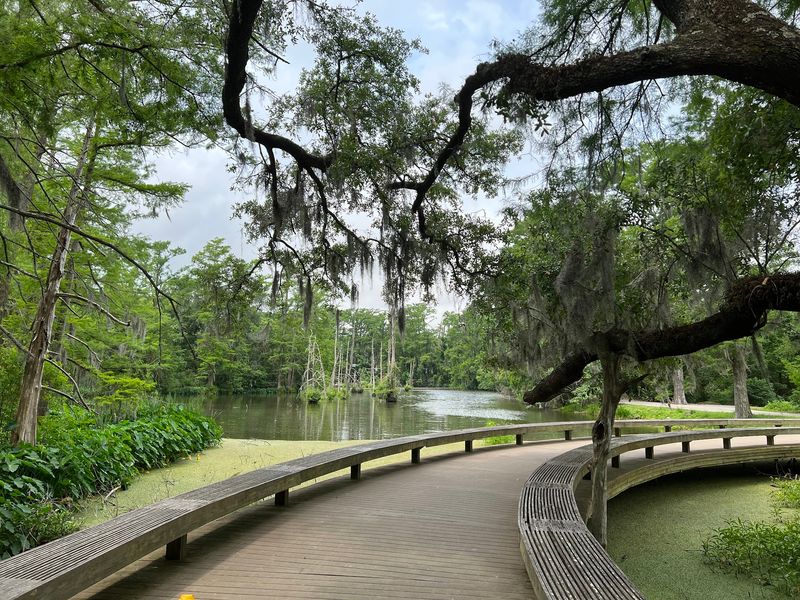
Orange, Texas is not always the first place that comes to mind for a botanical adventure, but Shangri La manages to be genuinely surprising every single time.
Spread across 252 acres along the quiet waterways of Adams Bayou, this destination blends formal garden design with the raw, untamed character of a Southeast Texas wetland.
Wooden boardwalks carry visitors beneath towering ancient cypress trees, their canopies forming a dense, cathedral-like ceiling that filters sunlight into shifting green patterns below.
The botanical gardens feature more than 300 plant species arranged within five formal garden rooms, complemented by four sculpture rooms that add an artistic layer to the natural setting.
A historical color garden known as the Pond of the Blue Moon pays tribute to the site’s original vision, showcasing 41 varieties of azaleas with roots tracing back to H.J.
Lutcher Stark’s original Shangri-La design. The reflection pond, often brightened by azalea blooms, has a quieting effect that is hard to shake.
The Nature Discovery Center invites hands-on exploration of the area’s wetland ecosystems. For a deeper experience, guided watercraft tours travel along Adams Bayou to outposts where visitors can learn about the ecological importance of wetlands, upland forests, and grasslands.
It is the kind of tour that changes how a person thinks about water.
A dedicated bird blind allows unobtrusive viewing of nesting birds within the site’s active heronry. As a certified green space, Shangri La reflects a genuine commitment to balancing human enjoyment with environmental stewardship.
Address: 2111 West Park Ave, Orange, TX 77630
9. Boardwalk at Lady Bird Lake
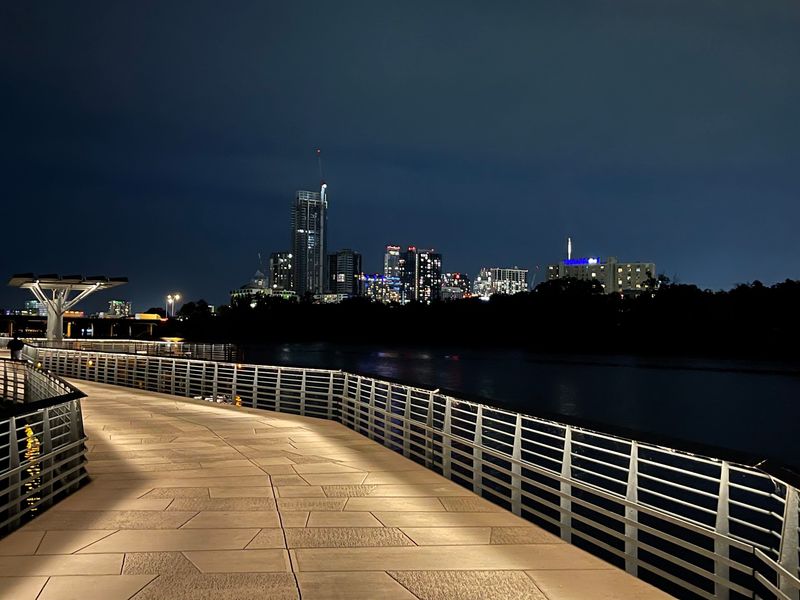
Austin is a city that rarely sits still, and the Boardwalk at Lady Bird Lake matches that energy perfectly while still offering genuine moments of calm. This 1.3-mile section forms part of the larger Ann and Roy Butler Hike-and-Bike Trail, which loops the entire lake for 10.2 miles.
The boardwalk specifically hugs the south shore of the Colorado River, connecting previously unlinked sections of the trail and making the full loop accessible in a way it never was before.
The design is thoughtfully urban. Concrete deck planks, galvanized steel shade canopies, and viewing areas that extend gracefully over the water give the boardwalk a polished but welcoming feel.
Kayakers pass beneath the elevated sections without any disruption to foot traffic above, and the trail weaves across reedy islands and through pockets of leafy forest that offer shade even on warm afternoons.
After dark, 13,000 LED lights concealed within the handrail illuminate the pathway with a soft, warm glow that transforms the experience entirely. It is a genuinely lovely way to end an evening.
The railing also carries a distinctive artistic element called “Belting It Out” by artist Ken Little, featuring 36 cast bronze western-style belts embossed with lyrics from celebrated Texas musicians.
Multiple access points make this trail easy to reach from different parts of the city. The boardwalk offers sweeping views of Austin’s skyline that shift beautifully as the light changes throughout the day.
Address: 1820 S Lakeshore Blvd, Austin, TX 78741
