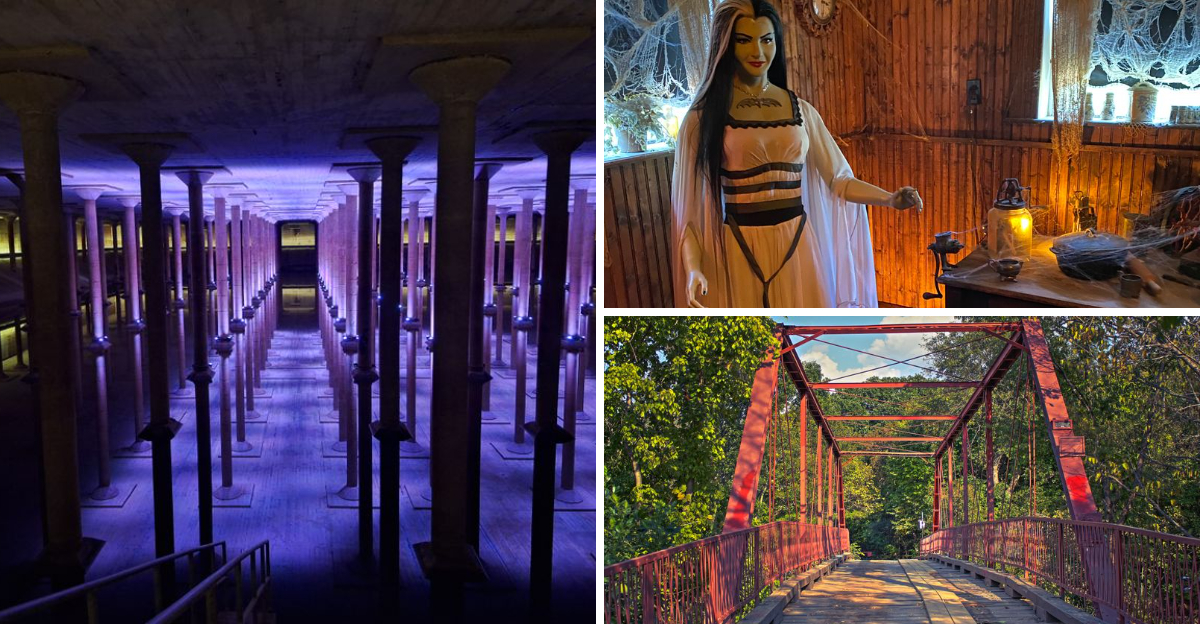
Texas looks familiar on the surface, but once you start digging, it gets strange fast. I always thought I knew the state pretty well until I started running into stories that sounded made up.
Underground buildings nobody talks about, lights in the desert that refuse to be explained, places that locals mention casually and then change the subject. Most people stop at the famous spots, snap a photo, and move on.
That is where they miss the fun. Texas hides its weirdest stories in plain sight, and once you start paying attention, it is hard to stop.
So what are these places, and why do so few people talk about them? That is where this gets interesting, because some of Texas’s strangest landmarks are the ones that make you question what you think you know about history and reality.
1. The Texas State Capitol Underground Extension
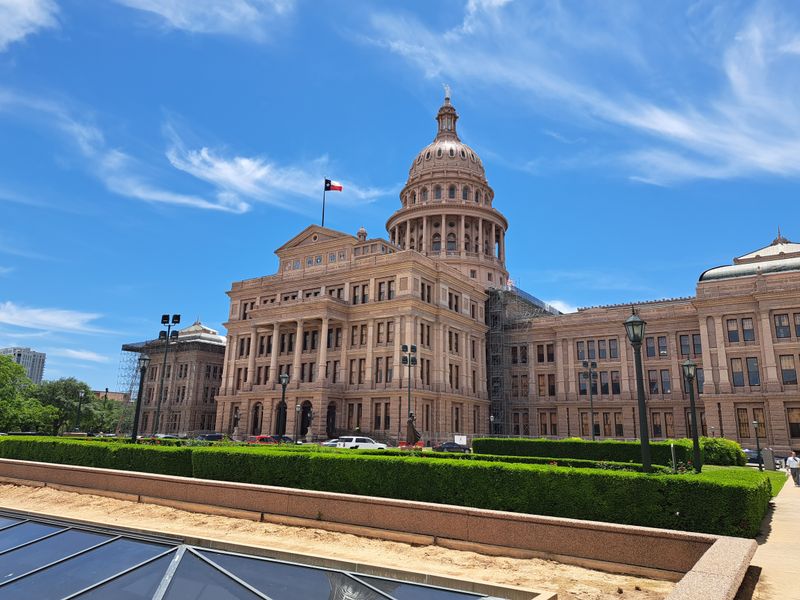
Beneath your feet at the Texas State Capitol lies one of the most ingenious architectural achievements in American government. While tourists gaze up at the magnificent pink granite dome, few realize they’re standing on top of a four-story inverted skyscraper that burrows deep into the Austin bedrock.
This isn’t some secret bunker or Cold War relic; it’s a fully functioning office complex that extends 667,000 square feet underground.
Built between 1990 and 1993, this subterranean marvel solved a seemingly impossible problem. State officials needed more workspace, but Texas law prohibited any building from blocking the view of the historic 1888 capitol dome.
Rather than compromise the skyline, architects decided to build down instead of up, creating what locals affectionately call the “upside-down skyscraper.”
Walking through the underground extension feels like stepping into a science fiction movie. Natural light floods the corridors through strategically placed skylights embedded in the lawn above.
Visitors on the capitol grounds can peer through these glass panels and watch legislators rushing to meetings four stories below.
The subterranean rotunda mirrors the grandeur of its above-ground counterpart, complete with marble floors and soaring ceilings that make you forget you’re buried beneath tons of earth.
The construction required excavating 700,000 cubic yards of limestone, enough to fill the Astrodome. Engineers reinforced the historic capitol building with steel cables during construction, ensuring the 130-year-old structure wouldn’t crack or shift.
The project cost $75 million but preserved Texas heritage while embracing modern needs.
Address: 1100 Congress Ave, Austin, TX 78701.
2. Marfa Lights Viewing Area
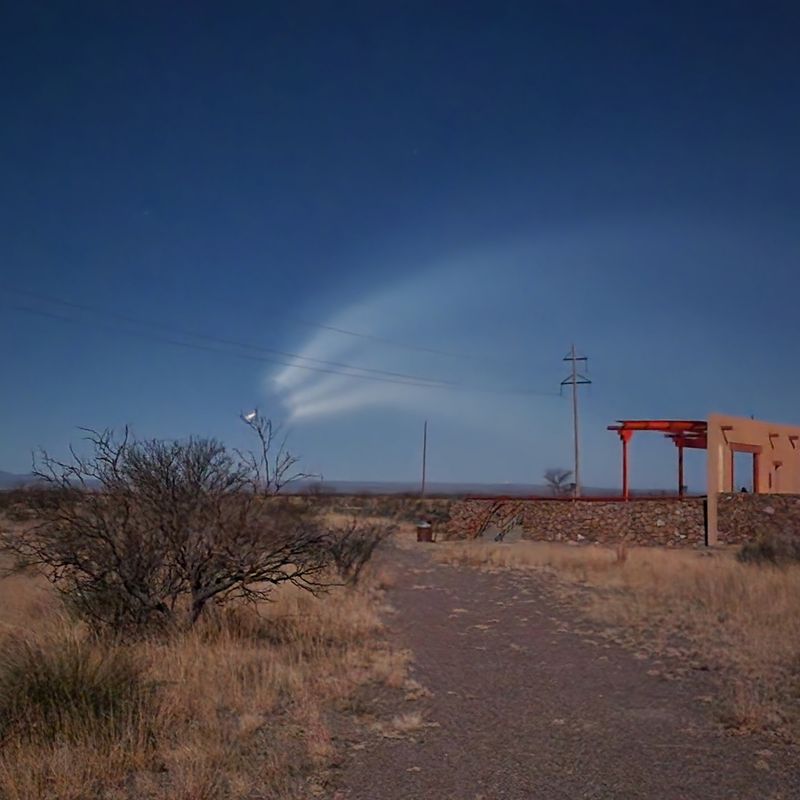
Out in the West Texas desert, where the sky stretches forever and civilization feels like a distant memory, something impossible happens almost every night. Basketball-sized orbs of light dance across the horizon, splitting apart and merging back together in ways that make physicists scratch their heads.
Welcome to the Marfa Lights, one of America’s most enduring supernatural mysteries that refuses to be solved despite 140 years of investigation.
First documented in 1883 by a young cowhand named Robert Ellison, these luminous spheres have baffled everyone from casual tourists to scientists armed with thermal imaging equipment.
The lights appear roughly 60 nights per year, floating and bobbing between the Chinati Mountains like living creatures with minds of their own.
They change colors from white to yellow to red, sometimes hovering motionless for minutes before suddenly shooting across the desert at impossible speeds.
Skeptics have proposed explanations ranging from car headlights to swamp gas, but none hold up under scrutiny. The viewing area sits nine miles from the nearest highway, and the lights appeared decades before automobiles existed in this region.
Modern drone surveys and spectral analysis have only deepened the mystery, revealing electromagnetic signatures that don’t match any known natural or man-made phenomenon. Some nights the lights perform for hours; other times they’re completely absent.
The official viewing platform offers benches, informational plaques, and unobstructed views of the light show zone. Bring patience and an open mind because these mysterious visitors operate on their own schedule.
Address: US-90, Marfa, TX 79843.
3. The Houston Cistern
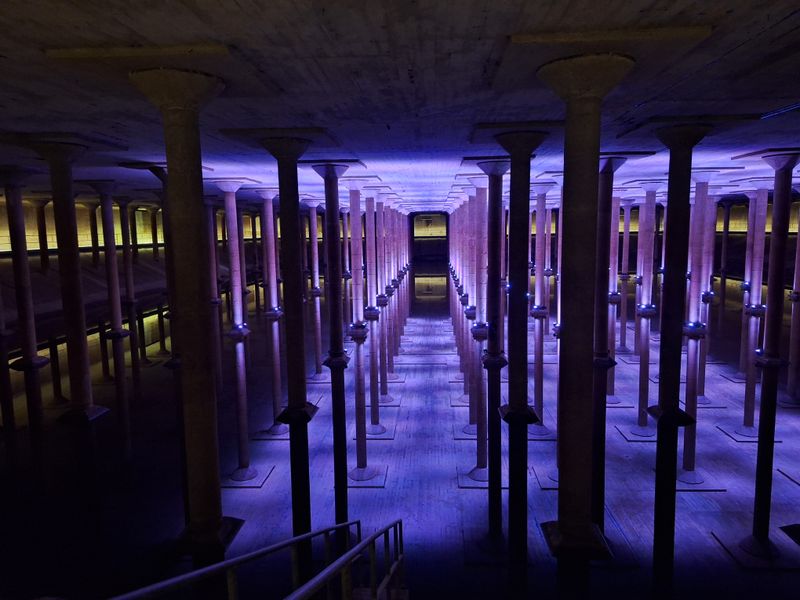
Picture a cathedral built not for worship but for water, a vast underground palace that held Houston’s drinking supply for decades before vanishing from public memory.
The Buffalo Bayou Park Cistern sprawls beneath the city like a secret world, its 221 concrete columns creating an otherworldly forest that photographers dream about.
This 87,000-square-foot chamber once held 15 million gallons of water, enough to supply the entire city during emergencies.
Constructed in 1926, the cistern served faithfully until 2007 when workers discovered an irreparable leak. Rather than fix it, the city simply drained the reservoir and forgot about it completely.
For three years this architectural marvel sat empty and abandoned, known only to a handful of municipal engineers who kept its location off public records. Then in 2010, a group of urban explorers stumbled upon the entrance and Houston suddenly remembered it had buried treasure.
What makes this space truly bizarre isn’t just its forgotten history but its acoustic properties. The cistern produces a 17-second echo that transforms whispers into thunderous reverberations.
Speak quietly at one end and your voice bounces between columns like a living thing, growing louder instead of fading. Sound engineers consider it one of the most unique echo chambers in North America.
Today the cistern operates as an art installation space, with carefully controlled tours that limit visitor numbers to preserve the eerie atmosphere. The shallow layer of water covering the floor creates perfect reflections, doubling the visual impact of the endless columns stretching into darkness.
Address: 105 Sabine St, Houston, TX 77007.
4. The Menger Hotel
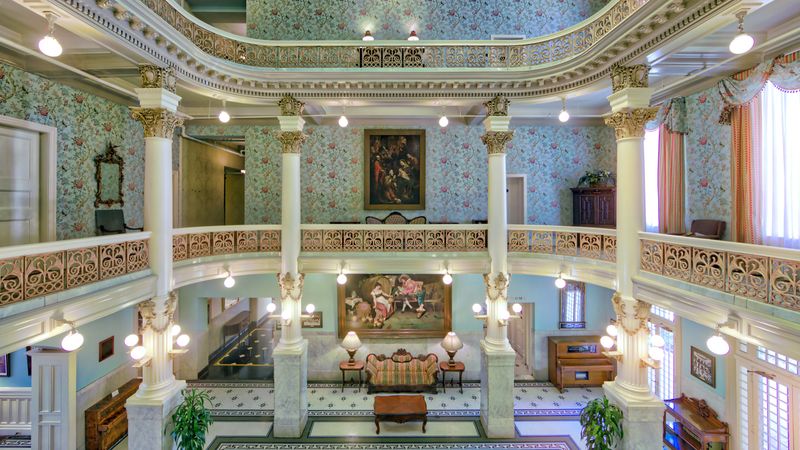
Right next door to Texas’s most famous landmark sits a hotel where the dead apparently never check out. The Menger Hotel opened in 1859, just 23 years after the Battle of the Alamo, built partially on ground where Davy Crockett and his fellow defenders made their last stand.
Guests who book rooms here aren’t just reserving a bed; they’re signing up for potential encounters with 32 documented spirits who roam the halls like they still own the place.
The hotel’s most famous living visitor was Theodore Roosevelt, who recruited his legendary Rough Riders regiment at the Menger Bar in 1898. Teddy’s ghost reportedly still hangs around, seen most often near the bar where he convinced cowboys and lawmen to join his charge up San Juan Hill.
But Roosevelt shares the spotlight with a crowded cast of spectral residents, including a chambermaid named Sallie White who was murdered by her husband in 1876 and apparently decided to keep working anyway.
Room 256 draws paranormal investigators from around the world because it’s where Captain Richard King, founder of the massive King Ranch, died in 1885. Guests report seeing his apparition pacing near the windows, possibly still conducting business deals from beyond the grave.
The hotel’s original lobby features a Victorian Gothic design that feels frozen in time, with thick carpets that muffle footsteps and chandeliers that cast shadows in every corner.
Whether you believe in ghosts or not, sleeping in a building constructed on a battlefield creates an atmosphere that gets under your skin.
Address: 204 Alamo Plaza, San Antonio, TX 78205.
5. Jacob’s Well Natural Area
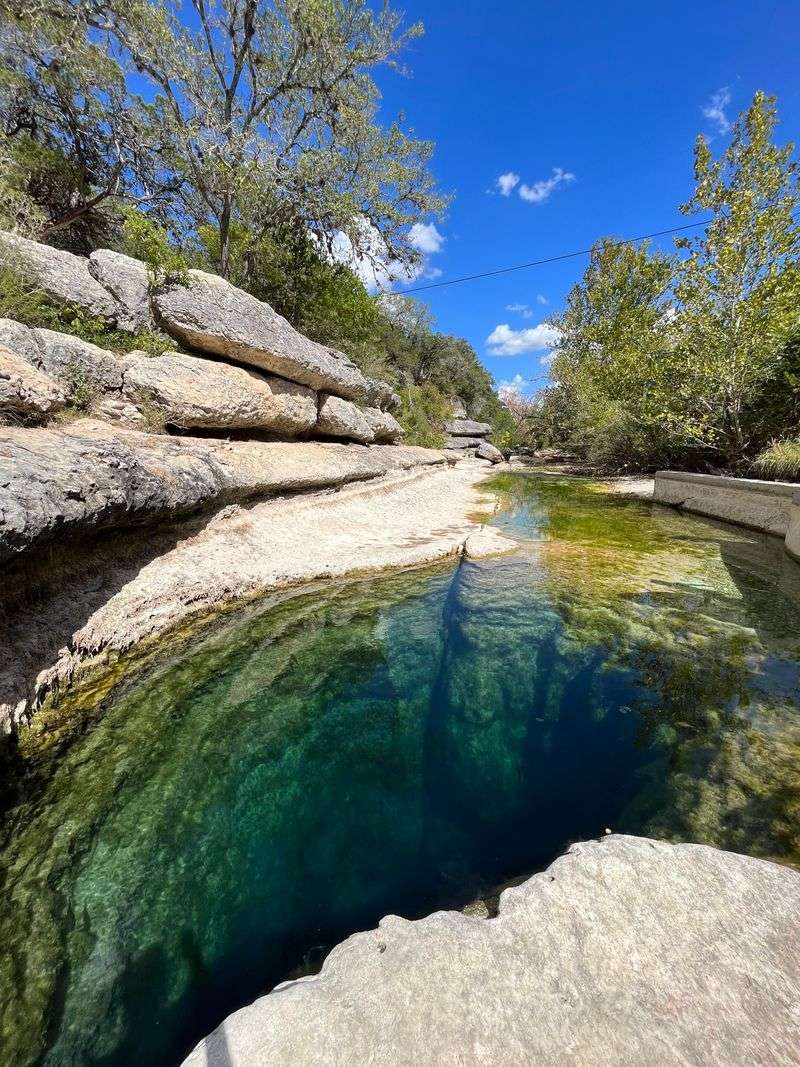
From the surface, Jacob’s Well looks like paradise: a crystal-clear spring bubbling up through limestone, creating a swimming hole so beautiful it belongs on postcards. Then you learn about what lies beneath, and paradise transforms into something far more sinister.
This seemingly innocent natural pool marks the entrance to one of the longest underwater cave systems in Texas, a maze of passages that has claimed at least 12 lives and earned the nickname “The World’s Deadliest Trap.”
The well plunges 140 feet straight down through four distinct chambers, each more dangerous than the last. Chamber one welcomes swimmers with warm water and plenty of light filtering from above.
Chamber two narrows considerably, requiring divers to remove their tanks and push them ahead through tight passages. Chamber three opens into a larger room with multiple tunnel exits, and this is where the nightmare begins.
Several of these passages are “false chimneys” that appear to lead upward toward safety but actually dead-end in rooms too small to turn around in.
Divers who enter these false chimneys find themselves trapped in limestone coffins, unable to back out and running out of air. The cave system extends more than 4,300 feet underground, with unexplored passages that may connect to other aquifer systems.
In 2000, after eight deaths in two years, officials installed a gate at the entrance to the fourth chamber, physically preventing recreational divers from going deeper.
Despite its deadly reputation, the well remains a popular swimming spot because the upper area is perfectly safe for surface activities. The water maintains a constant 68 degrees year-round, fed by the Trinity Aquifer.
Address: 1699 Mt Sharp Rd, Wimberley, TX 78676.
6. Old Alton Bridge Goatman’s Bridge
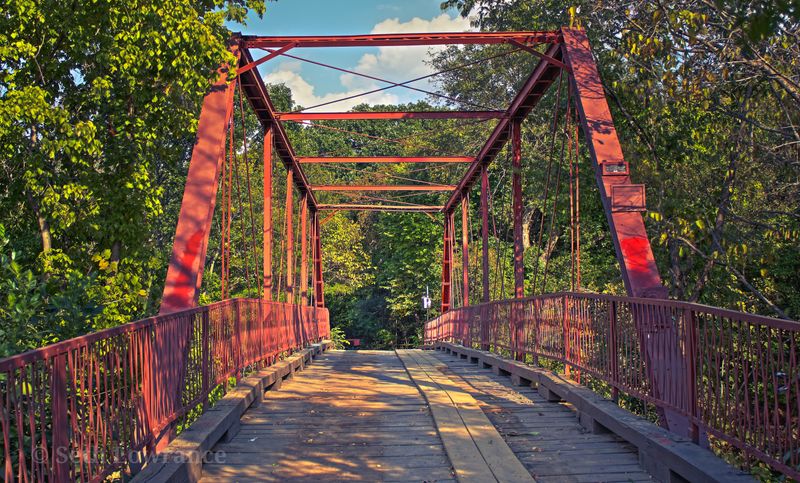
Some bridges connect two pieces of land. Others connect the living world to something far darker.
Old Alton Bridge earned its sinister reputation the hard way, through a story so disturbing that even skeptics feel uneasy walking across its weathered planks after sunset.
Built in 1884, this iron truss bridge once served as a vital crossing point for North Texas farmers, but today it’s famous for an entirely different reason: it’s supposedly home to a vengeful half-man, half-goat creature born from racial violence and mob justice.
The legend centers on Oscar Washburn, a successful goat farmer who lived near the bridge in the 1930s. Washburn hung a sign reading “This Way to the Goatman” to advertise his business, and locals began calling him by that nickname.
His prosperity as a Black man in Depression-era Texas attracted the wrong kind of attention. One night, Klan members grabbed Washburn, threw a noose around his neck, and hung him from the bridge.
When they looked over the edge, his body had vanished, leaving only the rope swinging in the darkness.
Whether Washburn survived and escaped or met a darker fate remains unknown, but something changed at the bridge after that night. Visitors report the overwhelming stench of decaying meat with no visible source, plus glowing red eyes watching from the surrounding forest.
Car engines die inexplicably on the bridge, restarting only after being pushed to the other side. Brave souls who knock three times on the bridge railing allegedly summon the Goatman himself.
Address: Old Alton Rd, Lantana, TX 76226.
7. Cathedral of Junk
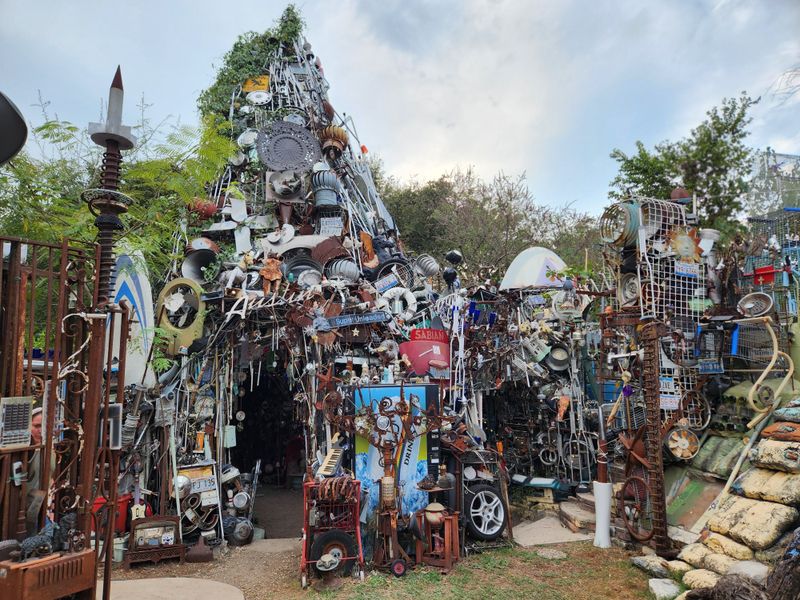
In a quiet Austin backyard stands proof that one person’s trash really can become another person’s cathedral. Vince Hannemann started collecting junk in 1989, and three decades later his backyard houses a 60-ton, three-story monument to creative obsession that somehow passed city engineering inspections.
This isn’t a carefully planned art installation; it’s organized chaos held together by what Hannemann calls “junk logic,” a structural philosophy that shouldn’t work but absolutely does.
The Cathedral towers 33 feet high, constructed entirely from materials other people threw away: bicycle parts, old TVs, car hubcaps, toilets, circuit boards, toys, and thousands of other items that found new purpose in Hannemann’s vision.
Walking through the narrow passages feels like exploring the inside of a kaleidoscope designed by someone who never learned the word “impossible.”
Every surface tells a story, every corner reveals something unexpected, from vintage typewriters to disco balls to enough shopping carts to stock a supermarket.
What makes this landmark genuinely strange isn’t just its existence but its legitimacy. When Austin code enforcement showed up in 2010 threatening to shut down the Cathedral, engineers examined the structure and found it surprisingly sound.
The seemingly random placement of materials actually distributes weight effectively, creating a stable framework that meets safety standards. Hannemann had to make some modifications and limit visitor numbers, but the Cathedral survived official scrutiny.
Visitors can tour the Cathedral by appointment, climbing through tunnels and ascending to platforms that offer views across Austin. The structure continues evolving as Hannemann adds new treasures and rearranges existing pieces.
Address: 4422 Lareina Dr, Austin, TX 78745.
8. The Munster Mansion
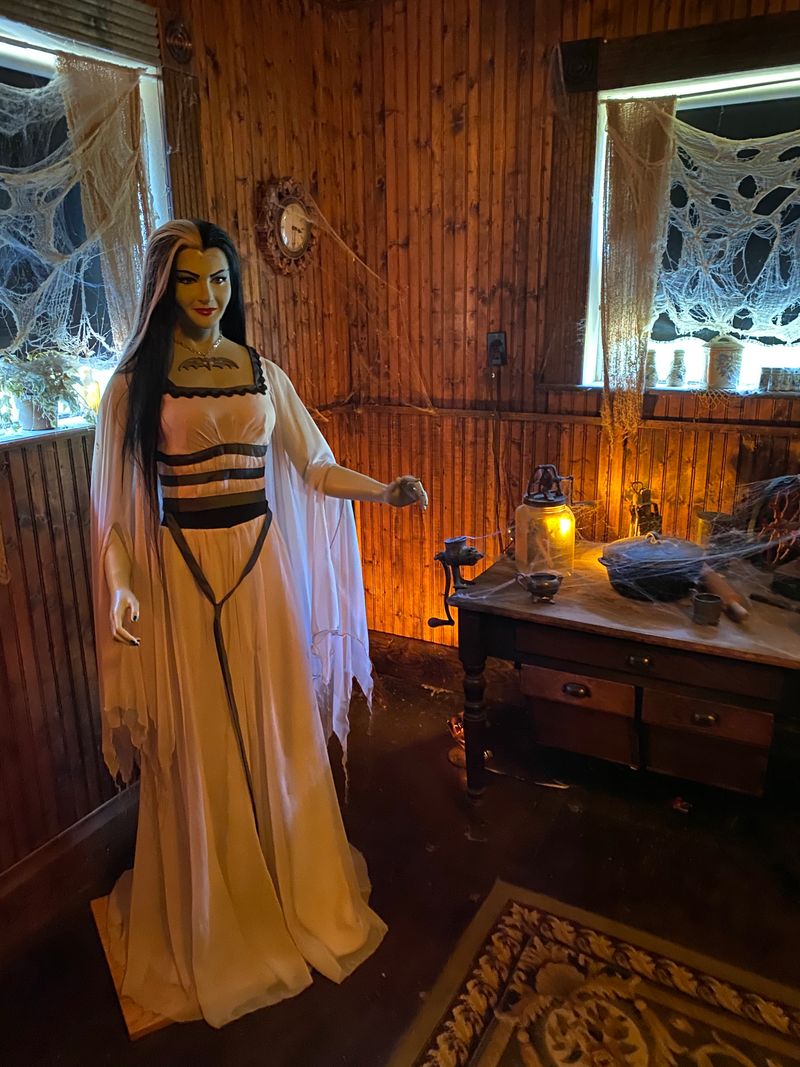
Most people build houses to live in. Charles and Sandra McKee built theirs to live inside a television show.
Their Waxahachie home isn’t inspired by the Munster family residence from the classic 1960s sitcom; it’s an exact, obsessively accurate, frame-by-frame replica that took two years of construction and cost over $250,000.
Every detail matches the original Hollywood set, from the distinctive peaked roof to the ornate Victorian trim to the address number painted on the door.
The McKees studied hundreds of episodes, pausing scenes to measure proportions and identify architectural details invisible to casual viewers.
They tracked down original blueprints from Universal Studios and hired craftsmen who could recreate the Gothic Revival style that made the TV Munsters’ home so memorable.
The result is a house that looks like it was transported directly from a Hollywood backlot to rural Texas, completely out of place among the surrounding ranch homes and farmland.
Inside, the commitment to authenticity reaches almost supernatural levels. The living room features the same curving staircase where Lily Munster descended in elegant gowns.
The grandfather clock in the hallway matches the one that appeared in dozens of episodes. Most impressively, a fire-breathing dragon animatronic lives under the main staircase, just like in the show, occasionally startling visitors who forget they’re in someone’s actual home.
The McKees open their mansion for tours and special events, welcoming fans who want to experience the Munster universe in three dimensions. Walking through these rooms blurs the line between fiction and reality, making you wonder if Herman Munster might stumble through the door at any moment.
Address: 3636 FM 813, Waxahachie, TX 75165.
Dear Reader: This page may contain affiliate links which may earn a commission if you click through and make a purchase. Our independent journalism is not influenced by any advertiser or commercial initiative unless it is clearly marked as sponsored content. As travel products change, please be sure to reconfirm all details and stay up to date with current events to ensure a safe and successful trip.
