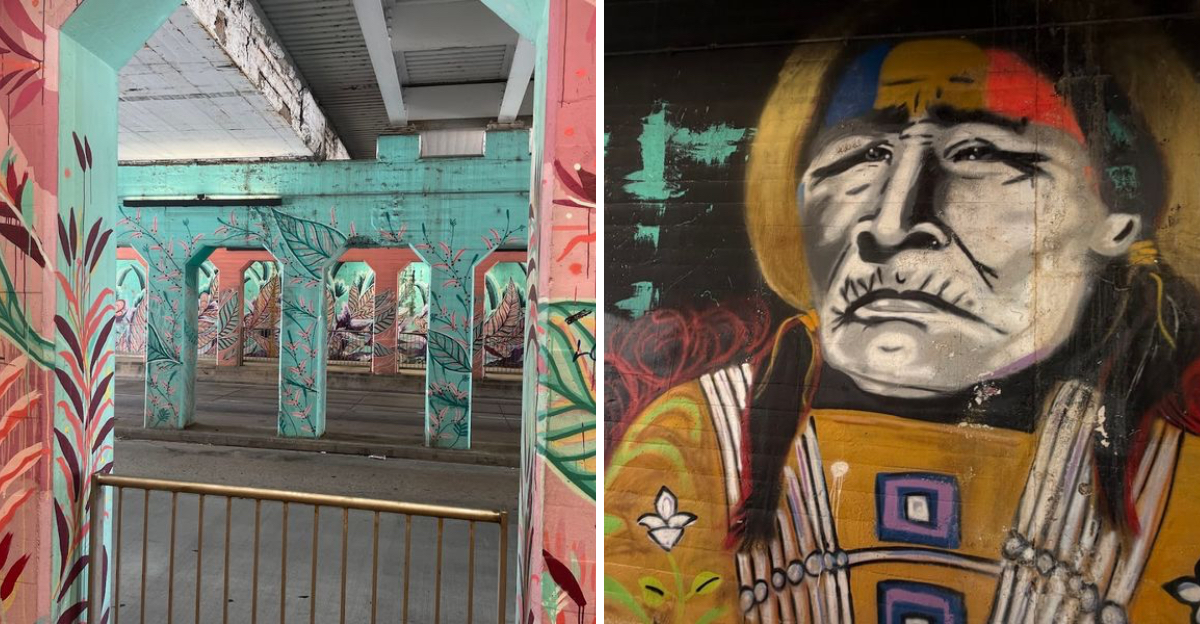
Imagine standing beneath a railroad bridge, surrounded by an explosion of color that stretches as far as you can see in both directions. Most people drive right past this spot without a second glance, which is honestly their loss.
Underneath the concrete and steel of a working train bridge in Oklahoma City lives one of the most surprising pieces of public art I have ever stumbled across. It is bold, it is big, and it is hiding secrets you will want to find for yourself.
This is the kind of place that makes you stop mid-step and say, out loud, to nobody in particular: “Wait, how did I not know about this?”
A massive mural wraps the entire underside of the bridge, packed with hidden images and wild color combinations that pull you in like a puzzle you did not know you needed to solve. If you love street art, scavenger hunts, or just genuinely cool things most tourists never find, keep reading.
This one earns every bit of the attention it deserves.
The Mind-Blowing Scale of the Mural
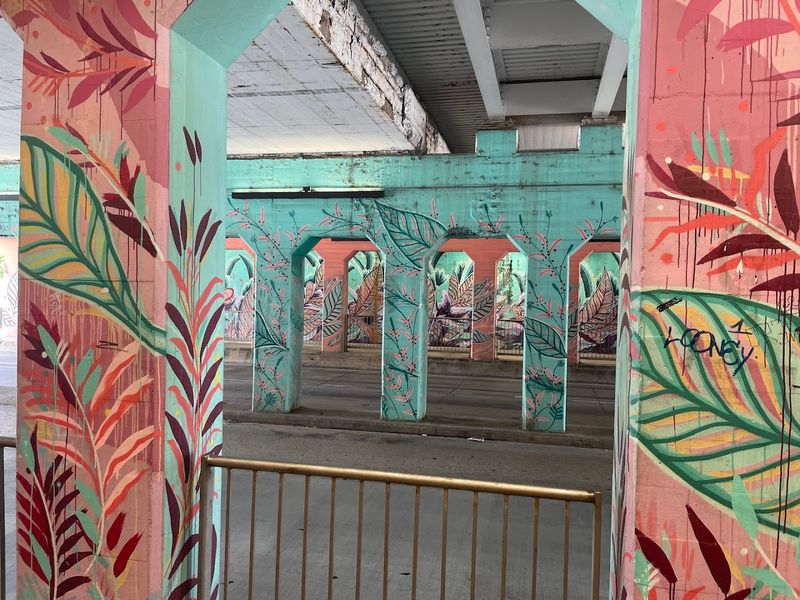
Nothing prepares you for the sheer size of it. You walk up expecting something cool, and then your brain just short-circuits for a second.
The mural beneath the Main Street railroad bridge near Oklahoma Avenue in Oklahoma City covers close to 10,000 square feet of surface area. That is not a typo.
To put it in perspective, 10,000 square feet is roughly the size of two full basketball courts placed side by side. Now imagine every inch of that space painted in rich, swirling, layered abstract color.
It runs the full length of the bridge underpass, wrapping pillars, coating walls, and filling every surface with explosive visual energy.
Standing at one end and looking down the full stretch of it feels almost cinematic. The colors shift as the light changes throughout the day.
Morning light gives the blues a cool, electric quality. Afternoon sun warms the oranges and reds into something almost glowing.
The scale is what hits you first, but the detail is what keeps you rooted to the spot. You keep finding new things the longer you look.
Most visitors end up walking the length of it two or three times without even realizing it. That is the mark of truly great public art.
Who Painted All of This
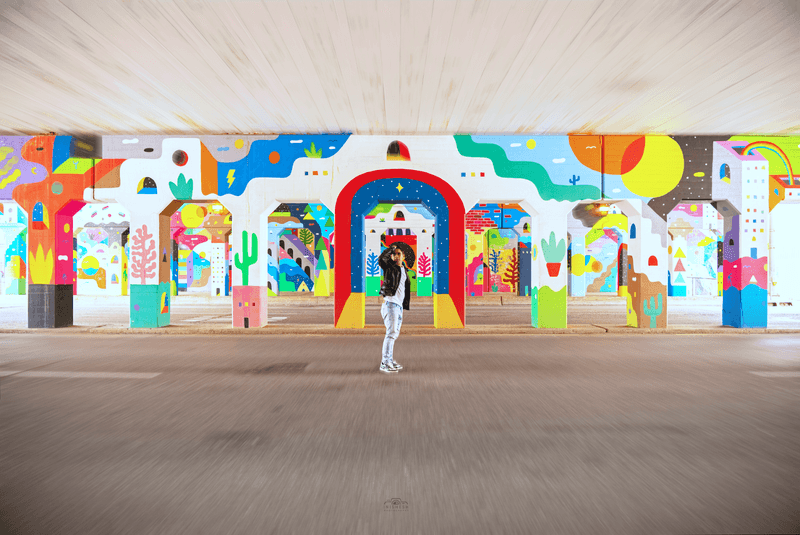
Behind every massive mural is one seriously dedicated human being. The entire Abstract Passages mural was created by Oklahoma City local artist Kris Kanaly, who goes by the creative alias Pyramid Guy.
He completed the project in 2017, and the work has been drawing curious visitors ever since.
Kanaly is not a household name outside of Oklahoma, but within the local art community he is well respected. His style leans into bold abstraction, layering shapes, patterns, and hidden imagery in a way that rewards patient viewers.
The Pyramid Guy nickname fits the work well. There is something almost ancient and geometric about the way shapes interlock and repeat throughout the mural.
What makes this even more impressive is the physical challenge of painting beneath a bridge. The surfaces are uneven, the lighting is inconsistent, and the scale demands a kind of stamina most artists never have to tap into.
Kanaly pulled it off with a level of consistency that is hard to fake. Every section of the mural feels intentional, like each brushstroke was placed with purpose rather than rushed to fill space.
The result is something that feels both massive and intimate at the same time. Local art like this is what gives a city its real personality.
The Scavenger Hunt Hidden Inside the Art
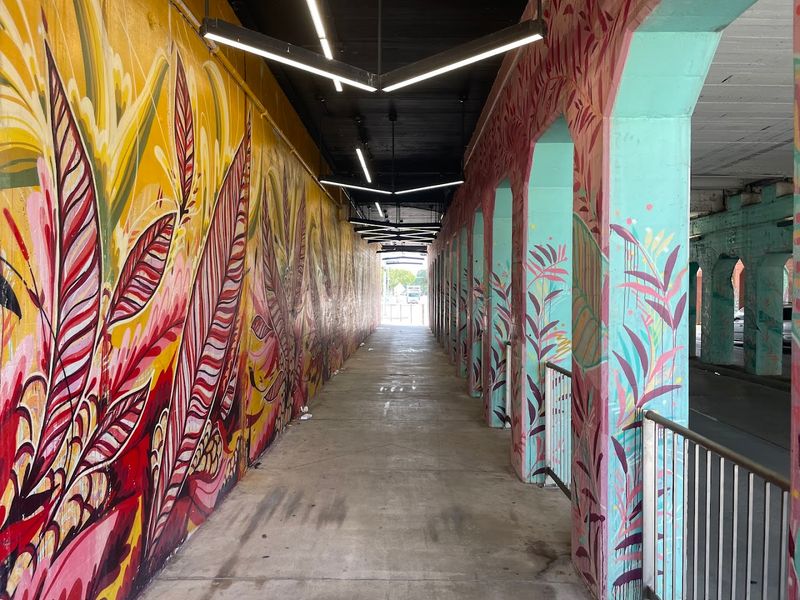
Here is where things get really fun. The mural is not just a visual spectacle.
It is also a scavenger hunt hiding in plain sight. Scattered throughout the design are concealed images that take real focus to find.
The state of Oklahoma is in there somewhere. So is a strawberry.
And if you look hard enough, you will spot the Devon Tower, one of Oklahoma City’s most recognizable landmarks.
The hidden elements are worked into the abstract shapes so skillfully that you can walk past them multiple times without seeing them. That is intentional.
Kanaly embedded them with enough camouflage that finding one feels like a small personal victory. Kids absolutely love this aspect of the mural.
So do adults, honestly. There is something deeply satisfying about training your eye to see past the obvious and find what is lurking underneath.
The best approach is to slow down and scan in sections rather than trying to take in the whole thing at once. Give each pillar and wall panel its own moment of attention.
Bring a friend and make it a competition. The person who spots the most hidden objects gets bragging rights for the rest of the day.
It is the kind of activity that turns a quick stop into a full hour of engagement without anyone complaining.
The Atmosphere Beneath the Bridge
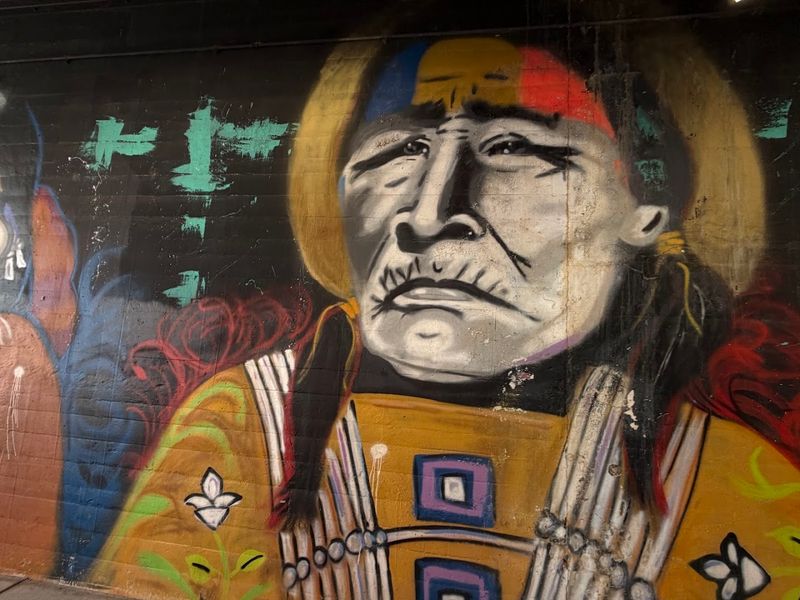
There is a particular kind of energy in a space like this. You are technically outdoors, but the bridge above you creates a sheltered, almost enclosed feeling.
The sound of the city softens here. Traffic noise becomes a low hum.
Train rumbles pass overhead occasionally, and somehow that just adds to the drama of the place.
The light inside the underpass is its own thing entirely. It filters in from both open ends, creating a gradient effect that shifts depending on the time of day and the season.
On overcast days the colors of the mural pop differently than on bright sunny afternoons. There is no bad time to visit, but golden hour in the late afternoon casts everything in a warm glow that makes the oranges and yellows in the mural look almost liquid.
The ground beneath your feet is urban and unpolished, which suits the whole vibe perfectly. This is not a manicured gallery.
It is raw, real public art in a working industrial space. You can hear the city breathing around you.
The occasional train overhead reminds you that this bridge still has a job to do. That contrast between function and beauty is part of what makes the atmosphere here feel so unexpectedly alive.
It does not try to be anything other than exactly what it is.
The Bricktown District Connection
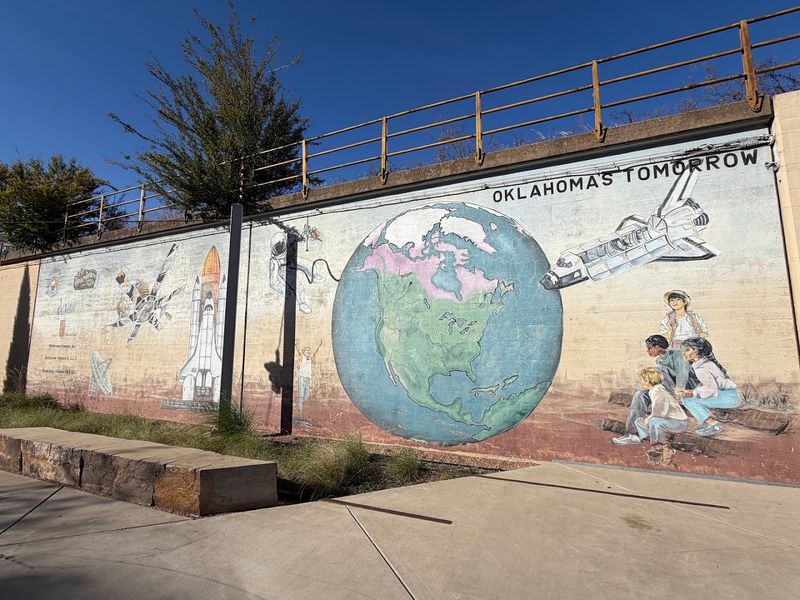
The mural does not exist in isolation. It sits just east of Bricktown, within easy walking distance of the district.
Bricktown was once a warehouse district that fell into serious decline, and its transformation into a cultural and entertainment hub is one of the more impressive urban revival stories in the American South.
The canal running through Bricktown is a short walk away. So are restaurants, entertainment venues, and the AT&T Bricktown Ballpark.
The neighborhood has a creative, forward-moving energy, and the mural fits right into that spirit. Public art is woven into Bricktown’s identity, and Abstract Passages is one of the most striking examples of that commitment.
Walking from the mural into the broader Bricktown area feels like a natural progression. You go from this intense, immersive art experience into streets full of interesting architecture, murals on building sides, and the kind of urban life that makes a city feel alive.
The mural acts almost like a gateway. It sets a tone for how you experience everything around it.
If you are visiting Bricktown for the first time, making this your first stop is a genuinely smart move. It calibrates your eyes and your mood for everything the neighborhood has to offer.
Taking Photos Without Losing Your Mind
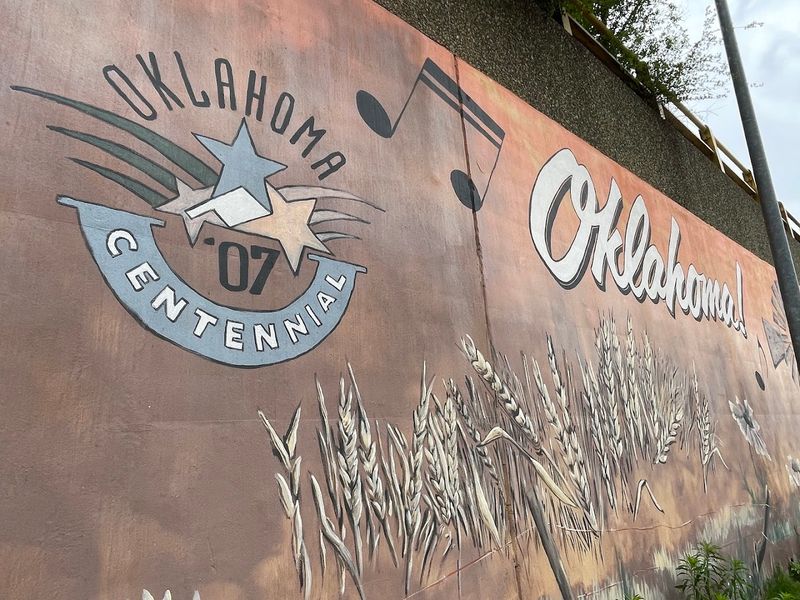
Let me be upfront about something: getting great photos here requires a bit of strategy. The underpass runs alongside active roads, and traffic moves through the area regularly.
You cannot just plant yourself in the middle of the road and snap away without paying attention to your surroundings. Awareness is non-negotiable.
That said, the photographic opportunities are extraordinary. Wide shots from one end of the underpass give you a tunnel-vision effect with the mural wrapping around you in every direction.
Close-up shots of individual sections reveal the layered complexity of Kanaly’s technique. If you are hunting for the hidden objects, macro-style shots help you document your finds in satisfying detail.
The best photo spots tend to be from the sides of the underpass where you can get some distance from the walls without stepping into traffic lanes. Early morning visits mean fewer cars and softer light.
Weekday mornings are quieter than weekend afternoons. There is a parking lot nearby, which helps enormously.
Arrive, park, and then give yourself the freedom to move at your own pace without worrying about a meter running out. The mural is open around the clock, so there is no pressure to rush.
Take the time to get the shots right. This place deserves that kind of attention.
Why This Mural Hits Differently Than a Gallery
There is something about encountering art in an unexpected place that rewires how you receive it. Walking into a gallery, you are already in art mode.
Your brain is primed and ready. But stumbling across a 10,000 square foot mural beneath a working railroad bridge?
That is a completely different emotional experience.
The surprise is part of the power. You were not expecting this.
The city was not whispering about it on every corner. You found it, or you sought it out specifically, and either way the scale of it lands like a physical sensation.
Art in public spaces carries a democratic quality. It belongs to everyone.
Nobody needs a ticket. Nobody needs to dress a certain way or speak quietly.
You can stand there with your mouth open and nobody will judge you.
Abstract Passages earns that reaction honestly. It is not decorative filler slapped on a wall to make a neighborhood look less gray.
It is a considered, complex, and deeply personal work of art placed in a functional urban space. The contrast makes both things more interesting.
The bridge becomes a gallery. The gallery becomes part of the city’s living infrastructure.
That relationship between art and environment is rare to find so naturally achieved, and it is a big part of why this mural lingers in your memory long after you have left.
Why Oklahoma City Deserves More Credit for Its Art Scene
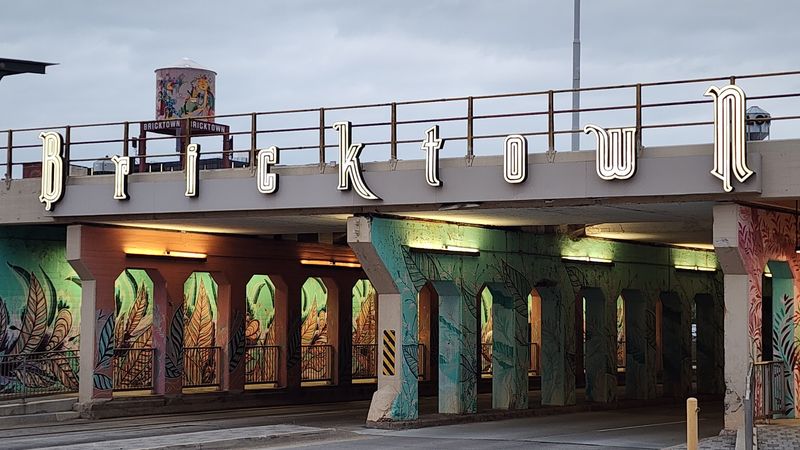
Oklahoma City does not always make the shortlist when people talk about great American art cities. That is a mistake worth correcting.
The city has been quietly building a public art culture for years, and Abstract Passages is one of the most compelling pieces of evidence for that argument.
The mural is not an isolated case. Bricktown and the surrounding neighborhoods are full of creative energy, from commissioned murals on building exteriors to independent art spaces and galleries.
The city has invested real attention in making public space feel culturally alive. The Devon Tower, which appears as a hidden image in the mural itself, stands as a symbol of a city that is growing with intention.
Visitors who write off Oklahoma City as a flyover destination are missing something real. The art scene here has an authenticity that comes from not trying too hard to impress anyone.
Things get made because local artists want to make them, not because a tourism board commissioned a trend report. Abstract Passages, Oklahoma City is the perfect example of that spirit.
A local artist, a railroad bridge, nearly 10,000 square feet of vision, and zero pretension. That combination is rarer than people think, and it is exactly why this place deserves a spot on your travel list.
Dear Reader: This page may contain affiliate links which may earn a commission if you click through and make a purchase. Our independent journalism is not influenced by any advertiser or commercial initiative unless it is clearly marked as sponsored content. As travel products change, please be sure to reconfirm all details and stay up to date with current events to ensure a safe and successful trip.
