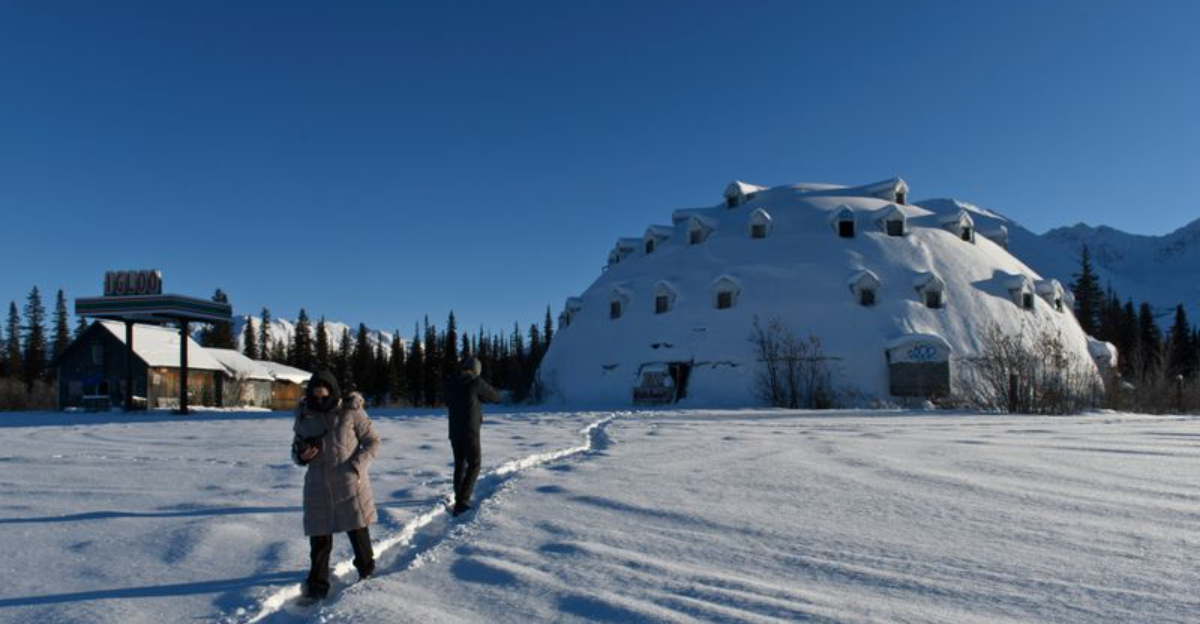
Along a lonely stretch of the George Parks Highway in Alaska sits a towering four-story structure shaped like an igloo, abandoned and slowly crumbling into history.
Igloo City was meant to be a grand hotel and tourist stop in the 1970s, but it never opened its doors to a single guest.
Today, this bizarre roadside landmark stands frozen in time, a monument to big dreams that never quite came true. Travelers passing by can’t help but pull over and wonder what could have been.
The Vision Behind the Giant Igloo
Back in the early 1970s, a businessman named Leon Smith had an ambitious idea. He wanted to build a hotel that would stop travelers in their tracks as they drove between Anchorage and Fairbanks. His vision was a massive, igloo-shaped building that would serve as a rest stop, restaurant, and overnight lodging all rolled into one unforgettable package.
Construction began with high hopes and plenty of excitement. The unique design drew attention from locals and travelers alike, even before it was finished. Smith imagined tourists flocking to stay inside this architectural oddity, making it a must-see destination along the highway.
Unfortunately, the dream hit some serious roadblocks. Funding dried up, and construction stalled before the interior could be completed. Building codes and zoning issues also complicated the project.
What started as a bold vision ended up as an empty shell, never welcoming a single overnight guest or serving a meal to hungry travelers passing through the Alaskan wilderness.
A Landmark You Can’t Miss
Even from miles away, Igloo City catches your eye. The giant dome rises unexpectedly from the flat tundra, looking almost like something from another planet. Its white and weathered exterior stands in stark contrast to the wild Alaskan landscape surrounding it.
Located at mile 188.5 of the George Parks Highway, this quirky structure has become one of the most photographed roadside attractions in Alaska. Travelers heading to Denali National Park or Fairbanks often stop to snap pictures and explore the area.
The building’s sheer size is impressive, standing about four stories tall with a diameter that makes it hard to ignore.
Over the decades, the elements have taken their toll. Paint peels from the curved walls, and the structure shows signs of wear from harsh winters and strong winds. Yet somehow, this decay only adds to its charm and mystery.
Visitors are drawn to its eerie beauty, capturing images that tell the story of ambition frozen in time along a remote Alaskan road.
Inside the Unfinished Dream
Stepping inside Igloo City feels like entering a time capsule. The interior was never completed, leaving behind bare concrete floors and exposed framework. Empty rooms echo with the footsteps of curious explorers who venture past the entrance.
Raw construction materials still sit where workers left them decades ago. Wooden beams, old tools, and building supplies create an atmosphere that’s both haunting and fascinating. Natural light filters through windows and cracks, casting strange shadows across the unfinished spaces.
Safety concerns mean visitors should be cautious when exploring. The building has deteriorated over the years, and structural integrity is questionable in some areas. Many people choose to admire the structure from outside rather than risk going in.
Still, the glimpse through doorways and windows offers enough to fuel the imagination about what this place might have become if things had gone differently for its creator back in those hopeful early days.
The Smaller Igloo That Actually Worked
Right next to the giant failed hotel sits a much smaller igloo-shaped building that tells a different story. This one actually operated as a gas station and convenience store for many years. Travelers could fuel up their vehicles and grab snacks before continuing their journey through Alaska’s wilderness.
The little igloo proved that the concept could work on a smaller scale. It served the community and passing tourists for decades, becoming a beloved pit stop along the highway. People remember stopping there for supplies, using the restrooms, and chatting with friendly staff who kept the place running.
Eventually, even this smaller operation closed its doors. Today it sits quietly beside its much larger sibling, both structures aging together in the Alaskan elements. The contrast between the two buildings is striking.
One represents dreams that were too big to realize, while the other shows what practical ambition could achieve, at least for a while, before time caught up with it too.
Why It Never Opened
Money troubles plagued the project from early on. Building something this unusual in such a remote location cost far more than originally planned. The harsh Alaskan climate made construction difficult and expensive, with short building seasons and tough working conditions.
Permit and code issues also created major headaches. The unique design didn’t fit neatly into standard building regulations. Getting approval for various aspects of construction became a lengthy and frustrating process. These delays only added to the mounting costs and complications.
By the time the exterior was mostly complete, funds had run out entirely. The interior remained an empty shell, never receiving the finishing touches needed to actually function as a hotel. Leon Smith’s dream was simply too ambitious for the resources available.
Rather than opening partially finished, the decision was made to leave it standing as is. Decades later, it remains a testament to the challenges of turning bold visions into reality in one of America’s most unforgiving landscapes.
A Photographer’s Paradise
Photography enthusiasts absolutely love Igloo City. The unusual architecture creates incredible compositions, especially during golden hour when the setting sun casts warm light across the curved walls. Winter visits offer stunning scenes with snow piled high against the structure, creating a truly Alaskan tableau.
The contrast between human ambition and nature’s power makes for compelling images. Weathered surfaces, broken windows, and encroaching vegetation tell visual stories without words. Many professional photographers include Igloo City in their Alaska portfolios, and countless amateur snapshots have been shared across social media platforms.
Different seasons bring entirely different moods. Summer wildflowers bloom around the base, softening the abandoned feel. Autumn colors provide dramatic backdrops. Winter transforms the site into something almost magical, with frost and snow emphasizing the igloo shape.
Each visit offers new perspectives and fresh angles to capture. For anyone traveling through with a camera, this quirky landmark provides endless creative opportunities and memories frozen in digital form rather than just in time.
Local Legends and Stories
Over the years, locals have shared various tales about Igloo City. Some speak of plans to renovate and finally open the place, though these rumors never materialize. Others tell stories of travelers who sought shelter there during storms, finding temporary refuge in the empty rooms.
There are whispers about why the project really failed, with theories ranging from financial mismanagement to simply bad timing. Some old-timers remember when construction was active, watching the strange building take shape and wondering if it would actually work. Their stories add human texture to the bare facts of the timeline.
While no ghost stories or supernatural legends are strongly associated with the site, its eerie appearance certainly sparks imagination. The building stands as a conversation piece for anyone who has driven past it.
Locals use it as a landmark when giving directions, and it features in countless road trip stories. These accumulated memories and tales, passed between travelers and residents alike, have become part of Igloo City’s legacy.
Visiting Today and What to Expect
Igloo City remains accessible to curious visitors, though it’s important to approach with caution and respect. The site is located along a well-traveled highway, making it easy to find and stop at safely. There’s space to pull off and park while you explore and take photos.
Remember that the structure is old and deteriorating. Entering the buildings carries risks, as floors, walls, and ceilings may not be stable. Many visitors choose to stay outside, walking the perimeter and peeking through openings. This approach still offers plenty to see and photograph while keeping everyone safe.
Bring your camera, wear sturdy shoes, and watch for weather changes that can happen quickly in Alaska. The area is remote, so come prepared with water and snacks. There are no facilities or services at the site anymore.
Respect the property by not vandalizing or removing anything. Igloo City is a piece of Alaska’s quirky history, and future travelers deserve the chance to experience it too.
Dear Reader: This page may contain affiliate links which may earn a commission if you click through and make a purchase. Our independent journalism is not influenced by any advertiser or commercial initiative unless it is clearly marked as sponsored content. As travel products change, please be sure to reconfirm all details and stay up to date with current events to ensure a safe and successful trip.
