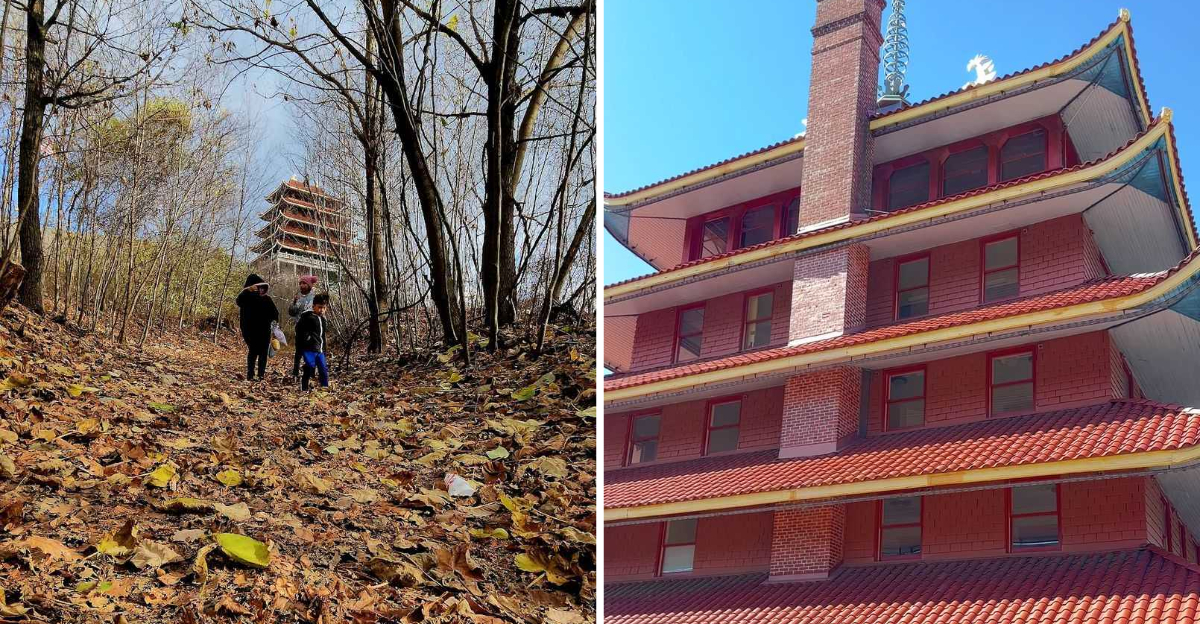
The red roofline appeared through the trees as I drove up the mountain, and at first I thought my eyes were playing tricks on me. A seven-story Japanese-style pagoda built in 1908 sat on a Pennsylvania mountainside above a city of brick rowhomes, and it did not quite fit, which was exactly what made it work.
I parked, walked to the edge of the overlook, and the whole valley opened up below me like someone had pulled back a curtain.
What surprised me most was learning it was built as the centerpiece of a luxury resort that never opened its doors, the bank took over when the owner was denied a liquor license, and the whole project was abandoned before it ever served a single guest.
And yet the pagoda has been standing there for over a century, watching the city grow, change, and light up at night. That contradiction is exactly why I keep going back.
A Quarry Scar, a Postcard, and One Very Big Idea
Most landmarks start with a plan. Reading’s started with an eyesore.
In the early 1900s, a local businessman and politician named William Abbott Witman, Sr. ran a stone quarry on Mount Penn. The digging left an ugly gash across the green slope, visible from the streets below, and people noticed.
His fix was unusual. Instead of simply replanting the hillside, Witman decided to build something so eye-catching that nobody would look at the damage anymore.
The inspiration reportedly came from a postcard image of Nagoya Castle in Japan, shown to him by his friend Charles C. Matz.
Witman hired Matz and his father to design something similar, and construction wrapped up in 1908 at a cost of around fifty thousand dollars.
He wasn’t thinking small either. The seven-story building was meant to anchor a mountaintop resort hotel and restaurant, a fancy getaway with a view no competitor could match.
Standing near the base now, I find that origin story oddly comforting. Something built partly out of embarrassment turned into the thing this whole city is known for, which feels like a decent lesson about second chances.
The Hotel That Never Welcomed a Single Guest
Here’s the part that always stops people mid-sentence when I tell them: the resort never opened.
Witman’s application for a liquor license was denied, and money troubles piled up on top of that. The grand inn he imagined, full of guests and mountain air and long dinners, simply sat there finished and silent.
By 1910 he had to sell the property to Jonathan Mould, a local merchant and bank director, to settle a bank note. That could easily have been the end of the story, with the building fenced off and slowly falling apart.
What happened next changed everything. In 1911, Mould and his wife Julia handed the Pagoda and roughly ten acres of surrounding land over to the City of Reading for one single dollar.
One dollar. A private failure became public property overnight, and the people of Reading inherited a landmark nobody had planned to give them.
I think about that whenever I look up at it from downtown. The building never served its intended purpose for even one night, and somehow it became more useful than a hotel ever would have been.
Red Roofs, Field Stone, and the Only Pagoda With a Chimney
Up close, the details are what get you.
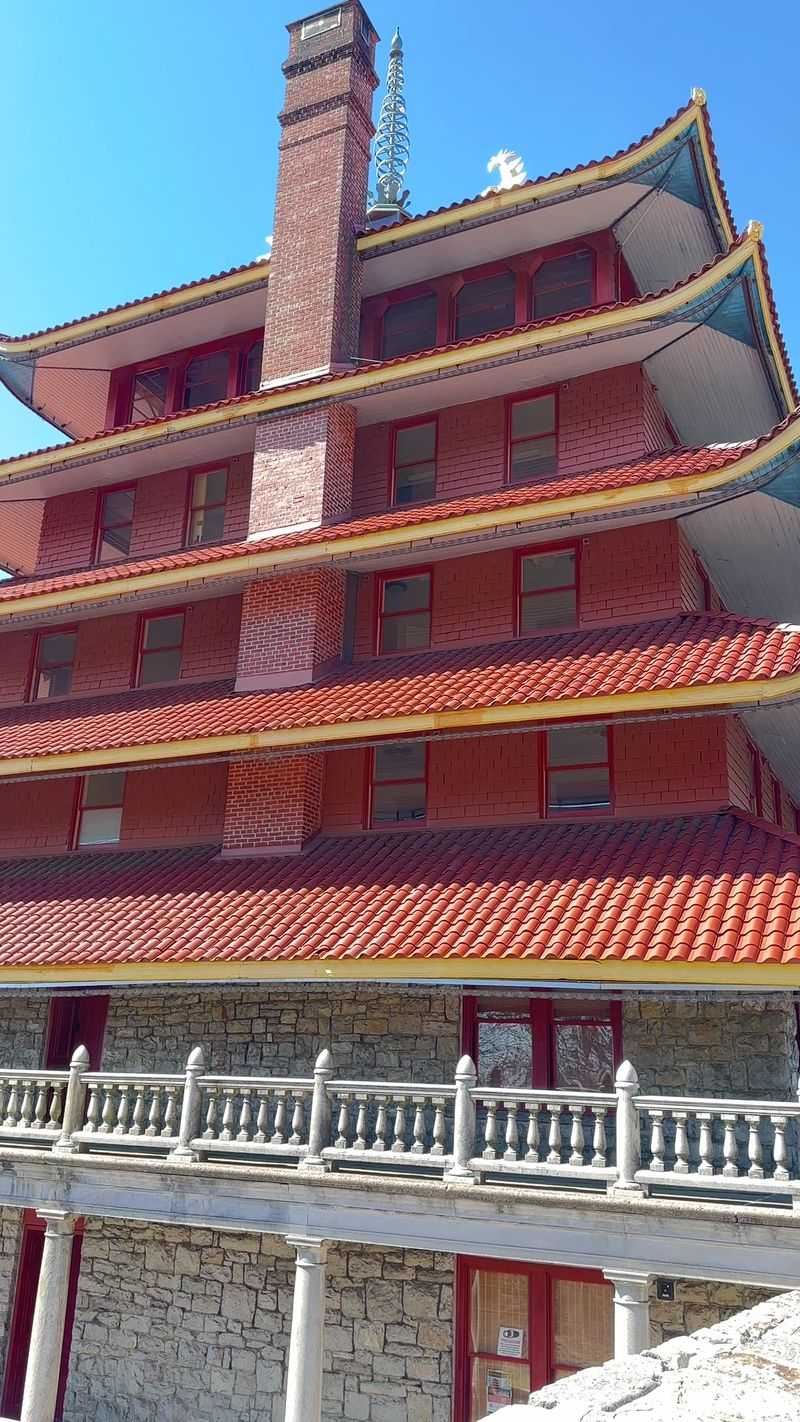
The structure rises about 72 feet tall, roughly 28 feet wide and 50 feet long, with five overhanging red roofs stacked one above the other. Each tier pulls back about two feet from the one below it, and a torii gate marks the entrance.
Architectural historians sometimes file it under American turn-of-the-century exotic revival rather than authentic Japanese design, and that mix is part of its charm. It borrows a shape from across the world and then builds it out of Pennsylvania.
The base uses local field stone pulled straight from Witman’s own quarry, so the hill it hides is literally part of it. There’s also a fireplace and chimney inside, which reportedly makes it the only pagoda on the planet with one, a leftover clue from those hotel ambitions.
My favorite detail sits on the eaves. Stylized dolphin figures called shachihoko perch up there, creatures believed in Japanese tradition to guard buildings against fire.
Guardians on the roof, quarry stone at the foot. Nothing about it should work together, and yet it absolutely does.
Thirty Miles of View and a Lantern That Once Talked
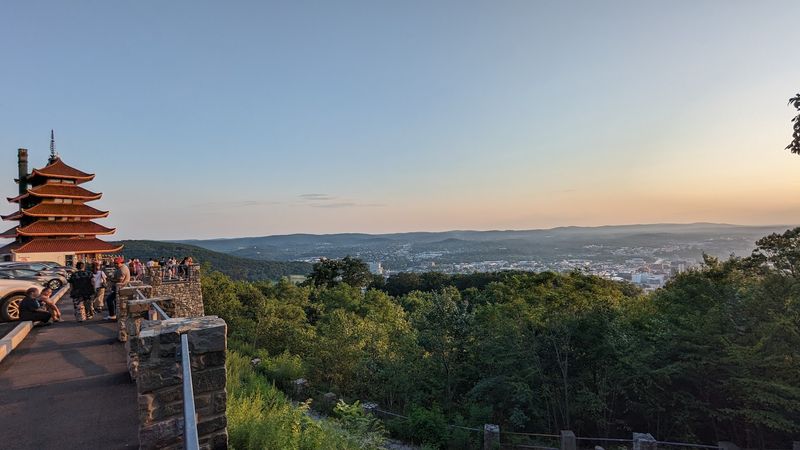
The view is the reason most people make the drive, and it earns every switchback.
Sitting roughly 620 feet above the city and 886 feet above sea level, the overlook stretches out about 30 miles on a clear day. Reading spreads below in a neat grid, the hills roll off toward the horizon, and you can trace roads with your finger.
Wind is part of the deal up here. Visitors mention it constantly, and I’d second the advice to bring a jacket even when it feels mild in town.
Long before phones, the Pagoda actually communicated with the city. A signal lantern on top flashed news and weather in Morse code to residents below, sharing everything from fire alerts to World Series scores and, at Christmas, Santa’s arrival.
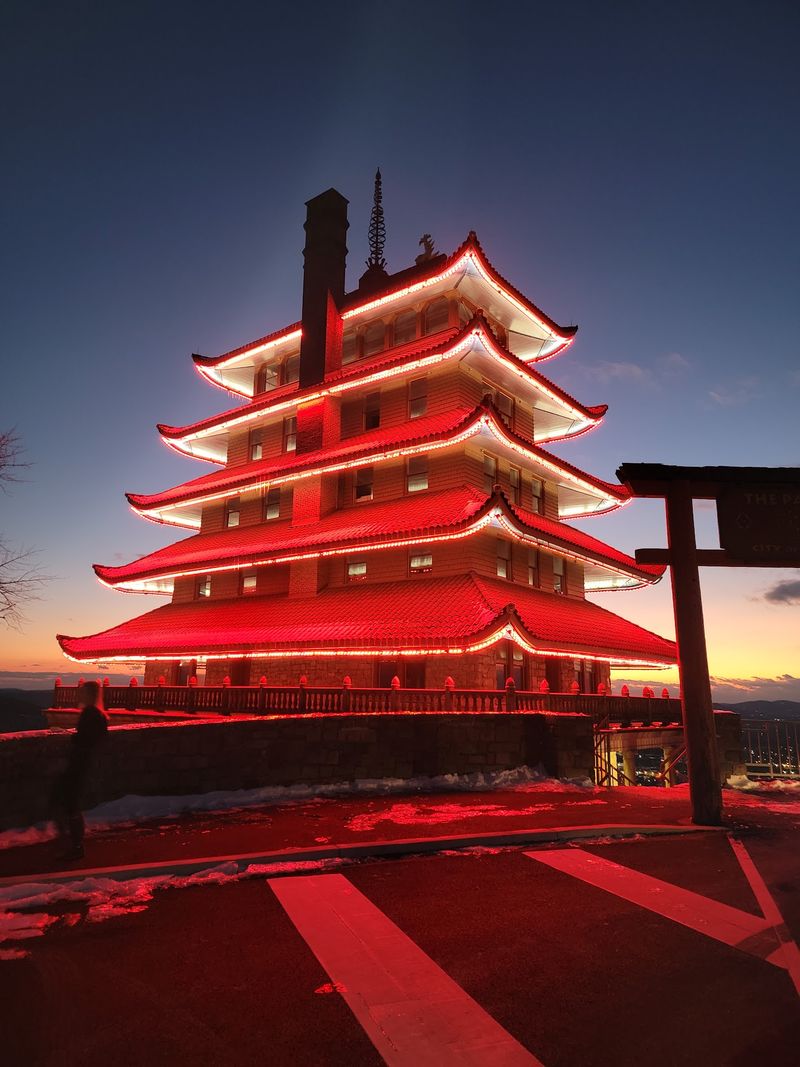
Sunrise and sunset both draw crowds, and night visits have their own reward when the city turns into scattered lights.
Skyline Drive’s security gates open at 7 a.m. and close at 9 p.m. daily, so plan around that. I once arrived a few minutes early and waited by the gate, and honestly the anticipation made the view better.
The 1739 Bell That Crossed an Ocean to Get Here
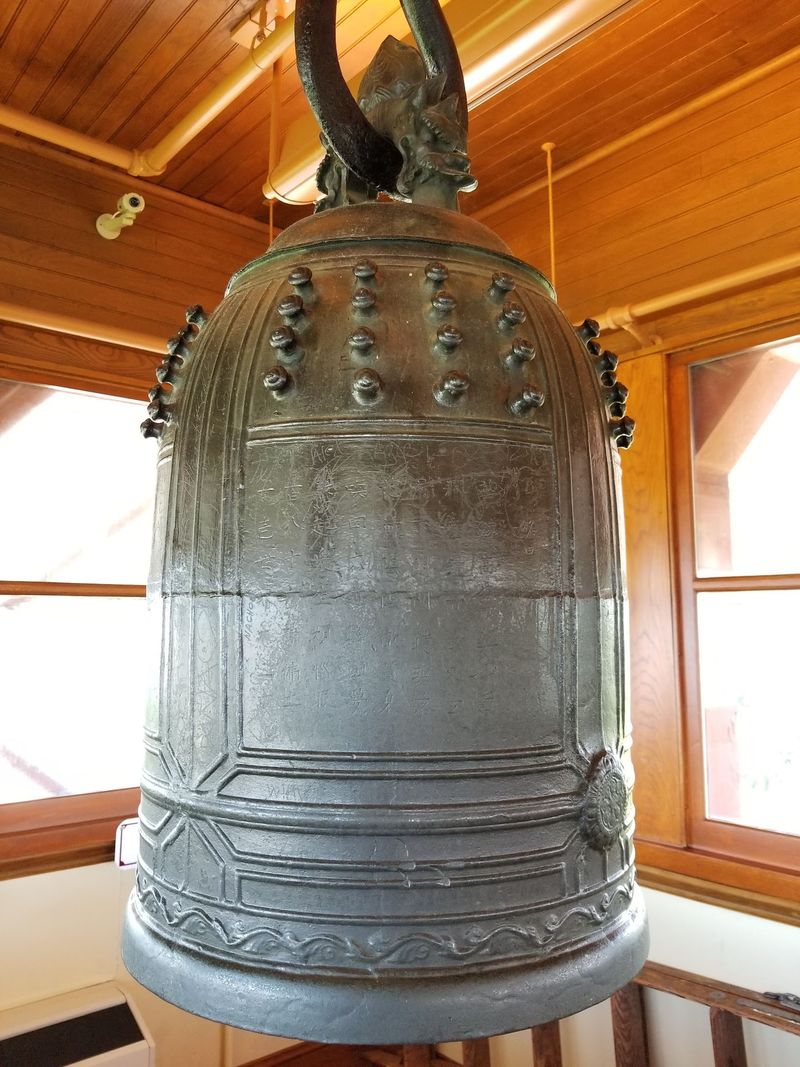
Tucked in the top story is an object older than the building by nearly two centuries.
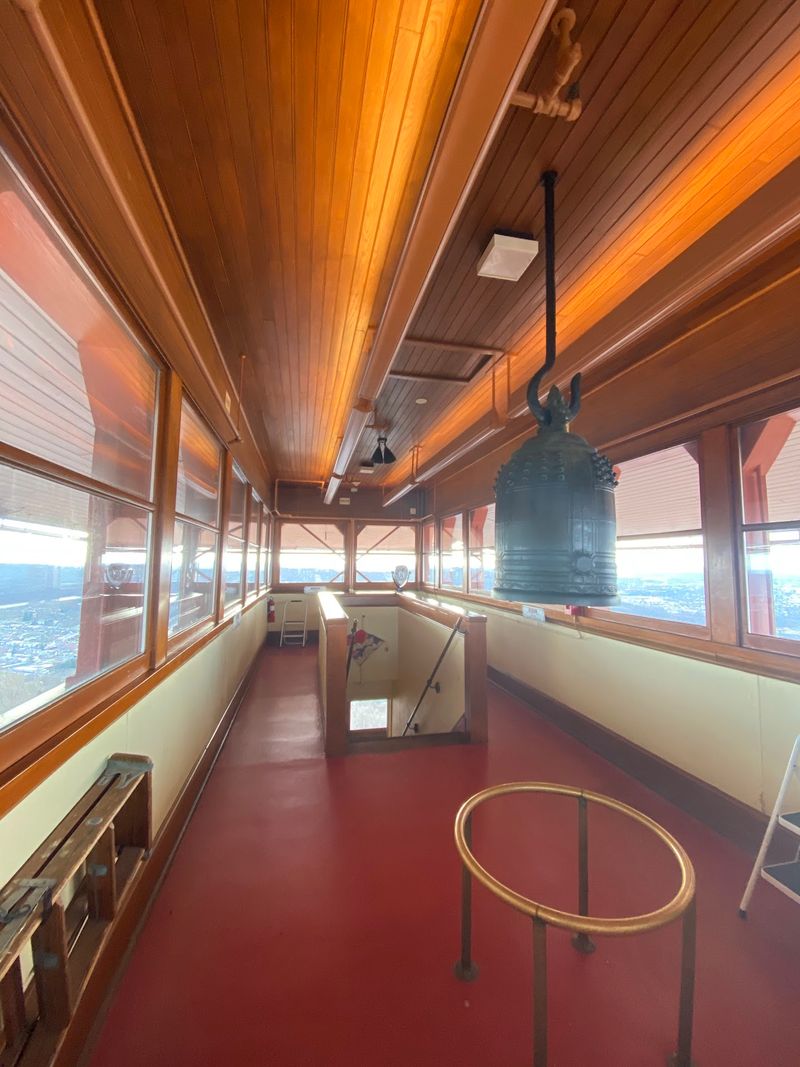
The bell, sometimes called a tocsin, was cast in 1739 in Obata, Mie Prefecture, Japan. It originally hung at a Buddhist temple in the Saitama Prefecture area north of Tokyo, either in Ogose or Hanno.
That temple closed in 1881 and was later destroyed. Witman acquired the bell in 1907, and it reportedly traveled to Pennsylvania by way of the Suez Canal.
Try picturing the paperwork involved in shipping a massive bronze temple bell halfway around the globe in 1907. It arrived in Reading that same year and has stayed put ever since.
Japanese characters run along its sides, listing the names of 48 donors and including a prophecy about the end of time. That’s a heavy thing to hang in a building that was supposed to be a resort.
The interior is closed for restoration right now, with a reopening planned for spring 2026, so the bell is out of reach for the moment. Knowing it’s up there anyway changes how the whole structure feels from the parking lot.
Volunteers, Trees, and a Town That Refused to Let It Go
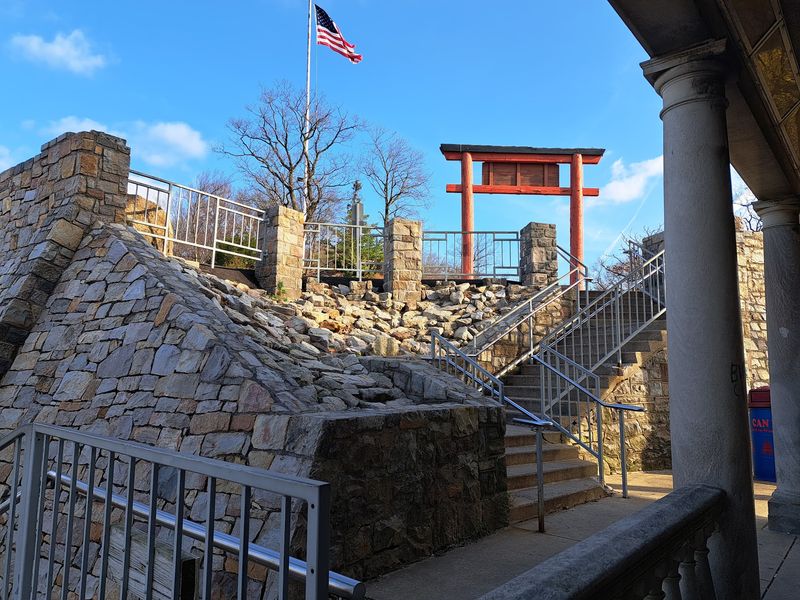
Buildings like this don’t survive on luck alone.
After the 1911 gift, the Pagoda genuinely became the people’s, and it landed on the National Register of Historic Places in 1972. Keeping it standing, though, has been mostly a volunteer effort.
The Foundation for the Reading Pagoda, a nonprofit started in 1969 under the name Pagoda Skyline, Inc., works alongside the City of Reading on restoration and upkeep. Their reach extends beyond the walls into the surrounding Mount Penn Preserve, which now covers about 1,595 acres of city-owned land.
The greenery you see today isn’t accidental either. Back in 1914, the Berks County Conservation Association planted more than 10,000 trees on that scarred mountainside, essentially healing the quarry the Pagoda was built to hide.
That same year, conservationists gathered here and briefly renamed the building the Temple of Conservation, which I find delightful.
Current work involves major infrastructure repairs and upgrades, and yes, scaffolding has frustrated a few visitors hoping to go inside. Still, watching a whole town chip in to save a building that never had a job feels like the most human thing about the place.
Seasons, Switchbacks, and Why Locals Keep Coming Back
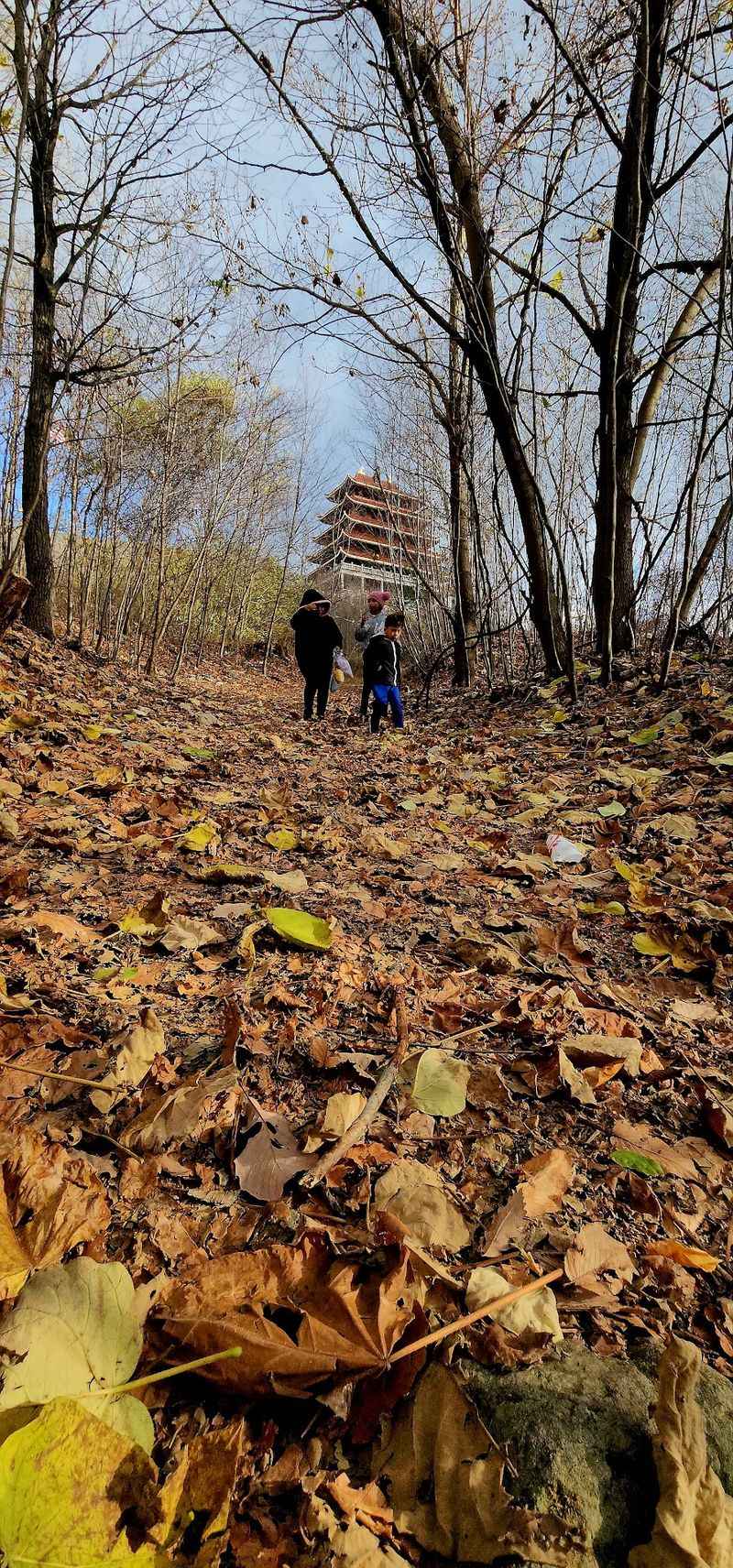
Every visit up here lands differently depending on the calendar.
Autumn is the showstopper, with the red roofs sitting inside a swirl of orange and gold across Mount Penn. Winter flips the palette, and after fresh snow the whole thing looks like an illustration someone drew by hand.
Spring brings cherry trees into bloom, planted during restoration work in the 1970s, softening the rocky setting considerably.
Getting there is half the fun. The road up features tight hairpin turns that make the climb feel like an event, though parking at the top is limited, so weekends can get tight.
Locals treat it as a gathering spot. Car enthusiasts, cyclists, mountain bikers heading for the trails on Mount Penn, families showing grandkids the view, photographers chasing the light.
Even with the interior closed, the grounds and overlook stay open daily from 7 a.m. to 9 p.m., and the experience holds up.
A tower that never opened as a hotel, never served its purpose, and somehow became the thing that says home to an entire city. That’s a pretty good trade.
Address: 98 Duryea Dr, Reading, PA 19602.
