Picture this: a tragedy so dramatic it changed aviation forever, yet decades later, it’s drawing more curious visitors than ever before.
The Hindenburg Disaster Memorial at Lakehurst, New Jersey, marks the spot where the German passenger airship LZ 129 Hindenburg erupted into flames on May 6, 1937, killing 36 people and ending the era of luxury airship travel.
Tucked inside Joint Base McGuire-Dix-Lakehurst, this solemn site isn’t your typical roadside attraction you can just pull up to and snap photos. Getting in requires advance planning, security clearance, and a guided tour led by passionate military veterans who bring history to life.
What makes this place so fascinating is how it balances tragedy with education, offering visitors a rare glimpse into both aviation history and active military operations.
Why is a nearly 90-year-old disaster site suddenly trending? Turns out, people are craving authentic, under-the-radar historical experiences that social media can’t replicate.
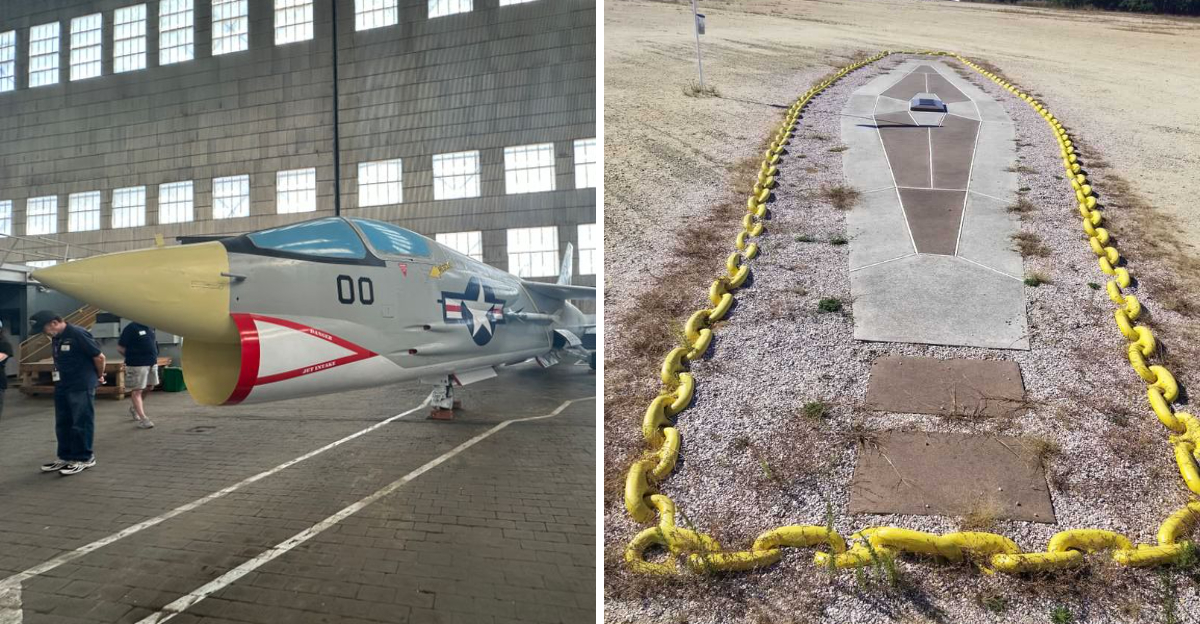
You’ll stand on the exact ground where the airship fell, walk inside the massive 1921 hangar that once housed these giants of the sky, and hear stories that textbooks never told.
Ready to step back in time and discover why this New Jersey memorial is having its biggest moment yet?
You Need Security Clearance Just to Visit

Planning a spontaneous road trip to see where the Hindenburg went down? Think again, because this isn’t your average tourist spot with open gates and a gift shop.
The memorial sits smack in the middle of Joint Base McGuire-Dix-Lakehurst, an active military installation where security is tighter than a drum. You can’t just roll up to the guard gate and sweet-talk your way in, no matter how charming your smile might be.
At least one month before your desired visit date, you’ll need to contact the Lakehurst Historical Society, the dedicated group of military veterans who run these exclusive tours. They’ll request personal information for everyone in your party, including full names, dates of birth, and other identifying details necessary for thorough background checks.
Military installations don’t mess around with security protocols, so expect the process to be detailed and non-negotiable.
Once your background check clears and you receive approval, you’ll be assigned a specific tour date, typically a Wednesday when tours operate from 10 AM to 1 PM. The entire experience lasts roughly three hours and covers not just the crash site itself but also the historic hangar and an impressive military museum tucked inside.
Visitors rave about how informative and worthwhile the tour is, with many saying the wait and paperwork were absolutely worth it.
This exclusivity actually adds to the site’s appeal in our Instagram-saturated world. Not everyone can just waltz in and check it off their bucket list, which makes the experience feel genuinely special and earned rather than commodified.
The Memorial Takes the Shape of the Airship’s Gondola
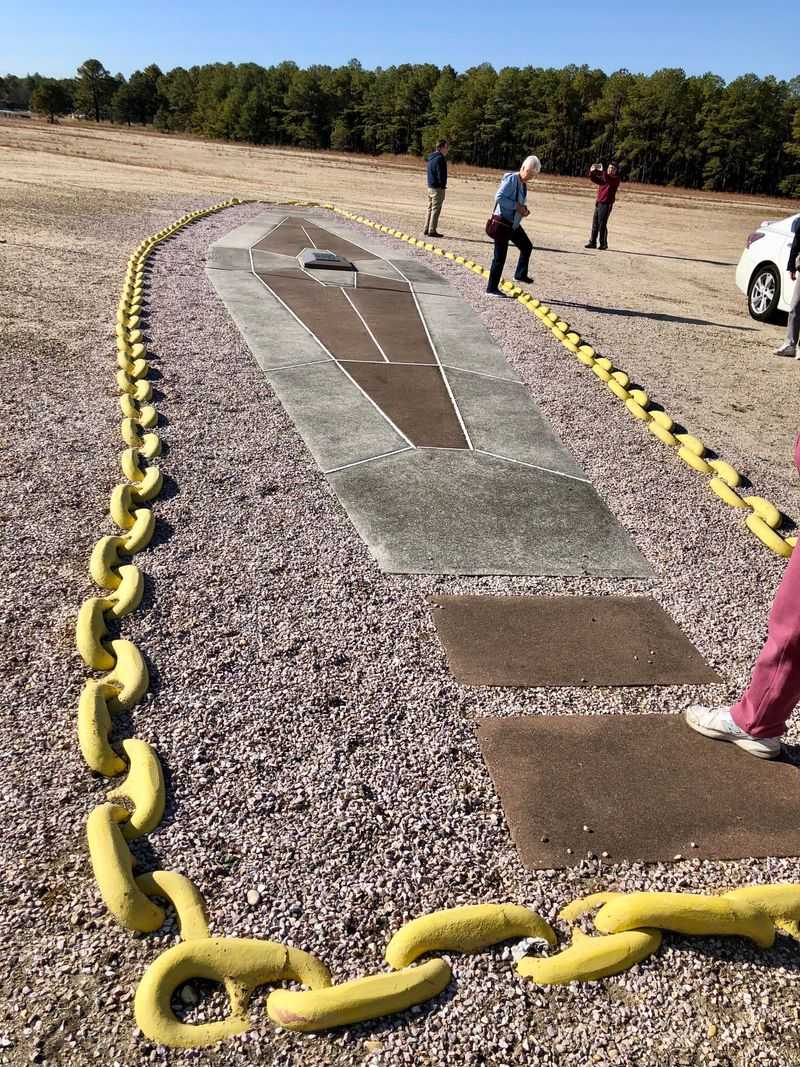
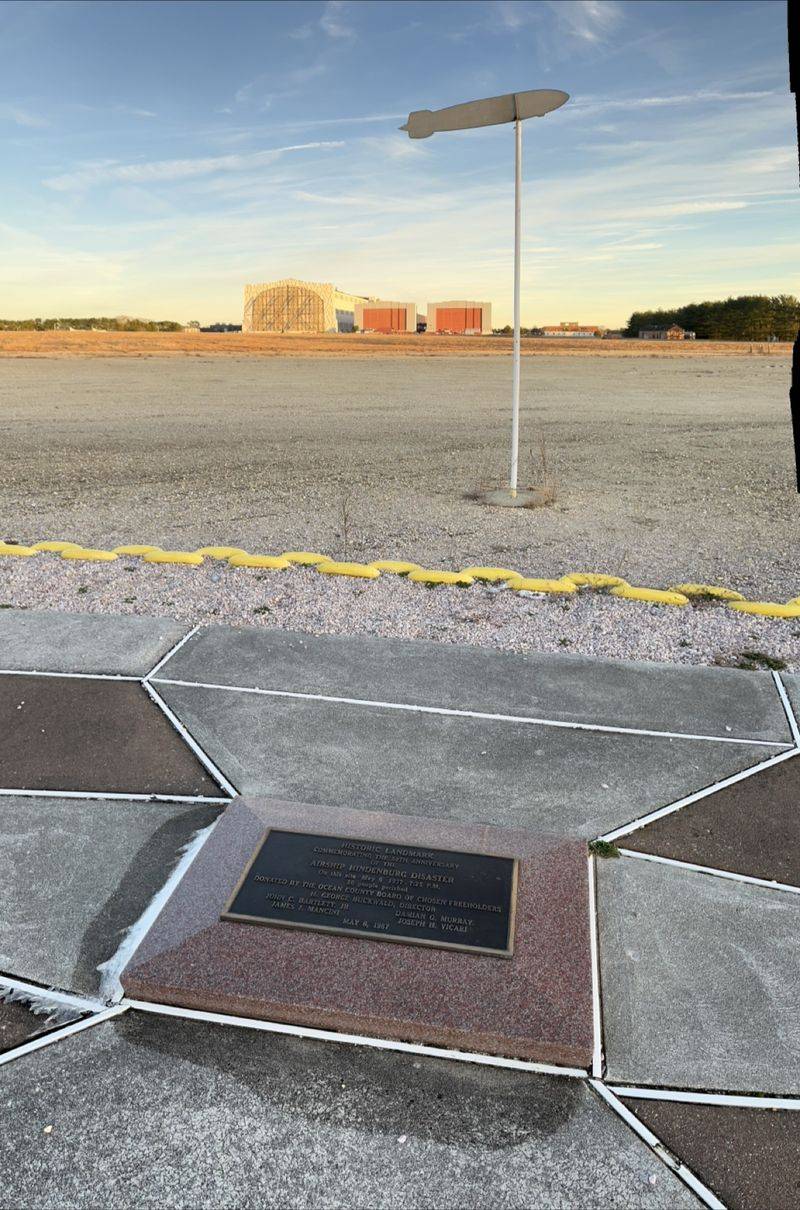
Standing in an open field marked by a simple yellow chain, the Hindenburg Disaster Memorial might initially seem understated for such a monumental tragedy. But look closer and you’ll notice something profound: the memorial’s layout mirrors the exact shape and size of the gondola that hung beneath the massive airship.
Walking the perimeter gives you a visceral sense of scale that no photograph or documentary can truly capture.
At the center of this gondola-shaped memorial sits a bronze plaque commemorating the 36 victims who perished in the disaster, including passengers, crew members, and one ground worker. Above the memorial, a dirigible wind vane rotates with the breeze, a subtle nod to the lighter-than-air craft that once dominated these skies.
The simplicity of the design speaks volumes, allowing visitors to focus on reflection rather than spectacle.
Many visitors describe standing at this spot while listening to Herbert Morrison’s famous live radio broadcast as an incredibly moving experience. Hearing his anguished cry of “Oh, the humanity!” while standing on the very ground where those words were born creates a connection to history that feels almost tangible.
The field itself has never been repurposed or built upon, preserved exactly as it was on that fateful May evening in 1937.
Tour guides encourage visitors to take their time at the memorial, understanding that this isn’t just another photo opportunity but a place of genuine historical significance and human loss.
Retired Military Veterans Lead Every Tour

Forget about bored college students reading from index cards or audio guides droning on in monotone voices. Every single tour at the Hindenburg site is led by retired military personnel who volunteer their time through the Lakehurst Historical Society.
These aren’t just history enthusiasts reading from Wikipedia; they’re men and women who’ve served their country and have deep, personal connections to military aviation history.
Visitors consistently mention in reviews that hearing stories directly from these veterans was the absolute highlight of their experience. These guides share not only the facts about the Hindenburg disaster but also weave in tales from their own service, insights about naval aviation history, and fascinating details about how the base has evolved over nearly a century.
Their passion is contagious and transforms what could be a dry historical lecture into something genuinely captivating.
The “old guys,” as one affectionate reviewer called them, bring authenticity that no professional tour company could replicate. They know the base inside and out, having worked and trained there themselves.
They can point out details that official plaques might miss and answer questions with the kind of depth that only comes from lived experience.
One reviewer specifically urged people to “go now while at least a few of the old guys are still around,” recognizing that these living connections to history won’t be available forever. The tours operate entirely through donations and gift shop purchases, making them a true labor of love rather than a commercial venture.
The Original 1921 Hangar Still Stands
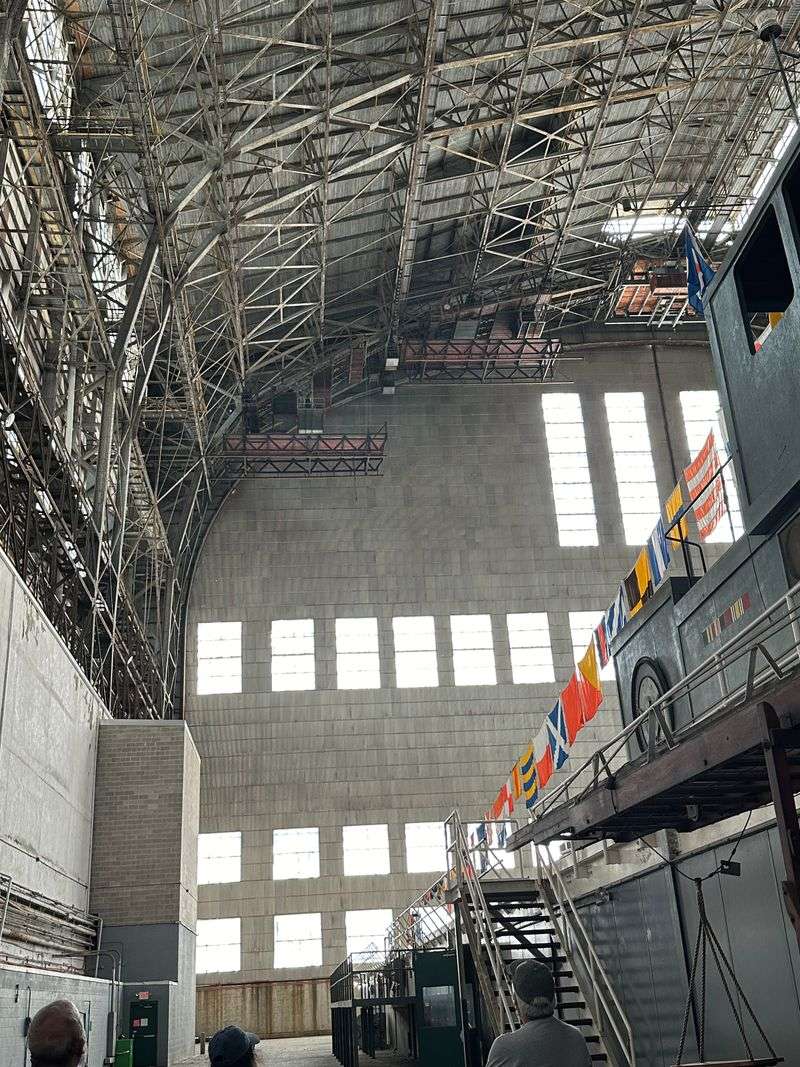
Imagine a building so massive it could swallow entire football fields and still have room to spare. Hangar One at Lakehurst, constructed in 1921, was specifically designed to house the colossal rigid airships that once represented the cutting edge of aviation technology.
This isn’t some reconstructed replica or museum piece; it’s the actual structure that witnessed the golden age of dirigibles and the tragic end of passenger airship travel.
Walking into this cavernous space is an experience that leaves even the most jaded visitors awestruck. The hangar’s sheer scale is difficult to comprehend until you’re standing beneath its roof, which soars high enough to accommodate airships that were longer than three city buses placed end to end.
The building has been repurposed over the decades, currently serving as a training facility that simulates aircraft carrier operations for military personnel.
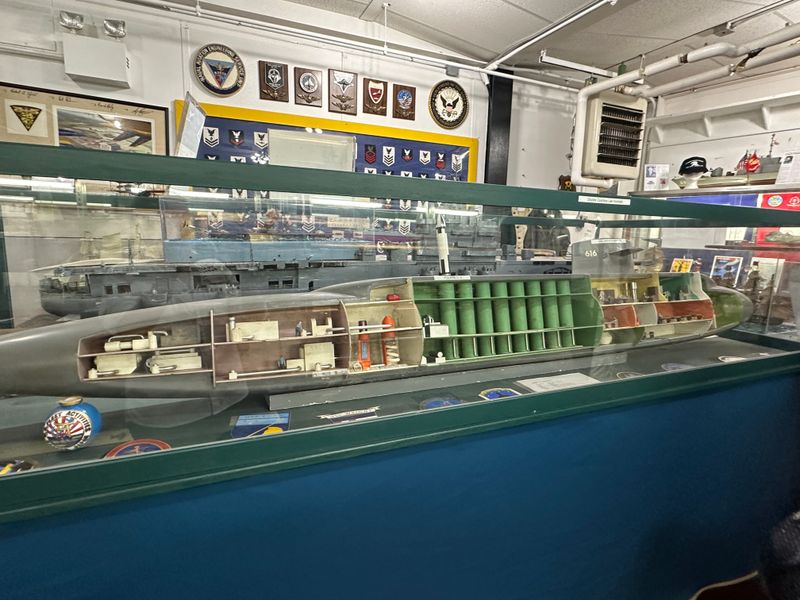
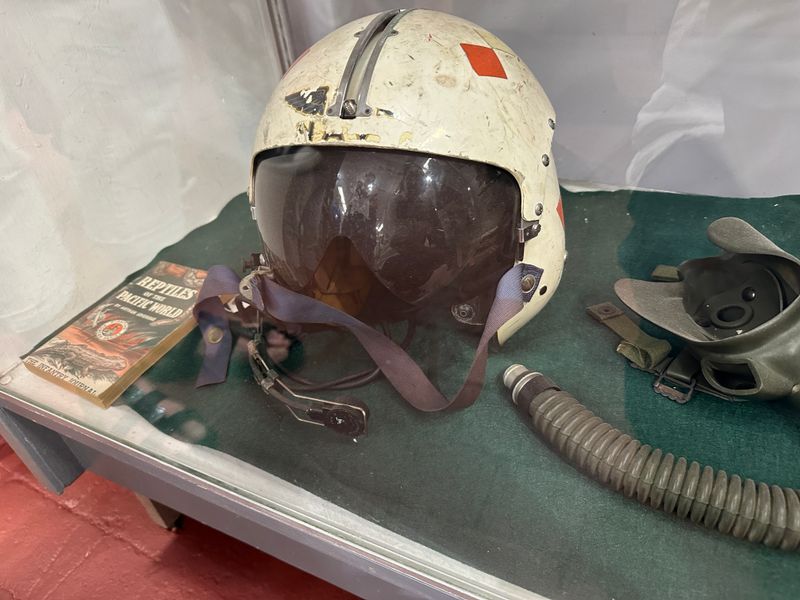
Beneath the main hangar floor, you’ll find something unexpected: an extensive military museum packed with dioramas, personal effects, memorabilia, and artifacts spanning all branches of service and multiple wars. This isn’t advertised as heavily as the Hindenburg memorial itself, making it feel like a secret bonus for those who make the journey.
The collection includes POW-MIA exhibits that visitors describe as deeply moving and educational.
The historical society actively accepts donations of military uniforms, trinkets, and personal items from families looking for a respectful home for their loved ones’ service memorabilia, ensuring these stories continue to be told for future generations.
Tours Only Run One Day Per Week
Scarcity creates value, and nowhere is that more apparent than with these Hindenburg memorial tours. Every Wednesday from 10 AM to 1 PM, weather and military operations permitting, the Lakehurst Historical Society opens the gates to history seekers.
That’s it. One three-hour window per week.
Miss it, and you’re waiting another seven days, assuming you’ve already completed your security clearance paperwork.
This limited schedule isn’t a marketing gimmick designed to create artificial demand. It’s simply a matter of logistics, volunteer availability, and the realities of operating tours on an active military base where operational needs always take priority.
Several reviewers shared stories of traveling significant distances only to find their tour cancelled same-day due to unscheduled military operations, a frustrating but understandable risk when dealing with an active defense installation.
The Wednesday-only schedule means planning is absolutely essential. You can’t decide on a whim to visit during a weekend getaway or squeeze it into a random Tuesday afternoon.
This requirement filters out casual tourists and attracts genuinely interested history enthusiasts who are willing to work around the constraints.
Interestingly, this exclusivity has actually boosted the site’s popularity rather than limiting it. People love experiences that feel rare and special, and the Hindenburg memorial tour delivers exactly that.
Social media posts about the site often emphasize how difficult it was to arrange a visit, which only makes others more determined to do the same.
It’s Located at 563 Saniuk Road, Lakehurst
Addresses matter when you’re dealing with military installations, and the Hindenburg Disaster Memorial officially sits at 563 Saniuk Road, Lakehurst, NJ 08733. But here’s the catch: you can’t just plug that address into your GPS and expect to drive straight there.
The memorial is inside Joint Base McGuire-Dix-Lakehurst, which means you’ll need to follow specific instructions provided by your tour coordinators about where to meet and how to gain base access.
Most tours begin at the Cathedral of the Air, an off-base location where the group gathers before everyone drives together in convoy to the crash site. This staging area allows tour leaders to check credentials, provide safety briefings, and ensure everyone understands the protocols for visiting an active military facility.
Trying to navigate directly to the memorial without going through proper channels will result in nothing but frustration and a stern conversation with base security.
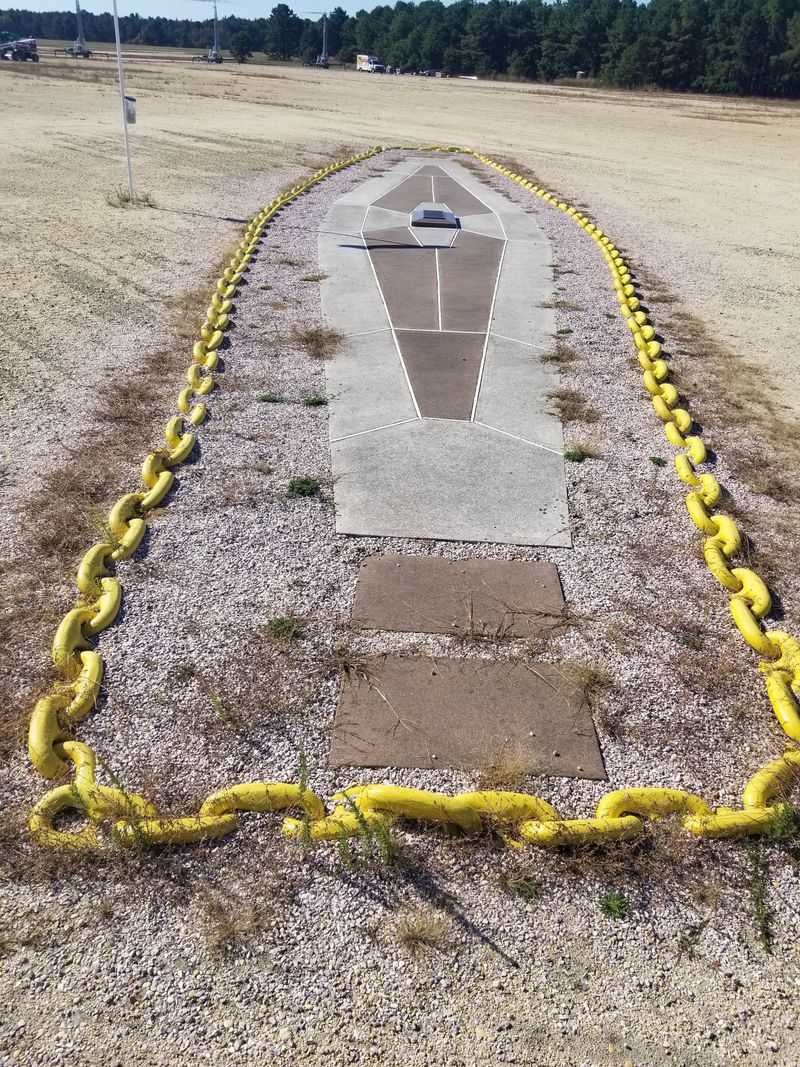
Once inside the base, you’ll drive past the commissary, and reviewers with military IDs note that the memorial is accessible by taking a left just after that building. The crash site itself sits in what appears to be a large, otherwise empty field, marked by that distinctive yellow chain perimeter.
The understated presentation surprises many first-time visitors who expect something more elaborate or dramatic.
Ocean County, New Jersey, where Lakehurst is located, doesn’t always get credit for its historical significance, but this address represents one of the most important sites in aviation history, right here in the Garden State’s backyard.
You’ll Hear the Actual Radio Broadcast at the Crash Site
Herbert Morrison’s anguished radio report of the Hindenburg disaster remains one of the most emotionally raw pieces of journalism ever recorded. His voice cracking as he witnesses the airship engulfed in flames, his famous cry of “Oh, the humanity!” becoming forever etched in the American consciousness.
Reading about it in history books is one thing, but hearing it while standing on the exact spot where Morrison stood changes everything.
Tour guides make a point of playing the original newsreel audio during the visit to the memorial, creating what visitors consistently describe as an incredibly solemn and moving moment. Suddenly, the tragedy becomes more than dates and statistics; it transforms into a visceral human experience.
You can almost see the massive airship descending for landing, imagine the passengers and crew anticipating their arrival, and feel the shock and horror as everything went catastrophically wrong in mere seconds.
The field where you stand hasn’t changed much since 1937. The same New Jersey soil, the same approximate weather patterns, the same view toward the hangar.
This continuity creates a bridge across nine decades, connecting modern visitors to that terrible evening in a way that feels almost supernatural.
Many visitors report getting emotional during this part of the tour, even those who came primarily out of curiosity rather than deep historical interest. The combination of place, sound, and story creates an experience that stays with people long after they’ve left the base and returned to their everyday lives.
There’s a Surprisingly Extensive Gift Shop and Bookstore
Who knew that a memorial inside a military base would have one of the most comprehensive collections of airship literature and memorabilia anywhere in the United States? The gift shop and bookstore, located in the small display area inside the hangar, serves as the Lakehurst Historical Society’s only fundraising operation.
Every purchase directly supports their volunteer efforts to maintain the memorial and continue offering these educational tours.
You’ll find books ranging from technical analyses of what caused the disaster to personal accounts from survivors and witnesses. There are photographs and reproductions of historical documents, scale models, and various commemorative items that you simply won’t encounter anywhere else.
This isn’t mass-produced tourist trap merchandise; these are carefully curated items that reflect genuine historical interest and research.
The display area surrounding the bookstore features memorabilia, photos, and pieces from airships from around the world, creating a mini-museum experience before you even enter the main hangar. Visitors mention being surprised by how extensive and well-organized these collections are, especially considering they’re maintained entirely by volunteers with limited resources.
Because the historical society operates on donations and gift shop revenue alone, purchasing something during your visit is more than just acquiring a souvenir. It’s directly supporting the preservation of this important historical site and ensuring future generations can access these tours.
The volunteers aren’t getting rich from book sales; they’re simply trying to keep history alive and accessible to anyone willing to make the effort to visit.
Franklin D. Roosevelt Helped Establish the Base
Long before the Hindenburg disaster made Lakehurst internationally infamous, the base was already making history as America’s first international airport. Franklin D.
Roosevelt, during his tenure as Assistant Secretary of the Navy, played a crucial role in establishing and developing Naval Air Station Lakehurst as a center for lighter-than-air aviation. The facility represented cutting-edge technology and American ambition during the early decades of flight.
The base’s strategic importance extended far beyond passenger airships. Military dirigibles conducted surveillance, anti-submarine patrols, and experimental operations that contributed to naval aviation development.
The massive hangars weren’t just impressive architectural achievements; they were essential infrastructure for a new type of warfare and reconnaissance that seemed to promise unlimited possibilities before the Hindenburg disaster effectively ended the airship era.
Tour guides share fascinating details about how the base evolved over the decades, from its airship heyday through World War II operations and into its current role as part of Joint Base McGuire-Dix-Lakehurst. The layers of history here go far deeper than a single disaster, encompassing military innovation, technological evolution, and the changing nature of American defense strategy throughout the 20th and 21st centuries.
Understanding this broader context helps visitors appreciate why the memorial and tours matter beyond simple disaster tourism. This is a place where American military and aviation history intersected in dramatic and consequential ways, with ripples that extended far beyond New Jersey’s borders.
It’s Surprisingly Close to Six Flags Great Adventure

Here’s something you probably didn’t expect: one of America’s most sobering historical memorials sits just a short drive from one of the East Coast’s most popular amusement parks. Six Flags Great Adventure in Jackson, New Jersey, is roughly 20 miles from the Hindenburg memorial, making it entirely possible to combine a day of roller coasters with a dose of serious history.
Talk about range!
This proximity makes the Lakehurst site particularly accessible for families visiting the Garden State for vacation. Parents who’ve promised their kids a Six Flags adventure can also expose them to genuine American history without requiring a separate multi-day trip.
The contrast between the two experiences couldn’t be more stark, but that’s exactly what makes the combination so valuable and memorable.
Ocean County and the surrounding area offer plenty of other attractions too, from the beautiful Jersey Shore beaches to the Pine Barrens wilderness areas. The Hindenburg memorial fits naturally into a broader exploration of what makes New Jersey such a historically and culturally rich state, far beyond the stereotypes and jokes that dominate popular culture.
Smart trip planners might schedule their Hindenburg tour for a Wednesday morning, then spend the afternoon enjoying Six Flags or exploring nearby Lakewood or Toms River. This kind of itinerary provides balance between education and entertainment, reflection and fun, making for a well-rounded vacation experience that appeals to different interests and age groups.
New Jersey’s compact geography makes these combinations not just possible but genuinely convenient and enjoyable.
Dear Reader: This page may contain affiliate links which may earn a commission if you click through and make a purchase. Our independent journalism is not influenced by any advertiser or commercial initiative unless it is clearly marked as sponsored content. As travel products change, please be sure to reconfirm all details and stay up to date with current events to ensure a safe and successful trip.
