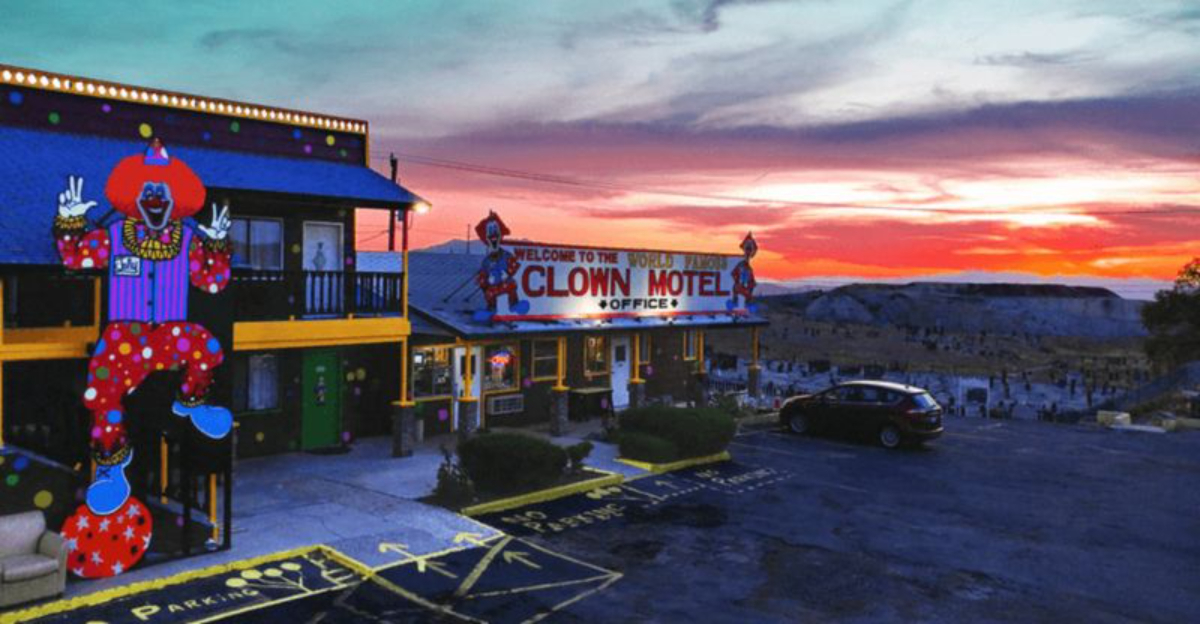
Neon flickers on the loneliest highway, and a painted smile beckons from the edge of Tonopah’s desert night. If you’ve ever wondered why some travelers check in without names, this is the motel where legends sign the ledger for them. The World-Famous Clown Motel blends kitsch and goosebumps, luring road-worn wanderers with a promise of privacy and a dare to believe. Step closer – the laughter might be the wind, or it might be your story beginning.
The Nameless Check?In Ritual
At the Clown Motel, the front desk lamp glows like a lighthouse, and the ritual is simple: a quiet nod, a key slid across polished wood, and as few questions as you like. Travelers arrive with dust on their boots and stories in their pockets, but many leave no names behind – just the imprint of a room number and a memory that refuses to fade.
The anonymity feels deliberate, as if the desert itself protects its pilgrims. You sense the staff understands; they’ve seen the jittery, the curious, the sleepless. In this hush, a register can feel like a spellbook, and privacy becomes part of the lore. Outside, the wind combs the gravel.
Inside, porcelain smiles stand watch. You tuck your identity in your jacket and vanish into the hush, certain the night already knows you.
Cemetery Next Door, Whispers Through Walls
There’s a cemetery a few steps from the office, and the rooms wear that proximity like a chill beneath the wallpaper. Guests swear they hear soft shuffling in the hall at 3 a.m., or laughter threaded through the air-conditioning’s sigh. The Old Tonopah Cemetery holds miners, drifters, and desert secrets – neighbors with urgent stories and glassy patience.
You crack the door, listen, and the night leans in. It’s not always frightening; sometimes it’s simply a presence, asking to be remembered. People book under no names because they’re not here to be recognized – they’re here to witness or be witnessed, quietly, by something older. The neon washes the headstones in pink and blue, and time feels thin as paper.
Dawn brings ravens, sun, and the inevitable question: did the quiet keep you safe, or did it simply notice you?
A Gallery of Grins and Stares
The lobby is a museum of painted cheer, where porcelain, fabric, and canvas faces gather like a chorus stuck on the same note. It’s whimsical until you notice how many eyes seem to follow the door. Travelers drift in, speaking softer than usual, as if waking the collection would be impolite. Some claim certain dolls shift, or that a framed clown tilts between dusk and dawn.
Whether tricks of perspective or something stranger, the effect is the same: you feel watched, but not judged – observed as a fellow performer in a very long play. Anonymous bookings make sense here; you’re just another character passing the spotlight for a night.
The brightness is part defense, part invitation. You sign, you smile back at a hundred smiles, and you wonder which one will remember your face when you’re gone.
Room Keys, Stories, and Static
The rooms feel like time capsules, with bedspreads that whisper in patterns and televisions that hum a little too meaningfully when the night gets late. Most decorations are soft-spoken – clown prints, a vintage color palette, a lamp that warms the edges of your uncertainty. People arrive with theories and leave with stories, some scribbled on napkins and tucked into glove boxes.
The key fob lies heavy in your palm, a small artifact connecting you to everyone who turned it before. Sometimes names complicate a tale. Here, a room number is enough to anchor what happened between dusk and sun. There’s comfort in that simplicity – no loyalty points, no algorithms, just a door that knows your knock.
If the static pops and a laugh peeks through, you can always lower the volume, or you can listen and learn the punchline.
Halfway Between Anywhere and Elsewhere
Tonopah is the desert’s intermission, a place the road takes a breath. Between Reno and Las Vegas, the horizon is an ongoing sentence, and the Clown Motel is the comma that changes the meaning. Night drivers spot the neon and feel their shoulders loosen – the promise of sheets, strangeness, and silence. Anonymous check-ins thrive where distances are long; out here, a name can feel like extra baggage.
The desert unburdens you, strips the day to essentials: fuel, water, shelter, mystery. In the morning, you’ll find coffee and the soft hum of stories swapping owners. In the evening, you’ll find stars that don’t blink, and a sign that does. This in-betweenness is a kind of magic, a map margin where the legend lives. Pull over. Let the miles hush.
The road will remember you, even if the registry doesn’t.
Ghost Hunters, YouTubers, and the Quiet Ones
On any given night, you might pass a camera crew whispering into red lights, an investigator waving an EMF meter, and a weary traveler slipping past with their eyes down. The Clown Motel hosts them all: the performers who publish their fear, and the pilgrims who keep it folded away. Anonymous bookings keep the streams from crossing – spectacle on one side, solitude on the other.
Staff have learned to nod in all the right languages: curiosity, caution, courtesy. In the hallway, your footsteps sync with someone else’s, then don’t. Doors shut softly, gear cases click, and the building listens. Some guests capture orbs; others capture sleep. Either way, the night leaves evidence – battery drains, dreams sharper than usual, a laugh that never quite resolves.
Checkout is early, but the comments – spoken or secret – tend to linger.
Kitsch as a Protective Spell
The motel’s kitsch feels intentional, like a magician’s patter: bright distraction around something older and quieter. Clown colors, plastic blossoms, and coin-op nostalgia create a shell so cheerful it begins to look like armor. Guests lean into it, grinning for photos, daring nerves to settle. But in the mirror, the room sometimes feels larger than its walls, and the air holds its breath between jokes.
Anonymity thrives in this theater. A nameless reservation lets you play your part without the burden of proof. Laugh lines become sigils, gift shop trinkets talismans. You leave with a postcard that smells lightly of dust and ozone.
Somewhere between tacky and sacred, the décor becomes a spell – one that promises that if the dark comes closer, it will have to smile first. Most nights, that’s enough to keep it polite.
Night Clerk, Keeper of Thresholds
The night clerk is part storyteller, part lighthouse keeper, and part border guard between the ordinary and whatever else walks in. They know who wants a chat and who wants a key with minimal friction. Your name, if offered, is respected; if withheld, it’s respected twice. They’ve seen batteries drain in fresh flashlights, watched guests stutter at doorways, and learned which rooms hum with extra attention.
Their smile says you’ll be fine, but also that the building has rules of its own. Anonymous bookings feel like a courtesy extended to the night itself, which doesn’t care for bureaucracy. You sign what’s necessary, slide the card, and step over.
The clerk returns to their book, their radio, their listening. It’s comforting to know someone tends the threshold while you test the legend inside.
Desert Soundtrack: Wind, Neon, Laughter
Sound travels differently here. The wind doesn’t just move; it narrates, combing the gravel and threading through the sign’s electric hum. Somewhere, a laugh rides the current – maybe from the lobby’s TV, maybe from a painting that refuses to stay still. Coyotes tune the middle distance. Anonymous guests drift in like choruses, leaving harmonies but not names, and the building arranges them into a nightly suite.
Crack a window and the desert composes itself on your skin: dry, cool, a little brave. Some people sleep hard. Some listen harder. Either way, you’ll carry the motel’s soundtrack for a few exits down the highway, where the neon fades to memory and the wind edits the rest.
If you return, the music will recognize you even if the ledger doesn’t – an old refrain humming, welcome back, don’t look too long.
Legends That Check In First
Long before you arrive, the story has your room. Rumors about spectral miners, wandering nurses, and punchline-loving phantoms seep through local bars and backseat conversations. You come to test them and find the legends already unpacked – sitting in the desk chair, tilting the art, nudging the curtains. This is why no-name bookings work: the tale takes top billing, and you play the understudy.
You might experience nothing at all, which is its own kind of answer, or you might collect a fragment – the flicker, the breath, the improbable knock – that makes you part of the archive. Out on the gravel, tires crunch like closing credits. Inside, the bed awaits your scene.
When you leave, the legend remains, punctual and patient, checking into the next traveler’s night long before their GPS finds the turn.
Leaving Without Proof (And Wanting More)
Dawn rinses the rooms in peach light, and everything seems gentler – less haunted, more human. You return the key, exchange a nod, and pocket your story without needing to name it. There may be no photos that capture what you felt, only a memory that follows at your shoulder like a curious stray. That’s the trick: the Clown Motel satisfies and withholds at once, creating a gap you’ll want to revisit.
Anonymous bookings make the return easier; you can slip back through the same threshold without explaining why. As the highway pulls you onward, the sign shrinks to a bright punctuation mark, and you realize the sentence isn’t finished. Maybe it never is.
Out here, unfinished stories are currency, and the desert pays on time – interest accruing in miles and the occasional, inexplicable smile.
Dear Reader: This page may contain affiliate links which may earn a commission if you click through and make a purchase. Our independent journalism is not influenced by any advertiser or commercial initiative unless it is clearly marked as sponsored content. As travel products change, please be sure to reconfirm all details and stay up to date with current events to ensure a safe and successful trip.
