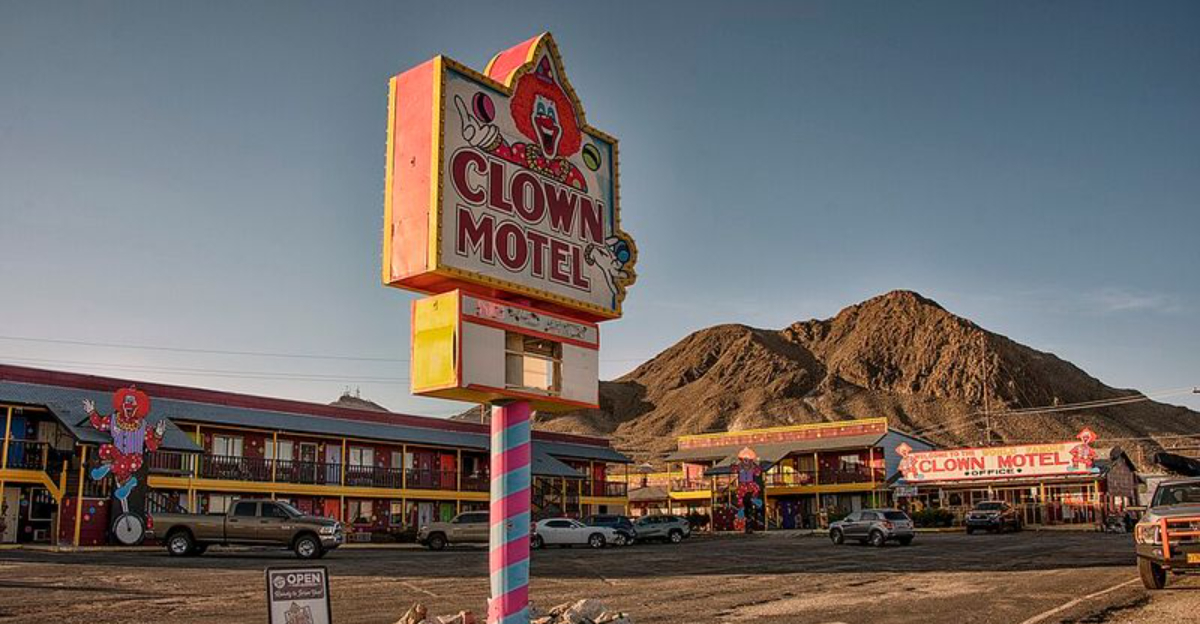
In the heart of Nevada’s endless deserts, far from the neon lights of the cities, a motel emerges from the darkness as if conjured by the desert itself. Locals whisper that it only appears after midnight, a shimmering refuge poised between moonlit sand and silent ghost towns. Travelers speak of a place where the retro glow of neon meets the hush of the open road, and stories settle like dust along the porch rail. They call it the Clown Motel in Tonopah – a surreal landmark where laughter and unease share the same room key. If you crave a journey that blends desert solitude with a touch of the unexplained, this is the legend you’ll want to chase.
Room 7’s Television Snow
Room 7 is ordinary by day: a tidy spread, a humming mini-fridge, a TV with streaming menus ready. But after midnight, the screen drifts to snow, and then shapes flicker within the static – like headlights climbing an unseen hill, like silhouettes turning toward the viewer.
Some guests claim the volume won’t stay down, that voices in the static argue softly about routes to forgotten towns. Others see a clownish grin appear and fade, a nod to Tonopah’s stranger heritage just down the road. Switch the TV off and the glass still glows, faint as foxfire.
It’s not malicious, just insistent, as though the room wants to tune itself to a broadcast from another time zone where night never ends. By morning, your shows pick up where they left off. The remote, though, feels warmer, as if held by other hands.
The Neon That Breathes
They say the sign inhales first. A soft hum rises from the pole, and the letters flare like a heartbeat, neon pooling over the asphalt in blue and red. Wind skims the lot, stirring paper cups and ghostly grit while the desert holds its breath.
Travelers claim the sign brightens only after midnight, as if the motel borrows power from the moon. Stand beneath it and the glow paints your hands, a promise of shelter and something stranger. You’ll hear the electrical buzz as a distant lullaby, pulling your gaze toward rooms that seem both empty and watched.
The light doesn’t just illuminate; it beckons. In a land of endless highway, that’s enough to make the curious stop. For others, it’s the first warning. Either way, once it breathes, the night truly begins.
Hallway Footsteps in Sand
Locals insist the hallways gather sand like a shoreline by morning, even with doors bolted and windows sealed. After midnight, soft footsteps pad along the corridor, leaving prints that stop at locked rooms. Some guests swear the grains whisper against the baseboards, drawn in by a draft that smells faintly of sagebrush and old rain.
You might hear a muffled knock with no one outside, followed by that unmistakable hush of retreating steps. Housekeepers shake their heads at dawn, sweeping dunes no storm could explain. The effect is subtle: just enough texture under your soles to make you glance down and wonder whose path you’re following.
In the stillness, the corridor seems to lengthen, doors receding, ceiling lights dimming in a patient pulse. If you listen, the sand itself becomes a guide, mapping nights no one remembers.
The Cemetery Wind
The wind that arrives after twelve has a memory for names. It crosses a century of stories from a hill of old markers and slips under the eaves, tasting of dry wood and iron. Guests on the balcony feel the draft lift their hair and carry a faint note of lavender, like a funeral ribbon kept too long.
Conversations hush; doors ease open; the world narrows to the sound of chimes that aren’t there. Some say they’ve heard a roll call on the breeze – miners, travelers, one ether-soft whisper of “home.” The air moves like a procession no one can see, then dissolves by the vending machine with a tired sigh.
At sunrise, it’s just air again. But at midnight, the wind knows the route by heart, crossing desert miles to tap gently on the motel’s bones.
The Pool That Isn’t There
There’s no pool on the map, yet locals tell of ripples appearing in the courtyard around one in the morning. The dirt darkens as if soaked, neon reflections wobble on nothing, and a chill steams off the surface that isn’t there. Travelers step closer and swear they smell chlorine – clean, sharp, impossible.
Some drop a pebble and hear a plink, then a spreading silence, like the desert swallowing sound. It lasts minutes, maybe less, before the ground dries and the air heats again. If you stand at the exact center, you might see stars refracted where no water lies, as though the night has a second surface to breathe through.
By dawn, boot prints circle an absent pool, pointing inward, curious as animal tracks around a spring. Come midnight, the oasis reforms, a rumor cupped in neon light.
Midnight Check-In Bell
The front desk sits quiet until the brass bell trembles without touch. A single chime slips across the lobby, at once polite and insistent, as if the night itself is a guest arriving late. The ledger’s corners curl, and the pen tilts toward an unmarked line.
Some witnesses describe a paperback ghosting open to a dog-eared page; others notice the wall clock falter a minute behind. The bell sometimes rings twice, spaced like careful footsteps approaching the counter. Those who linger report a hint of cologne, old-fashioned and dry, blending with coffee gone cold. No key slides across the counter.
No door swings shut. The sound simply fades, leaving the lobby newly awake. By morning, the bell rests like any other, tarnish catching the sun. Still, it remembers midnight, and waits for the next courteous knock.
The Highway That Shortens
Drive toward the motel after midnight and the miles fold in peculiar ways. Signs you passed an hour ago reappear, but closer, as if the road has learned your intentions and is helping. Locals call it the short stretch, that desert kindness that shaves time when you chase flickering neon.
You’ll watch your odometer and swear it lies, hear your GPS recalculating with nervous precision. The air cools; sage leans toward the asphalt; the sky recruits extra stars. Then the motel arrives in a rush, lights bright as a welcome home.
Those who leave before dawn find the opposite: a highway unspooling forever, horizon lazy, time stretching like hot gum. The Desert Oasis, they say, is a benevolent trickster. Night travelers get the shortcut. Day drivers pay the difference in long, honest miles.
Coffee of the Before-Time
There’s a percolator in the office that roars to life after midnight, even unplugged – so the story goes. The brew smells like campfire mornings and distant rain, warm enough to make strangers nod at each other like old friends. A single mug appears beside it: chipped rim, stylized coyote, steam curling in a question mark.
Sip it and you’ll recall roads you haven’t driven yet, landmarks you’ll later swear you recognized. The night manager shrugs – no one claims the mug, but no one throws it out. Coffee this good belongs to the desert, they say, part offering, part omen.
By dawn, the pot cools to silence, grounds shaped like a map of the hills beyond Tonopah. If you’re lucky, the taste lingers past breakfast, a compass on your tongue pointing toward something true and strange.
Guestbook of Names Twice Written
The guestbook tells stories ink can’t hold. After midnight, some entries appear twice – once bold, once faint, like an echo of the same hand crossing time. Names from a century ago mingle with last night’s signatures, forming a tapestry of arrivals that never overlapped.
Flip the pages and you’ll find marginal notes: room numbers that no longer exist, rates paid in silver, doodles of pickaxes and crescent moons. The paper smells of dust and citrus cleaner, humble and sacred. A few travelers claim the faint signatures grow darker as they read, as if remembered into solidity.
Others swear their own names shift a letter, then settle back when they blink. The manager locks it away at dawn, but you can ask to see it near midnight. If the pages turn themselves, be polite. The book appreciates manners.
Desert Radio at 12:13
Tune any radio at 12:13 a.m., and you might catch the station locals call the Desert Line. It hums between frequencies, a corridor of static where a warm voice reads road reports for towns erased from the map. Expect weather from a sky you’re not under, and lullabies in cracked harmony.
Truckers share routes that end in starlight; a woman asks if anyone’s seen her green scarf near Mile 61. The broadcast vanishes by 12:20, leaving your regular stations too loud and ordinary. Guests leave their radios on the dresser like little lighthouses, hoping the signal returns.
When it does, it feels less like entertainment and more like a handshake across time. If the voice thanks you by name, don’t be startled. The desert listens as well as it speaks, and its courtesy is precise.
The Vanishing at Dawn
By sunrise, the motel thins to mirage. Paint pales to the color of old bones; door numbers blur; the sign’s buzz falls quiet as a held breath. Some awed guests step out with bags ready and find only a rectangle of cooler air where their room once stood. It isn’t frightening – more like waking from a vivid story you’re sure you can finish.
The nearby highway reasserts itself, straight and practical, and the town’s ordinary day begins. Yet sand remembers shoe prints, and receipts appear in wallets with perfect letterhead and a checkout time of 11:59 p.m. Locals insist the Desert Oasis keeps its promise: shelter at midnight, a lesson at dawn.
You leave with the certainty that the road offers more than miles. It offers possibility, flickering true in the hour when worlds overlap.
Dear Reader: This page may contain affiliate links which may earn a commission if you click through and make a purchase. Our independent journalism is not influenced by any advertiser or commercial initiative unless it is clearly marked as sponsored content. As travel products change, please be sure to reconfirm all details and stay up to date with current events to ensure a safe and successful trip.
