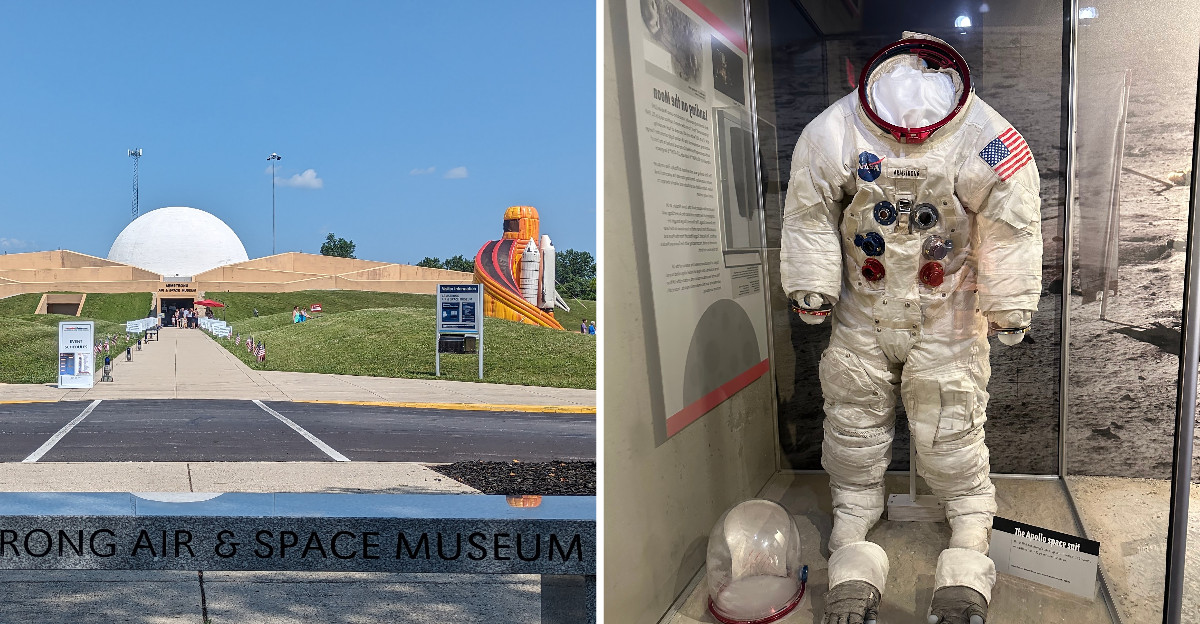
White domes in grassy fields look like they landed rather than were built, and that was enough to pull off the highway after years of driving past. Inside waits the story of a quiet Ohio kid who earned a pilot’s license before he could legally drive a car.
He later became the first human to set foot on the Moon. Real moon rock sits under glass.
Spacecraft that flew in orbit hangs overhead. The spacesuit he actually wore is displayed nearby.
What surprised most was how personal it all felt, like walking through a neighbor’s very extraordinary scrapbook. Rooms hold childhood photographs, model planes, and small-town mementos that make the achievement feel close.
By the gift shop, the reason locals talk about this place with so much pride becomes obvious. History here does not always shout, and this stop proves it.
A Moon Base Rising Out of the Ohio Cornfields
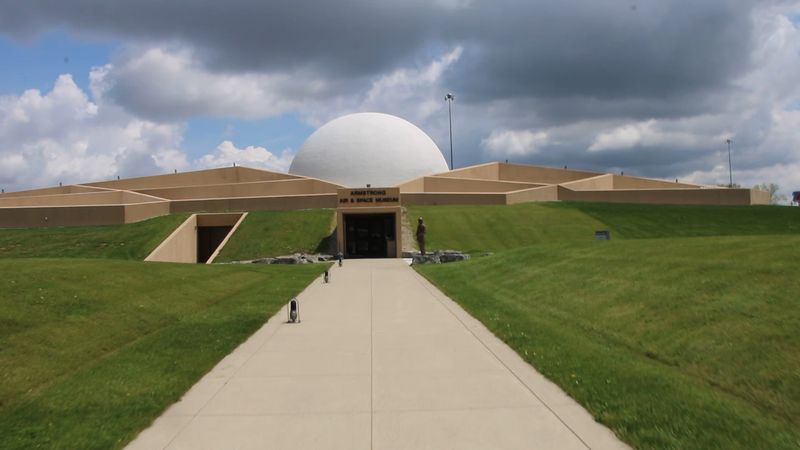
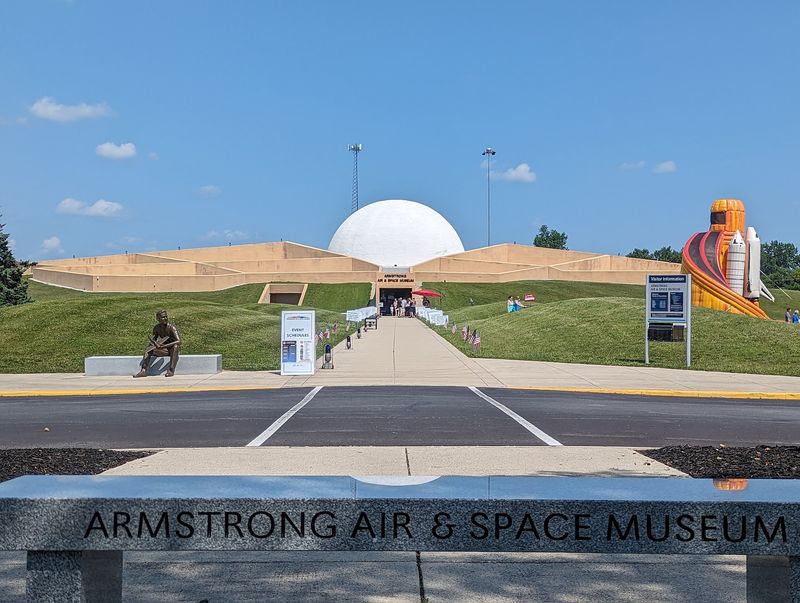
The first thing that gets you is the shape. A smooth white dome pushes up out of a grassy mound beside the highway, looking far more like a lunar outpost than a small-town museum.
That design was intentional. When the building opened on July 20, 1972, exactly three years to the day after Armstrong stepped onto the Moon, architects gave it the look of a futuristic moon base, with earth banked up around the sides so it seems partly buried in the Ohio soil.
I walked the grounds before going in, and there are aircraft and displays outside worth a slow lap. In December, the property gets decorated with light displays, which sounds unexpected until you see the glow bouncing off that white curve.
From the interstate it honestly looks tiny, and plenty of travelers assume it is a roadside curiosity they can skip. That assumption is wrong, and the parking lot full of out-of-state plates proves it.
Wapakoneta sits roughly halfway between Toledo and Dayton, which makes the museum an easy break on a long drive. Give yourself more time than you think you need.
Gemini VIII, the Capsule That Actually Flew
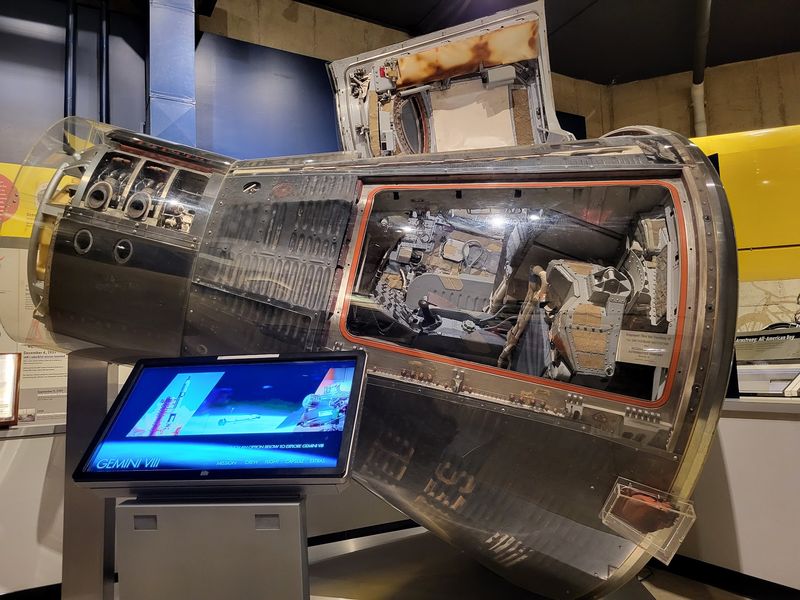
Some artifacts stop you mid-sentence. The Gemini VIII capsule did that to me, partly because of how small it is and partly because Armstrong genuinely rode inside it.
In 1966 he piloted this spacecraft with David Scott, and together they pulled off the world’s first docking of two vehicles in space. The mission also turned dangerous fast when the craft began spinning, and the crew had to bring it down early.
Seeing the real thing changes how you picture space travel. There is no glamour in that cramped cabin, just switches, seats, and a hull that took a beating coming home.
Visitors often linger here longer than anywhere else, and the staff seem happy to answer questions about what went wrong and how the crew recovered. I overheard a docent explaining the docking sequence to a kid who was completely hooked.
Ohio contributed enormously to aviation and spaceflight history, and this capsule is the hard proof sitting under museum lights. Take a slow walk all the way around it.
You will not find another one like it in the state.
The Spacesuit That Made the Trip Back Home
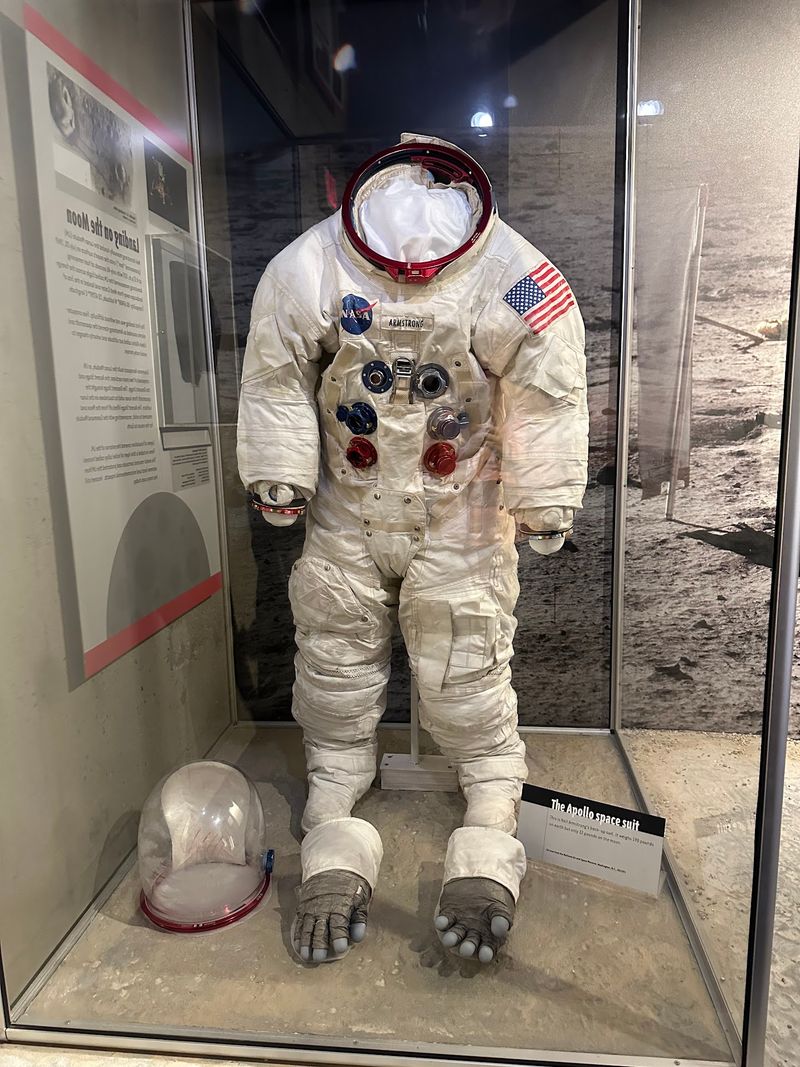
Here is the detail that gives the whole museum its emotional weight. Armstrong’s Gemini G4C spacesuit, the one he wore on that 1966 mission, is displayed right here in the town where he grew up.
The museum also shows an Apollo A7L suit built for him during the Apollo program. Standing close to the glass, you notice the layers, the hoses, the stitched patches, and how oddly handmade it all looks for something meant to survive the vacuum of space.
I expected the suits to feel like costumes. Instead they read as tools, worn and functional, shaped around a real person’s body.
Visitors mention the spacesuits constantly, and it makes sense. A capsule is impressive, but a suit is human-sized, and your brain instantly fills in the man who zipped himself inside it.
Armstrong left Wapakoneta as a teenager with a pilot’s license and came back famous, yet the town never treated him like a stranger. Having his suit displayed a few minutes from his boyhood street somehow closes that circle.
Bring the kids to this case first.
Touching a Piece of the Moon
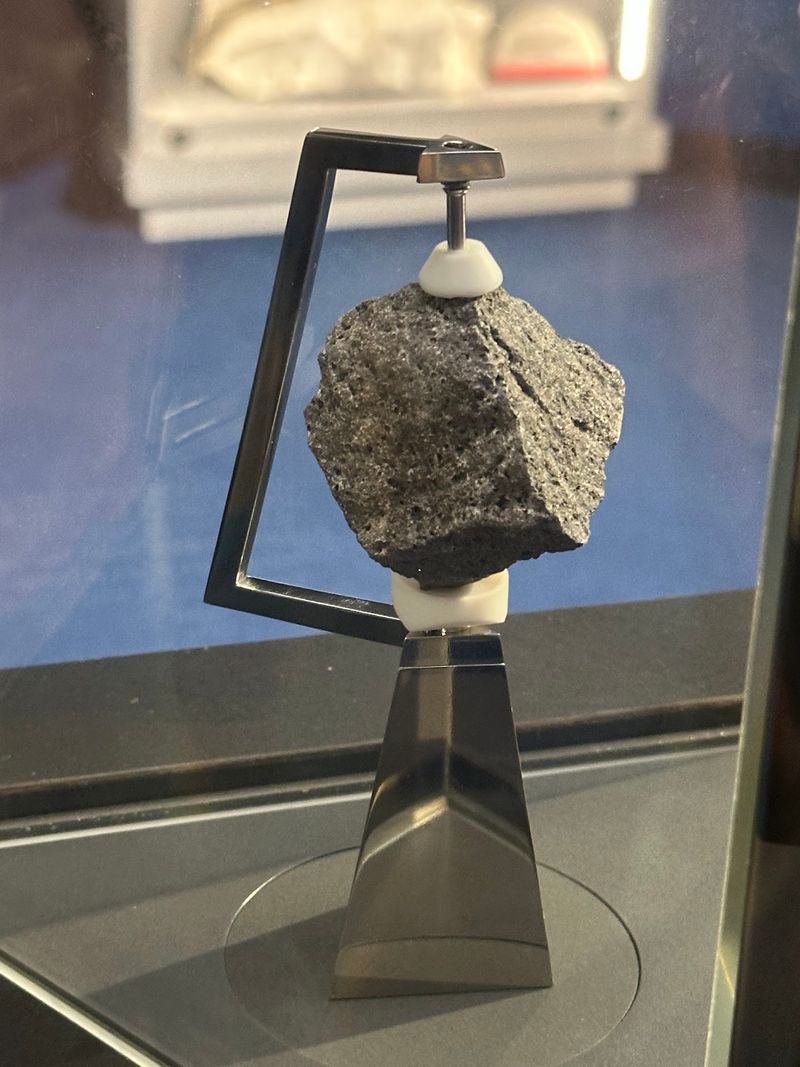
Nothing else in the building is quite like the moon rock. It came back from the first lunar landing, collected by Armstrong and Buzz Aldrin in July 1969, and now it sits quietly in a case in western Ohio.
I stared at it far longer than the size of the sample justified. It is not flashy, and if you saw it on a driveway you would walk right past it.
Knowing where it has been is the entire point. That rock existed on another world for billions of years before two men in bulky suits picked it up.
Around thirty visitors a month mention it in reviews, which tells you it lands the same way for almost everyone. Kids press their faces to the glass and adults get unexpectedly quiet.
The surrounding displays help set the scene, with newspaper clippings from landing day and photographs from the lunar surface. Reading those front pages next to the rock itself is a strange, wonderful kind of time travel.
Small towns rarely hold artifacts from another world. Wapakoneta does.
That contrast is what stayed with me most. The sample is tiny enough to overlook, yet its story stretches nearly 240,000 miles beyond Earth.
You do not need a huge display or dramatic presentation here.
A small piece of stone, a glass case, and a little context do all the work.
The Aeronca Champ and a Sixteen-Year-Old Pilot
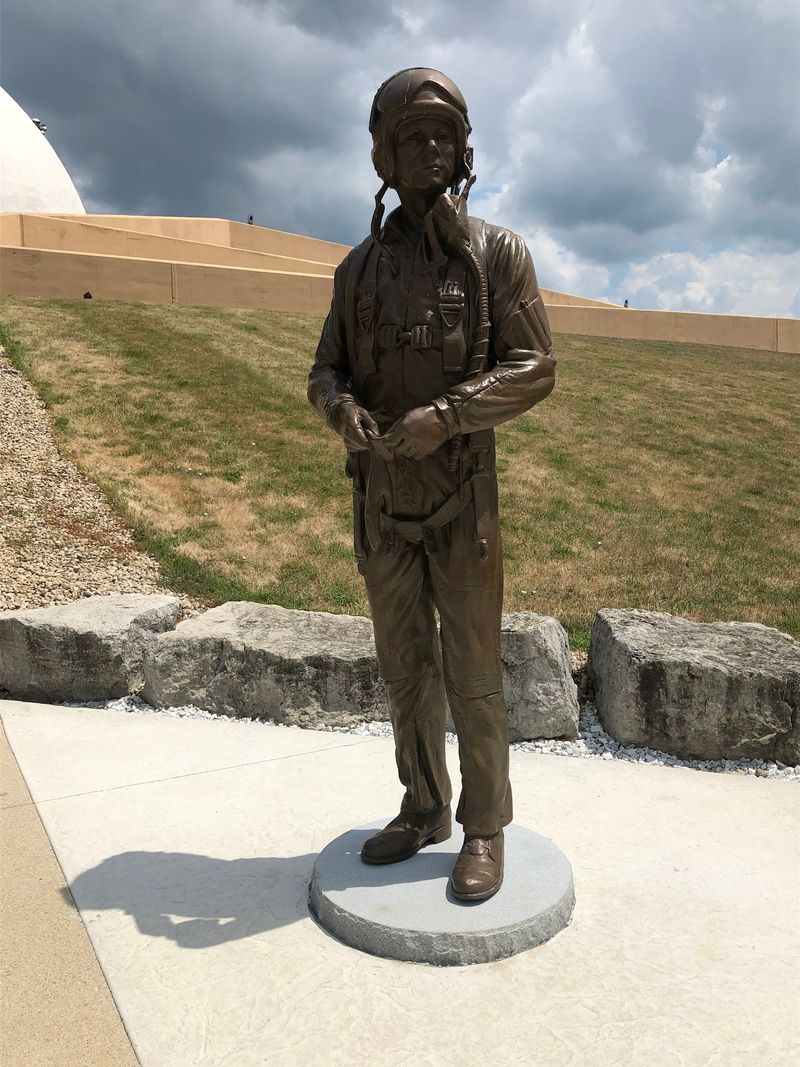
Long before rockets, there was a small yellow airplane and a teenager who could not wait. Armstrong earned his pilot’s license at sixteen, before he ever had a driver’s license, which still strikes me as the most Neil Armstrong fact imaginable.
Hanging in the museum is a 1946 Aeronca 7AC Champion, the same type of aircraft he learned to fly. Simple fabric wings, a modest engine, and no computers anywhere.
His family moved often because of his father’s auditing work for the state, but they settled back in Wapakoneta in 1944, and he attended Blume High School here. Those local skies are where the flying started.
Other full-sized aircraft he flew are also on display, and seeing them lined up shows the whole arc of one career. From a training plane to spacecraft, the leap is dizzying.
I liked this section because it grounds the legend. He was a normal Ohio kid with an obsession and a part-time job to pay for lessons.
Plenty of visitors say this is where the story finally clicks.
It turns an extraordinary career into something easier to understand, beginning with curiosity, persistence, and one small airplane over Ohio.
Thirty Minutes Under the Dome in the Astro Theater
Skip the film and you miss the heart of the visit. Tucked under the museum’s central dome, the Astro Theater plays a documentary about Apollo 11 that runs about half an hour and comes with admission.
I sat down mostly to rest my feet. Twenty seconds in, I stopped thinking about my feet entirely.
The footage and audio pull the mission together in a way display cases cannot, especially after you have already seen the capsule and the suits. Order matters here, and the theater sits roughly midway through the self-guided route for good reason.
Visitors mention this film constantly and almost always with the same advice: do not rush past it. One reviewer called it top notch, and another said it was the highlight of the stop.
Showtimes repeat throughout the day, so you rarely wait long. If you are traveling with restless kids, the dark room and big screen buy you a calm stretch too.
Plan for ninety minutes to two hours overall if you want to read everything and catch the movie.
The Infinity Room and the Simulators Nobody Wants to Leave

My favorite surprise was a hallway. The Infinity Room has been part of the museum since it opened in 1972, and it uses mirrors and tiny lights to create the illusion of endless stars stretching in every direction.
Walking through it, you lose your sense of where the walls are. It is simple, low-tech, and somehow still the thing people describe first when they get home.
Nearby, the interactive stations keep younger visitors busy. A space shuttle landing simulator and a lunar landing simulator let you try your hand at bringing a vehicle down safely, which is humbling in the best way.
I crashed. Twice.
My scores were not great, though the kid waiting behind me did significantly better and was very polite about it.
Families with preschoolers and grandparents alike seem to find something here, and the building is accessible throughout, including for visitors using canes or wheelchairs. The gift shop at the end is well stocked, and yes, there is a pressed penny machine with a rocket design.
Address: 500 Apollo Drive, Wapakoneta, Ohio
