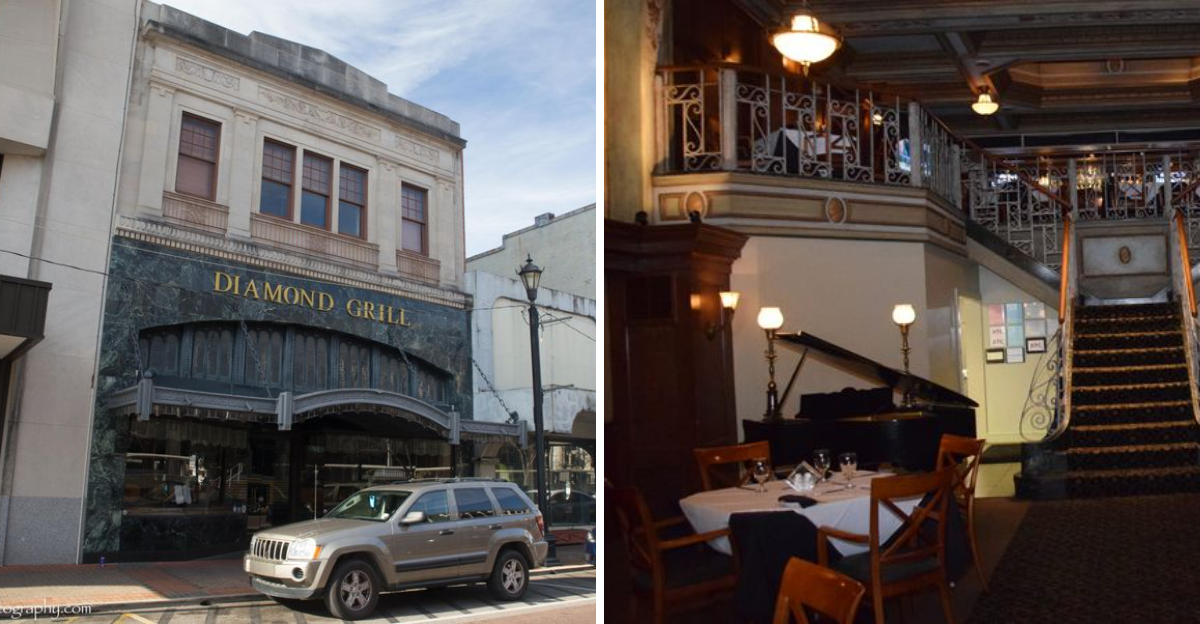
Travelers often seek places where history and atmosphere come together, and Alexandria, Louisiana, offers one such landmark. The Diamond Grill operates inside a historic jewelry store building dating to the early 1930s, a structure long admired for its Art Deco design and craftsmanship.
Its story blends architecture, community identity, and a layer of local folklore that has grown around the building over the years. The restaurant remains open today, continuing to serve guests while preserving the character of its historic setting.
Visitors can experience both its culinary offerings and the history embedded in its restored interiors. The building’s past as Schnack’s Jewelry adds depth to its modern role, giving diners a connection to Alexandria’s commercial heritage.
While ghost stories circulate informally, they belong to local legend rather than verified history. Together, these elements make The Diamond Grill a notable part of Alexandria’s cultural landscape.
A Jewel of Alexandria’s Past
The Diamond Grill occupies the historic C.A. Schnack Jewelry Company Store, a landmark Art Deco building constructed in 1931 in downtown Alexandria. The Schnack family operated their jewelry business there for many years, establishing the structure as a recognizable part of the city’s commercial identity, though little is documented about the family’s background beyond their long tenure in the trade.
After the jewelry store relocated, the building was eventually restored and adapted for restaurant use, with the precise duration of its vacancy not clearly recorded in public sources. Renaming it The Diamond Grill honored the property’s origins and preserved its connection to Alexandria’s retail history.
Residents welcomed the transformation, noting how the renovation respected the building’s architectural character while giving it a renewed purpose. Over time, the restaurant became a key component of downtown revitalization efforts, drawing people back into the historic core of the city.
Its presence demonstrated how preserving older structures can contribute to economic activity and cultural continuity. The building’s evolution from jewelry store to dining destination remains an example of adaptive reuse that strengthens both community heritage and urban identity.
Architecture That Sparkles
The building’s Art Deco architecture remains one of its defining features, distinguished by high ceilings, geometric flourishes, and original design elements that survived decades of use. Tudor’s renovation retained much of the jewelry store’s grandeur, which translated naturally into a formal dining atmosphere.
Photographs and architectural surveys consistently highlight the building’s craftsmanship, noting its blend of glass, metal, and ornamental detailing uncommon in the region. The interior emphasized vertical space and symmetry, lending the dining room a sense of elegance that guests immediately noticed.
Locals often described it as one of central Louisiana’s most striking restaurant interiors, admired as much for its structure as for its cuisine. Its careful preservation has made it a frequently referenced example of adaptive reuse in Alexandria.
The building remains an important visual anchor for the city’s historic district. Even today, its presence offers a reminder of the region’s architectural diversity during the early twentieth century.
A Menu with Local Roots
The Diamond Grill became known for its emphasis on Louisiana-rooted cuisine, reflecting regional flavors while incorporating contemporary presentation. Its menu relied heavily on local farms, seafood suppliers, and producers who contributed to the authenticity of each dish.
Diners praised both the generous portions and the balance between traditional comfort foods and elevated interpretations of Creole and Cajun staples. Seasonal changes kept regular customers engaged and showcased the restaurant’s willingness to evolve its offerings.
Out-of-town visitors were frequently brought there as an introduction to Alexandria’s emerging food culture. Reviews often highlighted the attention to detail in both menu development and overall dining experience. The Diamond Grill’s culinary reputation helped draw new attention to the broader downtown area.
Over time, the restaurant became a symbol of Alexandria’s commitment to revitalizing its identity through food and history.
Local Folklore and Eerie Atmosphere
Although no paranormal claims associated with The Diamond Grill are supported by historical documentation, the building has accumulated local folklore tied to its age and atmosphere. Some residents speak of unusual chills in upper rooms, unexplained footsteps on quiet nights, or the sense of being watched when alone in certain hallways.
These experiences, while anecdotal, contribute to the building’s reputation as one of Alexandria’s more “mysterious” historic structures. Stories circulate about a ghost informally referred to as “Stella,” though no records identify such a person connected to the property. Staff over the years have occasionally repeated tales of shadows moving unexpectedly or faint noises that seemed to echo through the building after closing.
Paranormal groups have visited the location, documenting their impressions rather than verifiable evidence. These accounts remain folkloric rather than factual, but they persist because of the building’s age, acoustics, and distinctive ambiance.
The result is an atmosphere that some visitors interpret as quietly eerie while others see as a natural byproduct of history and imagination.
A Continuing Presence in Alexandria
Despite rumors to the contrary, The Diamond Grill remains open and operating, maintaining its role within the city’s cultural and architectural landscape. Its survival reflects both sustained community interest and the enduring appeal of the building’s distinctive character.
The restaurant continues to draw locals and travelers who appreciate its historical setting as much as its menu. The structure itself stands as a carefully preserved example of downtown Alexandria’s architectural heritage.
Its continued use prevents the building from falling into disrepair, ensuring that a significant piece of the city’s history remains active rather than abandoned. Patrons often remark on how seamlessly the past and present coexist within its walls.
The Diamond Grill remains both a dining destination and an emblem of thoughtful preservation. Its story continues as a blend of documented history, community memory, and whispered legends that add texture – if not proven truth – to its longstanding identity.
The Building’s Place in Downtown Revitalization
The Diamond Grill played a meaningful role in Alexandria’s broader effort to restore and reactivate its historic downtown. When the building was renovated, it became an early catalyst for renewed interest in older commercial properties that had sat vacant for years.
City planners and preservation groups often pointed to the project as an example of how thoughtful restoration can strengthen community identity. Its reopening brought increased foot traffic to the surrounding blocks, encouraging new businesses and events to emerge nearby.
The building’s visibility and architectural appeal made it a natural focal point for civic gatherings and cultural celebrations. Its success also demonstrated that historic preservation could be economically viable, not merely nostalgic. As the area developed, the restaurant helped anchor a more vibrant and welcoming downtown corridor.
The building’s presence remains a reminder of how a single restored landmark can influence the direction of an entire district.
Ongoing Legacy and Cultural Memory
For longtime residents, The Diamond Grill represents a convergence of personal memories, historic preservation, and local pride. Many recall significant moments – family dinners, celebrations, or quiet evenings – that took place under its high ceilings and warm lighting.
These individual stories form part of the building’s cultural memory, giving it a resonance that goes beyond its architectural or culinary attributes. Even visitors who never experienced its earliest years often feel the weight of history within its walls.
Its ongoing operation ensures that new stories continue to accumulate, adding layers to its legacy rather than leaving it frozen in time. Community discussions frequently include references to both the building’s authentic past and the myths that surround it. This blend of verified history and local folklore gives the site a distinctive character that endures.
The Diamond Grill remains a living element of Alexandria’s identity, anchored equally in fact, memory, and atmosphere.
Dear Reader: This page may contain affiliate links which may earn a commission if you click through and make a purchase. Our independent journalism is not influenced by any advertiser or commercial initiative unless it is clearly marked as sponsored content. As travel products change, please be sure to reconfirm all details and stay up to date with current events to ensure a safe and successful trip.
