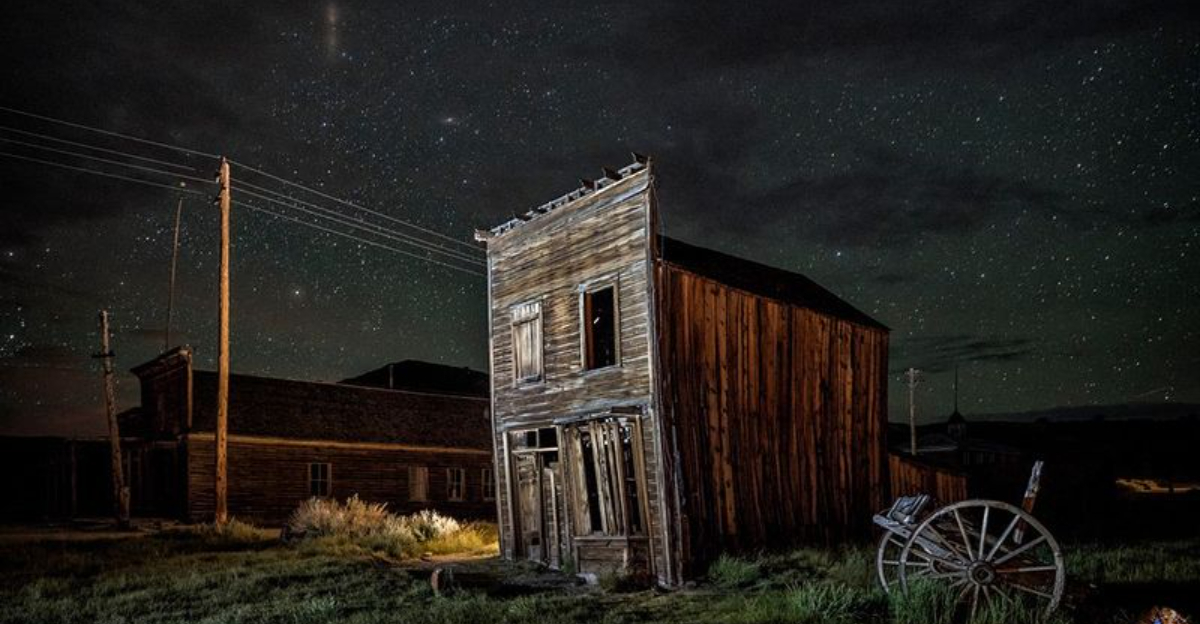
The Swasey Hotel stands in Bodie, California, a nationally recognized Gold Rush ghost town preserved in a state of arrested decay. Bodie is located in Mono County near the Nevada border and is managed as Bodie State Historic Park.
The Swasey Hotel is no longer an operating hotel but remains a preserved structure that contributes to the town’s authentic nineteenth-century streetscape. Its weathered appearance reflects both its age and the park’s preservation policy, which stabilizes buildings without modern restoration.
Visitors can view the hotel’s exterior from designated walking paths, as entry into unstable structures is prohibited for safety. The building’s presence helps illustrate the history of miners, families, and merchants who once populated Bodie at its economic height.
The structure stands today as a tangible reminder of the rapid rise and decline of mining communities in the American West. Rather than myth or legend, its significance lies in its documented connection to California’s mining history.
Construction After the 1892 Fire and Ownership by Horace F. Swasey
The structure known as the Swasey Hotel was built in 1894 during a period of reconstruction following Bodie’s destructive 1892 fire. The fire had devastated much of Bodie’s business district, prompting new construction efforts even as the town’s population was decreasing.
The building later became associated with Horace F. Swasey, a rancher and businessman whose ownership gave the structure its present name. Historical documentation indicates that like many Bodie buildings, it likely served multiple functions, combining lodging with other commercial uses.
Its simple wooden architecture reflected the practical frontier style common in remote mining towns. The building was constructed to endure Bodie’s harsh climate, which included strong winds and heavy winter snowfall.
Surviving photographs confirm the building’s straightforward façade and utilitarian layout. Its history is verified through archival images and official state park records rather than anecdotal or fictional accounts.
Bodie’s Decline and the Hotel’s Place in a Fading Community
By the time the Swasey Hotel appeared in 1894, Bodie was well past its peak population and entering sustained decline. Mining output had fallen significantly from earlier decades, causing many residents to leave the area.
The businesses that remained, including establishments like the Swasey building, adapted to serve a smaller and more transient population. The hotel’s role within Bodie was functional rather than glamorous, offering basic services to workers, travelers, and merchants who stayed in the region.
As Bodie’s population continued to shrink, many buildings were abandoned, but the Swasey structure persisted due to its sturdy construction. Economic downturns and additional fires further reduced the town, leaving only a fraction of its former structures by the mid-twentieth century.
When the state of California assumed stewardship, the building became part of a protected historic district. Today it helps illustrate what everyday life looked like in a mining town on the decline.
Present-Day Status and Historical Importance
The Swasey Hotel is now preserved as part of Bodie State Historic Park, which maintains buildings in their existing weathered state. The structure is stabilized as needed but not reconstructed or renovated, preserving its authenticity and historical character.
Visitors observe the building from the exterior, where its architectural form remains largely intact. This preservation approach helps illustrate the realities of how the building looked during Bodie’s decline rather than presenting a restored interpretation.
Photographers and historians frequently document the Swasey Hotel due to its recognizable appearance and well-recorded history. The building serves as a valuable educational tool for understanding Gold Rush–era architecture and community life.
Its survival offers context about Bodie’s transition from a thriving mining center to a deserted settlement. Through verifiable records and preservation efforts, the Swasey Hotel remains an authentic artifact of California’s mining past.
Original Architecture Preserved
The Swasey building’s architecture reflects the practical construction techniques common in late-nineteenth-century mining towns. Wooden framing and simple siding were used because materials had to be transported long distances or sourced locally under difficult conditions.
Decorative elements were minimal, as Bodie’s builders prioritized speed, functionality, and durability over aesthetic expression. The building’s rectangular shape and straightforward façade aligned with the commercial layout of Main Street during its post-fire reconstruction period.
Photographic evidence shows the structure possessed the plain architectural features typical in Bodie’s surviving buildings. Harsh winters, high winds, and fluctuating temperatures shaped how buildings were engineered in this remote location. Today, the structure’s appearance reflects decades of exposure to these environmental conditions.
Its architectural integrity is preserved not through restoration but through careful stabilization intended to halt further deterioration.
Preservation in a State of Arrested Decay
Bodie State Historic Park maintains the Swasey Hotel under the principle of “arrested decay,” which aims to stabilize structures without altering their historic appearance. This method ensures that visitors see Bodie as closely as possible to how it appeared when abandoned.
The park adds support beams, repairs roofs selectively, and treats wood for pests, but it avoids reconstructing missing parts or modernizing features. This approach preserves the authenticity of the building rather than creating a partially fictional restoration.
The Swasey building benefits from these interventions, which prevent collapse while retaining its historically accurate condition. Preservation staff document all maintenance activities to ensure consistency with state guidelines. The goal is to protect the structure’s educational value without misleading visitors about its historical state.
The result is an environment where history is visible in its true, weathered form rather than reimagined or embellished.
The Swasey Building in Historical Documentation
The history of the Swasey building is supported by archival photographs, state park records, and documented accounts from Bodie’s final decades of occupation. These sources provide verifiable evidence of the building’s construction date, ownership, and appearance throughout the early twentieth century.
Photographs taken in the 1930s and 1940s confirm the building’s consistent external form, despite ongoing decay. Historical surveys performed by preservation specialists identify the structure as an important surviving example of Bodie’s post-1892 commercial district. Rather than relying on folklore or anecdotal storytelling, documentation focuses on practical uses and architectural features.
Records emphasize its context within Bodie’s declining economy rather than suggesting a central social or political role. The building’s importance today arises from its survival rather than from any extraordinary historical events.
Its documentation anchors its significance firmly in recorded fact rather than imaginative narrative.
Significance Within Bodie’s Cultural Landscape
The Swasey Hotel contributes meaningfully to the overall cultural landscape of Bodie, which is recognized as one of the most complete ghost towns in the American West. Its presence helps define the visual character of the remaining commercial corridor.
Because Bodie is preserved as a historic site rather than a themed attraction, buildings like the Swasey maintain a sense of authenticity that cannot be replicated artificially. The hotel provides context for understanding how Bodie looked during its later years, when population loss left many structures partially abandoned yet still standing.
This authenticity is part of what draws historians, photographers, and researchers to the site. The Swasey building stands among about one hundred surviving structures, making it a significant piece of a much larger historical environment. It contributes to the town’s designation as a State Historic Park and a National Historic Landmark.
Its continued preservation helps communicate the story of a real mining community rather than a reconstructed or exaggerated version of history.
Eerie Atmosphere
The Swasey Hotel in Bodie possesses an atmosphere that many visitors describe as naturally eerie, created not by supernatural events but by the stark conditions of the ghost town itself.
The building stands in near-total silence interrupted only by strong, unpredictable winds that cause its aging wooden walls to creak and shift. Its darkened windows and partially collapsing interior contribute to a sense of abandonment that feels frozen in time.
The harsh climate and remote location amplify the isolation, making the structure seem caught between endurance and decay. This effect is strengthened by Bodie’s preserved state of arrested decline, where dust-covered rooms and long-unused objects remain undisturbed for decades.
Visitors often report a feeling of being watched, a sensation attributed to the building’s emptiness and the psychological effect of its forgotten spaces. The surrounding ghost town, with its numerous untouched structures, heightens the atmosphere and frames the Swasey building within a landscape of desolation.
Though entirely natural in origin, these elements combine to give the hotel an unsettling, haunting presence without relying on unverified tales or paranormal claims.
Dear Reader: This page may contain affiliate links which may earn a commission if you click through and make a purchase. Our independent journalism is not influenced by any advertiser or commercial initiative unless it is clearly marked as sponsored content. As travel products change, please be sure to reconfirm all details and stay up to date with current events to ensure a safe and successful trip.
