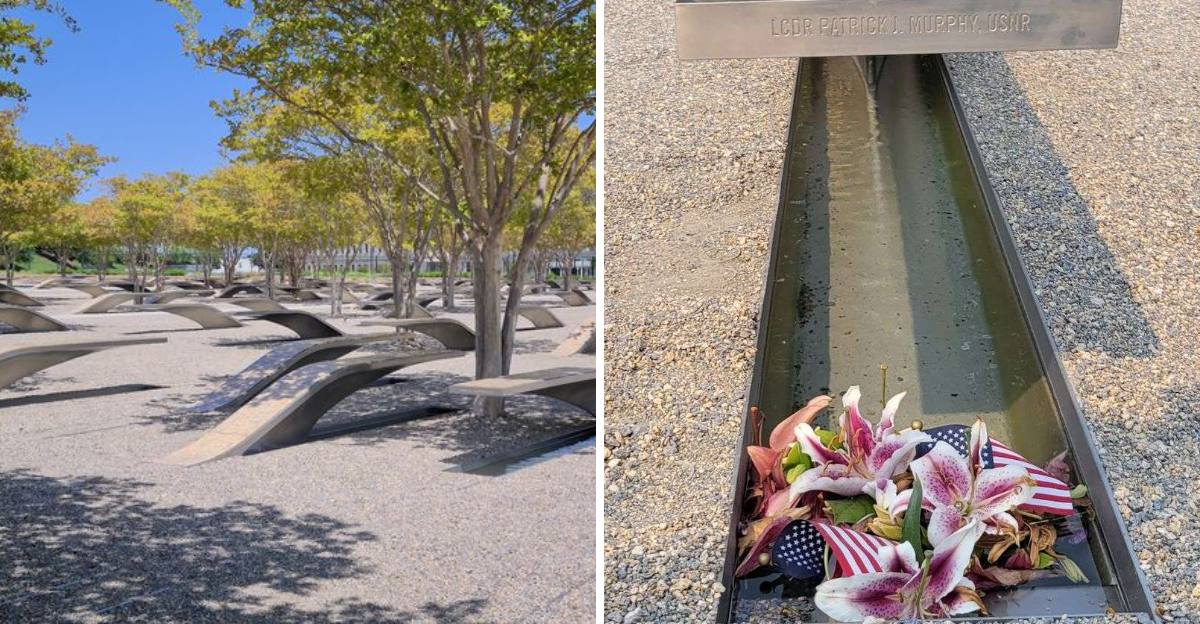
The moment you enter, everything slows to a near standstill. Just outside one of the most secure buildings in the world in Virginia, an understated outdoor space holds 184 illuminated benches, each engraved with a name, a birth year, and a life that ended too soon.
Water moves quietly through the design, adding to the sense of reflection that settles over the entire area. Nothing here demands attention, yet everything feels deeply personal.
It is a place built on remembrance rather than spectacle. Virginia offers many powerful landmarks, but few create this level of quiet impact, where every detail invites you to pause and truly take it in.
The Design That Turns Grief Into Geometry
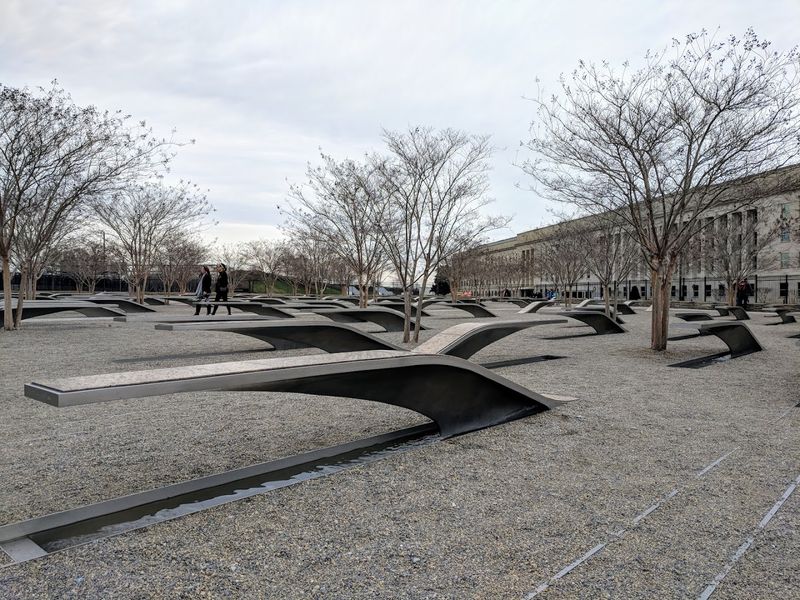
Architects Julie Beckman and Keith Kaseman faced an almost impossible task: how do you translate unimaginable loss into something people can walk through and actually feel? Their answer was geometry with a soul.
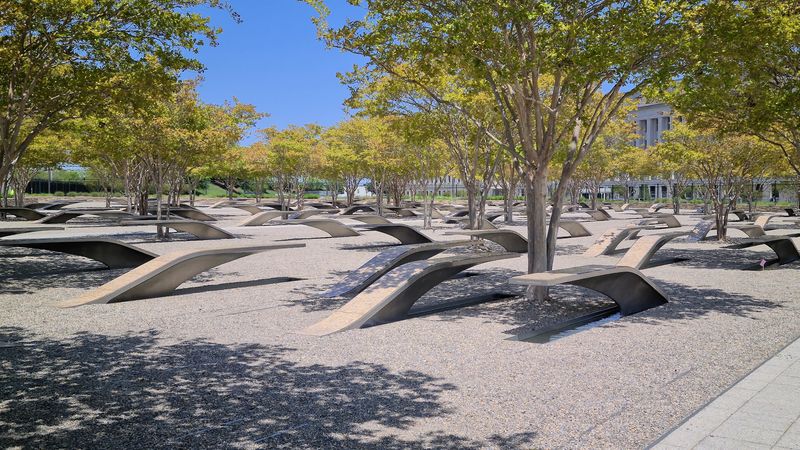
The memorial’s layout follows a strict age-line system, where each row of benches corresponds to a birth year, running from the youngest victim to the oldest.
Walking the grounds of the Pentagon 9/11 Memorial, Arlington, you move through time itself. Start at one end and you are standing among the oldest victims.
Drift toward the other end and the benches thin out into something almost unbearable. The youngest person honored here was just three years old.
Nothing about the design feels accidental. Every angle, every sightline, every placement was deliberate.
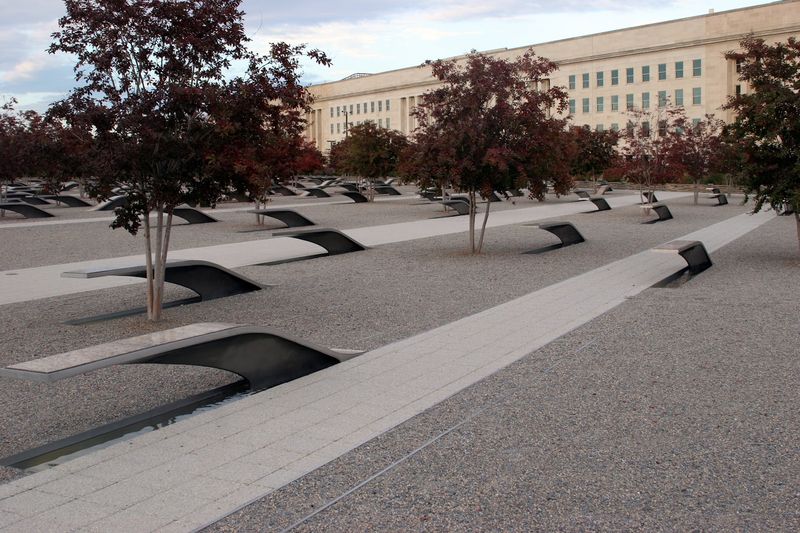
The memorial sits southwest of the Pentagon, and the benches are oriented so that those who were on the plane face one direction, while those inside the building face another. Virginia has seen bold architecture before, but this quiet precision cuts deeper than marble ever could.
184 Benches, 184 Stories Worth Knowing
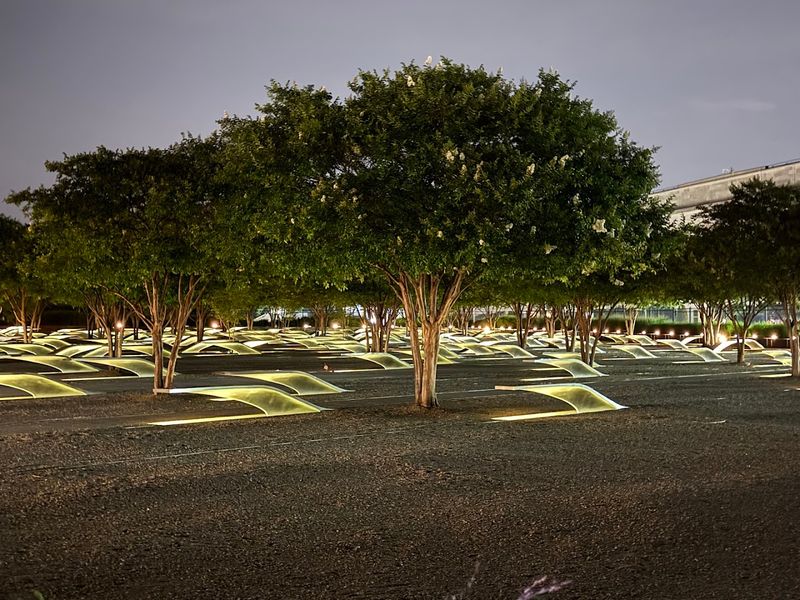
Each bench at the Pentagon 9/11 Memorial, Arlington is more than a seat. It is a monument to one specific person, engraved with their name and lit from within by a pool of gently flowing water underneath.
The effect at night is nothing short of breathtaking. Names glow softly against the dark, and the water catches the light in a way that feels alive.
Some benches carry small tokens left by family members. A coin balanced on the edge.
A folded note tucked beside an engraving. A sprig of flowers that someone carried a long way to leave behind.
These small gestures make the memorial feel actively loved, not just maintained.
Walking among all 184 benches takes time, and that is exactly the point. You are not meant to rush.
The memorial rewards slowness, curiosity, and the willingness to stop at a name you do not recognize and wonder about the life behind it. Virginia holds many monuments to history, but this one insists on the personal.
Every single bench is someone’s whole world.
The Youngest Victim and Why Her Bench Hits Hardest
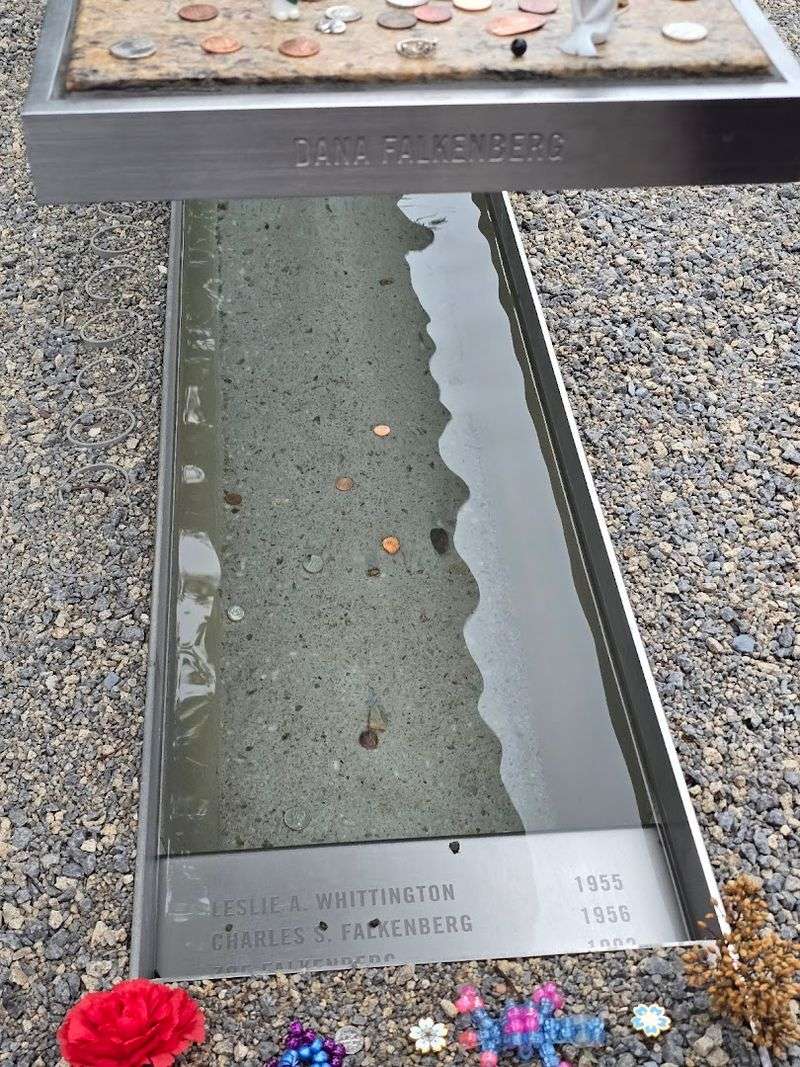
Dana Falkenberg was three years old on September 11, 2001. She was aboard American Airlines Flight 77 with her parents and older sister, all of whom also perished.
Her bench sits at one end of the memorial’s age-line arrangement, and many people who visit the Pentagon 9/11 Memorial, Arlington find themselves pausing longest right there.
There is something about a child’s bench that recalibrates everything. Adults processing grief, parents holding their own children’s hands, strangers who came just to pay respects, all tend to go quiet when they reach that end of the memorial.
The water beneath the bench moves the same as all the others, but somehow it feels heavier.
The memorial does not editorialize. It does not tell you how to feel or what to think.
It simply presents the facts of each life, name and birth year, and trusts you to bring the rest. But standing at Dana’s bench, the facts alone are enough to crack something open.
Virginia has many solemn places, but few demand this kind of reckoning so gently and so completely.
What the Flowing Water Beneath Each Bench Actually Means
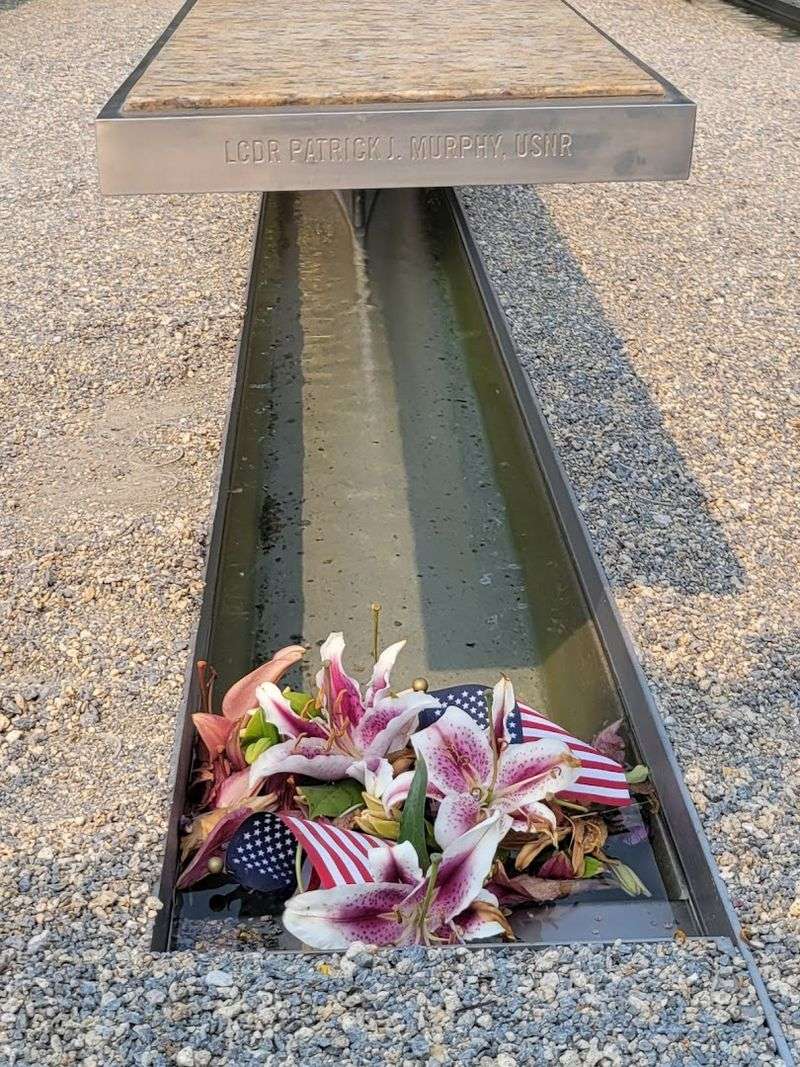
At first glance, the water features beneath each bench look like a simple design choice. Look closer and you realize they are doing a lot of emotional heavy lifting.
Each bench sits above a small pool of flowing water that is lit from below, giving off a gentle, steady glow. The sound of moving water fills the entire space without ever becoming loud.
The flowing water serves as a constant reminder that life, even when cut short, was in motion. It was going somewhere.
The design resists the idea of stillness as a metaphor for death and replaces it with something more honest: lives that were actively being lived when they were taken.
At the Pentagon 9/11 Memorial, Arlington, the water also creates a practical effect. It softens the ambient noise of the surrounding area, including the nearby highway, and wraps the space in a kind of acoustic intimacy.
You feel separated from the outside world even though you are technically in the open air. That sense of being held inside a quiet bubble is one of the most powerful things the memorial achieves without saying a single word.
Visiting at Night Changes Everything
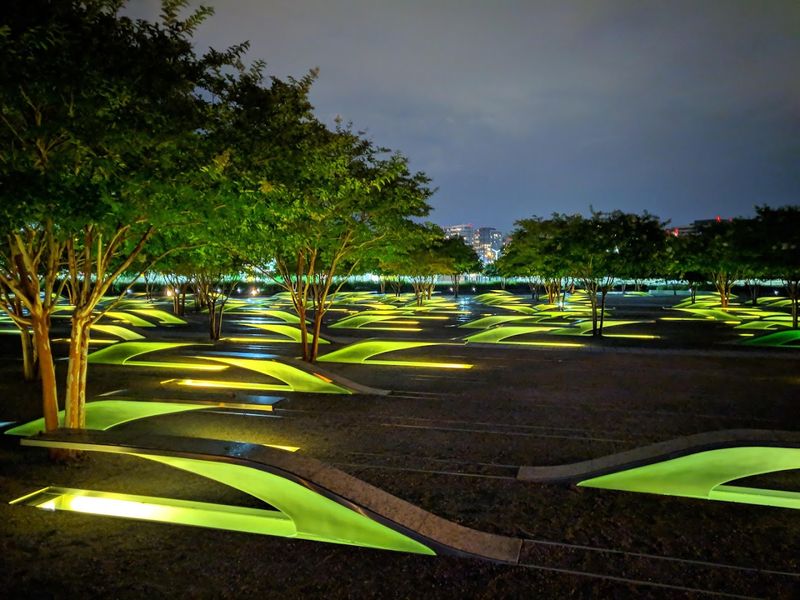
The memorial looks completely different after dark, and that is not a small thing. When the sun goes down over Arlington and the surrounding noise softens, the Pentagon 9/11 Memorial transforms into something almost otherworldly.
All 184 benches glow from within, their light reflecting off the water beneath them and casting a warm, steady radiance across the granite paths.
Open around the clock every day of the year, the memorial welcomes night visitors with no fanfare and no gates. You simply walk in.
The darkness strips away distraction and forces a kind of focus that daytime visits sometimes lack. Names that might blend into the landscape during a busy afternoon visit become sharp and individual at night.
My own evening visit to the Pentagon 9/11 Memorial, Arlington left me genuinely speechless. The rows of glowing benches stretched out in the darkness like a constellation that had landed on the ground.
Virginia evenings can be warm and humid or crisp and cold depending on the season, but the memorial holds its emotional charge regardless of the weather. If you can manage only one visit, make it after sunset.
How the Audio Tour Brings the Memorial to Life
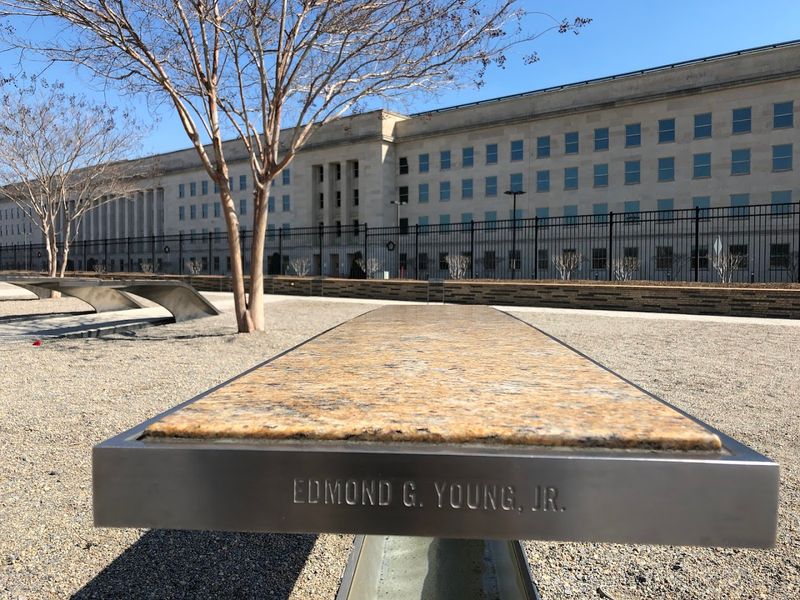
A twenty-four-minute audio tour is available to anyone visiting the Pentagon 9/11 Memorial, Arlington, and it genuinely changes the experience. Accessible by calling a dedicated number at the memorial entrance or streaming it online before you arrive, the tour walks you through the events of September 11 at the Pentagon, the history of the building itself, and the thinking behind every design choice in the memorial.
Knowing the story behind the bench orientation, the age-line layout, and the water features before you walk among them gives the whole space a different texture. Details that might seem subtle suddenly become impossible to miss.
The audio format also means you can move at your own pace, pausing whenever something needs a moment to sink in.
For families bringing children, the audio tour offers a structured way to introduce a difficult subject with context and care. For adults who remember that day clearly, it provides a framework that turns personal memory into shared history.
Virginia has no shortage of historical sites with guided experiences, but few audio tours carry this kind of quiet authority. The information is straightforward, the tone is respectful, and the effect is lasting.
The Trees That Grow Between the Benches
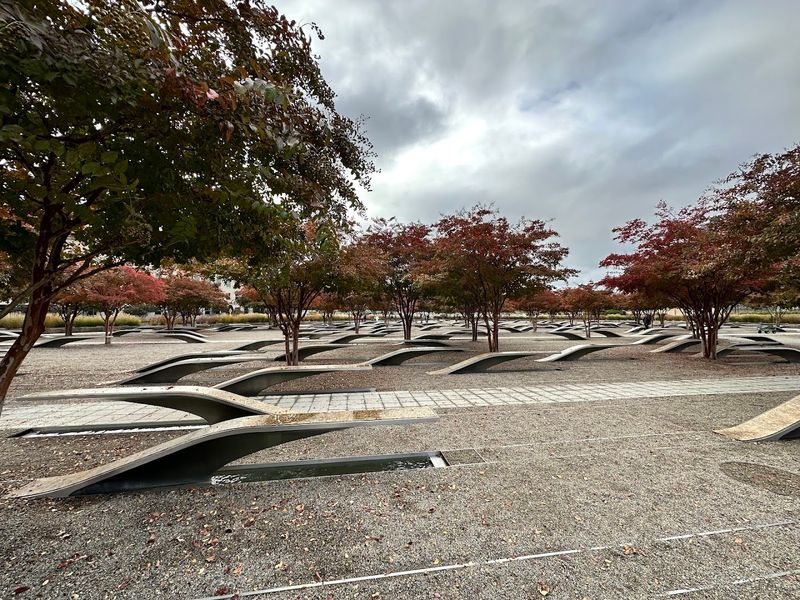
One of the first things you notice walking into the memorial grounds is the trees. They are crape myrtles, and they are planted deliberately among the benches in a way that feels both wild and considered.
Their trunks twist slightly, their canopies spread just enough to create pockets of shade, and their presence gives the memorial a living quality that pure stone and metal cannot provide.
The trees were selected partly for their seasonal behavior. They bloom, they shed, they change with the months.
That cycle of growth and dormancy adds a layer of meaning to a space that could otherwise feel frozen in a single moment of tragedy. At the Pentagon 9/11 Memorial, Arlington, time is always moving forward, even when memory pulls backward.
In autumn, the crape myrtles turn and drop their leaves across the granite paths, creating a natural carpet that feels almost ceremonial. Spring brings blossoms that soften the harder lines of the memorial’s structure.
Longtime Virginia residents who visit regularly note how the space feels genuinely different with each season, which is exactly the kind of living memorial the designers were reaching for when they planted every single one.
Getting There Without a Car Is Easier Than You Think
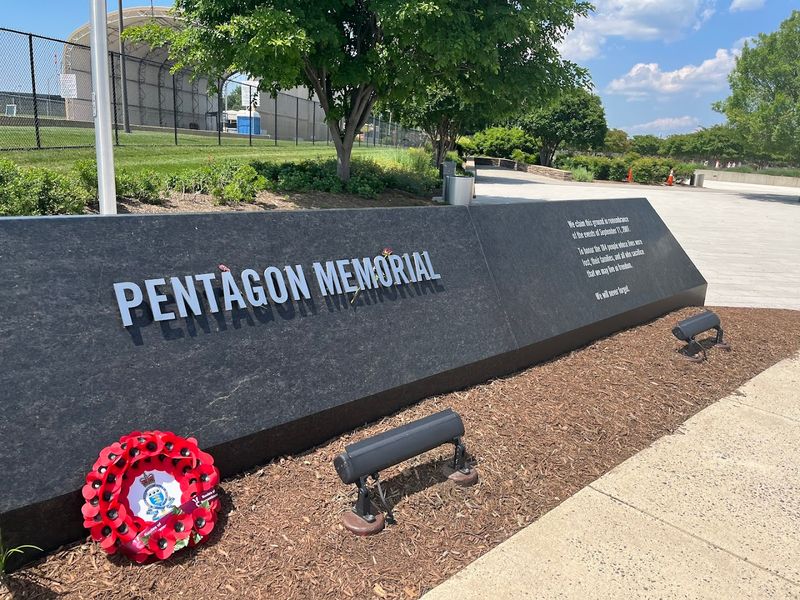
Public transit access to the Pentagon 9/11 Memorial, Arlington is genuinely straightforward, which matters because parking near the Pentagon is notoriously limited and the security presence in the area is serious. The Pentagon Metro station and the Pentagon City Metro station both put you within comfortable walking distance of the memorial entrance.
The walk itself is part of the experience. Approaching from the Metro, you pass alongside the sheer scale of the Pentagon building, which adds a layer of context that arriving by car simply does not provide.
The building is enormous in a way that photographs do not fully communicate, and understanding its size helps you grasp the full weight of what happened there.
A note worth keeping in mind: the surrounding area is an active military installation, and security personnel are present and attentive. Photography should stay focused on the memorial itself rather than the building or its immediate surroundings.
Virginia is full of places where history and daily life overlap, but few intersections feel quite as charged as this one. Plan your route ahead, check current construction detours on the official website, and give yourself more time than you think you need.
The Visitor Education Center Coming in 2028
The memorial as it stands today is powerful on its own terms, but something significant is coming. The Pentagon Memorial Fund is working toward completing a Visitor Education Center adjacent to the existing grounds, with a target completion around 2028.
The center is designed to expand the memorial’s reach without altering its current atmosphere.
Plans for the center include historic artifacts from the day of the attack, personal narratives from survivors and family members, and interactive displays that contextualize September 11 within broader American history. The goal is to serve future generations who did not experience that day firsthand and who need more than benches and water features to fully grasp what happened.
The Pentagon 9/11 Memorial, Arlington has always been a place of quiet reflection, and the Visitor Education Center is intended to complement that quality rather than overwhelm it. Virginia has a long tradition of building educational spaces alongside its memorials, from Civil War battlefields to presidential libraries, and this addition follows that same instinct.
For anyone planning a visit in the next few years, it is worth watching the official memorial website for updates on construction progress and opening timelines.
Why This Memorial Belongs on Every Virginia Itinerary
Arlington, Virginia is already packed with reasons to visit. The National Cemetery, the Marine Corps War Memorial, the views back across the Potomac toward Washington, all of it adds up to one of the most historically dense corners of the country.
The Pentagon 9/11 Memorial fits into that landscape not as an add-on but as an anchor.
What sets it apart from other memorials in the region is its insistence on the individual. Most large-scale memorials deal in collective grief, honoring a group, a cause, or an era.
This one refuses that abstraction. Every bench is one person.
Every name is someone’s child, parent, colleague, or friend. That specificity is what makes the Pentagon 9/11 Memorial, Arlington so unusually affecting.
My strongest recommendation is to visit with time to spare and no agenda beyond being present. Walk every row.
Read every name. Let the water do its quiet work.
The memorial is located at 1 North Rotary Road, Arlington, VA 22202, open every hour of every day at no cost. Virginia has given the country many monuments worth seeing, but few ask this much of you, or give this much back.
Pack your bags and go.
