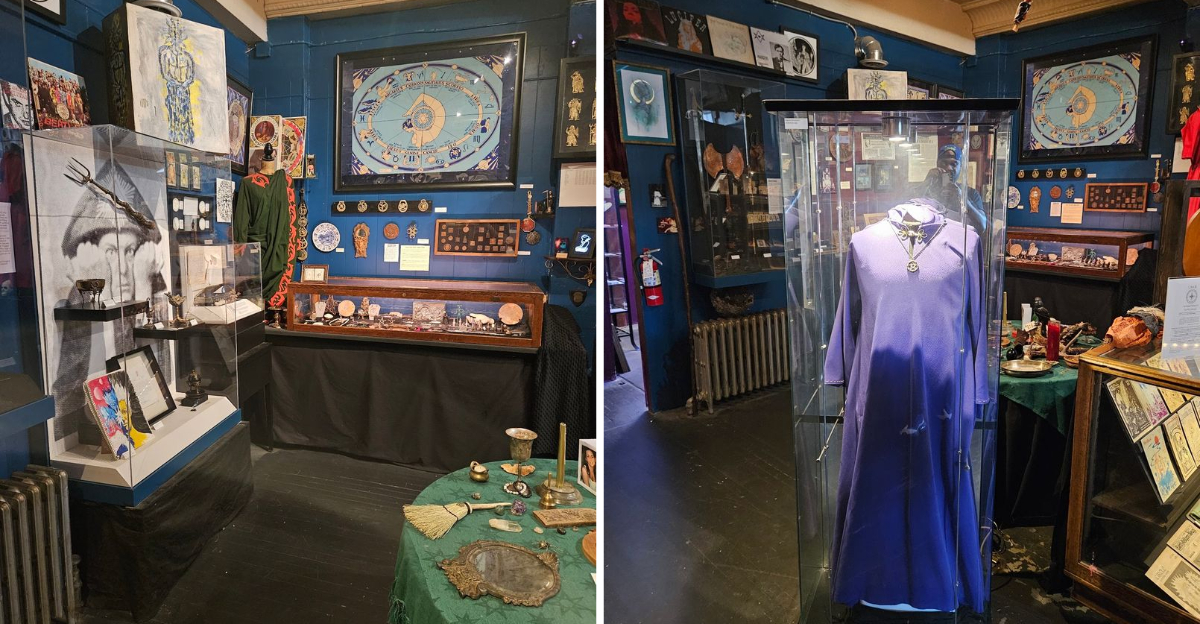
That dim little room on a city street held a box that supposedly traps a demon inside, and I stood there staring at it longer than I expected. I had come to Ohio expecting lake views and a rock hall ticket, and instead I found a museum of witchcraft and magick tucked behind a storefront you could drive past twice.
Inside, incense hangs in the air and more than 200 artifacts crowd the walls, the cabinets, and just about every inch of shelf space. The collection started as one man’s personal obsession back in 1966, built by a British occultist who moved to the States and kept gathering objects until he ran out of room.
I walked in curious and walked out with a notebook full of scribbles and a strange urge to learn more about mandrake roots. The museum holds a library of rare occult books, a replica of a Victorian séance room, and artifacts from around the world, each one with a story that feels like it is still unfolding.
Museums that are small, strange, and packed with stories deserve a spot on your list, and this one certainly earns it.
Raymond Buckland’s Collection and How It Landed in Cleveland
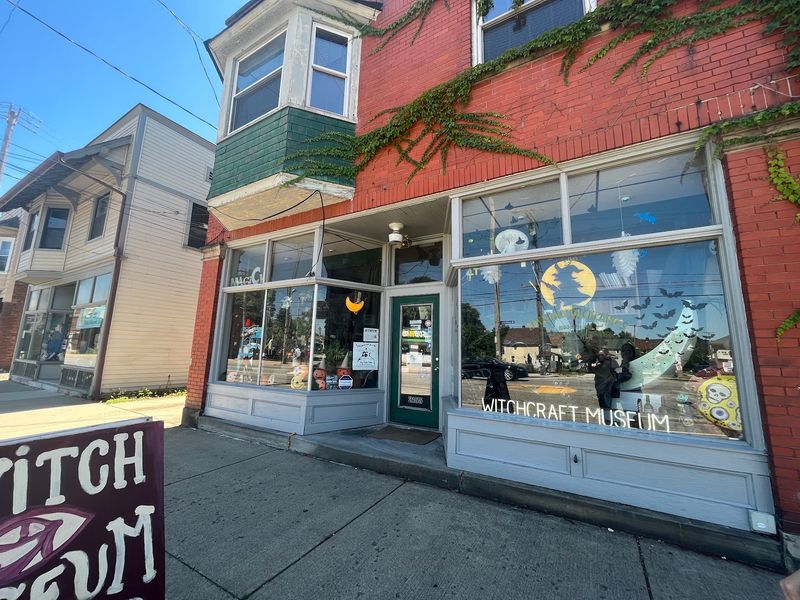
The whole thing traces back to one person, an English writer named Raymond Buckland, who is widely credited with bringing Gardnerian Wicca to the United States. After visiting Gerald Gardner’s collection on the Isle of Man, he decided he wanted one of his own.
He opened it in 1966 in the basement of his Long Island home, appointment only. The collection kept growing, so it moved to a bigger 19th-century house in Bay Shore.
From there it traveled quite a bit. New Hampshire held it from 1973 to 1976, then Virginia took over from 1977 to 1979.
Eventually Buckland got busy writing and lecturing, and the artifacts went into storage. A brief revival happened in New Orleans in 1999, and the collection passed through several caretakers before Rev.
Velvet Reith curated it.
In 2015 the artifacts went to the Ohio’s Temple of Sacrifice, a Columbus coven Buckland co-founded. Steven Intermill brought everything to Cleveland in 2016.
Toni Rotonda, High Priestess of the Temple of Sacrifice, owns the artifacts now. Intermill serves as chief curator, and he has said he’d love it to become the Vatican museum of the occult someday.
The Demon in a Box That Nobody Wants to Open
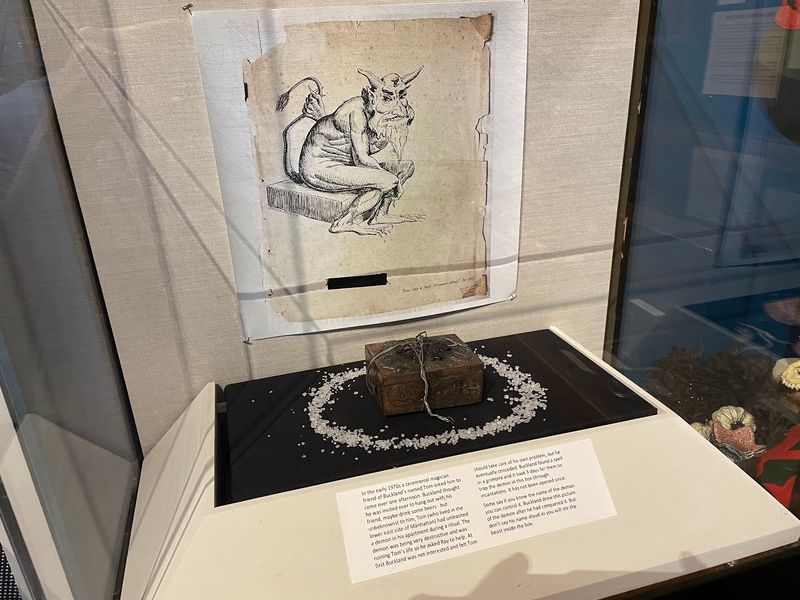
Of everything crammed into that room, the one display that made me pause the longest was a small ornate box tied shut with twine. A ring of salt crystals circles it.
Above it hangs an illustration Buckland himself drew of a demon called Belphegor.
The story goes that Buckland and a friend trapped the thing back in 1970. It has stayed sealed ever since, which honestly seems like the right call.
I stood there trying to decide whether I believed any of it. That’s sort of the fun of the place though.
You don’t have to believe to find it fascinating.
What struck me was how ordinary the box looks. No glowing runes, no dramatic lighting, just a little decorated container that would blend into any antique shop shelf.
The curator will happily walk you through the details if you ask, and the storytelling is a big part of why people rate this museum so highly. Guides here know the history behind nearly every object.
Photos without flash are allowed, so yes, you can absolutely take a picture of the demon box. Video recording is not permitted.
Scrying Mirrors, Crystal Balls, and the Art of Seeing Ahead
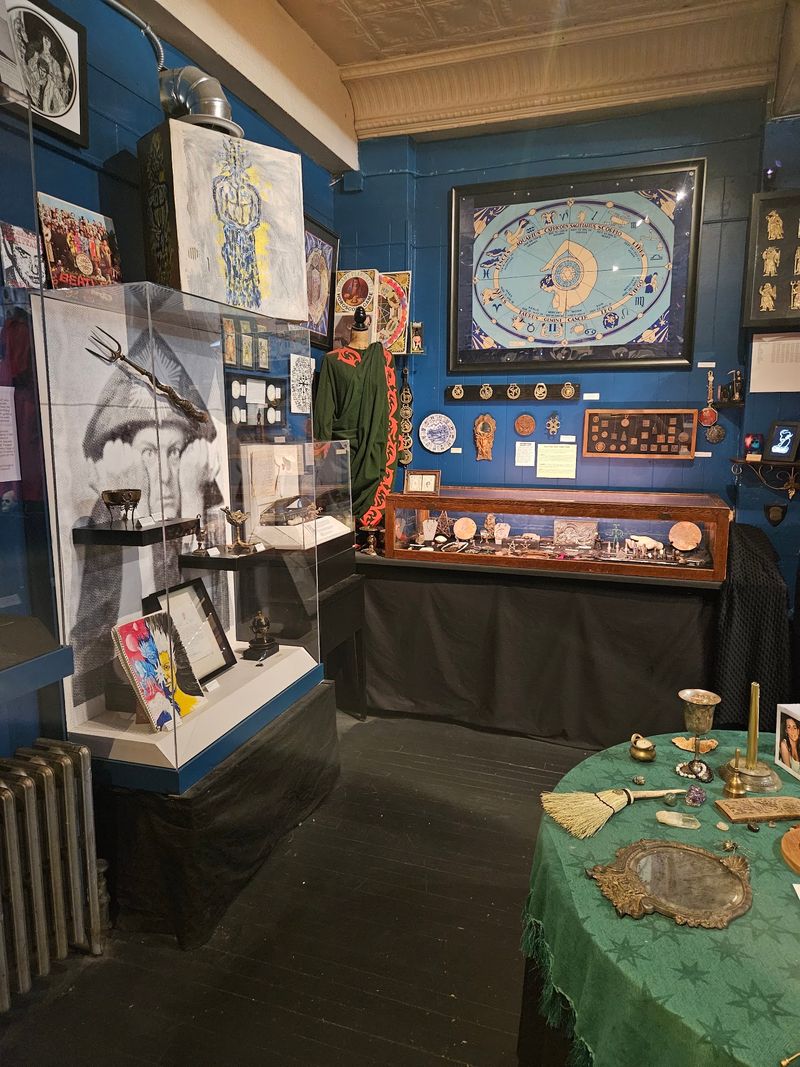
Divination gets a whole corner of attention here, and it’s easily one of the most visually striking parts of the room. Dark scrying mirrors sit near crystal balls and cabinets stuffed with tarot decks.
People have used these tools for centuries to look for answers, guidance, or a nudge toward a decision. Seeing them lined up in one place gives you a sense of just how long humans have been trying to peek around the corner of the future.
The tarot collection surprised me most. Decks from different eras and styles fill a curio cabinet, and the artwork alone is worth studying.
Some visitors report feeling a little lightheaded near certain cases, which the staff take in good humor rather than hyping it up. I felt fine, though the incense and the low light do create a certain mood.
A practical tip: give yourself time in this section. It’s easy to breeze past a shelf and miss something genuinely old.
If tarot interests you, the front gift shop carries a big selection of decks. Plenty of people leave with one tucked under an arm.
Ancient Oddities, Ushabtis, a Jenny Haniver, and a Carved Mandrake Root
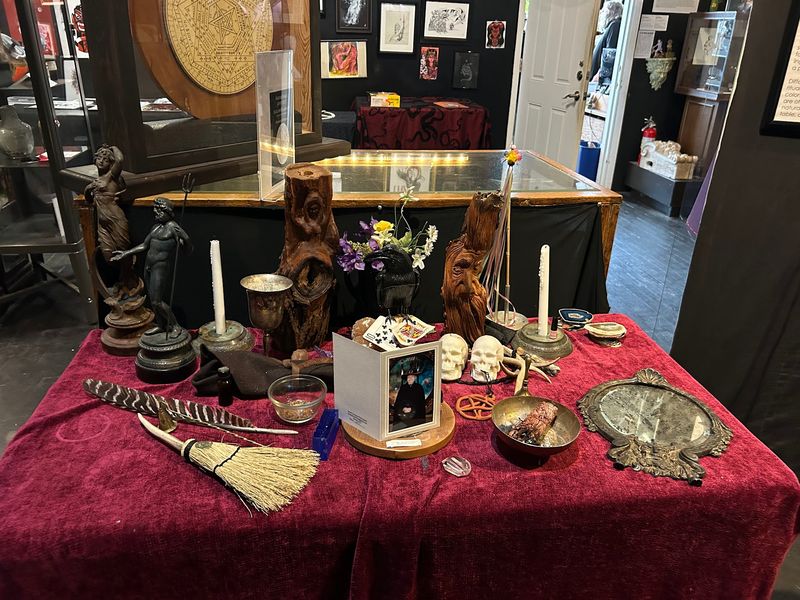
Some pieces in here are genuinely ancient. Egyptian funerary figurines called ushabtis sit in the collection, small carved figures that were buried with the deceased ones to serve them in the afterlife.
Then there’s the Jenny Haniver, which took me a minute to understand. Sailors used to dry out ray carcasses, carve and twist them into little humanoid shapes, and present them as captured demons or sea monsters.
It’s part hoax, part folk art, and completely bizarre to look at up close. I couldn’t stop staring at it.
Nearby sits an Alruan, a carved mandrake root. Mandrake roots naturally grow in shapes that look vaguely human, which is exactly why old European folklore built so many legends around them.
Colonial-era nails pulled from a house connected to the Salem Witch Hysteria also appear in the collection. Small, rusty, and heavy with history.
What I appreciated is how the museum treats these objects as cultural evidence rather than cheap scares. There’s a real educational thread running through the displays.
Ask questions while you’re there. The guides know the backstory on nearly every single item.
Ritual Tools from the Big Names of Modern Witchcraft
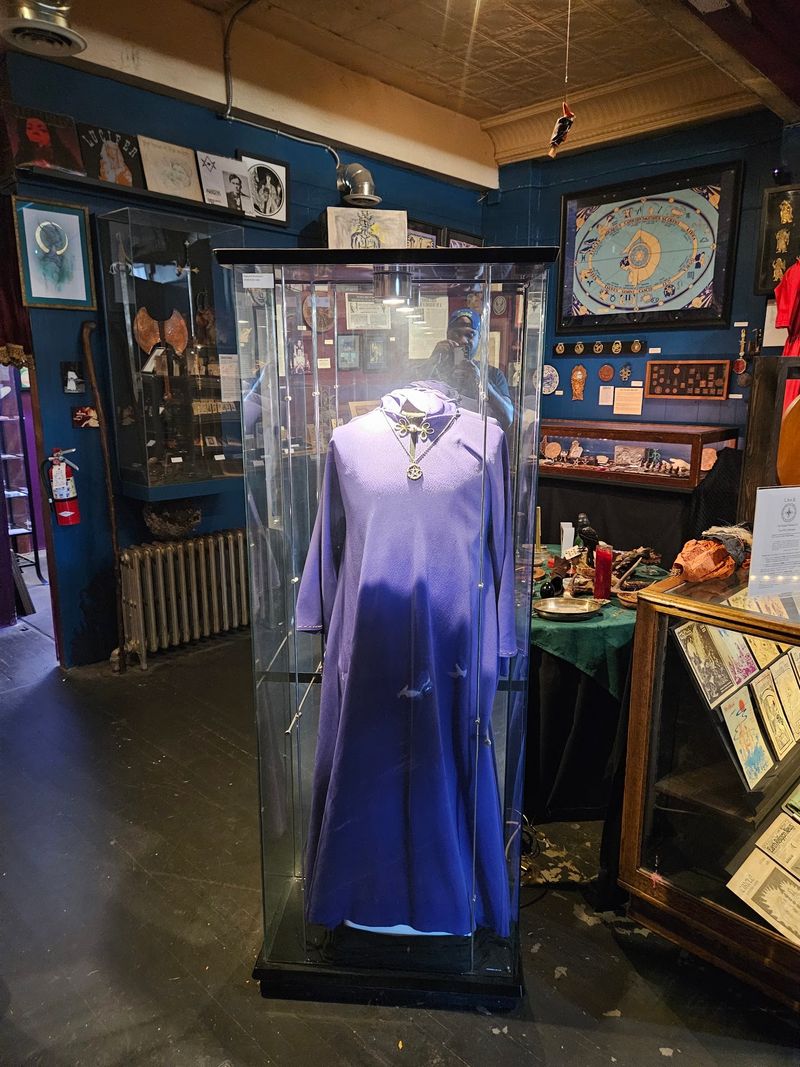
For anyone who has read about modern witchcraft, this section is the payoff. Buckland’s own purple ceremonial robe hangs on display, along with his ritual tools, a horned high priest helmet, and a crescent moon headdress.
Gerald Gardner, often called the father of modern Wicca, is represented too. His horned pipe and his broom are both here.
Aleister Crowley’s trident wand sits in the collection as well, which is the kind of object occult history buffs travel a long way to see. Anton LaVey’s membership card from the Church of Satan is also on display.
Various staffs donated by notable witches round things out. Seeing personal belongings rather than replicas changes how the history feels.
These aren’t props. Real people used them in real practice, and that gives the room a weight you don’t get from reading about it.
The museum’s stated mission covers exhibiting the tools and imagery of witchcraft and magick while celebrating the First Amendment and outsider art. That framing makes a lot of sense once you’re standing in front of these cases.
Take your time here. It rewards slow looking.
Pop Culture, Kitsch, and a Cat from Outer Space
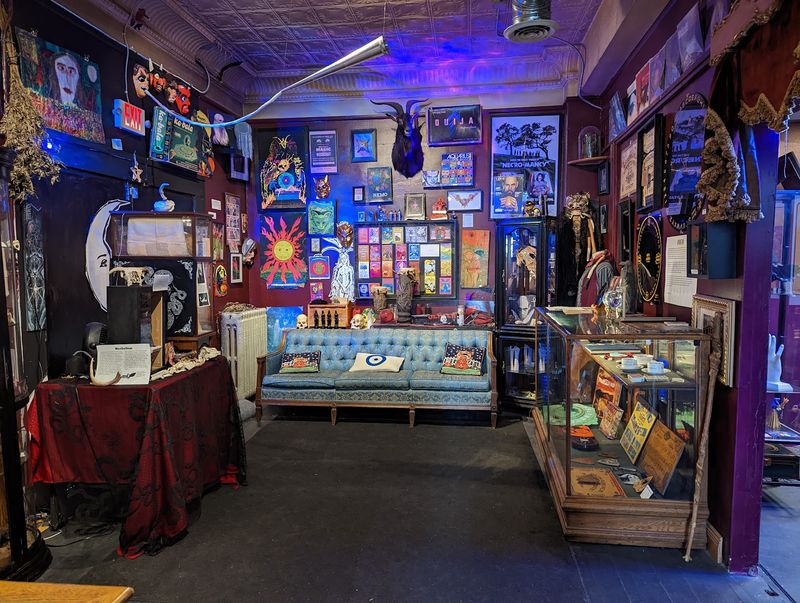
Not everything here is solemn. A big chunk of the collection leans playful, and I genuinely laughed out loud a few times.
There’s a vessel containing the fur of Lil Bub, described in the collection as a magickal cat from outer space. Yes, that Lil Bub, the famous internet cat.
Vintage board games and records that cashed in on 1960s and 70s occult curiosity fill a section too. They’re a snapshot of how mainstream culture handled witchcraft when it was suddenly trendy.
Original handbills from the Fillmore show off psychedelic poster art from that era, and the colors still pop. Buckland handed those over personally when the Cleveland location opened.
Props from the set of the film The Love Witch appear as well, which bridges the old and new nicely. Art from indie comics artists is scattered around too.
One visitor described the place as a perfect mix of culture and kitsch, and that’s about the most accurate summary I’ve heard. The serious history and the silly stuff sit side by side without clashing.
Rotating art exhibits also pop up, so repeat visitors often find something new.
Planning Your Visit to Old Brooklyn
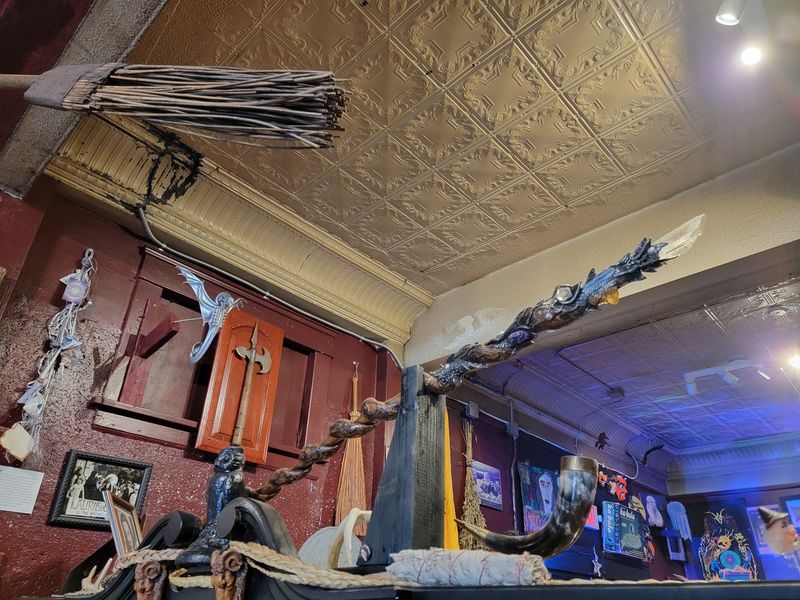
Practical stuff matters with a place this small, so here’s what helped me. The museum occupies essentially one large room packed with over 200 artifacts, and most people spend around 45 minutes inside.
Book tickets online ahead of time. It’s quick, and it saves any awkwardness at the door on a busy afternoon.
Parking works out fine. There’s street parking out front plus a small lot behind the building, reached by a short driveway to the left of the shop.
Hours run from noon most days, closing at 6 PM Monday through Thursday, 7 PM on Friday and Saturday, and 4 PM on Sunday. Worth double checking before you drive over.
A sign at the entrance reads Not for everyone, which is a fair warning that witchcraft carries a complicated history. Personally I found the atmosphere welcoming rather than intimidating.
The gift shop up front stocks books both new and used, crystals, jewelry, posters, candles, and shirts. They buy books too.
Special events and lectures happen regularly, so check the schedule if you want more than a walkthrough.
Address: 2155 Broadview Rd, Cleveland, OH 44109
