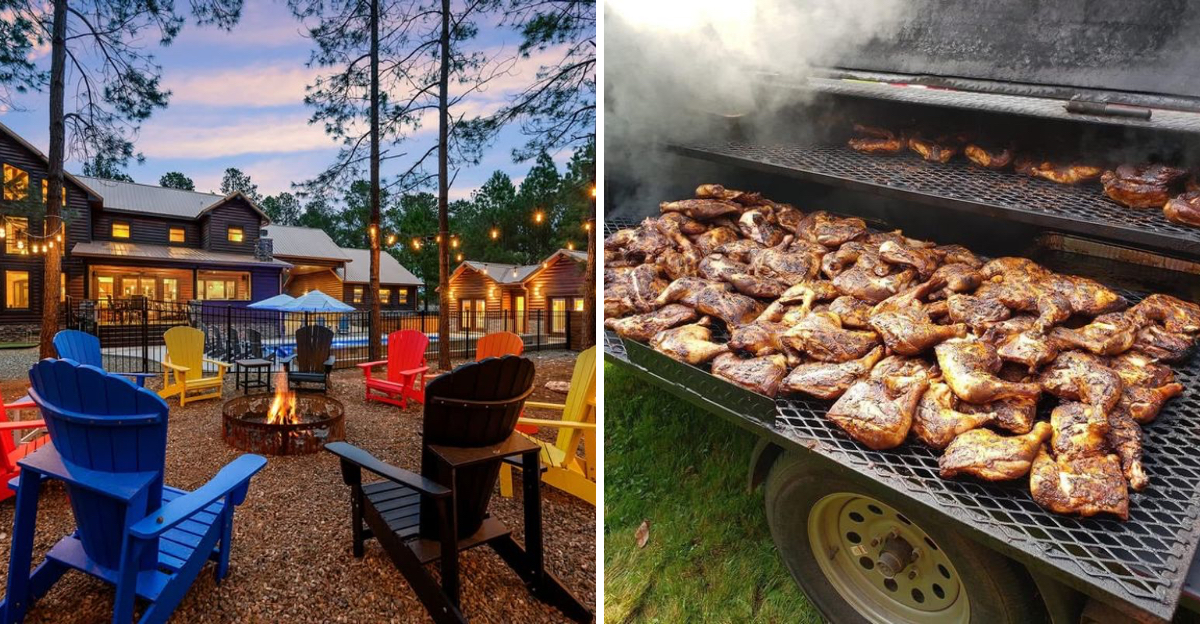
It starts in a gravel lot just outside town. Folding tables.
Pickup trucks backed in at odd angles. The smell of mesquite smoke drifting sideways in the wind.
In Oklahoma, the ritual that feels almost cinematic is the weekend barbecue fundraiser. Someone always stakes a plywood sign near the road.
Black spray paint. Crooked letters.
Maybe an arrow pointing you toward something bigger than just a meal. This is not about fine dining or curated experiences.
This is about neighbors showing up for neighbors, about smoke rising over empty fields, about cash boxes and foil-wrapped plates that somehow fund school trips and medical bills. The whole thing unfolds with the understated grace of a film scene, where every detail matters but nothing feels forced.
You will find this ritual repeating itself across Oklahoma towns and backroads, ordinary and unpolished, yet somehow perfect in its simplicity.
The Hand-Painted Sign on the Highway
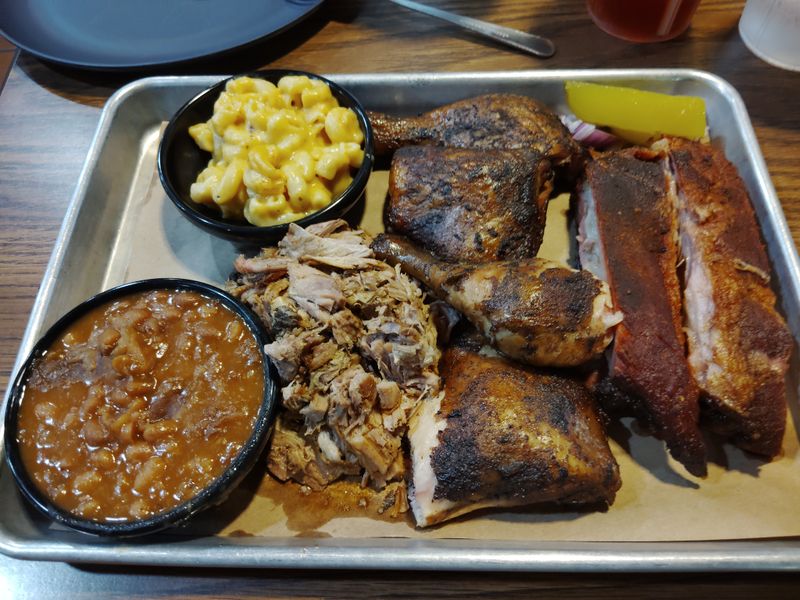
Someone always stakes a plywood sign near the road. Black spray paint.
Crooked letters spelling out something simple like BBQ TODAY.
Maybe an arrow points you in the right direction. Maybe it does not.
There is no branding strategy here, no coordinated marketing push designed by professionals in air-conditioned offices.
Just word of mouth and the understanding that if smoke is rising somewhere nearby, something important is happening. From a distance, the whole setup looks improvised, almost haphazard.
Up close, you realize it is perfectly organized. The sign might lean a little to one side, the paint might have dripped in places, but it serves its purpose with quiet efficiency.
This is how Oklahoma announces its communal gatherings. No billboards.
No digital ads. Just a piece of plywood and the trust that people will notice.
The simplicity feels cinematic, like a prop from a film about small-town life where every object carries weight. You slow down when you see it.
You consider turning around. More often than not, you follow that arrow into something genuine.
Cash boxes. Foil-wrapped plates stacked like silver bricks.
Styrofoam containers piled high enough to block the breeze.
A handwritten price list gets taped down at the corners so it does not blow away. The whole operation runs from folding tables that have seen a hundred events just like this one.
You pay, you nod, you step aside. No one lingers in line because everyone understands the rhythm.
The system is efficient without being rushed, organized without feeling corporate.
The entire economy here runs on familiarity. Everyone knows someone connected to the cause, whether it is a school band trip, a medical bill, or a family that hit hard times.
You do not need a long explanation. The purpose circulates quietly, just like the plates.
Money changes hands with minimal conversation because the transaction is about more than commerce.
In Oklahoma, this folding table setup appears across church parking lots and empty fields, always the same basic structure, always serving the same essential function. It feels like a scene from a film about community, where the props are minimal but the meaning is deep.
You buy extra even if you do not need it.
Smoke Rolling Across an Empty Field
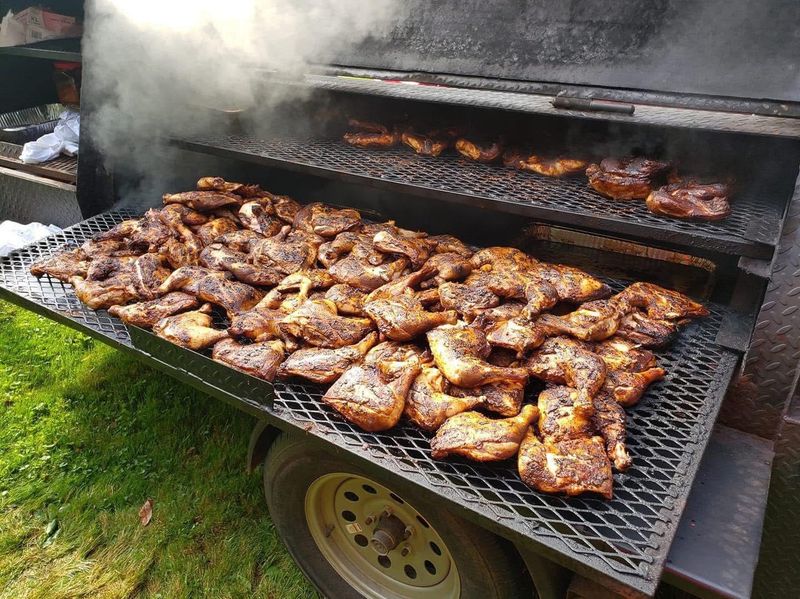
Large smokers sit open like steel vaults, ribs and brisket lined up in quiet rows inside. The smoke drifts across pastureland or over a church parking lot, moving sideways in the Oklahoma wind.
The setting is spare. Wide sky stretching in every direction.
Flat horizon with maybe a tree line in the distance.
A handful of lawn chairs get set up nearby, occupied by people who have been tending these smokers since before dawn. The landscape feels cinematic in its simplicity, like a frame from a film about small-town America.
Understated. Slightly austere.
Entirely sincere. The smoke becomes the main character in this scene, rolling low and thick, carrying the smell of mesquite and oak across the open space.
You can see it from the highway sometimes, that gray-white plume rising against a pale sky, signaling that something communal is happening just off the main road. In Oklahoma, these smokers appear in the most unexpected places, always surrounded by that same spare landscape.
The visual is striking without trying to be. It just is.
And that authenticity makes it feel like something a director would frame carefully, knowing the setting tells half the story before anyone speaks a word.
The fundraiser might be for a school band trip that needs new instruments. Or a medical bill that insurance would not cover.
Or a volunteer fire department that needs equipment.
Maybe it is for a family that hit hard times after a storm or a job loss. No one needs a long explanation because the purpose circulates quietly, passed along through text messages and Sunday morning conversations.
You show up because someone you know is connected to the cause, or because you remember when your family needed help and the community showed up for you. The food is excellent, sure, but that is not really the point.
The point is showing up. The point is buying extra plates even when you do not need them, handing them to someone else or taking them home to freeze for later.
In Oklahoma, these fundraisers happen because formal systems do not always reach far enough or fast enough. So neighbors fill the gaps with folding tables and smokers and cash boxes.
The whole thing feels like a scene from a film about what community actually means, stripped of sentimentality but full of genuine care. You leave with more than just barbecue.
You leave knowing you were part of something that mattered.
Pickup Trucks Backed In at Odd Angles
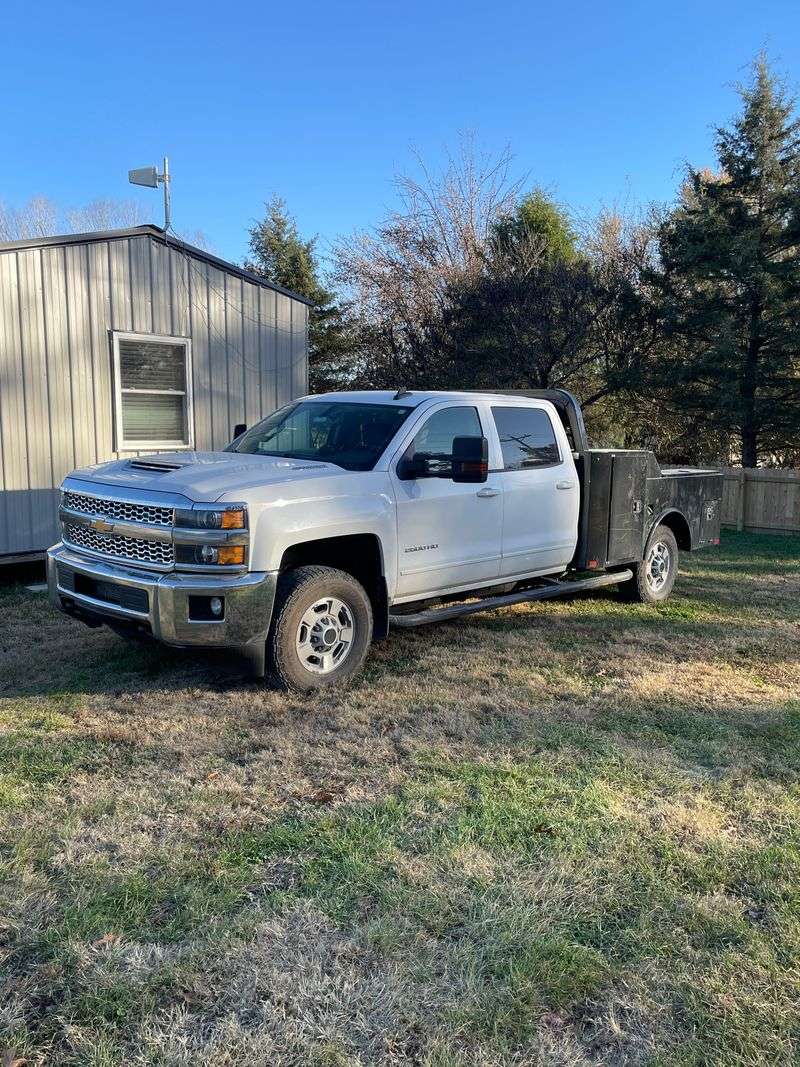
Pickup trucks arrive and back into the gravel lot at angles that make no geometric sense. Tailgates down.
Coolers in the bed. Sometimes a dog waiting patiently in the cab.
There is no parking attendant, no painted lines, no system beyond the unspoken understanding that you leave enough room for the next truck to pull in. The result looks chaotic from above but works perfectly on the ground.
Everyone knows how to navigate this kind of parking. It is a skill learned at county fairs and livestock auctions, at high school football games and farm sales.
The trucks become part of the scenery, as essential to the visual as the smokers and the folding tables. They frame the event, creating boundaries without fences.
In Oklahoma, these informal parking arrangements happen everywhere communal gatherings take place. No one questions it.
No one complains about the lack of organization.
It feels like a scene from a film where the director wanted to show how people create order out of apparent chaos, how community functions without official structure. You pull in, you find a spot, you back up until it feels right.
That is the whole system, and somehow it always works.
By midafternoon, the crowd thins. The smokers cool, their steel surfaces no longer radiating heat into the Oklahoma air.
The cash box is counted on the same folding table where the brisket was sliced hours earlier.
Pickup trucks pull away one by one, kicking up dust as they head back toward town or out toward the county roads. The field empties as quickly as it filled, leaving only a handful of organizers to pack up the remaining supplies.
There is no grand finale. No speeches or acknowledgments over a microphone.
Just a sense that something communal happened without spectacle.
The people who stayed late fold the tables, load the smokers back onto trailers, stuff the trash into black bags. The work gets done with the same quiet efficiency that characterized the whole event.
In Oklahoma, this is how these rituals end. Not with fanfare but with cleanup.
Not with celebration but with satisfaction that the job is done and the money raised will help whoever needs it.
It feels like the final scene of a film, where the camera lingers on an empty space that was full of life just hours before. You drive away knowing you were part of something real, something that will repeat itself next month in another town, another gravel lot, another plume of smoke against the sky.
Mesquite Smoke Drifting Sideways in the Wind
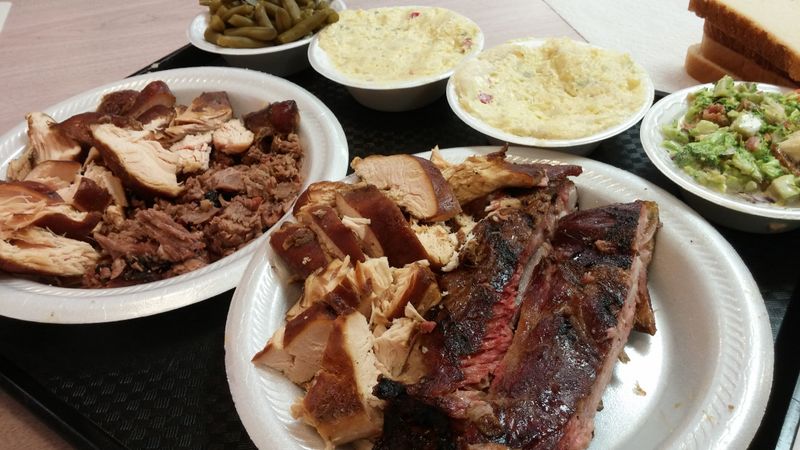
The smell hits you before you see anything else. Mesquite smoke drifting sideways in the Oklahoma wind, carrying across open fields and parking lots, announcing the event from a quarter mile away.
That smoke moves differently here than it would in a forest or a city. It travels horizontally, pushed by wind that has nothing to slow it down across the flat landscape.
You can track it with your eyes, watching it roll and dissipate, reforming and spreading. It becomes a kind of signal, a marker that something worth your time is happening nearby.
The mesquite itself is a deliberate choice. It burns hot and adds a flavor that people here recognize immediately, a taste that means home and tradition and weekend gatherings.
In Oklahoma, that particular smell triggers memories. Football games.
Family reunions. Fundraisers just like this one.
The smoke connects this event to dozens of others, creating a continuity that feels almost ceremonial.
It is the kind of detail a film director would insist on getting right, knowing that the audience would notice if it were missing or wrong. You stand downwind for a moment, letting that smoke wash over you, and you understand immediately what kind of event this is going to be.
Authentic. Unpretentious.
Worth the drive.
The cash box sits on the folding table, usually a small metal container with a simple latch. No credit card reader.
No digital payment system. Just cash and the occasional check from someone who came prepared.
Someone trusted sits behind it, making change from a stack of bills organized by denomination. The math happens quickly, without calculators, just mental arithmetic and the confidence that comes from doing this dozens of times before.
You hand over your money and receive your plate in a transaction that takes maybe fifteen seconds. No receipt.
No email confirmation. Just a nod and a thank you.
The simplicity feels almost radical in an age of digital everything. But here in Oklahoma, at these fundraisers, cash still rules because it is immediate and transparent and requires no technology beyond a box with a lock.
By the end of the day, that box is heavy with bills and coins, the physical weight of community support. Someone will count it carefully, probably twice, and announce the total to the organizers who have been working since dawn.
It feels like a scene from a film set in an earlier era, except it is happening right now, every weekend, across small towns where this system still works perfectly. You trust the cash box because you trust the people behind it.
Lawn Chairs Set Up Nearby
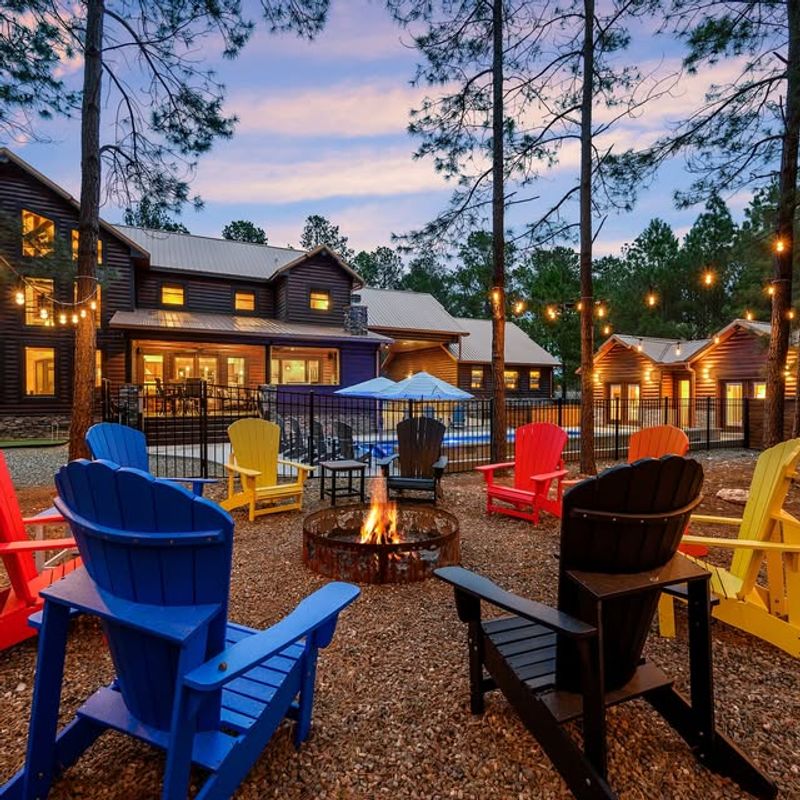
A handful of lawn chairs get set up near the smokers, occupied by the people who have been tending the meat since the middle of the night. They sit in a loose circle, watching the temperature gauges, adjusting vents, talking about nothing in particular.
These are not fancy chairs. They are the kind you buy at a discount store and keep in your garage for exactly this purpose, folding and unfolding them dozens of times until the fabric starts to fray.
The people sitting here are the backbone of the whole operation. They arrived in darkness to start the fires, to load the meat, to begin the slow process that will feed a hundred people or more by midday.
They do not expect recognition. They are here because someone asked and they said yes, or because they have been part of this crew for years and showing up is just what you do.
In Oklahoma, these lawn chair circles appear at every outdoor event that requires patience and time. The chairs become a kind of home base, a place to rest between tasks, to share a thermos of coffee, to watch the sun come up over empty fields.
It feels like a scene from a film about working people, where the camera focuses not on heroes but on the quiet competence of those who make things happen without fanfare.
Foil-wrapped plates stack up like silver bricks on the folding tables, each one containing a full meal that someone will carry home or eat standing up in the parking lot. The aluminum foil catches the light, creating bright spots that shimmer in the Oklahoma sun.
Underneath that foil is brisket or ribs, usually some coleslaw, maybe beans or potato salad, sometimes a slice of white bread that will soak up the juices. The portions are generous because no one wants to be accused of being stingy.
The plates get wrapped with practiced efficiency by volunteers who have done this enough times to know exactly how much foil to tear off, how to fold the corners so nothing leaks. It becomes a kind of assembly line, one person filling plates while another wraps and stacks.
You watch the stack grow throughout the morning, a visible measure of how much work has gone into this event. By noon, there might be fifty plates ready to go, then a hundred, then more as the crowd arrives.
In Oklahoma, these foil-wrapped plates are a kind of currency, traded for cash but worth more in terms of what they represent. Community.
Care. The willingness to spend hours preparing food for people you might not even know.
It feels like a scene from a film about abundance, where the camera lingers on those stacked plates, letting the audience understand the scale of generosity on display.
Wide Sky and Flat Horizon
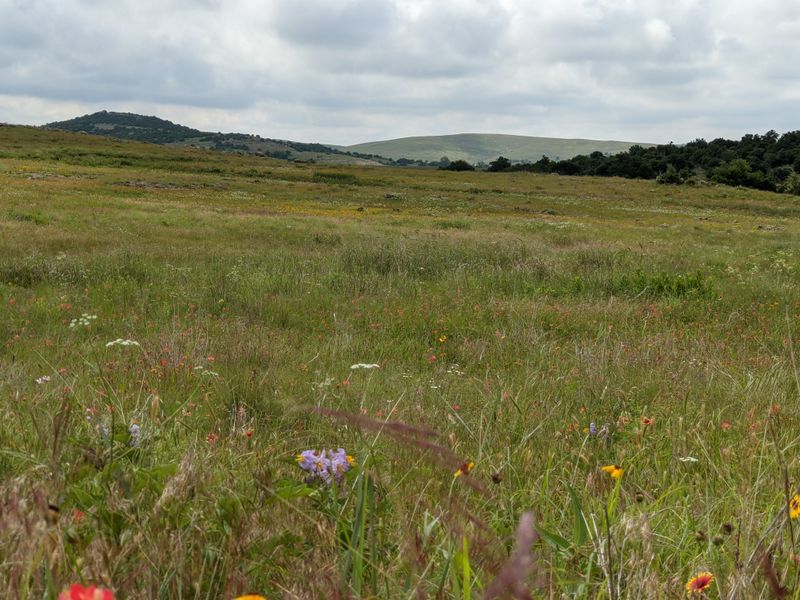
The setting for these fundraisers is almost always the same. Wide sky stretching from one edge of your vision to the other.
Flat horizon broken only by occasional tree lines or distant buildings.
This is Oklahoma landscape at its most characteristic. Not dramatic like mountains or coastlines, but compelling in its openness, its refusal to hide anything or pretend to be something it is not.
The sky becomes the dominant feature, changing throughout the day from pale morning blue to bright afternoon white to golden evening light. Clouds move across it like ships, casting shadows that race over the fields.
Against this backdrop, the barbecue fundraiser looks small but significant. The smokers and tables and trucks occupy just a tiny portion of the visible space, but they draw your eye because they represent human activity in an otherwise empty frame.
In Oklahoma, this relationship between human scale and landscape scale defines much of daily life. You are always aware of how big the sky is, how far the horizon stretches, how small your immediate concerns are in comparison.
It feels like a scene from a Coen Brothers film, where the landscape is not just background but a character itself, commenting on the action, providing context, reminding everyone that this moment is both important and fleeting. You look up at that sky and feel connected to something larger than yourself.
What makes these Oklahoma fundraisers feel cinematic is not spectacle but the opposite. They happen without fanfare, without anyone trying to make them into something they are not.
No one is performing for cameras. No one is trying to create a viral moment or generate social media content.
People just show up, do the work, serve the food, collect the money, and go home when it is done.
That authenticity creates a kind of beauty that feels rare. You watch people interact with genuine warmth, not because anyone is watching but because that is how community actually functions when it is working right.
The conversations are brief and practical. The transactions are simple.
The whole event has a rhythm that feels natural rather than orchestrated, like everyone knows their role without needing to be told.
In Oklahoma, this happens every weekend somewhere. A different town, a different cause, but the same basic structure.
The same folding tables and smokers and hand-painted signs. The same understanding that when neighbors need help, you show up with what you have.
It feels like a scene from a film that trusts its audience to appreciate subtlety, to understand that the most meaningful moments often happen quietly, without announcement or explanation.
You leave these events feeling like you witnessed something real, something that matters precisely because it refuses to pretend to be anything more than what it is.
Dear Reader: This page may contain affiliate links which may earn a commission if you click through and make a purchase. Our independent journalism is not influenced by any advertiser or commercial initiative unless it is clearly marked as sponsored content. As travel products change, please be sure to reconfirm all details and stay up to date with current events to ensure a safe and successful trip.
