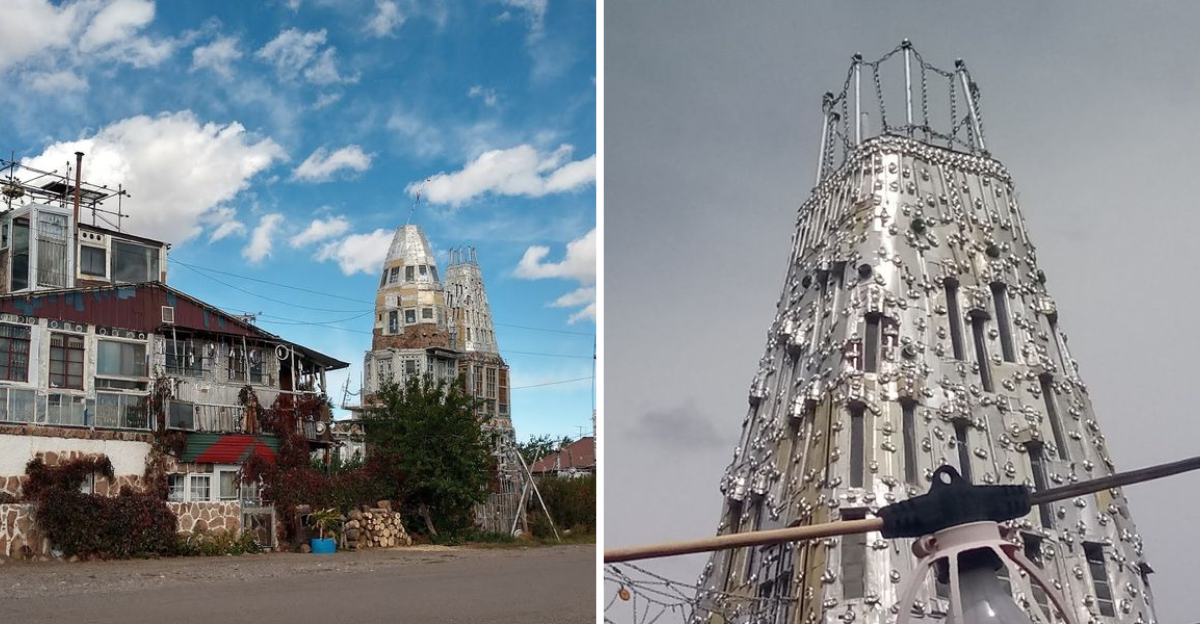
A quiet residential street in southern Colorado does not usually prepare you for a fever dream.
But then it rises up, glittering and strange, a structure built almost entirely from discarded aluminum cans, hubcaps, old grills, and other items that most people toss without a second thought.
A Vietnam War survivor began constructing this multi-tower marvel in 1980 as a spiritual act of gratitude.
The result is one of the most unusual and genuinely moving pieces of outsider art in the entire American West.
I pulled over and just stood there for a solid five minutes, trying to process what I was looking at. Sunlight hits the recycled metal surfaces and the whole thing seems to pulse and shimmer, like it is alive.
Honestly, nothing about a drive through the San Luis Valley can quite prepare you for the moment those towers appear on the horizon.
Bring a camera and an open mind, you will need both.
A Dream Built from Discards
The first thing that grabs you about Cano’s Castle is not its height or its unusual silhouette. It is the texture.
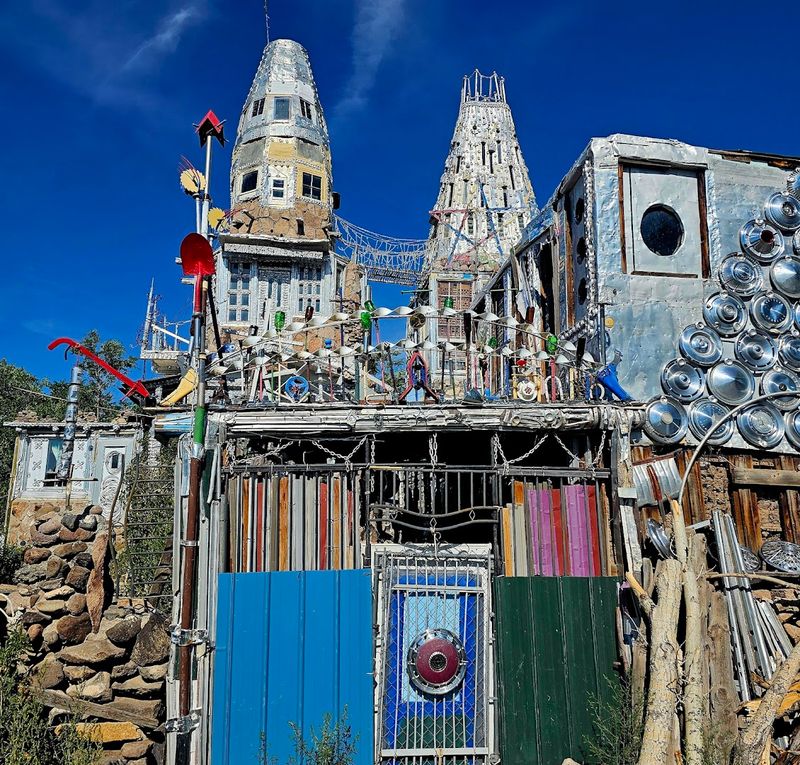
Every square inch of the exterior is layered with flattened aluminum cans, their surfaces catching the Colorado sun and throwing light in every direction like a disco ball that somehow ended up in a small-town neighborhood.
Dominic “Cano” Espinoza started building in 1980, and his motivation was deeply personal. He wanted to thank God for bringing him home alive from Vietnam.
The Buddhist temples he encountered during his service also influenced his architectural instincts, giving the castle its layered, ornate quality that feels almost ceremonial.
Beyond the aluminum cans, the materials list reads like a creative recycler’s dream. Hubcaps, old grills, glass bottles, discarded screen doors, and tiny bicycle reflectors are all embedded into the structure with surprising intentionality.
Each reflector catches a slightly different angle of light, making the towers seem to change color as you move around them.
Nothing here feels accidental. There is a clear artistic logic to how each piece is placed, even if that logic is entirely Cano’s own.
Neighbors have donated materials over the decades, turning the castle into a quiet community collaboration. The whole thing challenges the idea that something discarded has no value left to offer.
Cano’s Castle is proof that with enough vision, even the things we throw away can become something genuinely extraordinary and worth traveling miles to see.
The King, The Queen, and the Towers That Define the Skyline
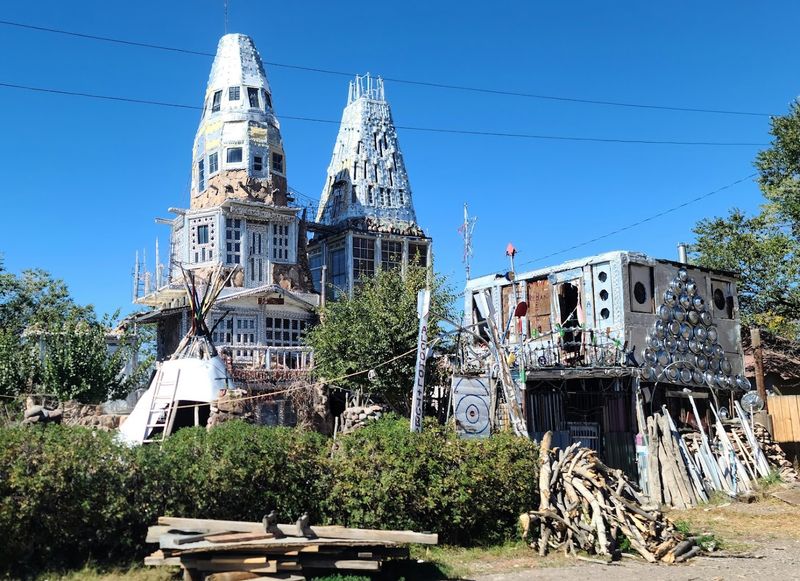
Most people arrive expecting one building and leave surprised to find a whole complex. Cano’s Castle is actually made up of four distinct towers, each with its own name and personality.
The King, the Queen, the Palace, and the Rook all rise from the same property, creating a skyline that is completely unlike anything else in the San Luis Valley.
The King tower is the centerpiece. At four stories and roughly 40 feet tall, it dominates the view from the street and sets the tone for the entire property.
Its walls are densely packed with recycled metal, giving it a weight and presence that photographs struggle to capture accurately. You really have to stand in front of it to understand the scale.
In January 2022, a fire damaged the King tower and destroyed the adjacent house where Cano had been living. The Queen and Rook towers survived, still standing in their full metallic glory.
Cano moved into an off-grid trailer on the property and continued his work, undeterred by the setback. That kind of resilience is part of what makes the castle feel like more than just a structure.
Each tower has a slightly different character when you look closely. The Queen feels more delicate in its details, while the Rook has a sturdier, blockier presence.
Together, they form a cohesive world, one man’s ongoing conversation with faith, memory, and the materials the rest of us leave behind. It is a genuinely remarkable place to simply stand and observe.
The Man Behind the Metal
Cano Espinoza is not a trained architect or a formally educated artist. He is a Native American Vietnam veteran from Guadalupe, Colorado, who came home from war and channeled his survival into something physical and lasting.
After returning to the San Luis Valley, he worked in potato fields before beginning his life’s defining project right in Antonito.
His philosophy about the castle is quietly profound. He has spoken about seeing himself not as the creator but as the instrument, with God as the true builder.
That spiritual framing gives the castle a different kind of weight when you look at it. It is not just art for art’s sake.
It is an act of ongoing devotion, built piece by piece over more than four decades.
Cano is a private person by nature, but he has been known to come out and speak with visitors who show genuine curiosity and respect. Those who have had the chance to hear him talk about the castle describe the experience as unexpectedly moving.
He is not performing for anyone. He is simply sharing something he believes in completely.
Donations of materials from neighbors and passing visitors have kept the project growing over the years. Cano has never charged for admission, and the castle remains freely visible from the street.
The generosity embedded in that choice feels consistent with everything else about the man and his creation. Visiting with that context in mind makes the shimmering towers feel even more remarkable than they already are.
What the Shimmer Actually Looks Like Up Close
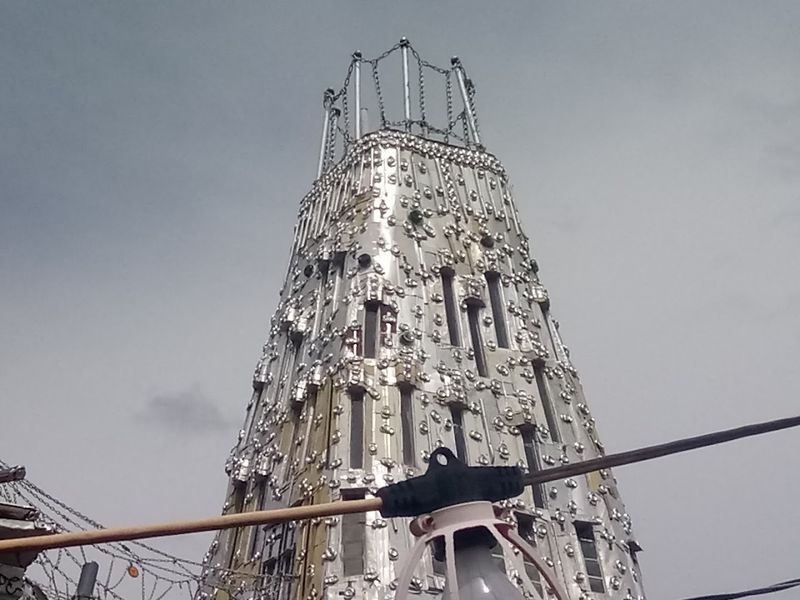
Photos of Cano’s Castle tend to flatten the experience. The images show glimmer and scale, but they cannot fully communicate what it feels like to walk the perimeter and actually study the surface.
Up close, the castle is almost overwhelming in its detail, a mosaic of recycled objects that rewards slow, careful attention.
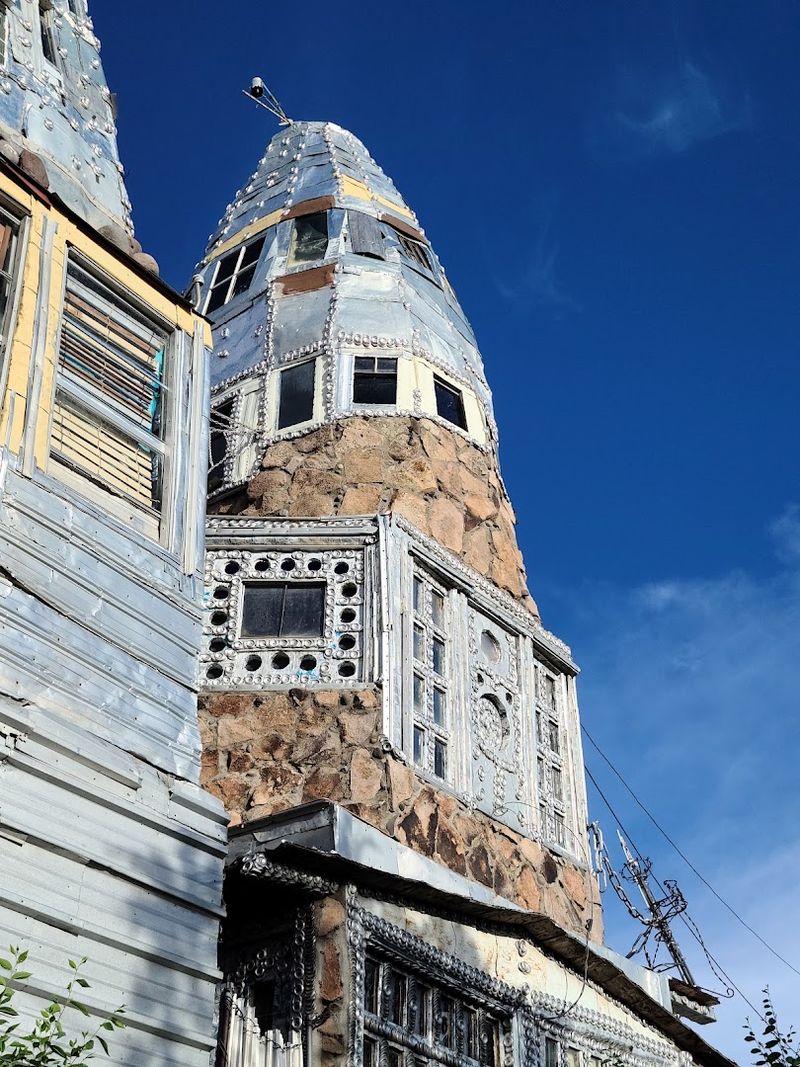
The aluminum cans form the base layer of most surfaces, their flattened faces pressed tightly together to create a kind of metallic skin. Scattered throughout are hubcaps of different sizes and eras, some still bearing the faint logos of car brands long out of production.
Old grills are worked into the walls at unexpected angles, their grates creating geometric shadows in the afternoon light.
Glass bottles catch the light differently than metal does. Where the cans shimmer and flash, the bottles glow, especially when the sun is lower in the sky and the light passes through them at an angle.
Blues, greens, and browns appear in patches across the surface, adding warmth to what might otherwise feel like a purely industrial texture.
The bicycle reflectors are perhaps the most playful element. Tiny and colorful, they are placed at irregular intervals across the towers, and they pop with unexpected brightness when the light hits them just right.
The overall effect is not chaotic, even though the materials are wildly varied. It feels deliberate and cohesive, like a visual language that takes a moment to learn but quickly starts to make sense once your eyes adjust to its logic.
Antonito Itself: The Quiet Town That Holds This Loud Secret
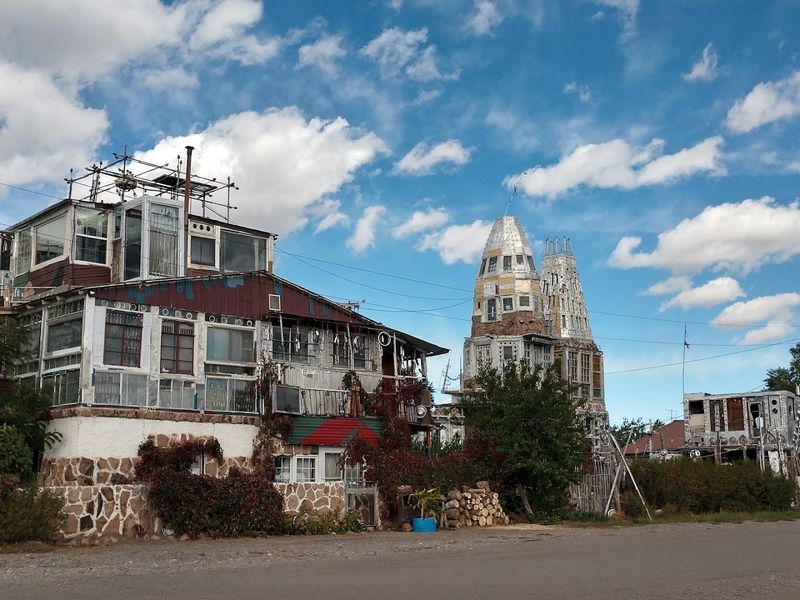
Antonito is the kind of town that does not announce itself loudly. With a population of around 700 people, it sits quietly in the San Luis Valley, surrounded by wide-open high desert and the kind of sky that makes you feel very small in the best possible way.
It is a town that rewards slow travel and genuine curiosity.
Cano’s Castle rises from an ordinary residential block, surrounded by modest homes that make the shimmering towers look even more surreal by contrast. That juxtaposition is part of the experience.
You turn a corner and suddenly the whole visual logic of the neighborhood shifts. It is the kind of moment that makes road trips feel worthwhile.
Antonito also serves as the southern Colorado departure point for the Cumbres and Toltec Scenic Railroad, a narrow-gauge historic railway that winds through some genuinely spectacular mountain terrain toward Chama, New Mexico. If you are planning a visit to the castle, combining it with a train excursion makes for a full and memorable day in this corner of the state.
The town has a quiet, unhurried pace that is easy to settle into. There are no crowds competing for space around the castle, no long lines or ticketing systems.
You simply show up, look, and take your time. That accessibility is part of what makes the stop so appealing.
Antonito is not trying to be a tourist destination. It just happens to contain one of the most genuinely original roadside wonders in the American Southwest.
Why Cano’s Castle Stays With You Long After You Leave
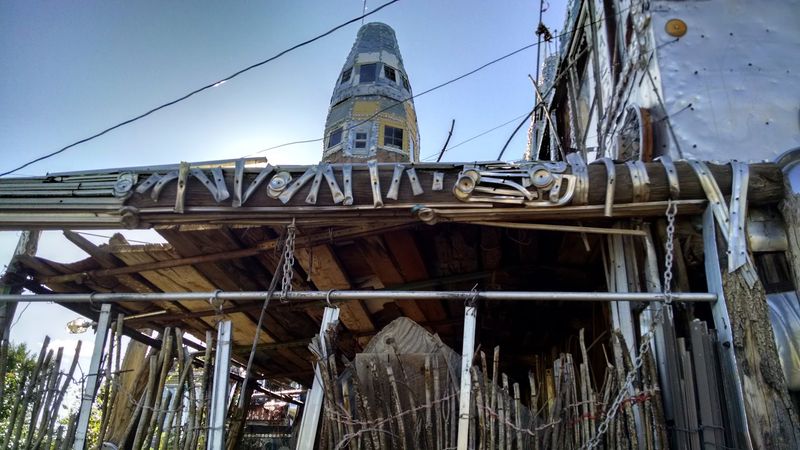
Some places are interesting in the moment and forgotten by dinner. Cano’s Castle is not one of those places.
There is something about the combination of materials, meaning, and sheer accumulated effort that makes it linger in the mind long after the drive home. It is the kind of stop that quietly reshapes how you think about creativity and value.
The castle asks a simple but surprisingly deep question: what makes something worthless? Every can, every hubcap, every glass bottle embedded in those towers was, at some point, headed for a landfill.
Cano saw potential where others saw garbage. That perspective shift does not just apply to materials.
It applies to time, effort, and belief in a project that the wider world might not immediately understand.
There is also something moving about the durability of the vision. Cano has been building since 1980.
A fire damaged part of the complex in 2022 and he kept going. Decades of weather, wear, and setback have not stopped the project from evolving.
That kind of commitment to a personal vision is genuinely rare and genuinely inspiring to witness in physical form.
If you find yourself driving through southern Colorado, even if Antonito is not on your original itinerary, it is worth the detour. Bring a camera, wear comfortable shoes, and give yourself more time than you think you need.
The castle rewards patience. Leaving a small donation is a meaningful way to support the work.
The towers will still be shimmering long after you have gone, catching light from things the rest of us threw away.
