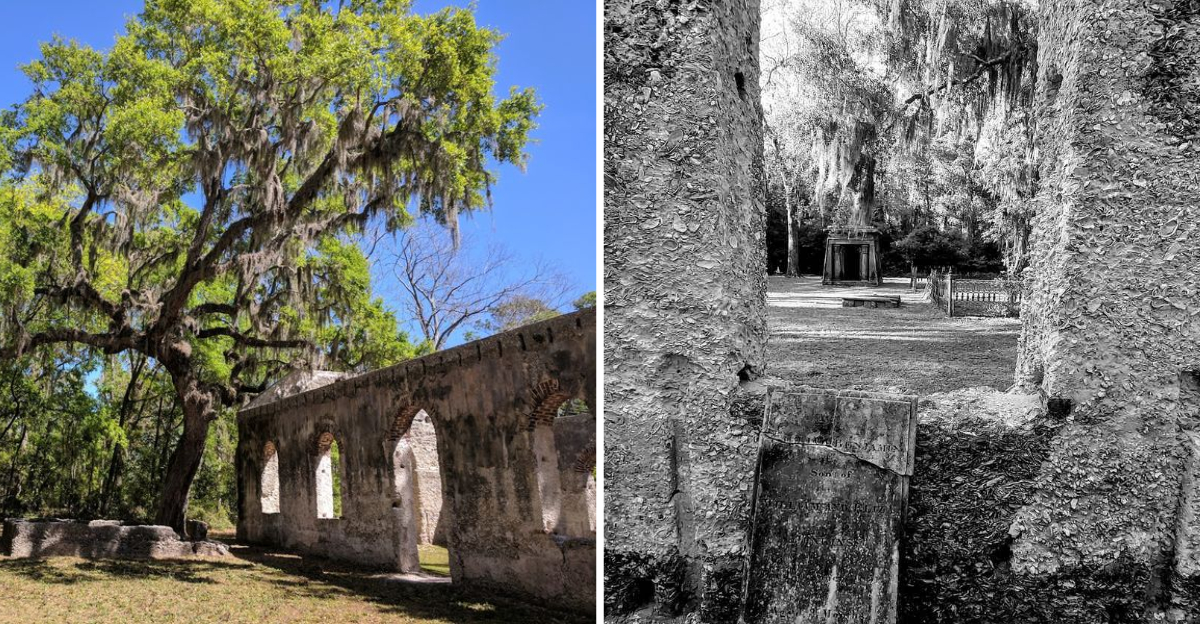
The car was cruising a quiet road toward the coast when a pair of roofless walls appeared through the Spanish moss like something out of a dream. I almost drove right past them, which feels ridiculous now that I know what sits behind those oak trees.
The ruins have been standing since the mid-1700s, built from crushed oyster shells, and a fire took the roof in the late 1800s. What is left feels strangely alive, with sunlight pouring through empty window frames and a small graveyard resting under the trees.
The old church once served as a place of worship for plantation owners and enslaved people alike, and you can still feel that layered history in the stillness of the site. I spent close to an hour there and did not talk much, which is unusual for me.
The quiet was heavy in a way that made words feel unnecessary. I walked around the crumbling walls, reading the weathered headstones, watching the light shift through the oaks.
Places where history sits right out in the open, waiting quietly, tend to stay with you. This one certainly did.
Oyster Shells Holding Up a Church, The Tabby Walls
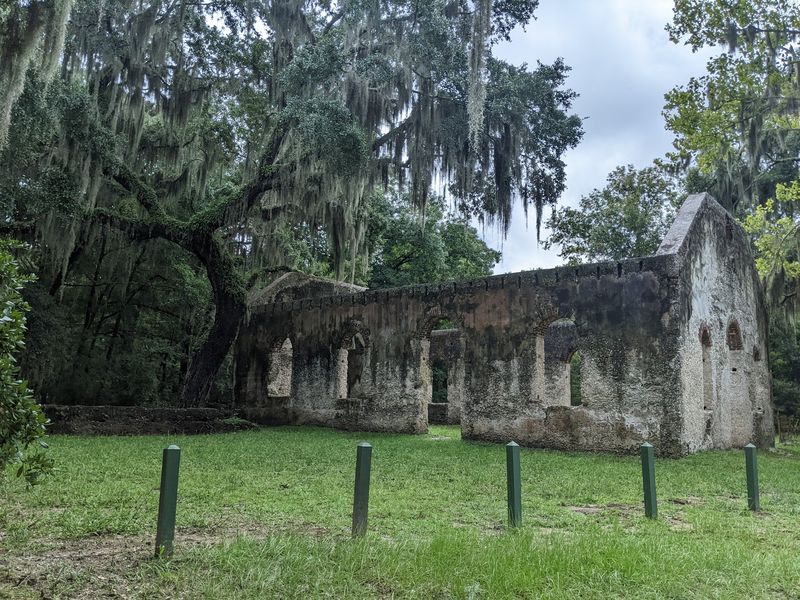
Run your fingertips along the wall and you feel it right away. Sharp little edges of oyster shell poke out of the surface like the building is made of frozen surf.
The material is called tabby, and it was the Lowcountry answer to a shortage of good building stone. Enslaved workers burned oyster shells to make lime, then mixed that lime with sand, water and more whole shells, pouring the slurry into wooden forms layer by layer.
You can still see the horizontal seams where each pour set before the next one went on top. It looks a bit like a giant layer cake that hardened in the sun.
Higher up on the walls, patches of smooth plaster still cling on. That coating once covered everything, so the chapel would have looked pale and tidy rather than rough and speckled.
Time stripped most of it away, and honestly the exposed version is more interesting to look at. Every square foot tells you something about how people solved problems here nearly three hundred years ago.
What struck me most was how thick the walls are. These are not decorative ruins propped up for tourists, they are the real load-bearing shell of a working church that simply lost its roof.
Bring a camera with a close-up setting if you have one. The texture photographs beautifully, especially in late afternoon when low light rakes across the shells and makes every ridge cast a tiny shadow.
Why a Chapel of Ease Existed in the First Place
The name confused me before I visited. A chapel of ease sounds like a spa, but the meaning is far more practical than that.
Back in the 1740s, planters living on St. Helena Island belonged to the parish church over in Beaufort. Getting there meant boats, tides and hours of travel, which made regular Sunday worship close to impossible.
So the Anglican parish built a satellite chapel out here to ease the journey. Construction happened around 1740, with some records placing the work between 1742 and 1747.
By 1812 the island had grown enough that the little chapel was upgraded to parish church status. That is a real promotion for a building that started life as a convenience.
Everything stopped in the fall of 1861. Union forces moved toward the Sea Islands, the planters evacuated, and the church emptied out almost overnight.
It did not stay silent, though. During the Federal occupation, Northerners used the building to educate and train freedmen, and Methodist freedmen worshipped here starting around 1868.
I like that part of the story more than the planter chapter. A building meant for one small group of people ended up serving the very families those people had enslaved, which is a rare kind of turnaround.
The historical marker on site covers the basics, but reading a little beforehand makes the visit land harder. Knowing the sequence turns two roofless walls into a timeline you can walk through.
The 1886 Fire That Ended Everything
Fire is what finally finished the chapel, not war and not neglect. In February 1886, a forest fire swept through this stretch of St. Helena Island and took the building with it.
Nobody rebuilt. The congregation had already scattered, the roof and timbers were gone, and the tabby shell was left to weather on its own.
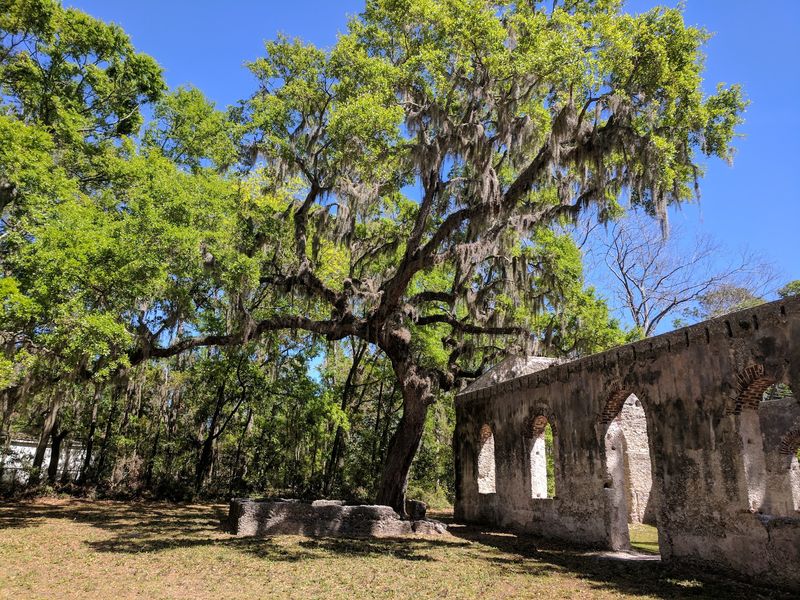
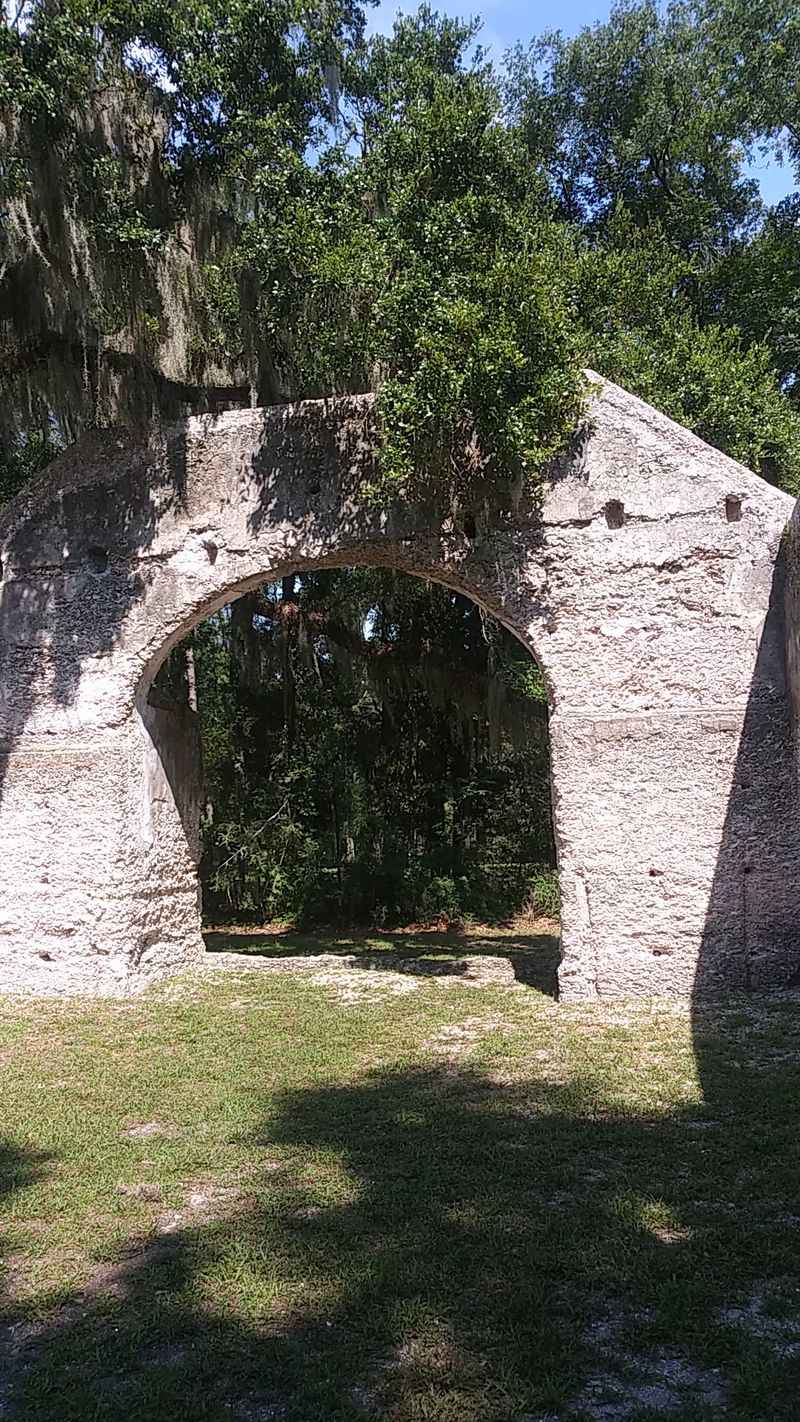
Stand inside the footprint and look straight up. Where the ceiling should be, there is nothing but sky and the tops of live oaks leaning over the walls.
One visitor told the internet it felt magical to stand there watching clouds pass overhead, and I get it completely. The missing roof turns the whole space into an open-air room where the ordinary rules of a church do not quite apply.
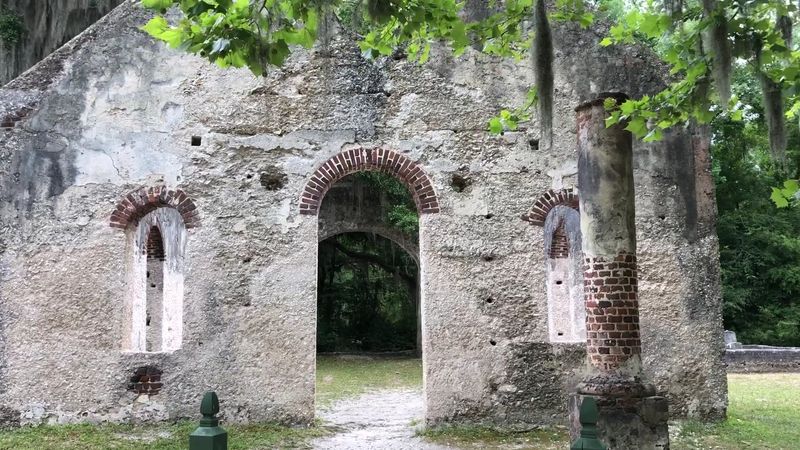
The window openings are still crisply shaped, tall and arched, framing green woods on every side. Photographers love them for good reason, because the light changes character every hour.
It occurred to me while standing there that a fire is a strange thing to be grateful for. Had the chapel survived, it would likely have been renovated, re-roofed and modernized until nothing original remained.
Instead the ruin froze in 1886 and became one of the best surviving examples of 18th century tabby construction anywhere. In 1988 the site earned a spot on the National Register of Historic Places.
Loss preserved it. That contradiction is half the reason the place feels so unusual.
The Fripp Mausoleum and Its Stubborn Bricks
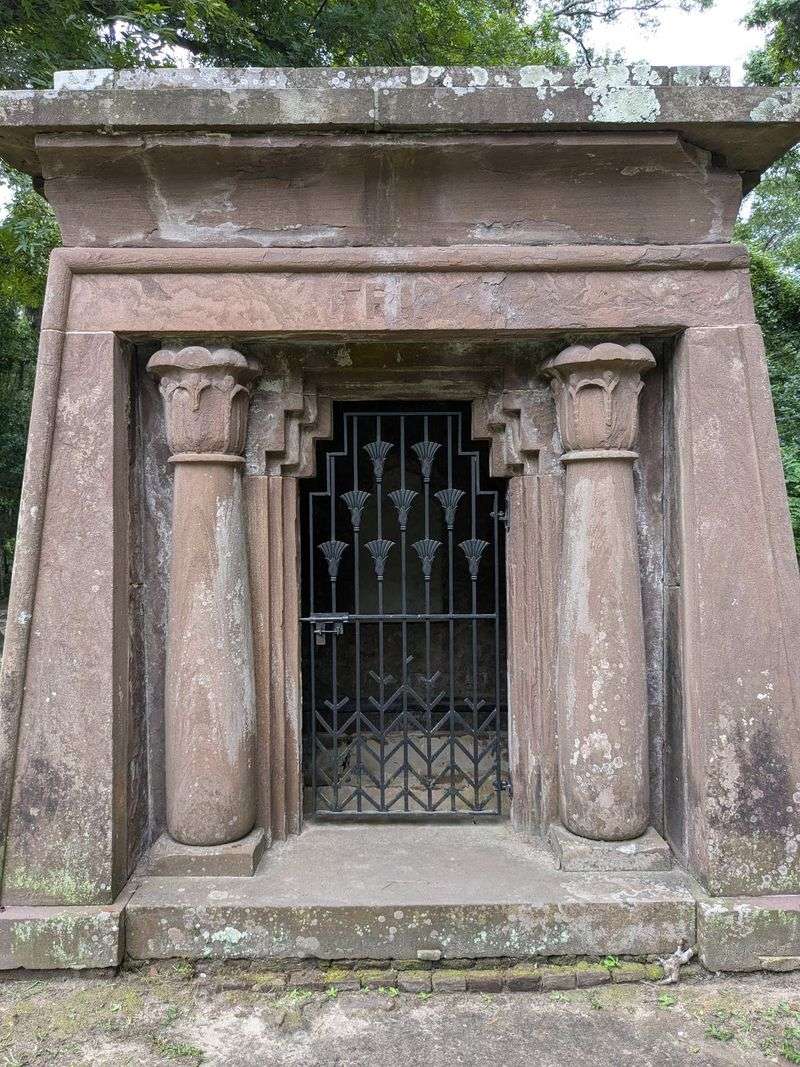
Tucked near the ruins sits the strangest structure on the property, and it caught me off guard. The Fripp mausoleum was built in 1852 for Edgar Fripp and his wife Eliza, and its Egyptian Revival styling looks nothing like anything else nearby.
Heavy, squared off, with a doorway that is only partly bricked shut. Peer inside and you can see the empty chamber and loose debris scattered across the floor.
The story behind that half-finished brickwork is where things get odd. During the Civil War, Union soldiers reportedly broke into the vault hunting for treasure and left it torn apart.
After the war, workmen came to seal it up again. According to local legend, they returned the next morning to find the bricks pulled out and stacked in a neat pile beside the mausoleum.
Whoever or whatever moved them apparently had strong opinions about tidiness. The workers decided the job was not worth finishing, and the vault has stayed half-sealed and empty ever since.
I am not going to tell you what to believe about that. What I will say is that seeing the unfinished brickwork in person makes the tale feel less like a campfire yarn and more like an unsolved errand.
A few visitors find the open chamber unsettling, especially in low light. Others photograph it from every angle and call it the highlight of the stop.
Either way, do not skip it. The mausoleum carries more of the site’s mystery than the chapel itself.
Whispers, Songs and the Lady in White
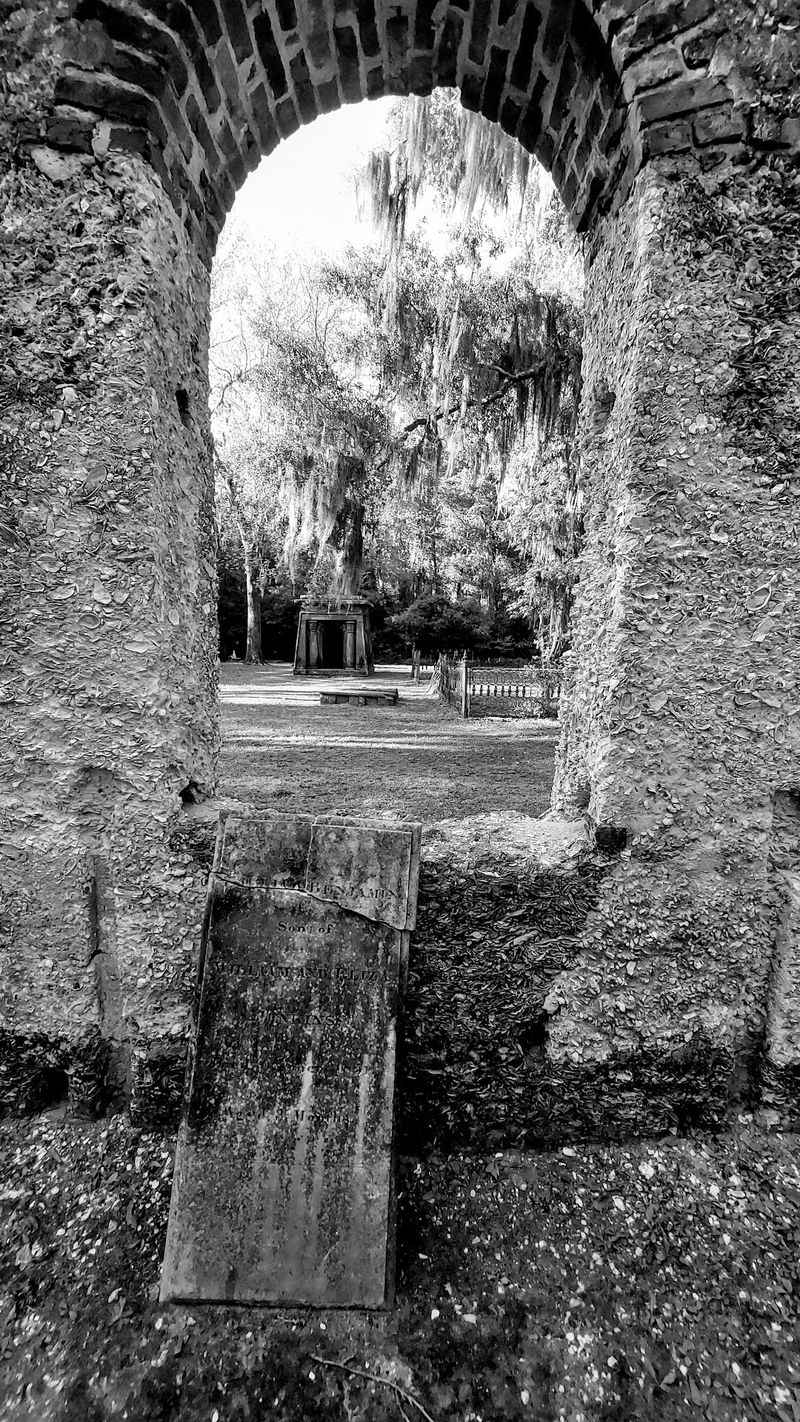
Ghost stories cling to this place the way moss clings to the oaks. Ask around St. Helena Island and you will hear plenty.
People who linger near the ruins report hearing whispered prayers drifting out from between the walls. Others describe singing, faint and layered, the kind that sounds like a congregation heard through a closed door.
In the graveyard, some visitors say they have heard names called out, either among the stones or from the woods just past them. Figures in 18th century clothing have supposedly been spotted moving through the trees.
The most repeated legend involves a lady in white, said to be Mrs. Sarah Scott, seen carrying a child among the tombstones. Her daughters were buried in this graveyard in 1833, which gives the story a sad weight that pure spookiness never has.
My own visit was disappointingly uneventful on the supernatural front. What I did notice was how completely sound behaves differently here, with birdsong going sharp and footsteps landing soft on the packed sand.
Wind moving through the oaks does make a sound you could mistake for voices if you were already primed for it.
Whether you believe any of it or not, the folklore is part of the site’s identity and worth knowing before you arrive. It sharpens your attention.
Just be respectful in the cemetery. Real families are buried there, and the stones are fragile enough without visitors leaning on them for photos.
Making the Stop,Timing, Bugs and Nearby Detours
Practical stuff matters here, because the site is self-guided and unstaffed. You pull off the road, park, and walk in whenever you like.
There is no ticket booth and no gift shop, just a historical marker and the ruins themselves. Most people budget ten minutes and end up staying an hour.
Timing makes a real difference. Early mornings on weekdays tend to be almost empty, and late afternoon delivers the softest light for photos as the sun drops behind the oaks.
Bugs are the honest downside. Lowcountry mosquitoes and no-see-ums can be brutal in warm months, so pack repellent and wear something with sleeves if you plan to wander the cemetery.
Footing is uneven around the graves, with roots, sunken ground and broken stones. Sneakers beat sandals every time.
The chapel sits only a short detour off the main route toward Hunting Island State Park, which makes it an easy add-on to a beach day. Fort Fremont is also close by if you want to stack a second historic stop.
The Parish Church of St. Helena in Beaufort manages the ruins, and events on the grounds require permission, so treat the space as an active piece of church property rather than a public park.
Take your trash with you and keep off the walls. Small courtesies go a long way at a site that survives on goodwill and careful upkeep.
Address: 62 Old Shell Rd, Beaufort, SC 29902
