Indiana might not be the first place that comes to mind when you think of weird roadside attractions, but the Hoosier State has some seriously strange surprises hiding along its quiet backroads.
From trees growing on courthouse roofs to graves smack in the middle of highways, these bizarre landmarks tell stories that are equal parts fascinating and funny.
Most travelers zoom past these oddities on their way to bigger cities, missing out on some of the most memorable stops in the Midwest.
Whether you’re a road trip enthusiast or just curious about the quirky side of Indiana, these seven strange sights will make you want to take the scenic route and discover the unexpected treasures that make this state truly one-of-a-kind.
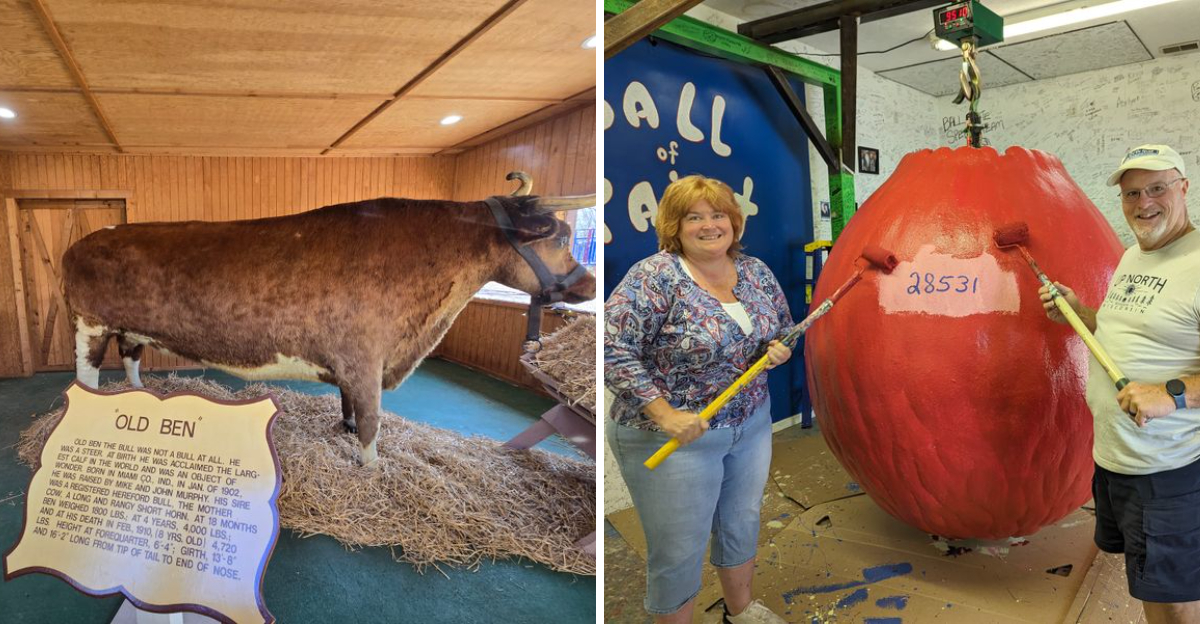
World’s Largest Ball of Paint

Back in 1977, Mike Carmichael picked up a regular baseball and decided to paint it.
He kept painting it every single day, and what started as a simple hobby turned into something truly extraordinary.
As of 2026, that baseball has transformed into a massive sphere weighing over 11,500 pounds, covered with more than 30,000 layers of paint in every color you can imagine.
Located at 10696 N 200 W in Alexandria, this Guinness World Record holder sits in a custom-built “Ball House,” where visitors from around the world come to witness this colorful creation.
The ball has grown so large that it is now supported by industrial steel beams.
What makes this attraction even more special is that you’re not just a spectator; you can actually become part of history by adding your own layer of paint.
Mike welcomes guests by appointment at the World’s Largest Ball of Paint, providing them with brushes and their choice of paint colors to contribute to this ever-growing masterpiece.
Each layer tells a story, from birthday celebrations to memorial tributes, creating a timeline of human connection wrapped around a simple baseball.
The Grave in the Middle of the Road

Picture this: county workers show up in the late 1800s, ready to build a new road, and they’re met with shotguns pointed right at them.
The Barnett family wasn’t about to let anyone disturb their beloved Nancy’s final resting place.
That standoff resulted in one of Indiana’s most unusual landmarks; a grave sitting right in the middle of County Road 400 South.
Nancy Kerlin Barnett’s grave, located near Franklin, has been there since 1831.
While she is the most famous resident, a 2016 archaeological project confirmed that she is actually joined by six other family members in this small plot.
To ensure the site’s preservation for the 2026 season, the county has reinforced the area with a protective concrete median, allowing traffic to flow safely around this island of history.
Today, drivers navigate a peculiar fork in the road where the pavement splits to accommodate the burial plot.
A historical marker at the Nancy Kerlin Barnett Grave explains the fascinating story to curious visitors who stop to pay their respects.
The sight is both touching and bizarre; a testament to family loyalty preserved amid modern asphalt.
Martini-Drinking Pink Elephant
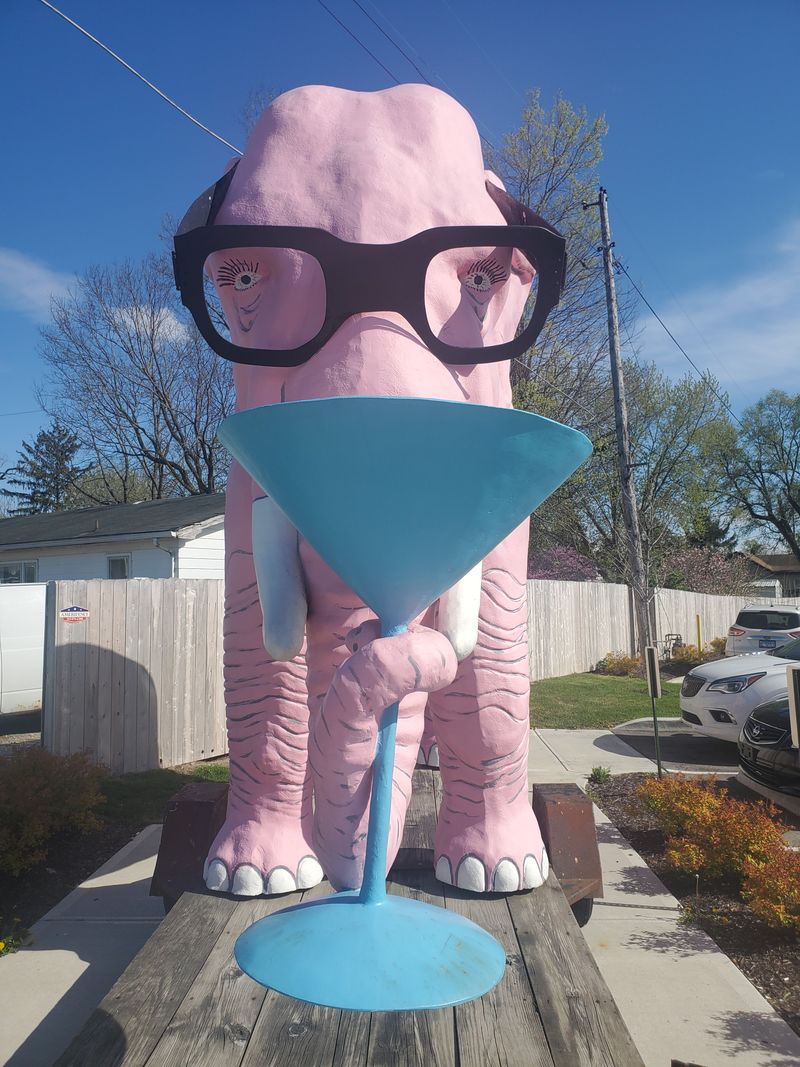
Standing outside a liquor store in Fortville, a larger-than-life pink elephant wearing spectacles and holding a martini glass greets passersby with undeniable charm.
This isn’t your typical business mascot; it’s a clever visual joke that brings the old saying “seeing pink elephants” to life in the most literal way possible.
The phrase has long been associated with the hallucinations people supposedly experience after too much alcohol, making this statue a perfect, tongue-in-cheek advertisement.
Located at 308 W Broadway Street, this quirky elephant has become a beloved local landmark and a must-see photo opportunity for anyone exploring Indiana’s stranger side.
The statue sports a sophisticated look with its glasses perched on its trunk, giving it an almost scholarly appearance despite its ridiculous pink color.
The martini glass adds the finishing touch to this whimsical scene, complete with what appears to be an olive.
What started as a simple marketing gimmick has evolved into something much more meaningful for the community.
Locals give directions using the pink elephant as a landmark, and visitors make special detours just to snap selfies with this absurd yet delightful sculpture.
The statue has survived decades of Indiana weather, standing as a testament to small-town humor and the kind of advertising that doesn’t take itself too seriously.
Kids giggle at the bright pink pachyderm while adults appreciate the clever wordplay behind its existence.
The elephant has even gained a sort of celebrity status on social media, with travelers sharing photos and tagging the location as a hidden gem along Indiana’s backroads.
Some visitors claim it’s the happiest-looking elephant they’ve ever seen, which makes sense considering it’s perpetually enjoying a cocktail.
This roadside oddity proves that sometimes the best attractions are the ones that don’t try to be profound; they just aim to make you smile and maybe chuckle at the absurdity of it all.
The Tree on the Courthouse Roof
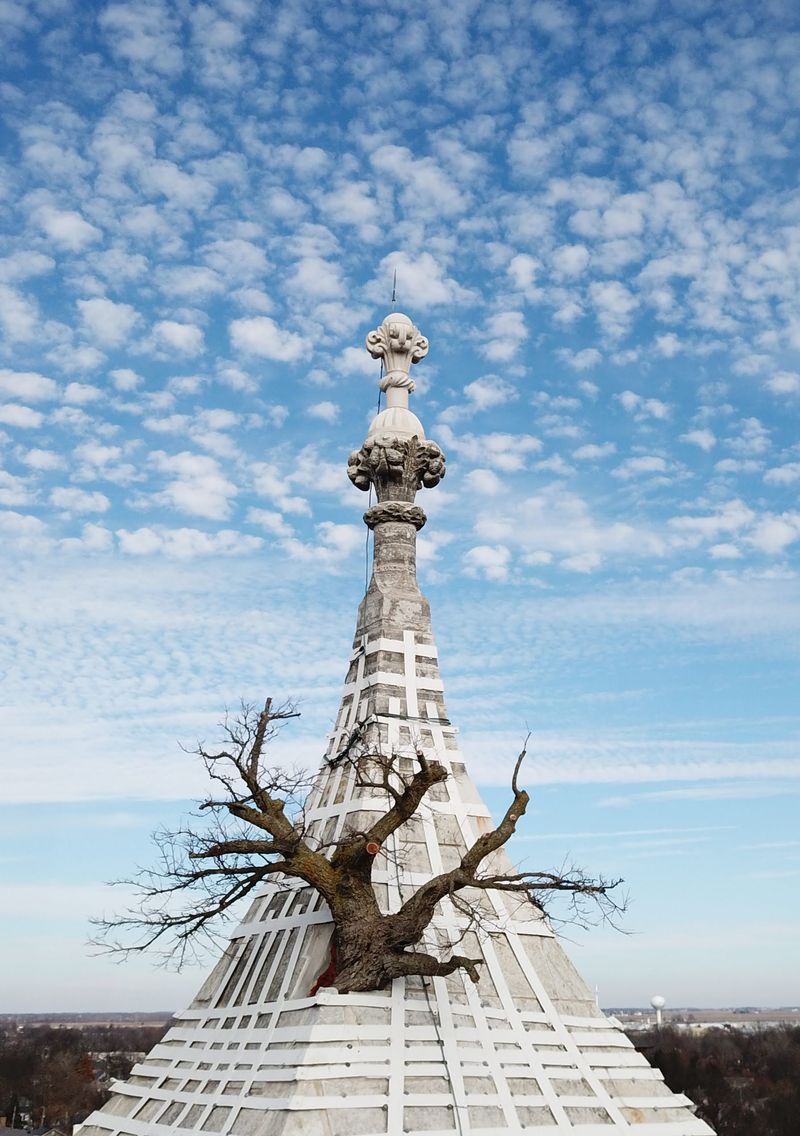
For more than a century, trees have been growing out of the Decatur County Courthouse tower in Greensburg, defying logic 110 feet above the ground.
This botanical oddity has earned the town the nickname “Tree City” and attracts curious visitors from across the country.
While previous growths were thought to be large-tooth aspens, forestry experts have identified the current primary resident of the tower as a Mulberry tree.
It is approximately the 14th tree to call the clock tower home.
These trees survive by finding just enough moisture and organic matter in the tower’s crevices to germinate and thrive against all odds.
You can spot this remarkable sight from downtown Greensburg at the Decatur County Courthouse, where the tree’s branches extend visibly from the tower.
The tree has survived decades of Indiana weather, becoming a symbol of resilience for the community.
Local officials carefully monitor the growth to protect the building, ensuring that Greensburg’s most famous “resident” continues to watch over the town square.
Old Ben and the Sycamore Stump
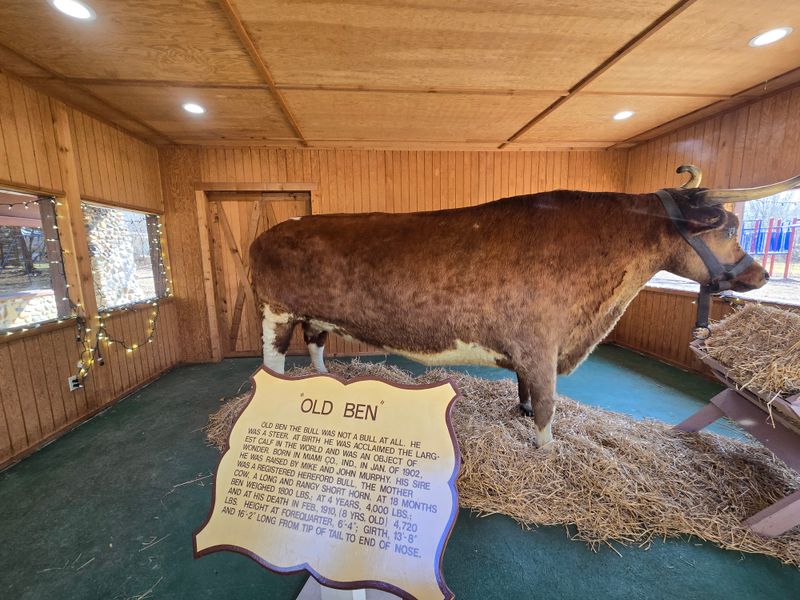
Highland Park in Kokomo houses one of Indiana’s most peculiar museum displays; the taxidermied remains of Old Ben, who held the title of world’s largest steer, standing next to a massive sycamore tree stump estimated to be 1,500 years old.
This odd couple of natural and agricultural history sits together in a small building, creating one of the strangest indoor attractions you’ll find along any backroad.
Old Ben weighed an astounding 4,720 pounds and stood over six feet tall at the shoulder during his prime in the early 1900s.
The giant steer became a celebrity in his time, touring county fairs and exhibitions across the Midwest where people paid just to see this bovine behemoth.
When Old Ben died in 1910, the community couldn’t bear to let him fade into memory, so they had him preserved and put on display.
The sycamore stump joined him later, having been discovered during construction projects and recognized as an ancient natural treasure worth preserving.
Walking into the small museum building feels like stepping into a time capsule of Hoosier pride.
Old Ben’s massive form dominates one side of the room, his impressive horns and sheer size still commanding attention more than a century after his death.
The sycamore stump sits nearby, its growth rings telling stories that span from ancient indigenous settlements to modern times.
Kids are often amazed by Old Ben’s size, trying to imagine how much food such a creature would need daily.
The stump provides a tangible connection to Indiana’s ancient forests, long before settlers arrived and transformed the landscape.
Together, these two attractions represent different aspects of Indiana’s heritage; agricultural achievement and natural history.
The building itself is free to visit, making it an accessible stop for families exploring Kokomo.
Some visitors find the display a bit eerie, while others appreciate the dedication to preserving these unique pieces of history.
It’s definitely not your typical museum experience, which is exactly what makes it perfect for a backroads adventure.
Flick Statue from A Christmas Story
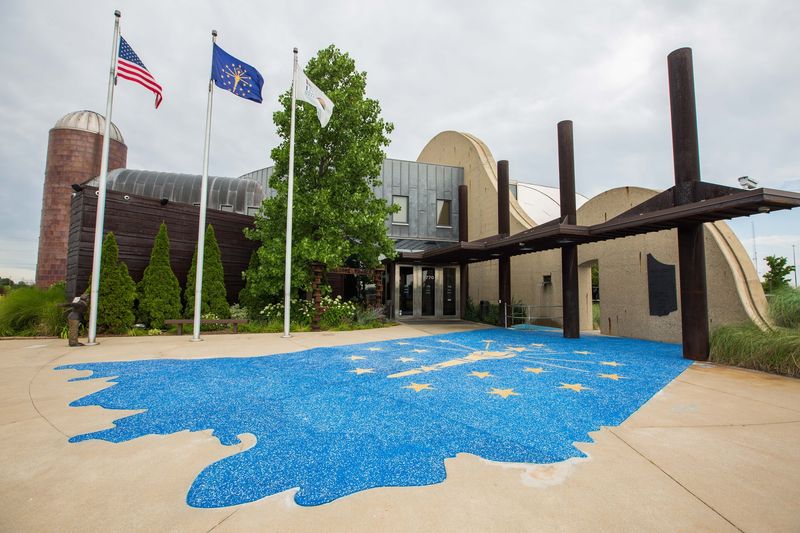
Anyone who’s watched “A Christmas Story” remembers the iconic scene where Flick gets his tongue frozen to a flagpole after accepting a triple-dog-dare.
That moment of childhood foolishness has been immortalized in bronze at the Indiana Welcome Center in Hammond, located at 7770 Corinne Dr. The statue captures Flick mid-panic, tongue stuck fast to the pole, his eyes wide with the realization that his friends were absolutely right about what would happen.
The sculpture is remarkably detailed, from Flick’s winter coat to the expression of regret frozen on his face forever.
Indiana claims this piece of movie history because author Jean Shepherd, who wrote the stories that inspired the film, grew up in Hammond and set many of his tales in Northwest Indiana.
The statue serves as both a tribute to Shepherd’s work and a playful warning to anyone tempted to test the tongue-on-frozen-metal theory.
Visitors to the welcome center can’t resist posing next to poor Flick, recreating the scene or pretending to offer help.
The statue has become one of the most photographed attractions at Indiana rest stops, with families making it a tradition to stop and snap pictures during holiday road trips.
During winter, when temperatures drop and metal poles actually become dangerous, the statue takes on an extra layer of relevant humor.
The welcome center staff report that people quote lines from the movie constantly while visiting the statue, particularly “I triple-dog-dare you!” and “Stuck?
Stuck?” The bronze has developed a nice patina over the years, giving Flick an even more timeless quality.
Some visitors leave coins at the base as offerings, while others simply stand and laugh at the absurdity of memorializing such a ridiculous movie moment.
The statue proves that Indiana embraces its connection to popular culture, even when that connection involves a kid doing something incredibly foolish on a dare.
It’s a perfect roadside stop that combines nostalgia, humor, and a uniquely Hoosier sense of pride in the stories that came from this state.
Jug Rock
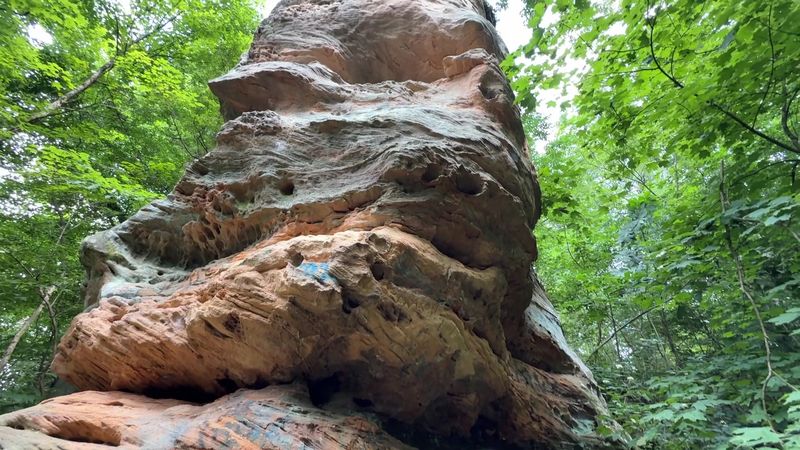
Rising from the Indiana landscape near Shoals, Jug Rock stands as nature’s own sculpture; a sandstone formation that looks exactly like a giant jug balanced on a narrow pedestal.
This natural wonder is the largest free-standing table rock formation east of the Mississippi River, measuring about fifteen feet tall and remarkably resembling a piece of pottery that some ancient giant left behind.
The formation developed over millions of years through erosion, with softer rock wearing away faster than the harder capstone, creating the distinctive jug shape.
Located off Albright Lane, Jug Rock sits in a peaceful rural setting where you can approach it on foot and marvel at geological processes that shaped this quirky landmark.
The “handle” of the jug is particularly impressive, a natural arch that completes the illusion of a massive vessel.
Native Americans knew about this formation for centuries before European settlers arrived, and local legends suggest they considered it a sacred or significant landmark.
Geologists love studying Jug Rock because it demonstrates erosion patterns so clearly, making it an outdoor classroom for understanding how water, wind, and time sculpt the landscape.
The formation is surprisingly fragile despite its massive appearance; the narrow base that supports the heavy top could theoretically collapse someday, though it’s held firm for thousands of years so far.
Visitors are asked to admire it from a respectful distance to help preserve this natural treasure.
The area around Jug Rock offers pleasant hiking and a chance to see other interesting rock formations, though none quite as dramatic as the main attraction.
Photographers particularly love the challenge of capturing Jug Rock from angles that best showcase its improbable shape.
During different times of day, the lighting transforms the rock’s appearance, highlighting various textures and colors in the sandstone.
Some people see a water jug, others see a mushroom or alien spacecraft; the formation’s ambiguity adds to its charm.
This is Indiana at its most unexpectedly beautiful, proving that you don’t need mountains or oceans to find natural wonders worth traveling to see along the backroads.
Dear Reader: This page may contain affiliate links which may earn a commission if you click through and make a purchase. Our independent journalism is not influenced by any advertiser or commercial initiative unless it is clearly marked as sponsored content. As travel products change, please be sure to reconfirm all details and stay up to date with current events to ensure a safe and successful trip.
