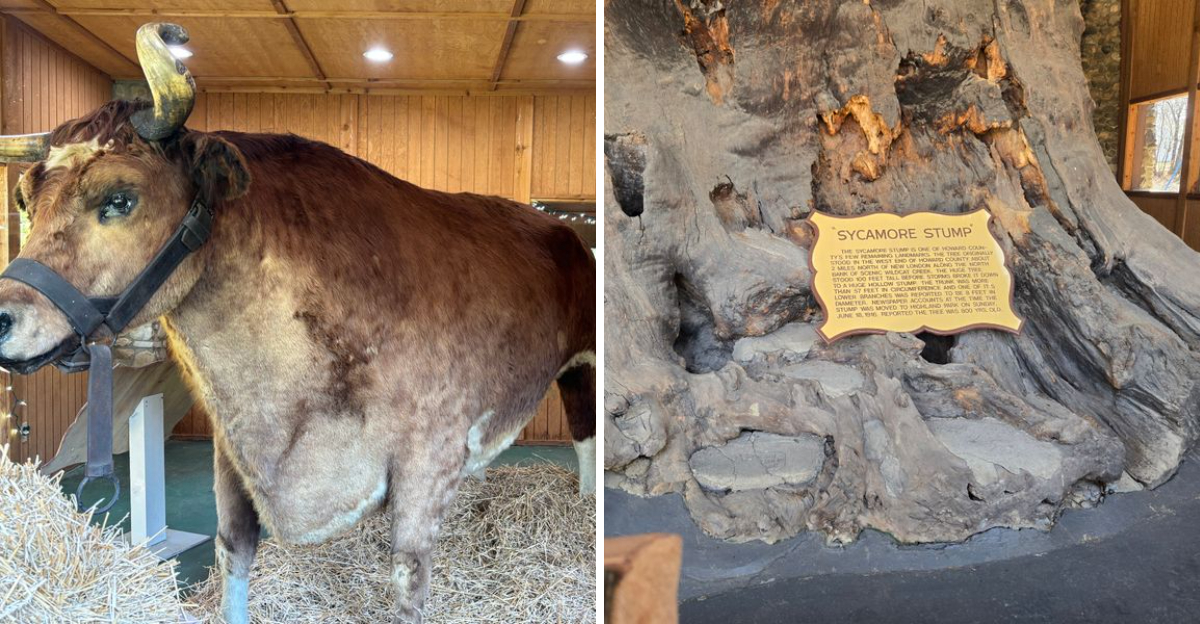
Standing behind glass in a quiet pavilion in Kokomo, Indiana, is one of the most unusual attractions in the Midwest: the taxidermied remains of Old Ben, once celebrated as the world’s largest steer. Born in 1902, this massive Shorthorn-Hereford cross grew to legendary proportions before his tragic death in 1910.
His preserved body has been drawing curious visitors for over a century, a testament to both agricultural history and small-town Americana. Old Ben’s story is filled with fascinating twists, from his record-breaking size to his unexpected fame during World War II.
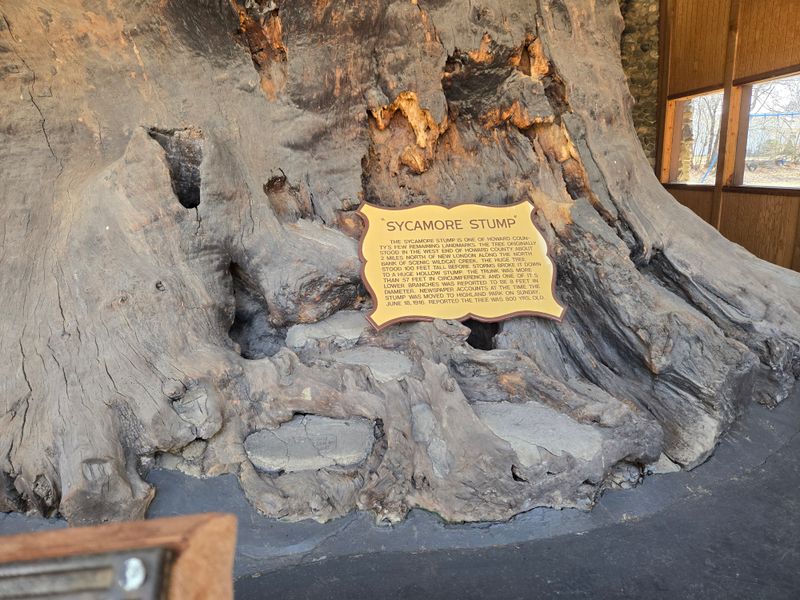
Today, he shares his display space with another Indiana marvel, the World’s Largest Sycamore Stump, creating a unique double attraction that celebrates the natural and agricultural wonders of the region.
Whether you’re a history buff, roadside attraction enthusiast, or just passing through central Indiana, Old Ben offers a glimpse into a bygone era when giant livestock captured the public imagination and became unlikely celebrities.
World Record Dimensions That Stunned America
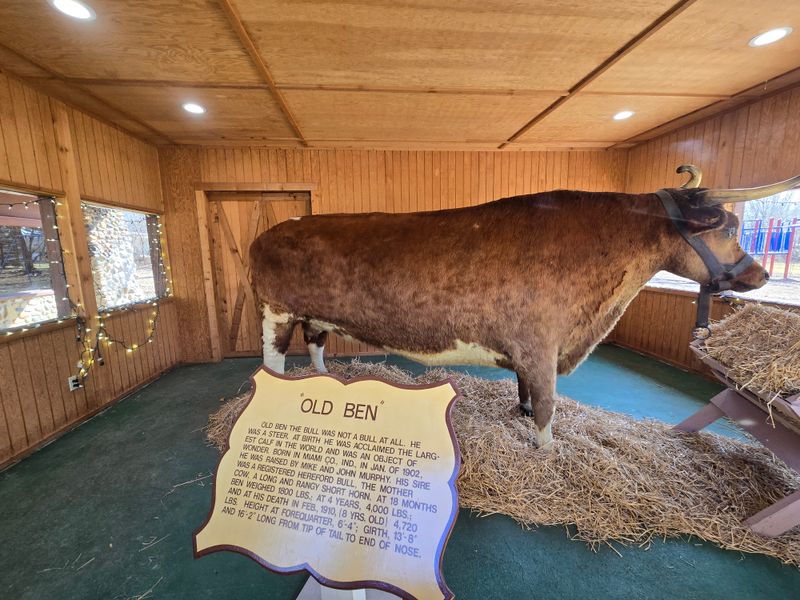
Born on a farm in Miami County, Indiana, in 1902, Old Ben was no ordinary calf. Even at birth, he tipped the scales at an astounding 135 pounds, more than double the weight of a typical newborn calf.
His owners, brothers John and Al Kersting, quickly realized they had something extraordinary on their hands.
As Ben matured, his growth seemed unstoppable. By the time he reached his full size, he weighed between 4,585 and 4,720 pounds, depending on which historical account you consult.
To put that in perspective, a typical modern steer weighs around 1,200 to 1,400 pounds at market weight. Old Ben was more than three times that size.
His measurements were equally impressive in other dimensions. Standing at 6.5 feet tall at the shoulder, Ben towered over anyone who approached him.
His length stretched over 16 feet from nose to tail, making him longer than many compact cars today. His girth measured an incredible 13 feet, 8 inches around his midsection.
These proportions earned him recognition as the world’s largest steer, a title that brought fame not just to Ben himself but to the entire Kokomo region. The Kersting brothers received numerous offers from circuses and traveling shows eager to display their giant animal.
They consistently refused, preferring to keep Ben on their farm where he lived a relatively quiet life despite his celebrity status.
Photographs from the era show Ben dwarfing the men standing beside him, his massive frame almost too large to believe. His size became a source of local pride and attracted visitors from across the state who wanted to see the gentle giant in person.
Even today, viewing his preserved body in Highland Park, visitors are struck by just how enormous this animal truly was.
A Tragic Accident on the Ice
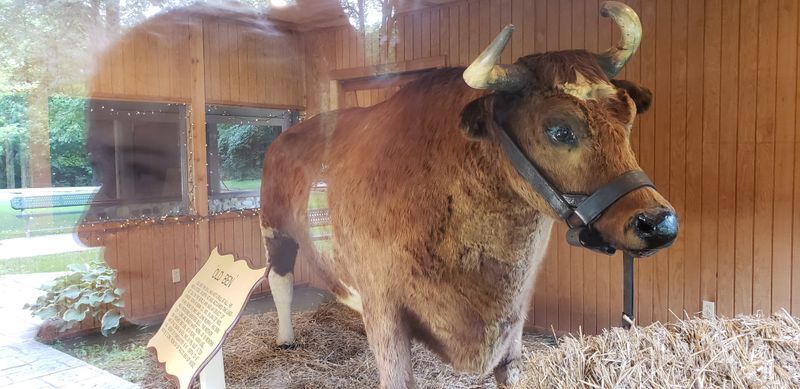
February 1910 marked the end of Old Ben’s remarkable life in a sudden and heartbreaking way. At eight years old and at the peak of his fame, Ben was being moved across the farm when disaster struck.
He stepped onto a patch of ice that had formed on the ground and lost his footing. For an animal of his tremendous size, such a fall was catastrophic.
When Ben went down, he broke his leg. For a normal-sized steer, a broken leg is often treatable with splints and careful management, though recovery is never guaranteed.
But Ben was far from normal-sized. His immense weight, approaching two and a half tons, made it physically impossible to support him during any healing process.
There was no way to keep him off the injured leg, and no splint or support system of that era could bear such massive weight.
The Kersting brothers faced an agonizing decision. Veterinary medicine in 1910 had few options for an injury of this magnitude in an animal of Ben’s size.
Keeping him alive would have meant prolonged suffering with no realistic hope of recovery. The humane choice, though painful, was clear.
Ben was euthanized shortly after the accident. The news of his death spread quickly through Kokomo and beyond, with newspapers carrying the story of the fallen giant.
Many local residents who had visited Ben over the years mourned his loss. He had become more than just a curiosity; he was a beloved symbol of Indiana agriculture.
Rather than let Ben’s legacy end with his death, the Kersting brothers decided to preserve him. They contacted a skilled taxidermist in New York who agreed to mount the massive steer, ensuring that future generations could witness his extraordinary size.
This decision transformed Ben from a living marvel into a permanent monument to agricultural history.
From Legend to Lunch: The Frankfurt Connection

What happened to the rest of Old Ben after his hide was carefully removed for taxidermy is both practical and slightly unsettling by today’s standards. In 1910, waste was simply not an option, especially when dealing with nearly 4,700 pounds of beef.
The Kersting brothers made the pragmatic decision to sell Ben’s carcass to local meat processors.
The result was several hundred pounds of frankfurters, or what we commonly call hot dogs today. These weren’t just any frankfurters—they were made from the world’s most famous steer.
The meat was processed in Indiana and sold as a local product, creating what might be the most unusual claim to fame any hot dog has ever had.
For a brief time, residents of Kokomo and surrounding areas could truthfully say they had eaten a piece of history. Local butchers and markets advertised the frankfurters as coming from Old Ben himself, turning them into a peculiar sort of collector’s item, albeit one that couldn’t be kept for long.
Some families reportedly served them at special dinners, treating the meal as a way to participate in Ben’s legend.
This practice might seem strange or even distasteful to modern sensibilities, but it reflected the practical mindset of early 20th-century farm life. Animals were raised for food, and Ben, despite his fame, was still a steer.
The Kersting brothers had invested years of feed and care into raising him, and the sale of his meat helped offset those costs and the expense of the taxidermy work.
The frankfurter story has become one of the most frequently mentioned facts about Old Ben, adding a quirky footnote to his legacy. It serves as a reminder that even the most celebrated animals of the agricultural world were ultimately part of a working farm economy where nothing went to waste.
A Pinup Steer: Old Ben’s World War II Fame

Old Ben’s celebrity didn’t end with his death or even with the early decades of his preservation. Decades after his passing, he experienced a surprising resurgence in fame during World War II, thanks to an inspired promotional idea that connected Kokomo to servicemen stationed around the globe.
In the early 1940s, someone came up with the clever idea of creating postcards featuring Old Ben to send to American troops overseas. But these weren’t ordinary tourism postcards.
They featured a 20-year-old local woman named Phyllis Hartzell posed alongside the massive mounted steer. The purpose was to demonstrate Ben’s incredible scale, and Phyllis’s presence provided a human reference point that made his size even more dramatic.
The postcards were hugely popular. They were mailed to servicemen throughout Europe, the Pacific, North Africa, and everywhere American forces were stationed.
For soldiers far from home, these quirky images provided a touch of Americana and a conversation starter. The postcards also served a morale-boosting purpose, reminding troops of the unique and sometimes wonderfully odd things waiting for them back in the States.
Phyllis Hartzell herself became a minor celebrity through these postcards, though she always remained secondary to Ben’s starring role. The images showed her standing beside or in front of the giant steer, often smiling, dressed in the fashion of the 1940s.
Her youth and Ben’s age—he had already been dead for over 30 years by then—created an interesting juxtaposition of eras.
This wartime publicity campaign cemented Old Ben’s status as more than just a local curiosity. He became a symbol of Indiana’s agricultural heritage and American ingenuity.
The postcards are now collectibles themselves, sought after by both Old Ben enthusiasts and World War II memorabilia collectors, representing a unique intersection of agricultural history and military morale efforts.
The Three-Tail Repair: Vandalism and Restoration
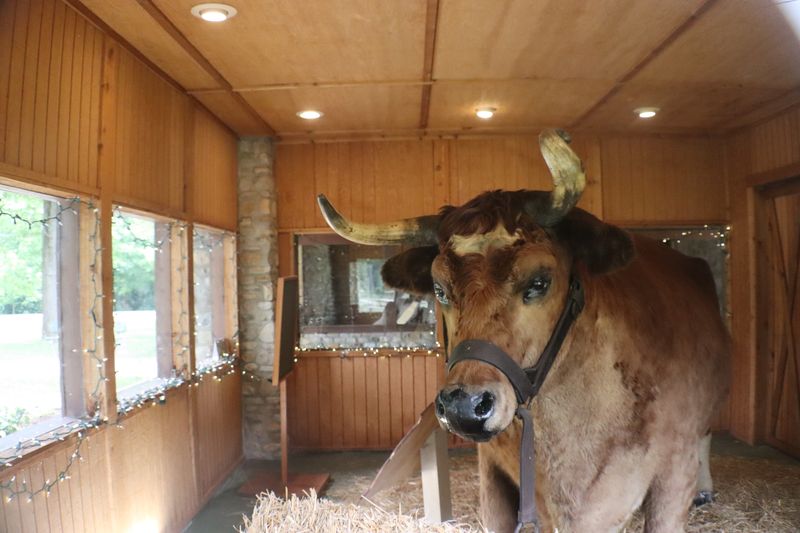
After nearly a century of display, Old Ben has weathered more than just the passage of time. In 2004, he became the victim of an act of vandalism that resulted in one of the most unusual restoration projects in taxidermy history.
Vandals broke into his glass-enclosed pavilion in Highland Park and made off with an unexpected trophy: his tail.
The theft might seem like a strange choice for vandals, but Ben’s tail was no ordinary appendage. Proportional to his massive body, the tail was enormous—far larger and heavier than a normal steer’s tail.
Its theft left a conspicuous gap in Ben’s appearance and required immediate attention from restoration experts.
The problem facing the restorers was significant. Where do you find a replacement tail for the world’s largest steer?
Normal steer tails were far too small to match Ben’s proportions. Using a single tail would have looked ridiculous, making Ben appear oddly incomplete or poorly preserved.
The solution required creative thinking and skilled craftsmanship.
Restoration specialists ultimately decided to stitch together three normal-sized steer tails to create a replacement that matched Ben’s original dimensions. This painstaking process involved carefully selecting tails of similar color and texture, then seamlessly joining them so the repair wouldn’t be obvious to casual observers.
The work required expertise in both taxidermy and color matching to ensure the new tail blended naturally with Ben’s century-old hide.
The repair was successful, and most visitors today have no idea they’re looking at a reconstructed tail made from three separate animals. The incident led to increased security measures around Ben’s display, including better lighting and monitoring.
It also highlighted the ongoing challenges of preserving historical specimens for public viewing while protecting them from damage, whether from environmental factors or human interference.
A Shared Landmark in Highland Park
Today, Old Ben stands in permanent display at Highland Park in Kokomo, housed in a climate-controlled, glass-enclosed pavilion at 1402 Defenbaugh Street. The park is open from 7 AM to 10 PM daily, allowing visitors plenty of opportunities to view this remarkable piece of Indiana history.
The pavilion itself was specifically designed to protect Ben from the elements while allowing clear viewing from all angles.
What makes Ben’s current home even more unusual is that he shares the space with another Indiana giant: the World’s Largest Sycamore Stump. This massive tree remnant measures 12 feet tall and over 50 feet in circumference.
The sycamore was estimated to be around 800 years old when it was felled by a storm in 1916, just six years after Ben’s death. The stump was later moved to Highland Park for preservation and public display.
The pairing creates a unique double attraction that celebrates both natural and agricultural wonders. Visitors can view both giants side by side, marveling at the scale of each.
The exhibits are lit at night, making them visible even after dark, and the glass enclosures allow for year-round viewing regardless of weather conditions.
Highland Park itself offers much more than just these two attractions. The park features multiple playgrounds, picnic areas with charcoal grills, walking paths, and plenty of green space for families to enjoy.
Restroom facilities are available near the pavilion, making it a convenient stop for travelers. The park has become a popular destination for both locals and tourists, with the Sycamore Stump and Old Ben serving as the main draws.
Reviews from visitors consistently praise the site, with many expressing amazement at Ben’s size and appreciation for the free access to such an unusual attraction. The glass enclosures, while installed to protect the specimens from vandalism and weather damage, do create some challenges for photography due to glare, but they ensure these pieces of history will be preserved for future generations to appreciate.
Dear Reader: This page may contain affiliate links which may earn a commission if you click through and make a purchase. Our independent journalism is not influenced by any advertiser or commercial initiative unless it is clearly marked as sponsored content. As travel products change, please be sure to reconfirm all details and stay up to date with current events to ensure a safe and successful trip.
