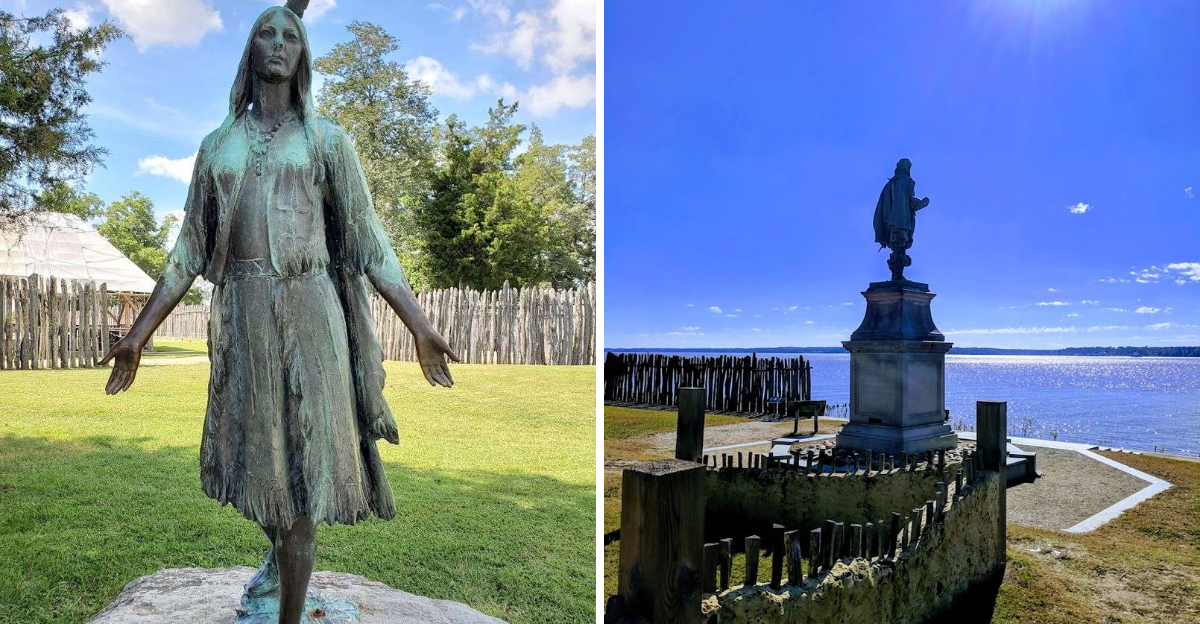
History reveals its surprises in unexpected places. Many travelers pass through Virginia focused on colonial forts and battlefield markers, overlooking a striking bronze figure at the entrance to one of the nation’s most significant sites.
Near the gate of Historic Jamestowne on Jamestown Island, a towering sculpture of Pocahontas reaches nearly 18 feet into the air, yet it often goes unnoticed. Standing before it on a cool morning feels surprising, given its scale, symbolism, and presence.
Virginia offers countless monuments, yet this one leaves a distinct and lasting impression.
The Story Behind the Sculptor and the Commission
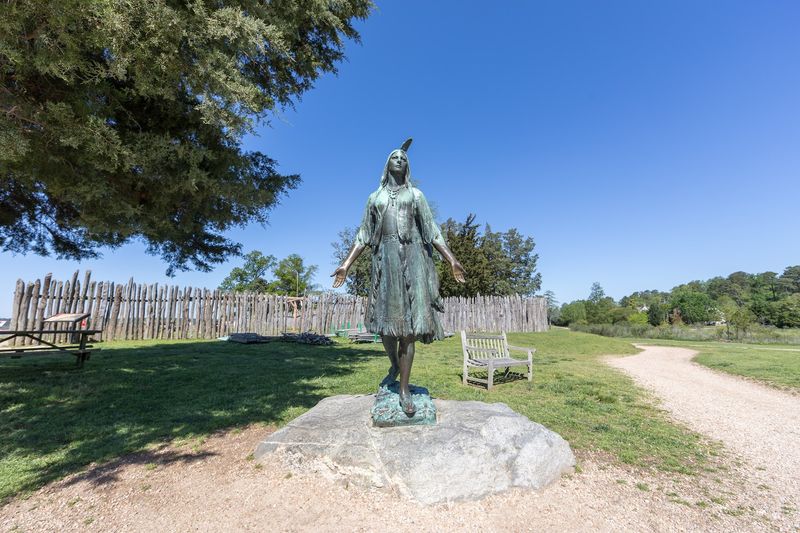
Not every monument has a fascinating origin story, but this one absolutely does. The Pocahontas Statue at Historic Jamestowne was created by William Ordway Partridge, a sculptor known for his ability to bring historical figures to life in bronze with remarkable emotional depth.
Partridge completed the work in 1913, and it was formally dedicated in June 1922, making it over a century old and still standing strong on Jamestown Island.
Partridge was no stranger to ambitious commissions. His portfolio included notable works across the United States, and the Pocahontas piece is widely considered among his most recognized achievements.
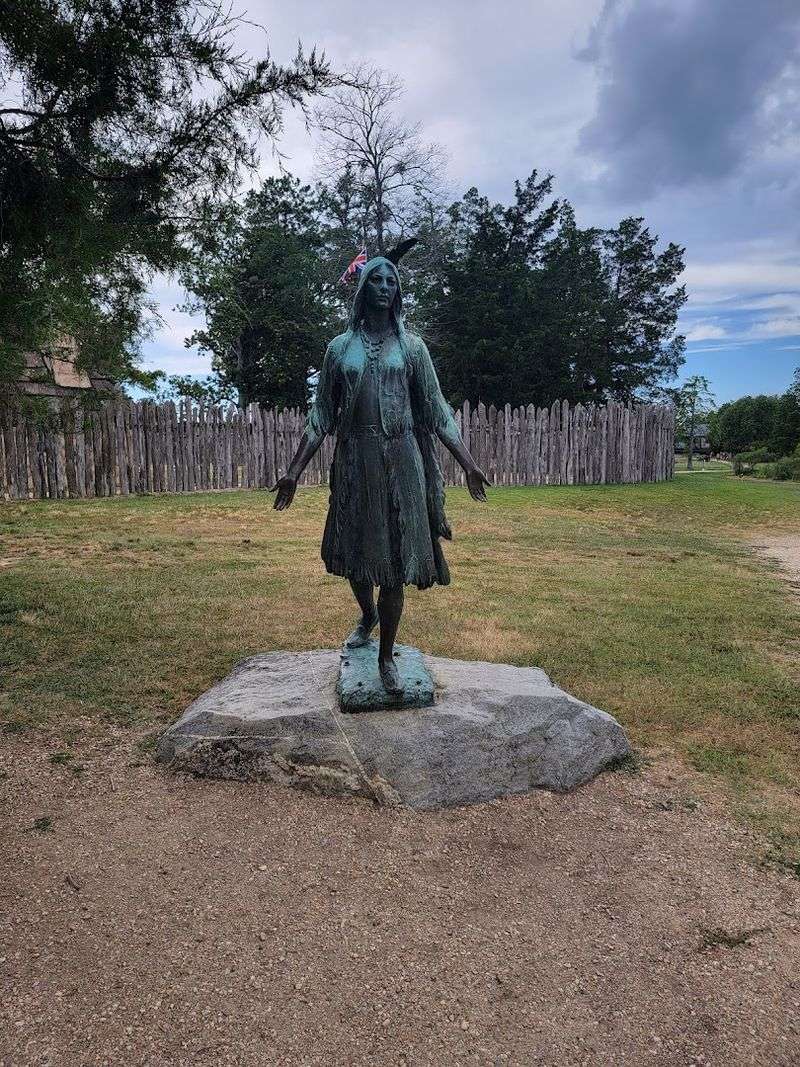
The statue captures Pocahontas in a commanding upright pose, projecting dignity and strength rather than submission.
What makes the commission even more interesting is the political and cultural climate of the early twentieth century, when Native American figures were rarely celebrated in this way. Virginia was bold to commission it, and the result is a sculpture that has only grown more meaningful with time.
Standing before it today, you feel the weight of that artistic intention.
Just How Tall Is This Thing, Really?
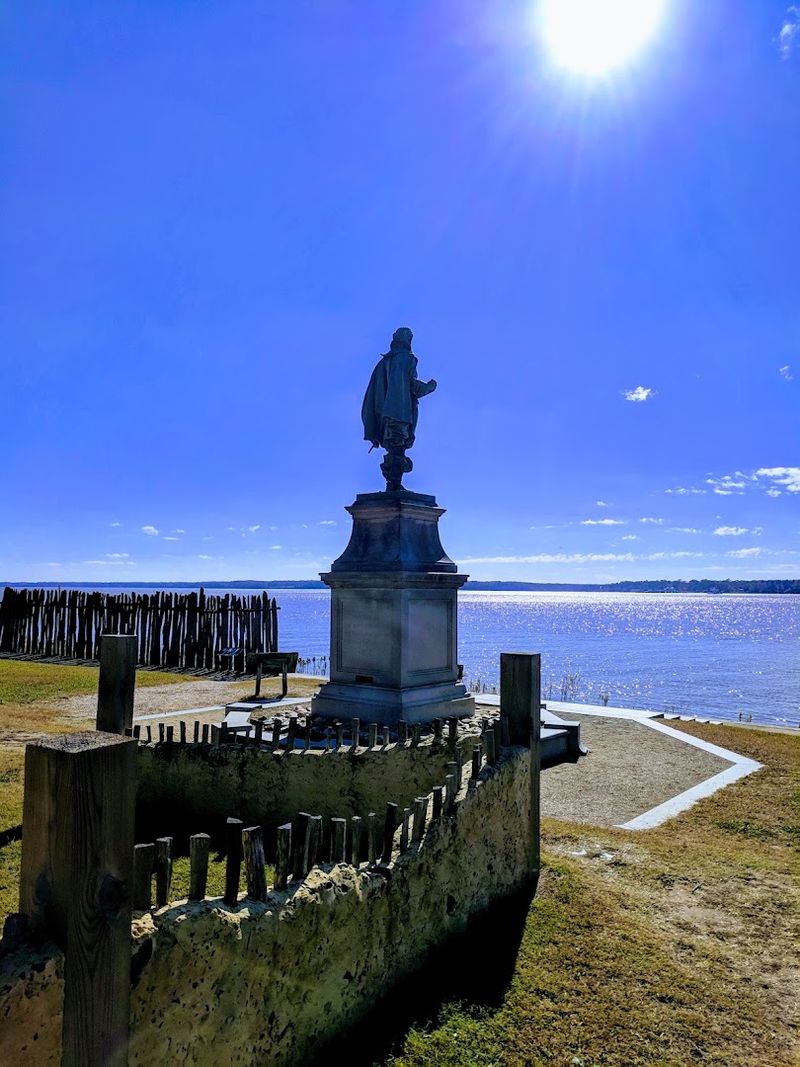
Standing nearly 18 feet tall including its pedestal, the Pocahontas Statue is genuinely, jaw-droppingly massive. Most people picture a modest garden sculpture when they hear the word statue, but this is something else entirely.
The sheer scale of it stops you mid-step the first time you see it.
The bronze figure alone commands serious vertical real estate, and the pedestal beneath her adds dramatic elevation that makes her visible from a distance across the grounds. On a clear day in Virginia, the statue practically glows against the blue sky, the bronze catching light in a way that shifts its appearance from warm gold to deep amber depending on the hour.
Scale matters in public art. It communicates importance, reverence, and permanence.
The decision to make this statue so physically imposing was intentional, a statement that Pocahontas deserved to be seen, not tucked away. Many tourists genuinely walk right past it because they are already scanning for the church ruins or the archaeological dig sites.
Take a moment to look up, and the scale alone will make your jaw drop.
The Historically Debated Outfit She Wears
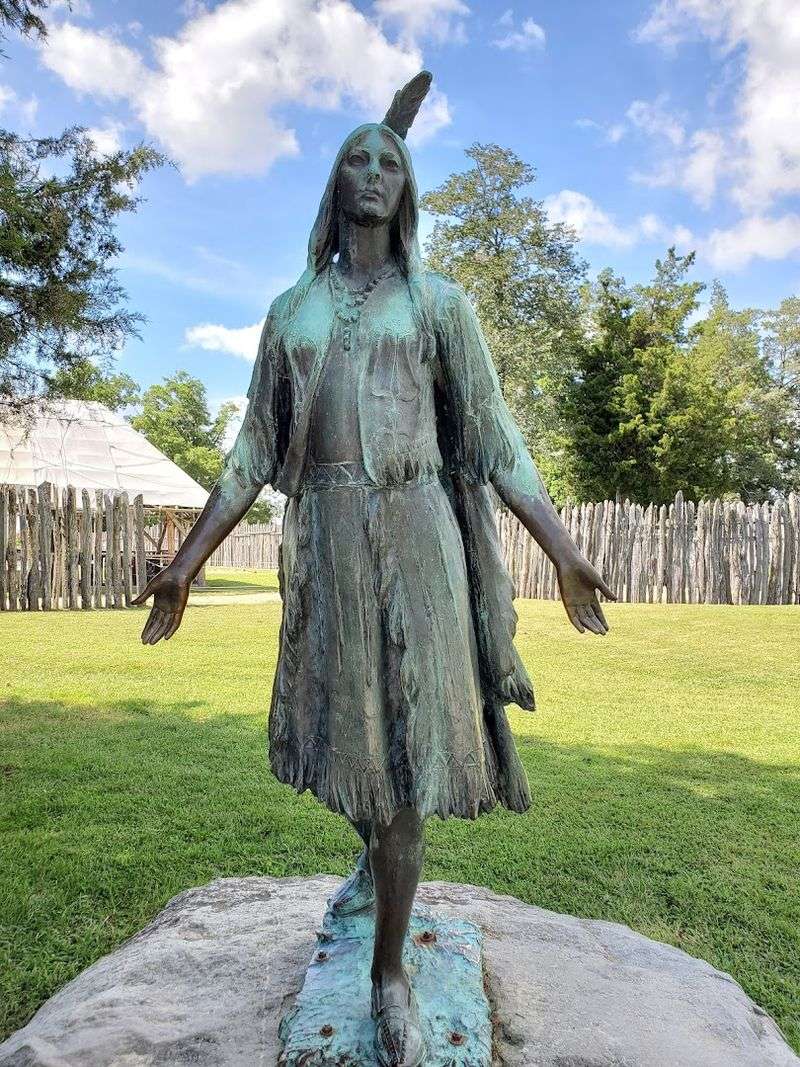
Here is where the conversation gets genuinely interesting. The attire depicted on the Pocahontas Statue has been noted by historians and cultural scholars as more consistent with Plains Indian clothing traditions rather than the Powhatan style that Pocahontas would have actually worn.
The Powhatan Confederacy was based in the Tidewater region of Virginia, and their dress was quite different from the romanticized imagery used in the sculpture.
This is not a minor footnote. It reflects a broader pattern in early twentieth-century American art, where Native American figures were often depicted through a generic, pan-Indian visual lens rather than with cultural specificity.
The sculptor, working in 1913, likely drew on popular imagery of the era rather than ethnographic research.
The statue’s inaccuracies do not diminish its power, but they do enrich the conversation around it. Historic Jamestowne itself acknowledges this openly, which speaks well of the site’s commitment to honest historical interpretation.
Visiting with that context in mind transforms the experience from simple sightseeing into a thoughtful reckoning with how America has chosen to remember its Indigenous figures.
The Glowing Copper Hands That Tell a Story of Their Own
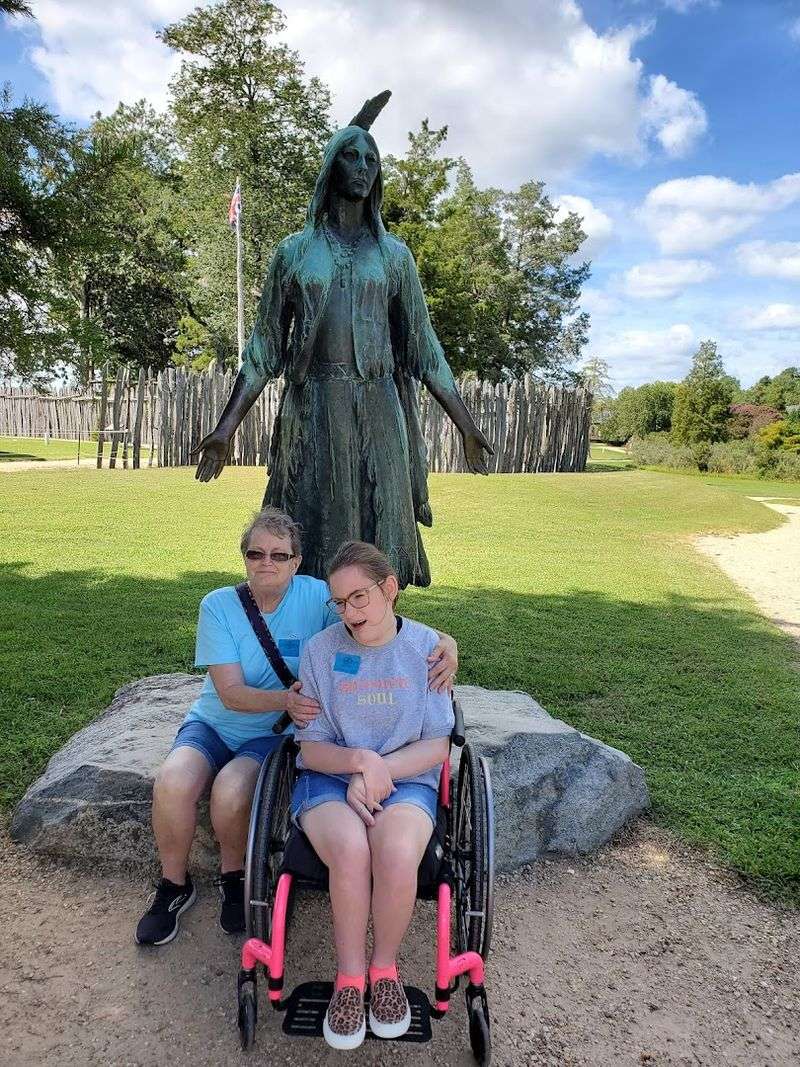
Look closely at the hands of the Pocahontas Statue and you will notice something striking. While the rest of the bronze figure has developed the deep, weathered patina you would expect from a century-old outdoor sculpture, her hands are a vivid, polished copper color.
They practically shine.
The reason is wonderfully human. Countless visitors over the decades have touched her hands while posing for photographs, and that repeated contact has worn away the oxidized surface, revealing the bright metal beneath.
It is a kind of unintentional folk art, a living record of every person who stopped, reached out, and connected with the statue.
There is something quietly moving about those glowing hands. They represent generations of curiosity, admiration, and the very human impulse to make physical contact with history.
In a place like Virginia, where history feels almost tangible in the soil and the air, those copper hands feel like a fitting symbol. The Pocahontas Statue at Historic Jamestowne does not just stand apart from its visitors.
In a very literal sense, it has been touched by all of them.
How the Statue Has Moved Around the Grounds Over the Years
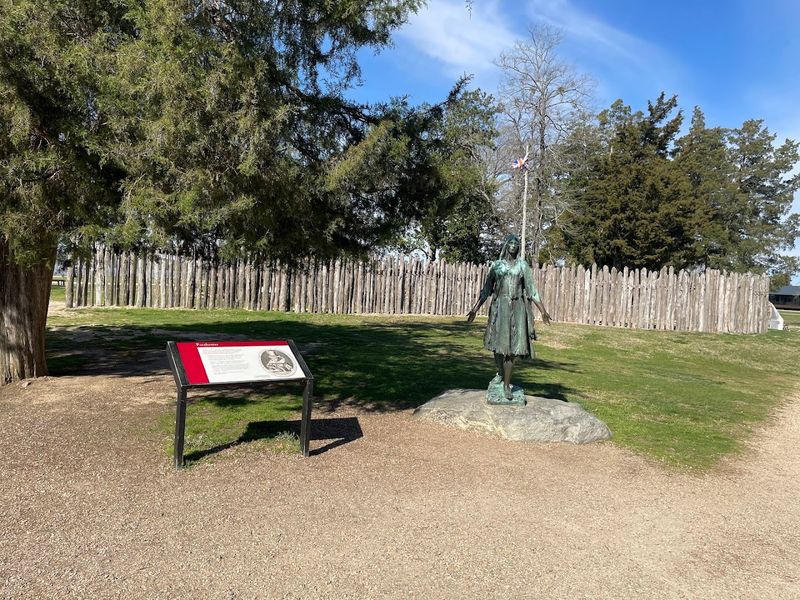
The Pocahontas Statue has not always stood where it stands today. Its journey around the grounds of Historic Jamestowne is itself a small piece of history worth knowing.
Originally positioned south of the 1907 Memorial Church, the statue was relocated in 1957 to its current spot near the entrance gate to accommodate ongoing archaeological work on the island.
Then, in 2014, it was moved again, this time just a few feet to the west, once more to facilitate excavations. The fact that archaeologists keep finding significant things in the ground around this statue says everything about the richness of Jamestown Island as a historical site.
The earth here is still giving up its secrets.
Each move has slightly changed the visual and spatial relationship between the statue and its surroundings. Today, positioned near the entrance gate, it serves as a kind of welcoming sentinel, the first major landmark many visitors encounter after entering the grounds.
That placement feels right. Pocahontas greeting you at the door of one of America’s oldest colonial sites carries a resonance that no signage or brochure could replicate.
Pocahontas Herself: The Real Woman Behind the Monument
Before the Disney movie, before the romanticized legends, there was a real person. Pocahontas was born around 1596, the daughter of Wahunsenaca, known to English colonists as Chief Powhatan, the paramount chief of the Powhatan Confederacy in the Tidewater region of Virginia.
Her birth name was Amonute, and she also carried the more private name Matoaka. Pocahontas was a nickname meaning playful one or ill-behaved child.
Her early life intersected with the English colonists at Jamestown in ways that were complex, politically charged, and often misrepresented in popular culture. She was captured by English colonists in 1613, converted to Christianity, took the name Rebecca, and eventually married tobacco planter John Rolfe.
She traveled to England, where she was presented at the royal court before dying in 1617 at roughly 21 years of age.
The statue at Historic Jamestowne honors this remarkable, complicated life. Standing before it with the actual history in mind makes the experience far more profound than a simple photo opportunity.
Virginia preserves her memory here, and it deserves to be received with the full weight of her real story.
The Replica That Crossed the Atlantic to England
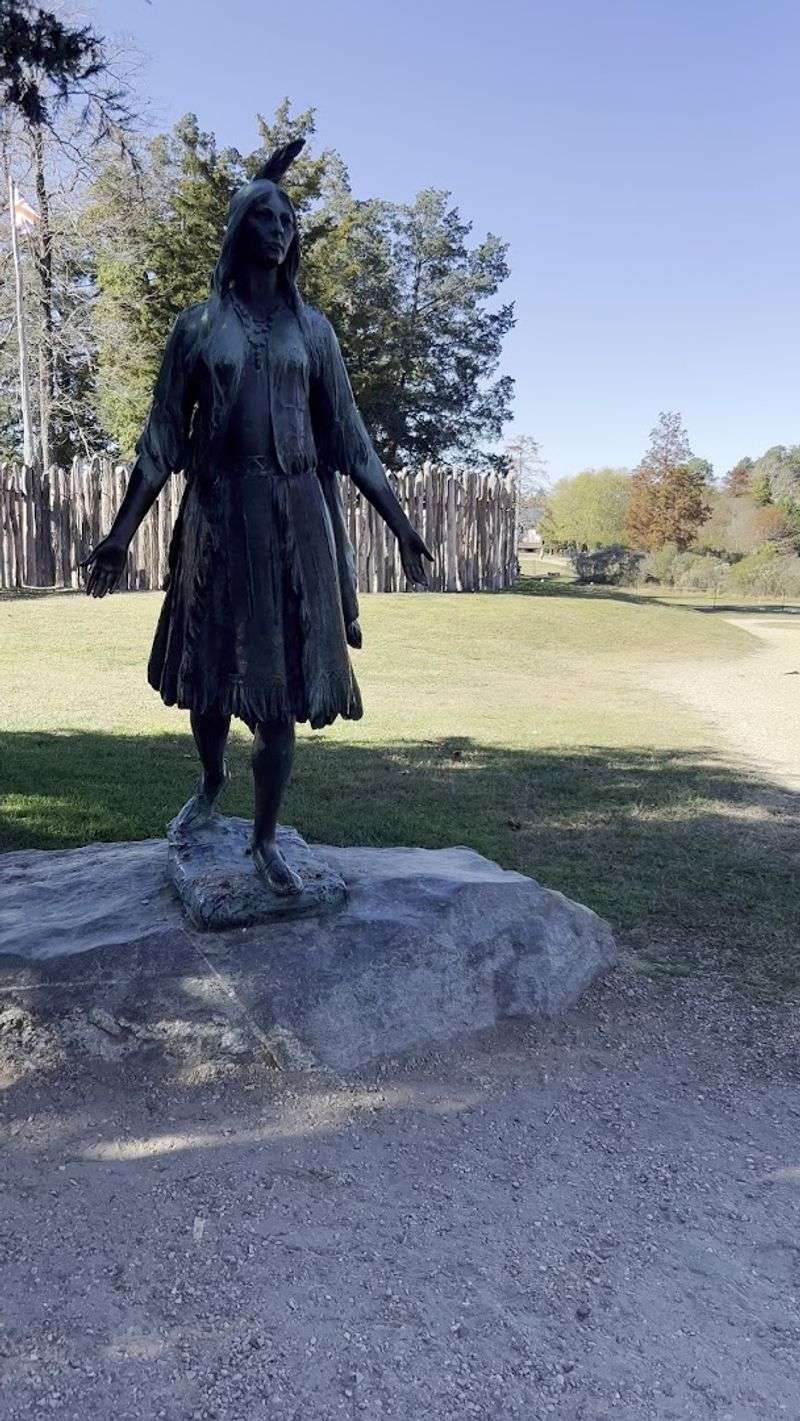
One of the most fascinating chapters in the story of this sculpture involves a second statue that now stands thousands of miles away. A reproduction of the Pocahontas Statue was presented to the British people by the Governor of Virginia, and it was installed at St. George’s Church in Gravesend, England, to mark the burial site of Pocahontas herself.
Pocahontas died in Gravesend in 1617 while preparing to sail back to Virginia with her husband John Rolfe and their young son Thomas. She was buried at St. George’s Church, and her grave has become a site of pilgrimage for people from across the world, particularly from the United States and from Indigenous communities.
The fact that Virginia sent a copy of this very statue to England as a gift creates a poignant transatlantic connection. Two bronze figures of the same woman, one in the land of her birth and one in the land of her death, standing as permanent markers of a life that bridged two worlds.
That story alone makes a visit to the original statue at Historic Jamestowne feel like something genuinely worth seeking out.
What the Surrounding Grounds of Historic Jamestowne Add to the Visit
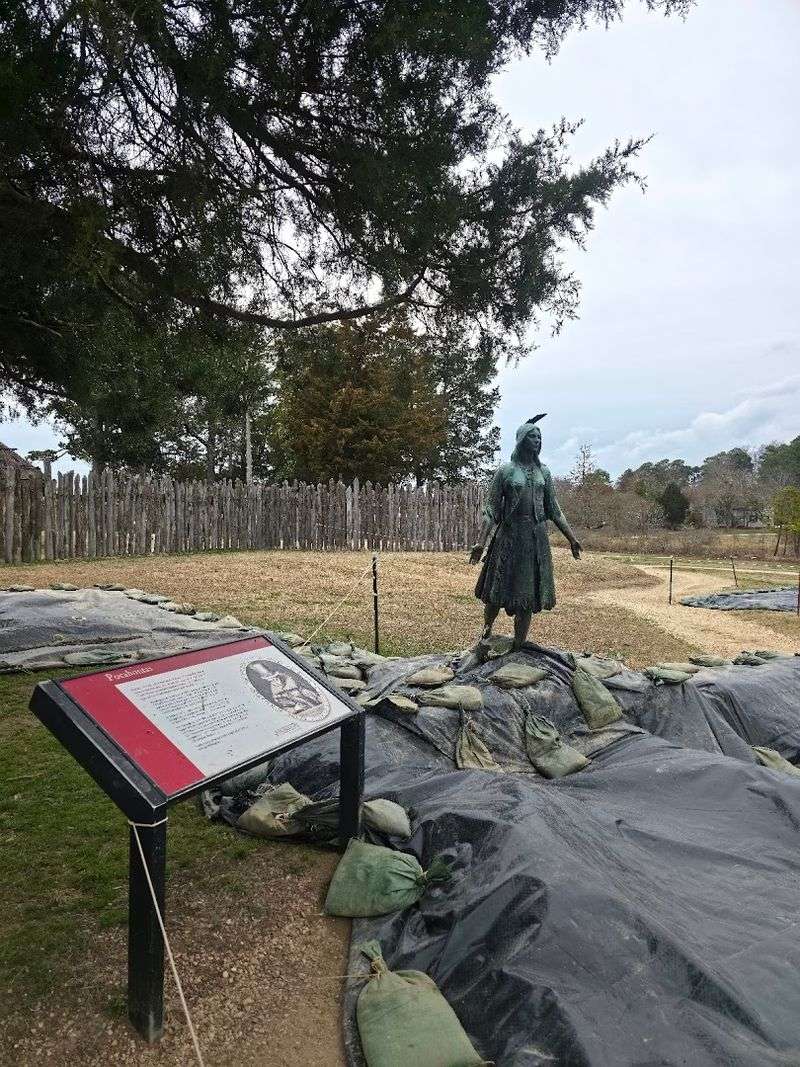
The Pocahontas Statue does not exist in isolation. It sits within one of the most historically dense landscapes in the entire United States.
Historic Jamestowne on Jamestown Island in Virginia is the site of the first permanent English settlement in North America, established in 1607, and the grounds are layered with centuries of human activity.
Walking the site means passing the ruins of the original 1607 James Fort, the Memorial Church built over the remains of the earliest church structure, and the active Jamestown Rediscovery archaeological project, where excavations have been ongoing since the 1990s. The dig has unearthed thousands of artifacts that have fundamentally reshaped our understanding of early colonial life.
The James River borders the island, providing a scenic backdrop that connects the present to the past in a visceral way. Standing by the water, you can almost picture the Susan Constant, Godspeed, and Discovery arriving in 1607.
The Pocahontas Statue anchors all of this history with a human face, a reminder that Indigenous people were here long before those ships appeared on the horizon. The entire site rewards slow, attentive exploration.
Why Most Tourists Actually Miss It (And How You Won’t)
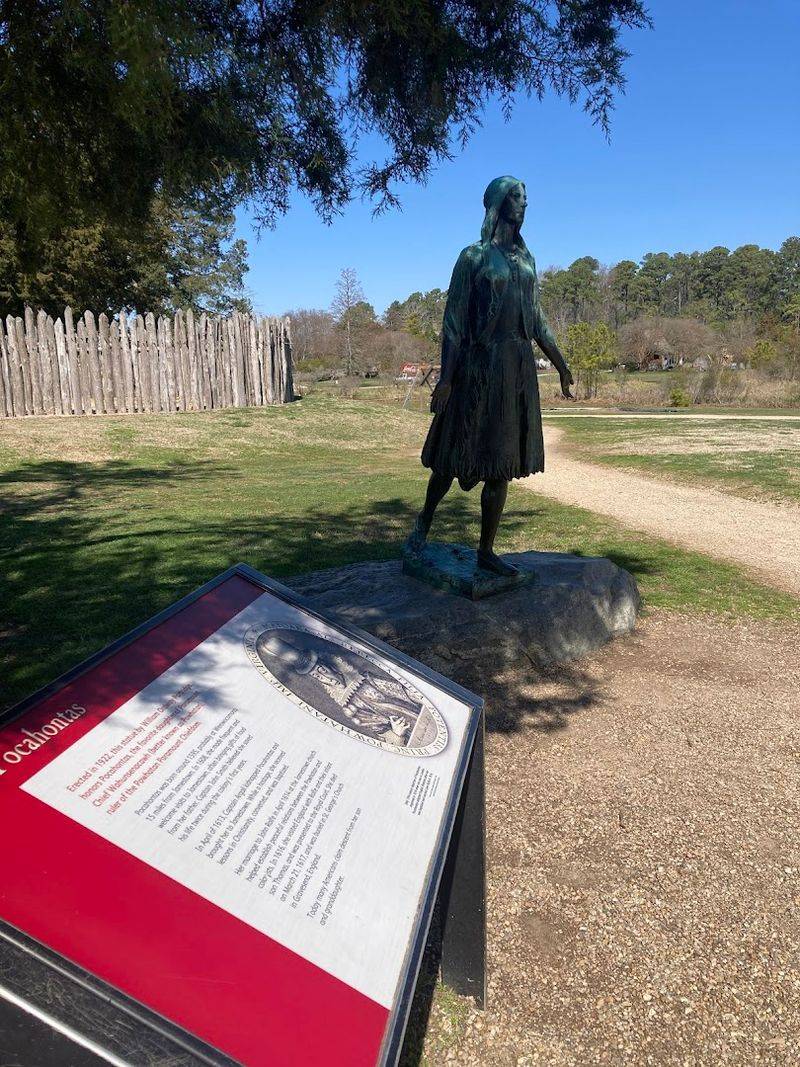
It sounds almost unbelievable, but the Pocahontas Statue genuinely gets overlooked by a significant number of visitors every single day. The reason is partly logistical.
When people arrive at Historic Jamestowne, their eyes go immediately to maps, signs, and the path toward the church ruins and the museum. The statue near the entrance gate is right there, but the brain in tourist mode tends to treat it as a landmark to pass rather than a destination to pause at.
There is also the issue of expectations. Many people associate the name Pocahontas with the animated film rather than with a real historical site, and when they arrive at a serious archaeological and colonial history destination, the statue can feel like a peripheral feature rather than a centerpiece.
My strong advice is to slow down before you do anything else. Stop at the Pocahontas Statue first.
Read the interpretive information nearby. Look up at the full height of the sculpture and take in the detail.
Give yourself five unrushed minutes with it. The rest of the grounds will still be there, and you will experience everything that follows with a richer, more grounded sense of why this place matters so much to Virginia.
Planning Your Visit to the Pocahontas Statue at Historic Jamestowne
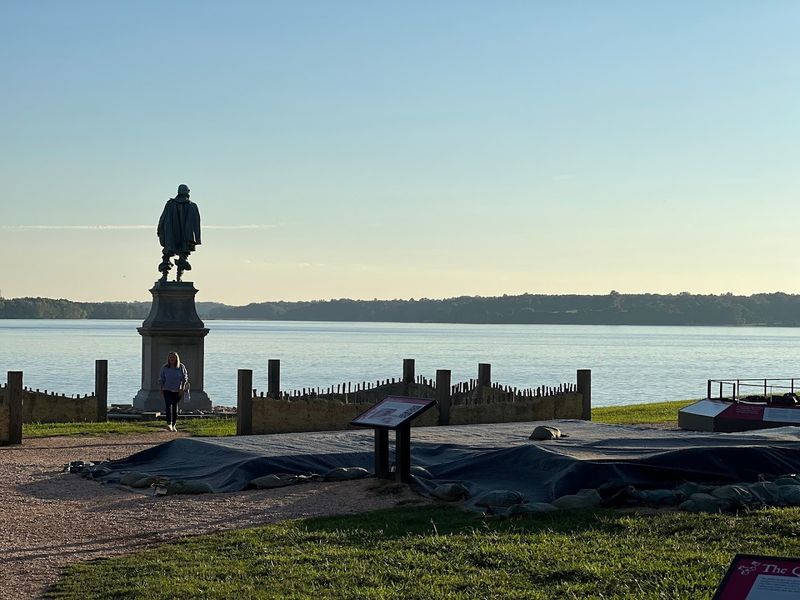
Getting to the Pocahontas Statue at Historic Jamestowne is straightforward once you know what to expect. The site is managed jointly by the National Park Service and Preservation Virginia, and accessing the statue requires entry to the Historic Jamestowne portion of the grounds, which is the Preservation Virginia side.
Plan for that accordingly when budgeting your day.
The address is located in Williamsburg, VA 23185, on Jamestown Island, and the site is part of the Colonial National Historical Parkway. Arriving in the morning gives you the best light for photographs and the most comfortable experience before the midday crowds arrive.
The grounds are open most days of the year, though it is always worth checking current hours before heading out.
Wear comfortable shoes, because the grounds are expansive and the walking is part of the experience. Bring water, especially in the Virginia summer heat, which can be genuinely intense.
The Pocahontas Statue is near the entrance gate, so you will encounter it early in your visit. My recommendation is to treat it as your starting point, let it set the tone, and let the rest of Historic Jamestowne unfold from there with full appreciation for the complex history all around you.
Dear Reader: This page may contain affiliate links which may earn a commission if you click through and make a purchase. Our independent journalism is not influenced by any advertiser or commercial initiative unless it is clearly marked as sponsored content. As travel products change, please be sure to reconfirm all details and stay up to date with current events to ensure a safe and successful trip.
