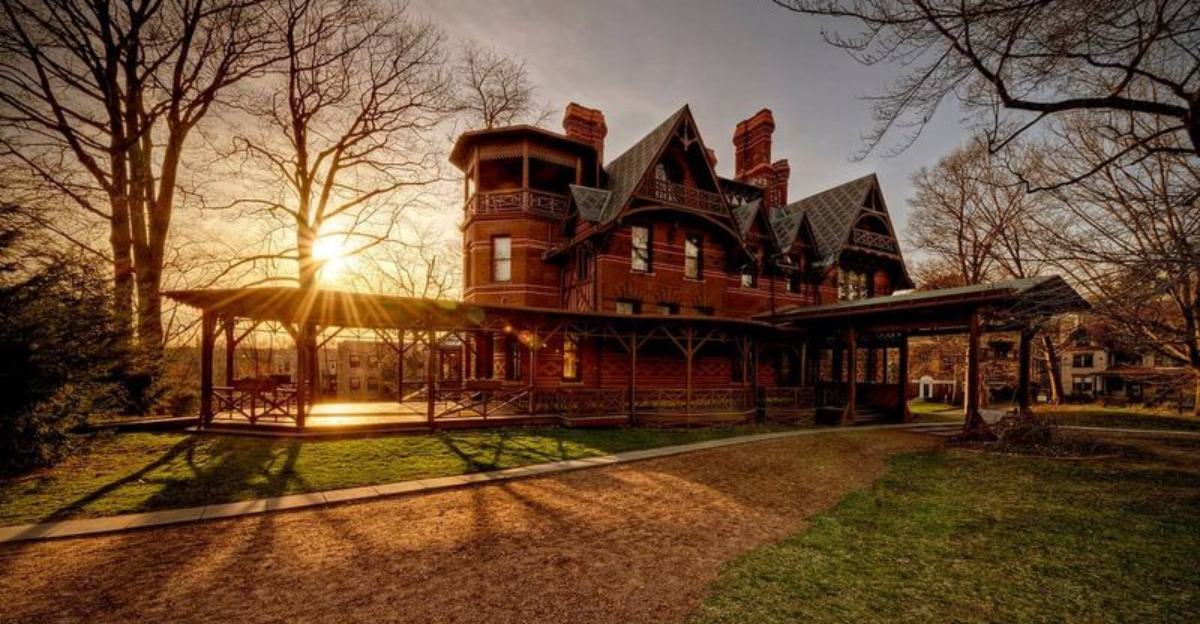
Step into the most private corner of Mark Twain’s Hartford home, where the writer guarded his solitude like treasure.
The third floor of his Victorian mansion at 351 Farmington Avenue once shut out almost everyone, yet now welcomes travelers.
Here, the billiard table doubled as a desk, and the walls held the rhythm of sentences that shaped American literature.
Visiting this level today is like opening a diary written in wood, fabric, and light.
The Billiard Table That Became a Desk
In Mark Twain’s third-floor study, the centerpiece wasn’t a conventional writing desk but a full-sized billiard table. On this green expanse he laid out chapters, proofs, and letters in sweeping order, visualizing his narratives at scale.
His desk, small and turned toward a blank wall, served as a secondary station, useful for handwritten corrections but never for sprawling thought. The felt surface gave him space to compare drafts side by side, trace continuity, and rearrange sections with ease. Olivia Clemens, his wife, handled these fragile manuscripts with care, ensuring each page returned to its place after edits.
This unusual workspace bridged leisure and labor, merging the calm of a game room with the rigor of a newsroom. When visitors see it today, they understand why the table stayed central to Twain’s method. It was not just furniture but an instrument of order, where play and productivity became the same gesture.
A Door That Said Not Now
The third-floor study served as Twain’s fortress of focus. Access was restricted to preserve an environment free of interruption, a rule as consistent as his writing schedule. The novelist could not risk stray conversation breaking the thread of thought that shaped his humor and criticism. While his home below bustled with music, guests, and family life, the top floor stayed still.
Only Olivia Clemens had the privilege to enter freely, often bringing correspondence or revised pages. This division between noise and quiet established the rhythm of the household. The rule was not cruelty but practicality; silence was part of his craft.
Today, the once-forbidden door opens easily for museum tours. Yet even with voices and cameras, the hush lingers. The room’s careful order, its measured spacing, deliberate furnishings, and closed walls, continues to express what Twain valued most: the steady discipline that lets imagination speak clearly.
Three Doors, Three Balconies, Three Views
Few nineteenth-century studies matched the inventiveness of Twain’s third-floor retreat, which opens onto three separate balconies overlooking Hartford. Each doorway frames a distinct slice of the city, the curved drive, the neighboring rooftops, and the soft line of the lawn. These balconies offered light, fresh air, and a literal step back from the page.
Twain used them as brief pauses during long writing sessions, pacing outdoors to let rhythm return before continuing. The design also moderated the climate inside; before electric fans or air conditioning, he could open one or more doors to channel breeze and sunlight.
The interplay between architecture and mood remains striking. Visitors standing there sense how the open air balanced the mental intensity within. The balconies were not luxury, they were tools, parts of a creative circuit that kept thought moving. From above Hartford, the writer managed both words and weather with quiet precision.
Olivia’s Custody of the Pages
Olivia Clemens stood at the heart of her husband’s creative system. She alone could touch the manuscripts that spread across the billiard table, keeping order as he moved between drafts. Her role combined editor, archivist, and quiet collaborator. She tracked revisions, transcribed changes, and organized correspondence that linked Twain’s Hartford study to publishers in New York and beyond.
In a time before carbon copies or typewritten duplication, accuracy depended entirely on trust. Their teamwork produced a flow that turned household space into an efficient literary office. Today, guides at the Mark Twain House explain how this partnership kept chaos from overwhelming invention.
Visitors hear about Olivia’s careful handwriting, her precision with page order, and her influence in maintaining deadlines. What appears a domestic arrangement was, in fact, an essential creative structure, two minds working in tandem, one shaping sentences, the other ensuring they survived intact.
Potter’s Tiered Retreat Above the Noise
Architect Edward Tuckerman Potter designed the Clemens home in 1874 to reflect both artistry and function. His tiered plan guided life upward toward privacy. The first floors hosted family and guests; the top belonged to work. The third-floor study’s height and isolation created a buffer against the noise of parlors and streetcars.
Potter’s brick and wood designs emphasized vertical rhythm, turrets, dormers, and gables that symbolized aspiration. Inside, narrow stairs led to rooms that felt increasingly secluded, a gradual retreat from public space to creative solitude. From the gardens below, visitors can see how the upper windows seem almost to float, catching sun while shielding their occupant.
The study’s placement shows how architecture can shape behavior. By lifting the workspace into the air, Potter gave Twain what he needed most: mental altitude. The design turned Hartford craftsmanship into a quiet machine for concentration.
From Game Room to Publishing Engine
Twain’s study balanced the energies of play and production. After long writing sessions, he would clear a section of the billiard table, rack the balls, and play short games to reset his focus. The same space where he refined Adventures of Huckleberry Finn or A Connecticut Yankee in King Arthur’s Court echoed with laughter between edits.
That rhythm of tension and release made the room feel alive, not austere. The lamps, cues, and worn felt remain as traces of that method. To modern eyes, the dual purpose seems odd, yet it captures the reality of creative work: discipline paired with relief.
The layout let Twain move physically without leaving his workspace, keeping momentum through motion. In Hartford’s museum today, the study appears as a self-contained engine, part leisure parlor, part publishing floor, where stories took shape under steady hands and the quiet click of returning balls.
Why the Third Floor Stayed Off Limits
Twain’s decision to close the third floor to his family was a rule of survival, not arrogance. Writing demanded unbroken hours, and even affectionate noise could scatter focus. The distance between living rooms and study stairs became a barrier against distraction.
Each morning he climbed into silence, and each evening he descended into family life renewed. That balance allowed him to maintain both devotion and productivity. The door to his study carried a clear message: entry required purpose. Olivia respected that boundary, teaching the household to treat work as sacred time.
Visitors now trace those same steps, passing through hallways once reserved for a single voice at a desk. Standing in the restored study, you feel how separation served creation. What once excluded now includes, allowing others to witness how deliberate solitude built some of America’s most enduring stories.
Guided Tours That Lift the Curtain
The Mark Twain House & Museum keeps this environment alive through guided tours that interpret every detail of daily life. Visitors follow a path from public rooms to the secluded third-floor study, learning how architecture, family, and work habits intertwined. Docents describe Twain’s morning routines, his editing process, and his quiet humor about needing distance from distraction.
The tours highlight original furnishings, stenciled walls, and preserved manuscripts. Nothing feels staged; authenticity is the point. Guests can view the balconies, the billiard table, and the desk just as Twain used them. Staff emphasize process over legend, showing how deliberate order supported creative freedom.
By the tour’s end, visitors understand that the house was more than a home, it was an instrument of focus. In Hartford, history is not frozen; it moves with every retelling, teaching what it means to protect the space where thought begins.
Architecture That Teaches Concentration
Climbing through Twain’s home is a lesson in attention. Each landing narrows sightlines and muffles sound, preparing you for the quiet at the top. Potter’s design acts like a physical meditation, guiding visitors from the social bustle below to the stillness of creation. The materials, brick, timber, plaster, speak softly, absorbing the echoes of footsteps.
By the time you reach the study, you have slowed your own rhythm, just as Twain intended. The third floor embodies the link between space and discipline: height equals perspective, separation equals clarity. Hartford’s light fills the windows, turning the room into both refuge and beacon.
The preserved structure reminds every visitor that focus is not an accident but something built, shaped, and defended. Architecture, in this house, becomes a tutor in concentration, translating nineteenth-century design into a timeless model for creative work.
Why Seeing It Now Matters
To visit the third floor today is to bridge past and present. The study reveals not a relic but a working idea, that creativity depends on intention and boundaries. You can stand where Twain drafted his masterpieces, seeing the pages and tools that carried his voice across generations. The room’s preservation invites reflection on how environment shapes outcome.
Each piece of furniture, each lamp and window, served a purpose in sustaining focus. The house also honors Olivia Clemens and the quiet labor behind public success. Together, they built a rhythm of order that outlasted its era.
Modern visitors leave with more than admiration; they leave with insight into how structure nurtures imagination. On stepping back onto Farmington Avenue, you feel the contrast between the city’s noise and the calm upstairs, and understand how stillness once fueled an entire literary world.
Dear Reader: This page may contain affiliate links which may earn a commission if you click through and make a purchase. Our independent journalism is not influenced by any advertiser or commercial initiative unless it is clearly marked as sponsored content. As travel products change, please be sure to reconfirm all details and stay up to date with current events to ensure a safe and successful trip.
