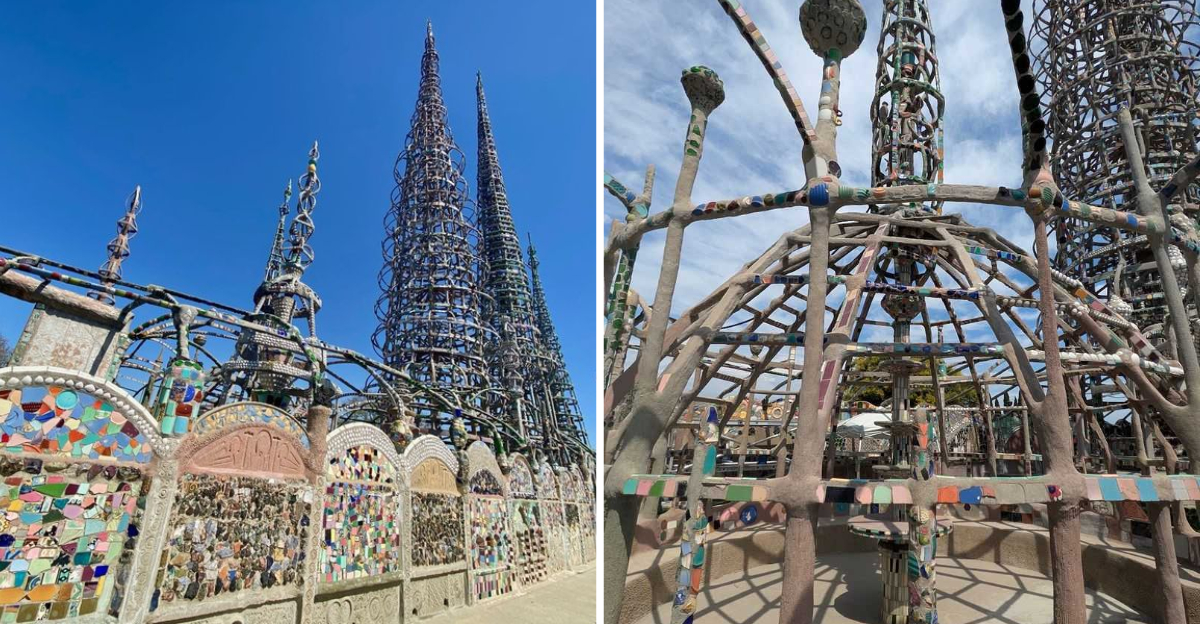
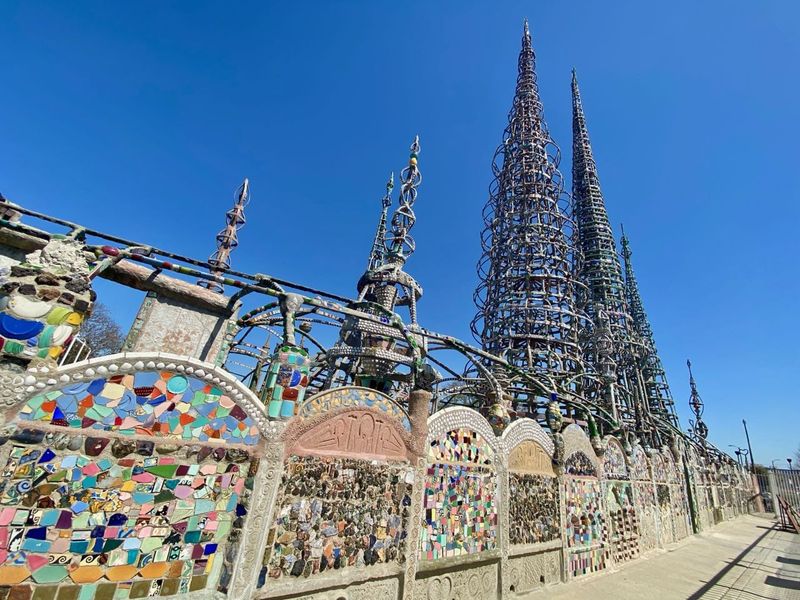
Spires of steel and mortar, studded with broken tile and green glass, rising above a quiet block of California houses like something out of a dream someone refused to wake up from. I had driven past this part of the state more times than I could count before I finally turned onto that street and saw them for myself.
The first thing I noticed was the sound, or rather the lack of it, because the block felt hushed compared to the rest of the city. Then I started spotting details: seashells pressed into cement, mirror fragments catching the afternoon light, hearts and shapes scratched into the surface by hand.
One man built all of this alone, over more than three decades, with no machines and no plans on paper. He worked at night after his day job, using whatever materials he could find, and he never stopped.
For a stretch in the mid-century, the city wanted the whole thing knocked flat. The towers survived, and they still stand, quietly claiming their space in a neighborhood that has long since learned to live with them.
Simon Rodia’s Thirty-Three Year Obsession
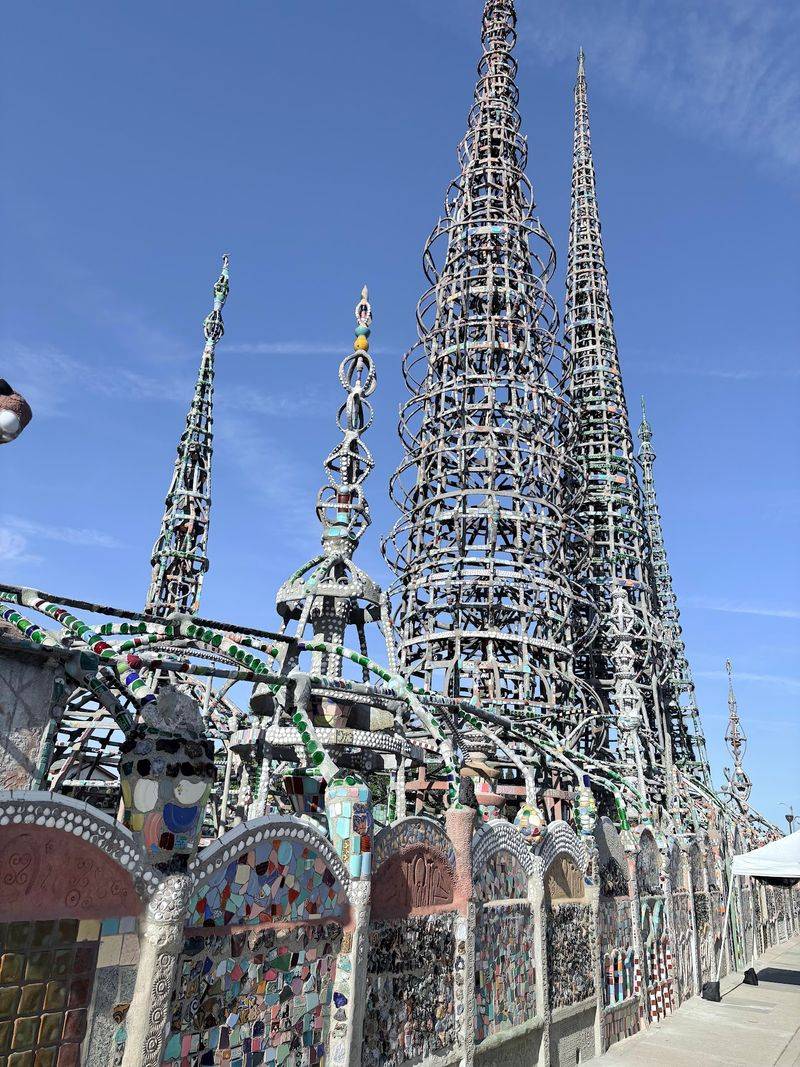
An Italian immigrant named Sabato Rodia, who most people knew as Simon, started building on a narrow triangular lot in Watts back in 1921. He was a tile mason and construction worker by trade, and he called his growing creation Nuestro Pueblo, meaning Our Village.
What gets me every time is how he worked. No scaffolding.
No cranes. No engineering drawings, no crew, no permits from a design firm.
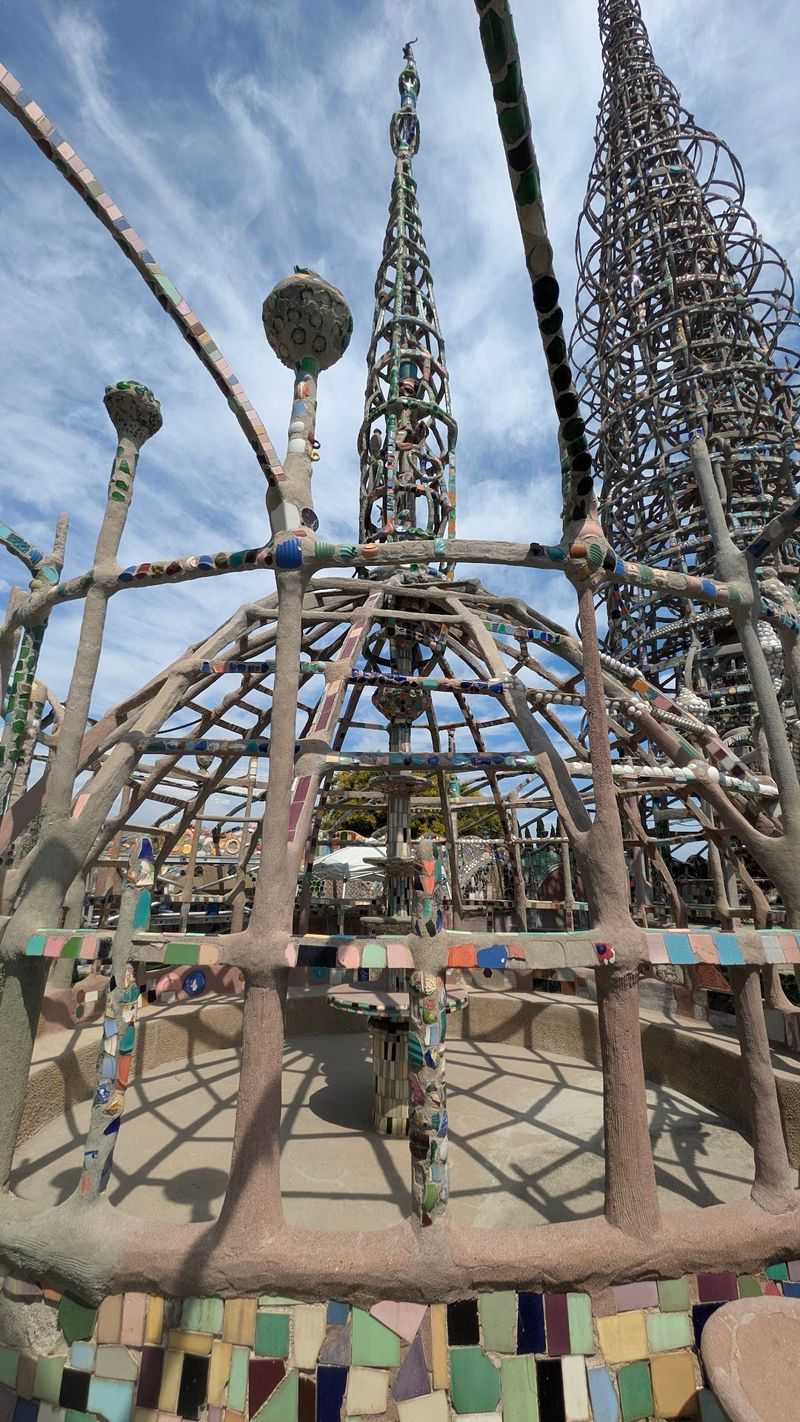
He climbed his own structures using window washer’s equipment and hand tools, bending steel rods, wrapping them in wire mesh, then packing on mortar by hand. Seventeen major sculptures came out of those decades of labor.
Rodia poured 33 years into the project, finally stopping in 1954 when he was in his mid-seventies. He deeded the property to a neighbor and moved north, apparently done with it.
Standing on the sidewalk looking up, I kept trying to do the math on how many hours that represents. It is the kind of number that stops feeling real.
What strikes visitors most is that this was nobody’s assignment. No museum commissioned it, no city planner approved it, no client paid for it.
A neighbor of mine once described obsession as love with no off switch, and that phrase kept looping in my head here. Rodia built because he wanted to build, and the result is one of the most singular pieces of self-taught art anywhere in the country.
You can see the whole exterior from the public sidewalk for free, which still feels like a small miracle.
A Mosaic Made From What Everyone Else Threw Away
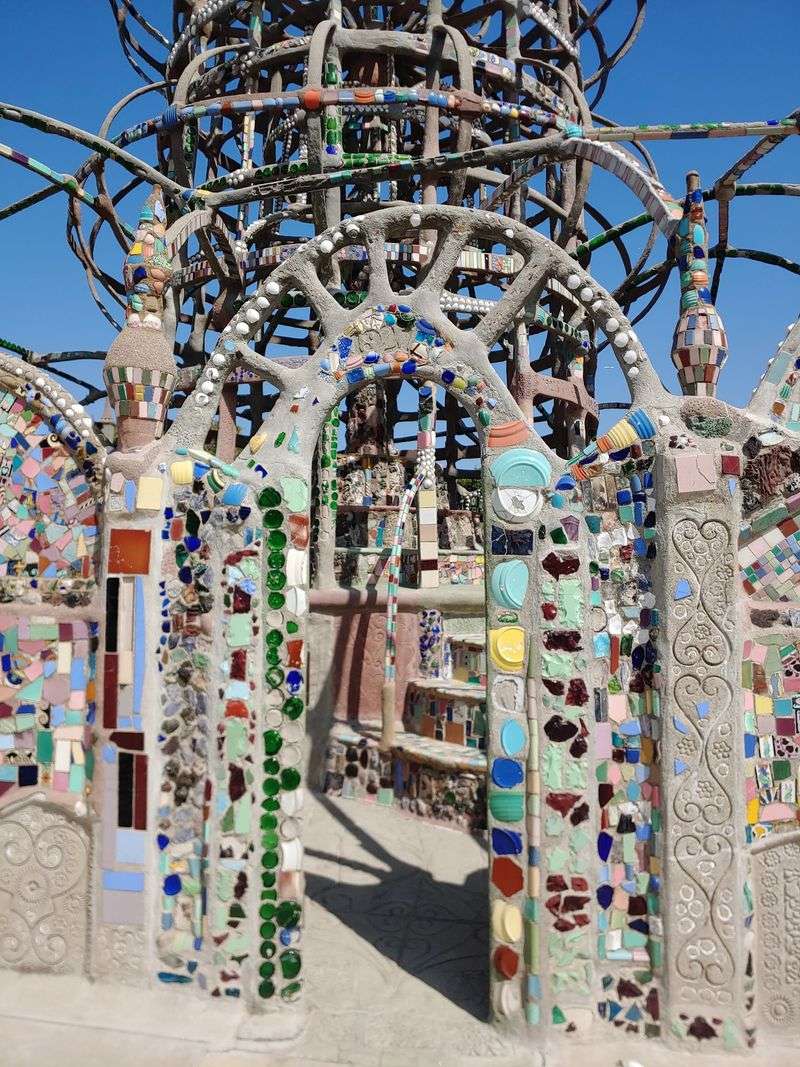
Get close to the walls and the towers stop being towers. They become a scrapbook of a neighborhood.
Rodia covered every surface with whatever he could gather: broken pottery, tile offcuts, seashells, mirror pieces, old bed frames, scrap metal, ordinary rocks from the ground. Bottle glass shows up constantly, and once you know what to look for the colors start naming themselves.
The soft green comes from 7-UP bottles. The deep cobalt blue comes from old Phillips’ Milk of Magnesia bottles.
I spent a solid twenty minutes crouched at one section just tracing patterns with my eyes. There are hearts, floral shapes, repeating rows of tile laid out with the patience of someone who genuinely enjoyed the work.
Sunlight is your best tool here. Mid-afternoon, the mirror fragments throw little flickers across the mortar, and the whole thing seems to shift as you move your head.
Bring a camera with a decent zoom or just use your phone up close, because the wide shots never capture what makes the surface special. Honestly, the details are the point.
Reviewers often mention the intricacy, and they are right. It is one thing to hear that a structure is made of garbage, and something else entirely to recognize a soda bottle from a century ago pressed into a wall like a jewel.
Rodia turned discarded material into decoration without irony or explanation, and that quiet confidence is part of what makes the place unforgettable.
When the City Ordered the Bulldozers
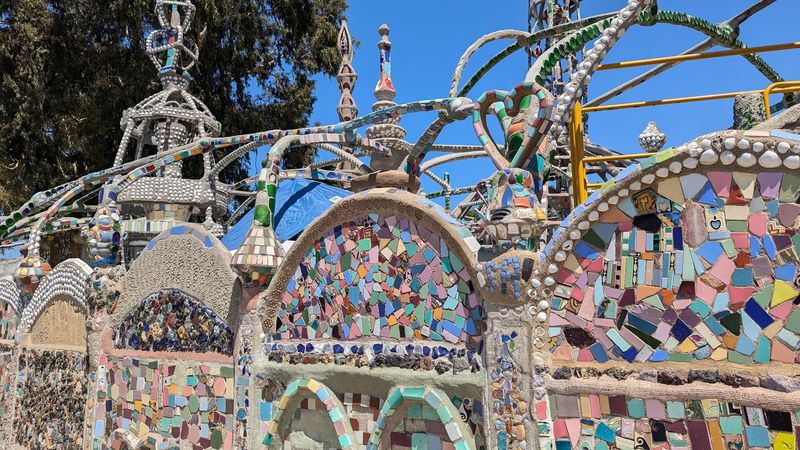
Here is the part of the story that makes my stomach drop a little. After Rodia left in 1954, the towers sat without their maker, and city officials decided the structures were unsafe.
A demolition order followed in the mid-1950s. Three decades of one man’s life, scheduled to be reduced to rubble because nobody in an office believed a self-taught mason could build something sound.
Neighbors had watched these spires climb into the sky for years, though. Long before critics and museums took notice, the towers were simply part of Watts, a landmark people gave directions by.
They meant something specific to the local African American and Latino communities: proof that one person could make something extraordinary in a neighborhood that too often got overlooked or shortchanged. Jazz bassist Charles Mingus, who spent part of his childhood in the area, grew up with that skyline.
Losing them would have erased more than sculpture. It would have erased a shared point of pride.
I find it hard to walk the sidewalk here without thinking about how close the whole thing came to disappearing. Cultural treasures do not usually vanish in dramatic fashion.
They vanish because a form gets stamped and nobody objects loudly enough. What saved Nuestro Pueblo was that people did object, and they organized fast.
Reading the interpretive plaques on site gives you the timeline, and I recommend taking a few minutes with them before you start photographing. The history changes how the structures look.
The 1959 Stress Test That Changed Everything
Artists, engineers, and residents formed a group called The Committee for Simon Rodia’s Towers in Watts, and they refused to accept the city’s safety verdict. Their argument was simple: test the structures before you destroy them.
So in 1959, that is exactly what happened. A steel cable was attached to the tallest tower and connected to a crane.
Then 10,000 pounds of sideways force was applied while officials watched.
The towers did not move. Not a shift, not a crack.
The testing equipment gave out before the sculpture did, which has to be one of the most satisfying outcomes in preservation history. The demolition order was revoked.
I love this moment because it proves Rodia understood structure in a way no diploma could certify. He had spent his working life with mortar and steel, and his instincts held up under pressure that would have flattened plenty of engineered buildings.
Public tours started in 1960, and people have been walking these grounds ever since.
The tallest spire climbs to about 99.5 feet, roughly ten stories. Looking straight up at it made me a little dizzy, in the good way, because the latticework seems far too delicate for that height.
Knowing about the cable test while standing beneath it adds something almost cinematic to the experience. You are not just looking at art.
You are looking at a structure that won an argument with the City of Los Angeles and never had to say a word.
The Arts Center, the Garden, and the Turtles Next Door
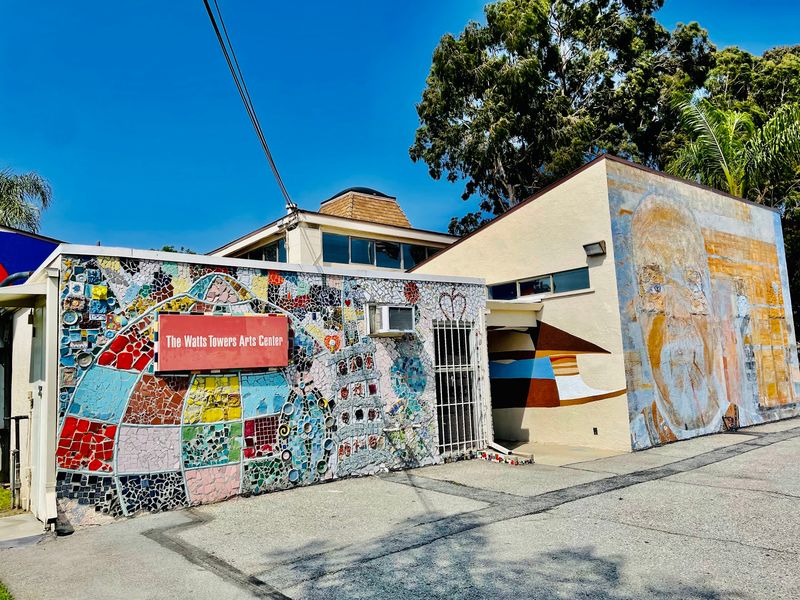
Right beside the towers sits the Watts Towers Arts Center, established in 1961, and skipping it would be a mistake. Inside there are exhibitions by local artists, workshops, classes, lectures, and music programming that keeps the site working as a living cultural space rather than a frozen monument.
The center uses Rodia’s sculptures as its anchor, which feels exactly right.
Outside, there is a small garden area, and visitors regularly mention the tortoise and turtles living there. One reviewer was told the tortoise is 23 years old, which delighted me more than I expected.
The public grounds include seating and patches of grass, so you can actually sit for a while instead of doing a quick lap and leaving.
A practical note on visiting: the towers themselves can only be entered on guided tours, and everything else you view from the public area. Several visitors have said the tour is worth it for the full story, and I agree that a guide fills in details the plaques cannot.
Access days are limited, so check the schedule before driving over.
Street parking on 107th can fill up quickly, and you may need to walk a block or two. The site is also a short distance from a Metro stop, which makes it one of the easier LA landmarks to reach without a car.
Plan an hour minimum. Two if you like reading plaques and staring at glass.
Address: 1765 E 107th St, Los Angeles, CA 90002
Landmark Status, Ongoing Repairs, and a Neighborhood That Held On
Recognition came slowly, then all at once. The towers became a Los Angeles Historic-Cultural Monument in March 1963, joined the National Register of Historic Places in April 1977, earned California Historical Landmark status in August 1990, and were named a U.S.
National Historic Landmark that December.
They are also part of Watts Towers of Simon Rodia State Historic Park.
Through all of that, the structures stayed physically untouched during periods of serious unrest in the neighborhood, including 1965 and 1992. That fact alone has given them a symbolic weight beyond anything Rodia could have planned.
Keeping them standing is constant work. The City of Los Angeles Department of Cultural Affairs manages preservation in partnership with organizations including LACMA, and conservators deal with real technical headaches.
Galvanized water pipes inside the mortar corrode over time, which threatens the sculpture from within. A major restoration project wrapped up in 2022, and upkeep continues.
If you visit and see scaffolding or a section fenced off, that is the site being cared for rather than neglected.
Knowing all of this made every shell and glass shard look more valuable to me on the way out. These towers survived a demolition order, a crane, decades of weather, and the slow chemistry of rusting metal.
Very few places in California carry that much stubborn history in one small triangular lot, and fewer still let you stand on a residential sidewalk to take it all in.
