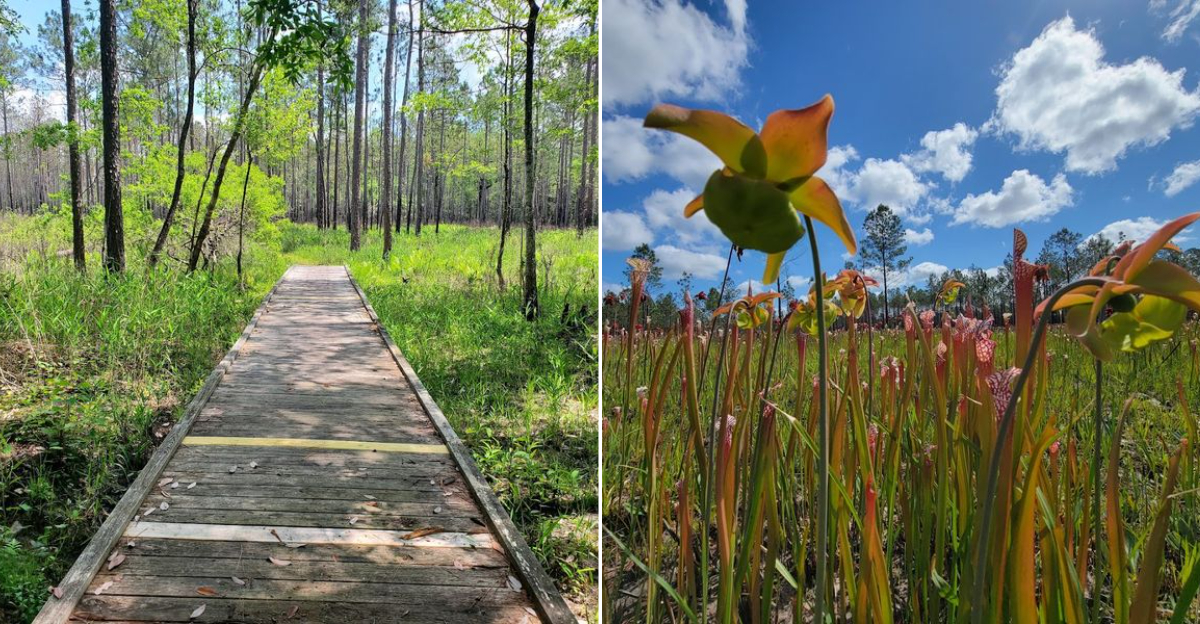
The plants here do not wait for bees to land politely. They lure them in, trap them, and slowly digest them for dinner.
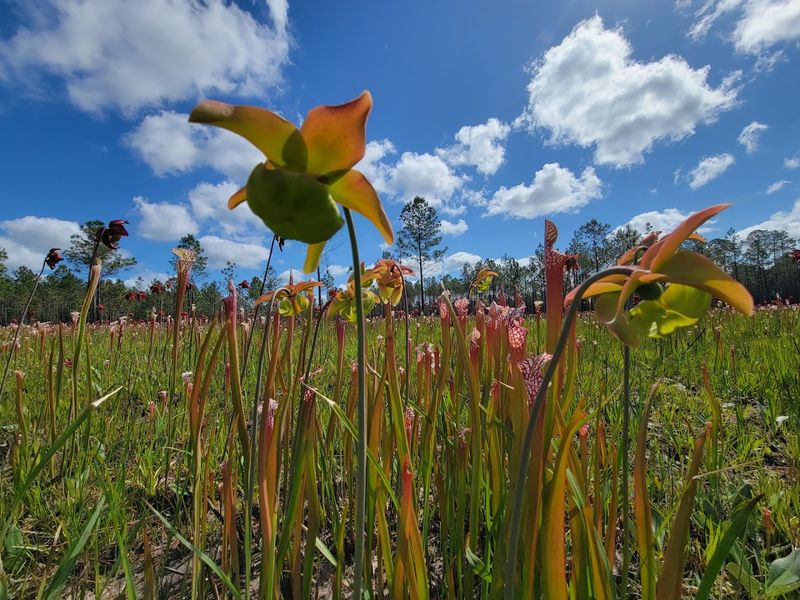
Welcome to one of the weirdest, wildest places in Alabama, a hidden preserve where thousands of carnivorous pitcher plants thrive in the sandy soil. The white topped tubes rise like eerie chalices, each one a death trap for unsuspecting insects.
You walk a short boardwalk that keeps your feet dry while you stare at a landscape that feels more prehistoric than present. Dragonflies zip past, birds call from the longleaf pines, and the pitcher plants just stand there, quietly eating.
It is strange, fascinating, and absolutely unforgettable. Kids love the gross factor, adults geek out on the botany, and everyone leaves with photos that make their friends ask, “Wait, that is in Alabama?” Yes, it is.
Go see nature at its creepiest and coolest.
Where The Landscape Starts Feeling Otherworldly
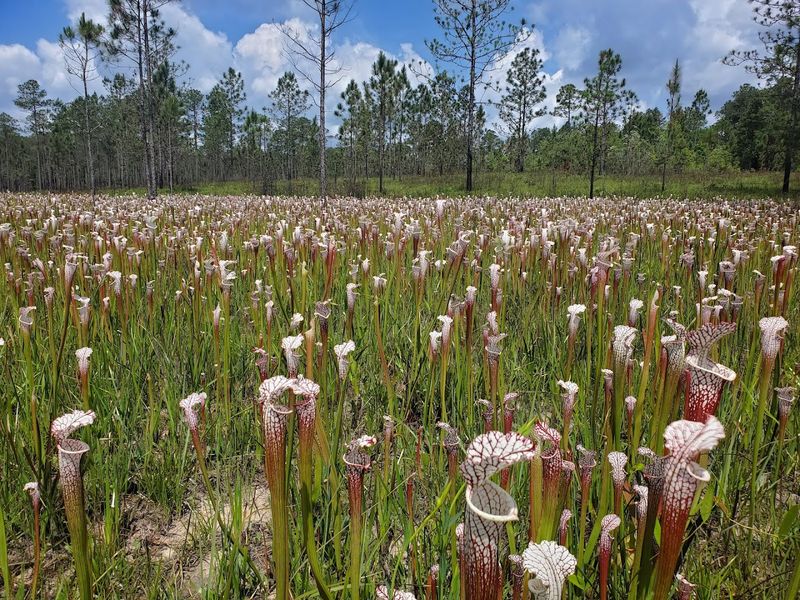
The weirdest thing, in the best way, is how fast the land changes your mood once you step near the bog. One minute you are in regular coastal Alabama scenery, and then you are looking across open wet ground dotted with pale pitcher plants that almost seem to glow.
It does not feel dramatic in a loud sense, but it does feel ancient, quiet, and a little surreal.
That is what stuck with me most, honestly, because the place lets the details do all the work. The longleaf pines stand back and give the bog room to breathe, the grasses move constantly, and the light seems to sit differently here than it does in a regular forest.
You start noticing shapes, colors, and tiny changes in the terrain that would be easy to miss somewhere less special.
Splinter Hill is part of one of the most important pitcher plant landscapes in Alabama, and you can feel that before you ever know the science behind it. The openness matters, the wetness matters, and even the stillness seems important.
If you like places that make you slow down without telling you to, this one really gets there.
It felt less like visiting a park and more like being let in on something old.
Getting There And Getting Your Bearings
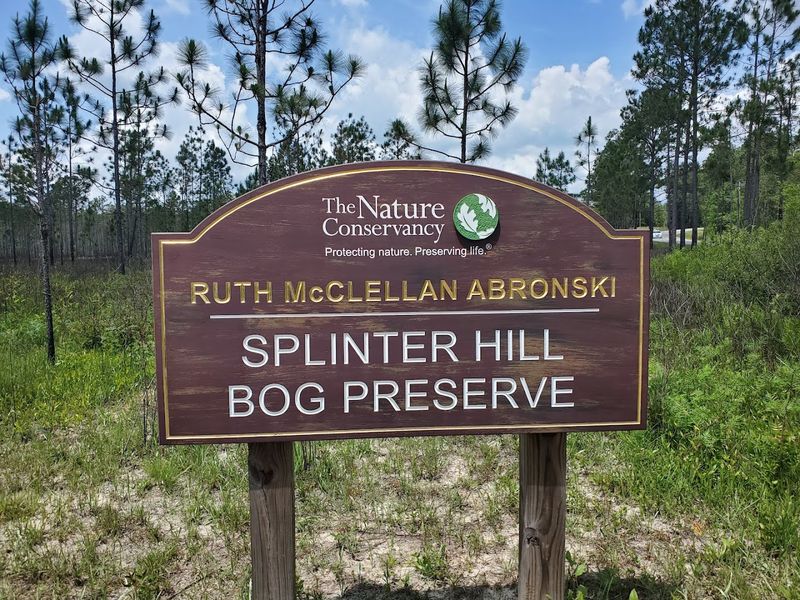
If you are the kind of person who likes knowing exactly where you are headed before the road gets quiet, here you go. The preserve is at Splinter Hill Bog Preserve, County Rd 47, Perdido, AL 36562, and the drive feels appropriately remote without being stressful.
That little sense of leaving everything else behind actually helps, because the whole experience starts before you even step out.
Once you arrive, it is not about flashy infrastructure or a big grand entrance, and I honestly appreciated that. The setting feels simple, rural, and very much tied to the headwaters landscape near the Perdido River.
You get the impression pretty quickly that the land itself is the reason to come, not the extras built around it.
This part of Baldwin County, Alabama, has that mix of piney quiet and coastal moisture that makes the bog feel right at home. Even the approach prepares your eyes for open patches, low vegetation, and that flat, luminous feel wetlands can have.
By the time you are ready to look around, you are already paying closer attention than usual.
That is a good mindset here, because this place rewards patience more than speed ever could.
The White Topped Pitcher Plants Steal The Show
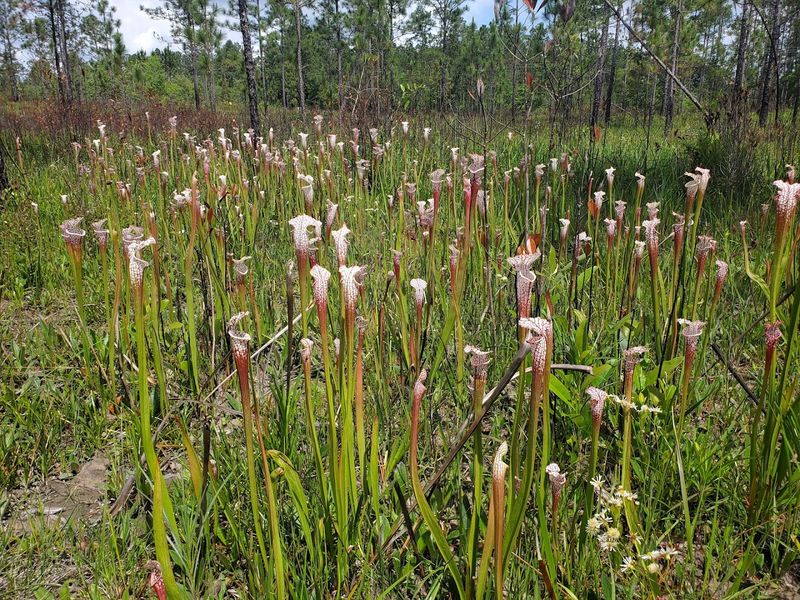
I knew the pitcher plants would be the headline, but seeing them in person still caught me off guard. The white tops shine against the greens and browns around them, so the whole bog starts to look lightly dusted with brightness.
It is beautiful in a very specific way, like the plants are delicate and tough at the same time.
What makes them so memorable is that they do not just sit there looking unusual for your benefit. These are carnivorous plants, and every tube, lip, and color shift has a job to do in a habitat that has been shaping them forever.
Once you start really looking, they stop feeling like oddities and start feeling like part of a deeply tuned system.
Splinter Hill is known as one of the largest white topped pitcher plant bogs on earth, which sounds huge and impressive, but it lands differently when you are actually standing there. Then it feels personal, almost intimate, because you are seeing thousands of individual plants in living texture.
Alabama has some remarkable wild places, and this one makes that point with zero effort.
I kept circling back with my eyes, because the plants somehow looked new every single time.
There Is More Than One Kind Of Hungry Plant Here
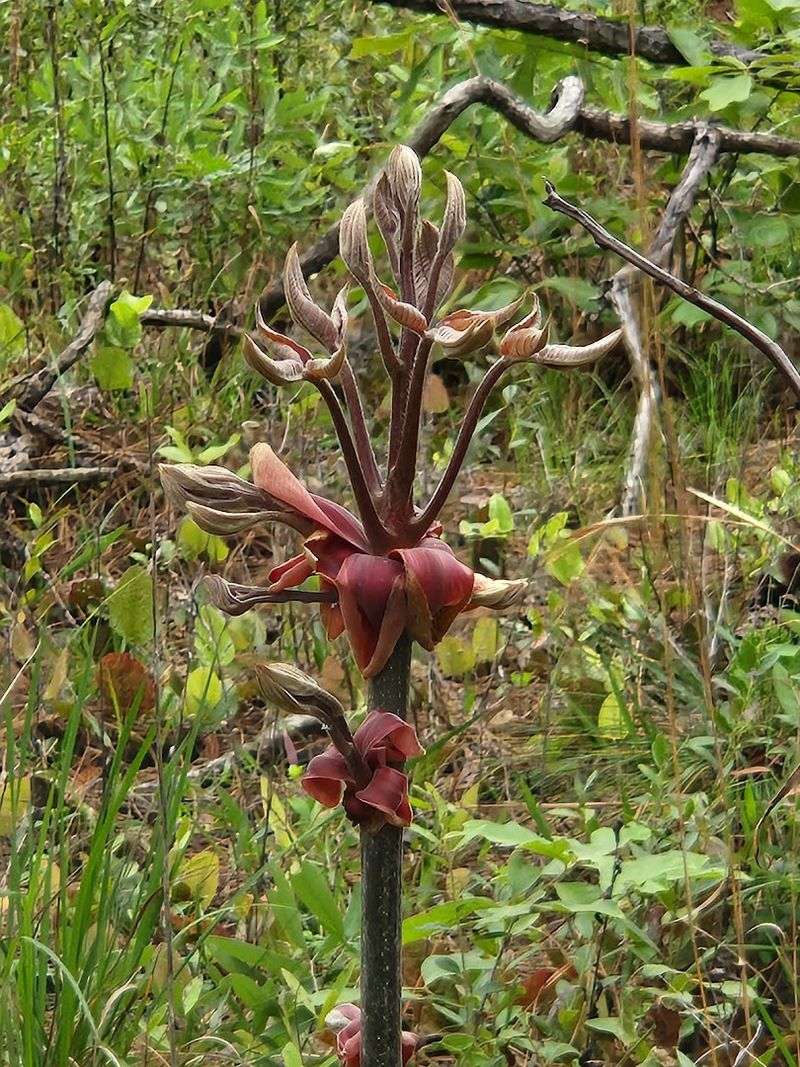
It would be easy to focus only on the pitcher plants and call it a day, but that would sell the place short. This bog supports a whole community of carnivorous plants, and that changes how you look at the ground once you know it.
You start realizing the landscape is full of tiny strategies, traps, and clever little adaptations.
There are multiple kinds of pitcher plants here, along with butterworts and sundews, which makes the preserve feel almost playful if you are into plant life. One species that gets a lot of attention is Wherry’s sweet red pitcher plant, and it adds another layer of rarity to an already remarkable ecosystem.
None of this feels museum-like, though, because everything is alive, shifting, and completely tied to the wet conditions around you.
I liked that the bog never turns into a checklist experience unless you want it to. You can come with a field guide and pay attention to every species, or you can simply notice that the place is buzzing with botanical personality.
Either way, Alabama ends up feeling much wilder and more biologically rich than people often assume.
That surprise is part of the fun, because the preserve keeps widening the story every time you look closer.
Why The Bog Stays Open And Sunny
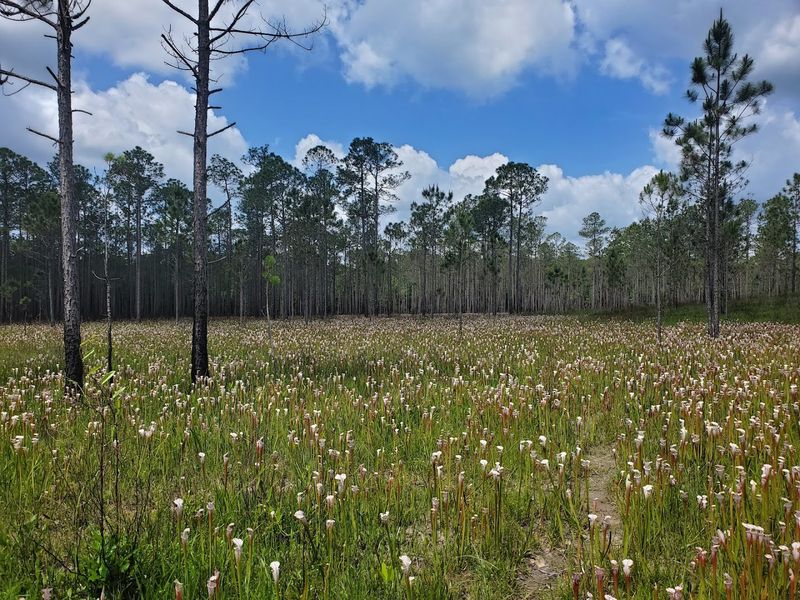
At first glance, you might wonder why the bog is so open when so much of the Southeast likes to grow thick and fast. Then you learn that open sunlight is exactly what keeps this system working, and suddenly the whole place makes more sense.
The pitcher plants are not asking for shade and crowding, and the preserve is managed with that reality in mind.
Fire is a big part of the story here, which sounds intense until you understand how natural and necessary it is in longleaf country. Prescribed burning helps hold back woody growth, keeps the habitat sunny, and supports the kind of conditions these bog species need.
Without that cycle, the landscape would slowly close up and lose the character that makes it so special.
I always appreciate when a place teaches you something just by letting you stand in it, and Splinter Hill does exactly that. The openness is not accidental, and the beauty is not separate from the management behind it.
In Alabama, some of the most impressive natural scenes survive because people are willing to work with the land instead of against it.
Once that clicked for me, every patch of sky above the bog started to feel meaningful.
You Really Need To Slow Down Here
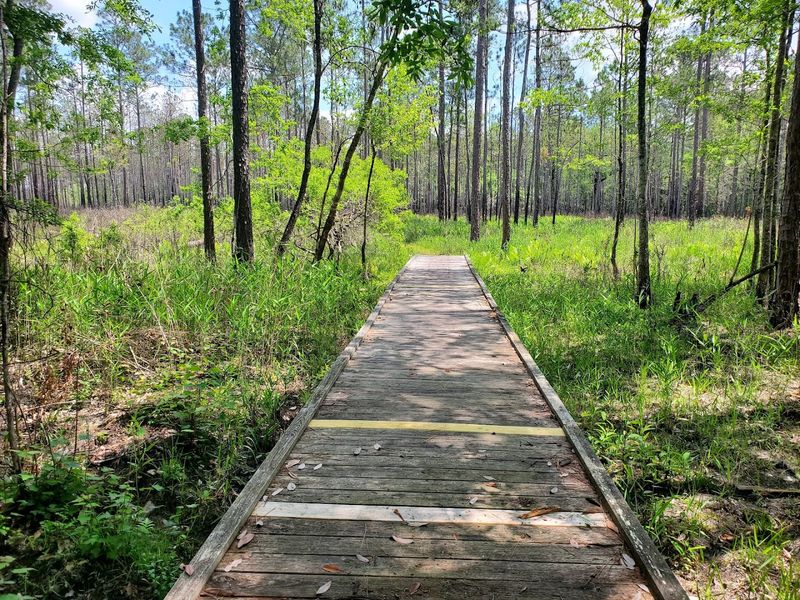
If you rush this place, you will miss half of what makes it work, and I mean that in the nicest possible way. Splinter Hill is not the kind of stop where you jump out, snap a picture, and feel like you got it.
The magic shows up gradually, after your eyes settle and your pace finally matches the land.
I started noticing little things only after standing still for a while, like how the breeze moves differently over wet ground and how the pitcher plants catch light from odd angles. Even the sounds feel spread out here, with birds, insects, and rustling grass never quite stacking into noise.
That gentleness makes the preserve feel restorative without becoming sleepy or dull.
If you are bringing someone who says they are not really into plants, this is still a good place to change their mind. You do not have to know every species to enjoy the feeling of being inside a rare ecosystem that still functions the way it should.
There is something deeply satisfying about a landscape that asks for attention and then actually rewards it.
By the end, I was moving slower than when I arrived, and honestly, that felt like the whole point.
This Is One Of The Gulf Coast’s Rarest Survivors
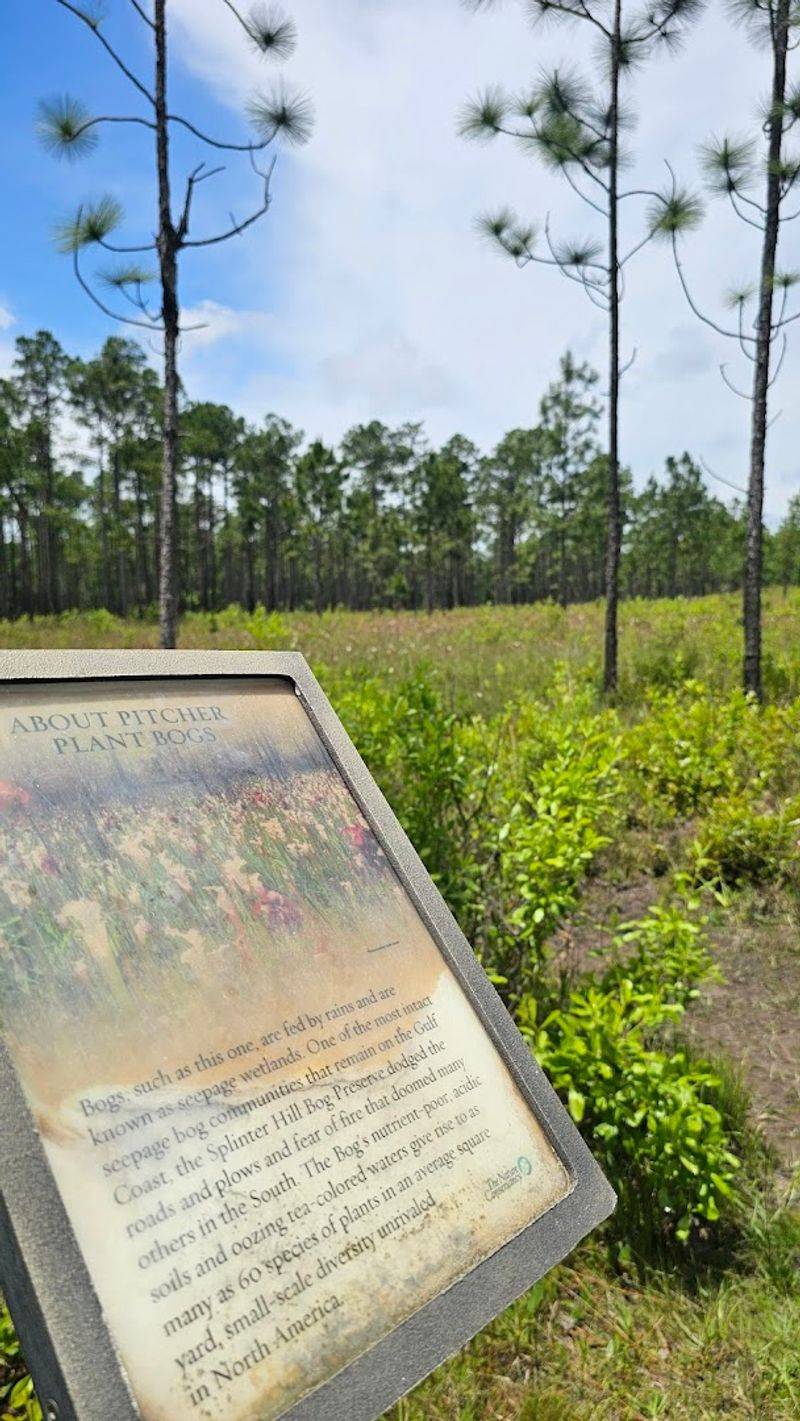
Here is the part that gives the whole visit some weight beyond the scenery. This preserve protects one of the last large, intact seepage bog systems along the Gulf Coast, which means you are looking at something genuinely uncommon.
It is not just pretty land, and it is not just quirky plant habitat, because the ecological value runs deep.
That matters even more once you understand how much of this kind of landscape has disappeared elsewhere. Wetlands get altered, forests change, water patterns shift, and suddenly the specific conditions that support species like these are gone.
At Splinter Hill, enough of the original character remains that the place still feels coherent, like the land remembers exactly what it is supposed to be.
I think that is why the preserve lands emotionally as well as visually. You are not only enjoying a beautiful stretch of Alabama, you are spending time inside a rare survivor that still supports extraordinary biodiversity.
Pitcher plant bogs are among the richest temperate habitats around, and standing in one makes that fact feel tangible instead of abstract.
It leaves you grateful, honestly, because places like this do not just happen by accident and keep going on their own.
The Headwaters Setting Gives It Extra Character
Something else I kept thinking about was where this preserve sits in the larger landscape. The bog lies near the headwaters of the Perdido River system, and that setting gives the whole place a feeling of source and beginning.
You can sense water shaping everything, even when it is not dramatically visible at every step.
That headwaters location helps explain why the preserve feels so layered instead of one dimensional. There are seepage areas, wetter pockets, rolling patches, and transitions into pine habitat, all connected by subtle changes in moisture and elevation.
It makes the walk feel more interesting because the scenery keeps shifting softly rather than staying fixed.
I always like places where geography and atmosphere are doing the same job, and that is definitely happening here. The land feels tender, porous, and alive, while also seeming sturdy enough to have held onto its identity for a very long time.
In southern Alabama, where rivers, wetlands, and forests overlap in complicated ways, this preserve gives you a particularly vivid look at that relationship.
You leave with a stronger sense that the bog is not an isolated oddball, but part of a much bigger living pattern.
