I speed along Interstate 15, the Mojave heat shimmering off the asphalt, my eyes scanning for a clue. Then I see it: a faded, warped billboard painted with a garish neon jester and the phrase “Rock-n-Roll” looming over nothing but rocks and dust.
That’s when I know I’ve found it. You’re driving between Los Angeles and Las Vegas, a journey through one of the driest places on Earth, when a flash of retro color catches your eye.
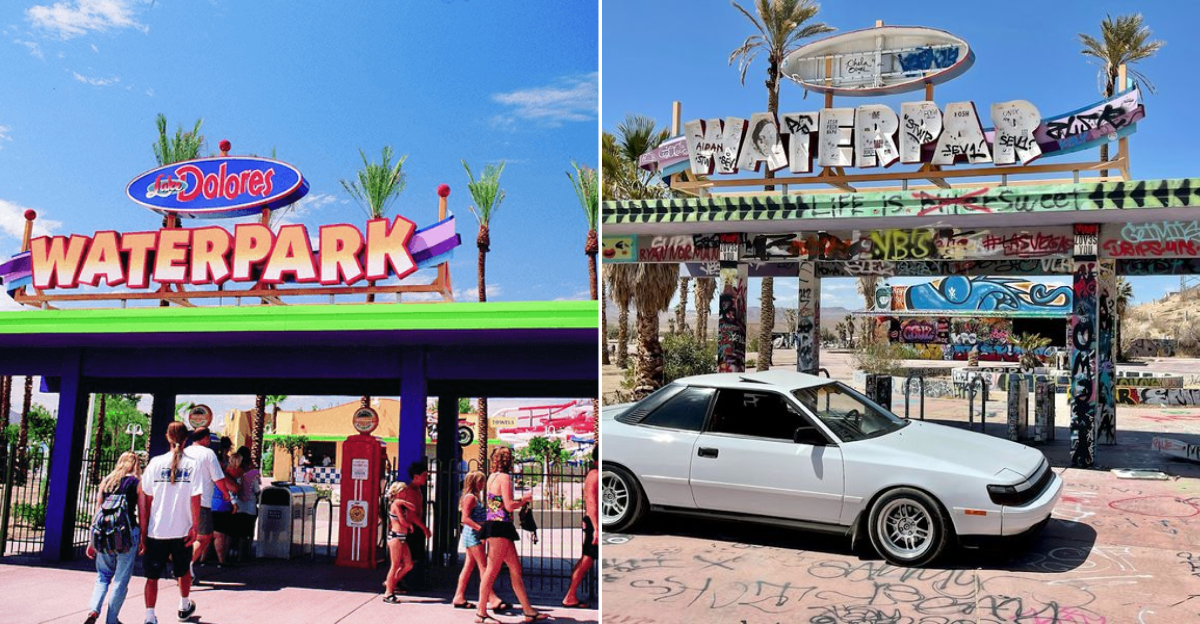
It’s not a mirage. Through the heat waves, you can see the skeletal remains of a waterpark, a place that was meant to be a paradise of splashing fun, now frozen in time as a surreal desert ruin.
It feels deeply ironic: a water park in the middle of the Mojave. But that contradiction is exactly what makes this spot so hauntingly beautiful.
The bright 1950s facades are now baking and peeling, the concrete pools are cracked and dry, and the massive steel slides stand as silent monuments to a dream that wilted under the relentless sun. It’s a truly unforgettable vision, a pop-art explosion abandoned to the sand and sky.
This is the ghostly allure of the abandoned Rock-A-Hoola Waterpark, a place where the music shut out long ago, leaving only the sound of the desert wind blowing through the skeletons of its slides.
A Watery Dream In The Mojave Desert
The first thing that hits me about Rock-A-Hoola is how wildly hopeful the whole idea must have felt when it began. Out here in the Mojave, where the light feels sharp enough to ring like glass, somebody looked at all that dry open land and imagined cool water, bright noise, and a place where families could shake off the desert heat.
That contrast still does something to you, even now, because the dream is still visible in the bones of the park.
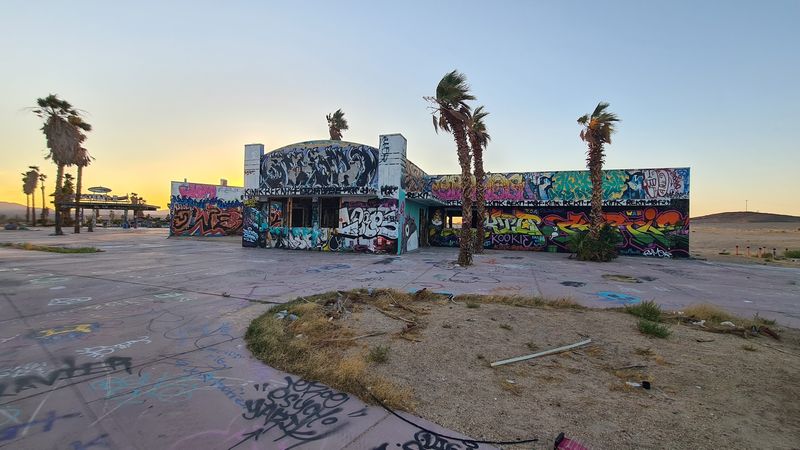
You can almost picture the old promise of it without trying very hard. The empty basins, the broad concrete paths, and the towering slide structures still suggest movement, chatter, and the kind of easy summer energy that once made the place feel bigger than its remote setting.
California has plenty of roadside oddities, but this one carries a strange sincerity that makes it harder to dismiss as just another abandoned attraction.
What I keep coming back to is how bold the original vision was. Building a water paradise in the desert sounds a little impossible, which is probably why it continues to grip people long after the gates stopped opening.
Even with the silence, or maybe because of it, the whole place still feels like a giant act of belief sitting under an enormous sky.
And honestly, that is what makes it unforgettable to me. It is not only a ruin, but a leftover wish, still standing in the sun.
The 1960s Birth Of An Oasis
What makes the early story so interesting is that this place did not start as some giant corporate stunt dropped into the desert. It began as a personal vision tied to underground spring water and the idea that a real oasis could exist out here, which honestly feels both ambitious and kind of sweet when you think about it.
The version tied to Rock-A-Hoola carries that older spirit with it, even if the names changed over time.
The address often connected with it is 1501 E Main St, Barstow, CA 92311, and even that sounds like the setup for a roadside daydream in California. Back in its earlier life, the park grew from a family-centered getaway into a bigger recreational stop, and that gradual change feels important because it explains why the place never fully lost its homemade heart.
You can sense that this was meant to be joyful before it was ever meant to be flashy.
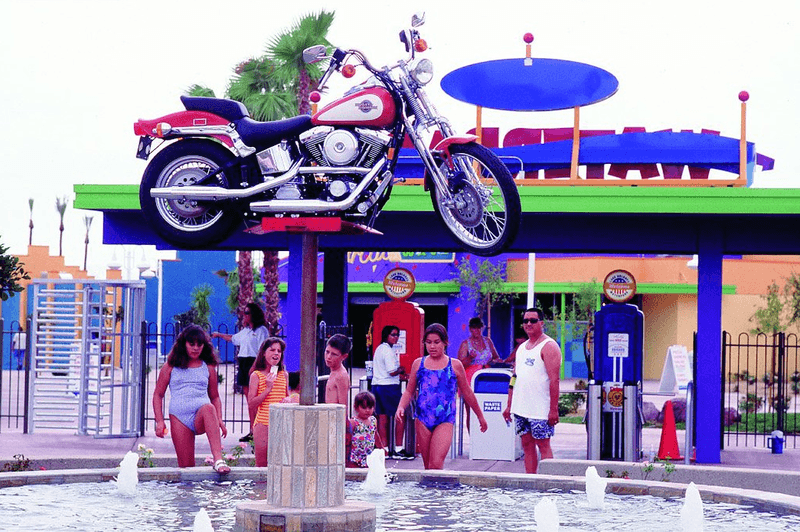
I like imagining those first seasons when the whole thing probably felt new in a very straightforward, human way. A patch of desert was transformed by water, shade, and the promise of escape, and people showed up because the contrast itself must have felt magical.
There is something deeply American about that kind of confidence, especially in California, where reinvention always seems one step away.
That origin story gives the ruins more weight for me. You are not just looking at failure, but at a dream that once genuinely worked.
The Echo Of Splashing And Laughter
There is a certain kind of silence in abandoned places that never feels fully empty, and this park has that in a big way. You look at the old pool edges and broad walkways, and your brain starts supplying the missing soundtrack all by itself, with splashing, shouting, and the constant background hum that water parks always seem to carry.
It is eerie, but not in a cheap spooky way.
What gets me is how easy it is to imagine ordinary happiness here. Not grand history, not some polished legend, just everyday summer chaos with bare feet on hot pavement and people calling out to each other across the water.
Those traces feel stronger because the layout still makes sense, so you are not guessing at the past so much as stepping into its outline.
I think that is why the park keeps drawing people who are fascinated by ruins. It is not only about decay, because decay alone can get repetitive, and you know that if you have seen enough abandoned spots.
Here, the emotional residue is stronger than the damage, and that gives the place a weird tenderness beneath all the concrete and dust.
Standing in front of empty spaces that were built for noise can really mess with your sense of time. You start hearing the park that used to be there, even while the desert keeps insisting on the present.
Bright Slides Under The Desert Sun
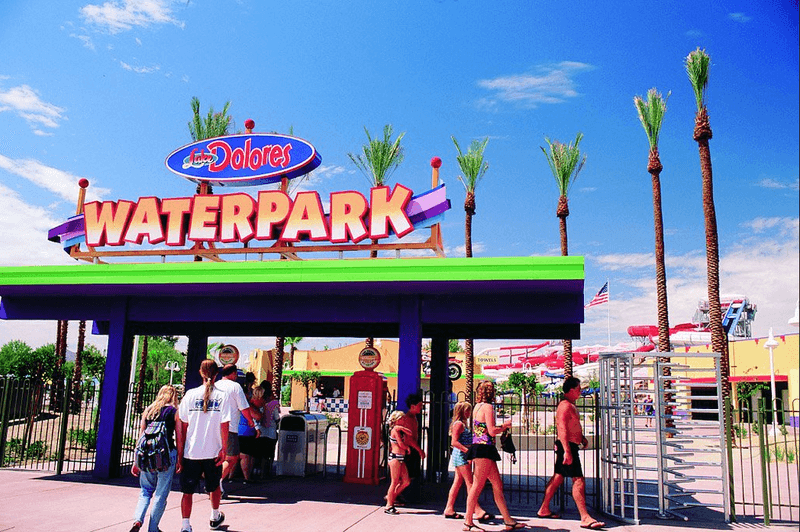
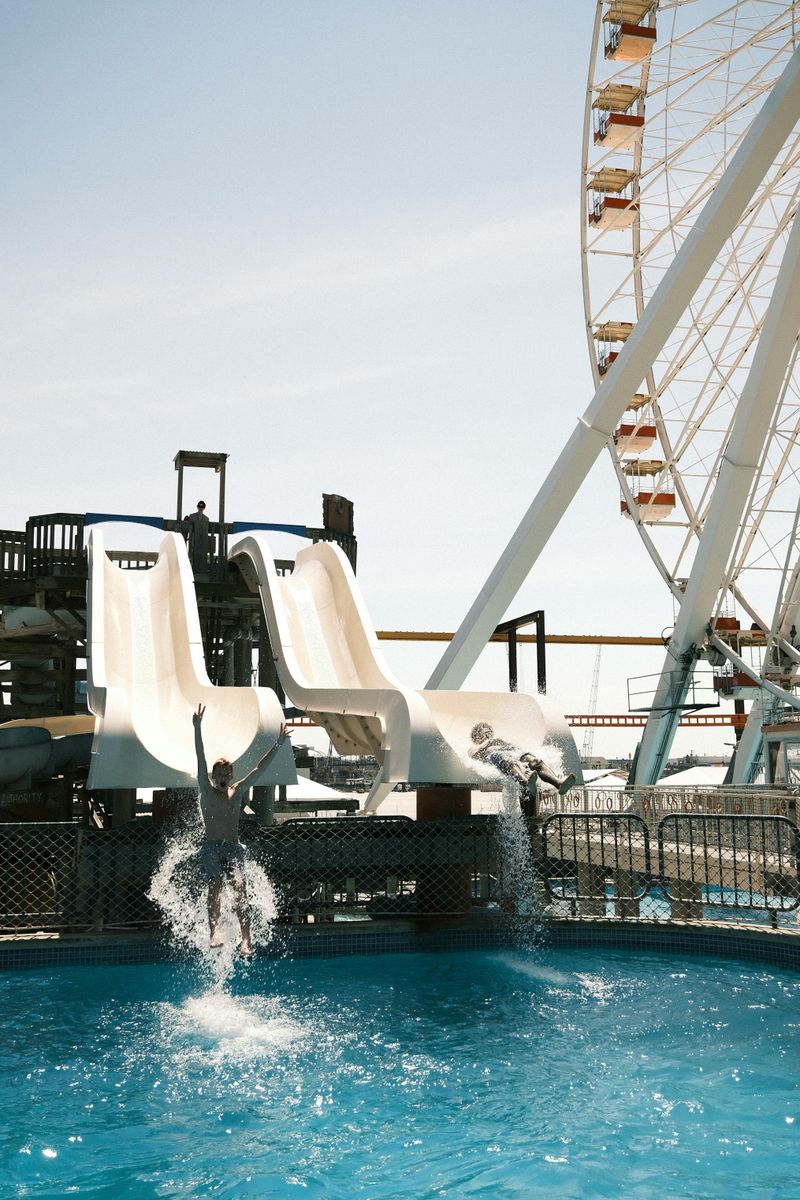
If you have ever seen photos of the slide towers out here, you know exactly why they stick in your head. Even drained of purpose, those huge curves and chutes still look like they were built for noise, speed, and that split second of hesitation right before you throw yourself downward.
Under the desert sun, the whole setup feels almost too bright for something so quiet now.
What I love is how the structures still hold onto a bit of showmanship. They were never meant to blend into the landscape, and that is probably why they look so surreal against all that dry California openness.
A water slide belongs to laughter, wet footsteps, and long lines of impatient kids, so seeing one stranded in silence feels oddly theatrical, like a stage after the audience has gone home.
You can tell the park once leaned hard into spectacle, and honestly, that was part of the charm. The bold shapes, the visible height, and the way everything had to compete with the giant desert around it meant the slides had to announce themselves from a distance.
Even now, they still do, just in a completely different voice.
Instead of calling people in for a day of fun, they stand there like giant punctuation marks in the sand. I think that is why they photograph so well, because they still look ready, even when nothing is happening.
A Sudden Hush Over The Park
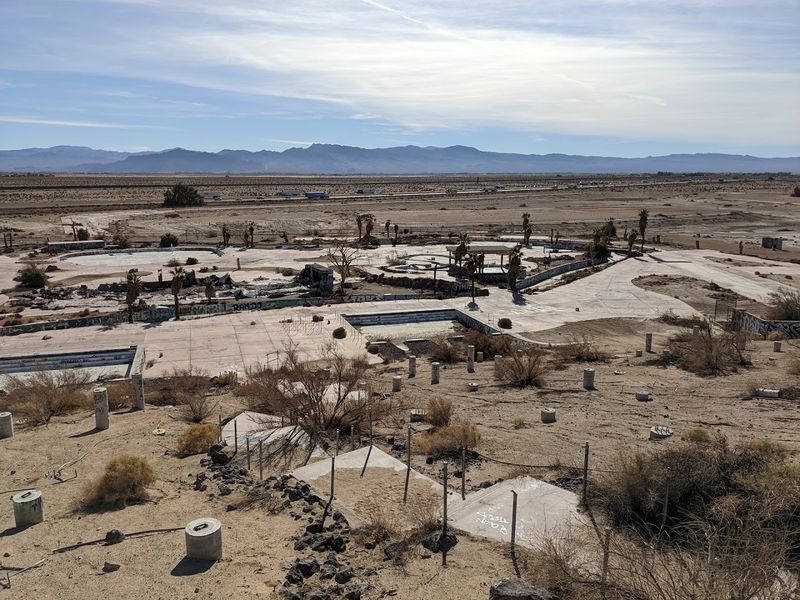
At some point, every abandoned place seems to cross an invisible line where activity stops and stillness takes over for good. With Rock-A-Hoola, that shift feels especially dramatic because the entire concept depended on motion, music, and people constantly circulating through the space.
Once that stopped, the park was left holding a shape that no longer matched its reality.
You can feel that mismatch everywhere in the remaining structures. The architecture still suggests excitement, but the atmosphere has settled into something much quieter and more reflective, like the site has accepted that its loud years are over.
I do not mean that in a gloomy way, either, because there is a calmness to it that can be strangely beautiful when the light is right.
Part of the story, of course, is that the park changed names and identities before finally falling silent, and that layered history matters. It was not one simple rise and fall, but a series of attempts to keep the idea alive, which somehow makes the final hush feel even more human.
You can sense effort in the remains, not just abandonment.
That is probably why this place lingers in your mind after you leave. It is not merely quiet, but the kind of quiet that arrives after years of trying, when the landscape finally takes the last word and the desert settles around everything like it was always waiting.
Sand Drifting Across Empty Walkways
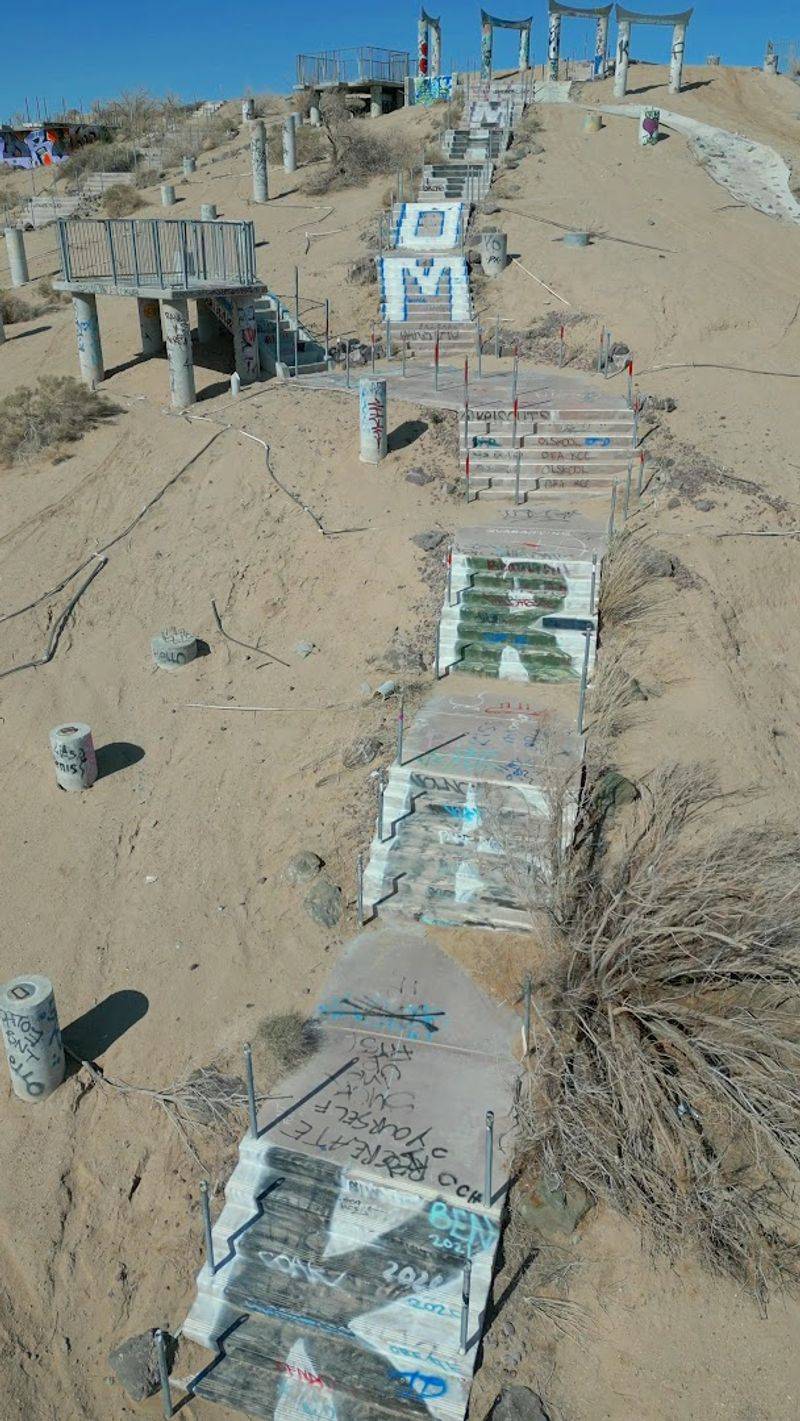
One of the strangest details out here is how gently the desert keeps reclaiming the place. It is not some dramatic swallowing of buildings, but a slow, steady drift of sand across paths that were meant for wet feet, rubber sandals, and constant movement.
That quiet takeover says a lot without trying very hard.
I always think abandoned places become most interesting when nature starts editing them instead of erasing them. Here, the walkways are still visible, the lines of the park still readable, but everything looks softened by dust, weather, and time passing in plain sight.
California ruins often get talked about in flashy terms, yet this one feels more patient than spectacular when you really look at it.
The empty paths tell their own story because they were designed to guide people from one burst of fun to the next. Without crowds, they become these long visual pauses that make you notice every faded surface and every patch where the desert has started writing itself back into the scene.
There is a weird grace in that, even if it also feels a little melancholy.
Honestly, the walkways might reveal more about the park than the headline features do. Slides grab your attention first, sure, but these quieter spaces show how a place built for summer energy can slowly settle into stillness while remaining completely recognizable at the same time.
The Quiet Curve Of A Giant Slide
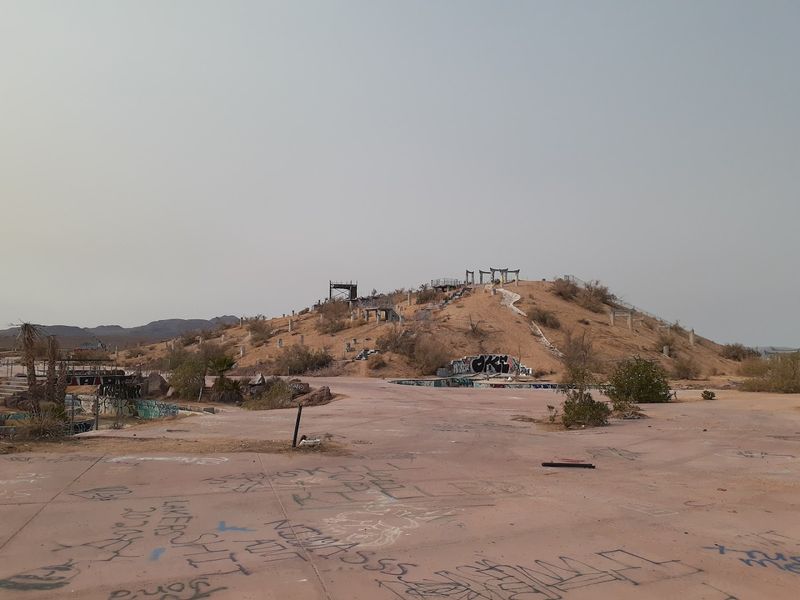
You know that feeling when a structure still looks thrilling even after its purpose is gone? That is exactly what happens with the big slide curves here, which somehow remain graceful and a little intimidating even in total silence.
Their shape still carries momentum, and that makes them feel almost alive against the stillness around them.
I keep coming back to the idea that design can preserve emotion long after function disappears. A giant slide is basically a physical promise of speed and surrender, so when you see one standing empty in the California desert, your body understands the contradiction before your mind does.
It is built to launch joy, yet now it mostly frames absence, which is such a strange thing to stand in front of.
There is also something sculptural about these forms once the water is gone. The curves look cleaner, bolder, and somehow more exposed, like you are seeing the park stripped down to pure outline instead of experience.
That change turns recreation into architecture, and architecture into memory, all in one glance.
If you are anything like me, you would end up staring longer than expected. Not because the slide is active, obviously, but because it still communicates so clearly what it was meant to do, and that leftover intention gives the whole place its haunting pull.
The Faded Beauty Of Park Murals
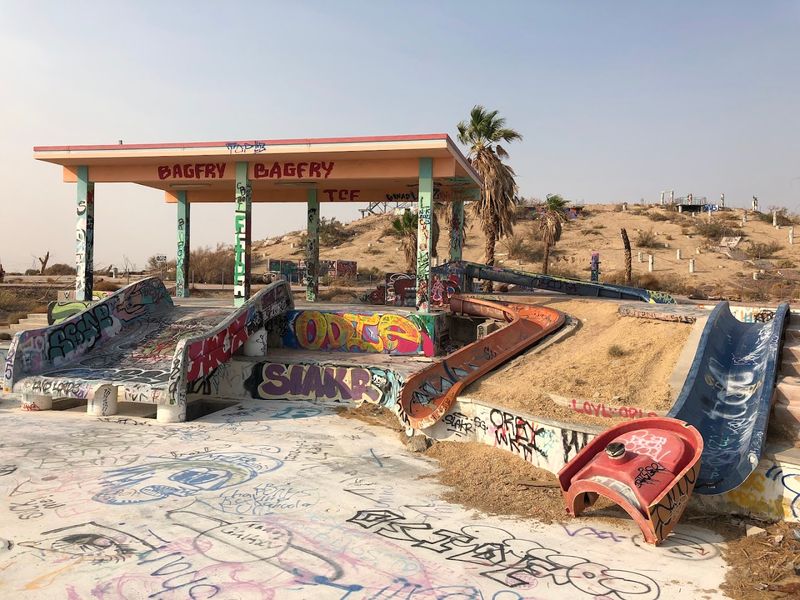
Then there are the painted walls, and honestly, they might be the most unexpectedly moving part of the whole place. Murals in abandoned parks always hit differently because they were meant to brighten a space that was already loud and playful, so when the crowd disappears, the artwork starts carrying more emotional weight than anyone intended.
Here, the faded color feels less decorative and more like a voice trying to stick around.
What I like is that the wear does not erase the personality. Sun, wind, and time have softened the surfaces, but enough remains to show that somebody wanted this place to feel cheerful, welcoming, and full of character rather than purely functional.
That matters, because it reminds you that amusement spaces are built as moods as much as physical layouts.
There is something deeply California about that mix of brightness and decay, where even worn paint can still glow under hard desert light. The murals do not hide the abandonment, and they do not need to, because their faded look is exactly what makes them memorable now.
They show the park trying to keep its spirit visible, even after everything else slowed down.
I think that is why these surfaces linger with me as much as the giant attractions. Big structures tell you what happened physically, but murals reveal what the place wanted people to feel when they first walked in.
The Still Waters Of The Main Pool
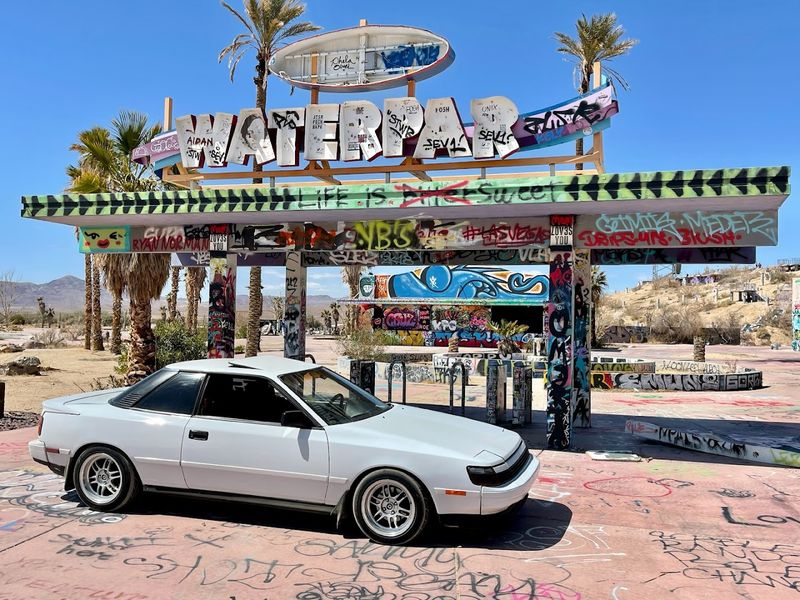
The main pool area has a different kind of presence from the slides, and you feel that right away. Pools are usually social by nature, with people drifting, watching, calling out, and circling the edges, so when a central pool goes still or empty, the silence feels heavier there than anywhere else.
It becomes less about action and more about the shape of gathering that used to happen around it.
I find that strangely affecting because a main pool is often the emotional center of a water park. Even people who were not racing toward the biggest attractions probably ended up there at some point, which means the space once held a broad mix of energy, from excitement to simple idling in the sun.
Now that center reads almost like a paused conversation that never resumed.
The surrounding deck areas and concrete borders make it easy to imagine the old rhythm without needing much help. You can picture movement tracing the perimeter, voices bouncing across the open space, and that constant sparkle that water brings to everything around it.
Without those things, the pool becomes a mirror for absence, and that sounds dramatic until you actually see how quiet it looks.
For me, this is where the park feels most human rather than merely unusual. The main pool does not just suggest entertainment, but shared time, which is why its stillness carries such a long echo.
A Desert Time Capsule Standing Proud
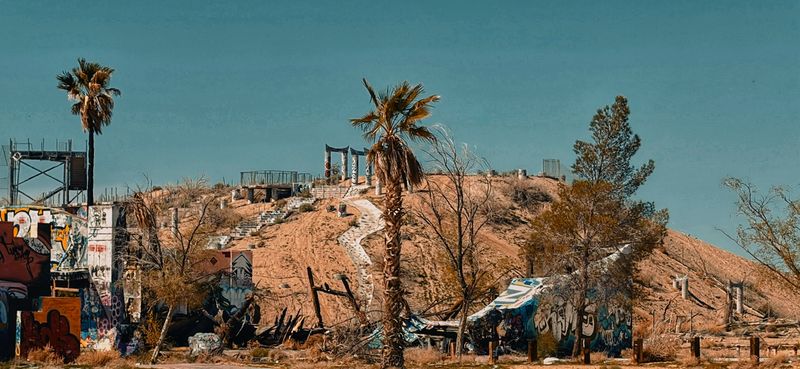
By the time I step back and think about the whole property, what stays with me most is how stubbornly it continues to exist as itself. Plenty of abandoned places collapse into shapelessness, but this one still reads clearly as a water park, which gives it the feeling of a time capsule left open under the sky.
The desert has changed it, but it has not erased its identity.
That makes Rock-A-Hoola feel oddly proud, even in ruin. The remains still announce ambition, fun, and a very specific kind of roadside optimism that belonged to another era of California recreation.
You do not have to romanticize every cracked surface to admit that the place holds onto its personality better than many polished attractions ever manage to do.
I think that is why people keep talking about it and photographing it and trying to understand what it says. It captures several stories at once, including family vision, reinvention, decline, and the strange afterlife that abandoned spaces sometimes develop when they become symbols instead of destinations.
Very few places can do all that while still looking this visually distinct from a distance.
So yes, it is a ruin, but that word feels too small on its own. This is also a memory machine, a landscape of leftover intention, and one of those rare places where the California desert seems to preserve not just structures, but the feeling of a dream that once expected to last.
