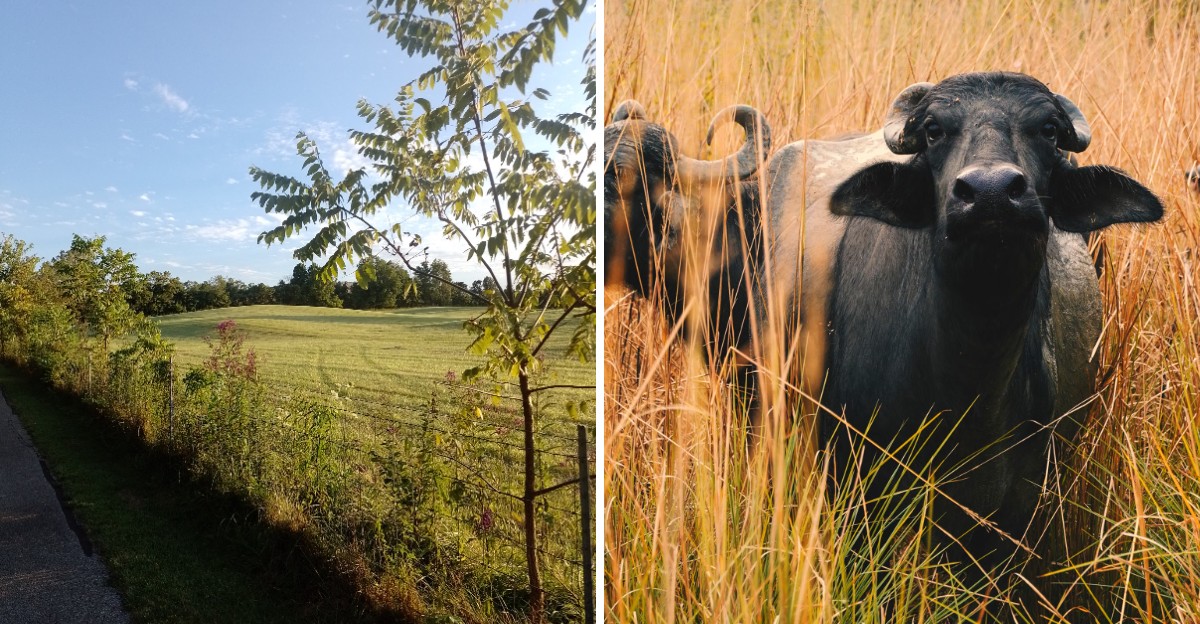
Water buffalo have no business looking this comfortable in Indiana. They are supposed to be somewhere with a very different climate, a very different landscape, and probably fewer people stopping to stare at them.
Yet here they are. The herd grazes in the pasture like this has always been the plan.
Their milk goes into rich, creamy cheese, while the rest of the farm keeps getting stranger. Heritage pigs roam nearby.
Organic hops grow on the property. Huge European-style garden plots take up their own corners.
Then there is the trailhead. And the old community gatherings.
And the slightly surreal feeling that an ordinary country road somehow led to a farm with its own little ecosystem. The water buffalo just happen to be the part that makes everyone do a double take.
Rolling Pasture Country That Slows Everything Down
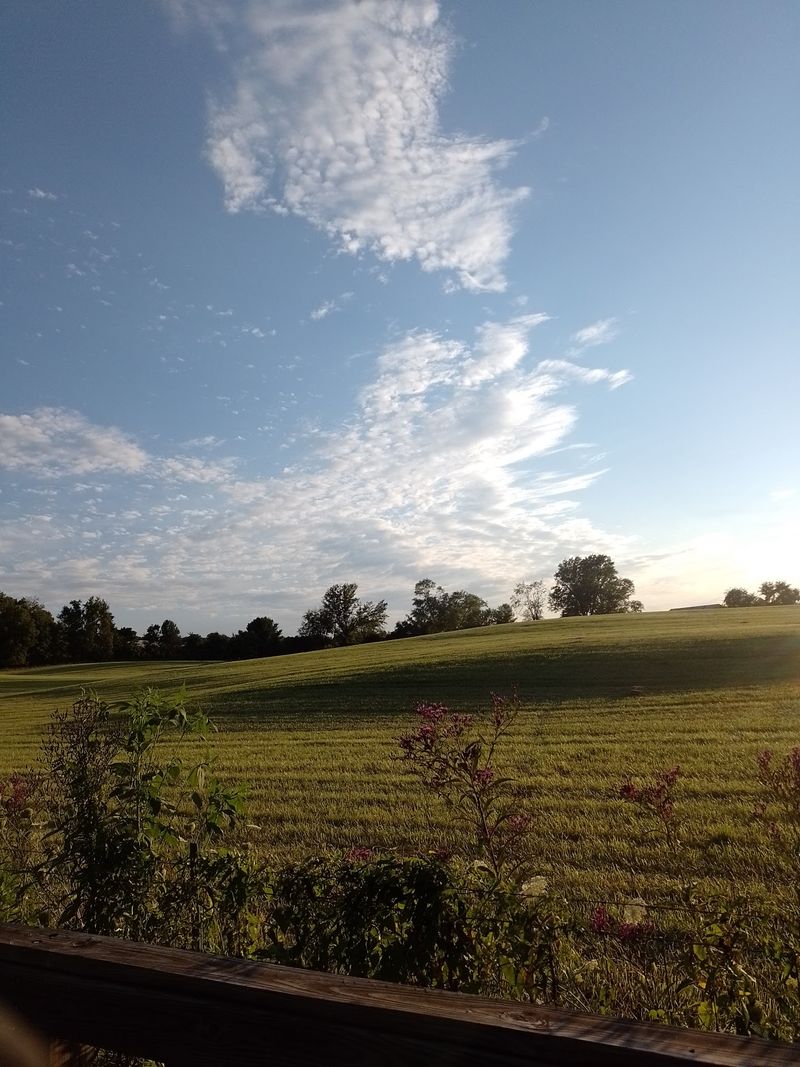
The drive out matters as much as the destination here. Bloomington’s edges give way fast, and within a few minutes the scenery softens into pasture, tree lines, and those low limestone-country hills that southern Indiana does so well.
Loesch Farm occupies a pocket of land at 2687 North Loesch Road, Bloomington, Indiana 47404, close enough to town for an easy morning trip yet tucked far enough away to feel genuinely rural. The air smells like cut grass and warm earth.
Birds handle most of the noise.
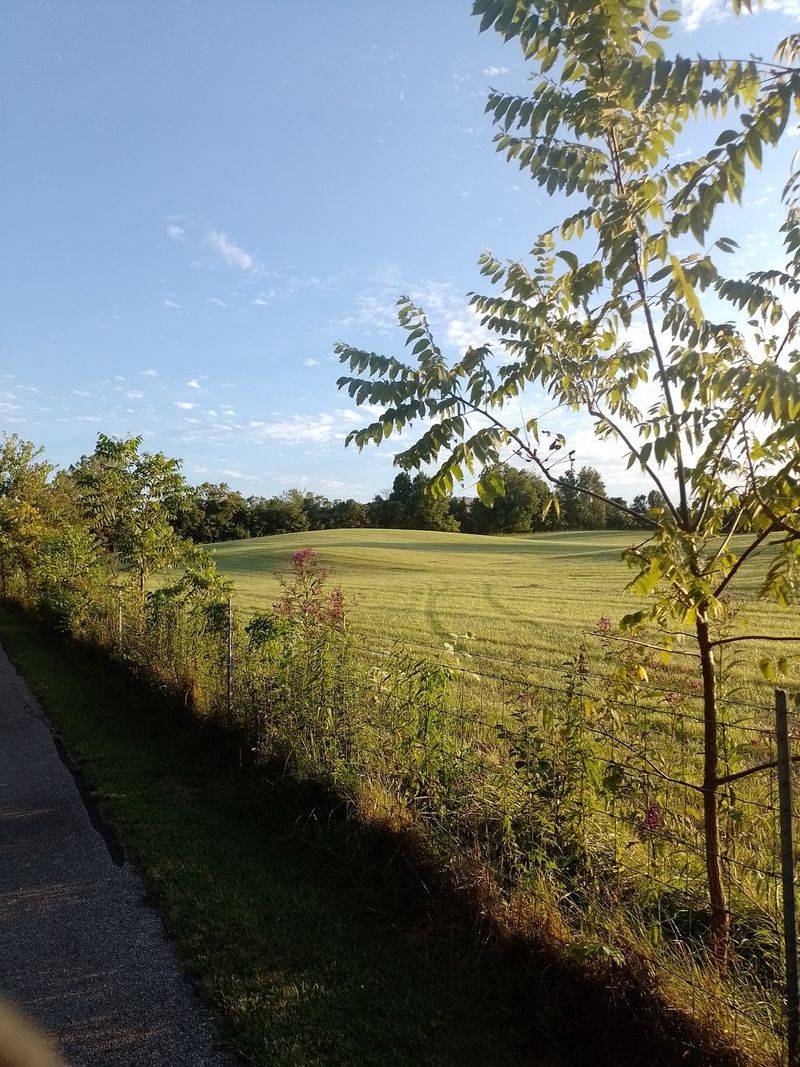
What makes the setting work is the lack of clutter. No billboards, no strip development, just fields sloping toward fence lines and the occasional cluster of trees throwing shade across the grass.
Morning visits tend to reward the early riser, when mist sits low over the pasture and the light comes in sideways. Late afternoon has its own appeal, with long shadows stretching across the fields and the whole property glowing a little.
Bring a camera, though honestly the view works fine without one. Dress for the ground rather than the photo, since rural roads and pasture edges can hold moisture well after rain.
Parking near the trailhead is limited to a handful of spaces, so arriving outside peak weekend hours makes life easier. Consider it a gentle reminder that this corner of Monroe County runs on its own unhurried schedule.
Meet the Water Buffalo, Indiana’s Most Unexpected Neighbors
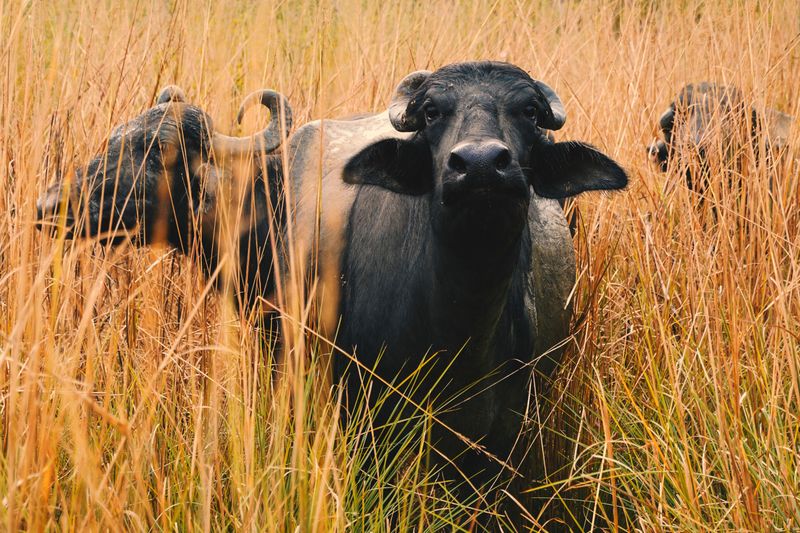
Nothing quite prepares a visitor for the first glimpse of dark, curved horns rising above Indiana grass. Asian water buffalo look like they wandered in from another continent, which, historically speaking, they did.
The herd here has been part of the farm’s identity for years. A 2012 article counted nineteen of them, and several carried names that suit their personalities better than their size, including Buffy, Ginger, Nilla, Sassy, Blanca, and Bella.
Watching them is oddly calming. They graze slowly, shift position with great deliberation, and treat urgency as somebody else’s problem.
Mud is a genuine highlight of their day. Water buffalo love a good wallow, and a pond edge churned into soft muck is basically a spa appointment for them.
The habit keeps them cool and comfortable, and it explains the occasional dramatically dirty shoulder.
Viewing happens from a respectful distance, which is exactly how it should be. These are working livestock, not petting zoo residents, and fences exist for everyone’s benefit.
Binoculars are a smart addition to any farm-country outing, especially for anyone hoping to catch the smaller details like ear flicks, jostling, and the pecking order within the herd.
Fun detail worth carrying home: water buffalo are among the most widely kept dairy animals on the planet, yet remain a genuine rarity across the American Midwest.
Milk So Rich It Practically Pours Like Cream

Here is the reason the buffalo are here in the first place. Their milk carries a thickness and a bright porcelain-white color that cow’s milk simply cannot match, and cheesemakers around the world prize it for exactly that reason.
The numbers back up the taste. Buffalo milk runs higher in calcium and protein, contains natural antioxidants called tocopherol, and actually carries less cholesterol than many people expect.
Plenty of folks who find cow dairy hard on the stomach report that buffalo dairy sits easier. That alone opens the door for a lot of eaters.
Mozzarella was the original goal at the farm, and it makes perfect sense. High-solids milk turns into the kind of soft, milky, melt-in-the-mouth cheese that anchors a caprese plate or turns a pizza into something memorable.
Worth setting expectations honestly: cheesemaking is not a public viewing activity here, and a casual visit will not include a production tour. The appeal lies in knowing the source.
For anyone who cares about where food comes from, standing near the very pasture that feeds the herd behind the milk behind the cheese is its own quiet thrill.
Practical tip for the curious palate: buffalo mozzarella tastes best barely chilled, served soft with good olive oil, ripe tomatoes, and torn basil. Simple wins every time with milk this good.
Garden Plots Borrowed From Britain and Germany
Most community gardens hand out a modest rectangle and wish the gardener luck. The plots at Loesch Farm take a different route entirely, stretching roughly 20 by 70 feet per gardener.
The design draws on British Allotment gardens and German Schrebergarten traditions, both built around the idea that a family should be able to grow a meaningful amount of its own food rather than a token handful of tomatoes.
Size changes behavior. With that much ground, gardeners can rotate crops, rest sections of soil, plant cover crops, and think about long-term health rather than squeezing every inch.
Year-round access opens up possibilities that short-season plots never offer. Cool-weather greens, garlic planted in fall, and successive plantings mean three or even four harvests across a single year for the organized grower.
A generous shared common area sits at the heart of the gardens, and that is where the social side happens. Surplus zucchini finds new homes.
Advice gets traded across rows.
Anyone considering a plot should think about water, tools, and a realistic weekly time commitment, because 1,400 square feet rewards consistency far more than enthusiasm alone.
Even for visitors just passing by, the sight of neatly staked rows running toward the horizon says a lot about how seriously this place takes growing food close to home.
How One Farm Feeds a Whole Family of Local Businesses
A single farm quietly supplying several well-known Bloomington kitchens is a neat trick, and that is exactly the arrangement here. Loesch Farm operates as part of One World Enterprises, the local group behind Lennie’s Restaurant, Pizza X, and One World Catering and Events.
The logic is straightforward. Rather than sourcing everything from distant suppliers, the company grows and raises a portion of its own ingredients within a short drive of the restaurants that use them.
Water buffalo get most of the attention, but they share the property with English heritage pigs and fields of organic hops.
Those hops carry real significance. They allow Bloomington Brewing Company to function as a farmstead operation, growing its own key ingredient on land it controls, a model far more common in parts of Europe than across the United States.
Sustainability has guided the group since its early days, and the farm reads like the practical expression of that commitment rather than a marketing line stapled on afterward.
For travelers, the payoff is delicious and easy to trace. Eating at one of the group’s Bloomington locations after a countryside drive closes a loop between pasture and plate in a way few trips manage.
Ask about seasonal menu items when dining in town, since availability shifts with what the fields and pastures are producing.
Bonfires, Drums and Wide Open Sky at Farm Gatherings
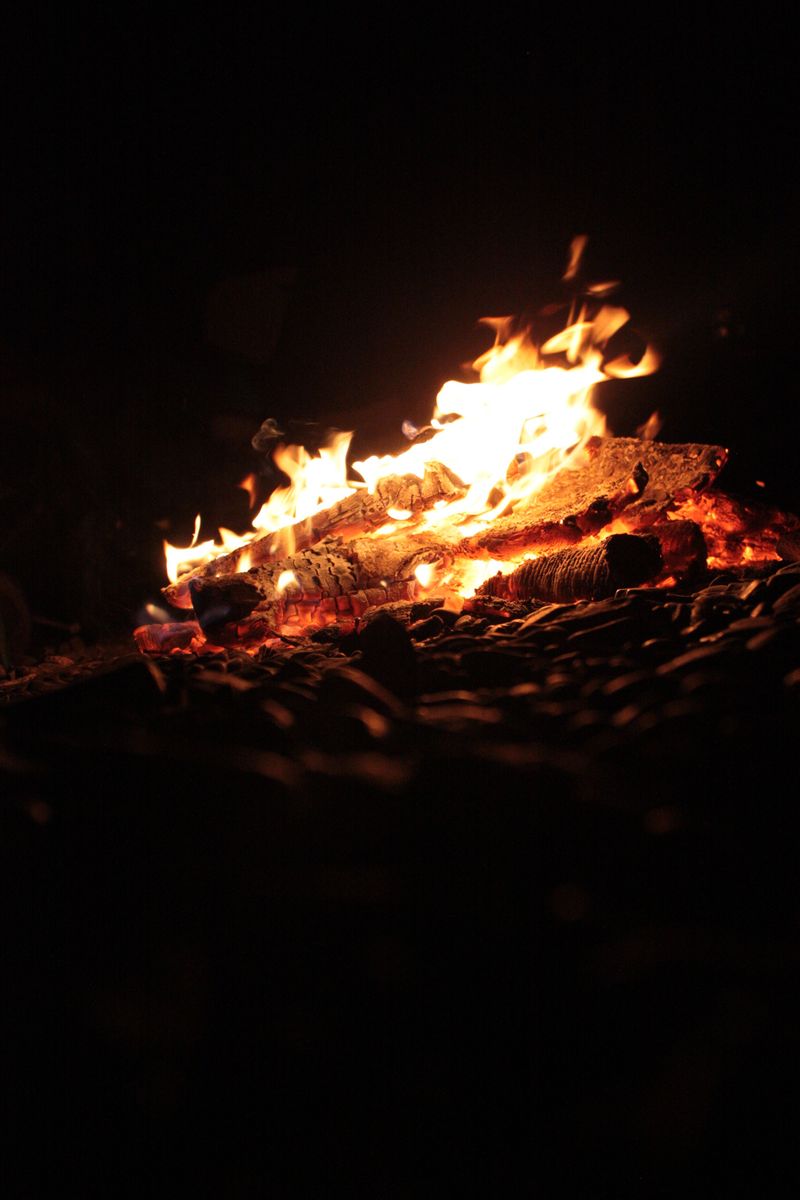
Come evening during event season, the working farm turns social. Open fields, big sky, and plenty of room mean this property handles a crowd better than most venues with four walls.
Public gatherings have included lively luaus and eclipse-watching parties, the kind of events where the sky itself becomes the main attraction.
Live music usually figures into the mix. So do bonfires, drumming circles, and potluck-style spreads where everyone contributes something to the table.
Camping has been part of certain events, which changes the whole texture of a visit. Falling asleep to crickets and waking to pasture fog beats a hotel parking lot by a wide margin.
Past attendees have described the atmosphere as warm, welcoming, and pleasantly free-spirited, with hospitality that makes newcomers feel folded in rather than watched.
Anyone planning to attend should check schedules ahead of time through One World Enterprises channels, since farm events run seasonally rather than on a fixed calendar.
Practical packing advice for an evening on open ground includes a folding chair, a blanket, layers for after sundown, bug spray, and a flashlight for navigating back to the car.
The combination of rural quiet and communal energy gives these nights a character that is hard to manufacture. It happens because the land, the people, and the setting all cooperate.
Walk the Karst Farm Greenway Right From the Farm’s Edge
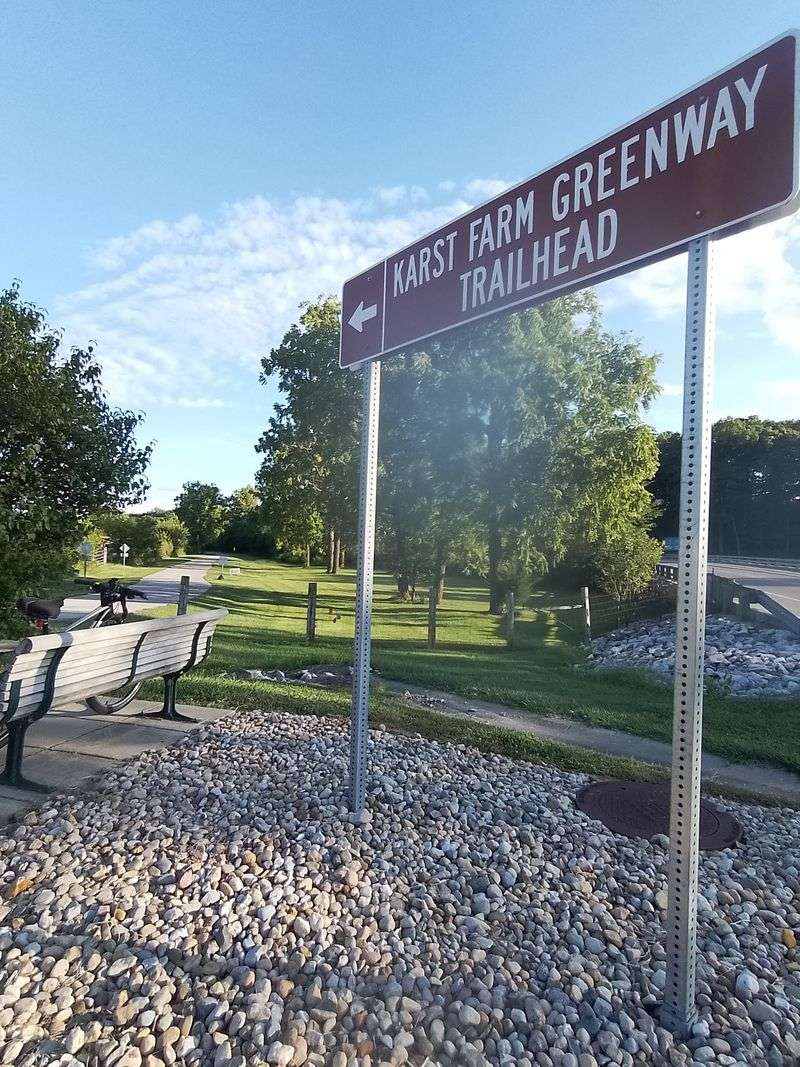
Convenience rarely lines up this nicely. The northern end of the Karst Farm Greenway begins right at 2687 North Loesch Road, Bloomington, Indiana 47404, meaning a farm visit and a proper walk can share the same stop.
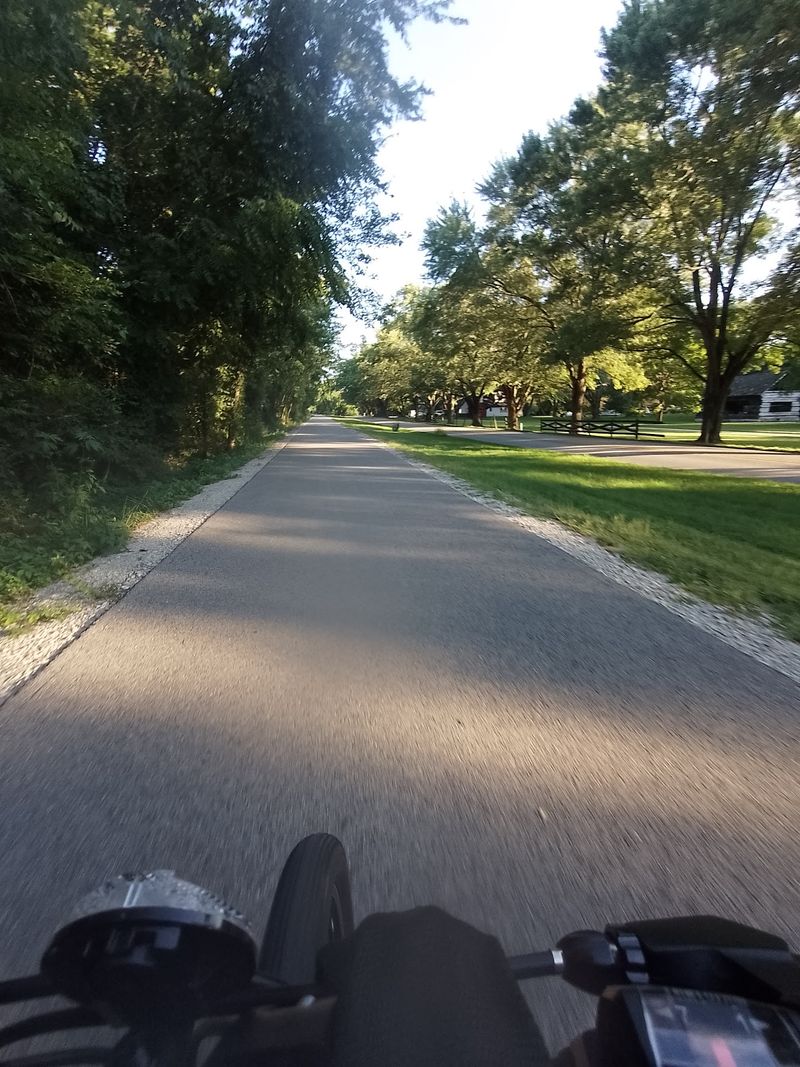
The trail is paved, smooth, and refreshingly flat, which makes it friendly for strollers, casual walkers, and cyclists who would rather enjoy the scenery than fight hills.
Shade shows up in helpful stretches. Summer walkers should still carry more water than feels necessary.
Newer sections extend the route toward Ellettsville, opening up longer outings for anyone with time and energy to spare. Shorter loops work just as well for a quick leg stretch.
Parking is the one real limitation, with only a handful of spaces at this trailhead. Weekday mornings and off-peak hours dramatically improve the odds of finding a spot.
Surrounding views lean heavily on pasture and grazing land, with gentle foothills rolling out toward older bedrock bluffs in the distance.
Quiet is the trail’s defining feature. Many stretches see few people, which turns an ordinary walk into something closer to a reset button.
Pack a lunch, take the trail at an unhurried pace, and let the combination of livestock, gardens, and open countryside make the case for spending a whole morning on Bloomington’s west side.
