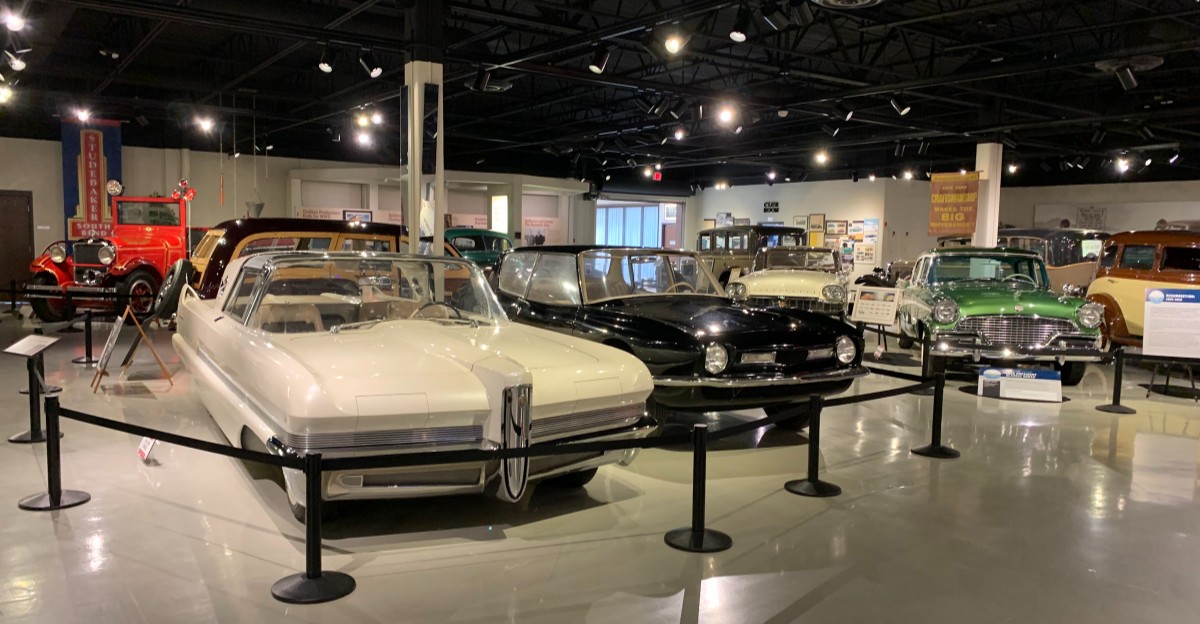
The car looks fake. Not cartoon fake.
Museum fake. Too shiny.
Too elegant. Too perfectly preserved.
Then you notice there are dozens more behind it, including prototypes that were never sold, strange old convertibles, wagons, carriages, and a presidential carriage that somehow survived long enough to end up here.
This Indiana museum takes up 55,000 square feet and three floors, which sounds large until the collection starts revealing what is actually inside.
A family business that began making wagons in 1852 eventually became part of American transportation history, and the museum tells that story without making it feel like homework. Kids can pretend to run an auto shop.
Car fans can get lost among the chrome. History buffs get one very sobering connection to Abraham Lincoln.
The entire place feels slightly impossible.
Wagons First, Engines Later, The Whole Studebaker Story
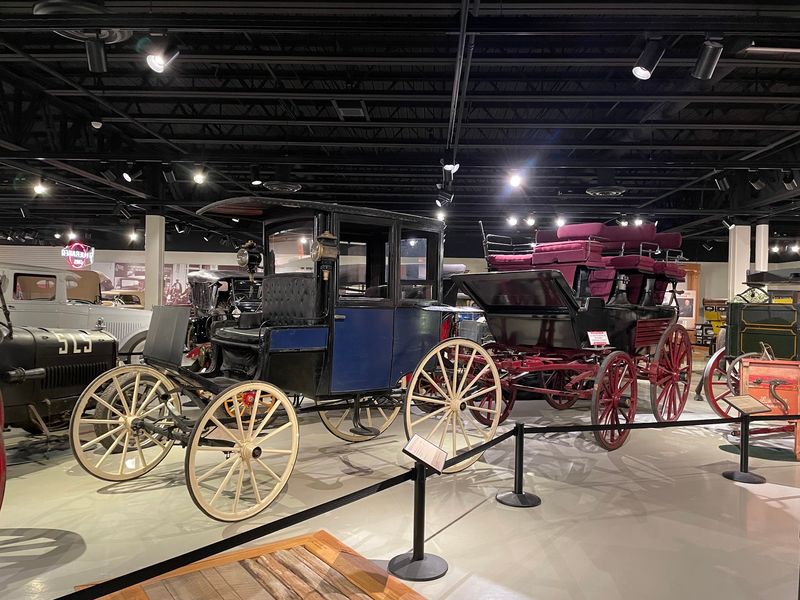
Most people arrive expecting cars and leave talking about wagons. The Studebaker story starts in 1852, when the Studebaker brothers opened a blacksmith shop in South Bend and began turning out sturdy horse-drawn wagons for farmers and settlers heading west.
Those wagons built the fortune that later funded the automobiles. Seeing them up close, with hand-painted lettering and iron-rimmed wheels, makes the leap to motorcars feel much bigger than a simple business decision.
By 1902 the company had moved into vehicle production, and within a few years it had become one of South Bend’s largest employers. The galleries walk visitors through that shift in order, so the change from hoofbeats to horsepower unfolds the way it actually happened.
Panels explain how the company supplied military vehicles during wartime and how its factories once employed thousands of local workers. Photographs of the old plants sit alongside tools, badges, and advertising art from each decade.
Here is a detail worth knowing. The core of the collection came from Studebaker’s own corporate display, handed over to the city back in 1966, which is why so many pieces are original rather than recreated.
The building itself nods to that industrial past, borrowing design touches from the former factories. Give the first section real time.
Rushing past the wagons means missing the foundation everything else stands on.
Lincoln’s Carriage and the Largest Presidential Carriage Collection Anywhere
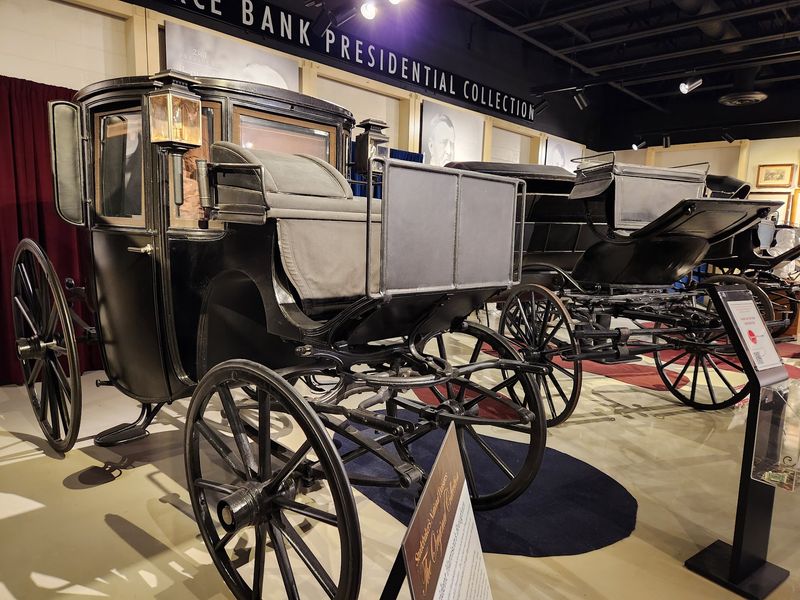
Few museum objects stop conversation the way this one does. The barouche that carried Abraham Lincoln to Ford’s Theatre on the night of his assassination sits quietly under museum lighting, and visitors tend to lower their voices without being asked.
It is not roped off in some distant hall. It sits right there, close enough to study the lamp brackets and the curve of the folding top.
Lincoln’s carriage is the headline, but the collection runs deeper than that. Vehicles connected to Ulysses S.
Grant, William McKinley, and Benjamin Harrison share the space, forming the largest gathering of United States presidential carriages in the world.
One carriage carried the Marquis de Lafayette during his farewell tour of America in 1824, decades before Studebaker existed as a company. That piece often surprises people, since Lafayette’s role in the Revolutionary War rarely comes up in a car museum.
These are treated as national treasures, and the climate-controlled galleries exist largely to protect them. Read the placards slowly, because each carriage carries a specific date, a specific passenger, and a specific moment.
Plenty of travelers assume artifacts like these only live in Washington. Finding them in northern Indiana is part of what makes the visit stick in memory long after the drive home.
Chrome, Fins, and the Famous Bullet Nose
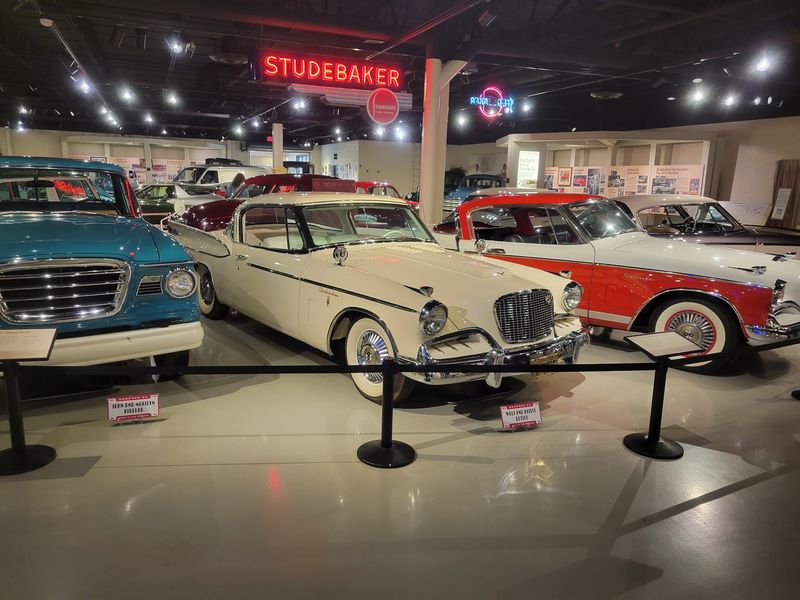
Turn a corner on the main floor and the chrome does the rest. Over 120 vehicles belong to the collection, with roughly 85 on display at any given time, which means rows of gleaming fenders stretching further than expected.
The 1950 Champion Convertible is the crowd favorite. Its pointed Bullet Nose front end looks like something drawn for a comic book, and photographs never quite capture how bold it is in person.
Nearby sits the 1955 President Speedster, built for a single model year and loaded with two-tone paint and a dashboard that looks more like an aircraft cockpit. Performance and flash mattered to Studebaker, and this car proves it.
Go back further and the 1932 President shows off pre-war engineering, powered by a 312 cubic-inch straight-eight engine that hints at how serious the company was about quality.
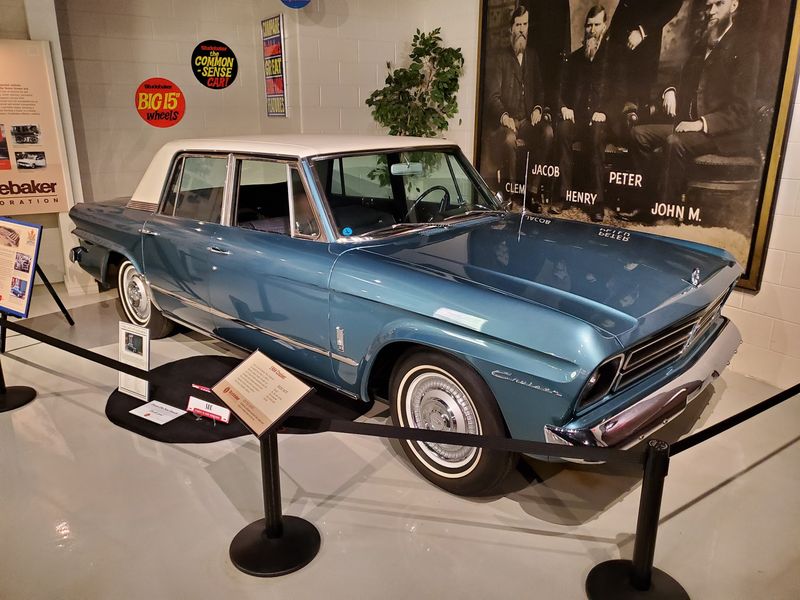
The timeline runs all the way to the end. The last car the company ever built, a Cruiser sedan from 1966, closes the story with surprising quietness after so much style.
One practical tip. The lighting is excellent for photos, but low angles work best for capturing those long hoods and curved rooflines without glare from the overhead fixtures.
Prototypes That Never Made It Out of the Design Studio
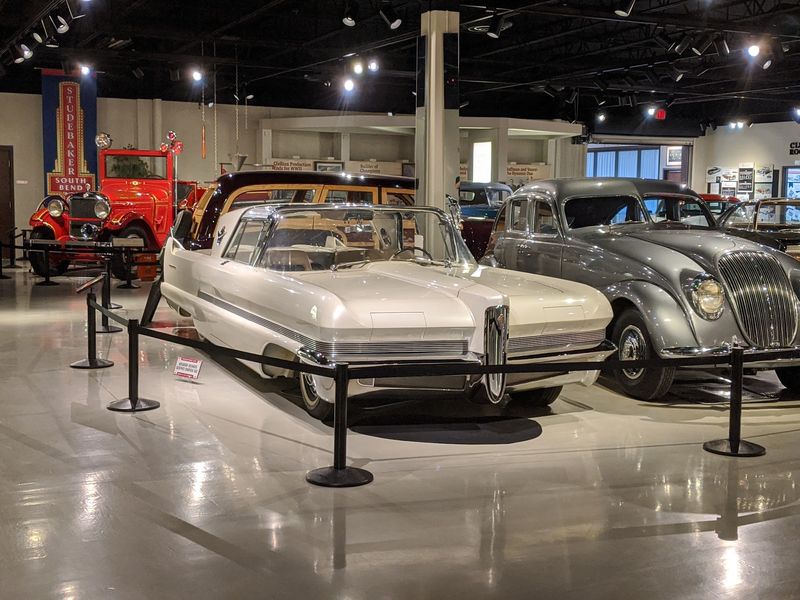
Concept cars have a strange magic. They show what almost happened, and the Studebaker National Museum holds several one-of-one machines that never reached a single dealership floor.
The 1962 Sceptre is the star of that group. Designed by Brooks Stevens, it features a full-width front light bar and clean, forward-leaning lines that look decades ahead of its moment.
Standing beside a car that exists in a quantity of exactly one changes how a person looks at it. There is no second example somewhere else, no replica touring the country.
What sits in South Bend is the whole supply.
Visitors frequently mention these prototypes as the biggest surprise of the trip, more so than the production classics. Seeing sketches, clay model photos, and the finished shape together explains how much thought went into cars that never sold a single unit.
Studebaker was also experimenting long before concept cars became common. The company produced electric vehicles at the very start of the twentieth century, a detail that lands differently in an age of battery-powered commuting.
Take a slow lap around each prototype. The details on the back and sides often reveal ideas that larger manufacturers would borrow years later, which makes the what-if factor genuinely fun to think about.
Fozzie Bear’s Commander and a Surviving Indy 500 Racer
Not every vehicle here is serious business. Fozzie Bear’s 1951 Studebaker Commander, the same model from The Muppet Movie, sits restored and ready for photographs, and it makes people grin before they even read the sign.
Movie cars have a way of collapsing time. Adults who watched that film as kids tend to linger the longest.
A few steps away, the mood shifts entirely. The only surviving 1933 number 34 Studebaker Special Indy 500 race car sits low and stripped down, built purely for speed around the brickyard.
Open wheels, a narrow body, and no comfort whatsoever tell the story of what racing demanded in the 1930s. It also proves Studebaker was willing to compete against the biggest names in American motorsport.
Elsewhere in the galleries, commercial vehicles and service trucks fill in the everyday side of the company. Visitors often point out the old mail truck, which triggers memories for anyone with a postal worker in the family.
Mixing a Muppet car with a race car and a mail truck sounds chaotic, but it works. The variety keeps the pace lively and gives groups with different interests something to argue about on the way out.
A Kid-Sized Auto Shop and Other Hands-On Corners
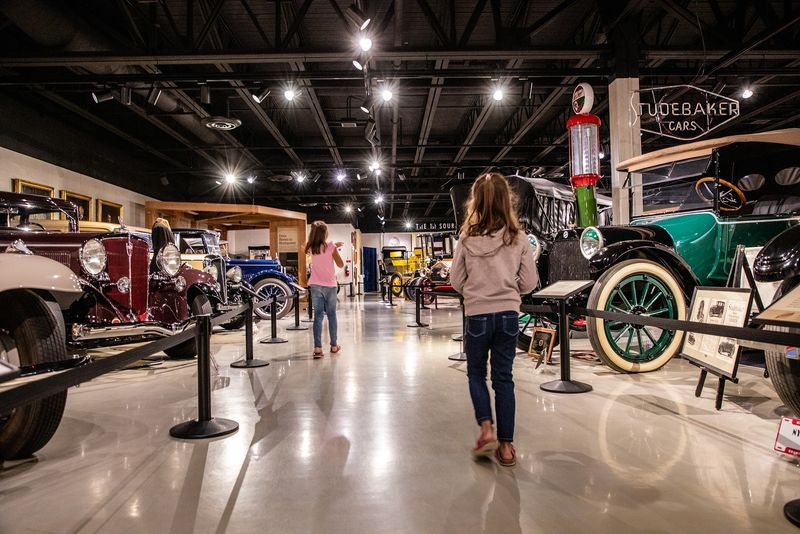
Bringing children to a car museum can be a gamble, except here the museum planned for it. The Super Service Center is a kid-sized auto shop stocked with pretend tools, where young visitors rotate tires, check fluids, and swap out mufflers on their own little vehicle.
It is loud, busy, and completely charming. Parents get a bench and a breather while the mechanics get to work.
Another display called Road Surfaces, Past and Present lets guests walk across different historic paving materials. Feeling the difference between rough early surfaces and smooth modern pavement explains why driving in the 1800s was such a rattling experience.
There is also an exhibit named A Touchy Subject, which tackles the universal urge to run a hand along a shiny fender. It demonstrates what skin oils do to paint and metal while offering a safe way to actually touch something.
One gallery includes a car visitors can sit inside for photographs, which turns into a family tradition for repeat guests.
Audio tours are available for anyone who wants deeper detail, and they can easily stretch a two-hour visit into most of a day. Everything stays comfortable indoors, making the museum a solid plan for rainy or freezing Indiana weather, located at 201 Chapin St, South Bend, IN 46601.
Rotating Exhibits and a Neighborhood Worth Exploring
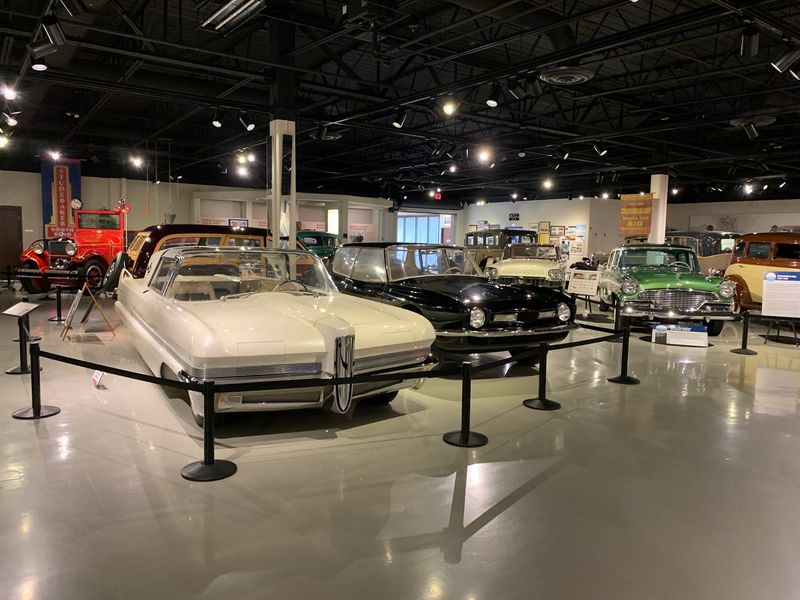
Repeat visitors rarely see the same museum twice. Two major feature exhibits arrive each year, and the vehicle displays rotate every six to nine months, so cars that sat in storage suddenly take center stage.
Recent features have widened the lens beyond Studebaker itself. One exhibition spotlighted pioneering women in automotive history and included Amelia Earhart’s 1937 Cord 812 Phaeton, a car that draws a crowd all on its own.
Another long-running display explores the broader automotive industry of South Bend and the surrounding region, showing how many manufacturers once called northern Indiana home. A speaker series and a Cars and Coffee gathering bring local enthusiasts together throughout the year.
The museum shares a campus and main entrance with The History Museum, and many visitors use 897 W. Thomas Street for easier parking access.
The Oliver Mansion stands nearby, though tours run on set schedules and tickets can go quickly.
Doors open at 10 AM Monday through Saturday and at noon on Sunday, closing at 5 PM.
Afterward, the historic West Washington Street neighborhood rewards a short stroll. Old homes, wide sidewalks, and quiet streets make a pleasant finish to an afternoon spent among wagons, prototypes, and presidential carriages.
