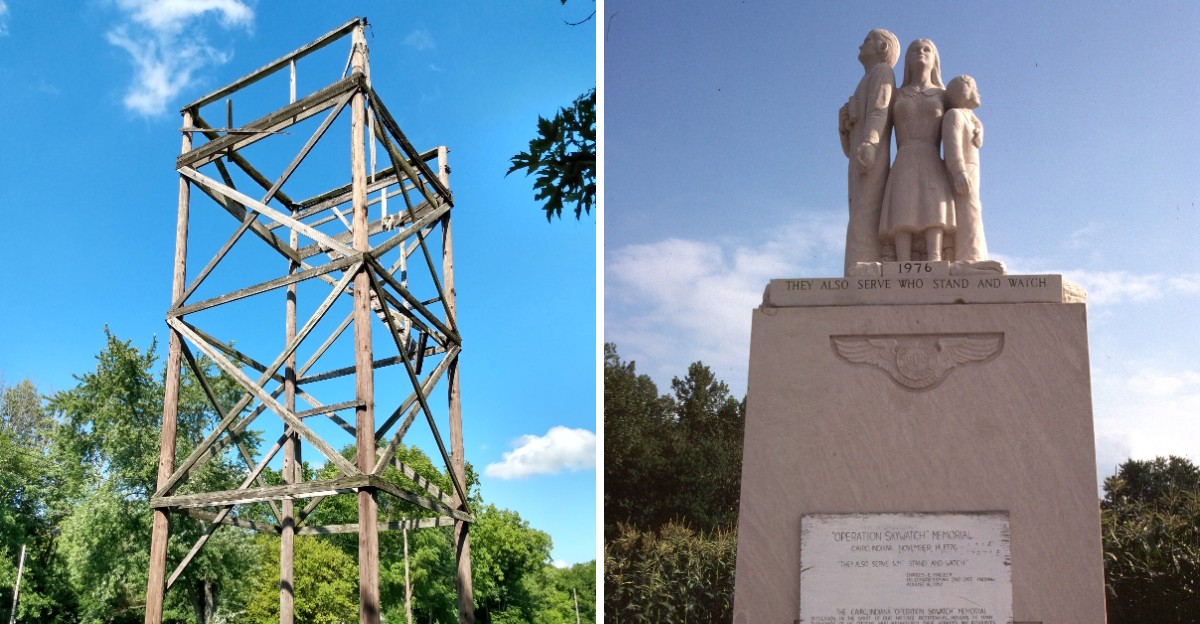
A treehouse is supposed to be fun. This one had a telephone.
And a very serious reason for being there. High above an Indiana cornfield, a tiny wooden cabin once served as a lookout post during the Cold War.
Volunteers climbed up, watched the sky through binoculars, and waited for the kind of sight nobody wanted to see. There was no radar.
No computer screen. Just people staring into enormous open skies.
The setup sounds almost primitive now, which makes the little tower even stranger to find beside an ordinary country road. It looks homemade.
Its mission was anything but.
The First Post of Its Kind in the Entire Country
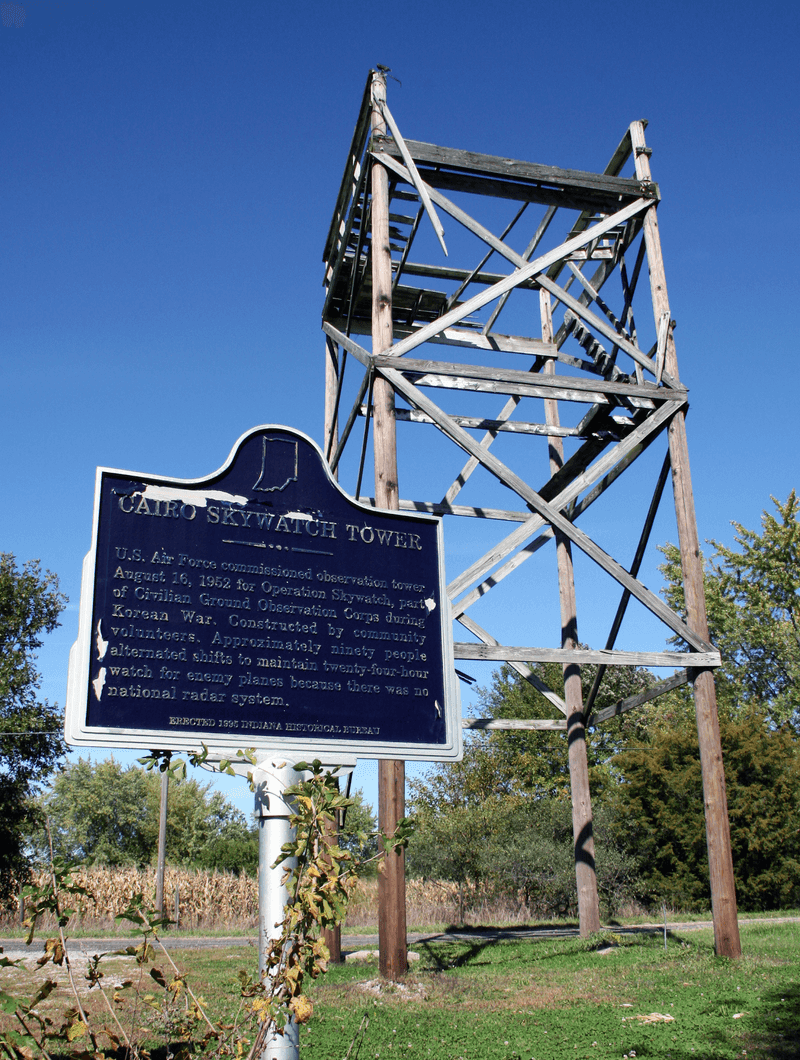
Plenty of small towns claim a first. Cairo actually has the paperwork to back it up.
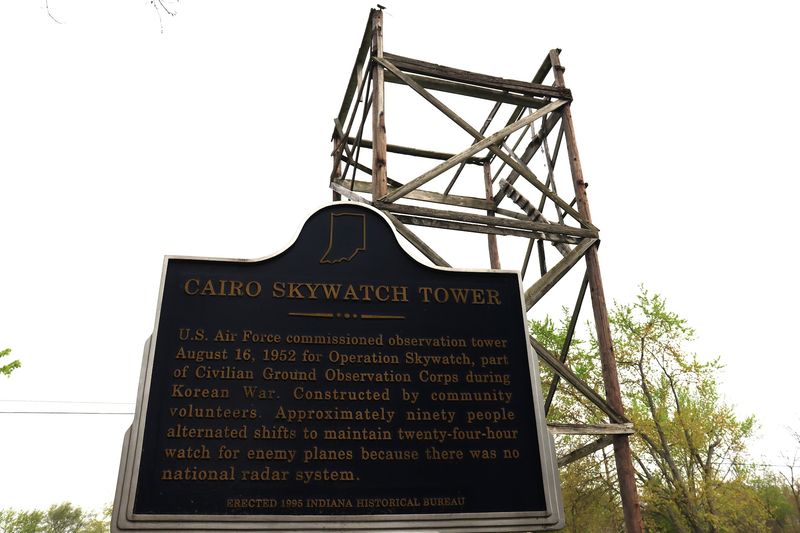
Commissioned by the U.S. Air Force on August 16, 1952, the tower became the first Ground Observation Defense Post activated anywhere in the nation.
That detail alone changes how the structure reads. What looks like a rickety farm lookout was once the leading edge of a coast-to-coast civilian defense idea, and the rest of the country followed the pattern set here in Tippecanoe County.
The timing matters too. The Korean War was underway, tension with the Soviet Union was climbing, and the United States had no complete radar net watching its own skies.
So the Air Force turned to people instead of machines. Farmers, homemakers, students, and retirees were asked to fill the gap with nothing fancier than sharp eyesight and a working phone line.
Visiting with that fact in mind gives the site weight it does not show at first glance. There are no ticket booths or gift shops out here, just a clearing, a gravel shoulder, and a structure that quietly started a national program.
History buffs tend to linger longer than expected. Something about standing under the first of anything makes the flat Indiana horizon feel a lot more significant than it did five minutes earlier.
Four Utility Poles, One Very Small Cabin
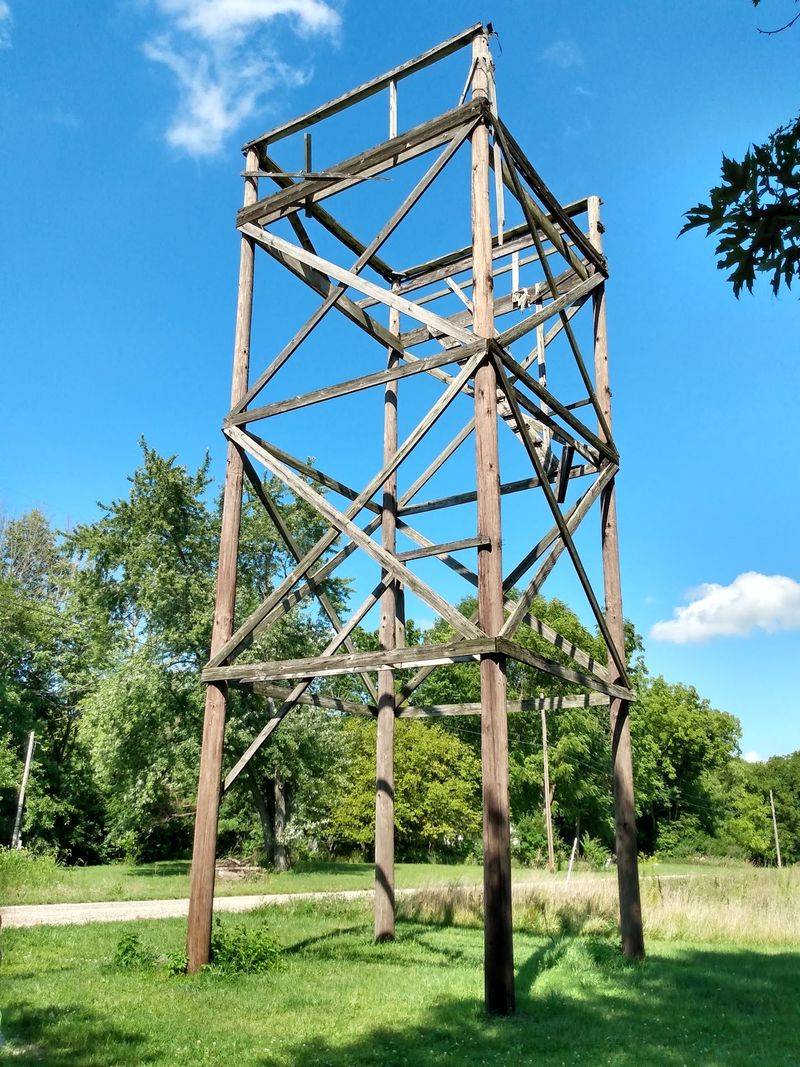
The construction details are almost comically simple, and that is exactly the charm. Four utility poles, each thirty feet tall, hold up a twelve by twelve foot platform.
On that platform sits a cabin measuring seven feet by seven feet, wrapped by a narrow railed balcony where observers could step out and turn a full circle scanning the sky. Roughly the footprint of a garden shed, lifted three stories into the Indiana wind.
Nothing about it was mass produced. Local volunteers cut, hauled, raised, and maintained the whole thing themselves, which explains why the joints and boards look handmade rather than factory perfect.
Wooden lookouts like this one have almost entirely vanished. Most were dismantled for scrap, blown down, or simply rotted away once the program ended, leaving this example as the last of its style still standing in the region.
Look closely and the craftsmanship shows in small ways. Weathered grain, hand-driven nails, and patched repairs from decades of Midwest storms all tell a story of people keeping something upright because it mattered to them.
Photographers love the geometry here. Four straight lines converging on a tiny box, framed against open farmland, makes for a shot that needs no filter and very little explanation.
Ninety to One Hundred Twenty Neighbors Kept Watch Around the Clock
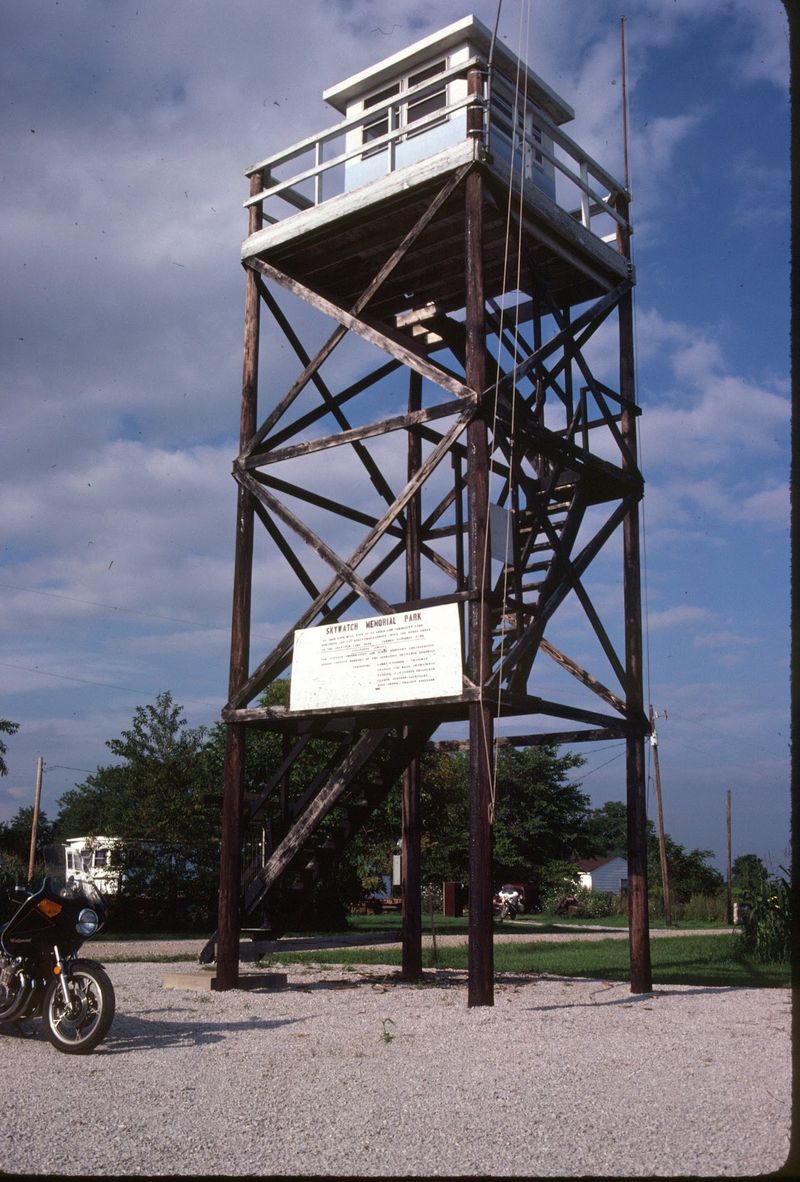
Round-the-clock coverage sounds like a military job. Out here it was a community schedule.
Somewhere between ninety and one hundred twenty local residents rotated through shifts to keep the cabin staffed twenty-four hours a day.
Many were organized through the local Grange, the farm community organization that already handled meetings, potlucks, and mutual help across rural Tippecanoe County.
Picture the practical side of that arrangement. Chores still had to get done, kids still needed supper, and someone still had to climb the ladder at two in the morning in January with a thermos and a flashlight.
Volunteers were trained to identify aircraft and report anything unusual straight to designated Air Force command centers. Speed mattered more than certainty, so the instruction was simple: see something odd, make the call.
Not one enemy plane was ever reported from this tower. That fact sometimes gets treated as a punchline, but it misses the point entirely, because the watching itself was the contribution.
Thinking about those shift lists while standing in the grass below makes the site feel less like a monument and more like a workplace. A cold, drafty, oddly heroic workplace where the paycheck was knowing the sky had someone looking after it.
Families in the area still trace relatives back to those rosters.
The Limestone Family Looking Skyward
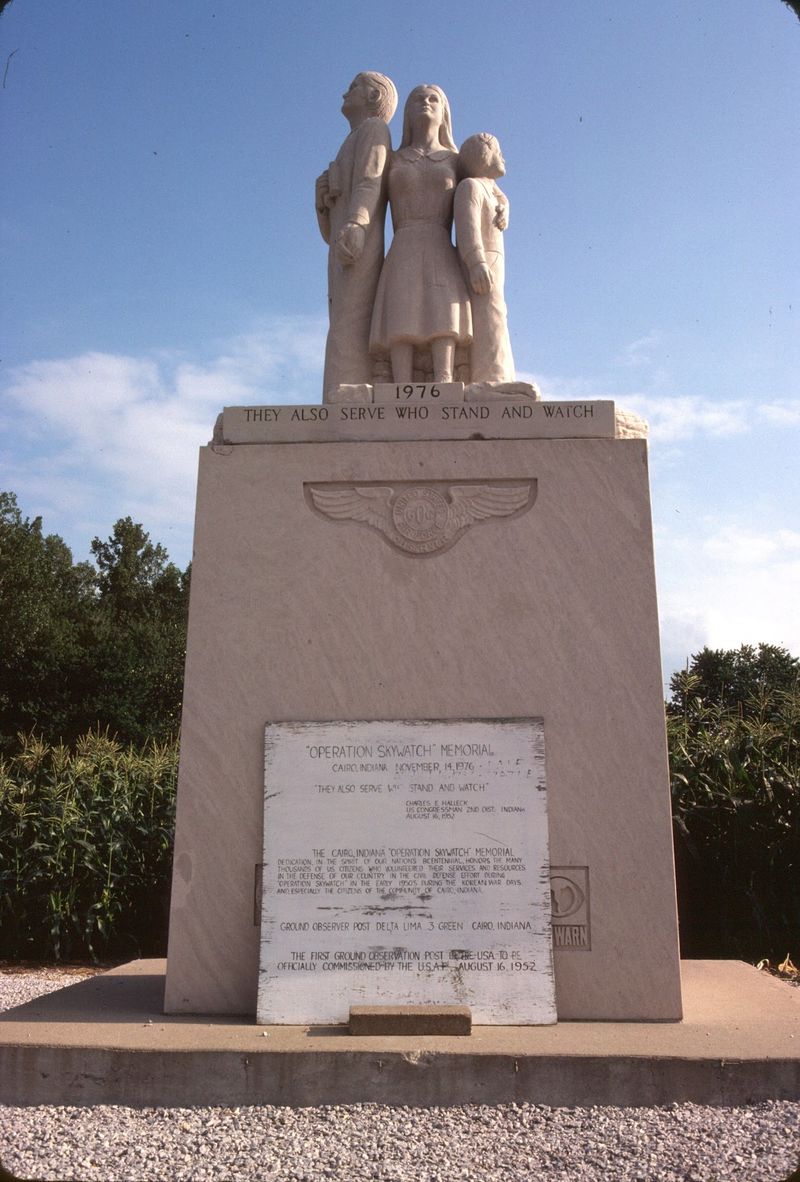
At the base of the tower sits the piece that tends to catch people off guard. A large Indiana limestone monument, carved with a man, a woman, and a child all tilting their faces upward toward the sky.
Dedicated to the Ground Observer Corps and their role in Operation Skywatch, the carving does something the wooden structure cannot. It puts human faces on the story.
The posture says plenty without a single word. Three figures, one family, eyes lifted, caught in the middle of the exact act this whole place was built for.
Limestone is a fitting choice for southern and central Indiana, where the stone has been quarried for generations and shows up in courthouses, churches, and monuments across the country. Weather has softened the surface over the years, which only adds to the effect.
Since the tower itself cannot be climbed, the monument becomes the main thing to walk up to and study closely. Run a hand along the stone, read the dedication, and the visit gains a focus it might otherwise lack.
Kids usually understand it immediately. Grown-ups sometimes need a second to realize the sculpture is not looking at anything in particular, just watching, the way roughly a hundred neighbors once did from thirty feet overhead.
A Weathered Skeleton That Refused to Fall
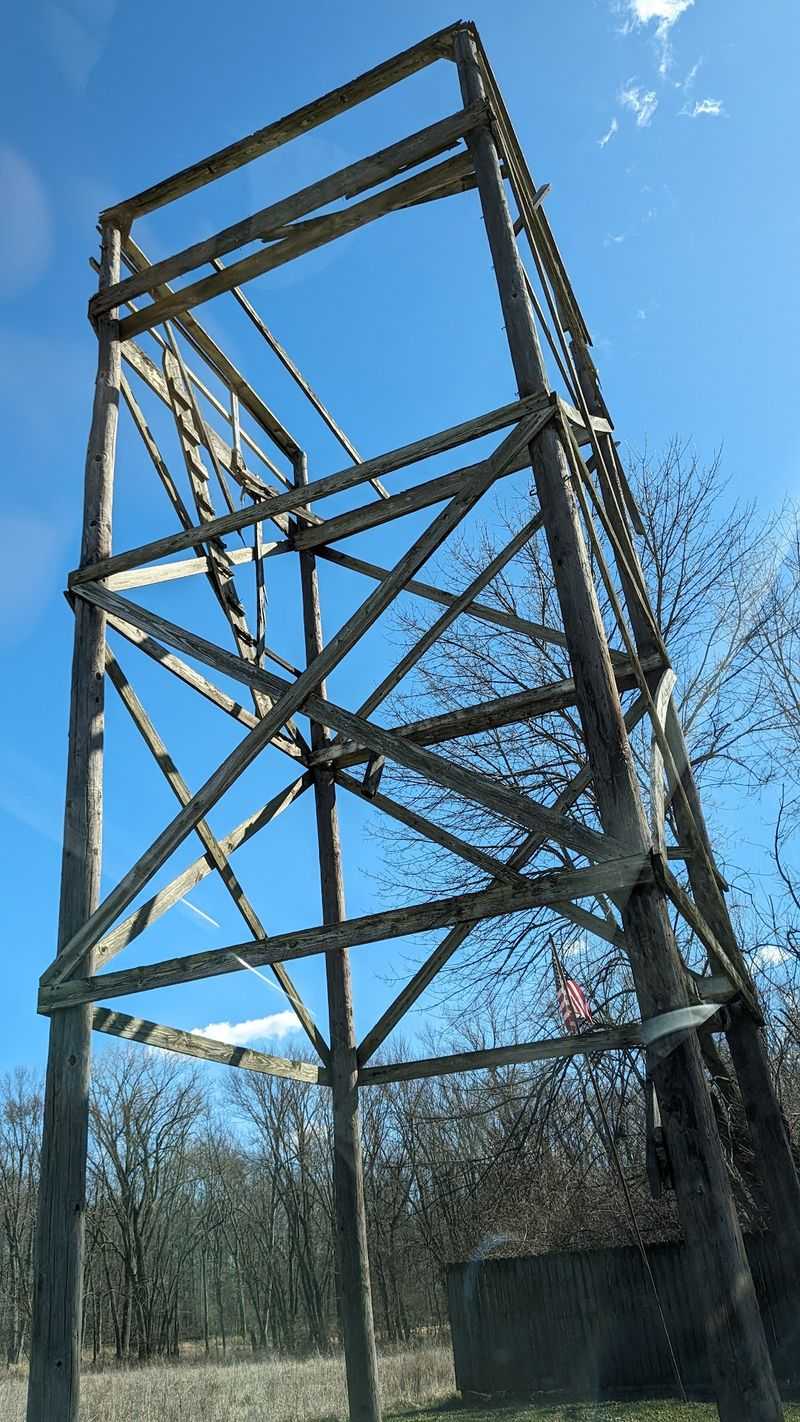
Operation Skywatch did not last long once technology caught up. Activity here was scaled back in 1954 after the Korean War ended, and the national program officially shut down in 1959 as electronic radar systems took over the job of surveying American airspace.
Most towers disappeared quietly after that. Cairo went a different direction.
While it was never fully reconstructed, the community rallied to clean up the site for the 1976 U.S. Bicentennial, dedicating it as a memorial park.
Time and the elements still won a partial victory, though. The actual glass-enclosed observation room at the top grew so rotted and unstable that it eventually had to be entirely removed for safety, leaving just the open wooden framing behind.
Today, the tower stands as a bare skeleton against the elements. That fragility actually makes the stop more interesting rather than less, as visitors look up at the empty platform and realize just how fleeting this piece of wartime history truly was.
Quiet Roads, Big Sky, and a Stop That Takes Ten Minutes
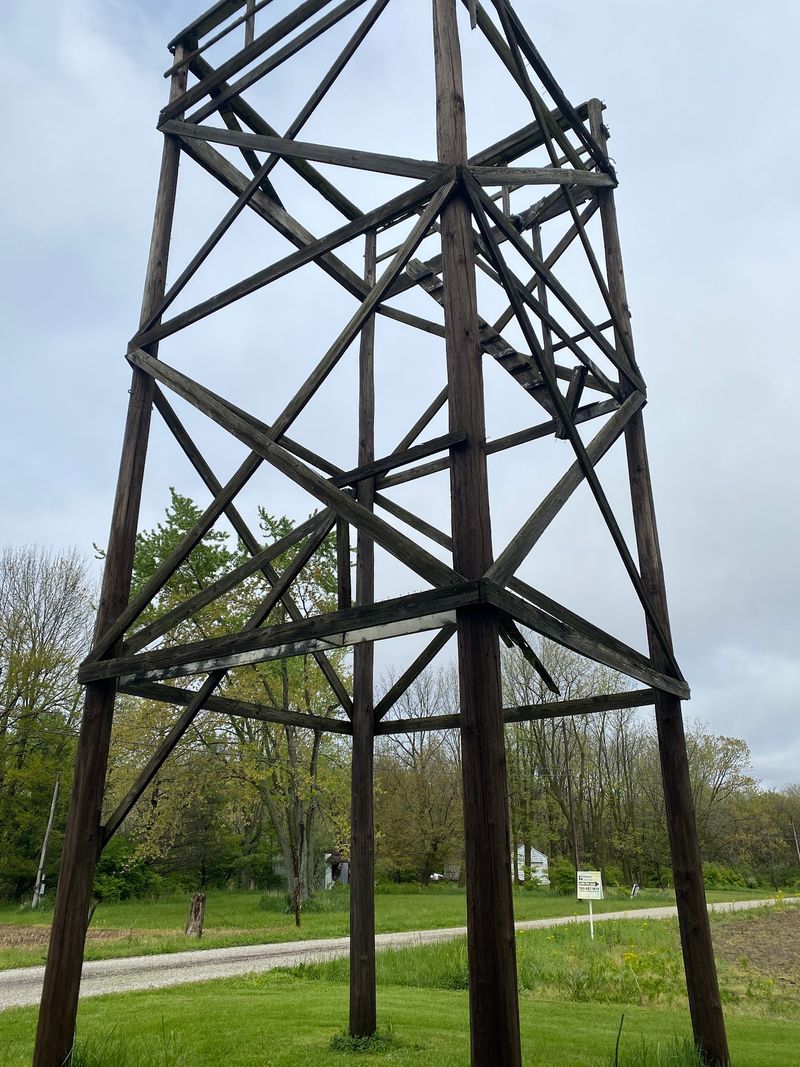
Finding the tower is half the fun, because nothing about the drive announces what is coming. The site sits along W 850 N, just east of County Road N 100 W, in the 47906 area north of West Lafayette.
Gravel shoulders, fence lines, and open fields dominate the approach. Blink and the poles slip past on the left.
Once parked, the whole experience is refreshingly short and low pressure. Ten or fifteen minutes covers reading the marker, circling the monument, taking photos, and looking up at the little cabin from every angle.
Silence is the strongest feature. Wind moving through corn, the occasional tractor, and birds overhead make up most of the soundtrack out here, which suits a place built for listening and watching.
Evening light works beautifully on weathered wood, and the site has a reputation as a pleasant stop on an unhurried nighttime drive when the stars come out over the fields.
Practical advice helps. Bring bug spray in summer, wear shoes that handle damp grass, and note that there are no restrooms, food, or shade structures at the location.
Cell service is generally fine, but screenshotting directions beforehand saves frustration. Rural road numbering out here can get confusing fast.
Pair It With Prophetstown and Tippecanoe Battlefield
A ten minute landmark deserves company, and this corner of Indiana delivers. The broader West Lafayette area stacks up several layers of history within a short drive.
Tippecanoe Battlefield Museum covers the 1811 clash that shaped early Indiana, sitting on ground that still carries the weight of that morning. From a 1950s lookout to an 1811 battlefield in one afternoon is a jump most road trips cannot offer.
Prophet’s Rock adds a natural landmark tied to the same period, a sandstone outcrop with a story attached and shaded paths nearby. The Farm at Prophetstown fills in the everyday side of Indiana life with heritage buildings, farm animals, and a look at how rural families actually worked the land.
Route the day so the tower comes first. Reading about civilian volunteers before exploring older frontier history gives the whole loop a nice chronological backspin.
Packing a lunch is smart, since the tower itself has no facilities and the surrounding roads run through farmland rather than shopping strips.
Anyone traveling with teenagers may find this stop sparks better conversation than expected. A leaning wooden box in a field raises real questions about fear, duty, and what neighbors do when asked to help, and those talks tend to last longer than the visit itself.
