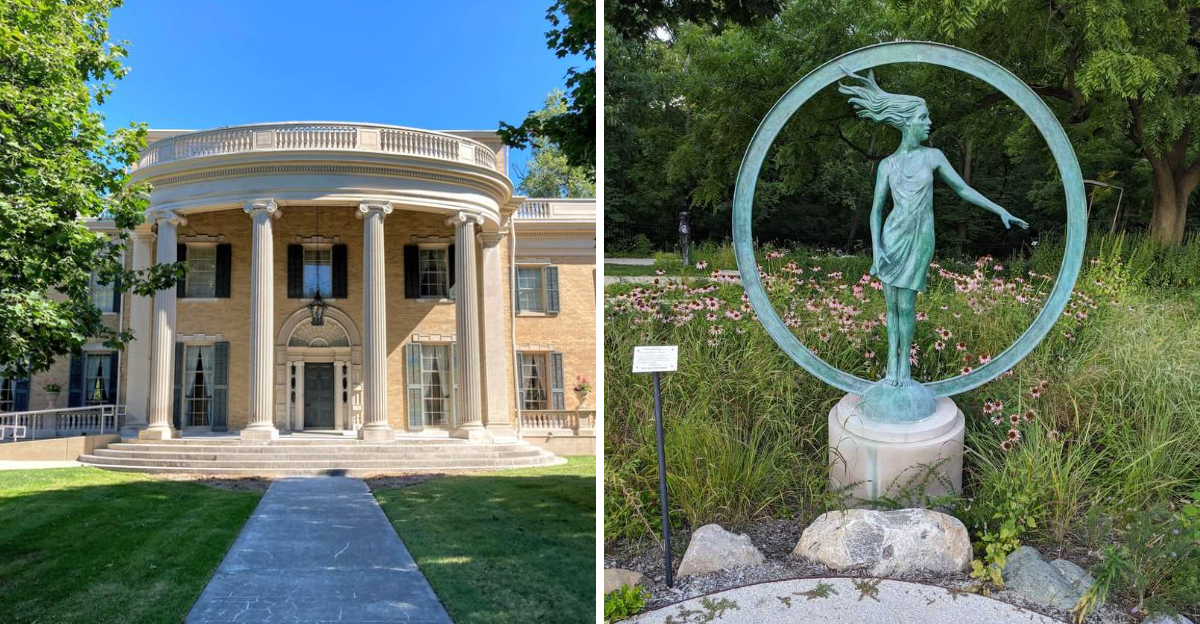
My first thought was that the mansion looked like the interesting part. Then I went around back.
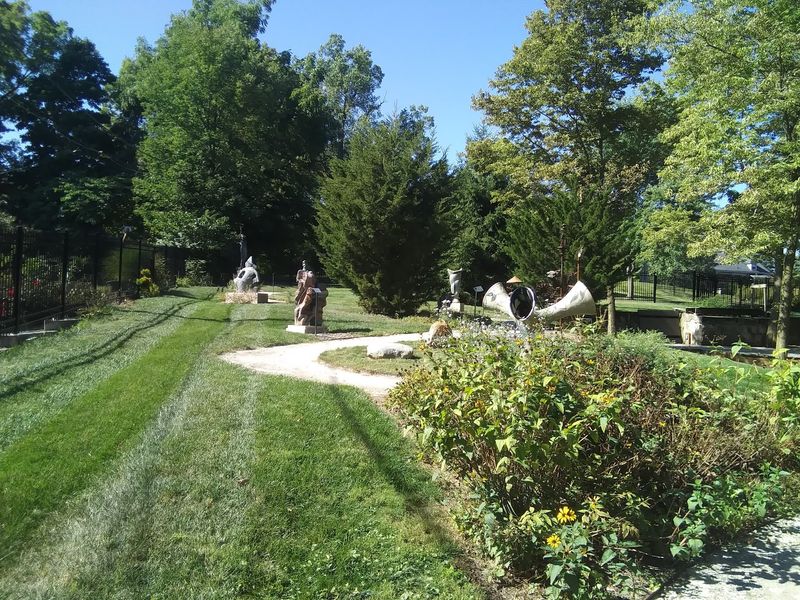
Three acres of trees opened up behind the house, with bronze sculptures sitting in the grass and stone carvings hiding along the paths. It felt less like walking through a garden and more like waiting to see what would turn up next.
The best part is that nobody charges admission for the outdoor grounds. Inside, the mansion holds more than a hundred paintings from Indiana artists, plus ceramics, carved clocks, and furniture that belongs firmly to another time.
The building once stood at the 1904 World’s Fair, which makes its current home feel even more unexpected. One old house, three acres of sculpture, and a free afternoon can make a pretty good combination.
A Mansion That Traveled by Train From a World’s Fair
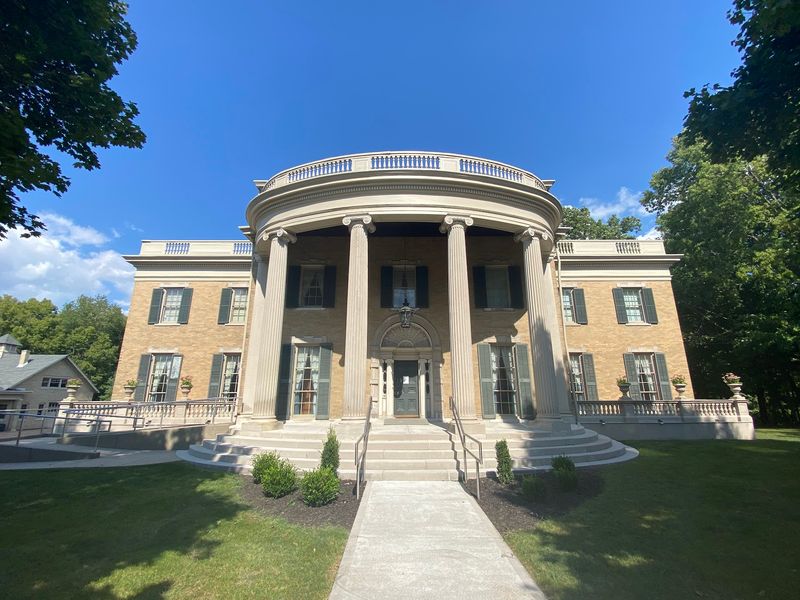
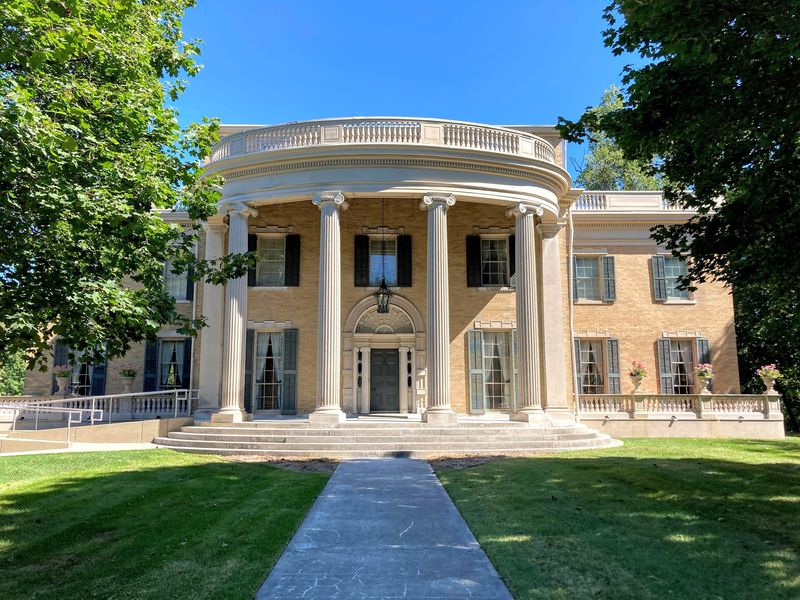
Few buildings can claim a moving day quite like this one. The mansion standing at 920 State Street began as the Connecticut Building at the 1904 St. Louis World’s Fair, designed by architect Edward T.
Hapgood to look like a gentleman’s country home.
When the fair closed, the whole structure was taken apart, loaded onto rail cars and rebuilt in Lafayette as a private residence for Mr. and Mrs. William Potter.
Look closely at the front entryway, the interior columns and the door capitals. Several of those elements were salvaged from the 1760 Hubbard-Slater Mansion in Norwich, Connecticut, which makes parts of the house older than the country it sits in.
The scale is genuinely surprising once inside. Three above-ground floors plus a full basement add up to roughly 16,000 square feet, with seven fireplaces, six bedrooms and five and a half bathrooms.
Very few buildings from that exposition survive anywhere, and this one remains remarkably close to its original design.
Bob and Ellie Haan bought the property in 1984, back when locals still called it the Potter Mansion. Restoration work and decades of collecting eventually turned a family home into a public museum that opened in 2013.
Take a slow lap around the exterior before heading in. The proportions and porch details read differently from the lawn than they do from the sidewalk.
Wander Through a Sculpture Garden for Free
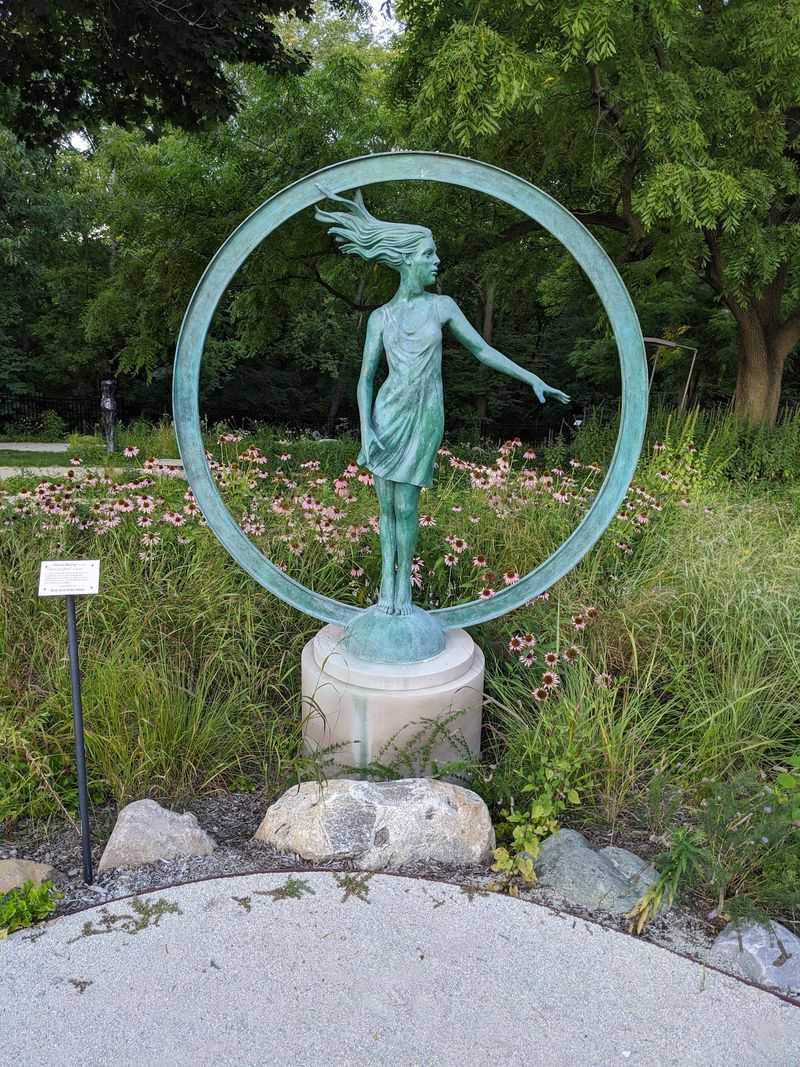
Here is the part locals quietly love. Behind the mansion, the lawn rolls out into an open-air gallery that stays free to the public every single day, dawn until dusk, no ticket needed.
The main path runs about 0.2 miles, is wheelchair accessible, and crunches pleasantly underfoot as it loops past more than two dozen sculptures by Indiana artists.
Variety is the whole point out here. Figural bronzes by Tuck Langland stand near dynamic metal work from Greg Mendez, while clay pieces by Marvin Bartel and Bill Kremer bring a softer, earthier feel to the mix.
Carved serpentine stone by Peter Rujuwa and glass platters by Kathleen Kitch round things out with color and shine.
Most sculptures stay under eight feet tall, which keeps the scale friendly rather than intimidating. Walk right up to them.
Circle around. Nothing here demands a whisper.
An outdoor theater with a stage sits on the grounds too, used for performances and events through the warmer months.
The wide lawn works beautifully for a picnic, and a team of volunteer gardeners keeps the beds looking sharp season after season.
Morning light suits the bronzes best, though late afternoon gives the metal pieces a warm glow worth catching. Bring a blanket and stay longer than planned.
Hoosier Group Paintings You Cannot See Anywhere Else
Art lovers tend to slow way down in these rooms. The museum holds the largest collection of Hoosier Group paintings found anywhere in the world, which is a big claim backed by walls full of proof.
T.C. Steele, J.
Ottis Adams, William Forsyth, Otto Stark and R.B. Gruelle all hang here, five names that shaped American Impressionism from an Indiana point of view.
Steele’s landscapes tend to stop people first. His light has a soft, low warmth that makes ordinary Indiana hillsides look like somewhere worth moving to.
Painters from the Brown County Art Colony appear throughout as well, capturing the wooded ridges of southern Indiana in thick, confident brushwork.
The collection reaches further back too. Richmond artists such as John Elwood Bundy and Maude Eggemeyer share space with Pioneer Painters including Barton Hays and Jacob Cox.
Roughly 100 paintings hang at any given time. The most significant works stay on long-term display, while others rotate for special exhibitions, so a return trip rarely looks identical to the first.
Docents circulate throughout the house and are happy to explain a canvas without hovering. Ask about a painting that catches the eye and a story usually follows.
Self-guided pacing means nobody rushes. Linger where it feels right.
Ceramics, a 4,000 Year Old Clock and Other Delightful Oddities
Paintings get the attention, but the odd objects steal the show. Hundreds of Indiana ceramics fill the mansion, ranging from slender vases and teapots to figural works and architectural pieces pulled from buildings.
Together they make a strong case that clay artists in this state have been doing extraordinary things for well over a century.
One piece fools nearly everyone. What looks like a shelf built for teacups turns out to be a massive ceramic tea container with working taps on both sides, essentially an antique water dispenser dressed up as furniture.
Then there is the grandfather clock, hand-carved in 1910 from a log found in southern Indiana. The tree it came from has been carbon-dated at roughly 4,000 years old.
Three of the largest Weller vases shown at the 1904 St. Louis World’s Fair live here as well, including a seven-foot giant that took home a Gold Medal for the Arts.
Bronze and stone sculpture, plus glass art, fill out the rest of the story across multiple mediums.
Keep an eye out for smaller details on shelves and mantels. Half the fun of this house is noticing something on the second pass that went unseen on the first.
Curiosity pays off here. Bring plenty of it.
Three Acres of Woods Waiting Past the Last Sculpture
Past the final sculpture, the mowed lawn gives way to something wilder. The museum property covers five acres, and roughly three of those are dense woods threaded by a rustic nature trail.
Signs along the way identify thirty different tree species, with extra markers explaining non-native and invasive plants plus the fruits certain trees produce.
Do not expect a flat stroll. The trail has real inclines, narrow stretches and rocky footing that can turn slick or muddy after rain, so proper shoes make a genuine difference.
It descends toward the bottom of the property near Valley Street before climbing back up the hill, which gives the whole loop a satisfying shape.
Birdsong replaces gravel crunch fairly quickly. On a quiet weekday the woods feel far removed from a street a few hundred feet away.
Like the sculpture garden, the trail stays open to the public daily from dawn until dusk at no cost.
Spring brings wildflowers and fresh leaf cover, while autumn turns the canopy into something worth photographing. Summer offers welcome shade for anyone who overheats easily.
Walking these woods after seeing the paintings inside adds a nice layer of context. The landscapes hanging on those mansion walls came from terrain that looks a lot like this one.
Furniture Grand Enough to Stop Conversation
Some houses have furniture. This one has furniture with a resume.
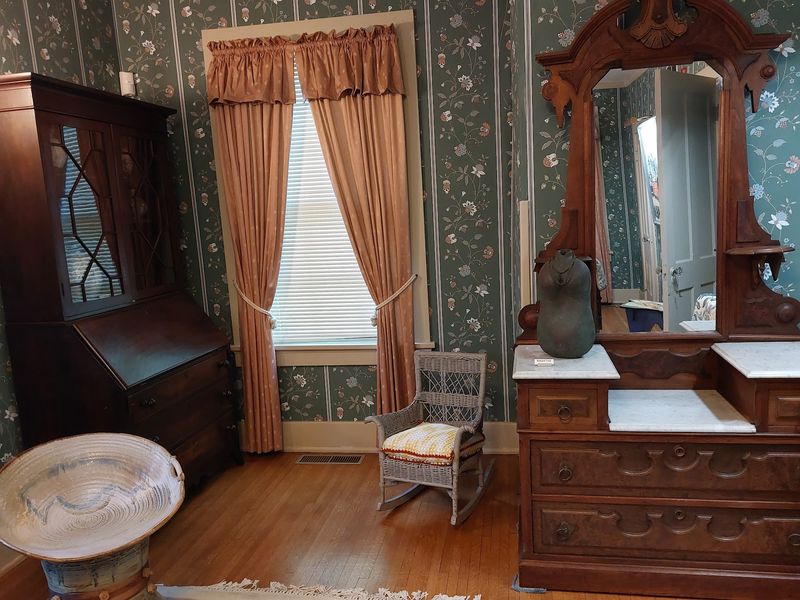
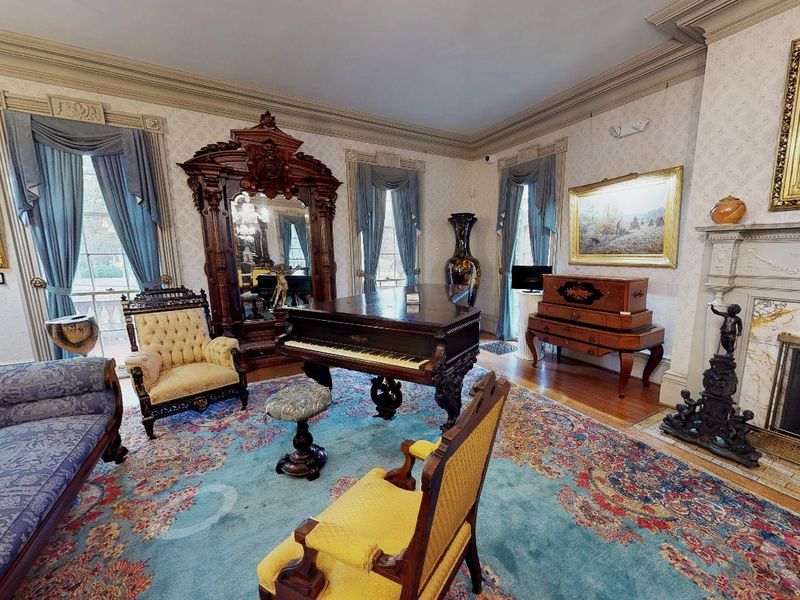
The museum holds a major collection of American Renaissance Revival pieces dating from the 1860s through the 1890s, heavy and ornate in a way modern rooms rarely allow.
Carved crests, dark woods and elaborate hardware turn ordinary cabinets into showpieces.
A superior-grade Wooton desk ranks among the standouts, its many compartments folding open like a piece of clever machinery. Nearby, a massive Thomas Brooks pier mirror commands its corner without apology.
The Great Hall sets the mood right away with columns and pilasters topped by Ionic capitals.
Look up in the open well and a 26-light brass and crystal chandelier hangs above the elegant double staircase leading to the second floor. It is the single detail most visitors photograph.
The Haans chose each piece to complement the artwork rather than compete with it, which is why the rooms feel lived-in instead of staged.
Seating is available throughout the house for anyone who needs a rest between rooms, so the visit stays comfortable at any pace.
Give the second floor extra time. Rooms up there hold surprises that first-time visitors often miss while hurrying back toward the stairs, and the woodwork alone rewards a closer look.
See the Collection Two People Chose to Share
Behind every object in this house sits a decision someone made on purpose. Bob and Ellie Haan bought the mansion in 1984, then started collecting historic Indiana art in earnest in 1992.
Their rule was simple and demanding. Chase only the finest works by the state’s most important artists.
That standard built a museum-quality collection over three decades, eventually expanding well past paintings into ceramics, sculpture and antique furniture.
In 2013 they began welcoming visitors for tours while still living in the house, an unusual setup that let guests walk through a genuinely lived-in home.
The bigger gesture came in 2015. The Haans donated the mansion, the grounds and a large share of the collection to establish the nonprofit Haan Museum of Indiana Art, then moved elsewhere themselves.
Volunteer docents carry that spirit forward now, greeting people at the door and offering background on any piece that catches attention without turning the visit into a lecture.
Indoor galleries operate Wednesday through Saturday from 1 PM to 4 PM, so plan the afternoon accordingly. The sculpture garden and nature trail remain open free of charge every day.
Generosity built this place, and it shows in how easy it is to enjoy.
Address: 920 State Street, Lafayette, Indiana
