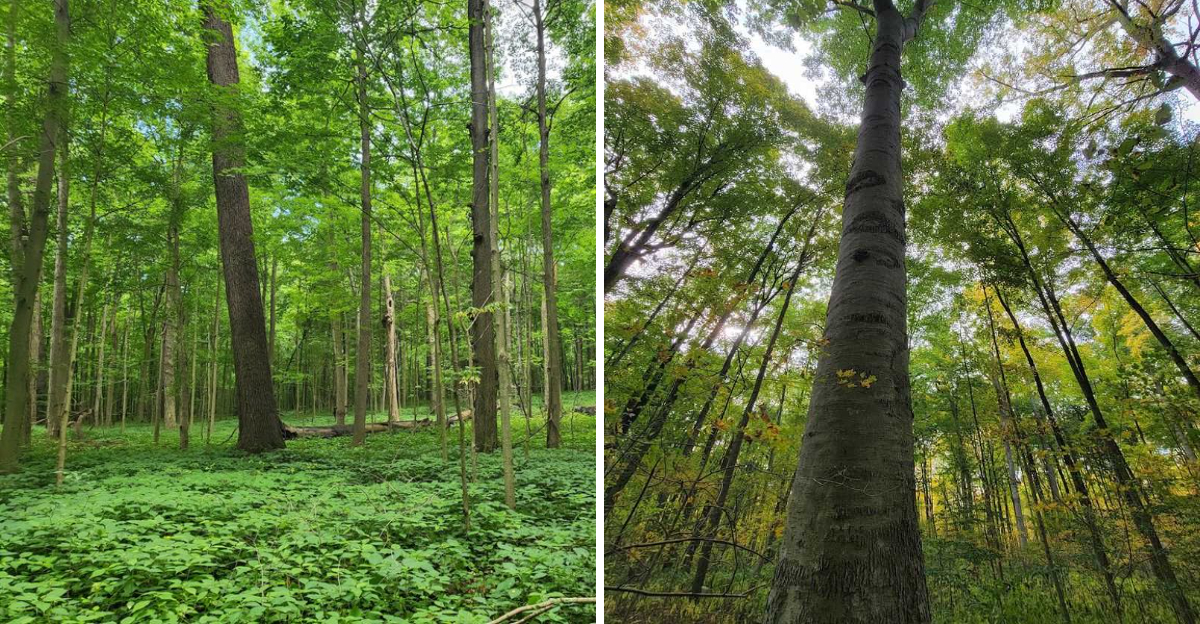
There is a place in Fayette County, Indiana where the forest still looks much the way it did centuries ago. This quiet nature preserve near Connersville protects a rare stretch of old-growth woodland filled with towering trees, seasonal wildflowers, and the kind of stillness that feels increasingly hard to find.
What makes it remarkable is not just the age of the forest, but the feeling of stepping into a landscape that has remained largely untouched while the world around it changed. Designated a National Natural Landmark decades ago, it offers visitors a chance to experience a piece of Indiana that predates modern roads, towns, and even the country itself.
For anyone who loves quiet trails and hidden natural history, it feels like discovering another era hidden among the trees.
Ancient Trees So Massive They Redefine What a Tree Can Be
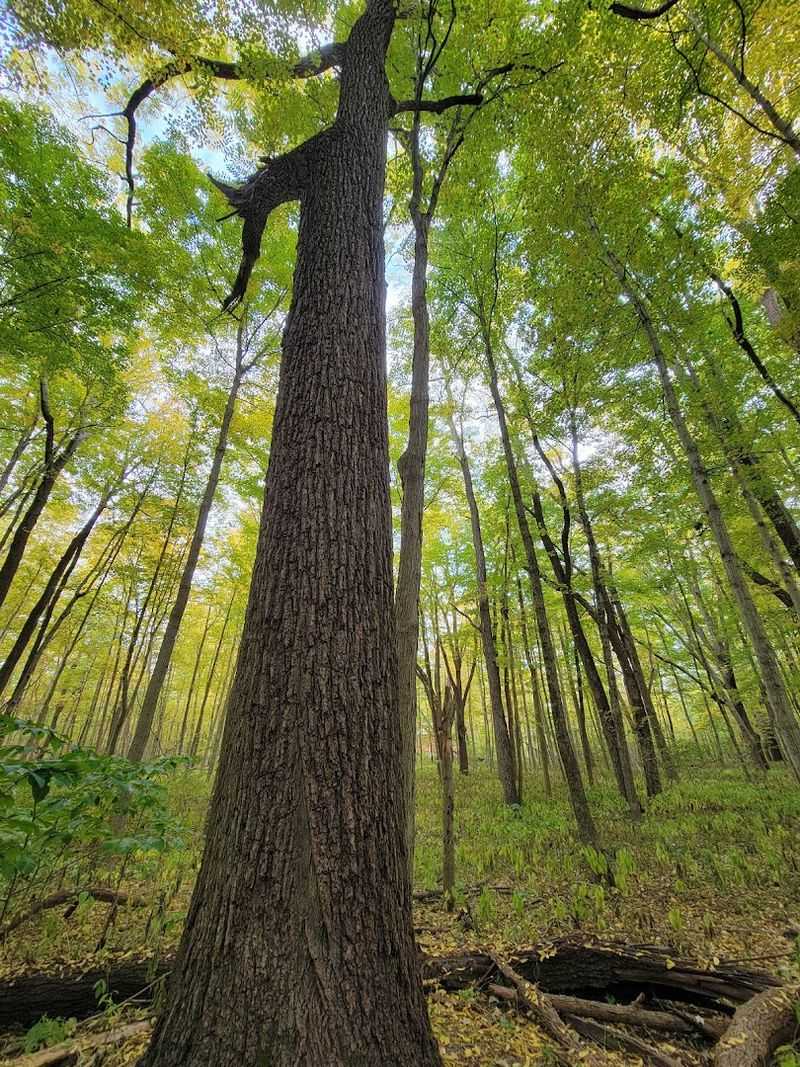
There is something humbling about wrapping your arms around a tree trunk and realizing it is wider than you are tall. That is the kind of moment waiting for you at Shrader-Weaver.
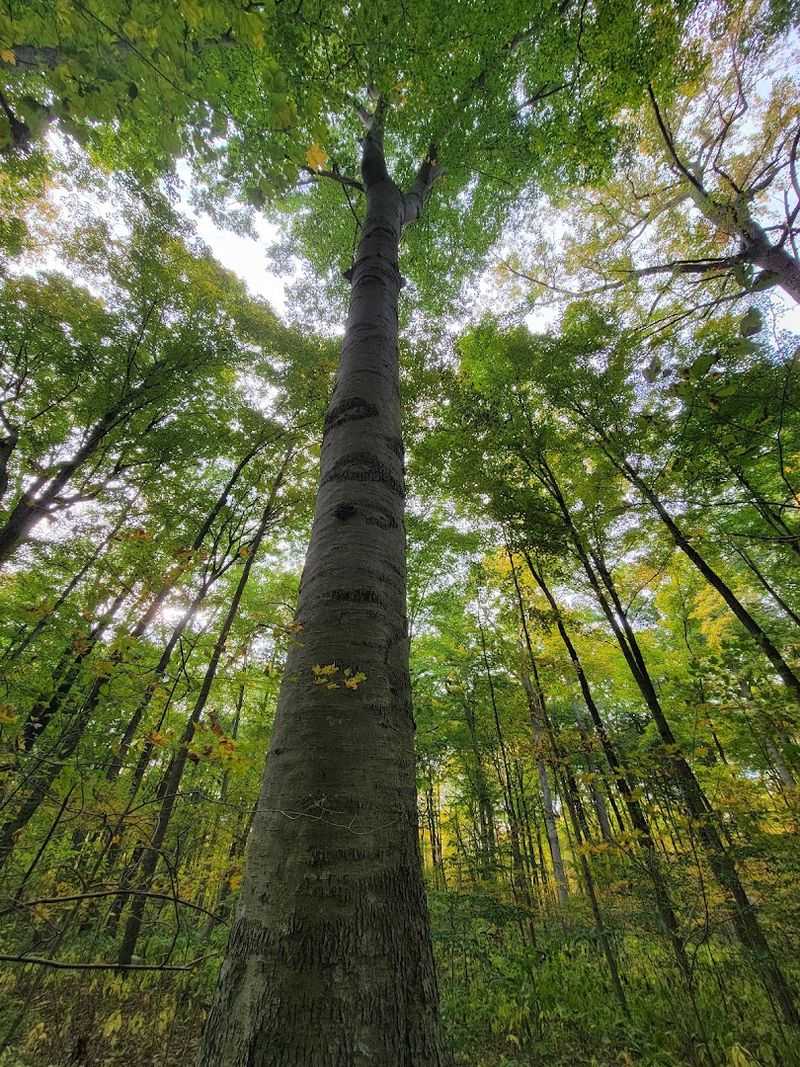
Some of these hardwoods measure three to four feet across at the base and shoot more than 100 feet into the sky.
The preserve is home to the largest black walnut tree in the entire state of Indiana. Let that sink in for a second.
Among every forest, backyard, and woodland in Indiana, the biggest black walnut lives right here in Fayette County.
A bur oak on the property stretches more than five feet in diameter, making it the largest tree in the woods by a significant margin. Many of the oaks here have been growing for over 250 years, meaning they were already mature trees before the American Revolution began.
Some sections of the forest were fully established by the time of the Civil War.
Looking up at these giants from the trail gives you a perspective shift that is hard to describe. They are not just big trees.
They are living records of time, weather, seasons, and survival that stretch back farther than most American institutions. Seeing them in person, rather than reading about them, is a completely different experience that stays with you long after you leave the trail.
Spring Wildflowers That Turn the Forest Floor Into Something Magical
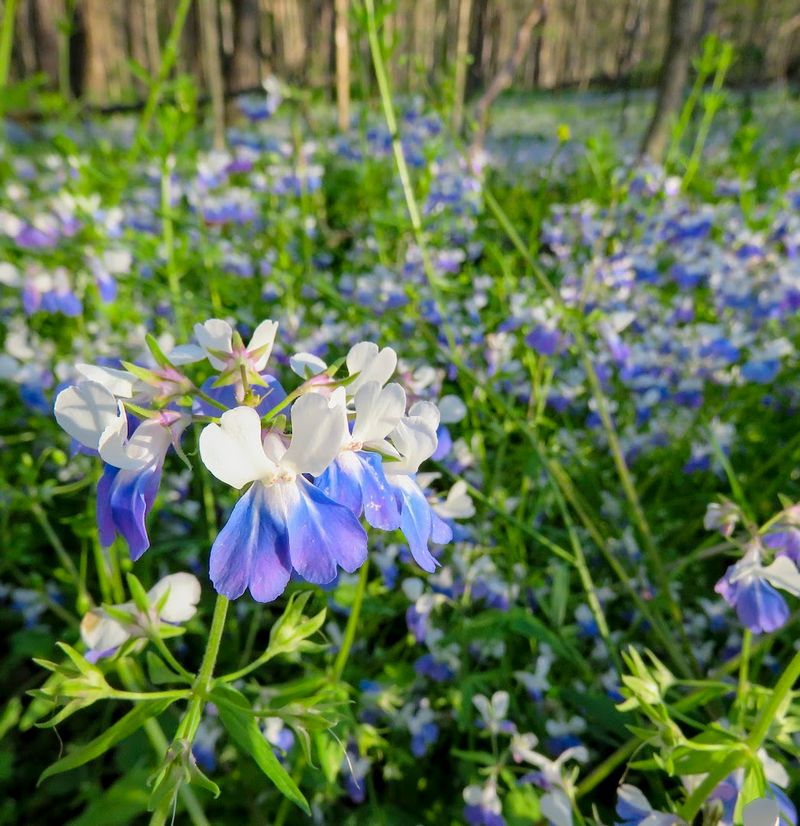
April and early May bring one of the most visually stunning natural events in all of Indiana, and Shrader-Weaver is one of the best places in the state to witness it. The forest floor erupts in waves of color as spring wildflowers push up through the leaf litter before the canopy closes overhead and blocks the light.
Blue-eyed Mary is perhaps the showstopper here, forming dense blue and white carpets across the ground that look almost painted. Trillium adds bold white blooms, while jack-in-the-pulpit brings its quirky, hooded appearance to shadier corners.
Skunk cabbage appears near the wetter areas, and the overall effect is layered, lush, and genuinely breathtaking.
The timing matters a lot. These wildflowers bloom in a narrow window, and once the tree canopy fills in, the light disappears and so do many of the blooms.
Visiting in late April tends to offer the best combination of peak flowers and still-open canopy. Early morning visits reward you with soft light that makes the colors even more vivid.
Photographers, botanists, and casual hikers alike make special trips to Shrader-Weaver just for this annual display. If you have never planned a hike around wildflower season before, this is the place to start.
The experience is completely free, genuinely jaw-dropping, and something most Indiana residents do not even know is happening an hour or two from home.
A Rare Old-Growth Forest That Indiana Almost Lost Forever
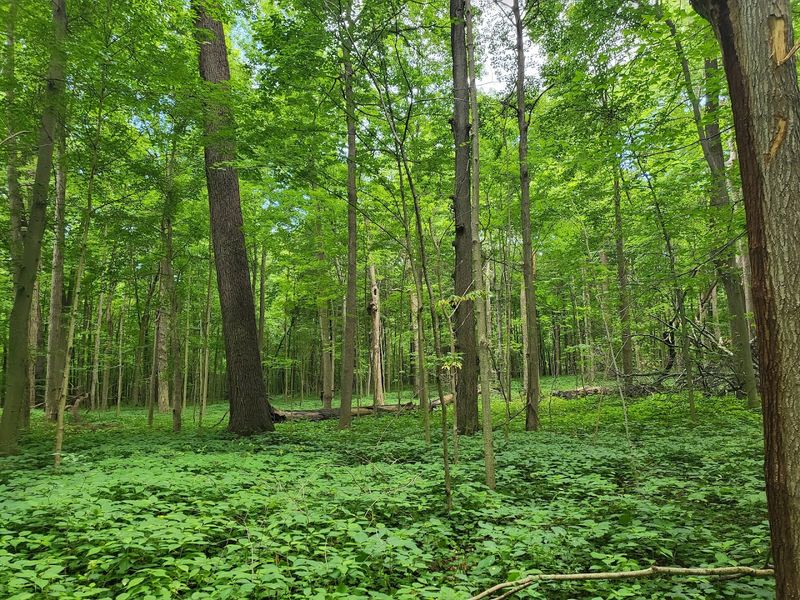
Most forests in Indiana were cleared long ago for farmland, and what grew back is mostly young second-growth woodland. Shrader-Weaver is different in a way that genuinely stops you in your tracks.
The 28-acre old-growth section here is one of the last remaining fragments of the original deciduous forest that once blanketed the eastern United States.
Walking into it feels like crossing a threshold into a completely different world. The trees here were never cut.
They have been growing, falling, and regenerating on their own schedule for centuries, and the ecosystem they support is unlike anything you will find in a typical Indiana park.
Beech and maple dominate the canopy, but you will also spot tulip trees, black cherry, black walnut, red elm, and bur oak scattered throughout. The understory is layered and dense in a way that only truly ancient forests can produce.
Fallen logs decompose slowly into the soil, feeding the next generation of growth in a cycle that has been repeating here for longer than the state of Indiana has existed.
Visiting this forest is not just a hike. It is a chance to witness a living piece of natural history that was somehow spared when nearly everything else around it was not.
For anyone who cares about what Indiana looked like before settlement, this place is irreplaceable.
Wildlife That Thrives in One of Indiana’s Most Biodiverse Corners
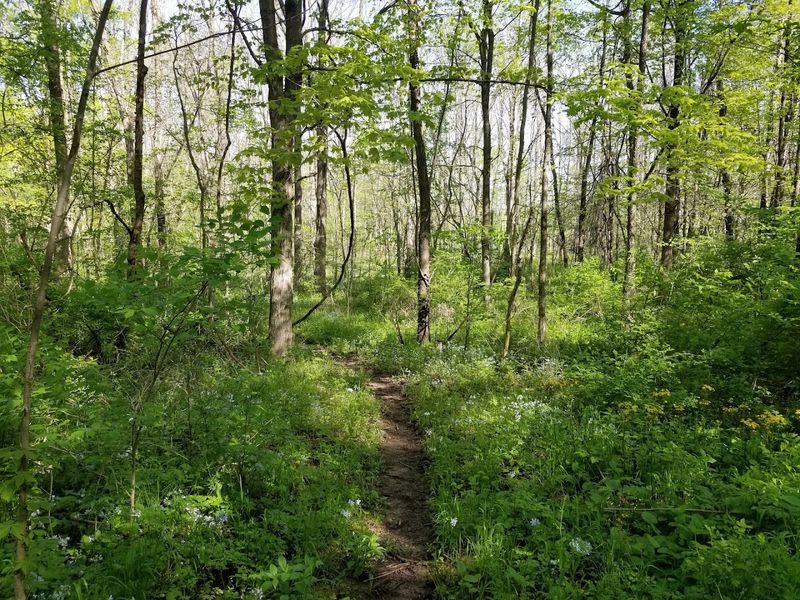
Beyond the trees and flowers, Shrader-Weaver is a functioning wildlife habitat that supports species you simply will not encounter in younger, more disturbed forests. The combination of old-growth canopy, dense understory, groundwater seeps, and creek habitat creates a patchwork of ecological niches that attracts an impressive range of animals.
Barred owls call through the trees with their unmistakable who-cooks-for-you sound, and great crested flycatchers dart through the upper canopy during warmer months. Cerulean warblers, a species that depends heavily on old-growth forest structure, use the preserve during migration.
Birders come specifically to add these species to their lists, and the preserve rarely disappoints.
Down at ground level, salamanders and frogs take advantage of the cool, damp conditions near the seeps and old creek bed. Dragonflies patrol the open areas near water in summer, and the insect diversity alone is worth paying attention to.
Pawpaw, spicebush, and Virginia creeper fill the understory, each supporting its own chain of insects and birds.
What makes this place stand out is that the wildlife here is not incidental. It is the result of centuries of undisturbed habitat building on itself.
Every layer of the forest, from the soil fungi to the canopy giants, plays a role. Spending time here quietly and patiently almost always rewards you with something unexpected, whether it is a flash of color in the branches or a rustle in the leaf litter below.
Geological Wonders Hidden Inside the Forest You Would Not Expect
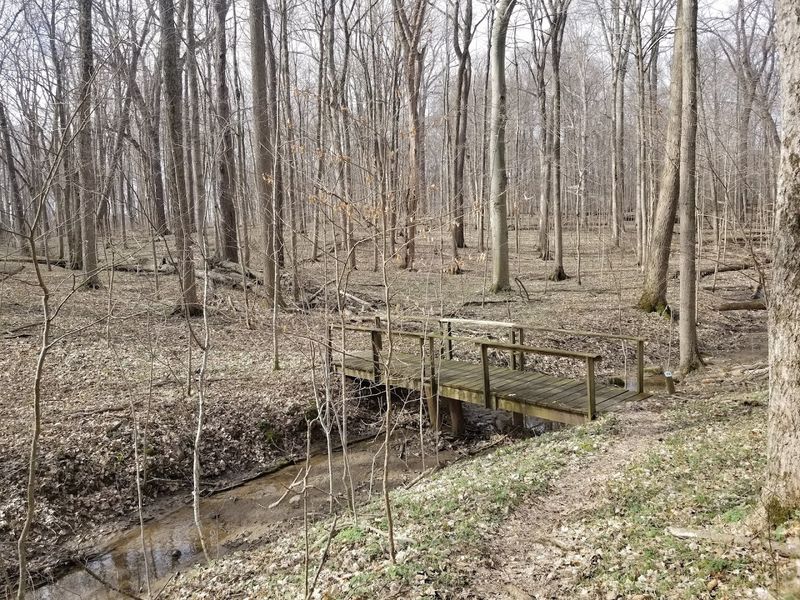
Most people come to Shrader-Weaver for the trees, but the ground beneath your feet tells its own fascinating story. The preserve contains groundwater-fed seeps, areas where water rises slowly from underground and creates consistently moist, cool microhabitats.
These seeps support plant and animal communities that are completely distinct from the surrounding upland forest.
Seep environments are rare in Indiana and often support specialist species that cannot survive in drier conditions. The plants growing in and around them tend to be unusual, and the cool temperatures they produce even in summer give the surrounding area a noticeably different feel when you walk through.
The old bed of Williams Creek runs through part of the preserve, and glacial boulders deposited thousands of years ago during the last ice age are still visible along its course. These rocks were carried here by glaciers and left behind as the ice retreated, and they have been sitting in this forest ever since.
Seeing them surrounded by centuries-old trees creates a layered sense of geological and ecological time that is genuinely rare.
The self-guided trail through the old-growth section points out many of these features, so you do not need to be a geologist to appreciate what you are looking at. The numbered stations along the roughly half-mile trail help connect what you see with what it means, making this one of the more educational hikes available in eastern Indiana without feeling like a lecture.
Two Distinct Trails That Show You Nature From Completely Different Angles
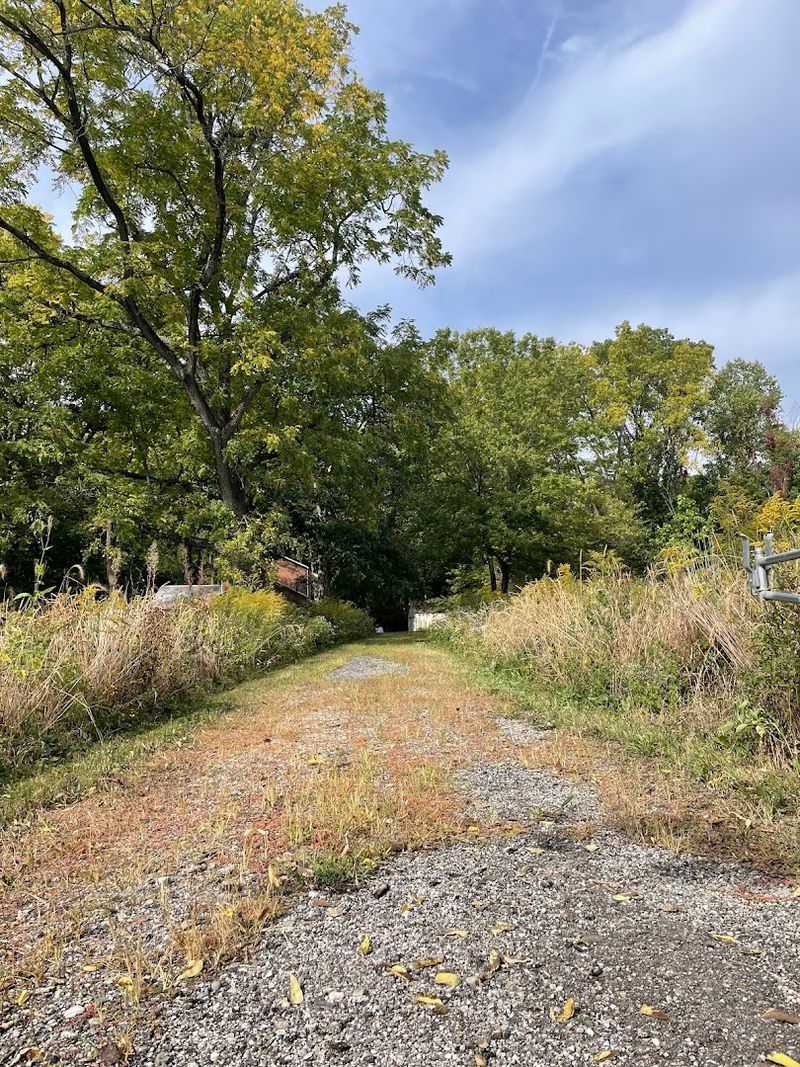
One of the more underappreciated things about Shrader-Weaver is that it offers two separate trail experiences, each designed to show visitors something genuinely different about how forests work and change over time. You do not have to choose one over the other, since both are relatively short and easy enough for most fitness levels.
The old-growth trail winds through the ancient forest for about half a mile and includes 22 marked stations along the way. Each station corresponds to a feature in the environment, from specific tree species to ecological processes, giving the walk a satisfying sense of discovery.
The trails are narrow and winding rather than flat and straight, which makes the experience feel more like actual exploration.
The Succession Trail takes a different approach, guiding visitors through old fields and lowland forest to illustrate how plant communities change over time as land is left undisturbed. Watching a field gradually become a forest over decades is one of ecology’s most compelling stories, and this trail makes it tangible and visible rather than abstract.
Both trails are open year-round from 8 AM to 6 PM, and each season brings something new. Spring means wildflowers, summer brings a full green canopy and birdsong, fall transforms the leaves into warm color, and winter strips everything back to reveal the architecture of the forest.
There are no restroom facilities on site, so plan accordingly before you arrive at 5299 N County Rd 450 W, Connersville, IN 47331.
A National Natural Landmark With a Pioneer Past Worth Knowing
Not many places in Indiana carry the designation of National Natural Landmark, but Shrader-Weaver earned it in 1974 and has held it ever since. That recognition from the federal government acknowledges that what exists here cannot be recreated or replaced.
It is a preserved monument to what Indiana’s natural landscape looked like before European settlement transformed nearly all of it.
The preserve also holds the remnants of a pioneer homestead, adding a layer of human history to the natural one. Historic buildings are visible near the property, though they sit on adjacent private land, so they are best appreciated from a respectful distance.
Still, their presence adds context to the landscape and reminds you that people lived and worked alongside these same ancient trees not so long ago.
Being a State Designated Nature Preserve means the land is protected from foraging, hunting, and picnicking, rules that exist specifically to keep the ecosystem intact for future generations. Those protections are part of why the forest still looks the way it does.
Without them, even a small amount of repeated human disturbance could unravel what centuries of undisturbed growth have built.
When I think about places in Indiana that deserve far more attention than they get, this one always comes to mind first. It carries real historical and ecological weight.
For anyone who wants to feel genuinely connected to this state’s natural roots, Shrader-Weaver is not optional. It is essential.
