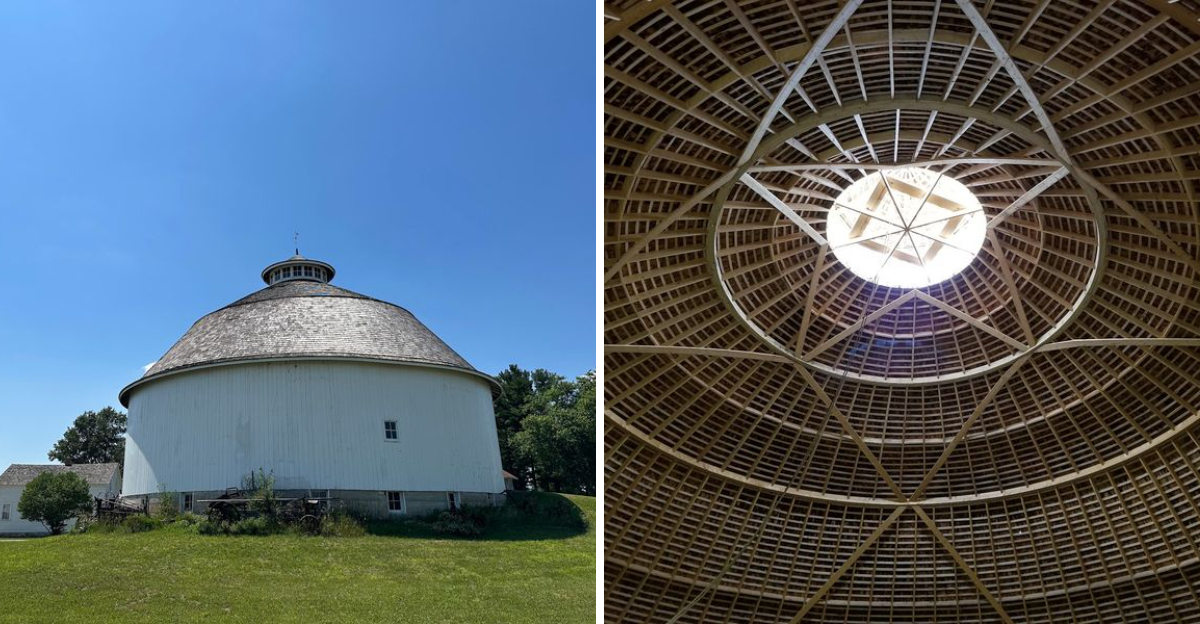
Why did farmers build a barn without corners? That is probably the first question that pops into your head when you see this enormous white building sitting beside the countryside.
It looks almost too perfectly round to be a real barn, complete with a tiny cupola on top, yet it has been standing for more than a century. The story gets better once you realize the barn is only the beginning.
Nearby, a living history village brings old-time Indiana to life with a blacksmith shop, general store, and caboose, while the surrounding area adds a lake, historic downtown, and seasonal festivals.
This little corner of Fulton County has even earned itself the nickname “Round Barn Capital of the World,” thanks to the area’s long history with these unusual farm buildings.
So yes, you can drive out to see one very strange barn. But once you get there, you might as well stay awhile.
The Bert Leedy Round Barn And Its Century Of Curves
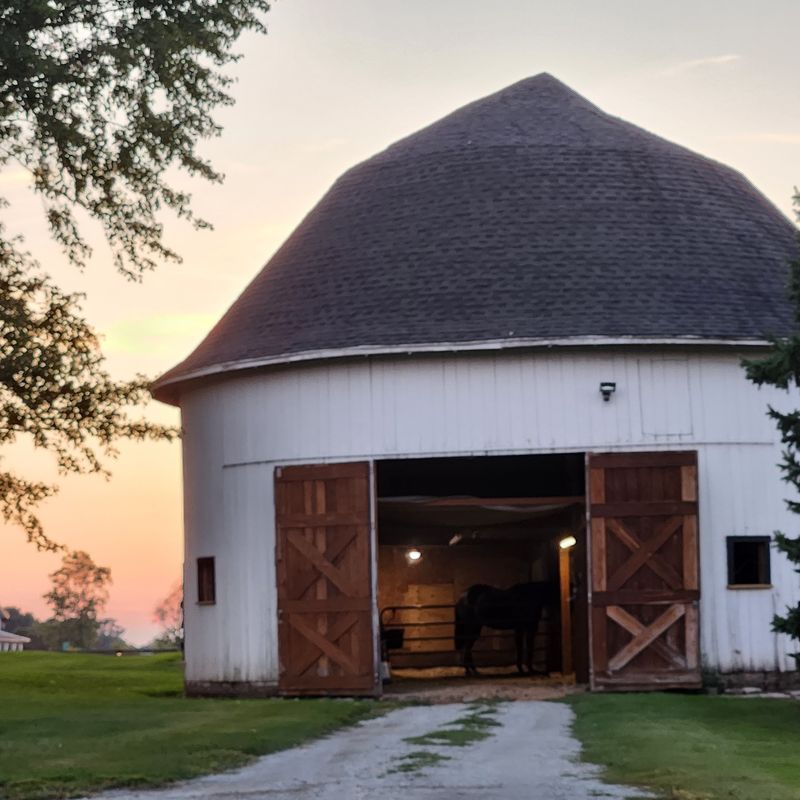
Fire started it all. Bert Leedy’s rectangular barn burned down, and in 1924 he put up a round one instead, racing to get livestock and equipment under cover before winter set in.
A hundred years later, that same barn still stands. It moved to the Fulton County Historical Society grounds in 1989 after a tornado tore at its roof, and the restoration crew saved roughly two-thirds of the original roofing material.
The shape is the whole point. Two stories tall, topped with a three-pitch gambrel roof and a round cupola whose windows pour daylight straight down into the middle of the building.
White vertical siding wraps the upper level, while poured concrete forms the sturdy base underneath. Farmers liked round barns because chores flowed in a circle instead of a straight line, cutting steps at feeding time.
Storm resistance helped too, since wind slid around the curve rather than slamming a flat wall.
Inside, antique horse-drawn implements, buggies, and older model trucks fill the floor. Downstairs, mangers and milking stations have been rebuilt so visitors can see exactly where cows stood and how the daily routine moved.
Fulton County once counted seventeen round barns of its own, part of an estimated 225 across Indiana at their peak. Standing beneath this one, that number stops feeling like trivia and starts feeling like a lost building tradition.
Loyal, Indiana, Where The Calendar Stops Around 1912
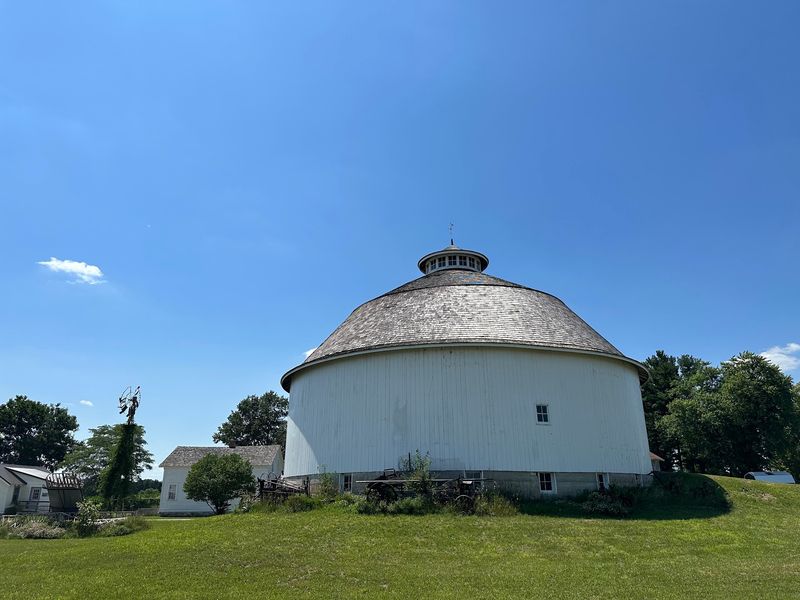
Right beside the barn sits a village that was built to look like it never left the early 1900s. Loyal, Indiana, recreates the years between 1900 and 1925, a stretch remembered as both the Golden Age of Agriculture and the Golden Age of Indiana Literature.
The name has a story. The community was originally called Germany, Indiana, and got renamed Loyal in 1918 during World War I.
Wander the gravel paths and the buildings come at you one after another. A log cabin, a blacksmith shop where iron once glowed orange, and a tall windmill that used to pull water up from the ground.
There is a stagecoach inn, a segment of railroad track with a caboose parked on it, and a vintage boxcar left over from the days when rail lines held small towns together.
A reproduced 1920s general store holds shelves of period goods, and the little Kewanna Jail looks about as comfortable as expected.
The William Polke House served travelers as a stagecoach inn back in 1832. Nearby, a combined doctor and dentist office displays early instruments that make modern appointments feel like a luxury.
What ties it together is the sense of a world in mid-change, horses giving way to automobiles, hand tools yielding to engines. Give it an hour, minimum.
Cameras stay busy here.
Rochester’s Downtown Has Good Bones
Brick storefronts, tall windows, and cornices with more detail than most modern buildings bother with. Rochester’s downtown carries the look of a town that got built carefully and then kept its buildings instead of replacing them.
It all started as a trading post in 1831, and Rochester grew into the Fulton County seat from there.
The Rochester Downtown Historic District sits on the National Register of Historic Places, which explains why the streetscape holds together so well. One-of-a-kind boutiques and specialty shops fill the old spaces, and cafes give tired legs somewhere to land.
Window shopping here has a slow rhythm to it. No rush, no crowds pushing along the sidewalk.
The Fulton County Courthouse anchors the district, a Richardsonian Romanesque building of heavy stone arches that also holds a National Register listing.
Its grounds carry historical markers worth pausing over, including one for Rochester College and another for the Trail of Death, the forced removal of the Potawatomi that passed through this very area.
Step a block or two off the main stretch and Victorian houses appear, with spindled porches, bay windows, and paint schemes that show real pride of ownership.
Walking shoes beat driving here. The whole district covers a small area, and the details reward anyone moving at human speed.
Lake Manitou And Its Monster Fish Legend
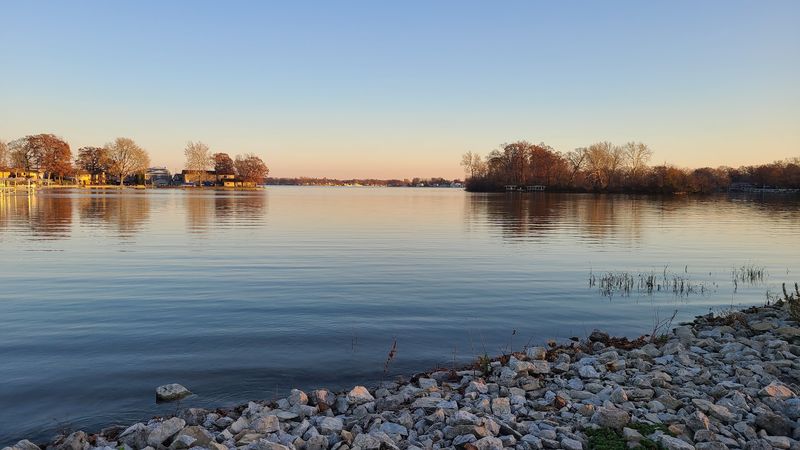
Here is something surprising about this 775-acre lake: people made it. Lake Manitou dates to 1827, making it one of the oldest man-made lakes in Indiana, created when the U.S. government built a mill tied to a treaty with the Potawatomi.
The Potawatomi called it Man-I-Toe, meaning spirit, and stories described a mysterious monster fish somewhere in the depths.
Modern visitors come for tamer reasons. Anglers cast for largemouth bass, black crappie, bluegill, northern pike, yellow perch, and spotted gar, and the fishing piers stay busy on warm evenings.
Boaters, kayakers, waterskiers, and jet-skiers all share the water, and a ski course near the southern end draws the fast crowd since there is no speed limit restriction.
A public boat ramp makes launching simple. Picnic pavilions and a marked swimming area handle everyone who would rather stay on solid ground.
Along the northwestern edge, a butterfly garden curls around the shoreline, trading engine noise for the flicker of wings over flowers.
Parks and nature preserves ring much of the lake, so the shoreline never feels overbuilt. Herons work the shallows while somebody’s pontoon drifts past.
Sunset is the move. Light spreads flat across the water, boats head in, and the lake goes quiet enough to hear the shoreline trees.
Festivals That Smell Like Woodsmoke And Fry Bread
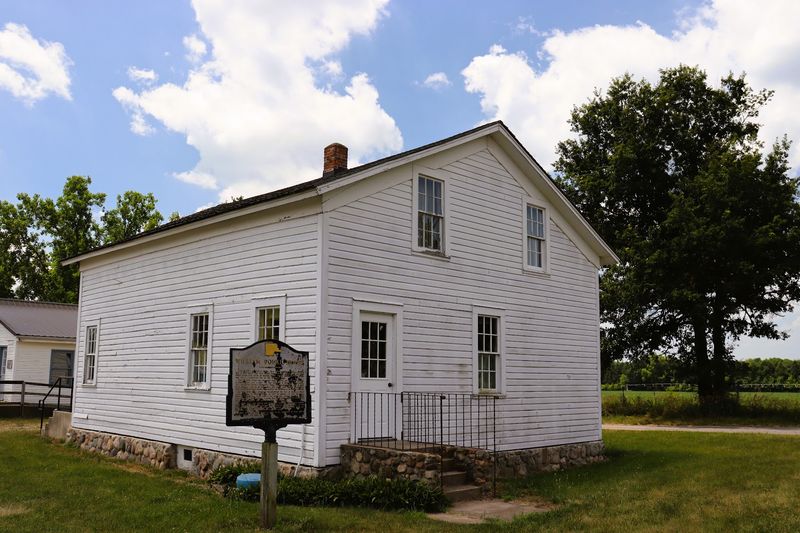
Three times a year the grounds beside the round barn turn loud, smoky, and completely alive. History here is not behind glass, it is cooking over a fire.
The Trail of Courage Living History Festival lands each September and recreates pre-1840 America across several encampments. French and Indian War camps, Revolutionary War scenes, Western Fur Trade traders, and Native American villages spread across the field.
It commemorates the era just before the Potawatomi removal along the Trail of Death, which passed directly through Rochester. Visitors watch Indian dances, catch pioneer music from two stages, and can take canoe rides on the Tippecanoe River.
Craft demonstrations include flint knapping, beadwork, and blacksmithing, with sparks and hammer rings included at no extra charge.
Spring brings the Redbud Trail Rendezvous, usually in April, covering Indiana history from the Revolutionary War through 1865. Re-enactors in period clothing explain frontier skills while food cooks over open flames, and vendors set up inside the living history village buildings.
The timing is deliberate, because the redbud trees bloom purple-pink across the grounds.
June belongs to the Historical Power Show, where hundreds of antique tractors, hit-n-miss engines, and vintage garden tractors chug and pop in rows. A steam-powered 1910 sawmill runs during demonstrations, slicing logs the old way.
Check dates before booking. These weekends fill the calendar fast.
Green Space, Trails, And A Wooden Mountain For Kids
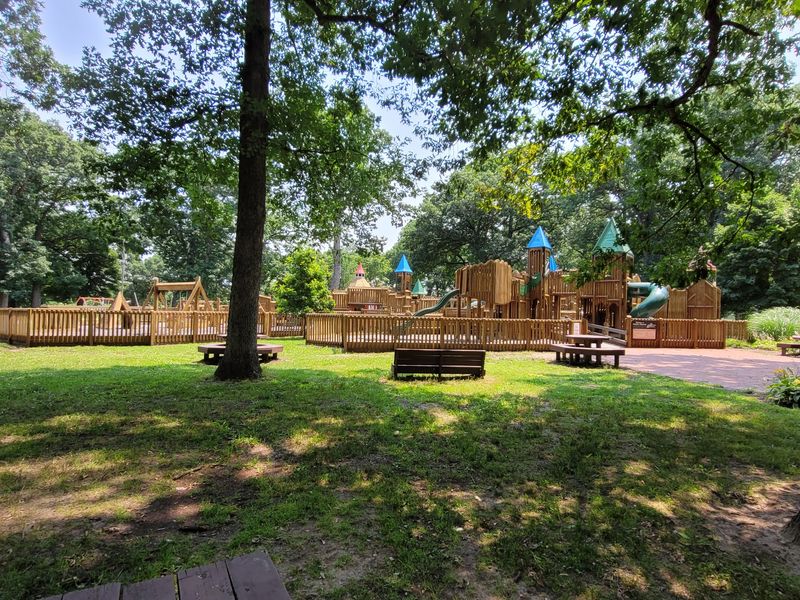
Kids spot it before parents do. Manitou Mountain, a sprawling wooden play structure built in 1997 through a community effort, sits inside Rochester’s City Park like a fortress made of beams and ladders.
The park itself covers roughly 33 acres of rolling, wooded ground shaded by mature trees.
Basketball courts, softball fields, a skate park, and a splash pad keep the place humming through summer. A disc golf course threads between the trunks, and picnic shelters give families a shady base camp.
Winter changes the mood entirely, when the sledding hill turns into the busiest spot in town.
Fun bit of trivia: these grounds served as the Fulton County Fairgrounds from 1850 all the way to 1950.
Down by the water, Lakeside Park offers a boat ramp, swimming area, fishing piers, a butterfly garden, and a picnic pavilion overlooking Lake Manitou.
Quieter options ring the lake. The Bob Kern Nature Preserve covers 162 acres on the east side, while the Judy Burton Nature Preserve holds 130 acres to the west, both sheltering bird habitat and unusual plants across marshy, wooded ground.
Ruth Kern Woodland Preserve adds 149.3 acres with 1.6 miles of trail for anyone wanting a slow walk under the canopy.
Cyclists head for the Nickel Plate Trail, a smooth ride straight through Indiana farm country.
Seventeen Exhibit Rooms And More Barns Down The Road
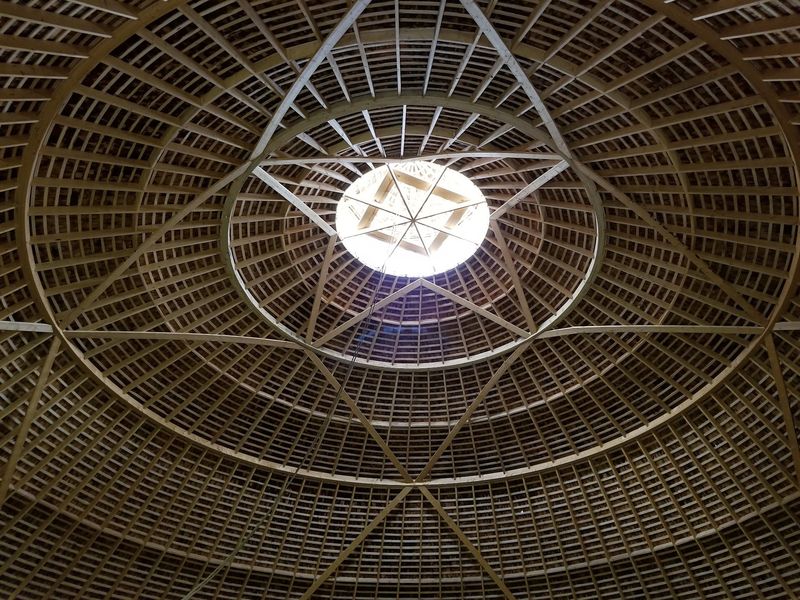
The barn gets the attention, but the museum next door quietly outguns it on sheer volume. Seventeen exhibit rooms fill the Fulton County Historical Society Museum, each taking on a different slice of local life.
Displays run through early Native American history, transportation, military service, and the region’s circus legacy. Recreated period kitchens sit near exhibits on sports, railroads, weaving, spinning, technology, farm tools, and Victorian home life.
Plan more time than expected. Rooms like these have a way of swallowing an afternoon.
Elsewhere in the county, the Prill School Museum offers a restored one-room schoolhouse from 1876, complete with the kind of desks that make modern classrooms look plush. The Millark Mill, built in 1860, speaks to the area’s early industry.
Trail of Death historical markers appear across Fulton County, tracing the route of the Potawatomi removal and giving travelers reason to slow down and read.
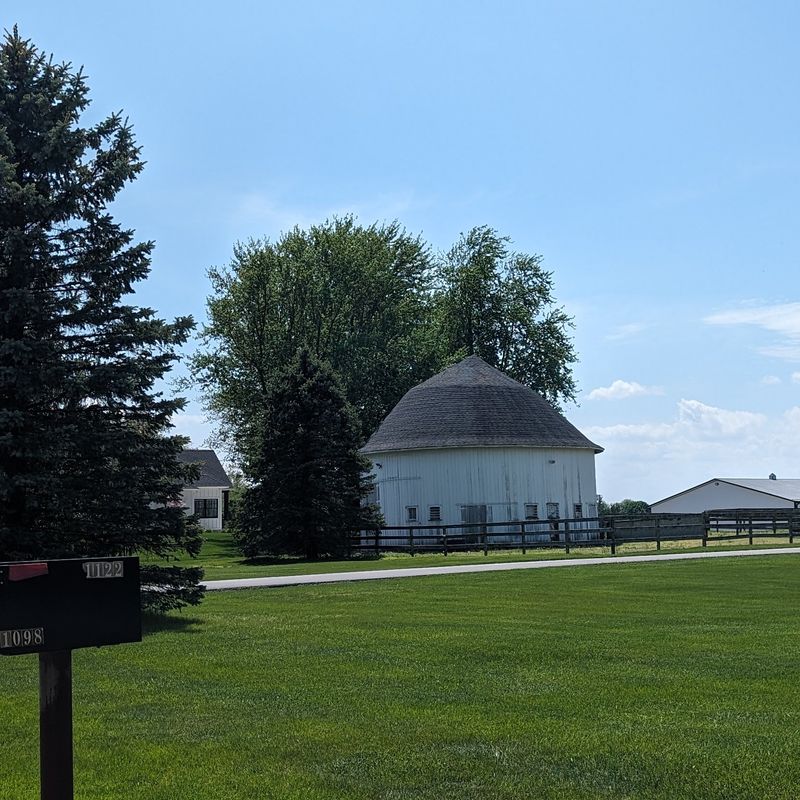
Then there are the other barns. Seven or eight historic round barns still stand around the county, including the John Haimbaugh Round Barn from 1914, itself listed on the National Register of Historic Places, and the Utter-Gerig Round Barn.
Some sit along working farm lanes, so admire them from public roads and respect private property.
Address: 37 E 375 N, Rochester, IN 46975
