Oklahoma’s wide horizons lull you into expecting simplicity, a steady rhythm of prairie, sky, and open road that feels timeless and familiar.
Then, without warning, something rises from the landscape that refuses to fit the picture.
It might be towering, playful, or downright puzzling, but it demands your attention all the same.
These landmarks do more than decorate the scenery.
They interrupt it.
Born from imagination, humor, and bold ideas, they turn ordinary drives into moments of surprise and disbelief.
Some feel like personal statements made permanent, while others seem designed to spark questions rather than answers.
Together, they reveal a side of Oklahoma that thrives on individuality and quiet audacity, inviting travelers to slow down, look closer, and wonder how such unforgettable creations came to exist.
1. The Rock Cafe
Natural stone walls have sheltered hungry travelers since 1939, when Roy Rives built this cafe from rocks hauled from the surrounding countryside.
Each stone was carefully selected and fitted, creating walls that have survived eight decades of Oklahoma weather.
The building sits on Route 66’s original alignment, serving generations who drove the Mother Road seeking adventure or new lives.
Mamie Mayfield ran the cafe for decades, becoming a beloved figure who treated customers like family.
Her recipes for fried chicken and homemade pies earned legendary status among regulars and travelers alike.
When fire damaged the building in 2008, the community rallied to restore this irreplaceable piece of highway history.
Volunteers and craftspeople donated time and materials, determined to preserve the cafe for future generations.
The interior retains its vintage character, with worn wooden booths and a counter where coffee flows endlessly.
Photographs and memorabilia cover the walls, documenting the cafe’s place in Route 66 lore.
Current owner Dawn Welch inspired the character Sally Carrera in the Pixar movie Cars, bringing renewed attention to the establishment.
The menu still features comfort food classics, prepared with the same care Mamie once demanded.
Eating here connects you to the golden age of highway travel, when family-owned cafes dotted every main route.
The stone walls absorb conversations and laughter, holding memories like the rocks themselves hold heat.
Oklahoma values these tangible links to the past, recognizing that once lost, such places can never be replaced.
Address: 114 W Main St, Stroud, Oklahoma
2. The World’s Largest Peanut
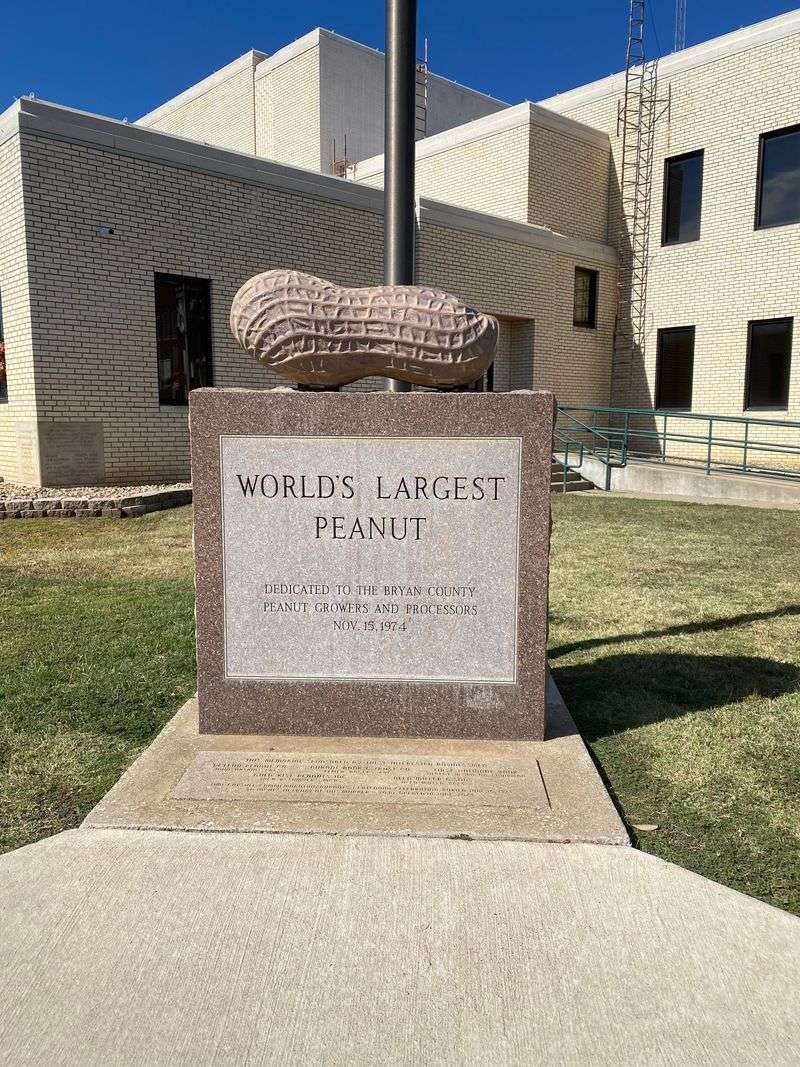
Durant proclaims itself the peanut capital of the world, and to prove it, they erected an 8-foot concrete legume that weighs thousands of pounds.
The statue sits on a pedestal outside the headquarters of the Durant Peanut Company, greeting visitors with its absurdly cheerful presence.
Someone decided that regular-sized peanuts weren’t impressive enough to represent the local agricultural economy.
Oklahoma farmers grow millions of pounds of peanuts annually, particularly in the southern regions where soil and climate favor the crop.
The statue was dedicated during a peanut festival, complete with speeches and celebrations honoring the humble groundnut.
Its surface is painted in realistic tan tones with textured ridges mimicking an actual peanut shell.
Travelers stop to photograph themselves beside this monument to agricultural pride, often striking silly poses.
The peanut has weathered decades of sun, rain, and occasional tornado warnings without losing its appeal.
Durant’s economy has diversified beyond farming, but residents maintain fierce pride in their peanut heritage.
Local restaurants serve peanut-themed dishes, from boiled legumes to desserts incorporating the protein-rich crop.
This landmark embodies small-town America’s tradition of celebrating local industries through oversized sculptures.
Oklahoma boasts numerous giant objects, but few capture the whimsy of a peanut elevated to monument status.
The statue reminds passing motorists that great things can come from simple agricultural roots.
Children ask their parents why anyone would build such a thing, receiving lessons about community pride and marketing in response.
Address: 1429 W Main St, Durant, Oklahoma
3. Cain’s Ballroom
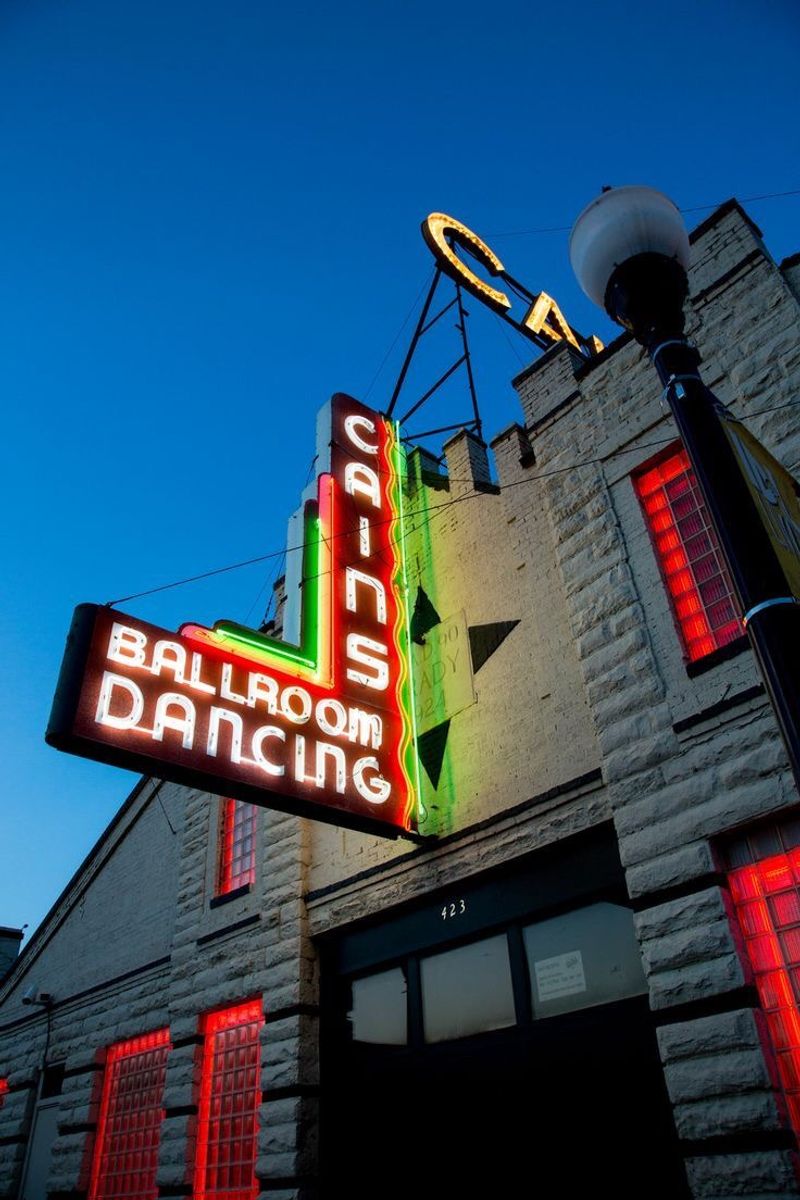
A wooden dance floor has absorbed the footsteps of countless dancers since 1924, when this building first opened as a garage before transforming into a legendary music venue.
Bob Wills and His Texas Playboys broadcast their western swing music from this stage during the 1930s, creating sounds that defined an era.
The ballroom’s maple floor bears the scars of decades, worn smooth by boots and shoes gliding across its surface.
Exposed wooden beams and simple architecture create acoustics that musicians praise, making every note ring clear and true.
Punk rockers, country legends, and indie bands have all played here, drawn by the room’s authentic atmosphere and musical history.
The Sex Pistols performed their final concert on this stage in 1978, ending their career in an Oklahoma dance hall.
Local preservationists fought to save the building when developers threatened demolition, recognizing its cultural importance.
Today the venue hosts concerts and special events, maintaining its role as a gathering place for music lovers.
Photographs covering the walls document everyone who has graced the stage, a visual timeline of American popular music.
The space feels alive with ghosts of performances past, energy lingering in the rafters and floorboards.
Oklahoma’s musical contributions often go unrecognized, but venues like this prove the state’s deep artistic roots.
Standing on that dance floor connects you to generations who came before, all seeking joy through rhythm and melody.
The ballroom represents a time when communities gathered for live entertainment, before screens replaced human connection.
Address: 423 N Main St, Tulsa, Oklahoma
4. The Golden Driller
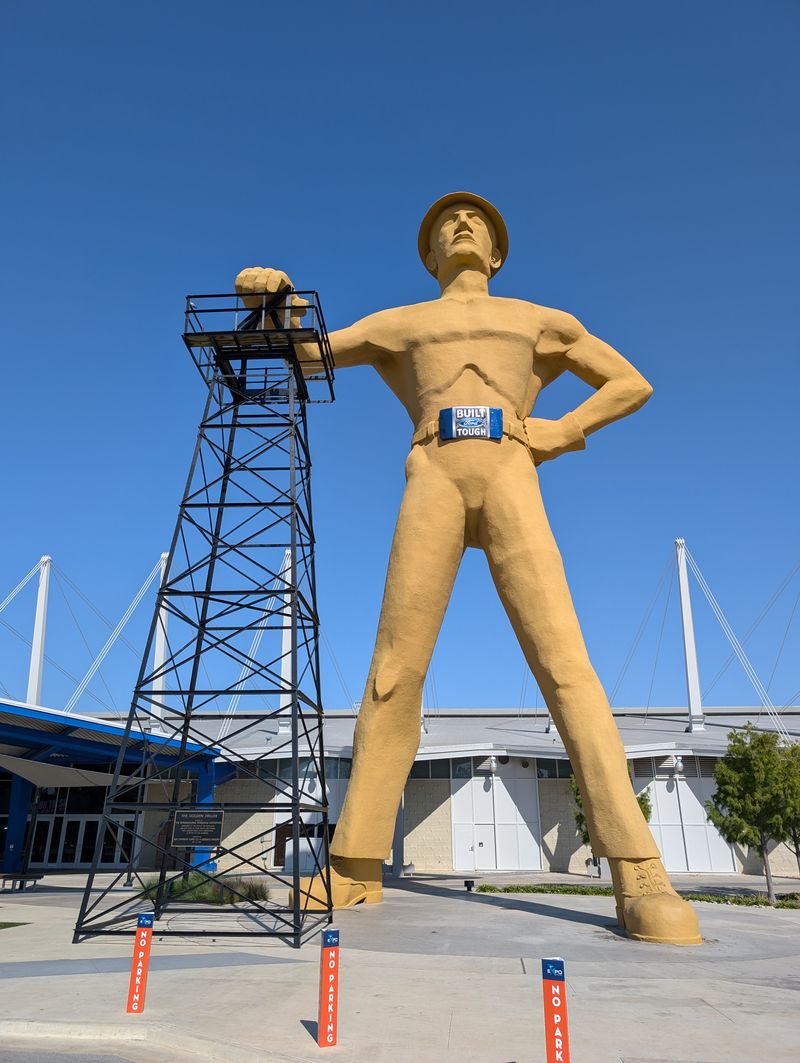
Standing 75 feet tall with a hand resting on an oil derrick, the Golden Driller watches over Tulsa like a protective guardian of Oklahoma’s petroleum heritage.
This colossal statue was erected in 1953 for the International Petroleum Exposition, celebrating the industry that built fortunes across the state.
Workers constructed the figure from steel and concrete, then covered it in gold-colored paint that gleams under the Oklahoma sun.
The driller weighs over 43,000 pounds and wears size 393 shoes, dimensions that boggle the mind of anyone standing at his massive feet.
His left hand grips a genuine oil derrick standing 16 feet tall, a miniature version of the towering structures that once dotted the landscape.
Originally the statue represented a generic oil worker, but later received the name of an actual Tulsa drilling pioneer.
Tulsa earned its nickname as the Oil Capital of the World during the early 20th century boom, when black gold flowed from wells across the region.
The Golden Driller became Oklahoma’s official state monument in 1979, cementing his place in local history and hearts.
Visitors to the Tulsa State Fair pass beneath his watchful gaze, often stopping to photograph this larger-than-life tribute to working people.
His expression carries quiet dignity, honoring those who labored in dangerous conditions to extract wealth from deep underground.
The statue has survived tornadoes, ice storms, and decades of weather that would crumble lesser monuments.
Address: 4145 E 21st St, Tulsa, Oklahoma
5. Center of the Universe
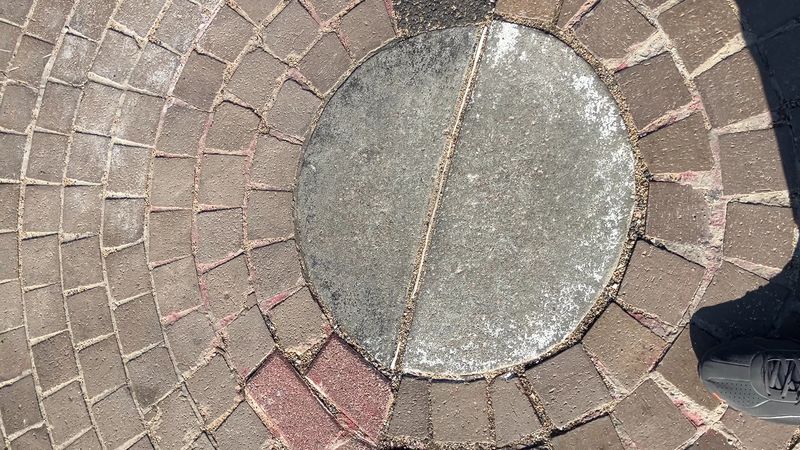
Downtown Tulsa holds an acoustic mystery that defies simple explanation, a spot where sound behaves in ways that seem to break natural laws.
A small concrete circle sits embedded in the brick walkway near the Boston Avenue pedestrian overpass, marked only by its unusual properties.
Stand in the center and speak, and your voice returns amplified, echoing back louder than you projected it outward.
Yet anyone standing just a few feet away hears nothing unusual, as if the sound exists only for the person inside the circle.
Engineers and acoustics experts have studied this phenomenon, offering theories about sound wave reflection from nearby buildings.
The circular pattern of bricks and concrete creates a focal point where sound waves converge and bounce back toward their source.
Local legend claims the effect was accidental, discovered by workers during construction who noticed the strange echo while talking.
Visitors line up to experience the sensation, shouting and singing to hear their voices transformed by invisible forces.
The spot gained its cosmic name from the dramatic way it makes you feel like the center of everything when sound swirls around you.
Couples whisper sweet words that only they can hear, while children giggle at the magic of their amplified laughter.
This landmark costs nothing to visit and requires no special equipment, just curiosity and a willingness to experiment with sound.
Oklahoma embraces quirky attractions like this, where science and wonder intersect on ordinary street corners.
Address: E Archer St and N Boston Ave, Tulsa, Oklahoma
6. Ed Galloway’s Totem Pole Park
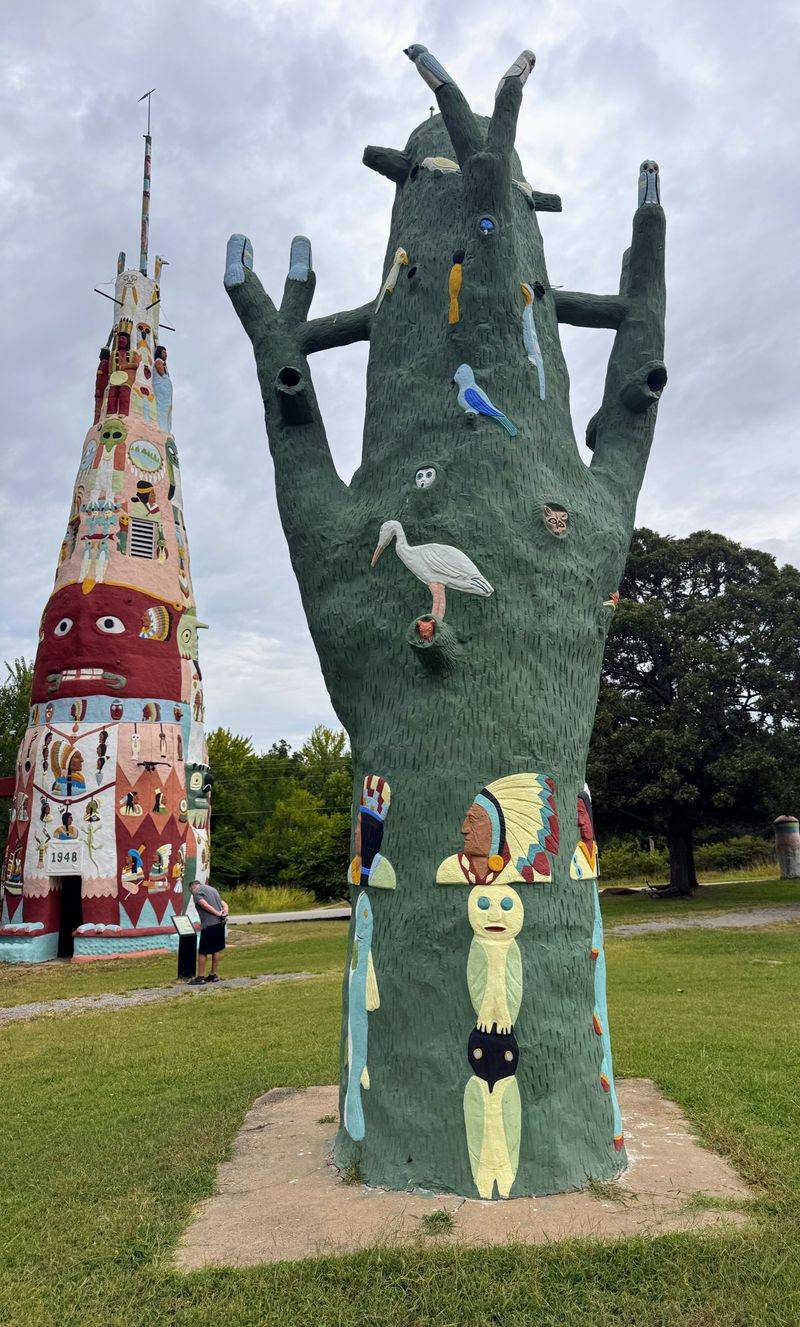
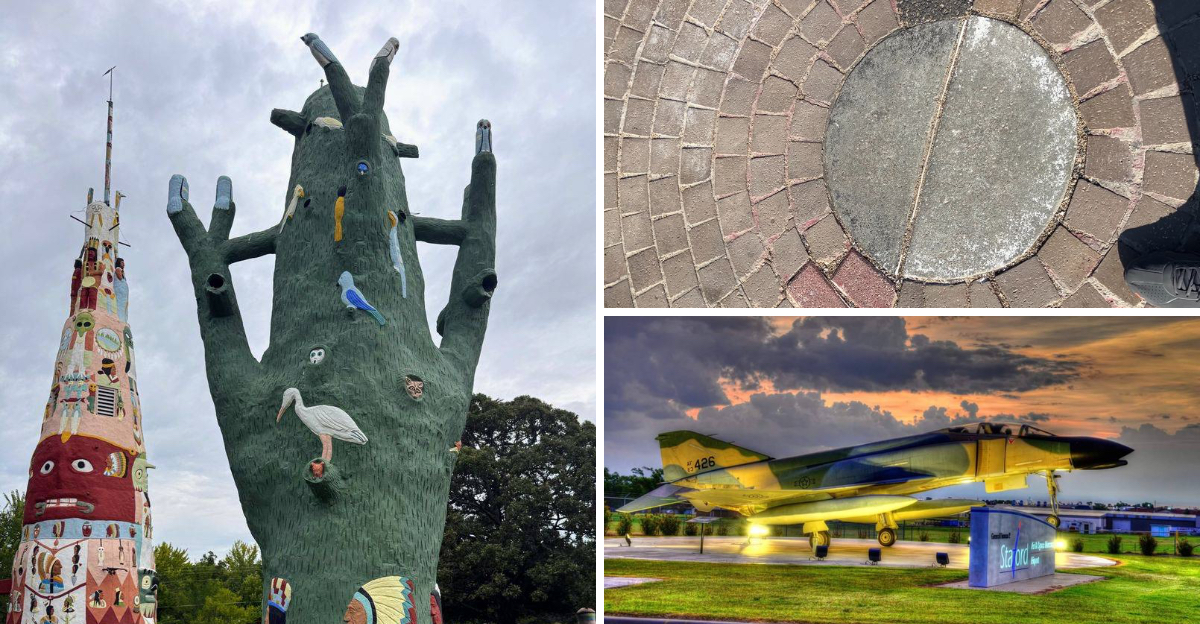
Between 1937 and 1961, a retired fiddle maker named Ed Galloway created a forest of folk art that stands as one of America’s most impressive outsider art environments.
The centerpiece towers 90 feet into the Oklahoma sky, claiming the title of world’s largest concrete totem pole built by a single person.
Galloway carved and sculpted every inch by hand, embedding the concrete with colored rocks, glass, and seashells that catch sunlight like jewels.
Hundreds of images cover the surface, depicting Native American figures, animals, and abstract designs that flowed from his imagination.
He worked alone with basic tools and unwavering determination, mixing concrete and climbing scaffolding well into his seventies.
The park includes a turtle-shaped building where Galloway displayed additional carvings and welcomed visitors to his roadside wonder.
After his death, the property fell into neglect until the Kansas Grassroots Art Association and local volunteers began restoration efforts.
Today the totem pole has been stabilized and repainted, preserving Galloway’s vision for future generations to discover.
Smaller totems and carved figures surround the main pole, creating a landscape where every surface tells a story.
Visitors wander freely through this outdoor gallery, marveling at what one man accomplished through patience and artistic passion.
The park represents the American folk art tradition where untrained artists create masterworks from pure creative impulse.
Oklahoma treasures this site as proof that great art doesn’t always come from formal training or fancy materials.
Address: 21300 OK-28A, Chelsea, Oklahoma
7. The Arcadia Round Barn
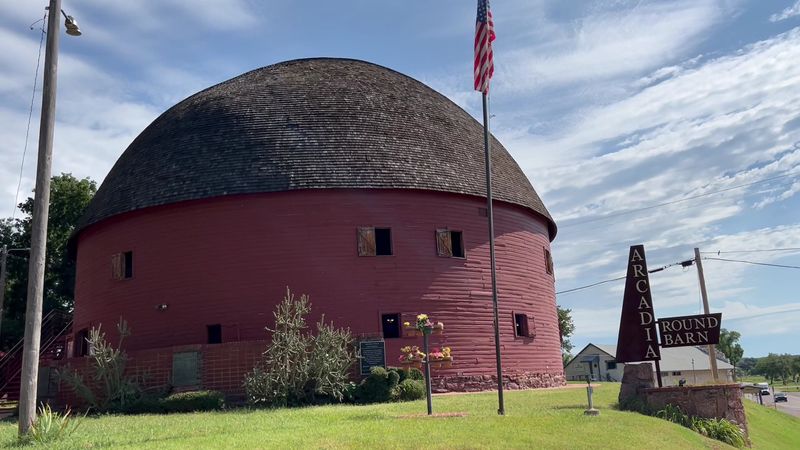
Circular barns were a farming fad in the early 1900s, praised for their efficiency and structural strength against prairie winds.
William Odor built this particular round barn in 1898, constructing walls from native burr oak and a roof that could withstand Oklahoma’s notorious weather.
The design allowed farmers to work more efficiently, with livestock feeding areas arranged around a central core.
Hay could be pitched down from the loft in all directions, saving time and labor during harsh winter months.
By the 1980s, the barn had deteriorated badly, its roof sagging and walls threatening collapse.
Local preservationists formed the Arcadia Historical and Preservation Society, launching a campaign to save this architectural oddity.
Volunteers spent countless hours restoring the structure, replacing rotted wood and reinforcing the foundation.
The barn reopened as a museum and event space, celebrating Route 66 history and rural Oklahoma heritage.
Its distinctive red exterior and perfectly round shape make it impossible to miss from the highway.
Inside, the soaring ceiling and open floor plan reveal the clever engineering that made these barns briefly popular.
Photographs and farming implements line the walls, telling stories of agricultural life when horses pulled plows and families worked sunrise to sunset.
The barn hosts concerts, weddings, and community gatherings, proving that historic buildings can find new purpose.
Oklahoma claims several round barns, but this one stands as the most accessible and well-preserved example along the Mother Road.
Address: 107 E Highway 66, Arcadia, Oklahoma
8. Pops 66 Soda Ranch
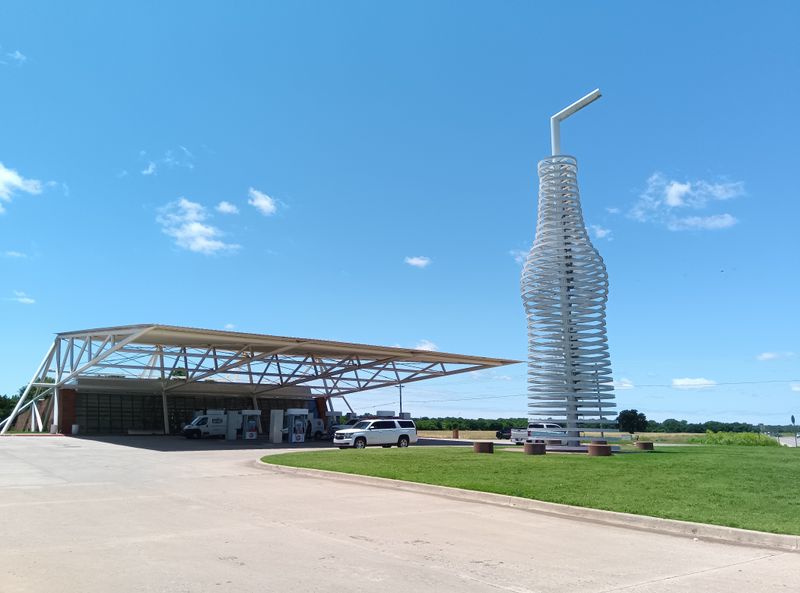
A 66-foot LED-lit soda bottle towers over the landscape like something from a retro-futuristic dream, visible for miles across the flat Oklahoma plains.
This modern landmark opened in 2007, bringing contemporary design to the historic Route 66 corridor.
The building’s glass walls and curved steel roof create a striking contrast with traditional roadside architecture.
Inside, over 700 varieties of soda pop line the walls in rainbow arrays, from classic colas to exotic flavors you never imagined existed.
The attached restaurant serves burgers and comfort food beneath soaring ceilings where light pours through massive windows.
At night, the bottle sculpture cycles through colors, transforming the stop into a beacon that draws travelers like moths to flame.
The place celebrates soda pop culture with the enthusiasm of a museum dedicated to carbonated beverages.
Visitors spend hours browsing bottles, reading labels from distant countries and obscure American bottlers.
Some flavors sound delicious while others challenge your sense of what belongs in a drink, from bacon to pickle varieties.
The gift shop stocks Route 66 memorabilia alongside the beverage selection, catering to collectors and casual tourists alike.
This landmark proves that new attractions can honor highway heritage while pushing architectural boundaries.
The LED bottle has become as photographed as any vintage roadside giant, earning its place in Oklahoma’s collection of memorable stops.
Young families and nostalgic baby boomers mingle here, united by their love of the open road and sweet fizzy drinks.
Address: 660 OK-66, Arcadia, Oklahoma
9. Pensacola Dam Spillway
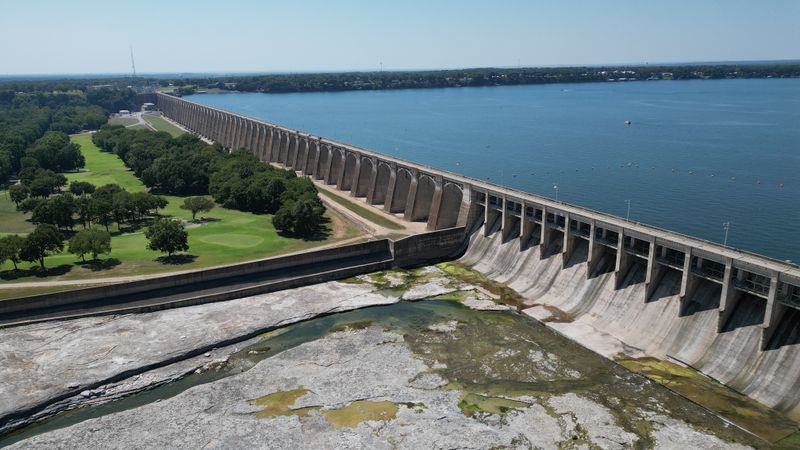
When Grand Lake formed in 1940, engineers created one of the longest multiple-arch dams in the world, stretching 6,565 feet across the Grand River.
The spillway features 51 gates that can release floodwaters in spectacular fashion when spring rains swell the lake beyond capacity.
During major releases, water thunders through the openings, creating artificial waterfalls that roar like approaching trains.
Photographers gather when the gates open, capturing the raw power of controlled water flowing back toward the river channel.
The dam’s art deco styling reflects 1930s engineering aesthetics, when infrastructure projects doubled as architectural statements.
Construction employed thousands during the Great Depression, offering paychecks to families desperate for work.
Workers poured concrete in massive quantities, shaping forms that would hold back millions of gallons for generations.
The project transformed northeastern Oklahoma, creating a recreational lake that attracts boaters, anglers, and vacationers year-round.
From certain angles, the dam’s repeated arches create optical illusions, curves seeming to stretch into infinity.
A highway crosses the dam’s top, allowing drivers to experience the structure’s impressive length firsthand.
Below, the released water churns white before settling back into the river’s natural flow.
This landmark serves practical purposes while inspiring awe, a reminder that functional structures can also be beautiful.
Oklahoma’s relationship with water management runs deep, as droughts and floods have shaped settlement patterns for centuries.
The dam stands as testament to human ability to reshape landscapes for better or worse.
Address: 28333 Pensacola Dam Rd, Langley, Oklahoma
10. The Blue Whale of Catoosa
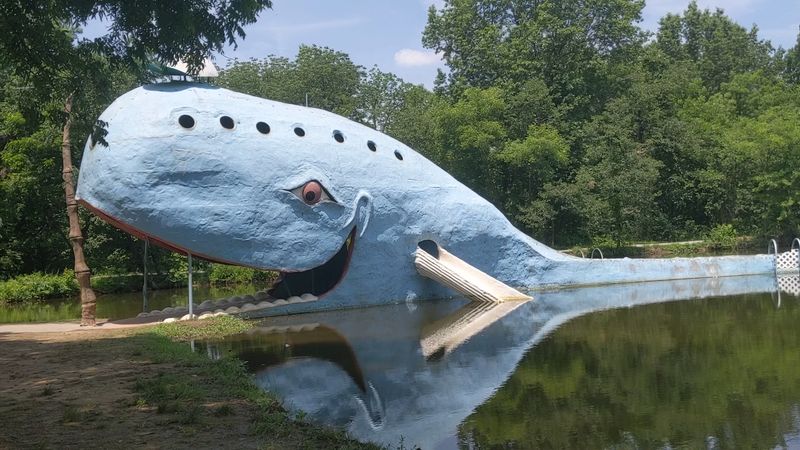
Route 66 winds through Oklahoma carrying legends of American road trips, and along its path sits a smiling blue whale that has greeted travelers since 1972.
Hugh Davis built this 80-foot creature as an anniversary gift for his wife Zelta, who collected whale figurines.
The structure began as a private swimming hole, complete with a diving board and rope swing attached to the whale’s tail.
Families would gather in the spring-fed pond beneath the watchful eye of this gentle giant, creating memories that stretched across generations.
After Hugh passed away in 1990, the whale fell into disrepair, its bright blue paint fading like forgotten dreams.
Local volunteers rallied in the early 2000s, restoring the landmark to its former glory with fresh paint and structural repairs.
Today the whale stands as one of Route 66’s most photographed attractions, drawing visitors from every corner of the globe.
Children climb through the whale’s mouth into its hollow interior, discovering the simple joy their grandparents once knew.
The pond no longer allows swimming, but the magic remains intact for anyone willing to stop and appreciate this roadside marvel.
Picnic tables dot the surrounding area where travelers rest beneath Oklahoma’s vast sky.
This landmark represents the quirky spirit of mid-century America when roadside attractions competed for attention along the Mother Road.
The Blue Whale reminds us that sometimes the best gifts come from unexpected places, built with love and preserved through community dedication.
Address: 2600 N Highway 66, Catoosa, Oklahoma
11. Stafford Air and Space Museum
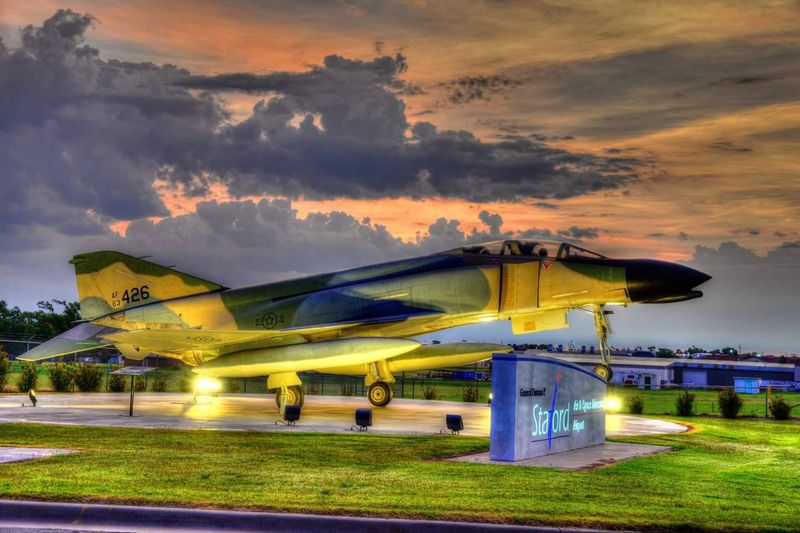
Weatherford native Thomas Stafford flew into space four times, commanding the Apollo mission that linked with Soviet cosmonauts during the Cold War.
His hometown built a museum celebrating not just his achievements but the entire story of human flight and space exploration.
Outside, a Titan II rocket points skyward, the same type that carried Stafford beyond Earth’s atmosphere.
The museum houses artifacts ranging from early aviation to modern space shuttle technology, tracing humanity’s journey from ground to orbit.
Interactive exhibits let visitors experience flight simulators and learn about the physics that make aerospace travel possible.
A planetarium projects stars across its dome ceiling, offering shows about astronomy and space science.
Oklahoma claims more astronauts per capita than most states, a source of quiet pride among residents.
The museum explains how this landlocked prairie state produced so many pioneers of flight and space exploration.
Stafford’s personal collection includes flight suits, medals, and photographs documenting his remarkable career.
Children press their faces against display cases, imagining themselves floating weightless among the stars.
The facility serves educational purposes, hosting school groups and offering programs about science and technology.
Exhibits detail the engineering challenges of space travel, from heat shields to life support systems.
This landmark reminds visitors that exploration requires courage, intelligence, and the willingness to venture into the unknown.
Oklahoma’s contributions to aerospace deserve recognition alongside more famous space centers in Florida and Texas.
Address: 3000 Logan Rd, Weatherford, Oklahoma
Dear Reader: This page may contain affiliate links which may earn a commission if you click through and make a purchase. Our independent journalism is not influenced by any advertiser or commercial initiative unless it is clearly marked as sponsored content. As travel products change, please be sure to reconfirm all details and stay up to date with current events to ensure a safe and successful trip.
