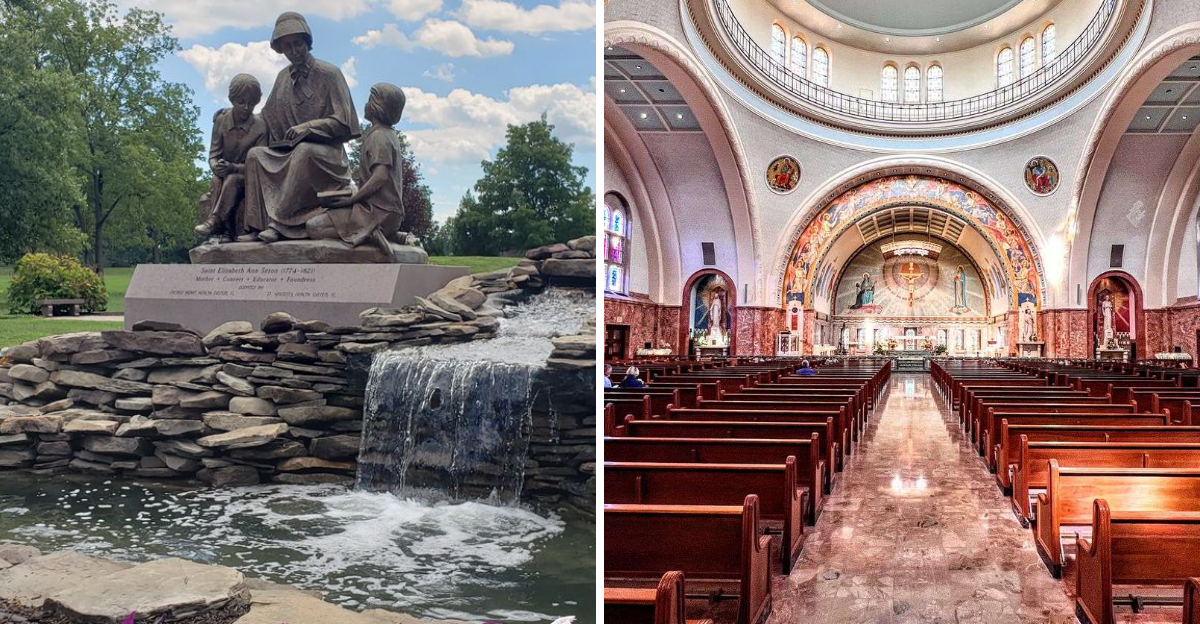
More than 200 years of history can make one Maryland stop feel like several completely different destinations rolled into the same afternoon.
The grounds preserve an 18th-century stone house where Elizabeth Ann Seton and the first Sisters of Charity of St. Joseph’s lived in 1809, along with another historic home connected to the community’s earliest school and a striking basilica completed in the 20th century.
Seton went on to become the first native-born American canonized as a saint, and her remains are now enshrined inside the basilica.
Beyond its religious significance, the site tells a fascinating Maryland story about education, community life, and the experiences of women in the early 1800s.
Even visitors who arrive mainly for the architecture will find considerably more history waiting behind those stone walls.
The Stone House Where It All Began
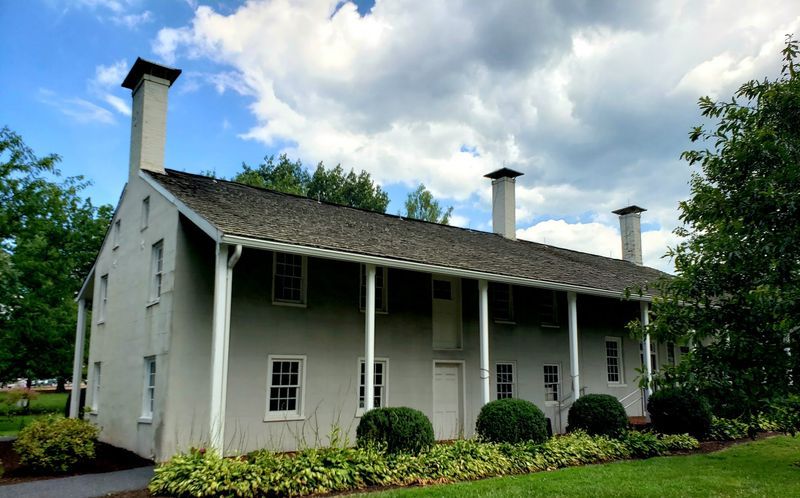
Small buildings often hold the biggest stories, and the Stone House proves it. Built around 1750 near Toms Creek, this modest fieldstone farmhouse was the very first home of Elizabeth Ann Seton and her companions when they arrived in Emmitsburg in 1809.
Sixteen people once shared four rooms here. Two upstairs, two downstairs, and one of the smaller lower rooms doubled as a chapel.
That detail stuck with me longer than anything else on the property. Mother Seton wrote cheerfully about the place in her letters, though comfort clearly was not part of the deal.
The house was later expanded as more women joined the community, and today it is furnished with period pieces that make the early 1800s feel surprisingly close. Wide plank floors, simple wooden furniture, and low ceilings do most of the storytelling without any help.
Guided tours cover the rooms in detail, but an audio recording about Saint Elizabeth Ann’s life is available for anyone arriving outside tour hours. Either way, plan to linger a bit.
Here is a fun bit of trivia worth remembering: one of the original keys to this house was given to Pope Francis by President Obama on behalf of the nation in 2015. A key to a farmhouse in rural Maryland, handed over as a national gift.
Take your time in the doorway before you leave. It frames the fields the way it would have two centuries ago, and that view says plenty about how much determination this beginning required.
The White House and Mother Seton’s Final Years
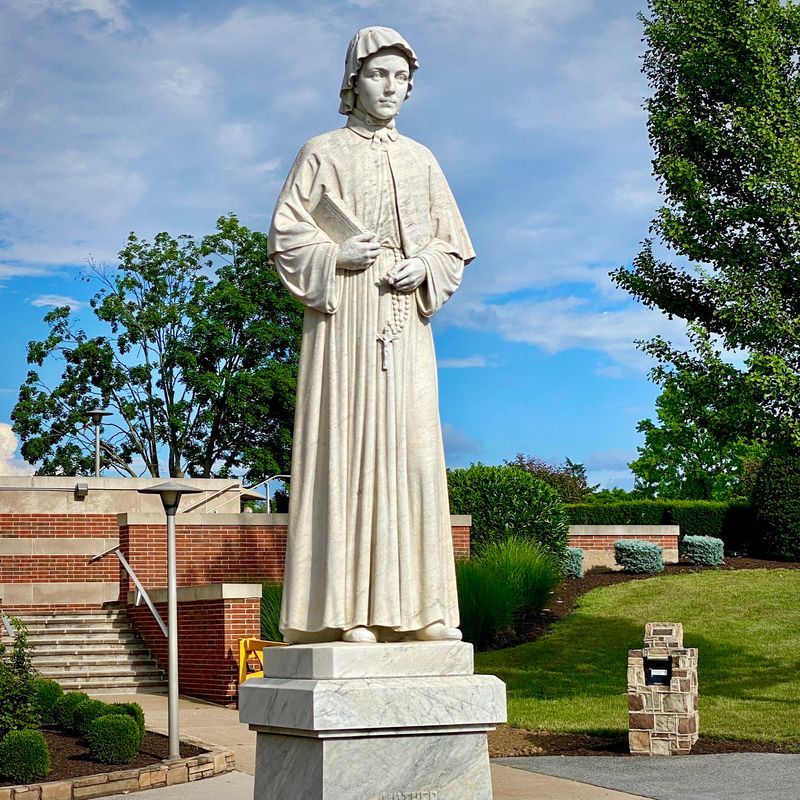
By 1810, the little stone farmhouse simply could not hold everyone. The Archbishop of Baltimore ordered a new residence built, and the result was a log building that everyone came to call the White House.
Elizabeth Ann Seton lived here until her death in January 1821, at just 47 years old. That fact changes how the rooms feel once you know it.
The building served as home, classroom, and headquarters all at once, which explains its layout better than any plaque could. Sisters slept here, students studied here, and letters were written here to bishops, benefactors, and worried parents.
Period furnishings fill the rooms, and the effect is less like a museum and more like a house whose family stepped out for the afternoon. Simple beds, a writing desk, and worn stair treads carry the weight.
Touring the Stone House first and the White House second makes the progression click. One shows survival, the other shows growth, and together they explain how the Sisters of Charity and Saint Joseph’s Academy actually got off the ground.
My favorite moment came upstairs, where the light through the old windows falls across the floorboards in long stripes. Quiet spaces like that stay with you.
Both historic homes sit within easy walking distance of each other on the same grounds, so no driving is required between stops. Comfortable shoes help, since the paths connecting the buildings invite a slow, wandering pace rather than a rushed loop.
Inside the Basilica of the National Shrine
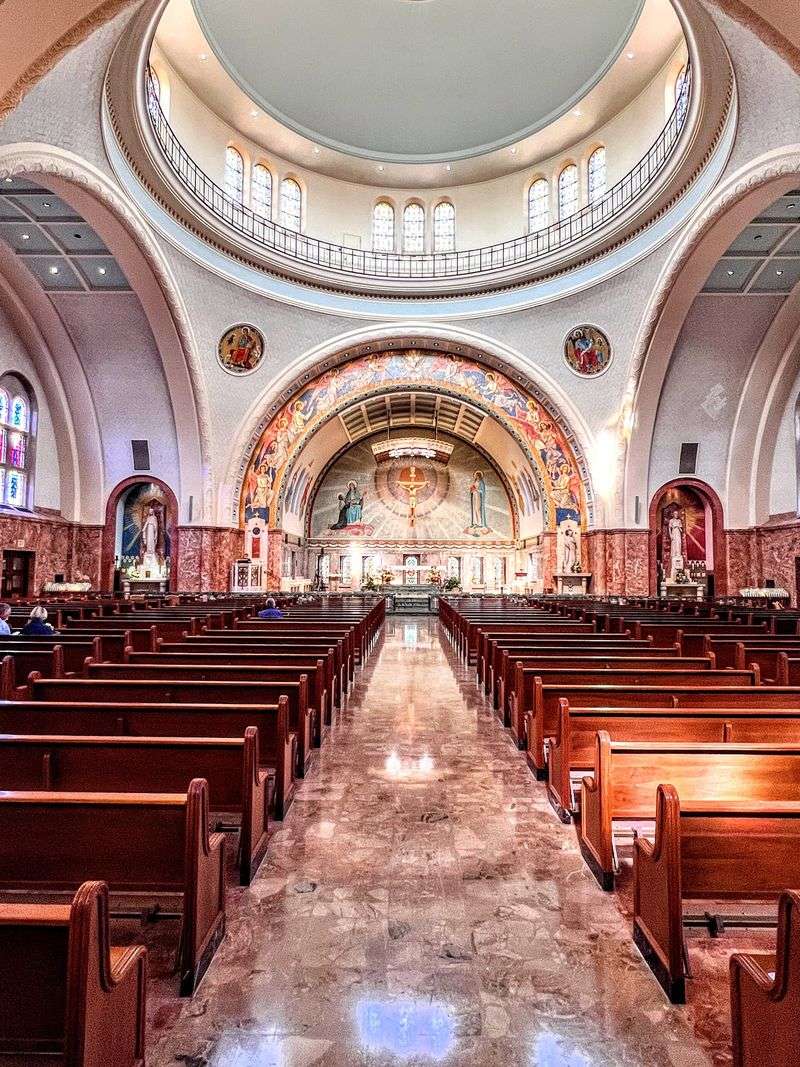
Nothing on the walk over prepares you for the moment those doors open. Completed in 1965, the Basilica at the National Shrine is a burst of marble, bronze, mosaic work, and stained glass that seems almost impossible for a town this size.
Craftsmen from Italy and Germany created much of the artwork inside. You can spend a long while just following the colors around the ceiling.
Originally built as a chapel for the Daughters of Charity, the church was designated her National Shrine after Elizabeth Ann Seton’s beatification in 1963. Pope John Paul II later raised it to the rank of minor basilica in 1991, a title reserved for churches of special significance.
Her remains rest in a small copper casket beneath the Altar of Relics, moved there in 1968 and placed in their final position at the time of her canonization in 1975.
Mass, confession, and adoration happen here regularly, and the bells chime through the day across the whole property. Even outside on the lawn, you hear them clearly.
Visitors of every background are welcome to sit quietly, and plenty do. The altar dedicated to Saint Elizabeth Ann draws people who simply want a few still minutes.
A tip worth passing along: check the schedule at the Visitor Center before heading in, so a service does not catch you mid photo. Respecting the rhythm of the building makes the visit better anyway, and the light shifts beautifully as the afternoon goes on.
A Story That Starts in New York City
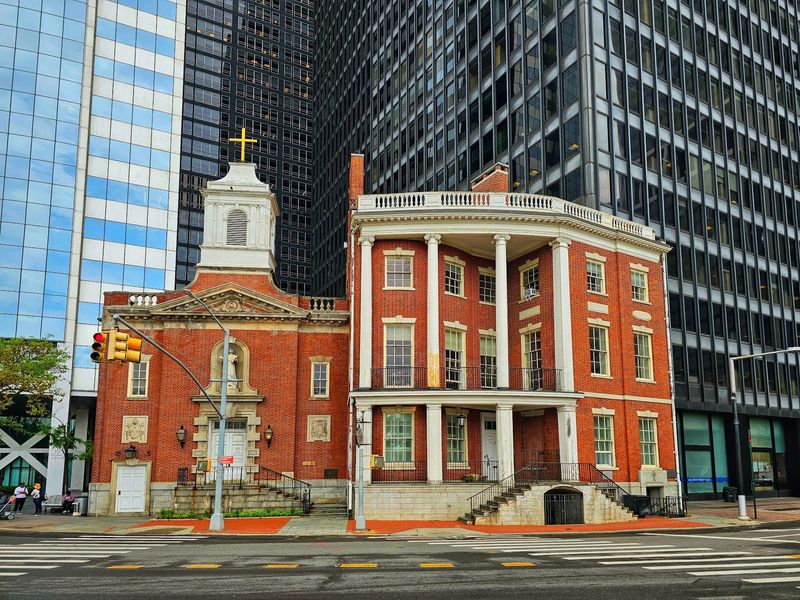
Long before Maryland entered the picture, Elizabeth Ann Bayley was born in New York City on August 28, 1774, into a well known Episcopal family. She lost her mother at age three, an early hardship in a life that would hold many more.
At nineteen she married William Magee Seton, a wealthy businessman. Five children followed.
Then the family fortune unraveled. Her husband’s health and business both failed, and he died of tuberculosis in Italy in 1803, leaving Elizabeth a widow at 29 with five children and very little money.
Her time in Italy introduced her to Catholicism, and she formally entered the Catholic Church in New York in 1805. That decision cost her socially, and the academy for young ladies she ran in the city struggled badly as a result.
An invitation from Father Louis William Valentine Dubourg changed everything. In 1809 she moved to Maryland, where a convert named Samuel Sutherland Cooper had purchased 269 acres near Emmitsburg.
Reading that timeline before touring the buildings makes the whole property land differently. The farmhouse stops being old and starts being brave.
She was beatified in 1963 and canonized by Pope Paul VI on September 14, 1975, becoming the first person born in what is now the United States to be declared a saint. Twelve short years separated those two milestones, and the Shrine grew around both.
Her span from wealth to widowhood to founder covers barely two decades.
How American Catholic Schools Started Here
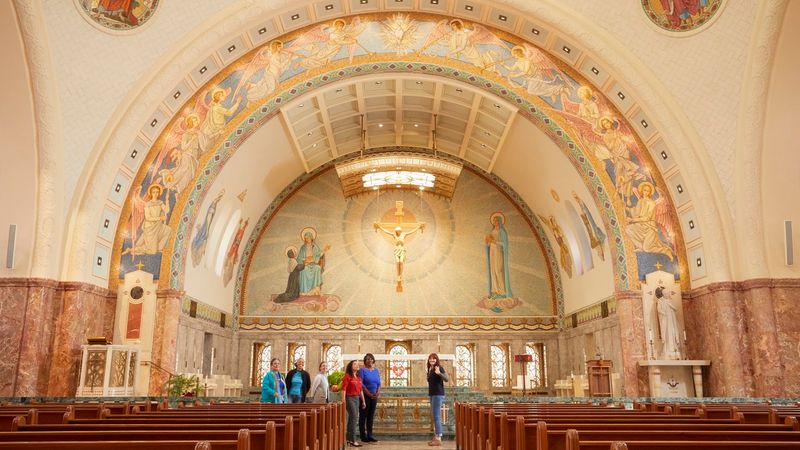
Here is the part that surprises most visitors: the American Catholic school system traces its roots to this patch of Maryland farmland. In 1809, Elizabeth Ann Seton founded the Sisters of Charity of St. Joseph’s, the first community of religious women established in the United States.
She modeled it on the Daughters of Charity of Paris. The focus was clear from day one, serving people living in poverty.
At the same time she opened Saint Joseph’s Academy and Free School, the first tuition free Catholic school for girls in the country. Families who could not pay a cent still had a place to send their daughters, which was genuinely radical for the era.
Everything grew from that. Her spiritual daughters, the Sisters of Charity and the Daughters of Charity, still work in schools, hospitals, and social service centers across North America and well beyond.
The museum carries an exhibit called Sisters Today: A World of Difference, which follows the current work of sisters from different congregations. It connects 1809 to right now in a way that feels concrete rather than abstract.
Teachers and parents tend to find this section especially interesting, and school groups seem to move through it slowly. Kids notice the old schoolbooks first.
Standing on the grounds afterward, the scale of it all is hard to shake. One widow, a borrowed farmhouse, and a free school for girls turned into a network stretching more than two hundred years and several countries wide.
Quiet Paths, the Legacy Garden, and God’s Little Acre
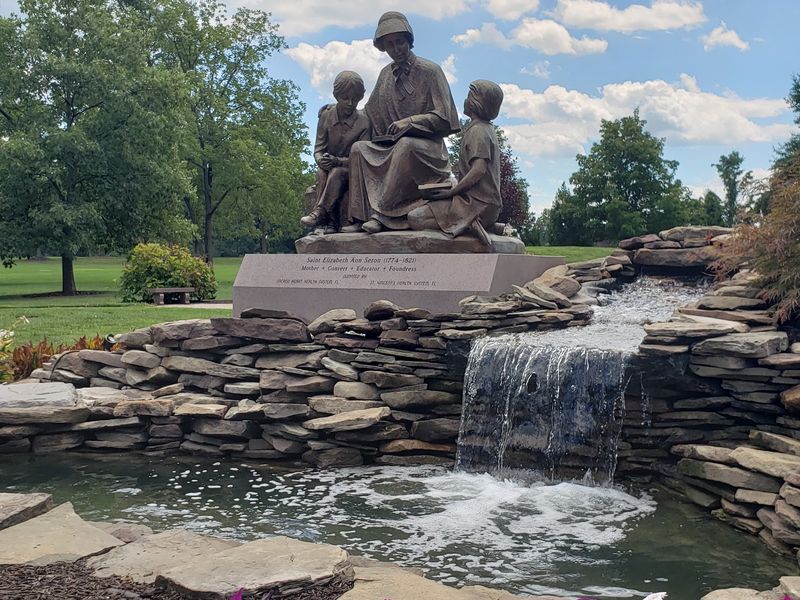
Give yourself extra time outside. The grounds here are wide, green, and dotted with statues, benches, and shaded corners that practically ask you to sit down for a while.
Trees line the walkways. Birds handle most of the noise.
Follow the paths and you reach St. Joseph’s Cemetery, known affectionately as God’s Little Acre, where Mother Seton was first buried after her death in 1821.
Simple markers stretch across the grass, each one belonging to a member of the early community who committed her life to this mission.
Right beside the cemetery stands the Mortuary Chapel, built in 1846. Her remains stayed there until her beatification in 1963, when they were moved to the Basilica.
The Seton Legacy Garden adds another layer, with a fountain and inspirational markers set along the walkway. Water sounds do wonders for a reflective mood.
What I appreciated most is that the outdoor spaces are open year round from dawn to dusk, even when buildings have closed for the day. Early morning visitors get the grounds nearly to themselves.
Autumn is a strong choice, since the surrounding hills turn color and the whole property feels warmer. Spring runs a close second.
Bring water on hot days and expect some walking between the cemetery, the chapel, and the historic homes. The distances are gentle, but the property is larger than it first appears from the parking area, and hurrying through it defeats the entire point of coming.
Starting Out at the Visitor Center and Museum
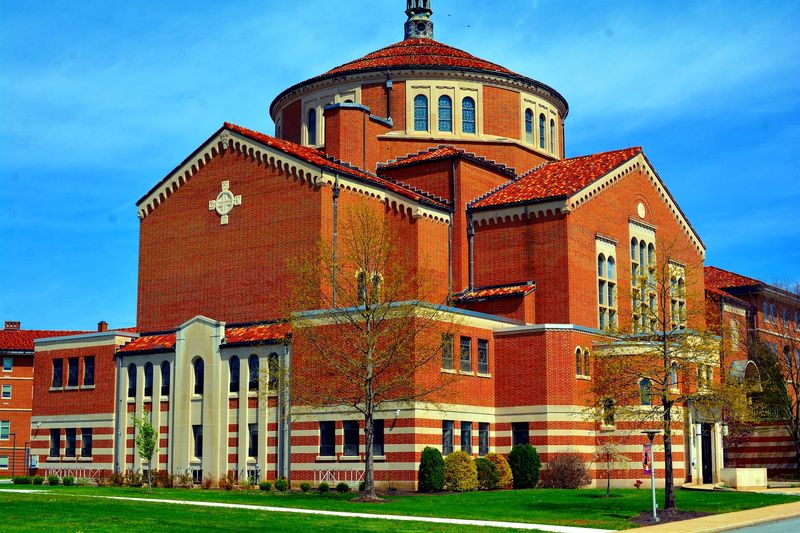
Skip the Visitor Center and you will spend the rest of the day playing catch up. Start there instead, because the museum lays out Elizabeth Ann Seton’s life in a way that makes every building afterward make sense.
Admission to the exhibits is free. That still feels a little unexpected given how polished they are.
Artifacts, personal writings, and interactive digital displays fill the space, arranged so the story flows from her New York childhood through her Maryland years. Younger visitors gravitate to the touchscreens, while older ones tend to slow down over the handwritten letters.
A twelve minute film covers her life for anyone who prefers the short version before exploring. It is a good use of a quarter hour.
Guided tours can be arranged here, or you can grab a map and guide and set your own pace through the property. Both approaches work well, though the guided option catches details easy to miss alone.
The Visitor Center and Museum are open daily, which makes planning simple. Restrooms and information are right there too, always useful before a long walk.
Families should know the museum includes hands on activities for children, so kids are not stuck reading panels the whole time. That single detail rescues many family outings.
Allow at least forty five minutes inside before heading toward the historic homes and Basilica. Rushing the exhibits means missing the connective thread that turns a collection of old buildings into one continuous, remarkable story.
Living History Days and Retreats on the Grounds
Fridays and Saturdays bring something extra. The Shrine runs a living history program that drops visitors into the year 1818 at Saint Joseph’s Academy, complete with interpreters portraying students and Sisters of Charity from Mother Seton’s own era.
They go about ordinary daily tasks and share stories as you pass through. Questions are welcome.
Getting a sense of a school day from that period turns abstract history into something you can picture clearly. Lessons, chores, and routines all get their moment, and the small practical details are usually the most memorable part.
Children respond especially well to this format, since it feels like a conversation rather than a lecture.
Beyond the weekend program, the Shrine hosts retreat programs that welcome thousands of visitors each year to the quiet grounds for reflection. Groups book them regularly, and the setting does a lot of the work.
Educational resources are available for teachers and families too, which fits the place perfectly given who founded it. Mother Seton would probably approve of the emphasis.
Plan your trip around a Friday or Saturday if the schedule allows, because the property genuinely feels more alive on those days. Check current program times before driving out, since offerings shift with the seasons.
Her whole story, from a widow with nothing to the first American born saint, sits inside these buildings and gardens waiting to be walked through. Bring curiosity and a little patience, and this stop rewards both.
Address: 339 S Seton Ave, Emmitsburg, MD 21727
