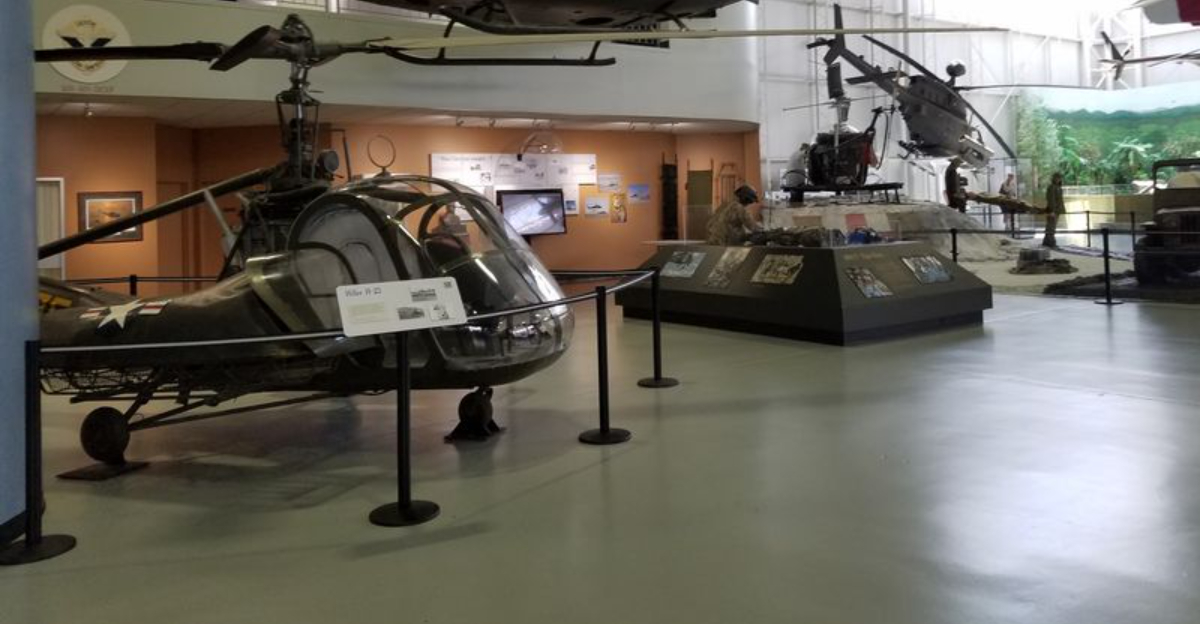
You count one helicopter. Then another.
Then you look toward the ceiling and realize there are rotor blades hanging over your head, too. At some point, counting becomes pointless.
Inside this massive Alabama collection, more than 160 aircraft are part of the lineup, with roughly 50 on display at a time across 70,000 square feet.
You can climb into old trainer cockpits, walk beneath enormous military helicopters, and get close to everything from a Wright Military Flyer replica to a stealth prototype that never made it into service.
Then comes the part that makes the collection feel less like a room full of machines and more like a room full of stories. Some of these helicopters actually went to war, including a Black Hawk that returned from Mogadishu.
And the best surprise may be waiting at the ticket counter: admission costs nothing. If you think you can see a place like this in an hour, give yourself more time.
Much more.
The Largest Helicopter Collection Anywhere on Earth
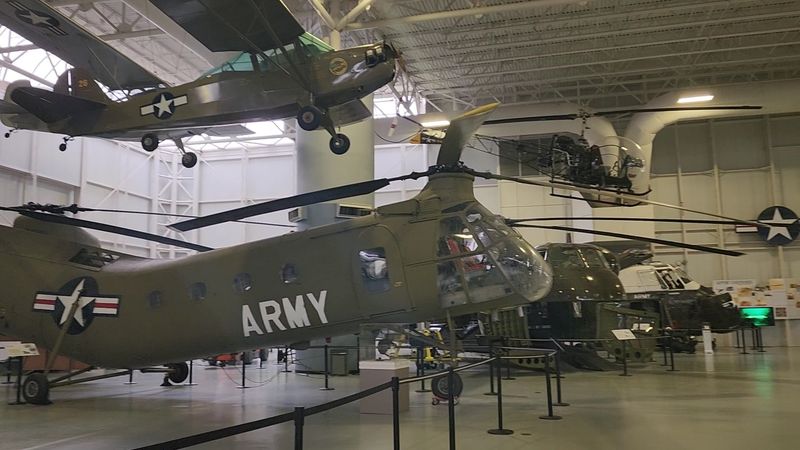
Rotor blades stretch overhead in every direction, and the sheer scale takes a moment to register. No other museum on earth displays this many helicopters under one roof, and the claim holds up the second the main hall opens up.
The full collection runs past 160 military aircraft right here in Alabama. Around 50 sit on public display at a time, rotating in and out of storage as restoration work continues behind the scenes.
Fixed-wing aircraft share the floor too, including the Cessna L-19 Bird Dog and the Grumman OV-1 Mohawk, but rotary wing is clearly the star. Chinooks, Hueys, Cobras, Apaches, and Black Hawks fill both the indoor galleries and the outdoor grounds.
Plan for at least two or three hours. Visitors who read every placard often stay longer, and the outdoor apron adds another chunk of walking on top of that.
A short film covering the history of Army Aviation runs on a loop near the entrance, and it plays continuously so latecomers can slip in mid-reel without missing the thread. Starting there makes the rest of the galleries click into place.
Elevator access reaches the upper floor, which matters for anyone with mobility limits. The layout is open and easy to follow, and staff at the front desk point people toward whatever they came to see.
Wooden Wings and the Birth of Army Flight
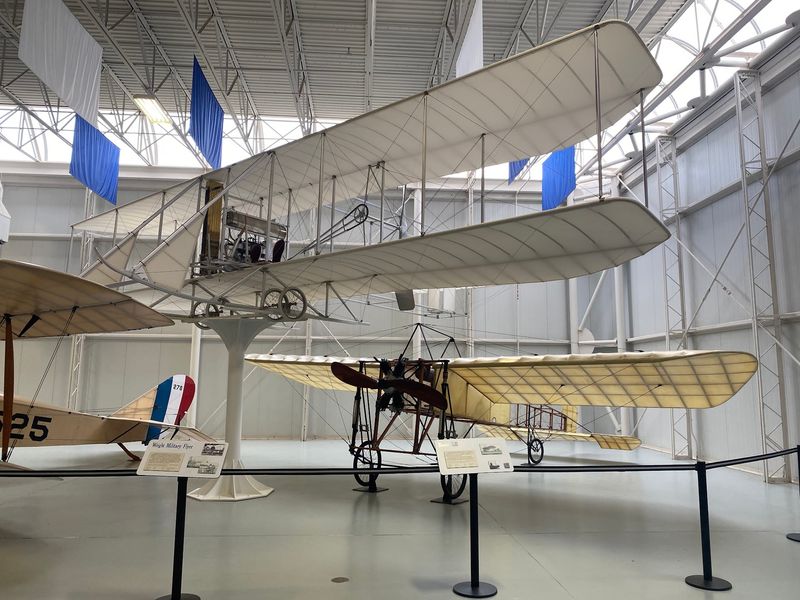
Before the rotors came the canvas and spruce. One corner of the museum belongs entirely to the earliest days of Army flight, and the contrast against the gunships nearby is striking.
A replica Wright Military Flyer anchors the story, representing the aircraft that launched Army aviation back in 1908. Fabric wings, exposed wires, and a bicycle-chain drive make modern helicopters look like science fiction by comparison.
World War I gets serious attention here. A Bleriot XI, an S.E.5a, a JN-4D Jenny, and a Nieuport 28C-1 all sit within a short walk of each other, joined by a replica Sopwith F.1 Camel that draws plenty of camera phones.
Details reward slow looking. Wooden propellers show their laminated layers, and the doped fabric skins carry a faint sheen under the gallery lights.
Kids who arrive expecting only helicopters often end up parked in front of the Jenny, asking how anyone flew something held together with wire. Fair question, honestly.
These early machines also explain why the Army pushed so hard toward vertical flight later on. Fragile biplanes could scout, but they could not land in a jungle clearing or lift a wounded soldier off a hillside.
Reading this section first makes the rest of the museum land with far more weight.
Hueys, Gunships, and the Sound of Vietnam
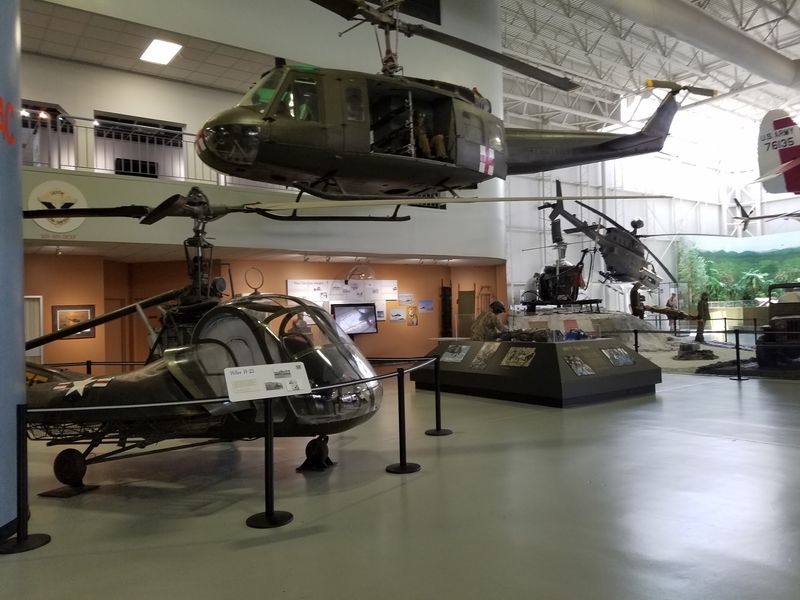
Few aircraft carry as much emotional freight as the UH-1 Huey, and this museum has more than 15 of them across the collection.
One Huey is staged mid air assault, recreating a famous combat photograph of the Bravo Blues from the 1st of the 9th Cavalry. Soldiers frozen in the moment of hitting the ground bring the scene uncomfortably close.
Another aircraft in the collection was genuinely shot down during the war. Seeing the real thing, rather than a stand-in, changes how visitors move through the room.
Look for Mad Dog, a well-known UH-1C gunship, and the Hughes OH-6A Cayuse nicknamed Miss Clawd IV, which carries documented combat history from Vietnam.
A smaller machine deserves attention too. The OH-13E Sioux, the bubble-canopy helicopter familiar to anyone who watched MASH, sits here with a skid-mounted M1919 .30-06 machine gun, making it one of the Army’s earliest attempts at an armed helicopter.
Placards throughout the section name units, missions, and crews rather than just aircraft types. That choice keeps the focus on people.
Photographers should note the lighting is soft and even across most of the gallery, which helps when shooting olive drab paint up close without harsh glare.
Nine Cobras Lined Up Like Sharks
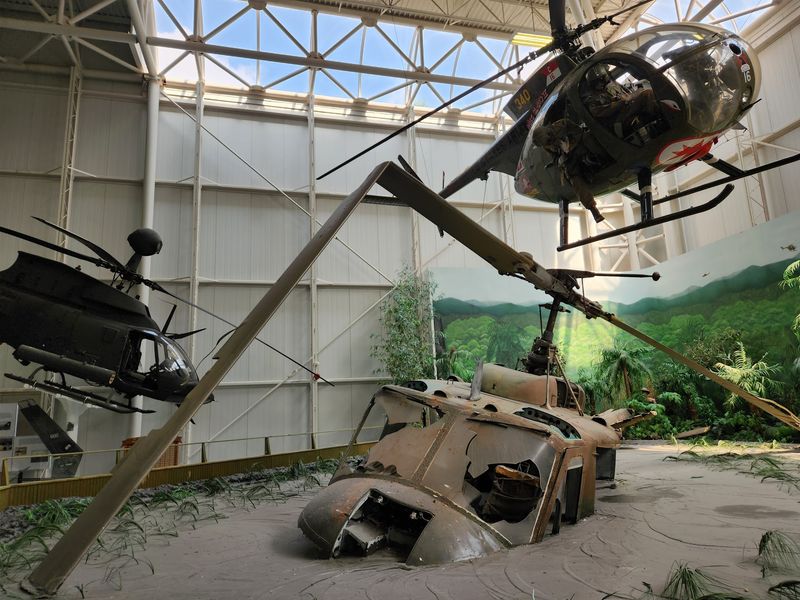
Narrow, mean-looking, and unmistakable from any angle, the AH-1 Cobra shows up here in remarkable numbers. Nine of them, in fact, which is a haul most museums could never assemble.
Seeing them grouped together turns the display into a lesson in evolution. Nose turrets change shape, cockpit glass shifts, and weapon systems grow more complex from one airframe to the next.
One AH-1G wears the name Playboys and carries an M134 7.62 NATO minigun in its chin turret. Nearby sits another AH-1G later upgraded to AH-1S standard, fitted with the M28 gun system pairing a minigun with a 40mm grenade launcher.
A post-Vietnam AH-1S rounds out the story with a three-barreled M197 20mm cannon, hardware that pushed the Cobra well past its original role.
The fuselage width surprises most first-time visitors. These aircraft measure barely wider than a person, built thin on purpose to make a harder target from the front.
Crouch down and look along the length of one. The profile nearly disappears, which was exactly the point.
Gun enthusiasts and engineering nerds tend to spend the longest here, but even casual visitors slow down. The Cobra simply looks like nothing else on the floor.
Prototypes That Almost Changed Everything
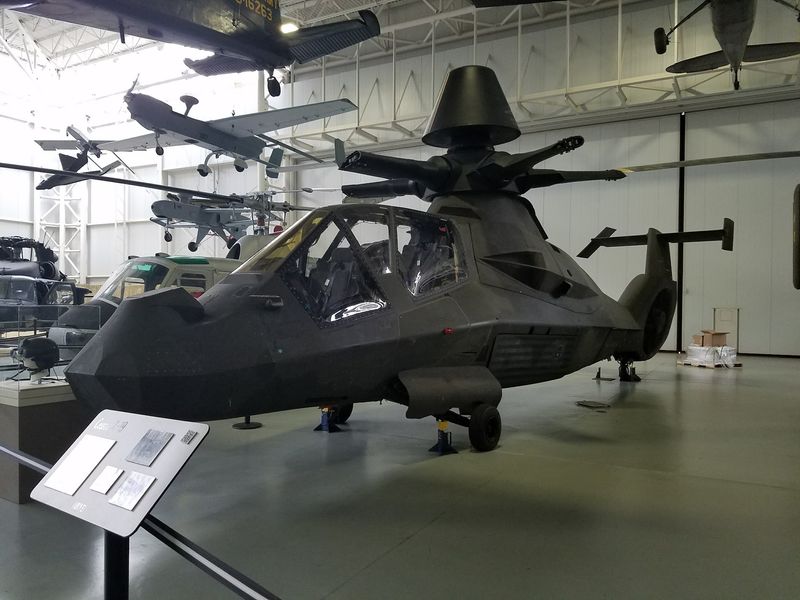
Some aircraft here never entered service, and those are often the ones visitors remember longest.
Both surviving prototypes of the Boeing-Sikorsky RAH-66 Comanche live at this museum. The stealth attack helicopter program was canceled, which makes these two angular, futuristic machines the end of a road that went nowhere.
A Bell YAH-63 also sits in the collection, one of only three ever built. It lost the 1970s competition for the Army’s next gunship to the Hughes YAH-64, the aircraft that eventually became the Apache.
Two of the ten Lockheed YAH-56 Cheyenne prototypes built in the 1960s are here as well, with their rigid rotors and pusher propellers looking like something drawn for a comic book.
Then there is the Boeing Vertol BV-347, the only one ever constructed. Developed from a CH-47A Chinook in 1970, it grew wings, a taller rear pylon, and a set of ideas that never reached production.
Visitors regularly stop in front of that winged Chinook and ask whether it is real. It is.
Aviation history usually gets told through the machines that won. Wandering this section flips the perspective toward the ones that came close and quietly disappeared.
Razor’s Edge, Dustoff, and the People Behind the Machines
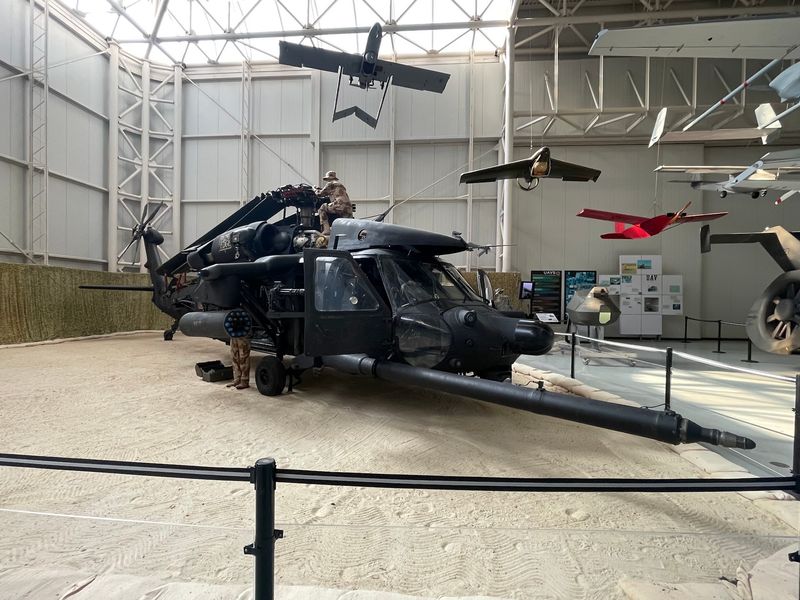
Metal and rivets fill the halls, but the exhibits that stay with people are the ones about crews.
The Super 68 display holds Razor’s Edge, a UH-60L Direct Action Penetrator and one of the Black Hawks shot down during the Battle of Mogadishu in 1993.
The event became widely known through the book and film Black Hawk Down, and standing near the actual aircraft carries a weight no screen can match.
Elsewhere, the Dustoff exhibit traces medical evacuation by helicopter, a practice that took shape during the Korean Conflict and went on to save enormous numbers of lives.
A Vietnam Memorial inside the museum honors the 4,347 Army Aviation personnel who died in that conflict. Names, not statistics, fill the space.
The Army Aviation Hall of Fame occupies another gallery, with portraits and citations for the people who shaped the branch through leadership, courage, or invention.
Statues near the entrance mark different eras of Army Aviation, and they set the tone before visitors even reach the aircraft.
Conversations tend to drop to a lower volume in these rooms. That happens naturally, without any signs asking for it, which says plenty about how the stories are presented.
From Hoverfly to Apache, Watching a Whole Technology Grow Up
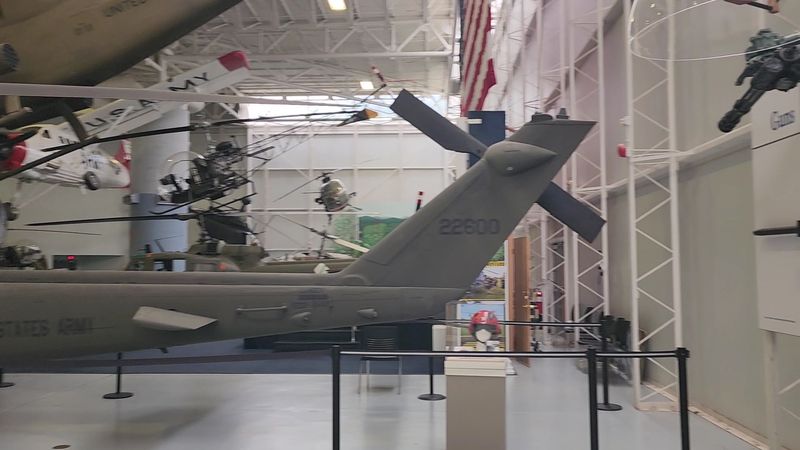
Line up a Sikorsky R-4 Hoverfly I against an AH-64 Apache and the leap becomes almost comic. Roughly eighty years separate the two, and the museum lays that progression out in a way anyone can follow.
The narrative runs from 1908 straight through to current aircraft, tracking not just engineering but doctrine. Exhibits explain why the Army wanted certain capabilities and how designers scrambled to deliver them.
Inter-service rivalries get honest coverage too, including the long tug-of-war over who should fly what. That backstory explains several odd design choices along the way.
Upstairs, trainer cockpits give kids something hands-on, and those seats stay busy on Saturday afternoons.
A Chinook parked inside can be walked through, which delights visitors who have only ever watched one thunder overhead.
Practical notes worth remembering: the museum sits on an active Army post, so non-military visitors stop at the Daleville gate visitor center for a pass, with valid identification required.
Hours run Tuesday through Friday from 10 AM to 4 PM and Saturday from 10 AM to 3 PM, with Sunday and Monday closed.
A gift shop near the entrance stocks models and books, restrooms are clean, and several restaurants operate on post for a mid-visit break.
Address: 6000 Novosel Street, Fort Novosel, Alabama 36362
