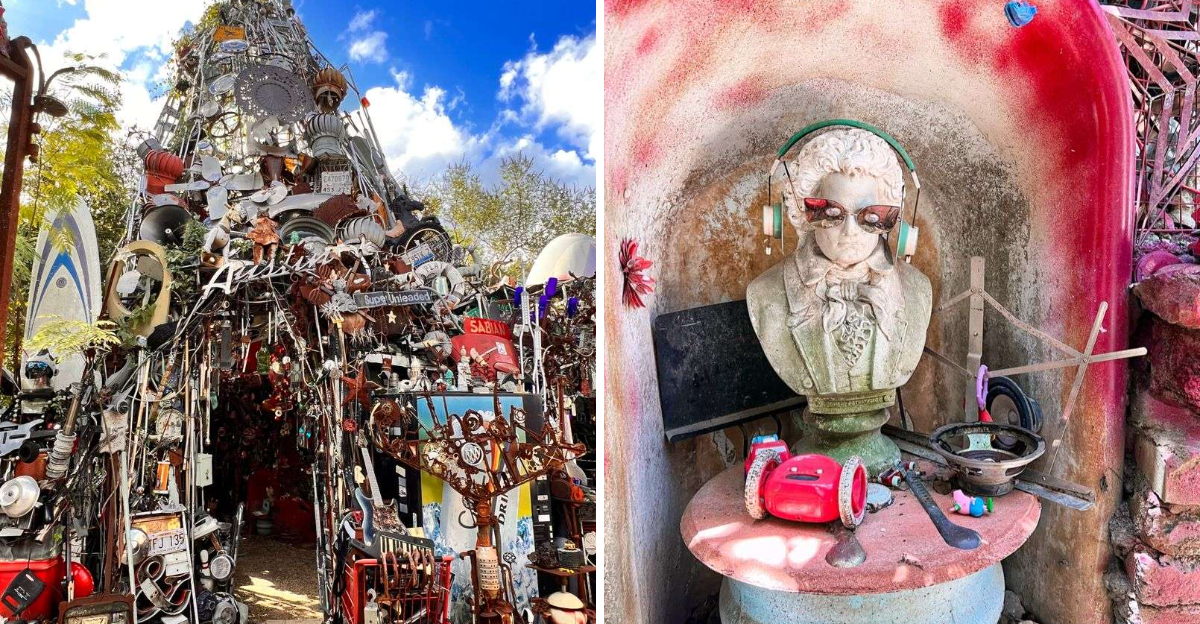
Tucked away in a quiet residential neighborhood at 4422 Lareina Dr, Austin, TX 78745, sits one of the most unexpected and mesmerizing art installations you’ll ever stumble upon.
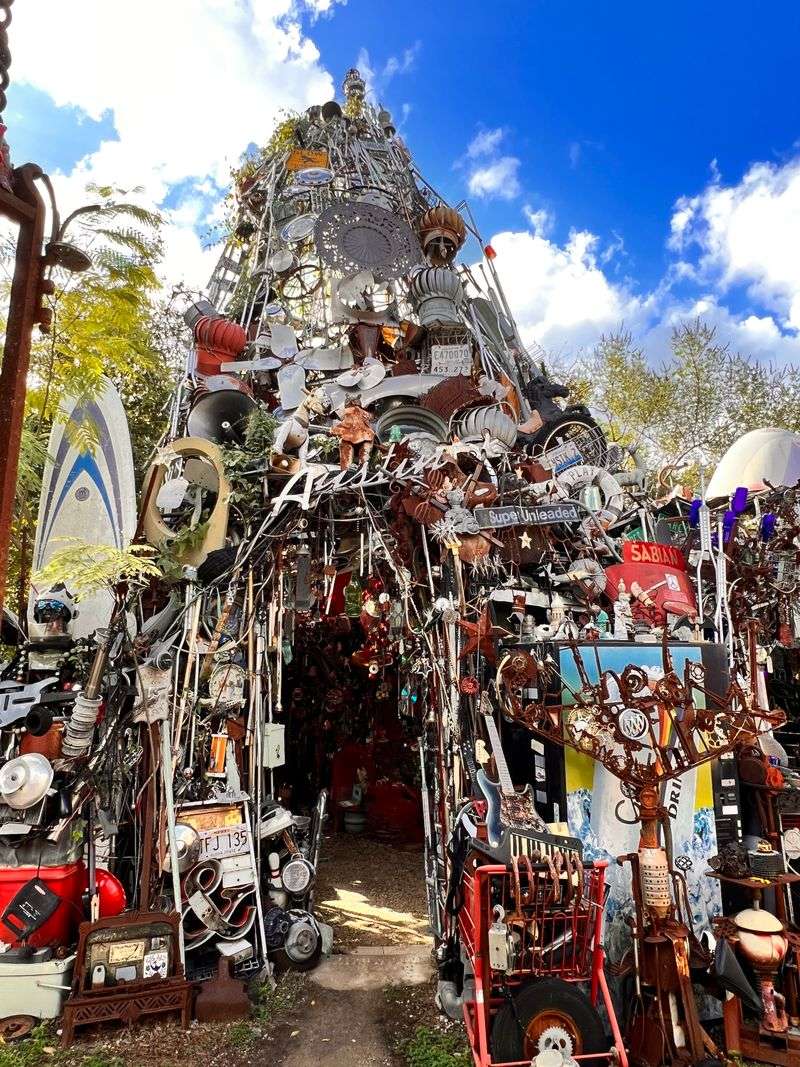
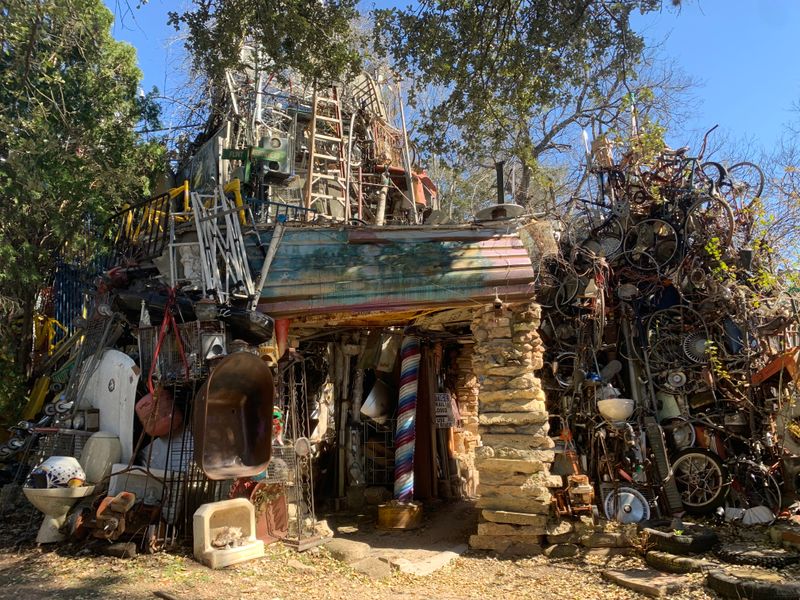
The Cathedral of Junk is exactly what it sounds like: a towering, multilevel structure built entirely from over 60 tons of discarded furniture, old toys, hubcaps, bicycles, kitchen gadgets, and every imaginable piece of refuse you can think of.
Created by artist Vince Hannemann starting in the late 1980s, this backyard masterpiece has become a quirky pilgrimage site for travelers seeking something genuinely offbeat and authentically Austin.
This isn’t your typical museum visit; it’s an adventure that makes you feel like a kid again, exploring a magical maze where trash transforms into treasure right before your eyes.
A Backyard Wonder That Defies Expectations
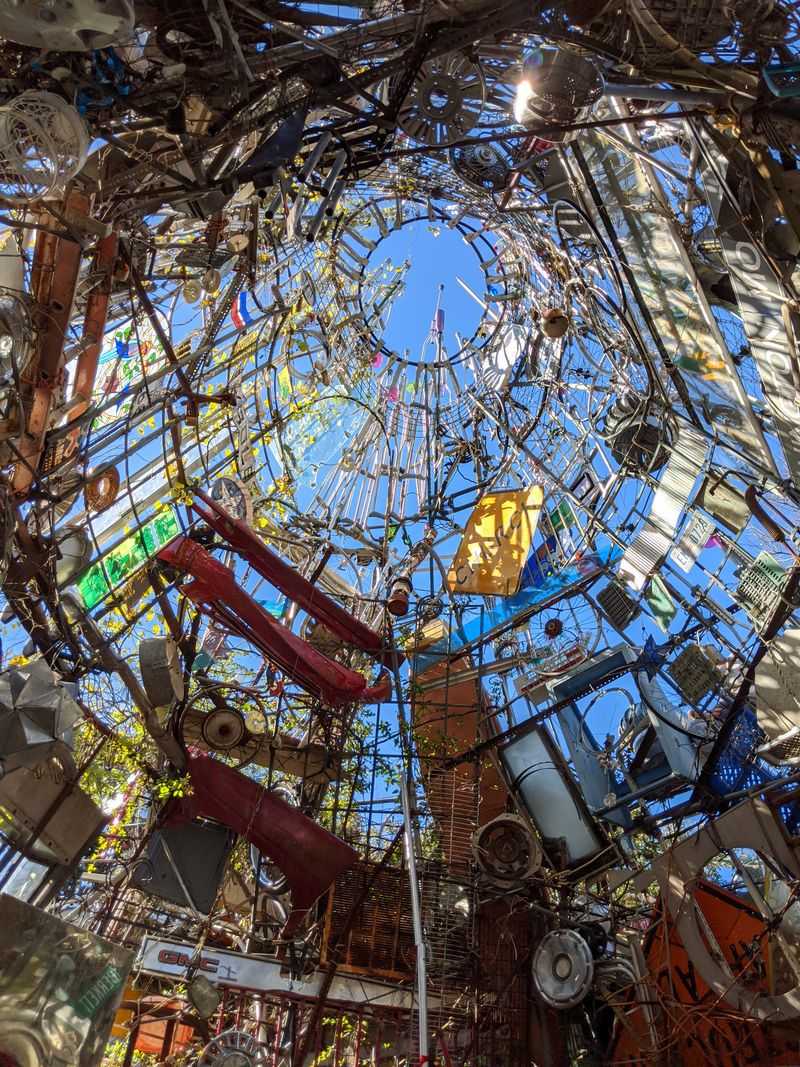
Most people imagine art galleries as pristine white-walled spaces with carefully curated paintings, but the Cathedral of Junk flips that concept completely upside down. Walking into Vince Hannemann’s backyard feels like entering an alternate universe where everyday objects get a second chance at glory.
The sheer scale of the structure catches you off guard immediately.
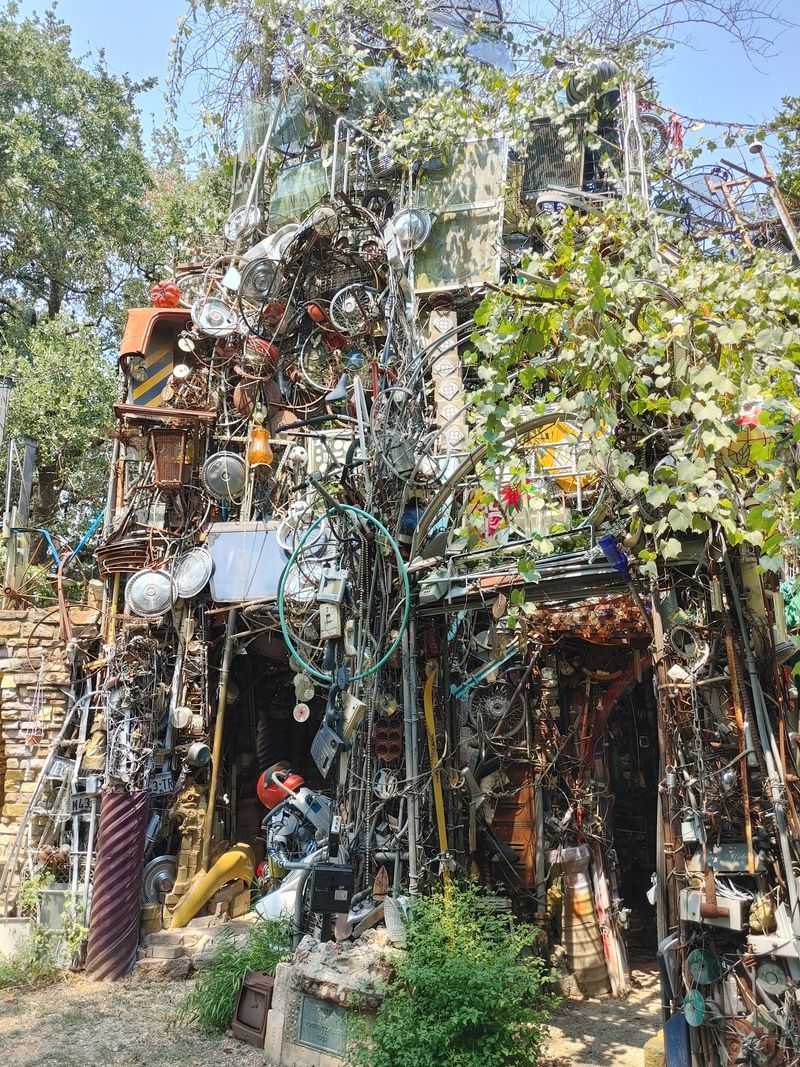
Standing three stories tall, this architectural marvel spirals upward with platforms, staircases, and tunnels that invite exploration at every turn. Old bed frames become structural supports while hubcaps create shimmering walls that catch the Texas sunlight.
Bicycle wheels dangle overhead, creating shadows that dance across the pathways below.
What makes this place truly special is how organic it all feels. Nothing seems forced or overly planned.
Instead, each addition flows naturally into the next, creating a cohesive whole from thousands of individual parts. Visitors often spend far longer than expected wandering through the maze-like passages, discovering new details with each glance.
The Visionary Behind the Chaos
Vince Hannemann didn’t wake up one morning and decide to build a junk cathedral. The project started organically in 1989 when he began arranging discarded items in his backyard as a creative outlet.
What began as a small artistic experiment gradually evolved into an obsession that would consume decades of his life. His dedication to the project is absolutely remarkable.
Visitors consistently mention how friendly and welcoming Vince is when he greets them at the gate. He genuinely loves sharing his creation with curious travelers and often provides fascinating insights into the building process.
His passion radiates through every conversation, making the experience feel personal and intimate rather than like a standard tourist attraction.
Over the years, Vince has appeared on numerous television shows and documentaries, bringing national attention to his backyard masterpiece.
Despite the fame, he remains humble and down-to-earth, treating each visitor with the same enthusiasm whether they’re the first or the ten-thousandth person to walk through his gates. His two adorable dogs often accompany him, adding to the warm, homey atmosphere.
Climbing Through Layers of History
The Cathedral isn’t meant to be admired from a distance. You’re actively encouraged to climb the stairs, duck through doorways, and explore every level of this towering creation.
Each platform offers a different perspective, both literally and figuratively, on the artwork surrounding you. The higher you climb, the more impressive the view becomes.
Sturdy staircases wind through the structure, constructed from salvaged materials that somehow feel completely safe despite their unconventional origins. Handrails fashioned from pipes and poles guide you upward as you navigate the various levels.
The engineering behind it all is surprisingly sophisticated, proving that Vince possesses both artistic vision and practical building skills.
From the upper platforms, you can gaze down at the intricate patterns formed by thousands of objects below while also getting a bird’s-eye view of the surrounding neighborhood. It’s a surreal juxtaposition seeing normal suburban houses just beyond the fence while you stand inside this fantastical realm.
The experience feels like discovering a secret world hidden in plain sight.
A Time Capsule of Pop Culture
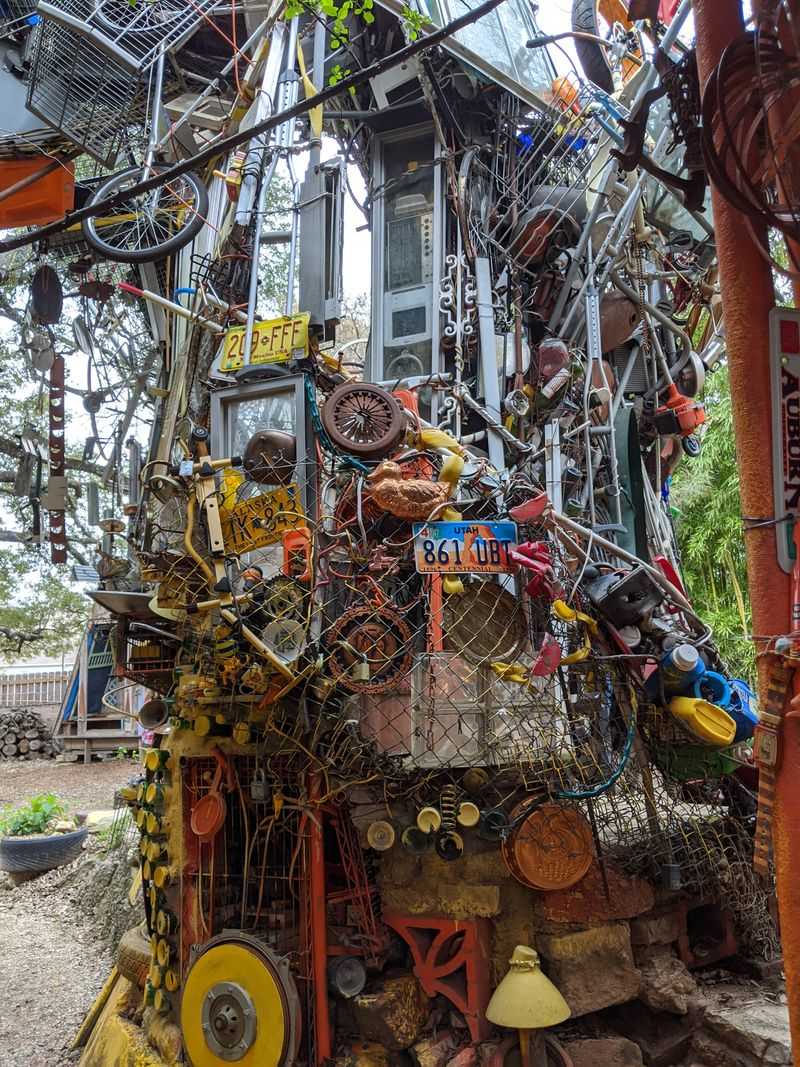
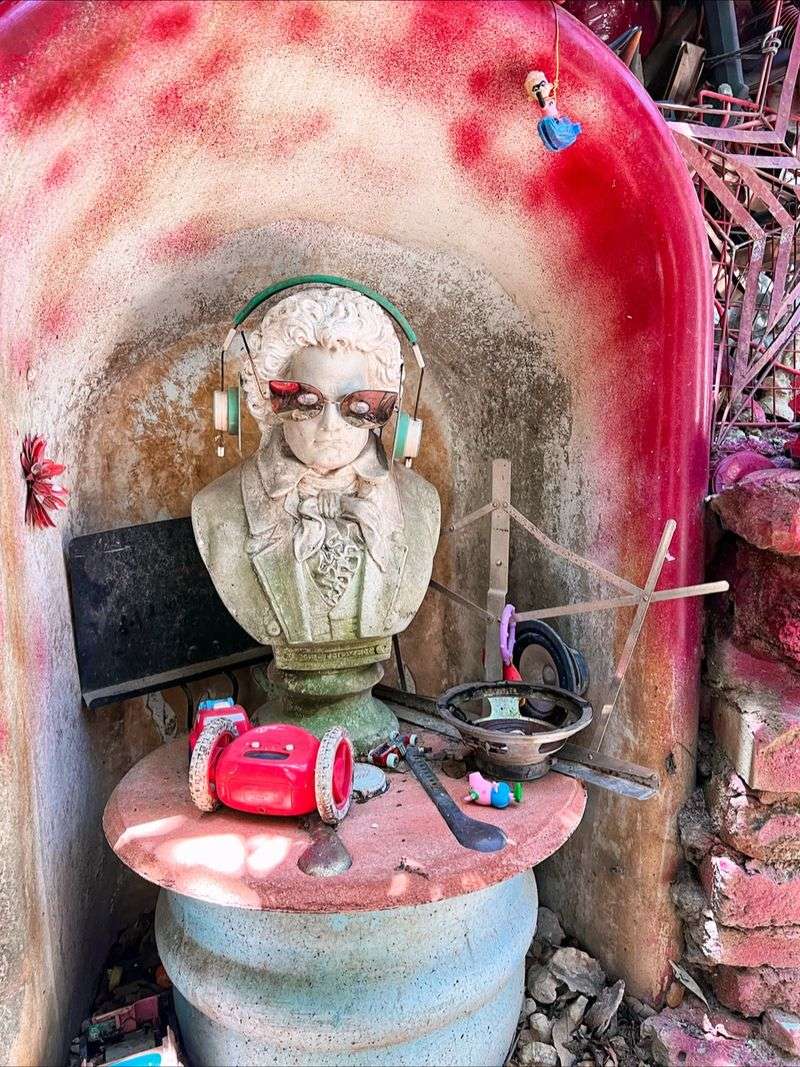
Wandering through the Cathedral feels like flipping through decades of American consumer culture in three-dimensional form. Vintage toys from the 1970s sit alongside outdated electronics from the 1990s, creating an unintentional museum of obsolescence.
Old rotary phones, cassette players, VHS tapes, and forgotten gadgets all find new purpose as building blocks in this magnificent structure.
Nostalgic visitors often experience powerful emotional reactions when they spot items from their childhood embedded in the walls.
That old lunchbox you carried to elementary school, the bicycle model you learned to ride on, or the kitchen appliance your grandmother used might all be represented somewhere in the maze.
These personal connections transform the experience from simply viewing art into a journey through your own memories.
The collection also serves as a commentary on planned obsolescence and throwaway culture. Items that were once considered cutting-edge technology now appear quaint and outdated, reminding us how quickly our possessions become irrelevant.
Yet here they’ve been granted immortality as part of something greater than their original purpose.
Keeping Austin Weird One Hubcap at a Time
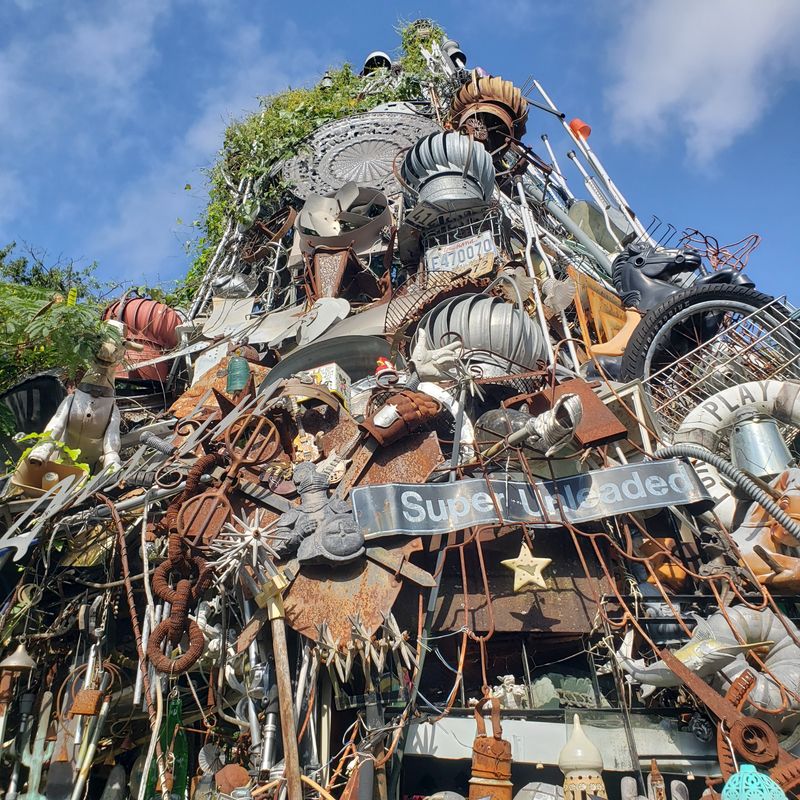
Austin’s unofficial motto is “Keep Austin Weird,” and the Cathedral of Junk embodies this spirit more authentically than almost any other attraction in the city. While some places try too hard to be quirky, this backyard installation achieves genuine weirdness through pure creative vision.
It represents the kind of grassroots, homegrown oddity that makes Austin special.
The installation has become a symbol of the city’s embrace of unconventional art and individual expression. Locals take pride in having such a unique landmark in their midst, even if it means navigating occasional street parking challenges when visitors arrive.
The surrounding neighborhood has adapted to the steady stream of curious travelers, demonstrating the community’s support for artistic endeavors.
Unlike commercial attractions designed by committees and focus groups, the Cathedral emerged organically from one person’s uncompromising vision. This authenticity resonates deeply with visitors who crave experiences that feel real and unfiltered.
There’s no gift shop, no corporate sponsorship, just pure artistic expression supported by small donations from appreciative guests.
An Appointment-Only Adventure
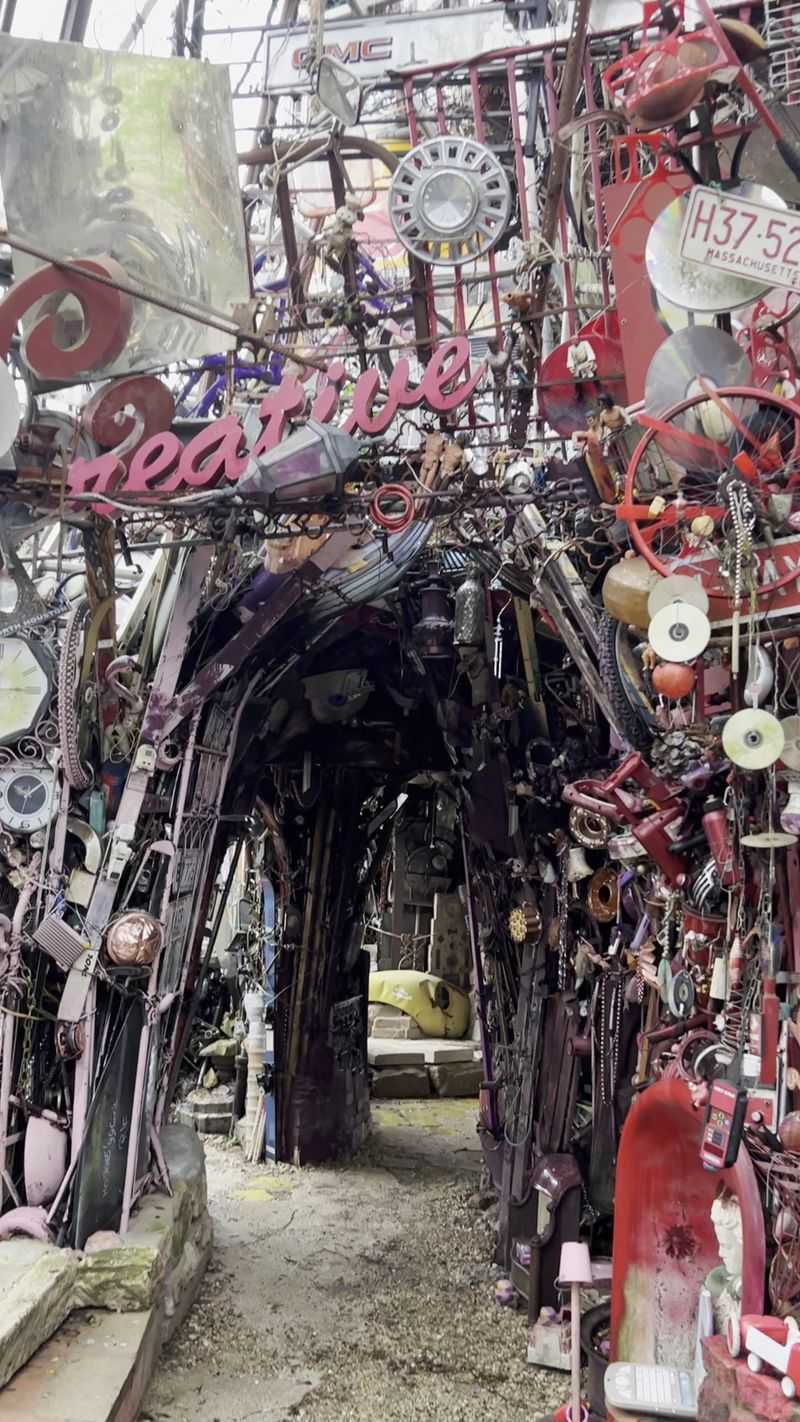
You can’t just show up at the Cathedral of Junk whenever you feel like it. This isn’t a commercial operation with set hours and admission fees.
Instead, you need to call Vince directly at 512-299-7413 to schedule an appointment before your visit. This requirement ensures that he’s available to greet visitors and maintain some control over the flow of foot traffic through his personal property.
The appointment system might seem inconvenient, but it actually enhances the experience by making it feel more exclusive and personal. You’re not part of a massive crowd shuffling through on a timed tour.
Instead, you get to explore at your own pace while Vince remains available to answer questions and share stories about specific pieces.
Most reviews mention that Vince is accommodating and flexible with scheduling, though it’s wise to call a few days in advance rather than expecting same-day availability. Some visitors have successfully shown up without appointments and been welcomed in, but this shouldn’t be counted on.
Respecting the appointment system shows consideration for Vince’s time and privacy.
The Donation Box and Supporting the Art
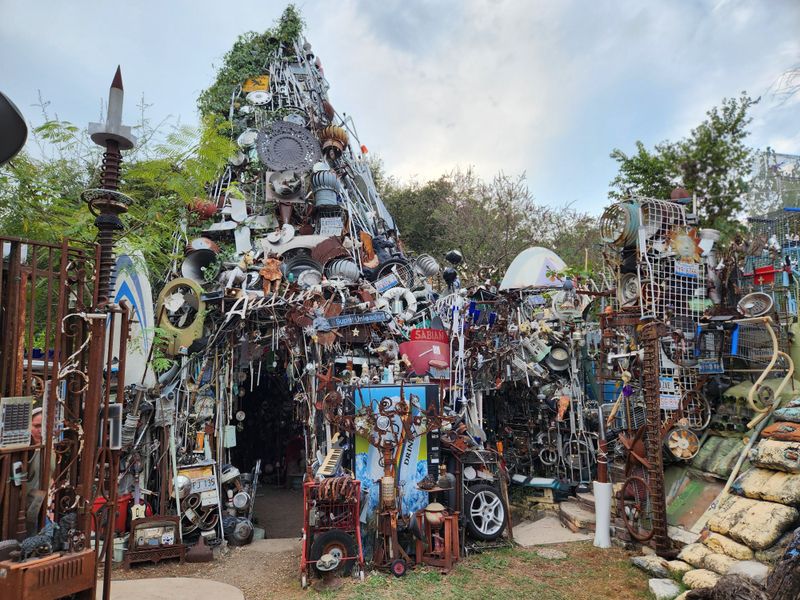
Admission to the Cathedral of Junk is technically free, but there’s a cash donation box near the entrance where visitors are strongly encouraged to contribute. Most people suggest bringing around five dollars per person, though any amount is appreciated.
This donation-based model allows everyone to experience the art regardless of financial circumstances while still providing support for ongoing maintenance.
The structure requires constant attention and occasional repairs to remain safe and stable. Weather takes its toll on exposed materials, and the sheer weight of 60-plus tons of objects creates engineering challenges that need regular monitoring.
Your donations help Vince purchase supplies, make necessary repairs, and continue his decades-long labor of love.
Some visitors bring additional items to potentially donate to the collection, though you should always ask Vince first before assuming he wants your old stuff. He’s selective about additions, ensuring that new pieces fit aesthetically and structurally within the existing framework.
The goal isn’t just to pile on more junk but to thoughtfully integrate items that enhance the overall composition.
A Photographer’s Dream Location
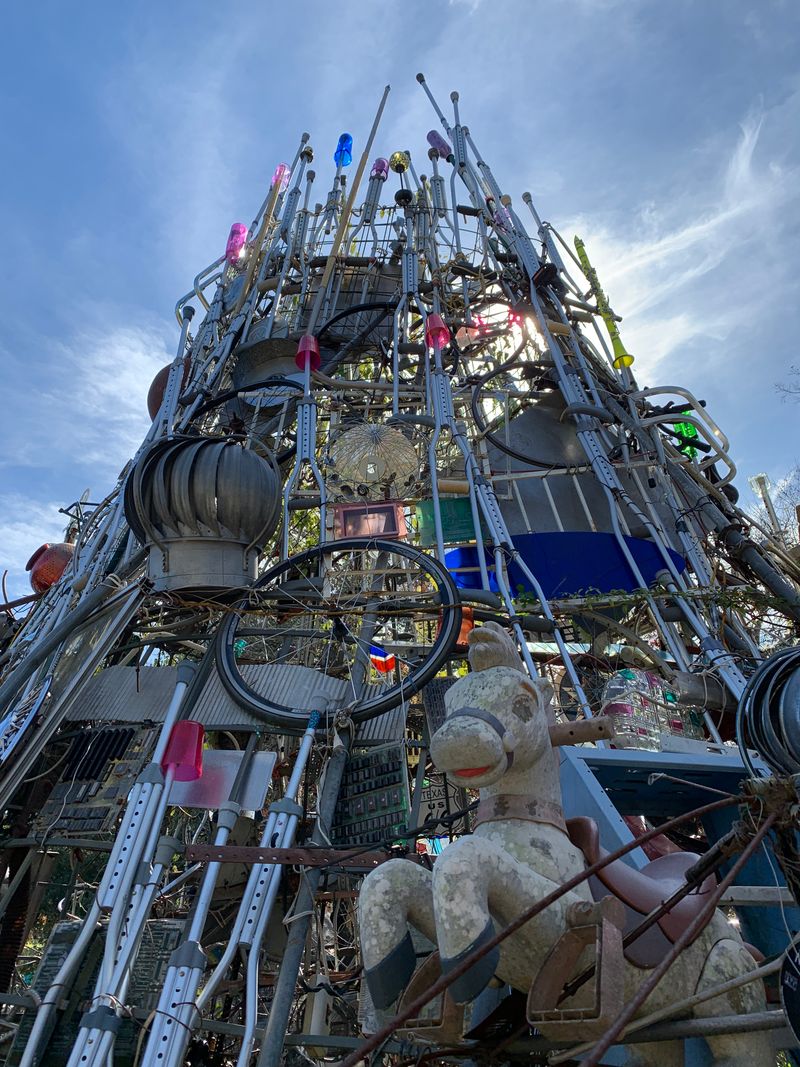
Bring your camera or smartphone because the Cathedral of Junk offers endless photographic opportunities. Every angle reveals new compositions, from wide shots capturing the structure’s impressive scale to intimate close-ups highlighting individual objects and textures.
The interplay of light and shadow through the various materials creates constantly changing visual effects throughout the day.
Social media enthusiasts will find themselves snapping dozens or even hundreds of photos, each one showcasing a different aspect of this multifaceted artwork.
The colorful, chaotic nature of the installation translates beautifully to photographs, making your friends and followers wonder where on earth you discovered such an amazing place.
It’s the kind of location that makes your travel photos stand out from typical tourist snapshots.
Morning light filters through the structure differently than afternoon sun, so photography buffs might want to plan their visit based on optimal lighting conditions. The Texas sky provides a brilliant blue backdrop that contrasts wonderfully with the earthy tones and metallic surfaces of the junk.
Cloudy days create softer, more even lighting that brings out different details.
Kid-Friendly Wonder and Exploration
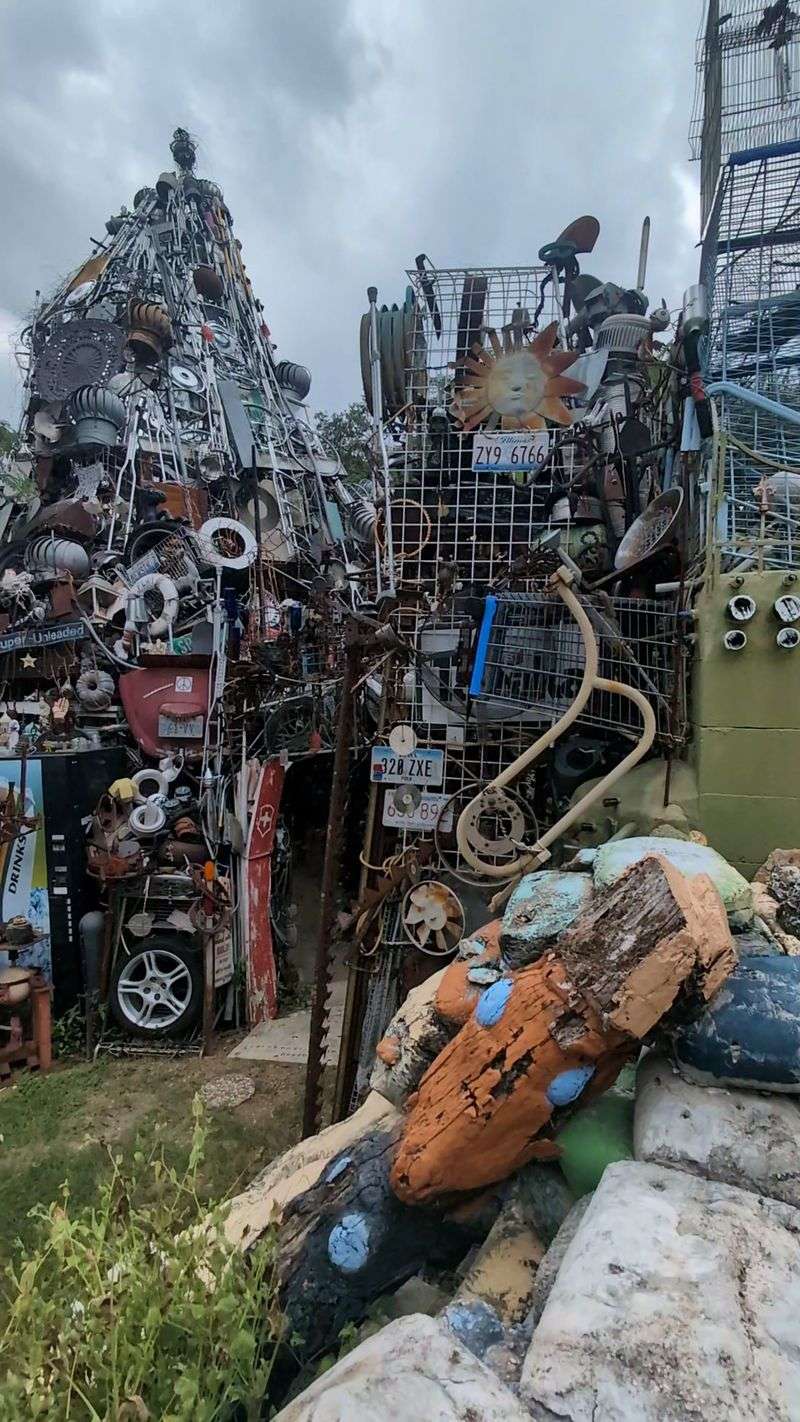
Children absolutely love the Cathedral of Junk because it speaks directly to their natural curiosity and sense of adventure. The structure feels like an elaborate playground designed by someone who understands what kids find fascinating.
Tunnels to duck through, stairs to climb, and countless objects to identify and discuss create an engaging experience that holds their attention far longer than most museums.
Parents appreciate that the visit combines entertainment with subtle educational value. Kids learn about recycling, creativity, and thinking outside the box while having too much fun to realize they’re absorbing these lessons.
The installation demonstrates that art doesn’t have to be formal or serious to be meaningful and impressive.
Playing games like eye-spy becomes genuinely challenging given the thousands of objects to choose from. Trying to count all the crutches scattered throughout the structure (a frequently mentioned element in reviews) could keep kids occupied for ages.
These interactive aspects transform passive viewing into active participation.
The Evolution Documented in Photographs
Near the entrance, Vince maintains a small shed containing photographs documenting the Cathedral’s evolution from its humble beginnings in the late 1980s to its current impressive form. These images provide fascinating context, showing how the structure grew organically over decades.
Early photos reveal modest beginnings that give no hint of the monumental creation it would eventually become.
Watching the progression through pictures helps you appreciate the incredible dedication required to build something this substantial. This wasn’t constructed in a few months or even a few years.
It represents decades of continuous work, constant problem-solving, and unwavering commitment to a singular artistic vision. The timeline demonstrates how patience and persistence can transform a simple idea into something extraordinary.
The photographs also show how Vince’s techniques and aesthetic evolved as the project matured. Early sections display a different character than later additions, though everything coheres into a unified whole.
You can trace the development of his skills and the refinement of his vision through these visual records.
Finding It in a Normal Neighborhood
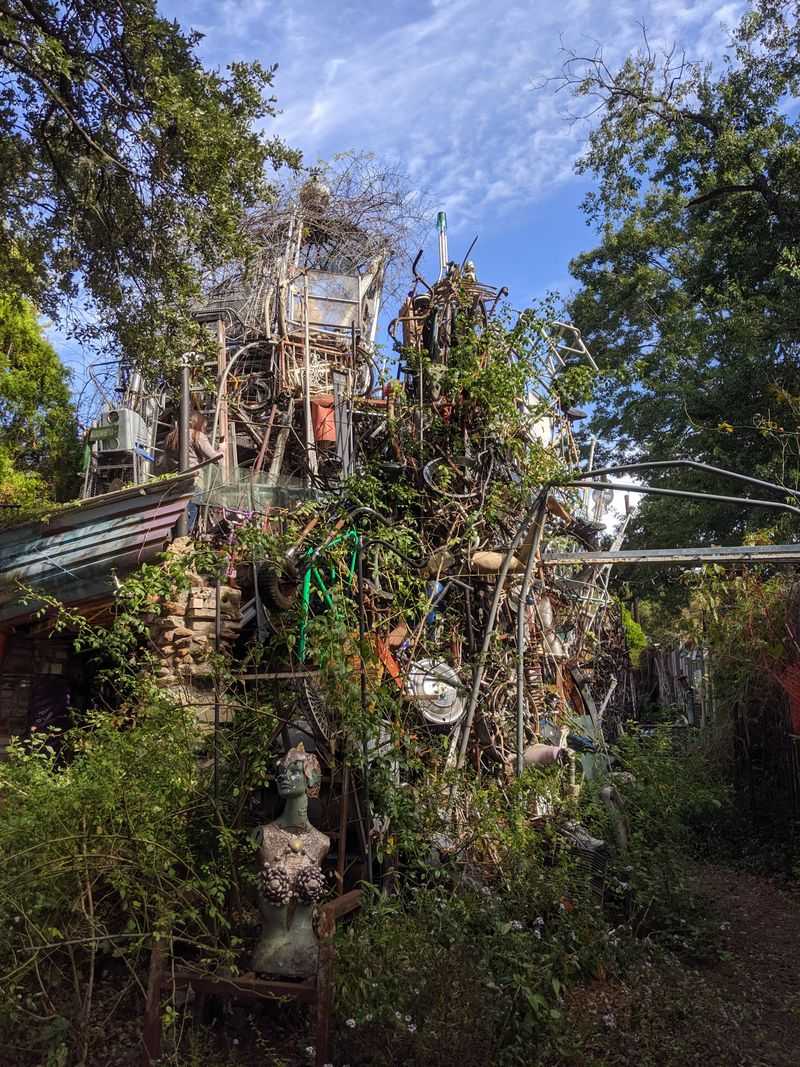
One of the most surprising aspects of visiting the Cathedral is its location in an ordinary residential neighborhood. You drive down regular suburban streets lined with typical houses, wondering if you’ve gotten the address wrong, and then suddenly this towering structure appears behind a fence.
The contrast between the mundane surroundings and the extraordinary artwork creates a delightfully jarring effect.
Street parking is the only option since this is a residential area without dedicated parking lots. Visitors need to be respectful of the neighbors, avoiding blocking driveways or taking up multiple spaces.
The local residents seem remarkably tolerant of the steady stream of visitors, probably because they appreciate living near such a unique landmark. Their patience deserves recognition and courtesy.
The residential setting actually enhances the experience by emphasizing that this is a grassroots creation rather than an institutional project. It reminds you that extraordinary things can emerge from ordinary places when someone has vision and determination.
You don’t need a museum or gallery to create meaningful art; sometimes a backyard works just fine.
Why You Should Visit Before You Leave Austin
Most Austin visitors stick to the well-known attractions like South Congress Avenue, Barton Springs, and the various food truck parks that populate the city. While those experiences are certainly worthwhile, the Cathedral of Junk offers something you genuinely cannot find anywhere else.
It represents the weird, creative, independent spirit that makes Austin special beyond its barbecue and music scene.
The installation challenges your assumptions about art, value, and creativity in ways that commercial attractions rarely achieve. You’ll leave thinking differently about the objects you discard and the potential beauty hidden in unexpected places.
These shifted perspectives represent the kind of meaningful travel experiences that stay with you long after vacation photos fade.
Reviews consistently emphasize that photographs cannot do the Cathedral justice. You really need to experience it in person to appreciate the scale, detail, and emotional impact of standing inside this remarkable creation.
It’s the difference between seeing a picture of a cathedral and actually walking through one; the physical presence matters immensely.
Dear Reader: This page may contain affiliate links which may earn a commission if you click through and make a purchase. Our independent journalism is not influenced by any advertiser or commercial initiative unless it is clearly marked as sponsored content. As travel products change, please be sure to reconfirm all details and stay up to date with current events to ensure a safe and successful trip.
